Introduction
In parasite–host systems free radicals are generated both by the host (as a defence reaction) and by the parasite (in its metabolism). Thus, free radicals are believed to be responsible (at least partly) for the parasite-induced pathology in the host (Morel et al., Reference Morel, Doussiere and Vagnis1991). A radical is any molecule which contains one or more unpaired electrons. Many species of highly reactive radicals participate in biological processes. Some of these radicals can exist in a free form and interact with various vital tissue and cell components, which results in organism dysfunction (Derda et al., Reference Derda, Wandurska-Nowak and Hadas2004). Oxidant stress causes lipid peroxidation with subsequent acute or chronic tissue damage (Kehrer, Reference Kehrer1993) and cytotoxic effects (Sanchez-Campos et al., Reference Sanchez-Campos, Tunon, Gonzalez and Gonzalez-Gallego1999). Antioxidants play an important role in the protection of the host from the harmful effects of highly reactive radicals. Chickens possess both enzymatic and non-enzymatic antioxidant mechanisms of defence that prevent the formation of free radicals or limit their toxic effects (Fridovich, Reference Fridovich1978).
Selenium (Se) is a trace element/antioxidant, which is fundamental for organisms. It has an important role since it is incorporated into selenium-dependent enzyme systems, using glutathione, such as glutathione peroxidase (GPX), which is involved in protection against oxidative stress. Se-dependent GPX utilizes reducing equivalents from reduced glutathione (GSH) to catalyse the reduction of hydrogen peroxide (H2O2) or lipid hydroperoxides (Rotruck et al., Reference Rotruck, Pope, Ganther, Swanson, Hateman and Hoekstra1973).
Selenium deficiency is related to worse performance, reduced growth and necrotic lesions in liver, muscle and heart (Levander et al., Reference Levander, Ager and Beck1995). Adverse affects on chicken superficial pectoralis muscle and multiple alterations in the antioxidant system have been found in conditions of Se and vitamin E (α-tocopherol) deficiencies (Avanzo et al., Reference Avanzo, De Mendonça, Pugine and Cesar2001). Combined with vitamin E deficiency, Se deficiency damages the T cell-dependent immunological functions and reduces the number of antibodies in the infected organisms (Chandra, Reference Chandra1999; Boscolo et al., Reference Boscolo, Di Gioaecchino, Qiao and Sabbioni2004), which leads to general immunosuppression. Enhancement of susceptibility to experimental Trypanozoma cruzi infection in mice fed with Se-deficient food has been observed (De Souza et al., Reference De Souza, De Olivera, Vanderpas, De Castro, Kivera and Aranjo-Jorge2003). A study by Gomez et al. (Reference Gomez, Solana and Levander2002), using a similar strategy for experimentally reducing Se plasma levels, also contributes to the concept that a decrease of Se is associated with greater pathological effects. The immediate hypothesis suggested by these results is that exogenous supplementation with Se would be beneficial to patients or T. cruzi-infected animals.
Selenium supplementation in animals has been shown to be associated with increases in natural killer cell activity, T cell proliferation, lymphokine-activated killer cell activity and delayed-type hypersensitivity skin responses (Finch & Turner, Reference Finch and Turner1996). Some experimental studies on animal models have reported a positive relationship between Se status and resistance against infections (Dhur et al., Reference Dhur, Gaban and Hereberg1990). Sodium selenite added to drinking water has decreased both the parasitaemia and mortality in mice infected with T. cruzi (Rivera et al., Reference Rivera, De Souza, Aranjo-Jorge, De Castaro and Vanderpas2003). Selenium is believed to be a major factor in the inhibition of Cryptosporidium parvum infection and in oxidative stress diminution. The survival time of infected mice has increased and oocysts in their faeces have been reduced (Hung & Yang, Reference Hung and Yang2002). Dietary supplementation with Se has been shown to reduce mortality, oocyst index and oocyst lesions and to increase body weights in non-immunized chickens infected with Eimeria tenella (Colnago et al., Reference Colnago, Jensen and Long1984).
Nowadays, Se is often added to commercial feeds to prevent clinical and sub-clinical diseases in animals and birds (Scott et al., Reference Scott, Lnesheim and Young1982; Leeson & Summers, Reference Leeson and Summers1991). Sodium selenite has been used as a traditional source for Se supplementation in poultry diets. However, evidence is now emerging that the organic form of Se may have additional benefits surpassing that of the inorganic form. Plenty of data indicate that organic Se compounds, as selenomethionine or selenium yeast, are more bioavailable than inorganic Se sources (Khaled et al., Reference Khaled, Mahmoud and El-Banna2004).
Ascaidiosis is a widespread helminthosis in birds, leading to reduction of body weight gain, deformation of the skeleton, changes in reproductive function, inbalance of some trace elements, and other secondary pathological symptoms (Vassilev et al., Reference Vassilev, Ossikowski, Bozhkov, Kamburov, Bankov and Rupova1973; Davtjan, Reference Davtjan1982). There is a lack of information on the antioxidant status of chickens infected with Ascaridia galli and treated with Se.
In the present study, the organic preparation Sel-plex (Alltech, Inc. Nicholasville, Kentucky, USA) as an extra supplemental source of Se was given to broilers additionally with their conventional food. The concentrations of plasma and liver selenium, activity of plasma GPX (pGPX), and liver vitamin E concentration in broilers, experimentally infected with A. galli, were determined in an experiment lasting 70 days post-infection. The changes of these biomarkers of the antioxidant status of broiler chickens were compared to the time courses of the infection level, mortality, and growth performance of the host.
At the same time, the mathematical model developed by us for quantitative investigation of parasite–host systems is applied. Its validity was also confirmed here, in the case of another breed of host. The description of the kinetics of A. galli populations and host growth provides possibilities to determine different kinetic parameters as experimentally determinable characteristics: the constant of nematode reduction and the relative rate of gain in body weight of the host.
Material and methods
A total of 160 one-day-old male Cobb hybrid broiler chickens were allocated into four groups each of 40 birds, weighed, and randomly divided to dietary treatment. The groups were as follows: group 1, control (healthy and untreated chickens); group 2, healthy and treated with Sel-plex; group 3, infected with A. galli and untreated; group 4, infected with A. galli and treated with Sel-plex. The mortality and the body weights of the birds were recorded in each group. In parallel to groups 1, 2, 3 and 4, separate groups 1p, 2p, 3p and 4p, each of 25 birds, were used for determination of worm counts, Se and vitamin E concentrations, and plasma GPX activity.
Control and experimental chickens were reared in a vivarium, placed in environmentally controlled brooder batteries with raised wire floors and continuous fluorescent lighting. All chickens were fed on a conventional corn–soybean meal diet, formulated to meet the nutrient requirements of 0–120-day-old broiler chickens (United States National Research Council, 1994). Chickens were allowed access to food and water ad libitum.
Each chicken from groups 3, 3p, 4 and 4p was orally infected by pipette with 1450 embryonated A. galli eggs as described by Permin et al. (Reference Permin, Pearman, Wansen, Bisgaard and Frandsen1997) on day 14 post-hatching. Sel-plex at a dose of 0.30 mg kg− 1 was given orally in the food, commencing 3 days before infection and 5 days post-infection (p.i.) to broilers of groups 4 and 4p. The 8 days-application of Sel-plex was repeated after one-month intervals. On the same days Sel-plex was given also to the healthy broilers of group 2.
Worm burdens in the intestines, chicken body weight, mortality, liver and plasma Se concentrations, liver vitamin E concentration, and pGPX activity were determined on days 10, 20, 30, 40, 50, 60 and 70 p.i. The chickens were killed with anaesthesia according to the rules of the European convention for protection of vertebrate animals used for experimental and other scientific purposes.
The central lobe of the liver from each broiler was collected and pooled by pen for determination of Se concentration. Blood was collected via cardiac puncture and placed into 7 ml tubes, free of trace elements, with 100 USP units of sodium heparin. After collection, the blood samples were centrifuged for 15 min at 3000g and 40°C. The plasma was collected and pGPX activity was determined analytically with fresh plasma as described by Beutler (Reference Beutler1984). The plasma and liver samples were analysed for Se by the fluorimetric method of Watkinson (Reference Watkinson1966) with 2,3-diaminonaphthalene (DAN) as a complex reagent. The fluorescence of the DAN complex was measured using a Hitachi F-4010 fluorescence spectrophotometer (Tokyo). The vitamin E concentration in liver was determined by high performance liquid chromatography methods using a fluorescence detector as described by Bieri et al. (Reference Bieri, Tollwer and Catigan1979).
The experiments canply with the current laws in Bulgaria.
The data were statistically processed by one-way analysis of variance (ANOVA). All results are presented as a mean ± SD. The differences were considered significant when P values were less than 0.05.
Mathematical model
The infected organ (the intestine) of the host is viewed as a unique ‘cultivator’ and it is assumed that the nematodes and the therapeutic agent (Sel-plex) are distributed evenly and form a homogeneous mixture in it. This allows differential equations for the development of A. galli populations.
Following infection with A. galli, the number of larval and adult nematodes decreases as a result of an immune response by the host. This process may be described in infected untreated chickens (group 3) with the differential equation:

where N is the worm burden in the host intestine, dN/dt is the rate of reduction of the worm population and ν ([ν] = [day− 1]) is a constant indicating the relative rate of the reduction of the nematode population. As host immunity results in a reduction in worm burden, ν could also be considered to be an integral characteristic of the host immune status, i.e. as a phenomenological (experimentally determinable) constant of the host immune response.
For a quantitative description of the chicken growth we use the logistic equation dP/dt = μP(C − P)/C, but interpreted differently population kinetics (Teodorova & Gabrashanska, Reference Teodorova and Gabrashanska2002). The parameter μ ([μ] = [g day− 1]) is the relative rate of gain in body weight. The experimental data of the gain in body weight in healthy birds allows us to consider two stages of growth within the framework of the experiment. Thus, the following ordinary non-linear equation for the kinetics of mean chicken weight P could be determined:

A decrease of gain in body weight of chickens infected with A. galli is assumed to be proportional to the number of worms present.
Thus, the kinetics of A. galli establishment in the intestines of chickens and of host body weight, without or with treatment, can be presented by the following system of ordinary differential equations:



under initial conditions:

where t 0 is the time moment corresponding to the day of infecting (we postulate: t 0 = 0), P ([P] = [g]) is the weight of the chicken; dP/dt is the change of P with time. We assume that the development of chickens takes place under the condition of substrate saturation because they take in a sufficient amount of food, i.e. μi = constant (i = 1, 2); μ1 and μ2 correspond to the first and second stages of chicken growth respectively:

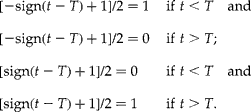
T ([day]) is the moment of ‘switching’ from the first to the second regime of chicken growth (the transfer between two development stages does not take place simultaneously for all chickens so that the moment T is related to the most likely day this transfer occurred); C 1 and C 2 are the maximum possible values of chicken weight for the first and second stages, respectively, and the parameter k ([k] = [g day− 1]) is the relative rate constant of retardation of gain in host body weight due to the influence of A. galli infection.
Equation 1 describes the establishment of the worm population in experimental groups 3 (infected chickens) and 4 (infected and treated chickens). Equations 2 and 3 present the gain in host body weight in groups 1 and 2, and in groups 3 and 4, respectively.
For equations 1 and 2 under conditions 4 the following analytical solutions were obtained:


Equation 3 was solved numerically.
The constant ν may be determined from equation 5 after taking in a logarithm:

This is an equation of a straight line with angular coefficients ν. Using the values of N for group 3, determined by the experiment, a plot of ln N as function of time can be constructed.
Equation 6 can be written for one of two stages in the following form:

After taking in a logarithm we have:

The relative rates μ1 and μ2 of gain in body weight for two stages, for groups 1 and 2 respectively, may be determined as angular coefficients of straight lines (9), using the values of P 1(2), determined by the experiment.
The moment T, which indicates the transfer from the first to the second stage, was determined from the equation:

Results
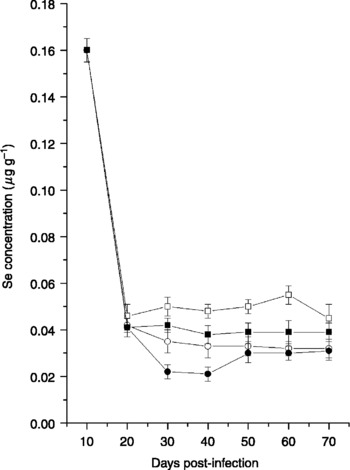
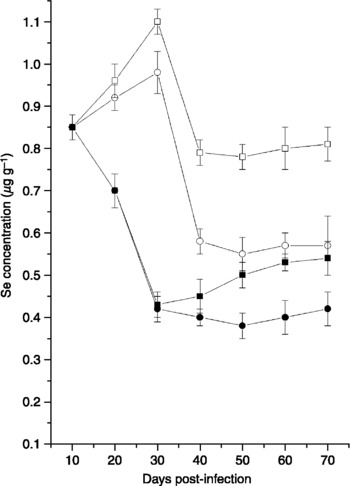
The levels of plasma Se in all groups exhibited a sharp decrease from day 10 to day 20 p.i. The concentration of Se in group 3 decreased a little more to day 40 and then slightly increased (fig. 1). The Se-supplemented birds, i.e. birds from groups 2 and 4 showed significantly higher Se levels compared to those from groups 1 and 3 (table 1). The levels of the liver Se in groups 3 and 4 sharply decreased up to day 30 p.i. and then slightly increased (fig. 2). Contrariwise, in groups 1 and 2 Se levels slightly increased up to day 30, then decreased sharply to day 40, and remained constant up to the end of experiment. It is interesting that almost equal relations SeGroup 2/SeGroup 1 and SeGroup 4/SeGroup 3 were observed regarding plasma Se (pSe) and liver Se (lSe) levels on day 70:

Changes with time of selenium concentration in the blood plasma of broilers. ○, Group 1 (healthy, untreated); □, group 2 (healthy, treated); ●, group 3 (infected untreated); ■, group 4 (infected treated).

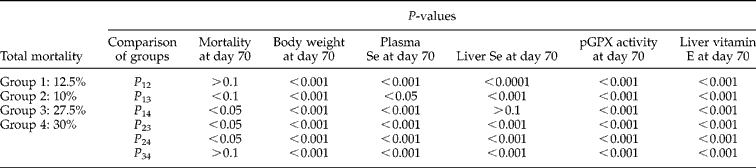
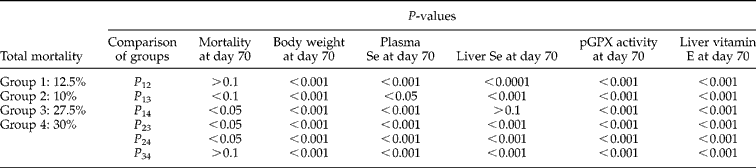
Comparison of the mortality and body weight of the chickens in control and experimental groups.
Changes with time of selenium concentration in the liver of broilers. ○, Group 1 (healthy, untreated); □, group 2 (healthy, treated); ●, group 3 (infected untreated); ■, group 4 (infected treated).

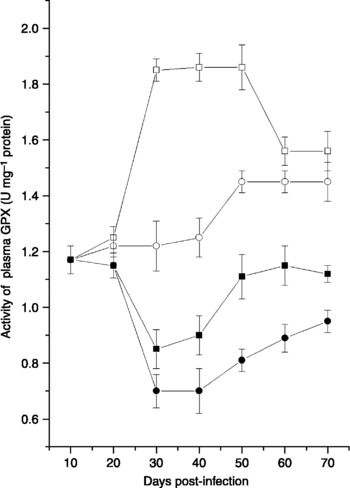
GPX activity in blood plasma is displayed in fig. 3. In group 1 (control) an increase to day 50 (P < 0.001) was measured and then constant values up to end the experiment were recorded. In group 2, pGPX activity sharply increased from day 20 to 30, remaining constant up to day 50 and then decreased close to the control values. On day 30 pGPX activity in group 2 was 1.5 times higher compared with group 1 (P < 0.001). A significant decrease in pGPX activity was observed in groups 3 and 4 from 20 to 30 days p.i. The activity of pGPX in infected untreated broilers (group 3) on day 30 p.i. was 1.74 times less than in the control group (P < 0.001). After day 40 pGPX activity in group 3 increased sharply and on day 70 its value was by 1.36 times higher regarding that on day 30 (P < 0.001). When group 4 was compared with group 3, pGXP activity was found to be elevated on average by 118%.
Changes with time of Se-dependent glutathione peroxidase (GPX) activity in the blood plasma of broilers. ○, Group 1 (healthy, untreated); □, group 2 (healthy, treated); ●, group 3 (infected untreated); ■, group 4 (infected treated).

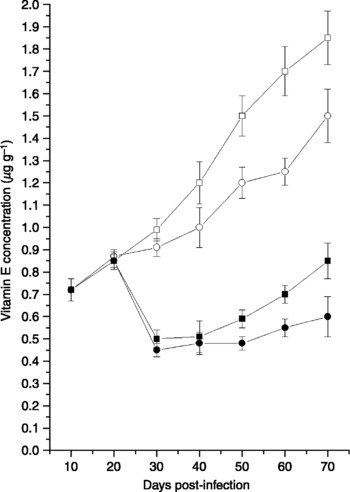
The concentrations of vitamin E in the liver of broilers are displayed in fig. 4. In groups 1 and 2 they increased during the experiment. On day 70 vitamin E concentration in group 2 was 1.23 times higher compared to that in the control group. In groups 3 and 4 the concentrations of vitamin E increased up to day 20 (P < 0.001), sharply decreased up to day 30, and then increased only in group 4. On day 70 vitamin E concentration in group 4 was 1.42 times higher than that in group 3.
Changes with time of vitamin E concentration in the liver of broilers. ○, Group 1 (healthy, untreated); □, group 2 (healthy, treated); ●, group 3 (infected untreated); ■, group 4 (infected treated).

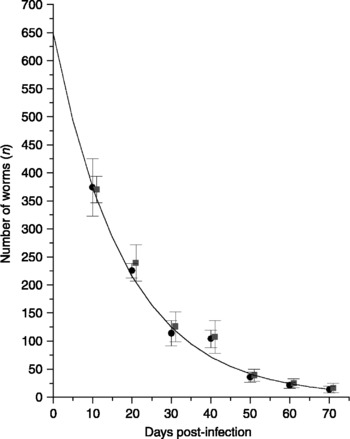
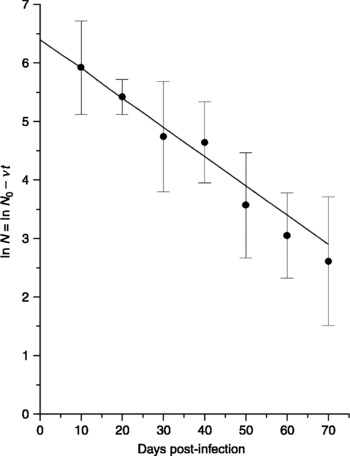
The change with time of A. galli populations in the host (experimental results and model solution) is demonstrated in fig. 5. The worm burdens in groups 3 and 4 decreased sharply without significant differences between both groups. (P 34>0.1). The constant ν, which indicates the rate of parasite reduction (i.e. intensity of host immune response) was calculated according to equation 7; ν is the angular coefficient of the straight line (fig. 6):

The establishment of Ascaridia galli populations in the intestine of two groups of Cobb hybrid broilers (theoretical curve and experimental points). ●, Group 3 (infected, untreated chickens); ■, group 4 (infected chickens, treated with Sel-plex).

Determination of the experimentally determinable constant of nematode reduction ν on the basis of equation 7 using experimental measures of Ascaridia galli numbers in broiler group 3 (infected untreated chickens).

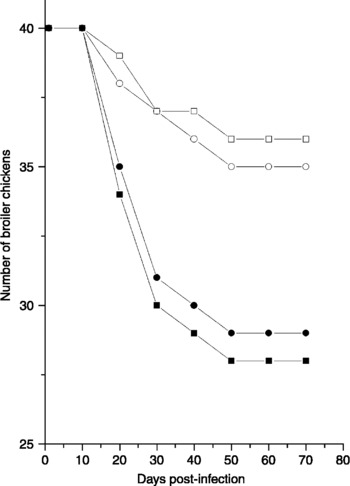
Data of the survival in the control and experimental chickens are presented in fig. 7. Statistically significant differences were established between groups 1 and 4, 2 and 3, and 2 and 4 (table 1).
The survival of chickens uninfected and experimentally infected with Ascaridia galli up to day 70 post-infection. ○, Group 1 (healthy, untreated); □, group 2 (healthy, treated); ●, group 3 (infected untreated); ■, group 4 (infected treated).

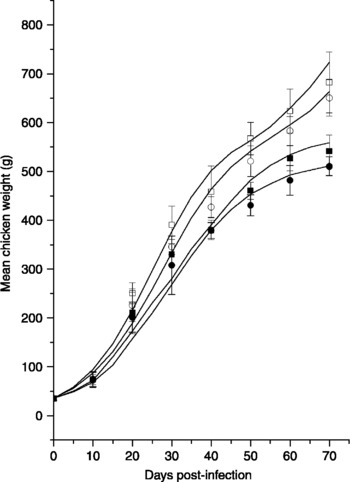
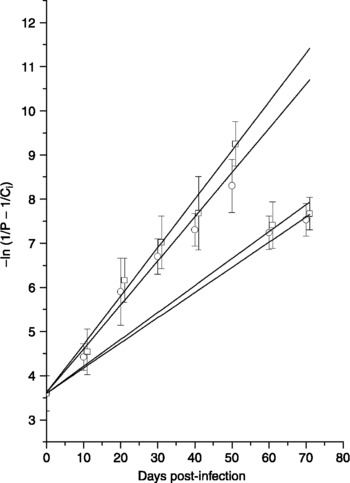
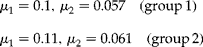
The host growth dynamics (experimental results and model solutions) are presented in fig. 8. The experimental values of the body weights in all groups showed significant differences on day 70 p.i. (table 1). Ascaridia galli infection considerably reduced the gain in body weight in the infected untreated chickens (by 22% relative to the control group). The constants μ1 and μ2, representing the relative rates of the host growth in the two stages of development, were calculated by the kinetic model. On the basis of experimental data and using equation 9 the plots were constructed (fig. 9) and the angular coefficients of the straight lines determined:
Time course for the mean body weight in chickens up to 70 days p.i. (experimental points and model solutions). ○, Group 1 (healthy, untreated chickens); □, group 2 (healthy, treated chickens); ●, group 3 (infected, untreated chickens); ■, group 4 (infected, treated chickens).

Determination of experimentally determinable constants μ1 and μ2 (relative growth rates) on the basis of equation 9 using experimental measures of the chicken body weight. ○, Group 1 (healthy, untreated chickens); □, group 2 (healthy, treated chickens).

Equation 3 for groups 3 and 4 were solved numerically using μ1 and μ2 for groups 1 and 2, respectively. The moment T, which indicates the transfer from the first to the second stage, was determined from equation 10:

The theoretical curves in figs 5 and 8 were calculated taking into account (12), (13) and (14) and the following values of initial conditions and parameters: N 0 = 650, P 0 = 35.2 g, C 1 = 600 g and C 2 = 1000 g for groups 1 and 2, C 1 = 500 g and C 2 = 900 g for groups 3 and 4, and k = 0.001 g day− 1.
Discussion
The fact that there is no significant difference between groups 3 and 4 regarding the parasite burden shows that selenium does not have an antiparasitic action. But Se supplementation improves the immunity response of the host and for this reason we should expect a greater nematode reduction in group 4. However, ascaridiae accumulate selenium (Paul & Barrett, Reference Paul and Barrett1980) and Se obviously influences positively their metabolism. The enhanced concentration of Se in ascaridiae may be due to the compounds in their organism, which activate some enzyme systems during oxidation–reduction processes, especially glutathione peroxidase containing Se in its active centre. This enzyme was established in Moniezia expansa and Hymenolepis diminuta (Paul & Barrett, Reference Paul and Barrett1980).
The theoretical solution (5) was in good agreement with the experimental results and supports our concept that the A. galli population in the host intestine decreases exponentially. The present value of ν is almost twice higher than ν in our previous studies with Leghorn (Hisex breed) chickens (Gabrashanska et al., Reference Gabrashanska, Teodorova and Mitov2002, Reference Gabrashanska, Teodorova, Galvez-Morros and Mitov2004a, Reference Gabrashanska, Teodorova, Galvez-Morros, Tsocheva-Gaytandzhieva and Mitovb). This fact may be due to the better features of Cobb hybrids, selected for fast growth, freedom from skeletal and feathering defects, feed efficiency and good vitality. Obviously, the broilers belonging to this breed are able to reduce nematode infections more intensively.
A possible reason for the body weight reduction in the infected untreated chickens could be the appearance of lesions of the gastrointestinal mucosa, caused by free radicals generated during the pathological processes. Thus, the absorption of food ingredients in the intestines, including many biogenic microelements, is disturbed. The supplementation of an antioxidant, as selenium in the form of Sel-plex, improves the absorption of nutrient substances and therefore, the growth performance (fig. 8). The model solutions were in good agreement with the experimental data for the mean chicken weight P. The constants of relative growth rate (13) are rather higher than in Leghorn chickens (Gabrashanska et al., Reference Gabrashanska, Teodorova, Galvez-Morros and Mitov2004a, Reference Gabrashanska, Teodorova, Galvez-Morros, Tsocheva-Gaytandzhieva and Mitovb) and this probably is due to the better quality of the Cobb breed.
The initial high Se concentration in the plasma and liver of the healthy broilers probably is due to the high Se levels in the yolk sac because the hens have been fed on diets supplemented with selenium. Payne & Southern (Reference Payne and Southern2005) have reported that Se supplementation into diets for laying hens increases Se content in their eggs. These selenium-enriched eggs are an important source of Se for human consumption (Yaroshenko et al., Reference Yaroshenko, Dvorska, Suraj and Sparks2003).
The increase of Se concentrations in the liver to day 30 (fig. 2) may be due to the increased concentrations of liver vitamin E in groups 1 and 2. It has been established that vitamin E facilitates the accumulation of Se in mitochondria and endoplasmic reticulum (Caygill et al., Reference Caygill, Lucy and Diplock1971). The decrease of liver Se after day 30 is obviously related to the existence of respective referent levels. There are no data for stable Se accumulation in liver because equations 11 indicate equal proportions of Se levels in groups supplemented and non-supplemented with Se both in plasma and liver on day 70.
The increase of vitamin E concentration during the experiment is an age-dependent process. It has been reported that vitamin E content rises proportionally with the bird's age: in 2-week-old chickens it is 0.7 μg g− 1 and in 12-week-old chickens 1.5–1.8 μg g− 1. In old birds 2–2.3 μg g− 1 vitamin E was found (Besarabov & Melnikova, Reference Besarabov and Melnikova2001). These data are in good agreement with the present results. The age-dependent elevation of vitamin E level is most probably due to its essential role in reproduction. The higher level of vitamin E in group 2 is probably due to the synergetic action of both selenium and vitamin E.
The sharp rise of Se-dependent GPX in group 2 from day 30 to 50 suggests a great sensitivity of this enzyme to Se and it is an expected result. Probably the presence of additional Se induces an accelerated synthesis of GPX. However, in healthy broilers no sufficient substrate for this enzyme occurs and GPX activity after some time tends to reach the normal value.
Our observation that the gain in body weight in healthy chickens supplemented with Se (group 2) increased by 5% compared with the control group is supported by the results of Khaled et al. (Reference Khaled, Mahmoud and El-Banna2004) who have obtained 5% higher weight of broilers treated with Sel-plex.
The parasite action on the host is accompanied by free radical production. Hydroxyl and superoxide radicals occur in the activation of phagocytosis as a defence mechanism of the host against the internal pathogens. On the other hand, hydrogen peroxide (H2O2) is a source of the very aggressive hydroxyl radical, which interacts with membrane unsaturated fatty acids, forming lipid radicals. The oxidation of the lipid radical results in a peroxide radical, which can again react with a new molecule of unsaturated fatty acid. Thus, a chain reaction of lipid peroxidation leads to membrane damage. The main defence antioxidant enzymes prevent the formation of new free radical species by converting the existing free radicals into less harmful molecules before they have a chance to react, or by preventing the formation of free radicals from other molecules (Derda et al., Reference Derda, Wandurska-Nowak and Hadas2004). The action of GPX belongs to the second type of protection. Substrates of GPX are hydrogen peroxide and lipid hydroperoxides. Vitamin E is also one of the most important antioxidant systems (Avanzo et al., Reference Avanzo, De Mendonça, Pugine and Cesar2001). It protects polyunsaturated fatty-acid groups of the phospholipids from oxidation. It reacts with lipid peroxide and participates in the detoxifying of superoxide and hydroxyl radicals.
The concentration of liver vitamin E (fig. 4) in groups 3 and 4 followed the age-dependent course of change up to day 20. Its further decrease may be due to the intensive use of antioxidants in the period of high infection level and greatest production of free radicals. The certain increase of vitamin E observed after day 30 seems to be related to the already reduced level of nematode infection. A correlation was observed between the time courses of liver vitamin E and liver concentration of Se in the infected groups (figs 2 and 4). The liver Se concentration in group 4 (infected broilers treated with Sel-plex) was 22% higher than that in group 3 (infected, untreated broilers) on day 70. On the same day the concentration of liver vitamin E in group 4 was 29% higher than that in group 3.
A correlation was observed also between the pGPX activity and infection level. The significant decrease in pGPX activity in groups 3 and 4 from day 20 to day 30 p.i. (fig. 3) could be explained by the fact that the activity of many antioxidant enzymes decreases in the presence of parasite infection due to modifications of protein structure affecting their functions. Such modification may be the result of reactions of protein molecules with oxygen species and lipid peroxidation products (Kolodziejczyk et al., Reference Kolodziejczyk, Siemieniuk and Skrzydlewska2005). An accumulation of unsaturated fatty acids appears in the infected chicken. It has been established that large amounts of gamma-butyric acids and propionic acids are excreted by A. galli as a result of its carbohydrate metabolism (Barrett, Reference Barrett1981). On day 40 the A. galli population was reduced by more than three times. After day 40 pGPX activity showed a significant increase. On day 70 pGPX activity in group 3 was 66% and pGPX activity in group 4 was 77%, respectively, compared to pGPX activity in control group. On day 70 pGPX activity in infected and treated chickens (group 4) was 15% higher than pGPX activity in infected and untreated chickens (group 3).
A correlation was established between Se supplementation, increasing levels of the antioxidants after day 40, and body weight gain of the host. From day 50 up to the end of the experiment body weights of the broilers in groups 3 and 4 differed significantly (P < 0.001). However, Se supplementation did not influence the mortality in the infected chickens.
In conclusion, the comparison of the considered antioxidants (Se concentrations in plasma and liver, plasma GPX activity, and liver vitamin E) demonstrated their relatively similar pattern of changes with time and synergistic action. Se supplementation of the broilers by dietary Se in the form of Sel-plex improved the antioxidant status of the broilers, decreased the detrimental effects of ascaridiosis on the chickens, and showed beneficial effects on the host growth performance.