


Introduction
The concept of self-esteem refers to the cognitive representations an individual develops about themselves based on their experience, which dictates the way in which the individual appraises themselves and their worth (Fennell, Reference Fennell1997). In cases of low self-esteem, these cognitive representations are self-critical and derogatory and can lead to an individual having increased feelings of inadequacy and incompetence (Fennell, Reference Fennell2009). Fennell (Reference Fennell1997) differentiates three types of low self-esteem: as either an aspect of a presenting difficulty, a consequence of a presenting problem or a vulnerability factor that precipitates an emotional disorder. In cases of low self-esteem being a feature or consequence of a disorder, it is recommended that disorder-specific treatment protocols be employed as self-esteem will probably improve in response (Fennell, Reference Fennell1997). The cognitive behavioural therapy (CBT) model for low self-esteem is endorsed in cases where low self-esteem represents a vulnerability factor to the development of a presenting difficulty (Fennell, Reference Fennell1997).
Research has identified correlations between low self-esteem and a number of outcomes including poor educational attainment (Guillon et al., Reference Guillon, Crocq and Bailey2003), self-harm (Kjelsberg et al., Reference Kjelsberg, Neegaard and Dahl1994), greater unemployment (Feinstein, Reference Feinstein2000) and mental illness (Brown et al., Reference Brown, Bifulco, Veiel and Andrews1990). The past decade has witnessed a growing interest in the efficacy of CBT for low self-esteem. This has attracted increased empirical enquiry with promising findings reported in a number of single case studies and group interventions (Fennell, Reference Fennell1997; Rigby and Waite, Reference Rigby and Waite2006; McManus et al., Reference McManus, Waite and Shafran2009; Morton et al., Reference Morton, Roach, Reid and Stewart2012; Waite et al., Reference Waite, McManus and Shafran2012).
Rigby and Waite (Reference Rigby and Waite2006) identified significant improvements in levels of self-esteem, depression and anxiety following a group intervention for low self-esteem which were maintained at follow-up. Similarly, from a single case study, McManus et al. (Reference McManus, Waite and Shafran2009) identified large effect sizes on measures of self-esteem (d = 1.22), depression (d = 3.61) and anxiety (d = 1.7) following treatment, with improvements being maintained at 1-year follow-up. The patient also showed both reliable and clinically significant change on all measures. Morton et al. (Reference Morton, Roach, Reid and Stewart2012) reported that a group intervention for low self-esteem was both statistically and clinically effective at improving levels of self-esteem, depression and anxiety. Furthermore, 81% of participants reduced by one or more clinical categories on measures of depression and 57% dropped one or more clinical categories on measures of anxiety. Waite et al. (Reference Waite, McManus and Shafran2012) conducted a randomized controlled trial of an individual CBT intervention for low self-esteem, with results indicating significant improvements in levels of self-esteem (d = 1.2), depression (d = 2.13), and anxiety (d = 0.94). All improvements were maintained at 11-week follow-up and were later replicated by the waitlist control who then attended the group.
Despite reporting promising results, research has been criticized for lacking methodological rigour due to the use of small, single gender samples and a lack of control groups. It is therefore difficult to make inferences regarding the effectiveness of CBT for low self-esteem. There are also few studies investigating the efficacy of CBT for low self-esteem delivered specifically within primary care, such as Improving Access to Psychological Therapies (IAPT) services. IAPT seeks to increase the availability of evidence-based psychological therapies for depression and anxiety within primary care (Westbrook et al., Reference Westbrook, Kennerley and Kirk2011). Since its inception, reviews of IAPT have consistently stipulated the importance of continuing to evaluate the clinical effectiveness of interventions to ensure the delivery of evidence-based treatments (Department of Health, 2012).
Pack and Condren (Reference Pack and Condren2014) describe the findings from their study investigating the efficacy of a CBT group intervention for low self-esteem delivered in a primary care, IAPT service. All participants were identified as having low self-esteem as measured by the Rosenberg Self-Esteem questionnaire (RSE; Rosenberg, Reference Rosenberg1965) and a large number of participants had comorbid diagnoses of depression and anxiety. The Patient Health Questionnaire (PHQ-9; Spitzer et al., Reference Spitzer, Kroenke and Williams1999) and the Generalized Anxiety Disorder Measure (GAD-7; Spitzer et al., Reference Spitzer, Kroenke, Williams and Löwe2006) were completed each week, both having demonstrated good reliability and validity [Kroenke et al. (Reference Kroenke, Spitzer and Williams2001) and Spitzer et al. (Reference Spitzer, Kroenke, Williams and Löwe2006), respectively]. The RSE (Rosenberg, Reference Rosenberg1965) was completed pre- and post-intervention. Ninety-eight participants attended the first group session. Fifty participants completed the group (32 female, 18 male) and sixteen were available for follow-up. As in previous research, the group intervention was based on the CBT model of low self-esteem as propagated by Fennel (Reference Fennell1999) and was delivered in ten weekly sessions of an hour and a half duration.
Results indicated that there were statistically significant improvements in levels of self-esteem following engagement with the group (p = 0.0001). Findings also identified statistically significant reductions on measures of depression and anxiety (p = 0.0001 and p = 0.0001, respectively) with improvements being maintained at 3-month follow up (p = 0.016 and p = 0.025, respectively). Unfortunately, this study experienced a large attrition rate at follow-up (68%) which may lead researchers to presume longevity of change without evidence of this. There was no significant difference between levels of self-esteem pre-group and at 3-month follow-up (p = 0.298), indicating that improvements in self-esteem were not maintained over time. Effect sizes were not reported in this study.
The research conducted by Pack and Condren (Reference Pack and Condren2014) corroborates previous findings demonstrating clinically and statistically significant improvements in self-esteem following engagement with a CBT group for low self-esteem, alongside improvements in depression and anxiety levels (Rigby and Waite, Reference Rigby and Waite2006; McManus et al., Reference McManus, Waite and Shafran2009; Morton et al., Reference Morton, Roach, Reid and Stewart2012; Waite et al., Reference Waite, McManus and Shafran2012). Replication of the Pack and Condren (Reference Pack and Condren2014) study is required to bolster assertions made regarding the efficacy of group CBT for low self-esteem delivered in an IAPT service.
Somewhat departing from previous research, Pack and Condren (Reference Pack and Condren2014) report findings from a mixed gender participant population as opposed to predominantly female cohorts. This study also benefits from the recruitment of participants with a wide variance of age (23 to 70 years). IAPT services are tasked with providing psychological therapies for the adult population and so investigating the efficacy of interventions across this range is important to the validity of the study. Nonetheless, it is difficult to make inferences regarding the effectiveness of the CBT group due to the lack of a control group and the cross-sectional nature of the study.
A number of recommendations were made by the authors including the need to recruit independent researchers to replicate findings. We therefore report on a study investigating the effectiveness of a CBT group intervention for low self-esteem delivered within an IAPT service conducted by an independent researcher. Based on previous findings, it is hypothesized that group attendance will lead to a significant increase in levels of self-esteem and a reduction in levels of depression and anxiety.
Method
Design
The current study utilized a quasi-experimental design employing a comparison group pre-test/post-test design (Campbell and Stanley, Reference Campbell and Stanley2015). The research reflects current clinical practice within IAPT services.
Participants
Participants were identified for the group following an initial assessment in which low self-esteem was identified as an underlying contributor to other mental health diagnoses. Participants were excluded from the group if undergoing concurrent psychological treatment. The sample consisted of 58 participants, of which 39 were female and 19 were male. All participants lived in the South of England. The age of participants ranged from 18 to 75 years (mean = 37.8, SD = 13.1). In addition to presenting with low self-esteem, participants presented with depression and/or anxiety. Primary diagnoses varied across participants and included depression, social phobia, post-traumatic stress disorder, generalized anxiety disorder and body dysmorphic disorder. Additional comorbid diagnoses were identified in 17 participants including depression, generalized anxiety disorder, social phobia and obsessive compulsive disorder. It was considered beyond the remit of the present study to measure change in disorder-specific presentations and as such no disorder-specific measures were completed as part of the outcome measures.
Measures
The Patient Health Questionnaire
The Patient Health Questionnaire (PHQ-9; Spitzer et al., Reference Spitzer, Kroenke and Williams1999) is a 9-item, self-report questionnaire in which respondents must indicate on a 4-point scale the frequency of which they have experienced each item over the preceding week (0 = not at all, 3 = nearly every day). A score of 5–9 indicates mild depression, 10–14 indicates moderate depression, 15–19 indicates moderately severe depression, and index scores between 20 and 27 indicate severe depression (IAPT, 2011). Scores under 9 are below caseness (IAPT, 2011). The term ‘caseness’ refers to the threshold at which treatment would be initiated. Recovery is demarcated when scores move below caseness. The PHQ-9 is comparable to other depression measures including the Brief-Beck Depression Inventory and the Short Form Health Survey (Martin et al., Reference Martin, Rief, Klaiberg and Braehler2006). The PHQ-9 has demonstrated good internal reliability and test–retest reliability (Spitzer et al., Reference Spitzer, Kroenke and Williams1999) and good construct validity in the general population (Martin et al., Reference Martin, Rief, Klaiberg and Braehler2006). Statistically reliable change is indicated by a decrease in score of 6 or more (IAPT, 2011).
The Generalized Anxiety Disorder Assessment
The Generalised Anxiety Disorder Assessment (GAD-7; Spitzer et al., Reference Spitzer, Kroenke, Williams and Löwe2006) is a 7-item, self-report questionnaire in which respondents indicate on a 4-point scale the frequency of each item over the preceding week (0 = not at all, 3 = nearly every day). A score of 5–10 indicates mild anxiety, a score of 11–15 indicates moderate anxiety and a score of 15–21 indicates the presence of severe anxiety. Scores of 7 or less are below caseness and individuals scoring 8 or above are considered to be experiencing clinically significant anxiety (IAPT, 2011). The GAD-7 is a validated and efficient tool demonstrating good reliability and consistency in primary care (Spitzer et al., Reference Spitzer, Kroenke, Williams and Löwe2006). Statistically reliable change is indicated when there is a reduction in score of 4 or more (IAPT, 2011).
The Robson Self-Concept Questionnaire
The Robson Self-Concept Questionnaire (RSCQ; Robson, Reference Robson1989) is a 30-item self-report questionnaire in which respondents must indicate on a 7-point scale how much they agree with each statement (0 = completely disagree to 7 = completely agree). Higher scores on the measure correspond to higher levels of self-esteem. The RSCQ has demonstrated good reliability (Cronbach's α of .89) and validity (clinical validity of .70) (Robson, Reference Robson1989). Psychometric evaluations of the RSCQ have concluded that the RSCQ is a reliable and valid measure for assessing levels of self-esteem (Addeo et al., Reference Addeo, Greene and Geisser1994).
Setting
The CBT group was delivered in an IAPT service for which there are two dominant methods of access: GP referral or self-referral. The IAPT programme was launched by the British government in 2007 (Department of Health, 2007) following a political commitment to increase the availability of evidence-based psychological therapies for depression and anxiety within primary care (Westbrook et al., Reference Westbrook, Kennerley and Kirk2011). IAPT is a nation-wide initiative assisting in the delivery of the government's strategy ‘No health without mental health’ (HM Government, 2011) and is tasked with providing patients with equitable access to effective talking therapies across the country. In addition to pursuing this ambition, IAPT seeks to monitor patient progress and satisfaction, appraise clinical effectiveness and expand existing services.
Intervention
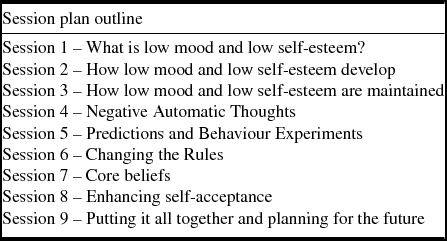
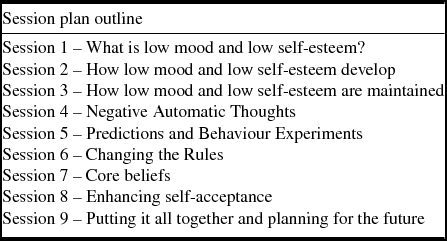
The ‘Boost your mood’ (BYM) group was based on Fennell's (1997) cognitive behavioural conceptualization of low self-esteem. The treatment programme consisted of nine weekly, 2-hour sessions including a 10 minute break after the first hour. The group programme was co-facilitated by two professionals who are accredited CBT therapists. Clinical supervision was provided by a Counselling Psychologist in the service. Data were collected across six cohorts of the group. Outcome measures were completed at the beginning of each group session. Session content was based on the treatment trajectory outlined by Fennell (Reference Fennell1999) and included modules on self-esteem, mood, formulation, negative automatic thoughts, rules for living and core beliefs (see Table 1). The initial aims of the group were to orientate group members to the concept of self-esteem and introduce goal setting. Group discussion was encouraged to allow participants to explore issues collectively. Therapeutic material was delivered verbally with hand-outs used to facilitate understanding and retention. During each session, PowerPoint was incorporated to present the session content. Homework tasks were set in each session and included tasks such as keeping a thought diary, thought challenging, and completing behavioural experiments. Homework was reviewed at the beginning of each following session to explore learning from the exercises and to also discuss any difficulties experienced by the participants.
CBT group intervention
Results
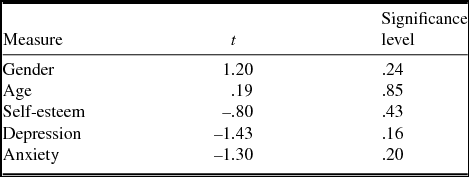
Data were derived from six separate groups. Fifty-eight individuals participated in the BYM group, although due an attrition rate of 27.58%, only 42 complete data sets were available for analysis. Independent t-tests indicated that there were no significant differences in the demographics of participants who completed the group and those who did not. Analysis also showed that there were no significant differences in the initial outcome measure scores of completers and non-completers (see Table 2).
Statistical comparisons between completers and non-completers

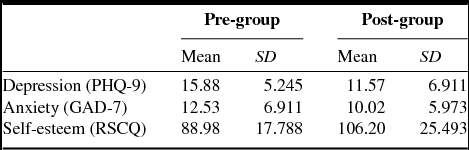
Across the six groups, there was an attendance rate of 89%. The mean number of sessions attended was 7.8, ranging from 5 to 9 sessions. In cases where post-treatment data were missing, post-treatment scores were based on an intent-to-treat analysis with last observation carried forward (Dancy and Reidy, Reference Dancy and Reidy2004). The means and standard deviations of the outcome measures are shown in Table 3 at both pre-group and post-group.
Means and standard deviations from the PHQ-9, the GAD-7 and the RSCQ

Self-esteem
Given an estimated effect size of d = 1.2 (Waite et al., Reference Waite, McManus and Shafran2012) a one-tailed, priori power analysis using G*Power calculated that a sample size of n = 10 had an 80% power to detect an effect size of d = 1.2 at p < 0.005 (Faul et al., Reference Faul, Erdfelder, Buchner and Lang2009). Therefore a sample of n = 15 had sufficient power for the comparison of pre- and post-scores.
The difference in means pre- and post-group was not normally distributed and as such, a non-parametric test was most suitable for the analysis. A Wilcoxon signed rank test showed that there was a significant difference in levels of self-esteem following completion of the BYM group (z = –3.41, p = 0.001). Effect sizes were calculated using Cohen's r (Rosenthal, Reference Rosenthal1991) and results yielded a large effect size (r = 0.62).
Depression
A one-tailed, priori power analysis using G*Power calculated that a sample size of n = 5 had an 80% power to detect an effect size of d = 2.13 at p < 0.005 (Field, Reference Field2013; Waite et al., Reference Waite, McManus and Shafran2012). Therefore the current sample of n = 42 was calculated to give sufficient power for the comparison of pre- and post-scores on the measures of depression.
Results indicated that there was a significant improvement in levels of depression following attendance at the BYM group (t (41) = 4.05, p < 0.001, 95% CI 1.78 to 5.31). Effect sizes were calculated using Cohen's d (Cohen, Reference Cohen1988). There was a large effect size for the difference between pre- and post-scores on the PHQ-9 (d = 0.7). Fifteen of the 42 participants (35.7%) on the PHQ-9 showed reliable change indicated by a decrease in score of six or more, whilst two participants (4.8%) showed reliable deterioration indicated by an increase in score of six or more. Results also indicated that 33% of participants showed clinically significant change.
Anxiety
A one-tailed, priori power analysis using G*Power calculated that a sample size of n = 14 had an 80% power to detect an effect size of d = 0.94 at p < 0.005 (Field, Reference Field2013; Waite et al., Reference Waite, McManus and Shafran2012). Therefore the current sample of n = 42 was calculated to give sufficient power for the comparison of pre- and post-scores on the measures of anxiety.
Results indicated a significant decrease in levels of anxiety following the intervention (t (40) = 2.08, p < 0.05, 95% CI 0.06 to 3.70). There was a low to medium effect size for the difference between pre- and post-scores on the GAD-7 (d = 0.39). Fifteen of the 42 participants (37.5%) showed reliable change on the GAD-7 indicated by a decrease in score of four or more, and six participants (14.3%) showed reliable deterioration indicated by an increase in score of four or more. Results identified that 31% of participants demonstrated clinically significant change.
Discussion
The current findings are consistent with the suggestion that group CBT may be effective at increasing levels of self-esteem and reducing levels of depression and anxiety (Rigby and Waite, Reference Rigby and Waite2006; McManus et al., Reference McManus, Waite and Shafran2009; Morton et al., Reference Morton, Roach, Reid and Stewart2012; Waite et al., Reference Waite, McManus and Shafran2012). The present study draws parallels with the research conducted by Pack and Condren (Reference Pack and Condren2014) and serves to reinforce the suggestions made by the authors regarding the efficacy of group CBT for low self-esteem delivered in an IAPT service. Although large effect sizes are reported here for changes on measures of self-esteem and depression, they are lower than those reported in previous research (McManus et al., Reference McManus, Waite and Shafran2009; Waite et al., Reference Waite, McManus and Shafran2012).
The current study attempted to address a number of shortcomings identified in previous research. This study benefits from reporting findings from a mixed gender sample across a wide age range (18–75 years). Considering the remit of IAPT services to deliver psychological therapies to the general adult population, this is important to bolster the validity of the present study. Also, the recruitment of an independent researcher in this study limits the inherent biases associated with researchers investigating the effectiveness of groups they facilitate.
Although encouraging, caution is advised when interpreting the current findings due to a number of limitations. Results reported here are derived from a small sample living in the same geographical area. The ethnicity of the group participants may not be representative of a larger sample, as the majority were White British. This study requires replication across a more heterogenous population in order to strengthen the inferences made. Moreover, despite the attrition rate in the current study being similar to that reported in the study by Morton et al. (Reference Morton, Roach, Reid and Stewart2012), it may act to undermine the strength of the findings (Field, Reference Field2013). Furthermore, no follow-up data were collated in the present study. Considering the longevity of low self-esteem it would be advisable to investigate the maintenance of therapeutic change over time (Trzesniewski et al., Reference Trzesniewski, Donnellan and Robins2003).
In addition to these limitations, the lack of a control group makes it difficult to attribute change solely to participation in the BYM group. There is a lack of control to account for the passage of time, and other variables that may have impacted upon the results. Efficacy of the group is therefore difficult to establish as it cannot be determined whether improvements in self-esteem, depression and anxiety would have been observed in individuals not attending treatment.
The current findings have implications for the dissemination of the BYM group. Despite the significant changes identified here in levels of self-esteem, depression and anxiety, the current research does not endorse the continued facilitation of the BYM group in IAPT services due to recovery rates falling below the key performance indicators for IAPT services (recovery rate of 50%).
There are difficulties in making direct comparisons between the current study and previous research due to variations across the studies. The studies vary in terms of the measures used to assess low self-esteem, depression and anxiety, the amount of therapeutic input and the exact content of the CBT programmes delivered. The current study, in addition to a number of others, neglected to include a measure of treatment fidelity and so the treatment integrity is equivocal. Using a variety of treatment protocols with idiosyncratic adjustment of materials also complicates attempts to extract the elements of CBT which are key in affecting change.
The agent of change was not investigated in this study although previous research has made suppositions regarding what element of the programme may have yielded the greatest therapeutic shift. Rigby and Waite (Reference Rigby and Waite2006) attribute positive therapeutic change to the inclusion of existential exercises in the treatment protocol. Such assertions are based on qualitative feedback from participants stating that the existential exercises allowed them to more easily apply learning between sessions. Morton et al. (Reference Morton, Roach, Reid and Stewart2012) postulate that a shift in core beliefs is the catalyst for change, whereas McManus et al. (Reference McManus, Waite and Shafran2009) argue that in addition to core belief work, breaking the maintenance cycles that keep individuals entrenched in maladaptive thinking and behaviour are vital for improvement. Pack and Condren (Reference Pack and Condren2014) collected qualitative feedback to supplement quantitative results, which gives an indication of the important elements in motivating change in participants. Group members reported that the intervention allowed them to challenge negative thinking and interpretations, allowing for the individual to attend more to their positive attributes and achievements. Therapeutic work to shift the attentional bias as emphasized in the model was concluded to be important in bringing about therapeutic change (Pack and Condren, Reference Pack and Condren2014). There is a tendency here for researchers to attribute change to the content of the programme or the method of delivery (McManus et al., Reference McManus, Waite and Shafran2009; Morton et al., Reference Morton, Roach, Reid and Stewart2012; Pack and Condren, Reference Pack and Condren2014). Some authors suggest that the agent of change is not isolated to the content of the programme but is rather an artefact of being part of a group (Rigby and Waite, Reference Rigby and Waite2006). The cohesiveness of a group is proposed to relate directly to factors such as group self-esteem which relates positively to increases in the individual self-esteem of group members (Yalom and Leszcz, Reference Yalom and Leszcz2005). Without further empirical study into the variables that relate to reported improvements in low self-esteem, depression and anxiety following CBT for low self-esteem, the agent of change remains undetermined.
Although the current study investigated CBT delivered in a group format, it is unknown whether individual CBT adopting the same treatment trajectory would yield similar results. Studies by McManus et al. (Reference McManus, Waite and Shafran2009) and Waite et al. (Reference Waite, McManus and Shafran2012) reported findings from an individualized programme but it is difficult to make comparisons with group delivery due to the relative merits and limitations of each approach. As Rigby and Waite (Reference Rigby and Waite2006) advise, the group format allows participants to identify cognitive biases in others and to observe the negative impact of this on their peers. This is considered to facilitate greater understanding and insight about the self. The group format allows for a collective consideration of alternatives and the development of more realistic ways of interpreting and evaluating experience. Nonetheless, individual therapy affords opportunities to attend to the individual needs and abilities of the service user. Future research could employ a randomized controlled trial to compare the efficacy of group and individualized CBT for low self-esteem. This would be of clinical interest particularly in cases where the group inclusion criteria dictate that certain individuals be denied access to a group.
Despite the empirical interest in CBT for low self-esteem, it is recognized that a growing number of authors dispute the usefulness of the term self-esteem and criticize the construct for its reliance on the self being evaluated in comparison with others (Swann, Reference Swann1996). Alternative conceptualizations are offered to describe the relationship with the self, with one such being self-compassion (Neff, Reference Neff2003). Self-compassion endorses a non-judgemental understanding of the self and is associated with a range of psychological benefits including decreased levels of depression and increased emotional resilience (Neff, Reference Neff, Leary and Hoyle2009; Raes, Reference Raes2010). Research indicates that self-compassion significantly predicts changes in depression over time with higher levels of self-compassion leading to greater reductions in depressive symptoms (Raes, Reference Raes2011). Given such benefits, there is the possibility that future treatment efforts will depart from attempting to increase levels of self-esteem and focus on increasing levels of self-compassion. Future research is needed to explore how this may have an impact on recovery rates in primary care services such as IAPT.
Main points
(1) Self-esteem refers to the cognitive representations an individual develops about themselves based on their experience.
(2) This study investigated the effectiveness of a CBT programme for low self-esteem delivered within primary care.
(3) Significant improvements in self-esteem, depression and anxiety were identified following engagement with the group.
(4) The current findings are consistent with the suggestion that group CBT may be effective at increasing levels of self-esteem and reducing levels of depression and anxiety.
(5) We acknowledge the limitations of this study and recognize the need for randomized controlled trials to strengthen assertions made here.
Acknowledgements
We would like to express our thanks to all the individuals who participated in the study and the therapists who were involved in facilitating the group. We acknowledge the support of Dr Mahdi Ghomi, Miles Wrightman, Oliver Hughes and Janine Ellis and value their contributions to the project. We would also like to thank Dr Wendy Whipp (Buckinghamshire New University) for her supervision of the research.
Conflicts of interest
None to disclose.
Ethical approval
All authors have abided by the Ethical Principles of Psychologists and the Code of Conduct as set out by the American Psychological Association. At the time at which the data were collected, participants gave permission for the data to be used for evaluation and research purposes and in accordance with service protocols, all patient information was pseudonymized. The information governance team for the associated NHS Trust gave permission for the researcher to access the data for the current research project and an honorary temporary contract was established to facilitate this. Ethical approval was also obtained from the Ethics Board at Buckinghamshire New University.
Financial support
None to disclose.
(1) To explore the concept of self-esteem and the research regarding the effectiveness of CBT for low self-esteem.
(2) To investigate the efficacy of a CBT group for low self-esteem delivered in an IAPT service.
(3) To understand the limitations of the current evidence base and how future research can employ more robust methodologies to explore this further.



Comments
No Comments have been published for this article.