INTRODUCTION
Cancer accounts for more than 8,500 deaths annually in Ireland (Irish Cancer Society, 2013). Medical advances have lengthened the time between diagnosis and death, which has resulted in individuals presenting with multiple comorbidities (Nissim et al., Reference Nissim, Rennie and Felming2012). A range of psychological constructs have been posited to explain the dying process (Kastenbaum, Reference Kastenbaum2000). Kübler-Ross (Reference Kübler-Ross1969) postulated that dying individuals pass through the stages of denial, anger, bargaining, depression, and acceptance. However, it has been argued that this undermines individual coping and pathologizes individuals who do not respond in a sequential manner (Corr et al., Reference Corr, Doka and Kastenbaum1999; Wright, Reference Wright2003). Clinical evidence suggests that individuals oscillate between emotions (Copp, Reference Copp1998). Pattison's framework (Reference Pattison1977) holds that with a terminal diagnosis the living–dying interval emerges with acute crises, chronic, and terminal phases, while Corr's (Reference Corr1991) model considers the completion of tasks within physical, psychological, social, and spiritual domains. It has been suggested that psychological frameworks have minimized dimensions of well-being, with research prioritizing fear of death over acceptance (Wong & Tomer, Reference Wong and Tomer2011). With the exception of Corr (Reference Corr1991) and Copp (1996), physical dimensions of dying have also been neglected (Kastenbaum, Reference Kastenbaum2000). Scholars wonder if a theory of dying is required or if it relates to other experiences involving separation (Corr et al., Reference Corr, Doka and Kastenbaum1999). Some theories have had a broad focus rather than providing insights into the individual's dying experience (Nissim et al., Reference Nissim, Rennie and Felming2012).
Cancer in Western society is the most feared of all illnesses, and lifestyle choices are implicated in its development (Fife & Wright, Reference Fife and Wright2000; Carlson et al., Reference Carlson, Baker, Halifax and McCracken2011). Public discourses construct cancer as a solvable problem with military metaphors utilized to instruct patients to engage in treatment (Willig, Reference Willig2009). Positive thinking can obstruct expressions of anger, grief, and planning (McCreaddie et al., Reference McCreaddie, Payne and Froggatt2010; Willig, Reference Willig2011). Perceptions that a person is dying may lead to changes in interactions, such as the withdrawal of others, a process that Sudnow (Reference Sudnow1967) calls “social death.” According to Talwar et al. (Reference Talwar, Harris and Schleifer2011), personal death is beyond comprehension. While humans can intellectually accept death, they cannot feel it. Conversely, terror management theory holds that individuals are aware of their mortality. This induces death anxiety, which is managed through cultural worldviews (Greenberg & Arndt, Reference Greenberg, Arndt and Van Lange2011). In the West, evading death has become the meaning of life, as death anxiety is suppressed through various routines (Willmott, Reference Willmott2000; Byock, Reference Byock2002). Kastenbaum (Reference Kastenbaum1996) contends that humans are not inherently anxious about death; rather, this is learned through socialization. The surge in debates concerning issues such as euthanasia may indicate emerging changes in public perceptions (Silverman, Reference Silverman, Berzoff and Silverman2004).
Diagnosis
With a terminal diagnosis, the individual becomes conscious of impending death (Coyle, Reference Coyle2004). This can cause a psychological disruption resulting in shock, which alters the individual's sense of security (Bury, Reference Bury1982; Bingley et al., Reference Bingley, McDermott and Thomas2006). Relief may also prevail as a complaint is validated (Willig, Reference Willig2011). Individuals become immersed in uncertainty (McKechnie et al., Reference McKechnie, MacLeod and Keeling2007). They shift from habitual behavior as they attempt to understand and import meaning onto the diagnosis (Kuhl, Reference Kuhl2002; Coyle, Reference Coyle2006). They reflect on their identity and lifestyle choices, and consider life assumptions including the future, relationships, and control (Brennan & Moynihan, Reference Brennan and Moynihan2008). A life review can restore temporal order and meaning but can also activate unresolved issues (Kearney, Reference Kearney1996; Carlick & Biley, Reference Carlick and Biley2004). Yedidia and MacGregor (Reference Yedidia and MacGregor2001) stipulate that individuals integrate diagnosis into their life perspective. Others contend that meaning reconstruction transforms worldviews (Carlick & Biley, Reference Carlick and Biley2004).
Responses to a Terminal Diagnosis
There are varying postulations as to whether individuals respond to a terminal diagnosis with similar methods of coping or if individual differences are more marked. However, there is consensus that most individuals strive to maintain control and normality (Reeve et al., Reference Reeve, Lloyd-Williams and Payne2010; Krikorian et al., Reference Krikorian, Limonero and Maté2012). They set goals and involve themselves in completing unfinished business (Nissim et al., Reference Nissim, Rennie and Felming2012). Legacies facilitate the partial dissolution of ego boundaries and establish after-death identities (Kearney, Reference Kearney1996; Exley, Reference Exley1999). According to McGrath (Reference McGrath2003), connection with family, friends, and work is as vital spiritually as transcendent meaning making. The family can support individuals to continue living (Coyle, Reference Coyle2006). However, relatives may avoid discussing death in order to protect each other (McCarthy et al., Reference McCarthy, Donnelly and Dooley2010a ). This contributes to fear and isolation (Kuhl, Reference Kuhl2002).
Marrone (Reference Marrone1999) asserts that the ability to ascribe meaning to a changed world is more significant than the content by which that need is filled. Finding meaning while dying reduces suffering (Chan et al., Reference Chan, Ho and Chan2007; Wrubel et al., Reference Wrubel, Acree and Goodman2009). Certain individuals rate their quality of life as higher after diagnosis (Kuhl, Reference Kuhl2002). However, most individuals experience some suffering and grieve losses (McKechnie et al., Reference McKechnie, MacLeod and Keeling2007). A predominate pain when dying is caused by separation from loved ones (Grumann & Spiegel, Reference Grumann and Spiegel2003). Individuals also report anxiety regarding the impact of their death on others, including leaving dependent children (Bell & Ristovski-Slij, Reference Bell and Ristovski-Slijepcevic2011). Concern for others can result in underreporting pain and feeling pressurized to undergo treatment (Quinlan & O'Neill, Reference Quinlan and O'Neill2009). Intense suffering ensues when dying undermines everything that is meaningful to the individual (Cassell, Reference Cassell2004). This can include changes in physicality and fear of burdening others, and loss of control, roles, or goals (Chochinov & Cann, Reference Chochinov and Cann2005; Krikorian et al., Reference Krikorian, Limonero and Maté2012). The demoralization syndrome arises when individuals experience feelings of hopelessness, meaninglessness, and diminished self-esteem. It significantly correlates with a desire for a hastened death (Kissane et al., Reference Kissane, Clarke and Street2001). Persistent hopelessness is not a normal feature of dying (McCarthy et al., Reference McCarthy, Donnelly and Dooley2010a ).
External Resources
External resources support individuals and their families. These include access to treatments, psycho-oncology teams, and palliative care professionals. The Health Service Executive recognizes the differing requirements of individuals and aims to provide such interventions on the basis of assessed individual needs (Health Service Executive, 2013). In reality, though, such resources are unevenly distributed throughout the country (Murray, Reference Murray2013). Treatments such as chemotherapy and radium invariably induce such side effects as fatigue, physical pain, and distress, as well as financial concerns (Hubbard & Forbat, Reference Hubbard and Forbat2012). However, they can lengthen lifespan, and certain individuals may engage in clinical trials for altruistic reasons (Nissim et al., Reference Nissim, Rennie and Felming2012). If treatment is discontinued, patients need their physical pain managed, which is imperative for maintaining quality of life (Kulh, 2002). They also require that their existential concerns be addressed (Breitbart, Reference Breitbart2006). While hospitals are in the process of adapting a hospice philosophy, they are underresourced (McKeown et al., Reference McKeown, Haase and Pratschke2010).
The hospice responds to an individual's holistic needs, which is pivotal to supporting quality of life (Levine & Karger, Reference Levine, Karger, Berzoff and Silverman2004; Murray, Reference Murray2013). A hospice ideal is a death that individuals choose (Farber et al., Reference Farber, Egnew, Farber, Berzoff and Silverman2004). A range of interventions are utilized to relieve pain (Kuhl, Reference Kuhl2002). Surface interventions target physical, emotional, and social distress at the conscious level (Kearney, Reference Kearney1996). In-depth interventions reconnect individuals with meaningful aspects of life (Kearney, Reference Kearney1996). Individuals may pursue writing, music, life review, psychotherapy, and therapeutic touch (Chochinov & Cann, Reference Chochinov and Cann2005). When individuals engage with their inner process, the meaning of the illness becomes less overwhelming (McSherry, Reference McSherry2011).
If interpersonal and internal conflicts remain, uncontrolled pain may persist (Byock, Reference Byock1996). Professionals bear witness to this, and sedation may be used, which can unintentionally hasten death (Farber et al., Reference Farber, Egnew, Farber, Berzoff and Silverman2004; Balducci, Reference Balducci2012). Despite public fears concerning the hospice, service users report that it is empowering (Broom & Cavenagh, Reference Broom and Cavenagh2011). Social support can also maintain self-esteem and buffer against death anxiety (Mikulincer et al., Reference Mikulincer, Florian and Hirschberger2003). Such external resources increase in importance in instances where family support is absent (Brennan & Moynihan, Reference Brennan and Moynihan2008). However, where relatives are present, excessive intervention can undermine the support of primary carers (Brennan & Moynihan, Reference Brennan and Moynihan2008).
An individual's response to dying reflects their context, including their mental maps of the self, the world, and external supports (Brennan & Moynihan, Reference Brennan and Moynihan2008). Qualitative research captures varying perceptions of dying among individuals with a terminal illness (Yedidia & MacGregor, Reference Yedidia and MacGregor2001; Wright, Reference Wright2003; Coyle, Reference Coyle2006). Nonetheless, there is a dearth of research in this area (Armstrong-Coster, Reference Armstrong-Coster2004). The current study explored how individuals with terminal cancer make sense of their dying experience within an Irish context.
METHOD
The ethics board at University College Dublin approved our study. Convenience sampling was applied. The Broadcaster RTE granted permission to utilize audio-recorded public interviews from the programs “Liveline,” “Marian Finucane,” “The Hospice,” “The Late Late Show,” and “Would You Believe” (n = 7). Another interview was accessed through The Irish Times.
Six interviewers completed interviews within hospice or residential settings from 2006 to 2011. Their experience ranged from 28 to 37 years. Three participants were interviewed on more than one occasion. One participant was interviewed a second time in a broadcasting studio. All interviews were semistructured. There were eight participants—six females and two males—all of whom had terminal cancer. Participant ages ranged from 36 to 68 years. They were residents of Ireland and receiving palliative care. Participants were alert, cognizance of their diagnosis, and voluntarily participated to share their experience.
Interpretative phenomenological analysis (IPA) explored how individuals made sense of their lived experiences (Smith & Osborn, Reference Smith, Osborn and Smith2003). This approach privileges the perspective of the participant, yet recognizes that the researcher's conceptualizations are required to interpret an individual's personal world (Smith et al., Reference Smith, Flowers and Larkin2009). The interviews were transcribed verbatim. As outlined by Smith and Osborn (Reference Smith, Osborn and Smith2003): (a) each transcript was read independently numerous times, (b) preliminary themes were identified, (c) themes were interrelated and clustered, and (d) shared themes were organized across transcripts. The emerging themes captured the quality of participants' experiences rather than arising from frequency in transcripts (Willig, Reference Willig2001). Two psychology postgraduates audited the transcripts and confirmed the themes. The findings were also compared with similar research.
RESULTS
Demographics
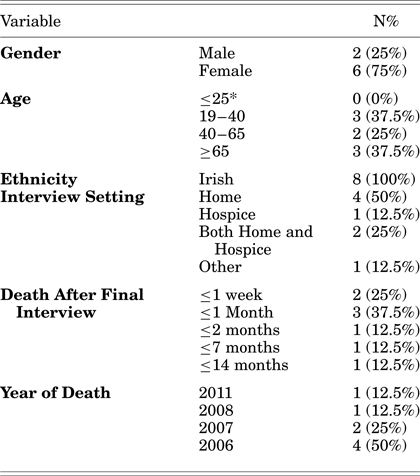
Table 1 presents the demographics of the sample.
Summary of participants' demographics (N=8).

*Age divisions align with Erikson's Psychosocial Stages (Reference Erikson1950).
Master Themes
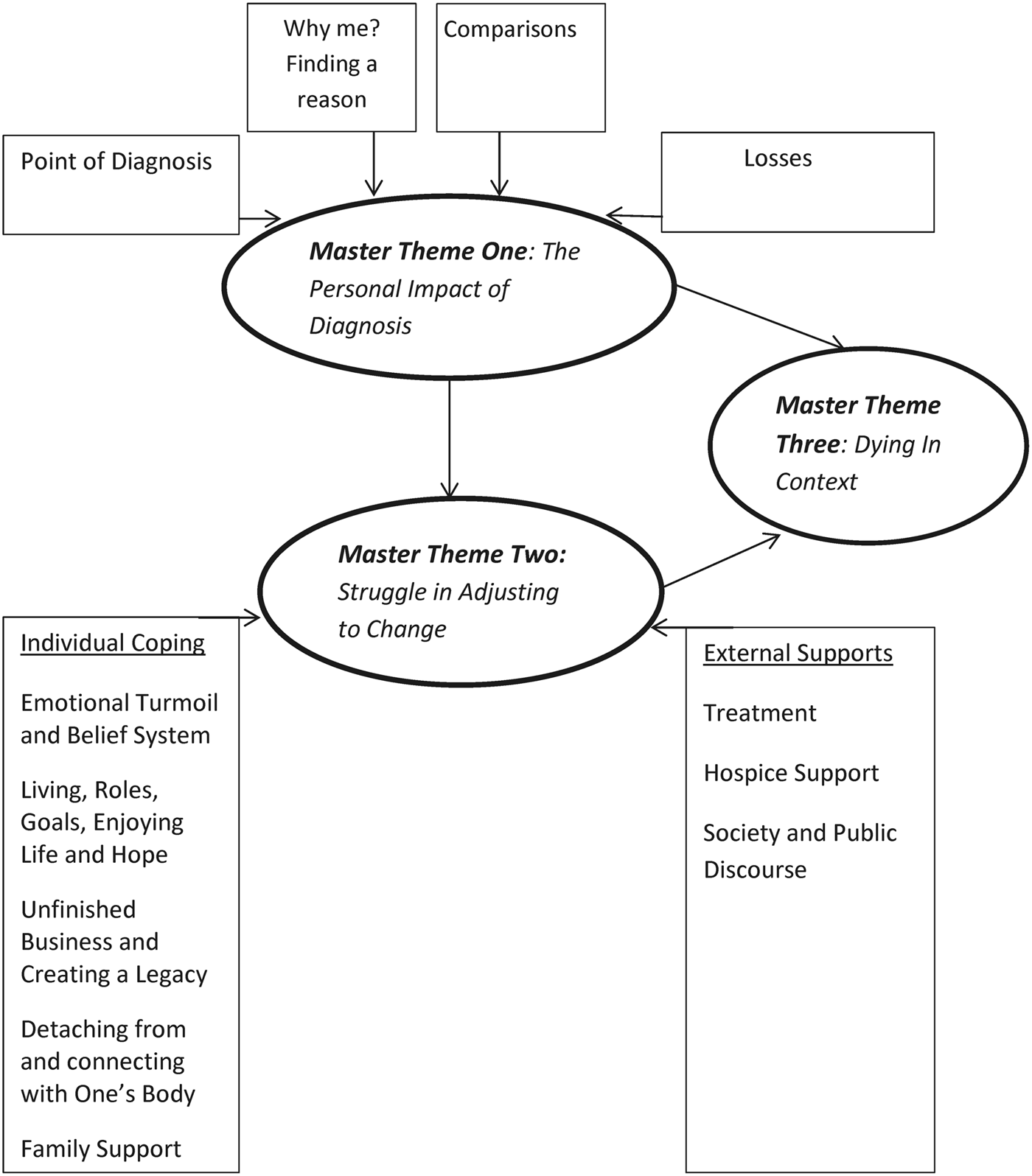
Figure 1 illustrates the three master themes that emerged from the analysis: the personal impact of diagnosis, the struggle in adjusting to change, and dying in context.
Thematic map, illustrating three master themes. Adapted from the thematic map framework provided by Braun and Clarke (Reference Braun and Clarke2006).
The Personal Impact of Diagnosis
Point of Diagnosis
Diagnosis was captured as a distinctive event resulting in shock, articulated by Levina thus: “If you had of hit me in the face it would have been easier.” Each participant referred to the doctor in the third person. Mary explained how when she “heard the word terminal” she sought information, and “He said, well, I have the information on me now if you want to know, but I think that you should have someone with you.” Mary would have preferred to have been informed independently. Levina explained how her doctor “just turned, and she says to me, well, Levina, she says, there is no easy way to say this, she says, you have a tumor.”
Why me?
The participants searched for reasons for the cancer and reflected on their identity. For instance, Emer described herself as “a nurse” and “a good mother.” Mary articulated, “there has to be a reason.” Some considered lifestyle choices. Nuala attributed illness to smoking, whereas Levina queried, “How can my liver be in such a bad way? I don't drink; I don't smoke.” Others engaged in social comparisons. John reflected on how numerous people receive such diagnoses: “I sit here saying, Jesus, sure, why not me.” Conversely, Beverley wondered, “Why can't it be somebody else?”
Comparisons
The participants compared the diagnosis to past struggles. Bill explained, “A terminal illness is, eh, not as bad as the depths of clinical depression.” He elucidated, “I don't think that I have ever been happier.” John considered his current situation as more favorable than the time when he contemplated suicide. He reported improved well-being following diagnosis, which he attributed to pain management. Doon also described how prior to diagnosis she was “emotionally numb” and how following it she had connected with her feelings.
Losses
Participants reported losses. For instance, Beverley explained how her children “want you to do things with them and you can't.” John said goodbye to his home and commented, “that was a sad auld moment.” Future goals were also relinquished. For instance, Doon was “unspeakably sad” with the realization that she “would never know” her grandchildren. Emer and Levina relinquished travel plans with their husbands.
The Struggle in Adjusting to Change
The participants drew on individual coping and external resources in adjusting to change.
Individual Coping
Emotional Turmoil and Belief System
As captured by Emer, participants experienced a “myriad of emotions,” which could conflict with how they wanted to be. Levina was “determined to fight” cancer while reporting to be in denial. Beverley also denied being ill while arranging her funeral. Bill expressed happiness and later reported “a dent in the positiveness of my existence.” John hoped for a miracle while accepting death.
Each participant extrapolated from their beliefs. Six participants drew on religious beliefs, which were fluid. For example, Beverley maintained, “If there was a God out there, he wouldn't do this,” yet later she prayed, “Tomorrow, please God, I will be even stronger.” John believed that “Healing is finally greater than the illness.” Emer believed that “We all have inner resources that we don't tap into everyday, but when your back is against the wall, you do.” Bill articulated, “There has to be some assistance within our psyche which allows us out of the world.”
Living
Participants were living not dying, captured by Doon thus: “I am living my life, not my death.” They coped by living day to day. Focusing on the present facilitated appreciation of what they found meaningful. For Bill, this included music. Beverley appreciated that “I have been here to see my son go to school.” Only Nuala considered herself to be “actually dying.”
Participants held multiple roles, which they worked to maintain. Doon instructed friends, “Don't treat me any differently.” Emer continued her parenting role and highlighted, “I don't know when this journey is going to end, but in the meantime I think it's nice that families write letters to their kids.”
The participants set goals. Beverley had a “wish list,” and Doon established “a plan of life goals.” Five participants organized trips to spend time with others or for other meaningful reasons. Beverley commented, “Every time I go away, when I come back I seem to get sick,” implying that trips were a form of escapism. Participants continued to enjoy life. Mary enjoyed “having a laugh” with her sister. John laughed as he recalled stories. Doon viewed humor as a “valuable technique allowing all sorts of things be dealt with.”
Each participant expressed hope, which manifested in various forms. Levina hoped that “God leaves me another twenty or thirty years.” Mary hoped for an afterlife. Bill articulated how he hoped to die.
Unfinished Business and Creating a Legacy
Participants managed unfinished business. Doon ended her marriage. Three participants reported the need to say goodbye. Through counseling Mary resolved “issues” concerning her daughter. Three participants had unresolved issues that contributed to suffering. Bill explained, “I have regrets in things that I did wrong, which I don't have the opportunity to put right, and I wish to goodness I had.” Levina was grieving for her father and felt that she couldn't die since her family needed her. Beverley too was “worried” about leaving her children.
Three participants reported having no unfinished business. John explained, “I got a great run at life. I'm sixty-eight years of age.” Doon declared, “I've achieved everything that I wanted to achieve.” Emer accepted death, believing that her children would “be alright” and that “you can't ask for anymore.”
In addition to completing public interviews, five participants reported creating other legacies. Emer prepared “gifts” for her children, recorded a film, and wrote journals—activities that were “therapeutic.” Beverley created memories with her children and mindfully purchased a cemetery seat. Doon created a DVD for her children of photographs of their childhoods. Levina did not create a legacy. She couldn't write to her son because she perceived it as “bad enough” for him to cope with her death.
Detaching and Connecting with One's Body
Participants separated their identity from the cancer and their bodies. John alluded to “cancer of the liver.” Doon considered, “once this cancer goes wild.” Emer drew on a metaphor that the disease was “galloping ahead” and how at times “you just wanted to curl up and just say, ‘I have had enough.’” Reconnection with their bodies facilitated the realization of imminent death. Beverley reconsidered fighting as, “Seriously, see me, I am going downhill, so that's that.” Levina reported not perceiving physical changes that reinforced her belief of being “one of the lucky ones.”
Family Support
Each participant highlighted the importance of or the desire for family support. Beverley explained, “The fight in me is my children and my husband.” Levina emphasized, “At a time like this, I think you need your family.” Bill requested relatives to be at his deathbed. Participants acknowledged that dying affected their family, captured by Emer thus: “It was hard on the family.” Levina explained, “I take my vengeance out at times, and God help Mick and the kids, they are the ones who get it.” In contrast to Emer, Levina did not discuss illness with her children.
External Resources
Treatment
Six participants discussed completing chemotherapy to fight cancer. John described how the doctors were “putting up a real old fight; do you know they are giving me the chemo.” Levina explained, “As it is going to keep you alive, that is the added bonus and you have to go through it.” Levina and John believed that a “miracle” could happen. Nuala rejected chemotherapy: “There is no chance of a cure.” Participants detailed treatment side effects. Doon highlighted fatigue. Levina explained, “You are like a pin cushion” and the “chemo does get in on you.” Emer concurred that “All the treatments, it just gets to you.” Emer discussed losing her hair three times. Conversely, Levina retained her hair and self-image.
Hospice
Pain management was salient to each participant. Bill considered pain as his “one fear,” and its control through the hospice care was “a great consolation.” Emer “embraced” hospice home care “as they look after your symptoms.” The hospice reportedly was empowering, cared for a range of needs, and improved quality of life. Mary described it as “absolutely brilliant, and there is nothing else that gives you reason to get up early.” Levina highlighted, “I wouldn't be here today if it wasn't for them.” She emphasized that professionals phoned regularly inquiring, “Is there anything I can do?” Mary explained, “You come in, have a chat, a cup of coffee, and then you can have alternative therapy.” The hospice also supported families. Levina highlighted how the social worker “has been excellent with the kids.” Mary found hospice counselors as helpful for issues “you are not able to solve yourself.” Six participants embarked on new endeavors, with three undertaking alternative therapies.
Society
Participants received support from friends. Doon processed her diagnosis “by talking to my friends.” John noted how he was “gathering all that Christian medicine” from his neighbors. Participants highlighted a dearth of societal discourse and education concerning terminal illness. Doon commented that acquaintances crossed the street to avoid her. Levina underlined how “It isn't until it hits in your own home, Pat, that you actually realize what the hospice does.” Emer emphasized the paucity of support within schools as her daughter would say, “Will you put on your wig when you collect me from the school.” Doon explained how wigs “make other people feel more comfortable.” Nuala commented that “People seem frightened or repulsed, and that is why I went and got a wig.” Despite this, participants drew on the artifacts of culture. For instance, John described dying as an “endgame now in the real Beckett sense,” while Mary listened to the radio during her illness.
Dying in Context
Each participant was living with uncertainty, captured by Beverley thus: “I don't know how long I have.” The length of the illness facilitated coping. Emer revealed, “I have had extra time because initially my diagnosis was two to three years.” Beverley disclosed, “I have put up a fight for so many years; now this year, now, there is no more fight left.” Doon stated, “Now over six years from my diagnosis, knowing that I will die from cancer.” Conversely, Levina was not afforded time to adjust. Upon diagnosis, her doctor informed her, “If you had come to me a year ago, I would have given you a year to live.”
Each participant's dying experience was unique. They attributed their own meaning to it. Bill viewed it as another life struggle and expected “an average result from an average life.” Emer perceived dying as “Everyone has a cross in life to bear and, er, maybe this is my cross.” John viewed it as a “transformation.” Mary believed it would lead to an afterlife. Doon perceived dying as a quest. Nuala lost quality of life and used the time to say goodbye. Beverley fought dying and summoned characteristic inner strength. Levina was unable to attribute meaning to dying but chose “to fight” as if “God is going to take me; let him take me the way I am.”
DISCUSSION AND CONCLUSION
The accounts support findings that diagnosis is a biographical disruption resulting in shock (Bury, Reference Bury1982; Coyle, Reference Coyle2004; Brennan & Moynihan, Reference Brennan and Moynihan2008). However, for individuals who had encountered adversity, diagnosis was less traumatic compared to previous life struggles. Hardship theory stipulates that such individuals have developed resources to manage illness (Atkinson & Rubinelli, Reference Atkinson and Rubinelli2012). Participants were susceptible to interactions with doctors. Third-person pronouns can function to psychologically distance individuals from events (Fujita et al., Reference Fujita, Trope, Liberman and Hassin2010).
Our findings align with research where terminal diagnosis initiates a life review (Murray, Reference Murray, Murray and Chamberlain1999; Coyle, Reference Coyle2006; Brennan & Moynihan, Reference Brennan and Moynihan2008; McSherry, Reference McSherry2011); participants searched to find a reason for the illness. As stipulated by Coyle (Reference Coyle2006) and Willig (Reference Willig2009), this involved reflecting on identities and lifestyles. However, in contrast to Willig's (Reference Willig2011) assertions, only one participant reported responsibility for the illness and attributed it to smoking. Levina was unable to find a reason. Murray (Reference Murray, Murray and Chamberlain1999) notes this impedes individuals from processing the diagnosis and exacerbates suffering. Three participants reported improved quality of life following diagnosis, as per Kuhl's (Reference Kuhl2002) findings. Conversely, Nuala reported reduced quality of life. As shown elsewhere, participants experienced losses, some of which were abstract (Coyle, Reference Coyle2006; McKechnie et al., Reference McKechnie, MacLeod and Keeling2007).
The participants presented as complicated individuals experiencing multiple emotions and internal conflicts. This resonates with other research findings (Levine & Karger, Reference Levine, Karger, Berzoff and Silverman2004; Kreuter et al., Reference Kreuter, Green and Cappella2007). Participants utilized numerous methods of coping. As noted by Yedidia and MacGregor (Reference Yedidia and MacGregor2001) and Grumann and Spiegel (Reference Grumann and Spiegel2003), this included drawing on beliefs, which were fluid. Certain participants stated that they did not believe in God, yet later utilized religious discourse. Six participants drew on Catholicism, which Quinlan (Reference Quinlan2009) notes influences how Irish people negotiate death. Religious beliefs can construct meaning and reduce suffering (Breitbart, Reference Breitbart2002). In variance to suggestions by Neimeyer et al. (Reference Neimeyer, Currier and Coleman2011), religion did not promote fear of death. Three participants believed in their self-efficacy, which Bandura (Reference Bandura1989) links with improved coping. Coyle (Reference Coyle2006) contends that emotional turmoil is lessened when individuals develop a philosophical approach to dying.
Participants focused on living, not dying, which is congruent with other findings (Benzein et al., Reference Benzein, Norberg and Saveman2001; Kuhl, Reference Kuhl2002; Nissim et al., Reference Nissim, Rennie and Felming2012). They strove to maintain roles, as found by McGrath (Reference McGrath2003). They perceived themselves foremost within roles they always held, rather than as patients. This contrasts with postulations that dying individuals establish new identities (Carlick & Biley, Reference Carlick and Biley2004). The participants illustrated a multiplicity of self by holding numerous roles simultaneously. At variance with Charmaz's (Reference Charmaz1994) research, they were able to fulfill their roles. However, as noted by McKechnie (Reference McKechnie, MacLeod and Keeling2007), diminished energy did change how participants conducted duties. Clarke and Black (Reference Clarke and Black2005) noted that sustaining valued roles even in a modified form contributes to quality of life. Aligning with previous research, participants set goals that included organizing trips (Nissim et al., Reference Nissim, Rennie and Felming2012). Such tasks maintain self-esteem, protect against death anxiety, and facilitate attending to controllable aspects of life (Greenberg & Arndt, Reference Arndt, Greenberg and Cook2002; McSherry, Reference McSherry2011). Humor was also an important coping mechanism. It can enable dying individuals to discuss sensitive issues (Exley & Letherby, Reference Exley and Letherby2001).
Concentration on the present facilitated participants to recognize what they found meaningful. According to Arndt at al. (Reference Arndt, Greenberg and Cook2002), consciousness of personal death raises awareness of what is important to an individual. Certain participants expressed gratitude. McSherry (Reference McSherry2011) found that cognizance of mortality induces appreciation. Each participant retained hope. Even when dying, the capacity for hope remained (Clayton et al., Reference Clayton, Hancock and Parker2008).
Completing unfinished business was indeed an important task (Wilson, Reference Wilson2007; McSherry, Reference McSherry2011). As denoted by Pinquart (Reference Pinquart, Frohlich and Sibereisen2005) age influenced whether participants were satisfied that they had completed life tasks. Three participants had unresolved family issues, which contributed to emotional suffering. McSherry (Reference McSherry2011) noted that dying with regrets and unsuccessful goal attainment induces pain. Kearney (Reference Kearney1996) emphasized that to process pain dying individuals must shift from a cognitive understanding to connecting with their dying experience. Certain participants reported suffering from knowing they would not complete their roles as mothers. Yedidia and MacGregor (Reference Yedidia and MacGregor2001) noted that individuals can be reluctant to relinquish life when desiring to complete certain experiences. Parenting with a terminal illness crystallizes cultural expectations that mothers are central to raising children, which exerts pressure to maintain a normal family life (Bell & Ristovski-Slijepcevic, Reference Bell and Ristovski-Slijepcevic2011).
Participants created legacies that, as found by Coyle (Reference Coyle2006), were unique and encompassed personal values. Certain participants demonstrated that they were caring parents. They provided emotional comfort to others while establishing after-death identities. Emotional labor did not undermine the authenticity of the person; rather, it reinforced identities (Exley & Letherby, Reference Exley and Letherby2001). With the exception of Levina, participants separated their identity from their bodies. As Exley (Reference Exley1999) noted, this is necessary to create after-death identities. They later reconnected with their body. Declining body function will lead to death acceptance (Kearney, Reference Kearney1996). Levina did not create a family legacy. She reported not perceiving physical changes and believed that life would continue. Contrary to other findings (Quinlan & O'Neill, Reference Quinlan and O'Neill2009), relatives did not impede the dying process, which may reflect the presence of palliative care.
With regards to the use of external resources, treatment choices centered on cure, hope, quality, and lengthening of life. Coyle (Reference Coyle2006) found that individuals undertake a cost–benefit analysis when making treatment decisions. Those who continued treatment desired to increase their lifespan, whereas those who discontinued it were resigned to dying soon. As noted by Camus (Reference Camus2009), treatment was described using military metaphors. This could reflect terror management theory and an imperative to survive (Arndt et al., Reference Arndt, Greenberg and Cook2002). Participants also highlighted treatment side effects. In line with previous research, pain control was paramount. The hospice was reported as important in managing pain, and it did indeed improve quality of life (Broom & Cavenagh, Reference Broom and Cavenagh2011). Seven participants undertook new activities. Tasks can support a sense of control (Reeve et al., Reference Reeve, Lloyd-Williams and Payne2010). Four participants engaged in alternative therapies. This enables a transition from cure to healing (Broom & Tovey, Reference Broom and Tovey2007). Participants who planned home deaths had medical backgrounds.
The importance of social support was highlighted. As noted by McCarthy et al. (Reference McCarthy, Weafer and Loughrey2010b ), within Irish society there was reportedly a dearth of discourse and education concerning dying. This aligns with Sudnow's (Reference Sudnow1967) concept of social death. However, participants did not withdraw. They drew on cultural artifacts and purchased wigs to ease tension during interactions. This resonates with Goffman's (Reference Goffman1990) concept of “covering.” It also challenges Howarth's (Reference Howarth1998) assertion that dying involves disengagement. Public interviews of middle-aged individuals were readily available. This could reflect Blauner's (Reference Blauner and Doka2006) contention that such deaths cause the greatest social vacuum. There was a deficiency of male interviewees. Men, in contrast to women, have an elevated risk of dying from cancer, which is linked to their reluctance to broach medical issues (Clarke et al., Reference Clarke, Sharp, O'Leary and Richardson2013).
Participants were immersed in uncertainty. This concurs with a plethora of research (Levine & Karger, Reference Levine, Karger, Berzoff and Silverman2004; McKechnie at al., Reference McKechnie, MacLeod and Keeling2007; Brennan & Moynihan, Reference Brennan and Moynihan2008). As noted by Zimmermann (Reference Zimmermann2012), time facilitated coping. Seven participants attributed meaning to their dying. Ultimately, as reported elsewhere, each individual's dying experience reflected their coping, external supports, and the context of their life (Kearney, Reference Kearney1996; Yedidia & MacGregor, Reference Yedidia and MacGregor2001; Levine & Karger, Reference Levine, Karger, Berzoff and Silverman2004; Coyle, Reference Coyle2006; McSherry, Reference McSherry2011).
The findings underscore that dying cannot be understood in universal stages, as the individual's context influences the process. Participants had differing methods of coping and distinctively used external resources. McKiernan at al. (Reference McKiernan, Steggles and Carr2013) highlighted how coping is mediated by numerous factors, including personal and environmental resources. Dying did not instigate the emergence of new meaning to life. Social constructs such as motherhood impacted on experiences. Such dimensions of identity are unaccounted for in psychological theories. Professionals need to support individuals to authentically choose how to die (Farber et al., Reference Farber, Egnew, Farber, Berzoff and Silverman2004). Aiding with unfinished business, facilitating life review, goal setting, and comparisons can alleviate pain, yet must be considered in context.
Our findings are not generalizable and arise from a specific context (Carlick & Biley, Reference Carlick and Biley2004). The analysis is only one interpretation (Smith et al., Reference Smith, Jarman, Osborn, Murray and Chamberlain1999). Participants died within 14 months following the final interview. If interviews had been closer to the time of death, we may have obtained different results. Interpretative phenomenological analysis assumes that language provides the means to capture experiences (Willig, Reference Willig2001). However, interviews are limited in obtaining embodied emotions, and intense pain impedes communication (Reeve et al., Reference Reeve, Lloyd-Williams and Payne2010). No participant desired a hastened death. Such contexts were not explored. The participants' identities were known, which can induce legitimization of positions.
Future research could consider how place of death relates to educational and socioeconomic status, how the family and public perceive dying, psychotherapeutic interventions, male experiences, transcendence and emotional labor at the end of life, and whether individuals' perceptions of dying alter with contextual changes.
Death is the moment when governance over human existence finds its outer limit (Giddens, Reference Giddens1991). While it cannot be controlled, individuals choose their reactions (Silverman, Reference Silverman, Berzoff and Silverman2004). Our research illuminates the importance of discovering what is meaningful to us and managing unfinished business long before death (Kuhl, Reference Kuhl2002). People are unique, with particular individual and external resources. Consequently, each person marks their dying as their own (Kaplan, Reference Kaplan2005). The provision of care reflects broader social values, which are affirmed or weakened (O'Shea et al., Reference O'Shea, Murphy and Larkin2008). The Department of Health is currently restricting palliative care resources (Health Service Executive, 2013). If society holds to the value of freedom, it is imperative that it support individuals to die authentically while simultaneously meeting their human needs for support, meaning, and transcendence (Cassell, Reference Cassell2004). This has the power to maintain the integrity of the person until the end.
ACKNOWLEDGMENTS
Thanks to Ms. Vicky Moran and Mr. John Glendon, Archive Researchers at RTE, for granting permission to draw upon the interviews. Thanks also to Mr. Eoin McVey, managing editor at The Irish Times.