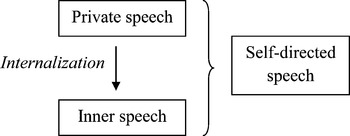
In early and middle childhood, children often talk themselves through their activities, producing private speech (PS) to regulate their thought and behavior. In the preschool years, private speech is usually overt, but in middle childhood, it is more likely to take the form of covert muttering and whispering, and silent, verbal lip movements (see Winsler, Reference Winsler, Winsler, Fernyhough and Montero2009). This shift toward covert PS is thought to reflect the gradual internalization of PS to form inner speech (IS), or silent verbal thought (Vygotsky, 1934/Reference Vygotsky, Rieber and Carton1987). In the terminology of Lidstone, Meins, and Fernyhough (Reference Lidstone, Meins and Fernyhough2010), PS and IS are two categories of self-directed speech (Figure 1). Vygotsky contended that, by middle childhood, goal-directed thinking and self-regulation are fundamentally verbal in nature, being mediated online by self-directed speech.
Conceptual relations between private speech, inner speech, and self-directed speech.

In support of this, there are positive associations between children's PS production during cognitive tasks and their performance of those tasks, in the areas of general problem solving (Behrend, Rosengren, & Perlmutter, Reference Behrend, Rosengren and Perlmutter1989, Reference Behrend, Rosengren, Perlmutter, Diaz and Berk1992), executive function (Fernyhough & Fradley, Reference Fernyhough and Fradley2005; Müller, Zelazo, Hood, Leone, & Rohrer, Reference Müller, Zelazo, Hood, Leone and Rohrer2004; Winsler, Diaz, & Montero, Reference Winsler, Diaz and Montero1997), and schoolwork (Bivens & Berk, Reference Bivens and Berk1990). Associations between aspects of PS production and other abilities, such as self-regulation (Winsler, De León, Wallace, Carlton, & Willson-Quayle, Reference Winsler, De León, Wallace, Carlton and Willson-Quayle2003) and theory of mind (Fernyhough & Meins, Reference Fernyhough, Meins, Winsler, Fernyhough and Montero2009), also support the idea that cognition and self-regulation are dependent on the online use of language. Experimental evidence for this claim comes from studies that assess the effect on task performance of preventing self-directed speech, using the dual task paradigm. Participants are asked to engage in articulatory suppression, such as repeating a word, and this has been shown to impair performance on several tasks, such as the Tower of London in children (Lidstone et al., Reference Lidstone, Meins and Fernyhough2010) and adolescents (Wallace, Silvers, Martin, & Kenworthy, Reference Wallace, Silvers, Martin and Kenworthy2009), and the Wisconsin Card Sort Test (Baldo et al., Reference Baldo, Dronkers, Wilkins, Lucy, Raskin and Kim2005) and Raven's matrices (Kim, Reference Kim2002) in adults. In sum, many types of cognition and self-regulation come to rely on self-directed speech during the course of typical development.
How does language come to have this self-regulatory function? Vygotsky (1930–1935/Reference Vygotsky, Cole, John-Steiner, Scribner and Souberman1978) proposed that, by participating in linguistically mediated joint activity, a child creates (with their interactional partner) a dialogue that can be internalized to form self-regulatory speech. As Fernyhough (Reference Fernyhough, Sokol, Müller, Carpendale, Young and Iarocci2010) explains, words that were previously used to regulate the thought and behavior of others, or that others have used to regulate the child's thought and behavior, become employed in regulating the thought and behavior of the self. According to this account, language is a crucial part of our explanation of human self-regulation, with biologically specified executive capacities being fundamentally transformed by their interaction with language, creating a new functional system.
This neo-Vygotskian view is supported by studies revealing social influences on the development of self-regulation (Kochanska, Murray, & Harlan, Reference Kochanska, Murray and Harlan2000; Landry, Miller-Loncar, Smith, & Swank, Reference Landry, Miller-Loncar, Smith and Swank2002; Lengua, Honorado, & Bush, Reference Lengua, Honorado and Bush2007). For example, in one study (Lengua et al., Reference Lengua, Honorado and Bush2007), children of mothers who were observed to scaffold their behavior effectively in a variety of contexts at one timepoint showed greater gains in effortful control over the next 6 months. Although no distinction was made between verbal and nonverbal maternal behaviors in this study, many of the scaffolding behaviors were presumably expressed in words. It is also pertinent to this discussion that the association showed some specificity: it was specifically scaffolding behaviors and not other maternal behaviors like maternal warmth or negativity that predicted changes in the children's effortful control. In another study, in which only verbal maternal behaviors were recorded, Landry et al. (Reference Landry, Miller-Loncar, Smith and Swank2002) found that maternal scaffolding of children's behavior in free play at age 3 predicted executive functioning at age 6, although indirectly through verbal and nonverbal ability.
This shift from linguistically mediated other-regulation to linguistically mediated self-regulation has also been demonstrated on a microdevelopmental basis, during collaborative problem-solving sessions between adults and children. Winsler et al. (Reference Winsler, Diaz and Montero1997) presented a microdevelopmental analysis of children's performance on a selective attention task during a session in which an experimenter would verbally scaffold their activity when needed. Key findings were that, after successful scaffolding, the children consistently used PS, and more so than if no scaffolding had been given. Furthermore, after scaffolding, children were more likely to succeed if they used PS than if they were silent. This relation between PS and performance did not exist for trials following a lack of scaffolding. Therefore, children's PS (or linguistically mediated self-regulation) seemed to mediate the link between linguistically mediated other regulation and their increasing competence on this executive task. This is one of several studies linking adult behavior in joint activity to children's subsequent PS production (Diaz, Winsler, Atencio, & Harbers, Reference Diaz, Winsler, Atencio and Harbers1992; Winsler, Diaz, McCarthy, Atencio, & Adams Chabay, Reference Winsler, Diaz, McCarthy, Atencio and Adams Chabay1999).
This research on the importance of language for cognition, and the developmental origins of its role, raises the question of what happens in specific language impairment (SLI). SLI is diagnosed when a child shows a significant failure of normal language development that is not attributable to environmental deprivation, hearing loss, focal brain injury, or any other neurodevelopmental disorder. Children with SLI exhibit problems with phonology, morphology, syntax, and semantics to varying degrees and often have impairment in both expressive and receptive language (see Leonard, Reference Leonard2000). Whereas in typical development language takes on a self-regulatory function during the preschool years, SLI in preschool age children would presumably present a twofold barrier to the development of self-directed speech. First, expressive language impairment might limit the utility of speech in cognition. Second, receptive language impairment might limit such children's comprehension of the verbal scaffolding provided by their interactional partners.
These factors might contribute to delayed development of self-directed speech in SLI, such that their development follows the typical trajectory, but occurs at a slower rate than in typically developing children. Alternatively, an early language delay might throw the development of self-directed speech off course in a more fundamental manner. This might manifest as a tendency not to use language for cognition (Sturn & Johnston, Reference Sturn and Johnston1999). Even if children with SLI do use language for cognition, we might find that their self-directed speech is less helpful than that of typically developing children. According to Diaz and Berk (Reference Diaz and Berk1995), the functional connection between speech and action is not a given but, rather, an outcome of development. Therefore, self-directed speech that develops later than in typical development might not have the same influence over performance as it does in typical development. In addition, an expressive language impairment might render self-directed speech ineffective or even counterproductive in directing thought. In sum, there might be a delay in the development of self-directed speech in SLI, or alternatively, deviance in its development, the latter manifesting as either a tendency not to use language for thought, or in its ineffectiveness for facilitating thought.
If language impairment causes either delay or deviance in the development of self-directed speech, this might go some way toward explaining the documented deficits in nonlinguistic tasks seen in SLI. Children with SLI exhibit poorer performance than age-matched controls in a number of areas, including Piagetian conservation (Mainela-Arnold, Evans, & Alibali, Reference Mainela-Arnold, Evans and Alibali2006), some mathematical abilities (Donlan, Cowan, Newton, & Lloyd, Reference Donlan, Cowan, Newton and Lloyd2007), some visual–spatial tasks (Akshoomoff, Stiles, & Wulfeck, Reference Akshoomoff, Stiles and Wulfeck2006; Bavin, Wilson, Maruff, & Sleeman, Reference Bavin, Wilson, Maruff and Sleeman2005; Windsor, Kohnert, Loxtercamp, & Kan, Reference Windsor, Kohnert, Loxtercamp and Kan2008), and some (Bishop & Norbury, Reference Bishop and Norbury2005a; Finneran, Francis, & Leonard, Reference Finneran, Francis and Leonard2009; Im-Bolter, Johnson, & Pascual-Leone, Reference Im-Bolter, Johnson and Pascual-Leone2006) but not all (Bishop & Norbury, Reference Bishop and Norbury2005b; Im-Bolter et al., Reference Im-Bolter, Johnson and Pascual-Leone2006; Weckerly, Wulfeck, & Reilly, Reference Weckerly, Wulfeck and Reilly2001) executive functions. Children with SLI have also been found to show poorer emotion regulation (Fujiki, Brinton, & Clarke, Reference Fujiki, Brinton and Clarke2002) and theory of mind (Farrant, Fletcher, & Maybery, Reference Farrant, Fletcher and Maybery2006) than their peers. Deficits in nonlinguistic tasks are usually interpreted as evidence of general processing problems that might help to explain language impairment. However, several authors (Bishop & Norbury, Reference Bishop and Norbury2005a; Fujiki, Spackman, Brinton, & Hall, Reference Fujiki, Spackman, Brinton and Hall2004; Johnston, Reference Johnston, Watkins and Rice1994; Leonard, Reference Leonard2000; Mainela-Arnold et al., Reference Mainela-Arnold, Evans and Alibali2006) have acknowledged that such deficits might be at least partly due to the effect of language impairment on the verbal mediation of thought.
Despite this, there is to our knowledge only one study of self-directed speech in individuals with language impairment. Sturn and Johnston (Reference Sturn and Johnston1999) observed preschoolers with language impairment and matched controls completing a construction task, and recorded their overt speech. Because the task was completed in pairs, the authors did not limit their analysis to PS but considered all external problem-solving speech, both private and social, to be relevant to their investigation of the extent to which preschoolers with language impairment would use language to facilitate thought. The children with language impairment produced less problem-solving speech than the controls, but they also produced less task-irrelevant speech, rendering the meaning of the reduced rate of problem-solving speech unclear. One interpretation of the results is that there was no specific failure to use language for thought in preschoolers with language impairment. Another is that there was a depression in their use of task-relevant speech that was related to (and probably resulted from) their overall difficulty with language.
In the preschool years, a tendency not to use task-relevant PS could indicate a failure in its development or just a delay in its emergence. In middle childhood, however, we would expect a delay in PS development to manifest itself as a lesser degree of internalization in comparison to age-matched controls, independently of any difference in the rate of PS production. Deviance in the development of self-directed speech, on the other hand, could be tapped using the dual task paradigm mentioned above: If children with SLI have a reduced propensity to use language for cognition, or if they use language as frequently but less effectively than controls, their performance on cognitive tasks should be less susceptible to articulatory suppression than that of controls.
To test these hypotheses, we investigated performance on a spatial planning task, the three-disk Tower of London, in children with SLI and in age- and nonverbal IQ-matched typically developing controls. The choice of control group (age- and nonverbal IQ matched rather than language matched) followed previous studies of cognition and self-regulation in children with SLI (Akshoomoff et al., Reference Akshoomoff, Stiles and Wulfeck2006; Bavin et al., Reference Bavin, Wilson, Maruff and Sleeman2005; Bishop & Norbury, Reference Bishop and Norbury2005a, Reference Bishop and Norbury2005b; Farrant et al., Reference Farrant, Fletcher and Maybery2006; Fujiki et al., Reference Fujiki, Brinton and Clarke2002; Im-Bolter et al., Reference Im-Bolter, Johnson and Pascual-Leone2006; Mainela-Arnold et al., Reference Mainela-Arnold, Evans and Alibali2006; Weckerly et al., Reference Weckerly, Wulfeck and Reilly2001; Windsor et al., Reference Windsor, Kohnert, Loxtercamp and Kan2008).
Participants completed Tower of London problems under normal conditions, and in two dual-task conditions: one in which they engaged in articulatory suppression to suppress the use of self-directed speech, and the other in which they engaged in foot tapping (control condition). We tested for group differences in (a) the internalization level of the PS produced, and (b) the susceptibility of performance to articulatory suppression, as reduced susceptibility in the SLI group would indicate either a relative lack of self-directed speech or its ineffectiveness in supporting Tower of London performance.
The frequency of participants’ PS production has, in previous research on autism, been taken as a measure of the extent to which their cognition is verbally mediated, with more PS indicating more typical development (Winsler, Abar, Feder, Schunn, & Rubio, Reference Winsler, Abar, Feder, Schunn and Rubio2007). However, in middle childhood, more frequent PS production could be viewed as a sign of immaturity in self-directed speech development, as children should by then be on a downward slope of PS production, as it is internalized to form IS (Fernyhough & Meins, Reference Fernyhough, Meins, Winsler, Fernyhough and Montero2009). Given these conflicting perspectives, the frequency of PS production was measured but was not considered informative with respect to the hypotheses.
The participants also completed a digit span task with articulatory suppression and, separately, with foot tapping, as part of another study (Lidstone, Reference Lidstone2010). Digit span is a task amenable to self-directed speech. However, we did not consider the susceptibility of digit span to articulatory suppression to be informative with respect to the present hypotheses, as children with SLI have impaired verbal short-term memory (see Leonard, Reference Leonard2000), which would be apparent in a foot-tapping condition but not under articulatory suppression. Nevertheless, many participants produced PS in the foot-tapping condition, presenting another opportunity to compare the groups in terms of the internalization level of PS. Only the foot-tapping condition is described here.
Method
Participants
The SLI group consisted of 21 7- to 11-year-old children (16 boys) recruited from specialist teaching facilities, language units, in the UK. Each child in the SLI group had a written report from a senior speech and language therapist indicating that, according to appropriate standardized assessments and their clinical judgement, the child displayed significant language impairment, accompanied by substantially greater nonverbal skills. This assessment was done in the context of determining the most appropriate educational placement for each child, and children were placed in these language units on the basis of this cognitive profile, and the absence of other significant developmental problems such as autism.
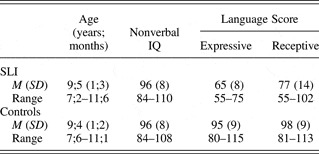
The experimenter for the present study (the first author) measured participants’ nonverbal IQ using the recall of designs and pattern construction subtests of the British Ability Scales (BAS-II; Elliott, Smith, & McCullough, Reference Elliott, Smith and McCullough1996). Participants’ receptive language ability was measured using the Test for the Reception of Grammar (TROG-2; Bishop, Reference Bishop2003), and their expressive language ability, using the recalling sentences subscale of the Clinical Evaluation of Language Fundamentals (CELF-4UK; Semel, Wiig, & Secord, Reference Semel, Wiig and Secord2006). Participant characteristics are shown in Table 1. Each participant with SLI had a standardized expressive or receptive verbal score of 75 or below, and a nonverbal IQ of 84 or above. For all children with SLI, nonverbal IQ outstripped either receptive or expressive verbal IQ by at least 20 points (mean difference between nonverbal IQ and the lower verbal IQ score = 31.1, SD = 6.4, range = 23–52). The mean verbal mental ages of the SLI group were 6 years, 4 months (receptive) and 5 year, 0 months (expressive).
Participant characteristics

Note: SLI, specific language impairment.
Twenty-one control group participants (12 boys) were drawn from a large group of typically developing children, recruited from mainstream classrooms. Control group participants were selected on an individual-matching basis in order to achieve close group matching. All but two participants with SLI had an individually matched control group participant with chronological age differing by no more than 4 months and nonverbal IQ differing by no more than five points. Independent t tests revealed that the groups did not differ in age, t (40) = 0.11, p = .91, or nonverbal IQ, t (40) = 0.06, p = .96 (Table 1). All controls had standardized expressive and receptive verbal scores of 80 and above. There were large group differences in standardized expressive and receptive language scores, t (39) = 11.47, p < .001 and t (38) = 5.85, p < .001, respectively. No participant had a diagnosis of attention-deficit/hyperactivity disorder or autism, a history of hearing problems, or focal brain injury, according to teacher report. Informed parental consent was obtained for all participants.
Although there were 21 participants in each group, not all participants were included in some analyses for two reasons. First, not all children completed all tasks, and second, the internalization level of PS could be coded only when children produced PS. More details are provided in the Analysis and Results sections below.
Procedure
Overview
First, the participants completed one Tower of London problem set with no dual task, and the digit span procedure. Then two further Tower of London problem sets were completed: one with articulatory suppression and the other with foot tapping. The order of the two dual task conditions was counterbalanced. The tasks were completed over two separate sessions, about a week apart. Sessions were video-recorded for later coding of PS and, for the Tower of London, response times. All tasks were completed in quiet rooms of the participants’ schools, in the presence of one experimenter.
Tower of London
The three-disk Tower of London was used (Shallice, Reference Shallice1982). In the present study this consisted of two wooden frames, each with three vertical pegs of differing lengths (tall enough to hold three disks, two disks, and one disk, respectively) and three colored disks. For each trial the disks are arranged on one frame in a configuration representing the start state and, on the other, in a different configuration representing the target state. The standard Tower of London procedure requires participants to move the “start state” disks one at a time to make them match the target state (Shallice, Reference Shallice1982). The present study used a modified version of the Tower of London designed to encourage participants to make full mental plans (after Baker et al., Reference Baker, Rogers, Owen, Frith, Dolan and Frackowiak1996; Boghi et al., Reference Boghi, Rasetti, Avidano, Manzone, Orsi and D'Agata2006; Owen et al., Reference Owen, Sahakian, Hodges, Summers, Polkey and Robbins1995), as previous work indicated that 7- to 10-year-olds spend little time planning unless they are prevented from moving the disks (Lidstone et al., Reference Lidstone, Meins and Fernyhough2010). Instead of asking participants to move the disks to make the configurations match (as per Shallice, Reference Shallice1982) we asked them to plan the moves mentally, and then tell the experimenter the minimum number of moves it would take to make the configurations match. As the task was introduced, the participants were asked to think about the problem in front of them, and then to tell the experimenter how many moves it would take to make the start state look like the target state. For the experimental problems, participants were asked “How many moves?” for each trial. The time between presentation of the problem and participants’ verbal numerical response was the planning phase of each trial. Only this planning phase was coded for PS in the no-dual-task condition. Similarly, in the dual task conditions, the secondary tasks were performed only during the planning phase.
Unlike in previous studies using this version of the Tower of London (Baker et al., Reference Baker, Rogers, Owen, Frith, Dolan and Frackowiak1996; Boghi et al., Reference Boghi, Rasetti, Avidano, Manzone, Orsi and D'Agata2006; Owen et al., Reference Owen, Sahakian, Hodges, Summers, Polkey and Robbins1995), the participants were asked to demonstrate the moves after telling the experimenter the number of moves they had planned. A Tower of London problem was scored as correct if the participant both named and correctly demonstrated the minimum number of moves required to make the start and end states match. The purpose of this moving phase was to verify that participants had planned the moves rather than merely guessing a number. Lidstone et al. (Reference Lidstone, Meins and Fernyhough2010, Experiment 2) showed that when children are asked to perform articulatory suppression during the planning phase (but not the moving phase), their performance suffers relative to a foot-tapping control condition; this supports the idea that a substantial amount of planning occurs during the “planning phase.”
There were eight structurally unique problems in each problem set, and the three problem sets were isoforms of each other. In each set, there were two two-move problems, two three-move problems, two four-move problems, and two five-move problems, presented in pseudorandomized order (e.g., a three-move problem, a five-move problem, a two-move problem, a four-move problem). The problem order was different in each condition. Each problem set also contained three practice problems; these were simple problems of two and three moves that did not duplicate problems in the experimental problem sets.
Digit span
The digit span procedure was adapted from Chincotta and Chincotta (Reference Chincotta and Chincotta1996) and Towse, Hitch, and Hutton (Reference Towse, Hitch and Hutton1998). For each trial, participants were presented, on a laptop computer screen, with 2 cm high digits at a rate of 1/s. After the last digit, there was a blank screen for 4 s. After this blank screen, a question mark appeared, and this signaled to participants that they should recite the digits they had seen, in the order in which they had been presented. Participants performed the secondary task from the start of each trial until the appearance of the question mark. This was the period observed for PS. The trials were organized in blocks of three trials of the same length, starting with trials of two digits. Participants proceeded to the next block if and when they had recalled two sequences of the current length correctly. Digit span scores took into account performance on both correct and incorrect trials, following Towse et al. (Reference Towse, Hitch and Hutton1998). As digit span performance does not relate to the hypotheses, the scoring is not described further here.
Secondary tasks
Each secondary task was performed at a rate of approximately one response per second. The articulatory suppression task was to articulate the word Monday, and the control secondary task involved tapping a foot pedal connected to a laptop computer.
In the tapping condition, each tap was accompanied by a beep, generated automatically by the computer. The beeping served as an aural reminder of the task. If the participant made a secondary task error in the tapping condition, the computer automatically emitted a warning sound, which ceased when tapping recommenced. In the tapping condition, a secondary task error was defined as a gap between taps of 2 s, which was equal to missing one tap.
In the articulatory suppression condition, the aural reminder of the secondary task was the experimenter's articulation of Monday in time with that of the child. If the participant made a secondary task error in the articulatory suppression condition, the experimenter reminded the participant to recommence by uttering her name. In the articulatory suppression condition, a secondary task error was defined as a missed Monday.
Articulatory suppression and foot tapping have been shown to exert equal general dual task demands (Emerson & Miyake, Reference Emerson and Miyake2003), suggesting the only important difference is that articulatory suppression prevents the use of self-directed speech.
Coding of speech
Tower of London
Each trial was coded (from the video recordings) as containing speech or no speech. Utterances that were part of the participant's response to the experimenter's question, How many moves? were not included, for example, Three; I think it's maybe three; Two, I mean, three! Dunno, can I just show you? The remaining speech was coded as social speech or PS. Social speech was defined as any full volume speech intended for communication with the experimenter. In line with previous work (see Winsler, Fernyhough, McClaren, & Way, Reference Winsler, Fernyhough, McClaren and Way2005), communicative intent was operationalized as the participant involving the experimenter (through gaze direction, physical contact, etc.), during or within 2 s of the speech. Examples of social speech are That one goes there . . . and They're swapped around. Thus, it was not the content of the utterance that determined whether it was coded as private or social but rather the accompanying behaviors. Although nearly all of the speech observed in this study could be considered useful for planning on the basis of its content, we followed other authors in adopting a conservative approach: coding speech as private only after looking for evidence that it was social, and finding none.
PS was defined as any speech that did not meet the criteria for social speech. PS is traditionally (Winsler et al., Reference Winsler, Fernyhough, McClaren and Way2005) coded according to Berk's (1986) three-level scheme, as Level 1 (task-irrelevant PS), Level 2 (task-relevant overt PS), or Level 3 (external manifestations of task-relevant IS, including inaudible muttering and whispering, and silent, verbal lip movements). There were only two instances of task-irrelevant speech in this study, so these were excluded from analysis. All PS considered hereafter is task relevant. Examples of the PS produced are: One, no, one, two, no . . .; That will go there; The blue one out of the way; This isn't working; How many moves . . . The frequency of PS production was the percentage of trials that contained PS.
Where PS was present during an observation period, it was coded in terms of its level of internalization. The coding scheme for internalization level devised for the present study was based on that of Berk (Reference Berk1986). The types of task-relevant PS implicit in Berk's coding scheme were defined for the present study as follows: (a) overt speech and muttering were defined as speech, audible because it is voiced. Muttering could be intelligible or unintelligible. Intelligible muttering was distinguished from overt speech as significantly quieter and/or more indistinct than the child's social speech between trials; (b) whispering was defined as unvoiced speech, audible not because it is voiced but because of the adduction of vocal cords caused by the exhalation of breath; (c) silent verbal lip movements were defined as lip movements that were clearly verbal in nature. In practice it was difficult to distinguish totally silent lip movements from those that were accompanied by very quiet sounds produced by the interaction of mouth parts. This category was therefore redefined as inaudible and barely audible verbal lip movements. Barely audible lip movements were distinguishable from whispering because, in the former, vowel sounds are inaudible.
Apparent in these definitions were three dimensions of covertness: (a) the volume of the speech, (b) whether the speech was voiced, and (c) whether the speech was intelligible (Table 2). Combining these dimensions (see Table 2) produced five levels of internalization:
1. Level 1: Fully overt speech
2. Level 2: Intelligible muttering
3. Level 3: Intelligible whispering OR Unintelligible muttering
4. Level 4: Audible but unintelligible whispering
5. Level 5: Inaudible and barely audible verbal lip movements
Derivation of five-level internalization coding scheme from three dimensions of covertness

Note: Not all theoretically possible combinations of the three dimensions are represented here because not all combinations are practically possible: for example, if an utterance is voiced, it must be audible.
aThree levels: 0 (full volume, the same as social speech), 1 (quieter than social speech), and 2 (inaudible and barely audible, which were difficult to distinguish from each other and therefore combined).
bTwo levels: 0 (yes) and 1 (no).
cThere was no rationale for categorizing either of these types of utterances as more internalized than the other.
Each trial with PS was given an internalization score. The internalization score of a trial was the mean of all the PS that occurred during that trial. For example, a trial containing 5 s of Level 3 speech, 5 s of Level 4 speech, and 4 s of no speech scored 3.5, as half the speech was of Level 3 and half the speech was of Level 4. Trials with no speech were not given internalization scores. A participant's internalization score for the task was the mean score of all the trials with PS. The range of possible internalization scores was thus 1.0 to 5.0, with higher scores indicating more internalized PS.
A second researcher, naive to the hypotheses and to group membership, independently coded 20% of the recordings (four from each group), for the calculation of interrater reliability. For the presence/absence of social speech during a trial, Cohen κ = 1.00. For the presence of PS, κ = 0.91. The agreement between raters’ internalization scores for all trials in the subset of recordings was assessed by nonparametric correlation (Spearman ρ = .87).
Digit span
There was no task-irrelevant PS or social speech, so each trial was coded from the video recordings as containing task-relevant PS or no speech. The frequency of PS and its internalization level were scored as described above.
A second researcher's codings for a random 20% of the recordings (four from each group) produced a reliability coefficient of κ = 0.85 for the presence of PS. For the internalization level of PS, Spearman ρ = .85.
Analysis
As the internalization level of individuals’ speech during a task is partly a function of their competence at that task (Berk & Spuhl, Reference Berk and Spuhl1995; Duncan & Pratt, Reference Duncan and Pratt1997), we needed to take into account the possibility that the tasks were more difficult for the SLI group than the control group (almost certainly true of the digit span task; see Leonard, Reference Leonard2000). This was done by calculating a second set of PS scores. For the modified scores relating to the Tower of London, for each participant we identified a set of trials on which performance was 50% accurate. For example, if a participant solved correctly both two-move problems, both three-move problems, one four-move problem, and neither five-move problem, only the three- to five-move problems would contribute to the modified PS scores. The digit span task ended when the participant answered incorrectly two out of the three trials at any one level of difficulty. Therefore, on the last few blocks of trials administered, the proportion of trials answered correctly was similar for all participants. Thus, the modified PS scores relating to digit span were based on the last three blocks of trials.
The Tower of London performance of all 42 participants was recorded, allowing the observation of PS, but the analyses of internalization level could only include children who actually produced PS: 37 children for the Tower of London. The subsidiary analyses controlling for task difficulty could only include children who produced PS during the subset of trials on which performance was 50% correct: n = 35. Two children with SLI did not complete the digit span task: in the first case, because of time constraints, and in the second, because of a difficulty waiting for the question mark to appear before responding. These children and their equivalents in the control group were excluded from the analyses relating to this task, so the data for this task relate to 38 children, 36 of whom produced PS. The number of participants producing PS in the trials included the analysis controlling for task difficulty was 35.
Tower of London performance in the dual task conditions was quantified in three ways: percentage of Tower of London trials answered correctly, mean response time, and percentage of trials containing one or more secondary task error(s).
Three children with SLI were not able to complete the Tower of London with the secondary tasks. To minimize discomfort, testing was terminated after three experimental trials in each condition. These participants were excluded from analyses of the dual task conditions and, to maintain good group matching, three controls of equivalent age and nonverbal IQ were also excluded, making the n for these analyses 36.
The distribution of all the variables was explored using Shapiro–Wilk tests, with an α of 0.01. The PS variables met the criteria for nonnormality (the frequency of PS production was positively skewed and the internalization scores were negatively skewed). Therefore, for these variables, the Mann–Whitney U test was used to compare groups. Otherwise, parametric tests were used.
Results
Preliminary analyses
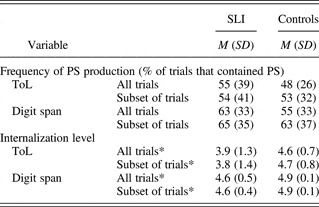
The percentage of Tower of London problems solved correctly was lower in the SLI group (M = 41.8, SD = 21.6) than in the control group (M = 56.5, SD = 13.5), t (40) = 2.66, p = .01. The mean response time did not differ between groups; SLI: M = 16.2 s, SD = 8.8; controls: M = 18.0 s, SD = 6.4; t (40) = 0.54, p = .59. The percentage of Tower of London trials with social speech was low in both groups, but was higher in the SLI group (M = 5, SD = 7) than the control group (M = 2, SD = 6; U = 160.5, p = .04). The PS results are shown in Table 3. For the Tower of London, the groups did not differ in total PS production (U = 194.0, p = .50). For the subset of Tower of London trials on which performance was 50%, there was no group difference in PS production (U = 213.0, p = .85).
Private speech (PS) production

Note: For the Tower of London (ToL), subset of trials refers to the subset of trials scoring 50% correct. For digit span, subset of trials refers to the last three blocks of trials each participant completed. For the frequency of PS production on the ToL task, n = 21 in each group. For the frequency of PS production on the digit span task, n = 19 in each group. For internalization scores, n = 16–20 (inclusive).
*p ≤ .05, group difference.
The digit span of the SLI group (M = 4.0, SD = 1.0) was lower than that of the control group (M = 4.9, SD = 0.7), t (38) = 3.17, p = .003. There was no group difference in the frequency of PS production, either overall (U = 152.0, p = .40) or for the last three blocks of trials (U = 173.0, p = .82).
Internalization scores
Internalization scores are shown in Table 3. For the Tower of London, the SLI group's PS was less internalized than that of the control group, both overall (U = 99.5, p = .02) and for the subset of trials for which performance was 50% (U = 96.0, p = .05). Similarly, for the digit span task, the SLI group's PS was less internalized than that of the control group, both overall (U = 77.5, p = .01) and for the last three blocks of trials (U = 77.5, p = .02).
Susceptibility of Tower of London performance to articulatory suppression
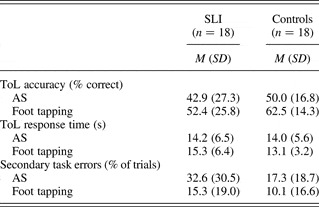
The results from the dual task conditions appear in Table 4. Each measure of performance was explored using a 2 × 2 (Condition [Articulatory Suppression, Foot Tapping] × Group [SLI, Controls]) mixed model ANOVA. For the percentage of Tower of London trials solved correctly, there was a main effect of condition, F (1,40) = 16.34, p < .001, with poorer performance with articulatory suppression than with foot tapping. There was neither an effect of group, F (1,40) = 1.98, p = .17, nor a Condition × Group interaction (F < 1).
Dual task results

Note: ToL, Tower of London; AS, articulatory suppression. Secondary tasks are AS and foot tapping.
The same model was used to explore response times. There was no main effect of condition or group (both Fs < 1), and there was no Condition × Group interaction, F (1,34) = 1.92, p = .18.
In the analysis of secondary task error rates, there was a main effect of condition, F (1,34) = 7.78, p = .01, with more articulatory suppression errors than foot-tapping errors. There was no main effect of group, F (1,34) = 2.50, p = .12, or Condition × Group interaction, F (1,34) = 1.73, p = .20.
Thus there was no Condition × Group interaction on any measure of performance, indicating no significant group differences in the susceptibility of Tower of London performance to articulatory suppression. Where the F value for the interaction was more than 1.00, we examined the data more closely for evidence that the susceptibility to articulatory suppression was smaller for the SLI group than the control group. Articulatory suppression decreased the mean response time from 15.3 to 14.2 s in the SLI group, t (17) = 0.98, p = .34, Cohen d = 0.17, and increased it from 13.3 to 14.4 s in the control group, t (17) = 0.99, p = .33, d = 0.20. These differences are small and nonsignificant. Articulatory suppression was slightly more detrimental to secondary task performance for the SLI group, t (17) = 2.69, p = .02, d = 0.68, than for the control group, t (17) = 1.14, p = .27, d = 0.41. In sum, there was no evidence that the performance of children with SLI was less susceptible to articulatory suppression than that of the controls.
Discussion
Our aim was to test two alternative hypotheses: (a) that the development of self-directed speech would be delayed in SLI, and (b) that the development of self-directed speech would be disturbed by early language difficulties, resulting in their relative absence or reduced effectiveness in middle childhood in SLI. The PS of children with SLI was less internalized than that of the controls on both the Tower of London and a digit span task, but the groups did not differ in the susceptibility of Tower of London performance to articulatory suppression. The results therefore suggest that the development of self-directed speech is delayed but not deviant in SLI.
The results indicate that delay in the development of self-directed speech might explain the poor performance of children with SLI on some nonlinguistic tasks. Although, as indicated by the dual task results, the impaired Tower of London performance of the SLI group could not be explained in terms of self-directed speech in the present study, the performance of children with SLI might suffer on tasks requiring more complex language. A related point is that, in middle childhood, immaturity in the development of self-directed speech manifests itself as a lesser degree of internalization, but, in early childhood, it presumably manifests as a delay in the emergence of PS. At a younger age, therefore, we would expect the rate of PS to be lower among children with SLI than their typically developing peers, and for this to contribute to impaired performance on any task that is amenable to PS in typically developing children. We recommend that future studies of nonlinguistic abilities in SLI include measures to assess the extent to which delayed development of self-directed speech contributes to any impairment found.
Clinical implications are that it may be helpful to encourage the development of PS in young children with SLI to attempt to mitigate the effect that language impairment might have on nonverbal cognition. Simply modeling PS is ineffective (see Diaz & Berk, Reference Diaz and Berk1995), but mature PS production can be fostered in joint activity by initially working collaboratively and then relinquishing control of a task as the child becomes more competent (Diaz et al., Reference Diaz, Winsler, Atencio and Harbers1992; Winsler et al., Reference Winsler, Diaz, McCarthy, Atencio and Adams Chabay1999). We see little value in attempting to speed the internalization of PS, and would imagine it to be a difficult and perhaps even counterproductive endeavor. However, for academic examinations and other assessments where silence is usually expected, children who rely on overt speech may benefit from being tested in an environment where speaking is permitted.
Although we have interpreted the group difference in internalization scores as representing a delay in the overall development of self-directed speech, two other interpretations are possible. One is that the children with SLI, who were presumably accustomed to working with speech and language therapists and teaching assistants, felt less inhibited in their speech production than the typically developing controls, for whom working one to one with an adult is most likely a rarer event. The fact that social speech was infrequent in both groups speaks against this possibility, but we note that social speech was more frequent in the SLI group than among the controls. Future research could investigate whether the group difference in internalization scores generalizes to PS produced in a nonsocial setting.
The other alternative interpretation of the internalization results is that they represent not a delay in the overall development of self-directed speech, entailing an earlier delay in the emergence of PS, but specifically a delay in the internalization of PS to form IS. The implication of Vygotsky's (1934/Reference Vygotsky, Rieber and Carton1987) work is that speech is internalized as the verbal self-regulation system becomes more efficient, so if PS is (for some tasks) less effective for children with SLI than for their peers, their PS might remain external for longer. Other authors cite social pressure not to speak to oneself as the major cause of internalization (Duncan & Tarulli, Reference Duncan, Tarulli, Winsler, Fernyhough and Montero2009), something children with SLI might experience to a lesser degree than typically developing children. These are two reasons to suspect that there would be a delay in internalization, either in addition to or instead of a delay in the emergence of self-directed speech.
As the self-directed speech of the SLI group appeared to be as effective as that of the control group, as indexed by susceptibility of Tower of London performance to articulatory suppression, the group difference in Tower of London performance is left unexplained. The SLI group's poorer performance is consistent, however, with previous reports of impaired visual–spatial short-term memory in SLI (e.g., Bavin et al., Reference Bavin, Wilson, Maruff and Sleeman2005), and possibly supports views of SLI as arising from deficits in general processing (for recent reviews, see Gillam, Montgomery, & Gillam, Reference Gillam, Montgomery, Gillam and Schwartz2009; Windsor & Kohnert, Reference Windsor, Kohnert and Schwartz2009). That said, planning is a complex skill that is likely to involve multiple mechanisms (Carlin et al., Reference Carlin, Bonerba, Phipps, Alexander, Shapiro and Grafman2000; Kaller, Unterrainer, Rahm, & Halsband, Reference Kaller, Unterrainer, Rahm and Halsband2004), so impaired planning performance could reflect deficits in any number of areas, including other executive functions, attention, working memory, visuospatial skills, or processing speed.
The present study had two significant limitations. First, it was cross-sectional in design, and the results apply only to middle childhood, so some of the possible implications should be treated with caution. Second, there were only two measures of the participants’ language abilities, and future research could include more measures to see if any particular profile of language impairment is associated with delayed self-directed speech development. Pertinent to this discussion is the relation between the present findings and the small but growing literature on self-directed speech in individuals with autism spectrum disorders (ASDs). Although the effect of impaired structural language on self-directed speech among individuals with ASD has not been studied, research has compared the self-directed speech of individuals with ASDs to that of verbal IQ-matched controls. Here, the hypothesis is that the social and communication impairments found in ASDs disrupt the development of self-directed speech. Findings so far generally have indicated that the performance of individuals with ASDs on executive tasks is unimpaired by articulatory suppression, unlike that of typically developing individuals (Holland & Low, Reference Holland and Low2010; Wallace et al., Reference Wallace, Silvers, Martin and Kenworthy2009; Whitehouse, Maybery, & Durkin, Reference Whitehouse, Maybery and Durkin2006; Williams, Bowler, & Jarrold, in press; but see also Lidstone, Fernyhough, Meins, & Whitehouse, Reference Lidstone, Fernyhough, Meins and Whitehouse2009), although the only study of PS provided no evidence of impairment or delay in children with ASDs (Winsler et al., Reference Winsler, Abar, Feder, Schunn and Rubio2007).
A further complication is that research has not yet elucidated the mechanism by which self-directed speech may be impaired in ASD: whether it is the effect of social and communication impairments on the social interactions that provide the foundation for the development of self-directed speech (Fernyhough, Reference Fernyhough1996), or the online effects of pragmatic language impairment on the usefulness of self-directed speech. To disentangle the potential effects of different types of language impairment and social and communication difficulties on the development of self-directed speech, future research could include four groups—children with SLI, children with pragmatic language impairment, children with ASD, and typically developing controls (see Bishop & Norbury, Reference Bishop and Norbury2005a, Reference Bishop and Norbury2005b)—measuring participants’ susceptibility to articulatory suppression and the internalization level of their PS.
In the meantime, the findings of the present study on the PS of children with SLI were clear and consistent across tasks, and we imagine they will be useful for those wishing to understand the nonlinguistic impairments found in SLI, and for the speech and language therapists and teachers who work with this population. More broadly, the findings add to a growing body of research suggesting that theories of cognitive development should take into account benefits associated with development in the online use of language for cognition.