Introduction
Conduct disorder (CD) has been reported to occur in up to 16% of school-aged children (Olsson, Reference Olsson2009). It is defined by a persistent display of antisocial behaviour such as deception, theft, vandalism and violence within a 6–12-month period prior to age 18 years (APA, 2000). Importantly, children with severe CD cost society 10 times more to support into adulthood than those without (Scott et al. Reference Scott, Knapp, Henderson and Maughan2001). Furthermore, there is a strong association between CD and other psychiatric disorders, for example substance use (Kessler et al. Reference Kessler, Nelson, McGonagle, Edlund, Frank and Leaf1996) and mood disorders (Vloet et al. Reference Vloet, Konrad, Huebner, Herpertz and Herpertz-Dahlmann2008), and persistent antisocial behaviour in adulthood. For instance, up to 75% of children with CD grow up to have adult antisocial personality disorder (ASPD) (Gelhorn et al. Reference Gelhorn, Sakai, Price and Crowley2007). Current treatment interventions are not effective in the majority of children with CD (Kazdin, Reference Kazdin1995). Despite the significant impact on individuals and society as a whole, the biological determinants of CD are poorly understood.
It is unlikely that CD can be explained by differences in the development of a single brain region. Nevertheless, increasing evidence suggests that childhood CD and adulthood antisocial behaviour are associated with abnormalities in the anatomy and function of brain regions associated with the limbic system, and particularly the orbitofrontal cortex (OFC) and amygdala (Sterzer & Stadler, Reference Sterzer and Stadler2009; Fairchild et al. Reference Fairchild, Passamonti, Hurford, Hagan, von dem Hagen, van Goozen, Goodyer and Calder2011; Sarkar et al. Reference Sarkar, Clark and Deeley2011). Studies of cognitive processing in children and adults with antisocial behaviour have reported impairments in neuropsychological tasks sensitive to differences in function of the OFC and amygdala, for example in reversal learning (Budhani et al. Reference Budhani, Blair and Blair2005; Budhani et al. Reference Budhani, Richell, Blair, Budhani, Richell and Blair2006) and emotion processing, respectively (Levenston et al. Reference Levenston, Patrick, Bradley and Lang2000; Blair et al. Reference Blair, Colledge, Murray and Mitchell2001, Reference Blair, Peschardt, Budhani, Mitchell, Pine, Blair and Mitchell2006). Damage to these brain regions is associated with CD (Ishikawa & Raine, Reference Ishikawa, Raine, Lahey, Moffitt and Caspi2003) and adult antisocial behaviour (see Brower & Price, Reference Brower and Price2001), and with impaired perception of fear and anger (Scott et al. Reference Scott, Young, Calder, Hellawell, Aggleton and Johnson1997; Adolphs et al. Reference Adolphs, Tranel and Damasio1998). In vivo functional brain imaging studies, from our group and others, also report significant differences in activation of these regions, and/or regions modulated by them, in children with CD (Finger et al. Reference Finger, Marsh, Mitchell, Reid, Sims, Budhani, Kosson, Chen, Towbin, Leibenluft, Pine and Blair2008; Marsh et al. Reference Marsh, Finger, Mitchell, Reid, Sims, Kosson, Towbin, Leibenluft, Pine and Blair2008) and adult criminal psychopaths (Raine et al. Reference Raine, Buchsbaum and Lacasse1997; Kiehl et al. Reference Kiehl, Smith, Hare, Mendrek, Forster, Brink and Liddle2001; Deeley et al. Reference Deeley, Daly, Surguladze, Tunstall, Mezey, Beer, Ambikapathy, Robertson, Giampietro, Brammer, Clarke, Dowsett, Fahy, Phillips and Murphy2006). There is also initial evidence that adolescents with CD have reduced functional ‘connectivity’ between the amygdala and OFC (Marsh et al. Reference Marsh, Finger, Mitchell, Reid, Sims, Kosson, Towbin, Leibenluft, Pine and Blair2008, Reference Marsh, Finger, Fowler, Jurkowitz, Schechter, Yu, Pine and Blair2011). However, little is known about the anatomy of limbic brain regions, or the connections between them, in children with CD.
Some structural magnetic resonance imaging (MRI) studies have reported that adults with antisocial behaviour have significantly reduced volumes of the amygdala (Yang et al. Reference Yang, Raine, Narr, Colletti and Toga2009) and OFC/prefrontal cortex (PFC) grey matter (Raine et al. Reference Raine, Lencz, Bihrle, LaCasse and Colletti2000; de Oliveira-Souza et al. Reference de Oliveira-Souza, Hare, Bramati, Garrido, Azevedo Ignácio, Tovar-Moll and Moll2008). Only nine structural MRI studies have been published to date on children/adolescents with CD (Bussing et al. Reference Bussing, Grudnic, Mason, Wasiak and Leonard2002; Kruesi et al. Reference Kruesi, Casanova, Mannheim and Johnson-Bilder2004; Sterzer et al. Reference Sterzer, Stadler, Poustka and Kleinschmidt2007; Huebner et al. Reference Huebner, Vloet, Marx, Konrad, Fink, Herpertz and Herpertz-Dahlmann2008; De Brito et al. Reference De Brito, Mechelli, Wilke, Laurens, Jones, Barker, Hodgins and Viding2009, Reference De Brito, McCrory, Mechelli, Wilke, Jones, Hodgins and Viding2011; Fahim et al. Reference Fahim, He, Yoon, Chen, Evans and Perusse2011; Fairchild et al. Reference Fairchild, Passamonti, Hurford, Hagan, von dem Hagen, van Goozen, Goodyer and Calder2011; Hyatt et al. Reference Hyatt, Haney-Caron and Stevens2011). These reported that young people with CD have significantly reduced grey-matter volume in the temporal lobes (Kruesi et al. Reference Kruesi, Casanova, Mannheim and Johnson-Bilder2004; Huebner et al. Reference Huebner, Vloet, Marx, Konrad, Fink, Herpertz and Herpertz-Dahlmann2008; Hyatt et al. Reference Hyatt, Haney-Caron and Stevens2011) and anterior insula (Sterzer et al. Reference Sterzer, Stadler, Poustka and Kleinschmidt2007) bilaterally, and left (Sterzer et al. Reference Sterzer, Stadler, Poustka and Kleinschmidt2007; Huebner et al. Reference Huebner, Vloet, Marx, Konrad, Fink, Herpertz and Herpertz-Dahlmann2008) or bilateral (Fairchild et al. Reference Fairchild, Passamonti, Hurford, Hagan, von dem Hagen, van Goozen, Goodyer and Calder2011) amygdala. However, evidence for differences within other regions, such as the PFC, is less consistent. For example, grey-matter volume and/or concentration of the PFC has been reported as no different (Sterzer et al. Reference Sterzer, Stadler, Poustka and Kleinschmidt2007), reduced (Huebner et al. Reference Huebner, Vloet, Marx, Konrad, Fink, Herpertz and Herpertz-Dahlmann2008; Fahim et al. Reference Fahim, He, Yoon, Chen, Evans and Perusse2011) and increased (De Brito et al. Reference De Brito, Mechelli, Wilke, Laurens, Jones, Barker, Hodgins and Viding2009). This variability probably arises because most studies were of relatively small heterogeneous samples that differed in several key respects, such as the age ranges of people studied (e.g. older adolescents frequently engage in higher levels of substance misuse than younger children). In addition, some did not control for potential confounding factors such as overall cognitive ability (Bussing et al. Reference Bussing, Grudnic, Mason, Wasiak and Leonard2002) and co-morbid attention-deficit/hyperactivity disorder (ADHD) (Bussing et al. Reference Bussing, Grudnic, Mason, Wasiak and Leonard2002; Huebner et al. Reference Huebner, Vloet, Marx, Konrad, Fink, Herpertz and Herpertz-Dahlmann2008). Importantly, studies have not considered the presence of callous–unemotional (CU) traits, often referred to as psychopathic tendencies. These are a constellation of interpersonal and emotional characteristics that accompany disruptive or antisocial behaviour in approximately 25% of children with childhood-onset CD (Frick, Reference Frick1998). Traits include low fearfulness, impulsivity, shallow affect, poor empathy and an absence of guilt (Hare, Reference Hare1991; Christian et al. Reference Christian, Frick, Hill, Tyler and Frazer1997). Children with CU traits show a pattern of neuropsychological deficits that implicate limbic/prefrontal dysfunction (Blair et al. Reference Blair, Peschardt, Budhani, Mitchell, Pine, Blair and Mitchell2006; Dadds et al. Reference Dadds, Perry, Hawes, Merz, Riddell, Haines, Solak and Abeygunawardane2006; Finger et al. Reference Finger, Marsh, Mitchell, Reid, Sims, Budhani, Kosson, Chen, Towbin, Leibenluft, Pine and Blair2008; Marsh et al. Reference Marsh, Finger, Mitchell, Reid, Sims, Kosson, Towbin, Leibenluft, Pine and Blair2008). Thus, CU traits delineate a distinct subset within CD that require consideration in research.
Brain regions do not function in isolation; they form part of brain ‘systems’. Hence it is crucial to investigate the white-matter connections linking brain regions putatively implicated in CD. We previously reported that adults with ASPD and psychopathy had a significant reduction in fractional anisotropy (FA) of the uncinate fasciculus (UF), a white-matter tract connecting the amygdala and OFC (Craig et al. Reference Craig, Catani, Deeley, Latham, Daly, Kanaan, Picchioni, McGuire, Fahy and Murphy2009). A recent study also reported reduced FA of the UF alongside several other tracts (Sundram et al. Reference Sundram, Deeley, Sarkar, Daly, Latham, Craig, Fahy, Picchioni, Barker and Murphy2012). FA value is derived from diffusion tensor MRI scanning (DT-MRI), and is an indicator of white-matter microstructural integrity through the quantification of directional differences in the diffusion of water molecules inside tissues. FA is derived from the difference between two absolute values, parallel/axial diffusivity (D parr) and perpendicular/radial diffusivity (D perp), the rates of diffusion observed along versus across fibre tracts, respectively. FA values range from 0 (perfectly isotropic diffusion) to 1 (perfectly anisotropic diffusion), providing a proxy measure of tissue integrity (Horsfield & Jones, Reference Horsfield and Jones2002). The microstructural basis for FA value is thought to lie with properties such as the organization within and between fibres, axonal diameter, and myelination (Beaulieu, Reference Beaulieu, Johansen-Berg and Behrens2009; Paus, Reference Paus2010). By contrast, D perp is considered a marker for reduced membrane integrity, which has its basis in reduced myelin content, and intra-axonal factors (see Beaulieu, Reference Beaulieu, Johansen-Berg and Behrens2009), based on the observation that increased D perp occurs with demyelination. Reduced D perp is also seen in typical brain maturation and is associated with increasing FA (Lebel et al. Reference Lebel, Walker, Leemans, Phillips and Beaulieu2008).
In summary, there is preliminary evidence that microstructural integrity of the UF (as measured using DT-MRI) is reduced in antisocial adults. However, it is unknown whether children with CD have similarly abnormal anatomy, or maturation, of this same tract as compared to their non-CD peers.
Therefore, we extended our prior work and investigated white-matter tract anatomical ‘connectivity’ within the limbic system of children with CD and healthy controls who did not differ significantly in age or IQ. As brain anatomy is modulated by chronic exposure to factors such as alcohol and substance misuse, which are frequently found in these populations (Versace et al. Reference Versace, Almeida, Hassel, Walsh, Novelli, Klein, Kupfer and Phillips2008), we additionally assessed self-reported substance use history. We tested the main hypothesis that children with CD have significant differences in the microstructural integrity of the UF, as indexed by reduced FA, and increased D perp. To confirm that any differences we found were specific to the limbic amygdala–OFC network, the same measurements were extracted from two non-limbic control tracts: the inferior fronto-occipital fasciculus (IFOF) and the inferior longitudinal fasciculus (ILF). We also tested the subsidiary hypotheses that: (1) individuals with CD and controls have significant age-related differences in the FA and D perp of the UF; and (2) the degree of white-matter abnormality is related to severity of antisocial behaviour and CU traits.
Method
This study was approved by the Joint South London and Maudsley Research Ethics Committee (243/00).
Participants
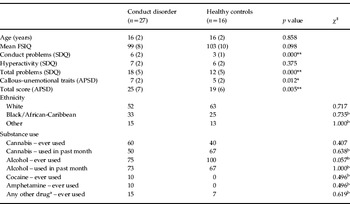
Twenty-seven CD participants aged between 12 and 19 years were recruited from: (i) an Institute of Psychiatry database of adolescents with conduct problems (CPs); (ii) three Youth Offending Teams; (iii) five Pupil Referral Units (PRUs; facilities providing education to children who cannot attend mainstream schools, e.g. following school exclusion); (iv) four youth projects; and (v) two mainstream educational institutions. A further 16 right-handed males were recruited as controls from the general public, through schools and youth services (i.e. youth clubs, ‘Connexions’ and several youth charities) within the same geographical areas (deprived and inner city) as the CD group. Groups did not differ significantly in age, full-scale IQ (FSIQ), ethnicity and self-reported history of alcohol or cannabis use (Table 1). Although more CD individuals (n = 2) than controls (n = 0) had previously used amphetamines and cocaine, this difference was not statistically significant. Furthermore, measures of current hyperactivity and the number of boys who had ever received a diagnosis of ADHD (Table 1) did not differ significantly between groups.
Description of the cohort

FSIQ, Full-Scale Intelligence Quotient; SDQ, Strengths and Difficulties Questionnaire; APSD, Antisocial Process Screening Device.
Values given as percentage or mean (standard deviation).
a Excluding alcohol and cannabis.
b Fisher's exact probability test.
* Significant p value ⩽0.05. ** Significant p value ⩽0.005.
All study participants satisfied MRI safety requirements and were medication free, did not have a psychiatric history (other than CD, ADHD or referrals for anger management), spoke English as their first language and were right-handed as assessed by the Edinburgh Handedness Inventory (Oldfield, Reference Oldfield1971). FSIQ was measured using the vocabulary and matrix reasoning subtests of the Wechsler Abbreviated Scale of Intelligence (WASI; Wechsler, Reference Wechsler1999). We excluded individuals with an FSIQ <80.
Measures
Questionnaires
Parent and self-report versions of the Strengths and Difficulties Questionnaire (SDQ; Goodman, Reference Goodman1999) and Antisocial Process Screening Device (APSD; Frick & Hare, Reference Frick and Hare2001) were administered. The SDQ was used to obtain CP and hyperactivity measures whereas the APSD assessed CU traits. Following methods of other groups, accepted subscales for both measures comprised the higher rater's score for each item (Jones et al. Reference De Brito, Mechelli, Wilke, Laurens, Jones, Barker, Hodgins and Viding2009).
Interviews
CD and oppositional defiant disorder (ODD) subsections of the Kiddie Schedule for Affective Disorders and Schizophrenia – Present and Lifetime Version (K-SADS-PL; Kaufman et al. Reference Kaufman, Birhamer, Brent, Rao, Flynn, Moreci, Williamson and Ryan1997) were used to obtain a research diagnosis of CD. Screening interviews for these disorders were administered to all participants, with those meeting criteria for CD or ODD given complete interviews for both disorders. No participants met criteria for ODD in the absence of CD. Finally, participants meeting CD criteria who additionally scored ⩾20 on the APSD parent or self-report questionnaire were then interviewed using the Psychopathy Checklist Youth Version (PCL-YV; Forth et al. Reference Forth, Kosson and Hare2003). Scores ⩾20 were used to indicate the presence of psychopathic traits (Finger et al. Reference Finger, Marsh, Mitchell, Reid, Sims, Budhani, Kosson, Chen, Towbin, Leibenluft, Pine and Blair2008). Interviews were conducted by a research psychologist (S.S.) trained and supervised by a psychiatrist (Q.D.). Additional information about antisocial behaviour was gathered from teachers, youth club workers, social workers and parents.
Participants in the CD group had a history of serious aggressive and violent behaviour, including robbery, burglary, grievous bodily harm and sexual assault.
Procedure
Full written informed consent was taken from participants, and additionally from a parent/guardian where boys were aged <16 years. Postal versions of parent questionnaires were obtained where older participants attended their test session unaccompanied.
DT-MRI acquisition
Each DT-MRI image was acquired using a GE Signa HDx 3.0-T MR scanner (General Electric, USA), with actively shielded magnetic field gradients (maximum amplitude 40 mT/m). The body coil was used for RF transmission, and an eight-channel head coil for signal reception, allowing a parallel imaging (Array Spatial Sensitivity Encoding Technique; ASSET) speed-up factor of two. Head movement was minimized by fitting extra padding beside the participant's head. Each volume was acquired using a multi-slice peripherally gated doubly refocused spin–echo echo planar imaging (EPI) sequence, optimized for precise measurement of the diffusion tensor in parenchyma, from 60 contiguous near-axial slice locations with a voxel size of 1.85 × 1.85 × 2.4 mm. The echo time was 104.5 ms and the effective repetition time varied between subjects in the range 12 and 20 RR intervals. Based on the recommendations of Jones et al. (Reference Jones, Williams, Gasston, Horsfield, Simmons and Howard2002), the maximum diffusion weighting was 1300 s mm−2 and, at each slice location, four images were acquired with no diffusion gradients applied, together with 32 diffusion-weighted images in which gradient directions were distributed uniformly in space. The sequence ran for approximately 15 min.
DT-MRI data preprocessing
All data were first converted to NIfTI format and then each raw diffusion dataset underwent a full quality control check where all B 0 values and diffusion-weighted volumes were inspected visually for image corruption, motion artefacts and signal drop-out effects using the light-box function available inside fslview (part of FSL software; www.fmrib.ox.ac.uk/fsl). Datasets showing more than two motion artefacts in different volumes on the same slice were removed from the study. Datasets showing significant head movements (>1 cm) were removed. No participant data acquired in this study required removal due to motion artefacts. Data were eddy current and motion corrected using ExploreDTI (Leemans et al. Reference Leemans, Jeurissen, Sijbers and Jones2009). The diffusion tensor was estimated following removal of outlier data (RESTORE function; Chang et al. Reference Chang, Jones and Pierpaoli2005) and whole-brain tractography was performed on the data. Whole-brain tractography parameters selected as seed voxels all those with FA ⩾0.2. Streamlines were propagated using Euler integration applying a b-spline interpolation of the diffusion tensor field (Basser et al. Reference Basser, Pjevic, Pierpaoli, Duda and Aldoubi2000), and the tractography algorithm step size of 0.5 mm. Where FA <0.2 or when the angle between two consecutive tractography steps was larger than 30°, tractography stopped. Finally, diffusion tensor maps (FA, mean diffusivity, FA-colour, D parr, D perp, mean diffusion weighted image) were estimated and exported to TrackVis (Wang & Wedeen, Reference Wang and Wedeen2007). Full details are given elsewhere (Jones et al. Reference Jones, Williams, Gasston, Horsfield, Simmons and Howard2002).
DT imaging (DTI) tractography
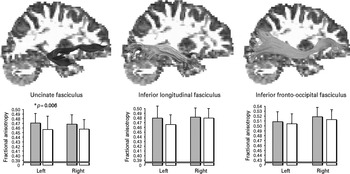
TrackVis software was used to hand dissect in native space. The tract of interest (UF) plus the two control tracts IFOF and ILF were dissected in the same order for all data by a trained and reliable operator (S.S.) blind to clinical groupings. Dissection of the three tracts was performed one hemisphere at a time using the region of interest (ROI) approach described elsewhere (Catani et al. Reference Catani, Howard, Pajevic and Jones2002;Catani & Thiebaut de Schotten, Reference Catani and Thiebaut de Schotten2008) in the order (i) IFOF, (ii) UF and (iii) ILF (see top of Fig. 1). The UF was defined with the first ROI placed on the axial slice at the level of the medial temporal lobe and the second ROI placed coronally slightly posterior to the external capsule. Short fibres that did not enter either termination of the tract were excluded, as were long fibres extending to regions outside the frontal and temporal lobes. These fibres were omitted through placement of exclusion ROIs.
Between-group differences in mean fractional anisotropy of the uncinate fasciculus and control tracts. , Conduct disorder; □, healthy controls.

Statistical analysis
All statistical analyses were carried out using SPSS software (SPSS Inc., USA). Repeated-measures analysis was used with the within-subjects variables of tract (UF, IFOF, ILF) and hemisphere (left, right), and CD as the between-subjects variable. This tested for significant differences in FA and D perp between CD and control participants in the UF and the two control tracts. Post-hoc analyses were carried out to identify significantly differing tract values between boys with CD and healthy controls using one-way analysis of variance (ANOVA). Analyses were Bonferroni corrected for multiple comparisons.
Where a significant FA/D perp difference was detected, post-hoc analyses were carried out to examine the relationship between these measures and age in each group using Pearson's correlations; we then determined if there were significant between group differences in these relationships using Z-observation analysis (Pallant, Reference Pallant2007). Finally, we examined whether significant differences in DT-MRI parameters were associated with greater severity of CPs or CU traits within, first, the whole sample and, second, the CD group only. Correlations were carried out between DT-MRI measures and (i) total SDQ score, (ii) SDQ CP score, (iii) total APSD score and (iv) APSD CU traits score, controlling for age.
Results
Tractography
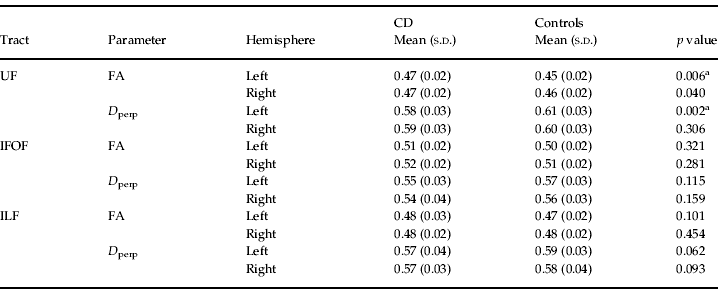
The CD group had significant differences from controls in the left UF, with a greater FA (CD 0.471; control 0.451; p = 0.006) and reduced D perp (CD 0.583 × 10⁻³ mm2/s; control 0.611 × 10⁻³ mm2/s; p = 0.002). They also had significantly greater FA in the right UF (CD 0.468; control 0.455; p = 0.040) but this did not withstand Bonferroni correction. No significant differences were observed between groups in either FA or D perp within the two control tracts (IFOF, ILF; Table 2; Fig. 1).
Results of the one-way ANOVA showing differences in DTI measures of the UF and control tracts between CD and healthy controls
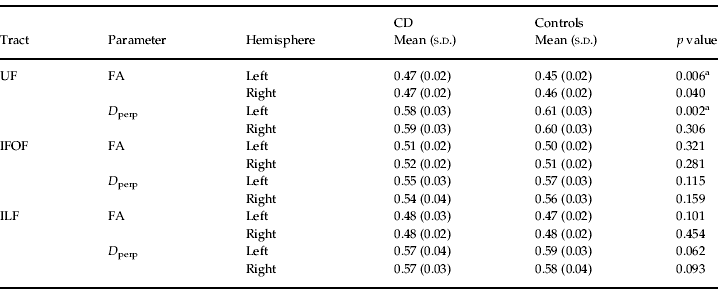
DTI, Diffusion tensor imaging; CD, conduct disorder; s.d., standard deviation; UF, uncinate fasciculus; IFOF, inferior fronto-occipital fasciculus; ILF, inferior longitudinal fasciculus; FA, fractional anisotropy; D perp, perpendicular diffusivity value and s.d. × 10−3 mm2/s.
a Significant after Bonferroni correction.
UF and age
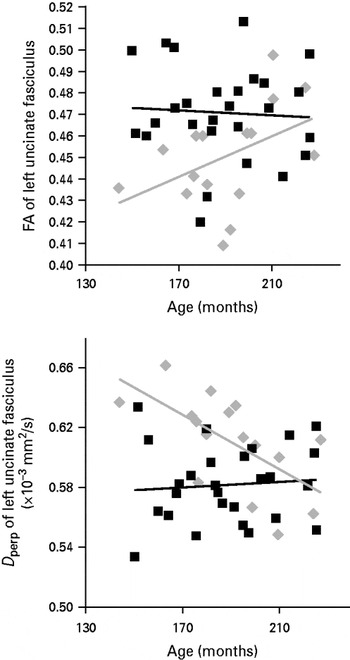
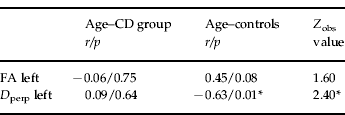
Within the CD group there was no significant association between left UF FA and D perp and age. By contrast, there was a significant negative correlation between age and D perp of the left UF (r = − 0.625, t = 0.01) within the control group, and this differed significantly from the non-significant correlation seen in CD (Z obs = 2.40, p = 0.01; Table 3, Fig. 2). DT-MRI indices between high and low CU groups did not differ significantly from one another (Z obs = 0.55).
Relationship between diffusion tensor magnetic resonance imaging (DT-MRI) measures and age in the left uncinate fasciculus of adolescents with conduct disorder (▪) compared to healthy controls ( ). FA, Fractional anisotropy; D perp, perpendicular diffusivity.

Pearson's correlations between left UF FA and Dperp with age in CD group compared to healthy controls
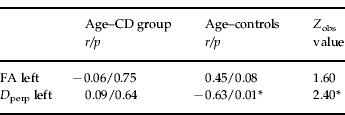
UF, Uncinate fasciculus; FA, fractional anisotropy; D perp, perpendicular diffusivity; r, correlation coefficient; p, significance level; CD, conduct disorder; Z obs, Z observation.
* Two-tailed significance level: p < 0.05.
UF and antisocial behaviour measures
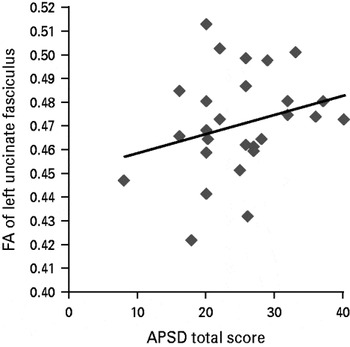
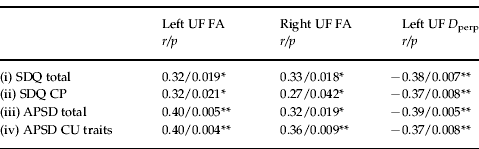
Significant correlations were found between left UF FA/D perp abnormality and severity of all SDQ/APSD behavioural scores within the whole sample (Table 4). There was also a strong trend, but this did not reach statistical significance, between APSD scores in the CD group alone (p = 0.09; Fig. 3).
Trend towards correlation between fractional anisotropy (FA) of the left uncinate fasciculus and total Antisocial Process Screening Device (APSD) score in the conduct disorder group (r = 0.271, p = 0.09).

Correlations between UF DT-MRI measures and antisocial behaviour scores in the whole sample
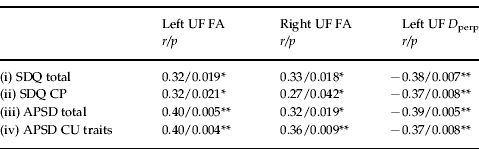
UF, Uncinate fasciculus; DT-MRI, diffusion tensor magnetic resonance imaging; SDQ, Strengths and Difficulties Questionnaire; APSD, Antisocial Process Screening Device; CP, conduct problems; CU, callous–unemotional traits; FA, fractional anisotropy; D perp, perpendicular diffusivity; r, correlation coefficient; p, significance level.
* p < 0.05, ** p < 0.01.
Discussion
We report, for the first time, that adolescents with CD have significantly increased microstructural integrity of the UF as compared to healthy controls. This increase was tract specific, that is no between-group differences were found in the ‘control’ tracts. Post-hoc analysis found that the expected decline of D perp with age was not seen in the CD group as it was in controls. We also found a significantly different relationship between age and this measure in the two groups. Moreover, post-hoc analysis found a significant relationship between microstructural abnormality and severity of antisocial behaviour in the whole sample, although not in the CD group alone. The significant findings reported here were found in the left UF; however, there was a trend towards significance in the right hemisphere.
These results support our a priori hypothesis that antisocial behaviour is associated with specific abnormalities in limbic connections (i.e. as opposed to global white-matter changes). However, the difference we found was in the opposite direction to what was hypothesized (i.e. increased FA). The UF tract is the major frontotemporal limbic tract and it connects the amygdala and OFC. Damage to this tract leads to impairments of conditional associative learning in animals (Gaffan & Eacott, Reference Gaffan and Eacott1995; Gutnikov et al. Reference Gutnikov, Ma and Gaffan1997). Reversal learning, a form of conditional associative learning, involves learning to ‘reverse’ responses that were previously rewarded but are later punished. Difficulties with reversal learning have been demonstrated in adults with antisocial behaviour and psychopathy (Budhani et al. Reference Budhani, Blair and Blair2005, Reference Budhani, Richell, Blair, Budhani, Richell and Blair2006). Furthermore, children with CD and CU traits show abnormal blood oxygen level-dependent (BOLD) activation in the ventromedial PFC on reversal tasks during functional MRI (Finger et al. Reference Finger, Marsh, Mitchell, Reid, Sims, Budhani, Kosson, Chen, Towbin, Leibenluft, Pine and Blair2008). It has been suggested that reversal learning deficits contribute to the perseveration of antisocial behaviour in both young people and adults, in which individuals fail to learn to avoid behaviour that has negative consequences for themselves and others (Sundram et al. Reference Sundram, Deeley, Sarkar, Daly, Latham, Craig, Fahy, Picchioni, Barker and Murphy2012). Our findings may help to explain the biological basis of this issue, which will be a focus of our future studies.
In addition, altered ‘connectivity’ of the OFC and amygdala secondary to abnormal development of the UF may contribute to impaired regulation of amygdala activity by the OFC, which in turn may contribute to the abnormal emotional processing and behavioural disinhibition observed in young people with CD and adults with ASPD/psychopathy (Blair, Reference Blair2008). For example, a prior study reported reduced functional ‘connectivity’ between the amygdala and ventromedial PFC in children with CD and CU traits during an emotional processing task (Marsh et al. Reference Marsh, Finger, Mitchell, Reid, Sims, Kosson, Towbin, Leibenluft, Pine and Blair2008). Furthermore, a DTI-MRI study of healthy children reported that a measure of engagement in dangerous and risky activities correlated positively with FA, and negatively with D perp, in frontal white-matter tracts (Berns et al. Reference Berns, Moore, Capra, Berns, Moore and Capra2009). It was also proposed that this may be attributable to earlier maturation of these tracts in high-scoring youngsters. Finally, the converse could be posited: that abnormal development of limbic and prefrontal grey matter may underlie the development of abnormal limbic–prefrontal circuitry.
Our findings raise the question of how age, behaviour and disorder-related differences in FA relate to the underlying biology and its developmental determinants. Our results show that, whereas in typical children D perp of the left UF decreases with age, in CD it does not. Moreover, the relationship between this DT-MRI measure and increasing age differed significantly between groups. As discussed previously, myelination is one process thought to underlie the decreasing D perp values and increasing FA seen in typical maturation (Song et al. Reference Song, Sun, Ju, Lin, Cross and Neufeld2003; Lebel et al. Reference Lebel, Walker, Leemans, Phillips and Beaulieu2008), alongside greater axonal calibre (Paus, Reference Paus2010) and reduced neuronal branching (Silk et al. Reference Silk, Vance, Rinehart, Bradshaw and Cunnington2009). It is not clear which of these factors makes the greater contribution to our findings. However, we also found significantly reduced D perp in the left UF accompanied by increased FA in CD, suggesting that these individuals may differ from controls with respect to the myelination of this tract. It is known that myelination differs by age and brain region (Lebel et al. Reference Lebel, Walker, Leemans, Phillips and Beaulieu2008), and is modulated by learning and environmental experience. For example, increased myelination has been found to accompany intensive practice of motor tasks, such as piano playing (Bengetsson et al. Reference Bengetsson, Nagy, Skare, Forsman, Forssberg and Ullen2005) and juggling (Scholz et al. Reference Scholz, Klein, Behrens and Johansen-Berg2009). In addition, children with ADHD showed increased FA in frontal tracts, which the authors speculated may arise from early myelin damage that later triggers hypermyelination (Li et al. Reference Li, Sun, Guo, Zang, Feng, Huang, Yang, Huang and Gong2010). Finally, FA changes are associated with social and emotional experience. For example, children who experience severe deprivation in early childhood have significant decreases in FA of the left UF as compared to control children (Eluvathingal et al. Reference Eluvathingal, Chugani, Behen, Juhasz, Muzik, Maqbool, Chugani and Makki2006). Similarly, it was reported that young adults exposed to high levels of verbal abuse from their parents during childhood have significant reduction in FA of two left hemisphere limbic tracts (cingulum and fornix) and the arcuate fasciculus (Choi et al. Reference Choi, Jeong, Rohan, Polcari and Teicher2009). Therefore, changes in tract integrity seen in developmental psychopathologies, such as those observed in this study, may have arisen from a complex mixture of social and biological factors. This highlights both the need for future studies of white-matter maturation to consider (for example) environmental and social variables, and the potential relevance of early interventions to prevent or moderate the course of developmental disorders.
Our post-hoc investigation revealed a significant association between CD/CU traits and UF FA/D perp in the sample as a whole but only a trend to significance in the CD group alone. This preliminary finding suggests that this tract may contribute towards the generation of behavioural variation in adolescents, perhaps through an increased ‘connectivity’ between frontal and limbic systems, but further (larger) studies are required.
Finally, the increased FA reported in CD adolescents was in the opposite direction to our a priori hypothesis, which had been based on findings in adults with antisocial behaviour (Craig et al. Reference Craig, Catani, Deeley, Latham, Daly, Kanaan, Picchioni, McGuire, Fahy and Murphy2009). One possible explanation for this may be that white-matter maturation of the UF in children with CD follows a different developmental trajectory to that of healthy individuals, consistent with abnormal patterns of white-matter maturation in non-CD children who indulge in extreme risk-taking behaviours (Berns et al. Reference Berns, Moore, Capra, Berns, Moore and Capra2009); that is, an initially increased rate of white-matter microstructural development in CD adolescents, with subsequent failure of typical development across adolescence. Such a mechanism may contribute towards a neurobiological explanation for the high rates of recidivism and treatment resistance found within persistently antisocial populations. For example, abnormal/precocious white-matter maturation in children with CD may interfere with neural mechanisms underpinning pro-social behaviour. However, it is only possible to investigate such a hypothesis through future longitudinal studies and the current study, like all previous published studies, was limited by its cross-sectional design.
Our study has several limitations. First, we did not find significant correlations between abnormalities in UF and measures of antisocial behaviour in the CD group alone (albeit we did find trends); this may have resulted from lack of power due to our sample size. Second, we recruited antisocial children with CD from predominantly non-forensic community samples. These children had carried out extremely serious offences (e.g. robbery, grievous bodily harm and sexual assault). Nevertheless, if we had recruited from juvenile detention centres and other forensic settings, we would probably have identified children with more severe antisocial behaviour. This in turn may have highlighted greater differences in white-matter measures between groups that may have associated with behavioural measures. However, given the difficulty of recruiting from such settings, the current study selected participants with the highest levels of antisocial behaviour observable in community samples. Furthermore, our findings are more generalizable to the wider population of children with CD, whose antisocial behaviour does not cross the threshold for incarceration within the criminal justice system. Conversely, one of the strengths of the current study lies in its recruitment of a healthy control group who closely resemble the CD group in many respects, such as FSIQ and ethnicity. One final caveat is that two of our four behavioural measures have a recommended upper age limit of 16 and 17 years, namely the APSD and SDQ respectively. However, as these were used only as screening measures prior to grouping participants using the K-SADS-PL and PCL-YV, this was not thought likely to affect our results.
In summary, adolescents with CD have significant differences from controls in the microstructural anatomy, and maturation, of the UF. However, it is not clear how these abnormalities arise, or if they predict outcome. Studies of antisocial behaviour within larger cohorts and across the lifespan are required.
Declaration of Interest
None.
Acknowledgements
This work was generously funded by a private donation, together with infrastructure support from the Medical Research Council (MRC, UK) AIMS Network (G0400061/69344, D.G.M.M., PI), an ongoing MRC-funded study of brain myelination in neurodevelopmental disorders (G0800298/87573), and the National Institute for Health Research (NIHR) Biomedical Research Centre for Mental Health at King's College London, Institute of Psychiatry and South London and Maudsley National Health Service (NHS) Foundation Trust.