1. Introduction
One characteristic feature of Medieval North Germanic, as well as its modern Scandinavian descendents, is a postposed definite article. This paper is a study of the changes undergone by the postposed article in Norwegian, one of the contemporary Scandinavian languages. The material comes from the western variety of Medieval North Germanic, known as Old Norse (ON), as it was written (and presumably spoken) in Norway and Iceland in the 12th and 13th centuries, and from the nynorsk variety of Modern Norwegian (MN). I will show that in ON the postposed definite article was a clitic, while it can be argued to be an inflectional affix in MN.Footnote 2 This kind of change is a well-documented step along the familiar ‘grammaticalization cline’ (Heine Reference Heine, Joseph and Janda2003: 578–579, Hopper & Traugott Reference Hopper and Traugott2003, and many others). A representative version of the grammaticalization cline is given in (1), from Hopper & Traugott (Reference Hopper and Traugott2003: 7).
(1) content item>grammatical word>clitic>inflectional affix
This cline, and the transitions symbolized by ‘>’, actually represent different kinds of change: content item to grammatical word is a morphosyntactic and semantic change, while grammatical word to clitic and clitic to affix are partly phonological changes, but primarily changes in the degree of cohesion and independence of the element in question. The cline in (1) should therefore be split in two:Footnote 3
- (2)
(a) content item>grammatical word
(b) word>clitic>affix
A clitic is morphologically less independent from a neighboring word than a (grammatical) word, and it is more independent than an inflectional affix. This change in cohesion does not necessarily affect the semantic content or the morphosyntactic function of the element.
In recent generative studies of syntactic change (Roberts & Roussou Reference Roberts and Roussou2003, Abraham & Leiss Reference Abraham and Leiss2007, Roberts Reference Roberts2007), grammaticalization has been treated as a movement upwards of the item in question. This makes perfect sense as long as a lexical item becomes grammatical, and thus comes to be merged in InflP rather than in VP, for example. But since certain grammatical words and clitics can also be merged in the C-domain, a change from grammatical word via clitic to inflectional affix may involve downward movement from the C-domain to the grammatical domain lower down in the structure.
In this article I will explain the reduction in independence and increase in cohesion within a generative (minimalist) framework, and demonstrate what the morphosyntactic consequences have been for the Norwegian noun phrase. In section 2 I give a brief overview of the forms of the definite article and the basic structure of the DP in Old Norse and Modern Norwegian. Section 3 is a discussion of the differences between clitics and inflectional affixes. In section 4, the structure of the ON DP is further discussed and motivated; and the diachronic change is described and explained in section 5. Section 6 is a conclusion.
2. The Scandinavian noun phrase
The Scandinavian languages, medieval and modern, have two kinds of definite article: one is a bound form attached to the noun, as in (3a), the other one a free form preceding the noun, as in (3b). The free form, a separate word, is used only when the noun is preceded by an adjective, as shown in (3c).
- (3)
(a) ON hestr-innMN hest-en ‘the horse’
(b) ON hinn gamli hestrMN den gamle hest-en ‘the old horse’
(c) ON *hinn hestrFootnote 4MN *den hest-en ‘the horse’
The Scandinavian DP has undergone several changes from medieval to modern times. Two are of particular relevance here: the loss of nominal case marking, and the introduction of so-called ‘double definiteness’.
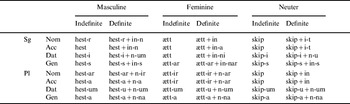
ON has a system of four cases marked on nouns and on other words within the DP. Even the postposed definite article has its own case marking. Table 1 gives the forms of the noun with and without the postposed definite article in ON for the four cases (Nom(inative), Acc(usative), Dat(ive), Gen(itive)), the two numbers, and the three genders of three regular nouns: hestr ‘horse’, ætt ‘family’, and skip ‘ship’. As can be seen from these forms, a definite noun in ON is formed by simply adding the article to the inflected noun (symbolized by ‘+’). The one exception is the dative plural, to which I will return in section 3. If the inflected noun ends in a vowel, as in the dative singular masculine and neuter, the accusative plural masculine, and the genitive plural, or if it ends in an -r preceded by an unstressed vowel, as in the nominative plural masculine and the nominative/accusative plural feminine, then the initial i- of the article is deleted. The noun and the article both have their own separate inflection for gender, number and case (indicated by ‘-’ in the table). The inflections are partly different in the nouns and the articles because the definite article is a determiner and as such has a different declensional pattern from that of the nouns.
Indefinite and definite nouns in Old Norse.

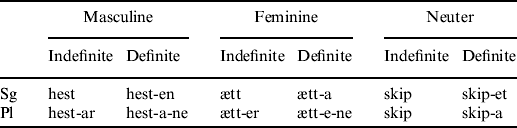
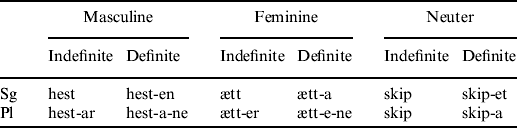
MN no longer has case inflection of nouns.Footnote 5Table 2 shows the indefinite and definite forms of MN nouns of the three genders. The plural forms here reveal that the definite form in MN is not formed by simply adding an element to the indefinite form. The plural noun itself may undergo changes in the definite inflection. The process in question here is a regular deletion of the final -r of the plural. Further such changes will be presented in section 3.
Indefinite and definite nouns in Modern Norwegian.
On the basis of these observations, I will claim that the definite forms in ON (table 1) consist of an inflected noun plus a clitic, while the MN nouns (table 2) are inflected for definiteness – in other words, that a change has taken place from clitic to affix.Footnote 6 It may be, and indeed has been, claimed, e.g. by Lahiri, Wetterlin & Jönsson-Steiner (Reference Lahiri, Wetterlin and Jönsson-Steiner2005a, b), that the MN definite article is still a clitic.Footnote 7 This of course depends on the definition, but it is a fact that the article has different cohesion properties and different syntactic properties at the two stages of Norwegian. They are in fact so different that I will argue that we are dealing with a clear case of a change, clitic>affix.
Another relevant difference between the two stages is double definiteness, which combines the two forms of the article in DPs with attributive adjectives, as illustrated in the MN phrase in (3b). This is obligatory in MN, but did not normally occur in ON. I will return to the significance of this feature in section 5 below.
A theoretically and empirically well-motivated structure for Scandinavian nominal phrases has been presented by Julien (Reference Julien2005). The analysis adopted here is a simplified and slightly modified version of hers, with omission of details and complications that are irrelevant in this context. Thus, instead of Julien's NumP and nP, I will assume one single functional projection, InflP, which will then host features other than just number, as we shall see. The noun moves to Infl, where it checks its features for number and other categories. Following Julien (Reference Julien2005), adjectives are phrases merged in the specifier position of an α projection above InflP. A simple phrase such as ON hinn gamli hestr then has the structure in (4).
(4)


This structure will be further expanded and motivated as we discuss the various constructions at the two stages of Norwegian and the changes taking place.
3. Clitic vs. affix
The assumption here is that clitics constitute a morphological category distinct from inflectional affixes. Although the surface distinction between the two categories in some cases may be blurred, they are basically distinct, especially if we adopt an inferential model of morphology, whereby inflectional forms of the word are created by morphosyntactic feature specification, rather than just added as separate morphemes (Stump Reference Stump2001: 1–9, Corbett Reference Corbett2006: 71–72). I will assume that clitics are merged in the syntax in the same way as independent words are, and are then brought into contact with their hosts by means of the syntactic operations of the language. On such a view there is no question of conflating clitics and inflectional affixes, and there can be no transitional or intermediate stages. A given word form can only be analyzed – and acquired – either as a word plus a clitic, or as a word with an affix (or neither). Even a lexical theory of morphology, in which inflectional affixes are seen as lexical items added to the stem (Lieber Reference Lieber1992, Halle & Marantz Reference Halle, Marantz, Hale and Keyser1993), can distinguish between clitics and inflectional affixes, the basic difference being one of cohesion and independence. I will demonstrate in what follows how the cliticized definite article was reanalyzed as an inflectional affix in the history of Norwegian. The change had both morphological and syntactic implications. Before looking at the Norwegian data in detail, I will point out some of the diagnostic traits of clitics which may serve to distinguish them from affixes. I am not claiming, however, that these traits are part of a definition of clitics, or that they are in themselves criteria for clitichood.
There is a vast literature on clitics, e.g. Zwicky (Reference Zwicky1977), Klavans (Reference Klavans1982, Reference Klavans1985), Zwicky & Pullum (Reference Zwicky and Pullum1983), Sadock (Reference Sadock1991), Halpern (Reference Halpern, Spencer and Zwicky1998), van Riemsdijk (Reference Riemsdijk and Riemsdijk1999), and, more recently, Anderson (Reference Anderson2005), to list just a few. Discussions of clitics based on Norwegian data are Enger (Reference Enger and Faarlund2003), Faarlund (Reference Faarlund2005), and Ottosson (Reference Ottosson, Josephson and Söhrman2008). Most of these works offer sets of criteria to distinguish clitics from the ‘neighboring’ categories of affixes and grammatical words. I am not going to discuss all of these criteria and definitions here. Instead, I will discuss a set of properties and criteria which separate clitics from affixes, and which characterize the postposed definite article in ON and in MN. This will demonstrate that the former has clitic properties while the latter has affix properties. I have found no criteria or definitions in the literature that would categorize the definite article at the two stages as having more clitic properties in MN than in ON, or vice versa. The distinction between clitics and words will not be discussed here. The relevant properties are presented and discussed in the next four subsections.
3.1. Clitics may have free-word counterparts, affixes do not
This property is neither a necessary nor a sufficient condition on clitichood. It should rather be considered an arbitrary lexical fact about the language (Anderson Reference Anderson2005: 12), but when it does apply, it is more likely to apply to clitics than to affixes, and it falls out very differently with regard to the definite article at the two stages of Norwegian.
In both ON and MN there is also an independent definite article, used when the noun is preceded by an adjective. In ON this article may have the same form as the postposed article (or it may start with an h). Compare the four case forms of ‘the old horse’ in (5) to ‘the horse’ in the ‘Definite’ column in table 1:
(5) Nominative inn gamli hestr
Accusative inn gamla hest
Dative inum gamla hesti
Genitive ins gamla hests
In MN, the definite article used with adjectives is etymologically unrelated and synchronically distinct from the postposed article.
(6) Masculine den gamle hest-en ‘the old horse’
Feminine den gamle ætt-a ‘the old family’
Neuter det gamle skip-et ‘the old ship’
Plural dei gamle hesta-ne ‘the old horses’
Note incidentally that the preposed independent article co-occurs with the suffix, creating double definiteness. This is an important part of the change in question, to which I will return in section 5. It can easily be seen that this independent article is a different item from the suffixed article. This is immediately obvious for the feminine and plural forms, but even in the masculine and neuter singular there is no direct historical link between the two. The suffixes -en and -et derive from ON -inn and -it, respectively, while the independent article is a weak form of the MN distal demonstrative (spelt in the same way), which derives from the ON demonstrative þann/þat.Footnote 8 (I will return to this development below.)
3.2. Clitics do not normally cause morphophonological changes in the host
When a clitic is added to a word, the word itself, the host, generally remains phonologically unaffected. This is different from inflection, where in many languages (especially Indo-European ones) the stem undergoing inflection may also change.Footnote 9 From table 1 we see that the definite article in ON is simply added to the inflected form of the noun: hestar – hestarnir ‘the horses’. There is, however, one exception to this generalization in the ON paradigm, namely the dative plural, where we find the forms hestunum, etc. instead of the expected *hestuminum. This is then a potential problem for the clitic analysis of the ON definite article. Note, however, that this is a single instance among 17 distinct cells of definite forms.Footnote 10 Nor is this deviation absolute, since we do find examples of the full dative plural form in early Old Norwegian texts: stæinomenom ‘the stones’; and an intermediate form: hundumnum ‘the dogs’ is also attested (Noreen Reference Noreen1903: 280). The standard form hestunum, etc. may be due to a (derivationally) late phonological rule.
When we contrast the ON situation with that of MN, we find that now a change in the host is the rule rather than the exception. Since there is no longer any case inflection, the relevant forms are the singular vs. plural. Table 2 shows that the final -r of the indefinite plural in the masculine and feminine regularly disappears in the definite form:
(7) hestar+ne>hestane
ætter+ne>ættene
Another change in the noun in the MN definite inflection is the reduction of syllables through contraction. A bisyllabic stem may be reduced to monosyllabic through the loss of the vowel of a final unstressed syllable:
(8) soge+a>soga ‘the story’
esel+et>eslet ‘the donkey’
gyger+a>gygra ‘the giantess’
This contraction is not found in ON; nouns ending in an unstressed vowel have the definite article added with the loss of the initial i of the article, as shown in (9a), and words corresponding to those now ending in an unstressed -el or -er are monosyllabic in the indefinite form, as shown in (9b).
- (9)
(a) saga+in>sagan ‘the story’
(b) gýgr+in>gýgrin ‘the giantess’
In MN there is a class of Latin loanwords ending in -um. In the definite inflection these lose the Latin suffix: museum ‘museum’ – muséet ‘the museum’. Words with this type of inflection are not attested in ON.
3.3. No arbitrary gaps
Among the clitics there is a certain group, first termed special clitics by Zwicky (Reference Zwicky1977), which have their own special syntax. This means that the clitic attaches only to a certain class of hosts. In the case of the definite article, this is the noun. As long as the definite article is a clitic, then, we expect it potentially to attach to any noun, which also seems to be the case. An inflectional affix, on the other hand, may fail to attach to certain items within the class. In MN certain masculine nouns already ending in -en tend to avoid the definite form, even if other nouns in the same environment would require it. Contrast the words eksamen ‘exam’ and dagsorden ‘agenda’ to ‘normal’ (near-)synonyms like prøve ‘test’ and sakliste ‘agenda’, which take the feminine definite article -a.Footnote 11
- (10)
(a) Eg greidde heile eksamen I passed whole exam ‘I passed the whole exam.’
(b) Eg greidde heile *prøve/prøv-a I passed whole test/test-def ‘I passed the whole test.’
(c) Kva står på dagsorden? What is on agenda
(d) Kva står på *sakliste/saklist-a? what is on agenda/agenda-def ‘What's on the agenda?’
In ON no clear examples of such gaps can be found.
3.4. Clitics may have their own inflection, while affixes are themselves inflections
Clitics are separate lexical items and as such they can have their own grammatical features and overt inflection, as in the tense inflection of the clitic forms of ‘have’ in English: I've – I'd. The ON definite article is a typical example of this state of affairs, as can be seen from inspecting the data in table 1.
From table 2 it can be seen that the definite suffixes in MN are -en, -a, -et, and -ne. These have no identifiable common root, and cannot be analyzed as a stem+suffix.
The phonological combination of clitic and host will be considered adjunction following internal merge of the host. Affixes, on the other hand, express interpretable or uninterpretable features. The uninterpretable ones receive their features through agreement.
There has thus been a reanalysis in the history of Norwegian, changing definiteness clitics into definiteness inflection.Footnote 12 The major change is the change in morphological type of the definite article, its cohesion and dependence have increased. This is a change subsumed under the more general concept of grammaticalization.
4. Structure of the Old Norse DP
Old Norse DPs contain one functional projection in addition to those assumed for Scandianvian by Julien and others, as witnessed by examples such as the following:
- (11)
(a) þau in stóru skip (Hkr I.437.13) those the large ships
(b) þeir hinir íslenzku menn (Hkr II.281.6) those the Icelandic men
(c) sá hinn helgi líkamr (Hóm 126.28) that the sacred body
In (11a–c) there is a preposed definite article (h)in- preceded by a demonstrative.Footnote 13 The demonstrative and the definite article are separate heads in their respective projections. It has been suggested (e.g. by Abraham & Leiss Reference Abraham and Leiss2007 and by Elly van Gelderen p.c.) that the demonstrative is in the specifier position of D, with the article as the head. There are, however, both theoretical and empirical arguments in support of the headedness of the demonstrative. A demonstrative is as likely a head as the definite article, it never has phrasal structure, and according to van Gelderen's (Reference Gelderen2004: 11) Head Preference Principle (‘Be a head rather than a phrase’), it should be analyzed as a head if at all possible. An empirical motivation for the D-head status of the demonstrative is the fact that it can be preceded by other material, which has been moved to SpecDP from lower positions within the DP. In (12c–d) there are examples of DPs with both a demonstrative and an article, preceded by material in SpecDP.
- (12)
(a) nökkurr sá maðr (Hkr II.304.14) some that man some (such) man
(b) ambátt sinni þeirri þrœnsku (Hóm 115.12) concubine.d his that.f.d Throndish‘his concubine from Throndheim’
(c) kvistr sá inn fagri (Bárð 3.8) twig that the beautiful ‘that beautiful twig’
(d) fé þat it mikla ok it góða (Nj 97.25) money that the big and the good ‘that great sum of money’
I will refer to the projection headed by the definite article as the reference phrase (RP), since this is where the referential properties of the DP are determined (Dyvik Reference Dyvik1979: 63, Faarlund Reference Faarlund2004: 56–57), such as specificity. The higher D projection is then headed by the demonstrative, which may have deictic properties and express unique reference. This difference in the referential properties and semantic function of the two determiners is also seen by the fact that when two adjectives are used to modify the same noun, the article is repeated but not the demonstrative – as in (12d) and (13), where there are two conjoined RPs in each example, but only one DP. The singular hverr and the verb show that the question concerns one single person.
(13) Hverr er sá inn mikli ok inn feiknligi? (Nj 277.27) who is that the big and the threatening‘ Who is that big and threatening (man)?’
The definite article in R has two forms in ON; it may be an independent word, as in (11) and (12c–d), or it may be an enclitic on the noun: féit ‘the money’, kvistrinn ‘the twig’. The structure of a simple definite noun such as hestrinn ‘the horse (nom.)’ is as in (14).
(14) DP[RP [R hestr-inn [InflP [Ihestr [NP [Nhest]]]]]]
The noun moves via Infl to R, where it adjoins to the article. This article is a lexical item, but it lacks independent word status (for phonological reasons), and becomes a clitic on the noun. Without internal merge of the head noun in R (‘I to R movement’), the derivation would crash, since the determiner needs a host to lean on.
When a modifying AP is present, as in (11), the situation is different. In a definite DP the adjective is preceded by the independent definite article, most commonly without a preceding demonstrative. As we have seen, this article may have the same (segmental) form as the clitic, or it may be preceded by an h-.
- (15)
(a) hinum kærsta sýni (Hóm 1.2) the dearest son.dat
(b) it fyrra sumar (Hkr II.281.11) the former summer ‘last summer/the summer before’
(c) inum sárum mönnum (Hkr II.503.13) the wounded men.dat
The structure of (15a) can now be represented as in (16a), and that of (11a) as in (16b).
- (16)
(a) DP[RP [R hinum [αP kærsta [InflP [I sýni [NP [Nsýni]]]]]]]
(b) DP[D þau RP[R in [αP stóru [InflP [I skip [NP [Nskip]]]]]]]
The question is of course why the independent inn is possible only in the presence of adjectives, and not with single unmodified nouns; why is *inn hestr (with the intended reading ‘the horse’) impossible in ON?Footnote 14 The only explanation I can offer at this point is that there is a selectional restriction in the independent word inn requiring it to merge with αP. This selectional restriction also explains why we do not get the reverse order of demonstrative and article. While we have data like that in (11), constructions with *hinn sá … are unattested. On the other hand, unlike MN and the other contemporary Scandinavian languages, ON allows movement of the noun to the position in front of an adjective if there is a clitic present in R, to which the noun can adjoin:
- (17)
(a) Orminum langa (Hkr I.414.10) serpent.d-the long ‘The Long Serpent [a ship's name]’
(b) andans helga (Hóm 31.23) spirit.g-the holy ‘of the Holy Spirit’
5. The change
The subsequent development of definiteness marking in Norwegian involves reductions both of the definite article inn and the demonstrative sá. I have already shown how the cliticized definite article has changed from clitic to affix, thereby reducing its status as an independent morphemic unit. The cliticized definite article has also undergone a phonological reduction: the root vowel of the article, -i-, has been reduced to a schwa or been lost altogether, and the final -t of the neuter form of the article has been lost (although kept in the standard orthography). The neuter form is therefore reduced from /it/to /ə/. The independent definite article inn has undergone an even more drastic reduction: it has been totally lost from the language; there is no longer any independent counterpart to the postposed article. As argued in section 3, while clitics may have free-word counterparts, inflectional affixes do not. Now we see that the free-word counterpart disappeared in connection with the transition from clitic to affix. Certain forms of the demonstrative sá have survived in reduced form. The masculine/feminine den, phonologically /dən/, is a continuation of the ON accusative masculine þann. The MN neuter form det /də/ comes from ON þat, and the plural for all genders is dei /dəĭ/Footnote 15 from þeir. The change from a demonstrative determiner to a definite article also involves semantic bleaching: the features demonstrative and distal are lost.
We see that in this kind of change, as in so many others, a main factor is reduction in one form or another. This is as expected since the locus of change is first language acquisition. In the child's analysis of the linguistic input, it is much more likely for an element to be ignored, and therefore omitted from the new grammar, than for something to be added at random.Footnote 16 One type of loss during acquisition is the loss of semantic content, as in the transition from demonstrative to definite article. Another type is the loss of morpheme boundaries. The three types of elements, words, clitics, affixes, correspond to three degrees of boundary. Morphosyntactic reduction then consists in the loss of morphemic independence and weakening of the boundary. In terms of acquisition and reanalysis, this means that the child misses some of the boundary cues, and interprets the input string as having a weaker boundary (stronger cohesion) at a certain point.
Like the ON independent article inn, the new independent definite article den /dən/, neuter det /də/, can only be used in front of adjectives, never directly before a noun.
- (1)
(a) /də/ store skipet the big ship
(b) */də/ skipet the ship
The ON demonstrative also has another descendent in MN, namely the modern demonstrative, which is spelt the same way as the definite article but whose pronunciation is different: it has a full vowel and may be stressed. In contrast to the article, the demonstrative can be used directly before a bare noun; note the contrast (19a–b) in MN and (20a–b) in ON (/də/ and /deː/ are both spelt det in standard orthography).
- (19)
(a) */də/ skipet the ship
(b) /deː/ skipet that ship
- (20)
(a) *it skip the ship
(b) þat skip that ship
The combination of a demonstrative and the preposed article is generally impossible in MN, illustrated in (21a), as opposed to the ON situation, illustrated in (21b).Footnote 17
- (21)
(a) *dei /dəi/ store skipa those the large ships
(b) þau in stóru skip (=11a)
The R-projection, which was headed by the definite article inn in ON, is no longer active in MN, since its head has been lost.Footnote 18 As a result (or as a cause?!),Footnote 19 the demonstrative took over the role of the independent definite article. We can see this in Norwegian manuscripts from the early 13th century. The examples in (22) and (23) are all from the same early Norwegian manuscript. In (22), the old definite article hinn is used, while in (23) we see how the old demonstrative sá is used alone before the adjective. The examples in (24) are modern Norwegian equivalents of the ones in (23), using the same definite article historically derived from the demonstrative.
- (22)
(a) hit þriðja sinni (Hóm 120.31) the third time.acc
(b) hinn helga Ólaf konung (Hóm 113.20) the holy Olaf.acc king
(c) hinn illi þræll (Hóm 150.4) the bad slave.nom
- (23)
(a) þeim helga manni (Hóm 119.2) the holy man.dat
(b) þann háleita sigr (Hóm 113.27) the superior victory.acc
(c) þess illa manns (Hóm 115.15) the bad man.gen
- (24)
(a) den heilage mannen the holy man
(b) den framifrå sigeren the superior victory
(c) den dårlege mannen the bad man
To sum up so far: Both the definite article and the demonstrative underwent various processes of phonological reduction, reduction of morpheme boundary, and semantic bleaching. The result is that the postposed definite article is no longer a clitic but a suffix; the independent definite article has disappeared and been replaced by a semantically and phonologically reduced form of the old demonstrative. This new independent article can no longer co-occur with a demonstrative, and the R-projection is no longer active in the Norwegian DP.
Before going on to discuss the morphosyntactic implications of this change, a few words about the semantic bleaching of the postposed definite article may be in order. One striking difference between the use of the definite article at the two historical stages is that in ON it seems to be missing in many instances where it would have definite reference and where it would be required in MN. Leiss (Reference Leiss2000) suggests that the definite article is primarily used in contexts where an indefinite interpretation would otherwise be the natural one: ‘Der postponierte bestimmte Artikel signalisiert Definitheit in syntaktischen Indefinitheitsumgebungen [The postposed definite article signals definiteness in syntactic indefiniteness environments]’ (Leiss Reference Leiss2000: 42). This strong tendency can be illustrated by the following examples:
- (25)
(a) sat konungr ok dróttning í hásæti (Hkr I.338.13) sat king.nom and queen.nom in high-seat ‘The King and the Queen were sitting in the high seat.’
(b) þeir sjá nú skipin fyrir sér (Nj 66.6) they see now ships.a-the before themselves ‘They now see the ships in front of them.’
In (25a), konungr ok dróttning is an animate subject, and therefore expected to be definite with unique reference. A definite article would therefore be redundant. In (25b), by contrast, the definite article is necessary to avoid an indefinite reading of the inanimate object skip ‘ships’. The definite article is thus the marked option. When used, it also seems always to have the same referential function, that of expressing unique and specific reference, uniquely picking out one particular referent among several possible ones (Dyvik Reference Dyvik1979).
In MN the definite article is much more frequent, and the referential function is often less obvious, as in the following expressions:
- (26)
(a) Eg tok bussen til byen. I took the.bus to town (‘some bus’)
(b) Når det blir kvelden. when it becomes the.evening (‘when evening comes’)
(c) Hesten er eit nyttig dyr. the.horse is a useful animal (generic)
There are also semantically unmotivated alternations:
- (27)
(a) i jula in the.Christmas ‘at/during Christmas’
(b) før jul before Christmas
In some cases speakers are in doubt whether to use the definite form or not. This happens when the two forms are homonymous, as in the case of neuter nouns ending in -e, since the final -t of the article is not pronounced. Thus we find both (28a) and (28b) in writing. The reason is that in speech there is no difference, and speakers have no clear intuition about whether or not to use the definite form in such cases.
- (28)
(a) Det er tilfellet.
(b) Det er tilfelle. that is (the) case
The consequence of these changes is a change in the marking of the category definite. In ON this was represented by a clitic or its free-word counterpart merged in R. It was not an inflectional category, and there was no definiteness agreement on the noun.Footnote 20 In MN, definiteness is a grammatical feature in Infl. The definite article has thus been reanalyzed (and further grammaticalized, if you like) from being a lexical item merged in R to being a grammatical feature in Infl. This is ‘grammaticalization downward’, in contrast to the general principle of grammaticalization proposed by Roberts & Roussou (Reference Roberts and Roussou2003), which is always and by definition ‘upward’ in the structure. However, grammaticalization involves a change from clitic to affix, and a clitic can be merged in D by Late Merge (van Gelderen Reference Gelderen2004: 12). Therefore grammaticalization must also involve diachronic movement ‘downwards’ in those cases where a clitic in the D-domain is reanalyzed as an inflectional affix in the Infl-domain. This is a problem with Roberts & Roussou's principle. It should not be a theoretical problem, however, since there is no reason to assume that reanalysis, as a diachronic process, is subject to synchronic principles of UG. If syntactic change is caused by reanalysis at acquisition, the outcome of any change will be constrained by UG and the triggering data alone. Abraham & Leiss (Reference Abraham and Leiss2007) are so concerned about downward grammaticalization, ‘which is against all odds of what we are used to think about grammaticalization nowadays’ (p. 17), that they argue instead for degrammaticalization from the cliticized to the independent article. This is not only at odds with general assumptions about grammaticalization (word>clitic, cf. (1)–(2) above), but also at odds with the historical facts.Footnote 21
Synchronically, the noun now moves to Infl to check its features for number and definiteness, and thus it receives definite inflection. The noun stays in Infl, since there is no longer a clitic in R to require it to move further up. Definiteness is now by agreement, as also suggested for Swedish by Embick & Noyer (Reference Embick and Noyer2001). The definiteness inflection of MN nouns was shown in table 2 in section 2. The structure of a simple definite noun in MN, such as hesten ‘the horse’, is shown in (29b); this should be contrasted to the structure of the ON counterpart in (14), repeated as (29a). The definiteness feature in Infl is valued by a corresponding feature in D, which does not have to be phonologically expressed, and the combination hest{+def} in Infl is spelt out as the definite form hesten (pronounced /hestn/, with a reduced article).
- (29)
(a) DP[RP [R hestr-inn [InflP [Ihestr [NP [Nhest]]]]]]
(b) DP[D{+def} [InflP [I hest{αdef}[NP [Nhest]]]]]
The D head may also be occupied by a demonstrative, which has {+definite} as an inherent feature value. The demonstrative then acts as a probe finding its goal in the noun, and the result is the so-called ‘double definiteness’ characteristic of Modern Norwegian and Swedish, whereby definiteness is overtly expressed twice within the DP:
- (30)
(a) den hesten that horse
(b) DP[D den{+def}[InflP [I hest{αdef}[NP [Nhest]]]]]
Another way of lexicalizing {+definite} in D is by means of the preposed definite article, which is a phonologically and semantically reduced form of the demonstrative den, and again double definiteness is the result. As we have seen, this can only be followed by an adjective, and it is required before an adjective and a definite noun. Its function thus corresponds to that of the ON independent definite article inn, cf. (5) and (6) above. The structure of (31a), a definite DP with an attributive adjective, is as in (31b).
- (31)
(a) den gamle hesten the old horse
(b) DP[D den{+def} [αP gamle{αdef} [InflP [I hest{αdef}[NP [Nhest]]]]]
In much previous work on Scandinavian DPs it has been assumed that N moves to D to adjoin to the definite article also in the modern languages, and not just in ON (Delsing Reference Delsing1993, Sandström & Holmberg Reference Sandström and Holmberg1994, Vangsnes Reference Vangsnes1999). In ON, a definite noun can precede the adjective, as we have seen in (17). An analysis whereby a definite noun moves to D in MN requires an explanation of why this is blocked by the presence of an adjective. This question has received much attention by Scandinavian syntacticians (such as those just mentioned). Most attempts to explain it have failed on empirical and/or theoretical grounds. It is clear that the attributive adjective is a phrase and not a head, and therefore the blocking cannot be due to an intervening filled head position.Footnote 22 If we assume that N never moves beyond InflP, however, this is not a problem, since the adjective is merged in a projection above InflP. Another possible approach is that of Julien (Reference Julien2005: 30), who instead of head movement of N assumes phrasal movement of nP to SpecDP. In the presence of an AP in the αP, this movement is blocked, and the noun therefore has to remain behind the adjective.
We have seen three clear syntactic consequences of the changes in the definite article: the loss of RP, as illustrated in (21); the introduction of so-called ‘double definiteness’, whereby definiteness is expressed both on the noun and in D, as witnessed in several of the above examples, cf. (6), (18a), (19b), (24), (30a), (31a); and the loss of postnominal adjectives, cf. (17) and (32). As regards semantics, it has been pointed out by several linguists working on Scandinavian DPs that the two definite articles have different referential and semantic functions: ‘n [the postposed definite article] encodes specificity while D [the preposed article] encodes inclusiveness’ (Julien Reference Julien2005: 38). ‘[W]hile the suffixal article seems to bring about specificity interpretations … , the pre-nominal determiner is responsible for uniqueness and a deictic reading’ (Roehrs Reference Roehrs2006: 73); ‘while the postposed article affix in Modern Norwegian appears to mark definiteness, in the wide sense, the preposed article seems to be a set-choice marker’ (Abraham Reference Abraham and Stark2007: 249). Taken together, these statements convey the insight that the present-day preposed article is not only phonologically and etymologically a continuation of the ON demonstrative, but also semantically and referentially, while the suffixed article continues the ON clitic, of which it is also a phonological and etymological descendent. This semantic difference between the two definite articles might seem a problem if their relationship is one of agreement. Their semantic features are not completely distinct and incompatible, however. The specificity feature of the postposed article appears to be included in – or entailed by – the uniqueness properties of the independent preposed article, and it is this specificity feature which is transmitted to the affix by agreement.
Another syntactic difference between the ON and MN DP is the loss of postnominal adjectives. In ON we find, besides structures with the adjective preceding the noun (as in most of the relevant examples so far), also adjectives following the noun. This is in fact the most frequent pattern in ON (Faarlund Reference Faarlund2004: 68ff.). In (17) we have seen examples of an adjective following a noun with the cliticized definite article. The adjective may also follow indefinite nouns:
- (32)
(a) örn mikinn (Gunnl 4.8) eagle big ‘a big eagle’
(b) höf stór (Hkr I.9.2) seas big ‘the ocean’
Even if such nouns are indefinite, they can be argued to move to the lower R, and thus come to precede the adjective. In MN, these patterns are now disallowed. It would be natural to see this as a consequence of the inactivation of R, which used to host the now-missing clitic or independent word (-)inn.
6. Conclusion
The diachronic process of grammaticalization is often depicted as a cline, as in (1) above. The change under discussion here corresponds to the last step on this cline. Grammaticalization theorists claim that changes like this are predicted by the theory, which also predicts unidirectionality (Heine, Claudi & Hünnemeyer Reference Heine, Claudi and Hünnemeyer1991; Heine Reference Heine1992, Reference Heine, Joseph and Janda2003; Haspelmath Reference Haspelmath1999, Reference Haspelmath, Fischer, Norde and Perridon2004; Hopper & Traugott Reference Hopper and Traugott2003). For a critical assessment of these claims, see Faarlund (Reference Faarlund and Eythorsson2008). The generativist version of grammaticalization imposes a synchronically motivated constraint on grammaticalization, namely that it can only go ‘upward’ in the tree. I have shown here that the change of a determiner in D into an inflectional affix in Infl represents a counterexample to this claim, and I have argued that there is no theoretical or empirical basis for such an alleged parallel between synchrony and diachrony.
The problem with regarding linguistic change as subject to certain principles of change, such as grammaticalization, is that it then has to be assumed that language has its own inherent principles independently of speakers, their minds, and their experiences. This creates a logical problem, since the infant acquiring language can have no access to the previous history of the language, and therefore will have no way of knowing ‘which way to reanalyze’. Therefore in principle anything can happen through reanalysis, within the limits of UG and intergenerational communication.
However, since certain kinds of change are more frequent than others, leading for example to the apparent unidirectionality of grammaticalization, some other factors than just blind grammar-building on the basis of input must be involved. The kinds of reductions that take place at acquisition are precisely of this type. Thus grammaticalization and its apparent unidirectionality can be seen as a result of omission at acquisition.