It was the structural mode of thinking which above all was transmitted from Menger to his successors.… The lasting fascination of capital theory for the Austrians, a field where structural analysis is particularly necessary, is itself an expression of the Austrian predilection (Streissler Reference Streissler1969, p. 250).
I. INTRODUCTION
Setting aside more ancient capital controversies (Hicks Reference Hicks1974), there were three major capital theory debates that took place over the last 120 years that are familiar to historians of economic thought: the debates among the marginalists and anti-marginalists in the period 1880–1910 in which Böhm-Bawerk, Clark, Fetter, Fisher, Veblen, and Wicksell loomed large; the Knight–Hayek–Kaldor debate in the 1930s; and the notorious ‘Cambridge’ controversies that erupted in the late 1960s and drew to an inconclusive close in the mid-1970s.Footnote 1
In retrospect, these debates revealed a deep, unresolved issue: what meaning may be given to “the concept of capital in the analysis of industrial capitalist societies” (Cohen and Harcourt Reference Cohen and Harcourt2003, p. 200)? There was irresolution on this matter not merely because the protagonists were posing different questions about capital, its formation, structure, measurement, its appropriate return, and so forth. Instead, the debates were underwritten by differences over the fundamental features or nature of capital. In other words, different sides in the capital debates held radically conflicting views on the ontology of capital that were deeply embedded in economists’ discourse. (Economic ontology is broadly defined as the study of the fundamental nature and properties of entities in the economic sphere.) It has been demonstrated that economists’ discourse can be subject to descriptive, explanatory reconstruction to uncover divergent commitments on the fundamental constituents of economic reality (Mäki Reference Mäki and Mäki2001, pp. 11–13). Wide differences over the meaning of capital in the literature of economics provide a good reason to attempt this task for one key item in the furniture of the economic world; namely, capital.
While the three major capital controversies have been well documented, some important differences within schools of economic thought on capital have not been appreciated. It is acceptable for some purposes to take for granted quite divergent positions on the nature of capital and its structure in the Austrian tradition from Menger to Hayek, Mises and Lachmann (e.g., in rational reconstructions of Austrian capital theory as in Harper and Endres Reference Harper and Endres2010). The present reconstruction requires, however, a survey of all relevant Austrian literature. We find that it is not until the appearance of Lachmann (Reference Lachmann1947), followed by a more comprehensive treatment in Lachmann (Reference Lachmann1956), that there is a return to deep structural issues originally sketched in Menger (Reference Menger1871) and reinforced in Menger (1888). Menger offered the beginnings of a theory in which capital was envisioned as a hierarchically organized, structured combination of economic goods that are used to produce other goods. Among Menger’s followers and intellectual successors, the works of Böhm-Bawerk, Wieser, Schumpeter, Strigl, Hayek, Mises, and Lachmann all discussed capital and capital theory in some depth.Footnote 2 While, as Erich Streissler (Reference Streissler1969, p. 250) maintained, all these Austrian economists were distinguished from other schools of thought by their common “structural mode of thinking,” there were undertones of strong disagreement in the Austrian tradition over the nature of capital. Perhaps out of filial respect for Menger, the disagreements were not amplified in discussion among the Austrians, although they were significant in terms of their consequences. For there was sufficient noise in the Austrian literature on capital to garble the signal; that is, the distinctive elements in the approach to capital originally contributed by Menger. On the subject of capital and capital theory, important differences between Menger and Böhm-Bawerk have been investigated (Endres Reference Endres1987; Garrison Reference Garrison and Caldwell1990) and between Menger and Wieser (Endres Reference Endres1997, pp. 201–205). Looking back in time from the perspective of Lachmann, Peter Lewin (Reference Lewin and Boettke1994, Reference Lewin1997, Reference Lewin1999) has elaborated on some of the other differences within the Austrian tradition. In this paper our objective is to make the account more complete.
Our account is organized as follows. The next section delves into Menger’s philosophical and methodological directives for fundamental research on capital. Menger likened capital to a “genus” in a morphological sense. Section III gives illustrations of some of the main differences between Menger’s concept and that of his principal successors in the Austrian tradition up to and including the publication of Lachmann (Reference Lachmann1956). Section IV elicits a continuum of Austrian micro analyses of capital, and investigates the central question of capital aggregation. Section V provides more detailed examination of Böhm-Bawerk’s capital concept. Though still retaining the Mengerian structural and realist elements, Böhm-Bawerk’s concept was opposed to Menger’s notion of capital on almost all other ontological and analytical dimensions. For example, Böhm-Bawerk’s treatment of capital accepted aggregative notions of capital that would have been anathema to Menger. Section V also considers capital concepts that offer points of stronger contrast with Austrian contributions: John Bates Clark’s ‘capital’ considered as a perpetual, amorphous fund, and Veblen’s concept of capital as a social artifact. Our conclusion in section VI considers some of the causes and consequences of misalignments identified in various Austrian treatments of capital.
II. SOME MENGERIAN PHILOSOPHICAL AND METHODOLOGICAL RESEARCH DIRECTIVES ON CAPITAL
One motivation for this paper is to respond to an ontological question originally posed by Menger (Reference Menger, White and Nock1985, pp. 146–147, n37), who refers to the general nature of capital and other phenomena constituting various fundaments of the economic world including economy, money, commodity, value, and price. Menger enquires as to the essential properties and building blocks of these fundaments, including capital. What is their “nature” and what causes their “movement”? Answering such questions was central to the
goal of scholarly research [which] is not only the cognition, but also the understanding of phenomena. We have gained cognition of a phenomenon when we have attained a mental image of it. We understand it when we have recognized the reason for its existence and for its characteristic quality (the reason for its being and for its being as it is) (italics in original).
Following recommendations in this important passage for the case of capital, any redescription and reconstruction of various accounts of capital beginning with Menger should be guided by the expectation that a Mengerian outlook will incorporate a degree of realism (“being as it is”). Mäki (Reference Mäki and Caldwell1990b, p. 294) maintains that Menger espoused “realism in different forms”; he was particularly insistent on “pursuing realisticness in economic theory.”Footnote 3 Menger’s research directive is programmatic. It has been followed faithfully in modern literature that has produced illuminating descriptive ontologies of various economic phenomena, though capital has not yet figured among them (Zúñiga Reference Zúñiga1999; Mäki Reference Mäki and Mäki2001, Reference Mäki and Mäki2002). In addition to examining the fundamental character of capital, its constituents and relations to other economic entities, Menger’s directive invites us to consider the modes of existence of capital; namely, whether capital exists independently of the human mind, whether it persists and produces effects external to the minds of economic actors, whether it emerges spontaneously as the result of an invisible-hand process, whether it has the properties it has irrespective of economists’ theorizing and representations about capital, and whether it can be reduced to more basic constituents of economic reality.
Menger (Reference Menger1883, Reference Menger, White and Nock1985) specifically mentions, inter alia, a need to understand the existence and nature of capital. He called on economists systematically to study the morphology of economic phenomena including capital.Footnote 4 His starting point, therefore, presumes that capital has a form, a relational structure and shape very much like a real living organism. It is proposed that we understand the morphology of an economic phenomenon when we recognize the grounds for its “being” and “being as it is” (“der Grund ihres Seins und ihres So-Seins,” Menger Reference Menger1883, p. 14). Here we are treated to Menger’s brand of realism: it is expressed in the study of the form and structure of various economic fundaments, describing these “in all their complexity and multi-formity.” Morphological study must account for economic phenomena “as they are presented by experience”; it must reflect in part what is done in everyday life; that is, “full empirical reality” as found in the common-sense world (Menger [Reference Menger and Hayek1889] 1994, p. 12). That world needs to be investigated in order to uncover recurring characteristics and constituent elements (Menger Reference Menger, White and Nock1985, p. 86). Economic science first ‘reduces’ an economic phenomenon to its elements or its phenomenal forms (Erscheinungsformen), which, when they recur, are designated ‘types’ (Typen). All theoretical representations, including typical connections between economic phenomena, exist on different levels. At one level of understanding, we recognize similar, concrete elements (e.g., particular exemplifications). At a second level, we construct representations of recurring relations between concrete elements or real types (e.g., generic instances). A third level contains representations of the most abstract elements, or Menger’s ‘exact’ types (e.g., universals).Footnote 5 It should be emphasized that the task of elucidating the third, abstract level is vital for Menger if we are to provide a full understanding of the nature of capital. For Menger (Reference Menger, White and Nock1985, pp. 147, 218), the third layer is concerned with “the phenomenon of abstract economic reality” such as “ unintentionally … or ‘organically’ created social structures.” On this level, research is conducted to discover the “inner connections” (innerer Zusammenhang) and “inner causation” (innere Verursachung) of real things (Menger Reference Menger and Hayek1889, pp. 190, 192).
The Mengerian project involves considerable realism about capital. Its goal is to investigate the general nature of capital and its general connection to other economic phenomena (Menger Reference Menger, White and Nock1985, p. 37). Capital is an economic type understood in the realist sense. Realism holds that economic types (general properties, relations, kinds) are entities that are really “out there” in the world, as general features of economic reality. Consequently, from a realist stance, capital exists at least objectively in that it exists independently of, and is unconstituted by, economists’ representations of it. Capital would come into being and continue to exist even if economic theorists were non-existent.Footnote 6 Moreover, when understood as an economic universal (i.e., type), capital makes a causal difference to the goods that instantiate it. Being capital brings extra-causal powers—thereby inserting instances of it into cause-effect relations with other entities: “All things are subject to the law of cause and effect” (Menger Reference Menger, Dingwall and Hoselitz1950, p. 51).
The degree of complexity of the capital structure in a modern market economy is not limited to what an individual human mind or group of such minds can comprehend. In order to explain the capital structure and its nature, we need more than just everyday common-sense reasoning. In Menger’s view, economic theory must account for the real character of the capital structure and identify the relations existing between the capital combinations comprising the elements of that structure. This is the task of theoretical economics. It is beyond any epistemic grasp based on common sense (Mäki 1990, p. 307).
For Menger (Reference Menger, White and Nock1985, p. 36), capital is an economic type understood as a universal (a “genus”). It is always and everywhere an ordered, structured, and selected combination of economic goods used to produce other goods. The genus capital exists only in the tokens that instantiate it, and it cannot exist separately from its tokens. The existence of this capital type is thus dependent on that of its tokens. (If the capital type did not have any empirical instances at all, it would not be a bona fide type and would not have real existence.) The capital universal cannot exist on its own, independent of particular things. It cannot float free from things, but is firmly rooted in the spatio-temporal world. It is in each and every one of its tokens. Capital is always instantiated in individual objects (or first-order types considered as second-order tokens), whether capital goods, capital combinations, or capital structures. The genus capital can be represented by generic instances of capital (e.g., ‘transport capital’) and by a particular exemplification such as a specific train set made up of locomotive and wagons. Accordingly, the Mengerian economist denies that capital or other economic universals are causally inert, abstract entities or Platonic forms that exist outside the ordinary world of space and time. Capital does not bear the hallmarks of substance, whether considered as individual substances or substance types.Footnote 7 Capital is not mind-independent. No objects of economizing and, hence, no capital goods or capital combinations, are substances, where “substance” is defined in the technical sense as that which is logically capable of independent existence. A capital item cannot lack relations or relational properties. In Mengerian economics, relations and relational properties of a particular economic object (e.g., a concrete capital good) are as much a part of the being (nature) of that particular as are its non-relational properties. For its existence, a capital good depends upon the existence of a use-plan and a judging mind. Capital goods must have a (perceived) causal connection to the satisfaction of a (perceived) human need, and they must also be subject to the control of an economizing individual who can direct them to the satisfaction of that need (Menger Reference Menger, Dingwall and Hoselitz1950, pp. 52, 303–304).
For example, Menger is quite explicit that goods-character, commodity-character, economic character, and the character of being an order of a good are relation types (1950, pp. 52, 58, 101, 102, 116, 240, 302). Menger states that goods-character, commodity-character, the order of a good, and its economic character are “nothing inherent in goods” themselves, and neither one of them is a “property of goods.” In other words, he is saying that they are not substance types or essences. They are each “merely a relationship between certain things and men,” a specific, transitory relation between particular things and the economizing individuals who have economic control over them. When a specific relationship ceases to hold, the thing loses that particular character, so that the thing ceases to be a good, a commodity, a good of particular order, to be economic, and so on. The goods-character, the commodity-character, and so forth of this particular thing “comes to an end”—the relation is no longer instantiated in this particular case. Menger seems also to regard capital-character as a similarly contingent, loosely connected affair.
According to Menger (Reference Menger, Dingwall and Hoselitz1950, p. 152): “The transformation of goods of higher order [i.e., capital goods] into goods of lower order [e.g., consumer goods] takes place as does every process of change, in time.” Furthermore, in Menger’s vision of capital formation, according to Hicks (Reference Hicks and Tang1976, p. 139) “time is unidirectional.” That is, capital formation presents itself as a temporal process in that time elapses between cause and effect. And the organization of capital has real effects in time. These effects are evident once an entrepreneur’s production plan is implemented in response to originating causes—the demands for final products. Time is regarded as an endogenous variable when Menger discusses capital in its most abstract form; it is not a technical datum determined by the inherent properties of capital goods. Finally, Menger (Reference Menger, Dingwall and Hoselitz1950, p. 109) ascribes to the entrepreneur capabilities to develop “deeper insights into the causal connections between things” in time. These insights motivate capital formation and generate economic progress.
III. MENGER AND HIS SUCCESSORS: AN OVERVIEW OF MAJOR DIFFERENCES IN THE NATURE OF CAPITAL
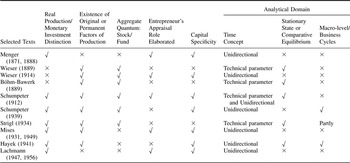
In this section we examine the principal differences between Austrian economists on the nature of capital. Table 1 summarizes key points of theoretical divergence and commonality between Austrian economists on this subject, only some of which have already been mentioned in the literature.
Austrian Treatments of Capital from Menger to Lachmann

Firstly, let us refer to the second column in Table 1 below. Menger would not have appreciated major tensions among economists in the three capital controversies that turned on the problem of the “dual” nature of capital: on the one hand, capital as a collection of heterogeneous goods combined in a specific manner in production; and, on the other hand, capital as a fund of value distinct from capital goods themselves that moves more or less freely between alternative uses according to its market-determined rate of return (Hennings Reference Hennings, Eatwell, Bliss, Cohen and Harcourt1987, pp. 108–109; Cohen Reference Cohen2008, p. 153). Menger (1888, pp. 43–45) resolves this ‘problem’ by distinguishing between two levels of reality: production activity and investment activity. Heterogeneous capital goods have a central place in the realm of production; when combined to form capital by entrepreneurs, they have a rate of return or yield (Menger 1888, p. 174). By contrast, money or financial capital is used for acquisitive purposes in the realm of investment and returns interest. Menger’s real capital doctrine contrasted with a variety of money capital doctrines in the history of economic thought. These doctrines lent themselves to the idea that capital is something other than combined heterogeneous capital goods; for example, a fund that could be measured in money and, depending on the approach taken, a fund that circulated, was advanced in time, and/or maintained its quantity while altering its material form (Hicks Reference Hicks1974).
Secondly, in respect of columns 3 and 4 in the table, Menger did not conceive of either ‘original’ factors of production or of capital as a measurable quantity, a homogenous aggregate or stock, but some of his followers—notably Böhm-Bawerk ([1889] 1923) and Strigl (Reference Strigl1934, Reference Strigl2000)—demurred. Böhm-Bawerk accepted the classical-Jevonian assumption that the ‘original’ factor, labor, with the assistance of land, produced capital. In the Mengerian approach, by contrast, the historical origin of resources was not the essence of capital; it was in the use of specific combinations of capital goods, whatever their origin, that constituted capital.
Thirdly, the domains of analysis differed between leading Austrian economists (see column 7 in Table 1). For example, it is well known that Böhm-Bawerk, armed with the concept of “roundabout methods of production,” tried to measure the average amount of time capital goods spent in production (the degree of ‘roundaboutness’) before final consumer goods emerged. Time is used as a common unit of aggregation structuring capital in the Böhm-Bawerkian economic system as a whole. It was an analytical procedure tantamount to turning heterogeneous capital goods into a single measurable stock (of waiting), and reducing the plans combining those goods to a common denominator (Garrison Reference Garrison and Caldwell1990, pp. 140–144; Lewin Reference Lewin and Boettke1994, pp. 210–213). Böhm-Bawerk therefore constructs a theory of the structure of production suitable for a stationary state. The analytical domain was, in fact, restricted to a specific notion of time. As John Hicks (Reference Hicks and Tang1976, p. 139) remarked, Böhm-Bawerk, unlike Menger, contributed “an economics of time, in which time is no more than a mathematical parameter” (italics in original). In Menger’s work, time is unidirectional. By comparison, in Bohm-Bawerk’s work, time becomes a technical parameter of capital intensity. In his economics of time all moments of time become identical; there was no room for genuine uncertainty in the capital formation process (Lewin Reference Lewin and Boettke1994, p. 212). Subsequently, the Böhm-Bawerkian conception of the capital structure of the economy “lent itself to the interpretation which focused more on the objective qualities and durabilities of physical things than on [entrepreneurs’] expectations and goals” (Kirzner Reference Kirzner1996, p. 11). Unfortunately, this approach to capital became known in the 1930s as the Austrian theory of capital in the Kaldor–Knight–Hayek controversy. As Nicholas Kaldor (Reference Kaldor1938, p. 163) explained: “The purpose of the Austrian or ‘time period’ theory of capital was to show that ‘capital’ is a distinct factor of production, which can be measured in homogeneous units, both in the production of particular goods and in the economic system as a whole.” Nothing could have been further from Menger’s original vision of capital, its formation, and its structure, either at the micro level or at the economy-wide level.
Fourthly, in respect of columns 5 and 6 in the table, Menger recommended decomposing (what for him were fictional) aggregates into their simplest, yet heterogeneous, structural characteristics reflective of the underlying economic realities (such as making the centerpiece of capital formation entrepreneurs’ forward-looking, heterogeneous plans and expectations). Schumpeter (Reference Schumpeter1954, p. 632) hesitated, offering the following warning: “Naturally we wish for the purposes of pure theory, to reduce these structural characteristics to as few and as general ones as possible, steering as best we can between the Scylla of unmanageable lifelikeness and Charybdis of sterile simplicity.”
In his own work on economic development, Schumpeter (Reference Schumpeter1912; 1934, p. 66) demonstrated the importance of entrepreneurs’ acts for creating more highly production-specific capital by “combining” heterogeneous goods, although those acts were insignificant in the pure theory of the stationary economy. Schumpeter (Reference Schumpeter1954, pp. 631–632) underscored the value of investigating the structural characteristics of capital in a growing, non-stationary economy because heterogeneous capital goods, when used in specific combinations, “represent a structural quantity or a quantity that always displays structural relations within itself, that shape, in part, the subsequent course of the economic process.” This point is generalized and investigated empirically in his work on business cycles in which, incidentally, there is also a strong distinction made between real capital goods and monetary capital (Schumpeter Reference Schumpeter1939, p. 129). The macro-level focus of business cycle research in the Austrian tradition had one drawback, however: it led to a demand for a macro notion of capital or investment (usually these terms were conflated) that assumed a measurable aggregate form, thereby downplaying the heterogeneity of capital combinations. This tendency was also evident in the Böhm-Bawerkian constructions that Strigl (Reference Strigl1934) applied at the macro level.
Like Menger, Schumpeter otherwise maintained the distinction between real capital directly used in production and money or financial capital made available to innovating entrepreneurs by investing capitalists. Only the former was pivotal in configuring the economy’s overall capital structure in the long run. In these respects Schumpeter remained perfectly consistent with his teacher Friedrich Wieser. In Der natürliche Werth (1889), Wieser expounded a similar theory of the nature of capital and its functions, firstly for the stationary economy case and secondly for the “progressing economy” case, as Wieser called it in his Theorie der gesellschaftlichen Wirtschaft (1914) (Endres Reference Endres1991).
Fifthly, in departing from Menger, Hayek (Reference Hayek1941, p. 58) gave approval to Wieser’s emphasis on the historical origin of resources. For instance, “original” resources such as natural features of topography, human temperament, climate, and so forth were not admitted to the category “capital.” Only “non-permanent resources” requiring replacement or active reproduction could be combined to form capital. Those resources then became produced “instruments of production” (Hayek Reference Hayek1934, p. 229). (See the third column in Table 1). From the outset Hayek follows Menger (1888) (and for that matter Marshall and Wicksell) by adopting a real-capital doctrine: he envisions capital as real, rent-yielding goods used in production rather than as a monetary, investment phenomenon yielding interest. However, by contrast with Menger, the analytical domain of Hayek’s formal capital theory was fundamentally macroeconomic; it was designed ultimately for the analysis of business cycles (Hayek Reference Hayek1935, Reference Hayek1936, Reference Hayek1941). The specific, heterogeneous nature of capital combinations was a fundamental cause of cycles. He was willing to entertain some degree of Mengerian “unmanageable lifelikeness” (as Schumpeter called it in the passage quoted above) in order to capture the structure of capital in any real economy. In this he constructed a capital theory based on what has been aptly labeled a “comparative-equilibrium analysis,” in which the structure and composition of the capital stock, and its movement from one equilibrium to the next, mattered for the explanation of business cycles (White Reference White2008, p. xxxv). By contrast, to accept the Knightian concept of capital understood as a fully mobile quantum, a “homogeneous mass” would not correspond to reality; it would be tantamount to contending there was no structure to capital whatsoever, and it would imply that capital was mind-independent insofar as it was not subject to human intention:
The notion that capital … can at will and without any loss of value be transformed in any concrete form … would be true if the concrete capital goods were just so many units of homogeneous ‘energy’ which could be put to any use, i.e. if they were completely non-specific. But this of course corresponds even less to reality than the assumption of complete specificity. It seems reasonable to suppose that all the capital goods existing at any one moment are at least partly the result of an historical process which again and again has put existing capital goods to other uses than those for which they were originally intended (Hayek Reference Hayek1934, pp. 228–229, italics in original).Footnote 8
In short, Hayek did not wish to completely to abandon Menger’s ontology of capital. (We shall address this point in more detail in section IV below in connection with Hayek’s attitude to the fundamental problem of capital aggregation.) Be that as it may, Hayek avoided explanation of the process by which the capital structure is organized and in particular the micro-level role of entrepreneurs’ intentions, expectations, and plans in that process.Footnote 9 He recommended studying “the time structure of the stock of real capital” in order to explain its “organisation” and “the place of individual capital goods in this time structure” (Hayek Reference Hayek1934, p. 231). The highly formal, aggregative constructions employed in Hayek (Reference Hayek1941) were not meant for the task of Mengerian micro-level process analysis. In retrospect, he expressly deferred to his LSE student, Ludwig Lachmann, who had concentrated his effort on the micro analytics of capital and its structure (Hayek Reference Hayek, Kresge and Wener1994, p. 142).Footnote 10
In the mid-twentieth century, Ludwig von Mises ([1931] 1981, pp. 217–231; and 1949, pp. 202, 204) begins by arguing that capital is coextensive with all human action involving the production of something. Capital is itself a product of a goal-directed reasoning process and ultimately “its place is in the human mind” (1949, p. 500). Mises denies that “abstract or ideal capital” can exist apart from concrete capital goods (land, physical instruments of production, and finance). Thus “capital is computed in terms of money.… But capital can also consist of amounts of money” (1949, p. 517). He considers capital goods as “intermediary steps” in a production plan. By a mental process, capital is therefore “embodied” in capital goods; it is a “praxeological concept” that involves forward-looking, logical appraisal linking physical entities (or intangibles) with some production goal (1949,p. 512). Mises is aware that at the empirical level the mental appraisal can be represented in an accounting statement or by a monetary pricing when capital is bought and sold in the market economy. At that level capital is represented as a sum of money determined in exchange.Footnote 11
In an actual production process, capital appears in the recurrent form of a definite composition of capital goods that are being transformed and/or depreciated. There is nothing independently “productive” about capital goods themselves since they are simply an un-utilized store of nature, past labor, and time (1949, pp. 488–490). Nature, past labor, and time act as constraints on present human actions designing production plans. Mises reflects on the various relationships capital goods may have in a planned production process. Depending on the plan, there will be a sequence and order in those relationships. Capital goods may be combined in many different ways and sequences. Plans to produce something create an “order” in the use of capital goods and the fact of use creates capital proper. Here he expands on his notion of “capital convertibility”: capital has a more or less “specific in character.” Thus, when entrepreneurs buy a machine, they also buy “the original factors of production to be expended in its reproduction plus time, i.e., the time by which [the] period of production is shortened.” The capital goods that compose an entrepreneur’s capital are a result of human action, of an economic calculation, resulting in a “definite process of production” (1949, p. 500). The degree of specificity, the potential for convertibility (recombination) of the same capital goods, depends on the proximity of those goods to the desired final outcome of production. So, iron is normally “less specific than iron tubes, and iron tubes less so than iron machine parts” (1949, p. 500). Presumably, users of iron may be able to ‘convert’ this material more easily (say, through innovating) than will users of less convertible items, such as machine parts.
Mises (Reference Mises1949, pp. 202–204, 488–490, 500–512) can be said to have made a partial attempt to rehabilitate Menger’s ideas on capital, though without much explicit acknowledgment of Menger. Mises dismissed the idea of the independent productivity of capital goods; these goods he considered as un-utilized stores of nature, past labor, and time.
There is no question of the alleged productivity of capital goods. The difference between the price of capital goods, e.g., a machine and the sum of the prices of the complementary original factors of production is entirely due to time difference. He who employs a machine is nearer the goal of production. The period of production is shorter for him than for a competitor who must start from the beginning (p. 505).
While possessing no productive power on their own, nature and labor are the ‘original factors’ of production. Time is an additional ingredient. So, on this point, Mises is closer to Böhm-Bawerk than to Menger.
For Mises, capital was created in a temporal, entrepreneurial, capital-using production process logically dependent on the structure of consumer requirements. However, that capital possesses a definite structure in Mises’ discussion seems partially due to physical features and objective functional capacities embodied in capital goods more than to the creative mental acts of Mengerian-type entrepreneurs. Capital is created in an exchange process with the original factors of production, nature, and labor. Mises ([1931] 1981, p. 218) uses the term “inconvertible capital (“Das festangelegte Kapital”) to describe those combinations of capital goods delimited by what is regarded as “technologically possible.” Technological possibilities have an overarching objective existence, and are represented by a specific, unchangeable combination of capital goods used in a production process. Mises’ notion of technology is concerned with given knowledge of functions in certain capital goods; it incorporates nature’s limits such as immutable physical structures (e.g., he includes land and climate), already committed labor, and a production time-structure immanent in a produced capital good.
Lastly, in the mid-twentieth century, we find that the questions, answers, and presuppositions in Lachmann’s treatment of capital are in concordance with Menger’s analysis across all criteria in Table 1. Like Menger, he constructs a “morphological theory of capital ... couched in terms of the heterogeneous resources we observe in reality” (Lachmann Reference Lachmann1956, p. 4). Lachmann tries to capture the inner workings of capital and its structure.Footnote 12 Lachmann (Reference Lachmann1956, p. 53) is interested in the existence of the structural feature of capital: “We shall be concerned with what is meant by capital structure; in what circumstances might it exist or continue to exist; what forms might it take in varying circumstances; and what effects its changes or its disappearance would have on the economic system (italics in original).”
Lachmann insists on realism; that is, on making his categories and concepts describing capital faithfully “reflect the actual pattern of capital use” (p. 4). Like Menger, he adopts a real capital doctrine and presupposes that all heterogeneous “resources” (Menger’s “capital goods”) exist initially as scarce means with many possible alternative uses, that they exist for the sake of uses to which they may be put, and that they become capital when they are organized effectively in practice to produce something. For Lachmann (again, like Menger), capital reflects certain actual and intended complementary relations. He continues the Mengerian focus on the appearance of different compositional forms, structure, and uses of capital, and disavows aggregation.
Lachmann restates a key Mengerian idea: capital comprises complementary combinations of heterogeneous capital goods. For Lachmann, capital is brought into existence by an entrepreneurial act of “planned complementarity” and any resource qualifies if it is used in that plan. Permanent and impermanent resources are often conjoined; different plans may well organize those very resources in multifarious ways. Therefore, actual use is the pre-eminent feature of “capital”; the historical origin of a resource is irrelevant (Lachmann Reference Lachmann1956, pp. 11–12).
Capital is also the outcome of structural consistency emerging from the interaction of the plans of individual entrepreneurs. The infinite varieties of plans forming capital are constituents of a system (Lachmann Reference Lachmann1956, p. 72). The system is not determined by any particular entrepreneur’s plan; it is “a complex of relationships that exhibit a coherent pattern” (p. 59). In other words, the “pattern” or capital structure exists independently of an entrepreneur’s capital since it is an overarching network of connections between various and possibly changing complementarities.
The intertemporal and interlocal organization of production will nevertheless take a particular shape (and confer that shape on the whole capital structure) insofar as technology and market conditions dictate that certain raw materials have only limited feasible uses in time and space. Moreover, durable capital goods may embody a given vintage, scale, indivisibility, and specificity (Lachmann Reference Lachmann1956, pp. 84–85). In fact, “complementarity plus indivisibility” influence the capital creation process (Lachmann Reference Lachmann1956, p. 80, his italics). Thus, in reality, capital is neither completely specific nor completely non-specific. Capital structure in the sense of shape begets function for capital goods (p. 53). It calls into being specific uses of those goods, and so renders an arrangement of resources in the economic system as a whole constituting a Mengerian spontaneous order.
Lachmann rejects a static and idealized notion of capital structure as an invariant (and perfectly dovetailed) composition of capital-goods combinations, in which the process of eliminating all less effective combinations has already been completed. Although it is an “order,” structural consistency does not imply fixed coefficients of production (1956, p. 109). Lachmann rejects an equilibrium sense of capital structure precisely because it lacks realism. The existing function of a capital good is not the only thing that counts in apprehending capital as an “order.” Lachmann favors disequilibrium process analysis (a “causal-genetic method”) to conceptualize incessant movements in the order of capital-goods combinations in reality, “tracing the effects of decisions made independently of each other by a number of individuals through time, and showing how the incompatibility of these decisions after a time necessitates their revision” (p. 39). In reflecting on his contribution in retrospect, Lachmann believed that all Böhm-Bawerkian versions of Austrian capital theory “offered little scope for the effects of individual actions” and, as a corollary, did not investigate the process of entrepreneurial appraisal that created capital combinations (Table 1, column 5).Footnote 13
IV. A CONTINUUM OF AUSTRIAN CONCEPTS OF CAPITAL AND THE AGGREGATION QUESTION
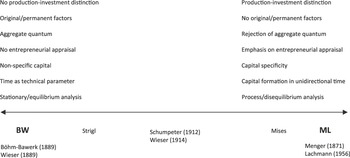
Our illustrations and broad comparisons in the foregoing section establish that Austrian theories of capital and its structure are not monolithic. There is a substantial degree of variation regarding ontological commitments about capital and the analytical methods suitable for gaining knowledge about it (i.e., there are significant methodological and epistemological differences). Micro-level analysis of capital predominated among the Austrians, except for Schumpeter (Reference Schumpeter1939), Strigl (to a certain extent), and Hayek, for whom capital (and investment) were analyzed with macroeconomic problems in view. With the micro-level analyses, there are two polar extremes: the Böhm-Bawerk/Wieser (Reference Wieser and Malloch1889) (BW) trajectory of thought; and the Menger/Lachmann (ML) trajectory . These poles are antithetical to each other in terms of the ontological, methodological, and analytical criteria set out in Table 1. (See Figure 1.)
A continuum of micro-theories of capital from Menger to Lachmann

Between these two poles on the micro level, there is a gradient of theories, with different theories bearing different degrees of similarity to these two prototypes. According to Figure 1, there is a continuum of theories. For example, Strigl’s approach is almost completely like BW’s except for one criterion: he accepts the real production/monetary investment distinction whereas BW does not. Similarly, von Mises is almost completely like ML except for his acceptance of original and permanent factors of production. There is middle ground between the two poles occupied by Wieser (Reference Wieser and Hinrichs1914) and Schumpeter (Reference Schumpeter1912). In Figure 1, these two theories are depicted as occupying a point halfway along the continuum in the sense that they are assorted mixes of the extremes on the listed criteria. Both Wieser and Schumpeter changed direction regarding their ontological commitments to the role of entrepreneurship in capital formation. Wieser’s (Reference Wieser and Hinrichs1914) more institutional work injected the entrepreneurial element, whereas Schumpeter’s (Reference Schumpeter1939) macro-level contribution made the opposite move and de-emphasized that element. However, in spite of these differences, they moved in a similar direction in rejecting stationary equilibrium approaches in favor of a more dynamic approach that relied on a unidirectional notion of time.
As with all attempts to classify authors’ treatments of capital (as in our Table 1 and Figure 1), we are mindful that some generalizations are implied; they may seem like a Procrustean bed onto which each treatment is fitted. In this connection it may be noticed that our summary classifications in Table 1 and Figure 1 mask some quite subtle differences in the Austrian tradition. In fact, classifying our selected texts according to whether they aggregated capital into a “quantum: stock/fund” (column 5, Table 1) was rather problematic, particularly in the case of Hayek. Aggregation is not an either/or matter. There were different degrees of capital aggregation accepted among the Austrians. The issue of aggregation was a central point of ontological difference on capital and its structure; it was interrelated with some of the other broad differences we have identified. Accordingly, this question deserves elaboration.
Following Wimsatt (Reference Wimsatt1997, pp. 375–377; 2006, pp. 675–676), there are specific conditions that must be met for a phenomenon to qualify as a mere aggregate of its parts. Here we shall proceed by paraphrasing Wimsatt with an application to capital. Capital aggregativity can be classed in the following four senses:
1. Intersubstitution: the property (value, quantity) of capital stock is constant under operations that rearrange or substitute for its parts;
2. Size scaling: the capital stock does not change its qualitative characteristics as it changes in scale; that is, as capital goods are added or subtracted from the capital stock;
3. Decomposition/re aggregation: the properties of the capital stock remain invariant or stable under operations that decompose and then reaggregate its parts;
4. Linearity: there are no cooperative or inhibitory interactions (or network effects, complementarities, economies of scope, etc.) among capital goods that affect the properties of the capital stock.
According to Wimsatt, these four conditions are separately necessary and jointly sufficient for aggregativity; they define the limit for the absence of structure in capital. Thus, aggregativity “is the complete antithesis of functional organization” (Wimsatt Reference Wimsatt2006, p. 675). If capital were a fully fledged aggregate, the properties of the whole would be nothing but the sum of the properties of the parts. Furthermore, to be aggregative, the properties of capital “would have to depend on its parts’ properties in a very strongly atomistic manner under all physically possible decompositions” (p. 675).
Now the capital ‘stock’ of ML fails to meet the conditions of aggregativity just described. The properties of the capital ‘stock’ depend vitally on its mode of organization and interaction. The ML conception fails to meet condition (1) above because the properties of the overall capital structure are affected by rearrangements and recombinations of capital goods, and the heterogeneity of capital goods means that the overall structure is affected by substitutions between capital goods; it also fails to meet condition (2) because the overall capital structure becomes increasingly complex as capital accumulates—it is not just a scalar magnitude that increases in value as the number and value of capital goods increases; it fails to meet (3) because the properties of the overall capital structure are not invariant to decomposition operations and corresponding reaggregation (e.g., path dependencies); and it fails to meet (4) because there are material interactions (e.g., economies of scope) between capital goods in capital combinations that affect the properties of the overall capital structure. Interactions between capital goods and the way they are ordered in specific combinations matter. It is in all these senses that, for ML, capital has structure and cannot meaningfully be considered in a purely aggregative manner, at least in reality.
Hayek is less consistent and thoroughgoing than ML in his rejection of capital aggregates. For instance, he says that capital can have an “expected aggregate value” (Hayek Reference Hayek1941, p. 11). Yet, he objects to the idea that “the aggregate value of capital should remain constant” (Hayek Reference Hayek1935, p. 243). That is, he believes that capital fails Wimsatt’s first condition above. He argues that it is legitimate to conceive of capital as an aggregate for some analytical purposes and under some decompositions: he mentions “the stock of capital” and the “stock of real capital” and the “stock” of impermanent resources” (Hayek Reference Hayek1934, pp. 207, 226, 231). Even here he recognizes that capital meets only some of the conditions of aggregativity—very approximately, some of the time and under certain conditions. Most significantly, and reflecting a clear departure from treating capital as pure aggregate, Hayek claims that the relevant properties of the overall capital “stock” do indeed depend on their mode of organization. The structure and composition of the capital “stock” or aggregate do matter for the understanding of business cycles. Moreover, Hayek rejects a focus on the whole at the expense of its components. He regards the “stock” as rooted in the properties of its parts, as explainable in terms of them, and he urges us not to think of the capital aggregate as a magnitude independent of the value of the real capital goods of which it consists (Hayek Reference Hayek1935, p. 243). Capital is not a “‘quantity’ ... which could be regarded as a ‘datum’ and which ... could be substituted for the purposes of economic analysis, for the fuller description of the concrete elements of which it consisted” (Hayek Reference Hayek1941, p. 5). The textual evidence in Hayek comes out overwhelmingly against treating capital as maintaining itself intact, or being completely mobile, malleable, without direction, or being in reality, a homogeneous, aggregate mass. More especially in changing conditions, to assume that “capital will be maintained constant in any quantitative sense is to assume something which will never happen … in the real world” (Hayek Reference Hayek1936, p. 216). Altogether, although Hayek uses the term “aggregate” in his work on capital, we find that he does not mean that capital is a fully fledged aggregate. For these reasons we consider that he does not subscribe to the view that capital is an aggregate quantum (column 5, Table 1).
V. SIGNIFICANT CONTEMPORARIES OF MENGER ON THE NATURE OF CAPITAL: THREE CASE STUDIES
Our objective in this section is to consider representative cases of Austrian, Neoclassical, and Institutionalist approaches to capital among Menger’s contemporaries. We choose three major contributors, respectively: E. Böhm-Bawerk, J.B. Clark, and T. Veblen. Both Clark and Veblen took Böhm-Bawerk’s capital concept more seriously than Menger’s, possibly because Böhm-Bawerk integrated his concept in a more complete theory of capital and interest (by comparison with Menger). Accordingly, Böhm-Bawerk’s was the most recognized and most influential “Austrian” approach; his main analytical conclusions were more attractive to contemporaries outside the Austrian tradition because of what they probably saw as Menger’s obita dicta on the subject. The debate between Böhm-Bawerk and Clark on capital concepts is instructive insofar as it illuminates how both writers differ from Menger’s and Lachmann’s ideas on the subject. The same comment applies to the reactions of Veblen to Clark’s ideas and Veblen’s alternative concept.
Case I: Böhm-Bawerk
Böhm-Bawerk followed Menger’s vision of capital only to a limited and quite superficial extent (Lewin Reference Lewin and Boettke1994, pp. 210–212; Endres Reference Endres1997, pp. 162–170). He envisions a time structure of production in which capital plays a role. However, this structure differs from Menger’s. Unlike Menger, Böhm-Bawerk proposes that all capital goods must be concrete instruments of production: “I know no capital other than concrete goods which constitute it; and I believe the world of facts knows no other.” So capital at the ontological level of empirical patterns (classified generic entities) consists in “mills, looms, ploughs, locomotives” (Böhm-Bawerk Reference Böhm-Bawerk1895, p. 21). Capital is defined not by its perceived, prospective value in the minds of entrepreneurs; it is instead defined by its completely objective, external manifestations and given functions. For example, those functions are to variously “grind corn, spin yarn or plough up land or carry a load” (Böhm-Bawerk [1889] Reference Böhm-Bawerk1923, pp. 58, 63–64, 76). This vision is not forward-looking insofar as it takes for granted both the mode of use of specific capital goods and future consumer valuations for the outputs (corn, yarn, the produce of plowed land, transport services, etc.) of capital.
In terms of actual patterns of events, production may be observed to take place over varying stages; it may exhibit a “roundabout” rather than direct character. Stages of production and, hence, the nature of capital in production are determined by the “technical nature” of the heterogeneous instruments of production (Menger’s capital goods). Böhm-Bawerk ([1921] Reference Böhm-Bawerk1959, p. 107) characterizes the degree of roundaboutness of production in terms of a time structure. Capital will be composed of specific sets of capital goods (e.g., a set comprising highly integrated things in a steel mill), and the time period for delivery of outputs will be given relative to other modes of steel production. As well, the time period for the use of any set of committed capital goods before they completely depreciate will also be given. A steel mill production set will enable a longer period of production, and may be superior to other capital goods-sets simply because it can produce more output for longer.
The use of capital is undertaken at one remove from the everyday, common-sense notion of capital as a productive sum of money. The structure of capital is manifested in the technical functions and vintages embodied in capital goods. These vintages are not caused by mental entities; that is, by entrepreneurs’ representations and imaginings concerning modes of possible use and the prospective value of outputs. Certainly, entrepreneurs can alter the mode of production and the distribution of capital goods in a production process since they are continuously making multi-period, alterable plans (Böhm-Bawerk [1921] Reference Böhm-Bawerk1959, p. 112). However, the forward-looking element in Böhm-Bawerk’s multi-period analysis of capital is only superficial. Inside every capital good is a natural, technical function waiting to be born. Böhm-Bawerk’s entrepreneur acts as a midwife for the forces of nature—the “originary productive forces” embodied in all capital goods (Böhm-Bawerk [1921] Reference Böhm-Bawerk1959, p. 95).
As for the role of time and the time structure of production in Böhm-Bawerk’s scheme, it is both contained in, and derived from, the specific functions of a capital good. His conception of “time” implies objective historical “lock in” by dint of the roundabout functions of durable capital goods, as if the goods could not be scrapped or used for different purposes not intended by their original design. A durable capital good used in a production process would embody not only the original forces of nature; it would also contain time in two senses. It takes time to convert natural forces into durable capital goods and time to use those goods to produce consumer goods. Time is a measurable, corporeal element contained in any capital. Entrepreneurs choose the degree of roundaboutness required; it is a time variable subject to a given fund invested in capital goods. Capital in this view is “congealed waiting” (Kirzner Reference Kirzner1996, p. 82). Once the capital good is chosen, it determines a production period. Capital is, therefore, an aggregate stock (of past waiting) governing the future course of the economy. If entrepreneurs’ forward-looking dispositions are evident at all—for instance, as in expectations of future consumer valuations of the products of capital— these expectations are regarded as constant (Lewin Reference Lewin and Boettke1994, p. 212).
Our discussion of aggregates in section IV above is helpful here. Böhm-Bawerk and his followers (notably Strigl) conceive of aggregate capital in which the properties of the stock or fund of capital are derivable from a measure of some common properties of the individual parts; those common parts do not interact with one another in a relevant or material way such as to change the nature of the aggregate. Capital is just an aggregate of past, congealed waiting. They also conceive capital in terms of an ‘average period of production’ that denotes the capital intensity of production. The average measure in homogeneous units of time increases as capital accumulates. This conception is entirely consistent with Wimsatt’s (Reference Wimsatt2006) second condition of aggregativity: size scaling or qualitative similarity of the system property, so that the average period of production is a quantitative property of the capital stock or fund differing only in value as capital accumulates. So although Böhm-Bawerk appreciates that capital goods are heterogeneous, his approach amounts to an “attempt to reduce this ‘complex’ [capital structure] to a common denominator and to measure all changes in it in a single dimension” (Lachmann Reference Lachmann1956, p. 73). (Similarly Hayek [1936, pp. 218–219] complained that Böhm-Bawerk “went astray in assuming … that the quantity of capital was a simple magnitude, a homogeneous fund of clearly determined size.”) The unidimensional measurement technique is imposed on a complex of heterogeneous capital goods and capital goods combinations that, from a ML perspective, have irreducible internal and external connections and structure. Böhm-Bawerk’s measurement technique summarizes objectively given features and functions of capital goods; it is not the result of market processes or entrepreneurial appraisal.
We observed in section III, Table 1, that Böhm-Bawerk’s concept of capital seemed suitable for stationary state analysis. He had in mind a particular kind of stationarity, one that was founded on inconsistent aggregativity. In overlaying unidimensional measurement on a complex multidimensional phenomenon that comprises heterogeneous capital goods exhibiting internal and external complementarities, he diverged from the ML trajectory of thought on the subject. Erich Streissler (Reference Streissler1969, p. 254) also noticed the inconsistency: the Böhm-Bawekian
supermodel … can best be described as the bastard stationary state, a stationary state in which aggregates remain constant while their structures change, in which only variances but not aggregates are parameters of thought.… Unhappily this is likely to be a model self-contradictory in the last resort, because a change in economic variance tends to reflect back on the values of the averages (italics in original).
The Austrian predilection for thinking in terms of changing structures extends to analyzing changes taking place within aggregates (Streissler Reference Streissler1969, pp. 239, 243). Unidimensional measurement procedures are incongruous in this context; they produce “undifferentiated aggregates” (p. 253), and thereby minimize appreciation of variances within aggregates and their impact on the whole. Contra Böhm-Bawerk, the ML perspective is an exemplar of consistent, unwavering focus on the nature and consequences of variance or dispersion in economic magnitudes, such as capital.
Lachmann’s (Reference Lachmann1956, pp. 79–80) assessment of the role of time in Böhm-Bawerk’s scheme is worthy of elaboration here. Two major objections are entered that have Mengerian connotations. Firstly, time was allowed for in Böhm-Bawerk’s well-known “roundabout” notion of capital; durable capital possessed “productiveness” that extended over time. Böhm-Bawerk’s capital possesses features of order in time, but it is descriptive of a world where “knowledge is equally shared by all” entrepreneurs; it is an entirely predictable “world of restricted progress, of progress in only one direction” exclusively dictated by the roundabout, technical functions embodied in durable (often indivisible) capital goods (p. 79). Secondly, Böhm-Bawerk overlooks the point that “complementarity plus indivisibility” are necessary for capital making (Lachmann Reference Lachmann1956, p. 80, his italics). A durable, indivisible, capital good will normally lengthen a period of production and promote higher productivity. Such a roundabout production process is time consuming. Yet, the fact that time is consumed is not the defining characteristic of capital. Time is indeed a dimension of capital, though “by itself it is not productive, nor is any human action necessarily more productive because it takes longer” (p. 84). A capital good could easily lose its “capital character” and become scrap in a plan that is extended in time and that is imperfectly referenced to, and yet intricately connected with, the plans made by others. So there is nothing entirely predictable about the nature of the capital structure of an economy dominated by a long, complex, changeable assemblage of production processes that use so-called Böhm-Bawerkian “‘original factors’ … [and that] change their physical shape on their journey towards the consumer” (p. 80). Capital does not always imply a definite, invariant time period of production; it may lead to production processes varying in time and with economic progress.
Böhm-Bawerk’s “capital” is always a product of original factors: nature and labor. He separates private capital from “social capital.” The latter is a stock of all possible and available capital goods; it has completely independent existence and resides in a “natural store” (Böhm-Bawerk [1921] Reference Böhm-Bawerk1959, pp. 63–64, 74). Here, in the most abstract representation, Böhm-Bawerk attributes capital status to anything that conceivably has an inherent, natural capacity to produce something. In summary, at the deepest ontological level, Böhm-Bawerk’s capital concept is founded on the idea that capital has productiveness that, in turn, is the result of the external, indestructible offerings of nature and waiting (time).
Case II: J.B. Clark—Capital Is a Perpetual, Amorphous Substance
At least in one respect, more like Menger than Böhm-Bawerk, John Bates Clark believed capital was something other than merely the product of nature and labor. While concrete things constitute capital, capital is something much more than a stock of potentially combinable things. Clark (Reference Clark1888) demonstrates full awareness of the common-sense notion—capital is a sum of money invested in capital goods such as land, buildings, machinery, and so forth. Capital may be considered a mere quantum of value such as the capitalized present value of the future net products of capital goods.Footnote 14 That capital is productive and yields a net product, often represented as a monetary sum such as rent or interest, is assumed rather than proven. It is an assumption deriving from the empirical realm. Capital goods may be different but their value can be aggregated. In fact, Clark’s capital concept satisfies all the conditions for pure aggregativity specified by Wimsatt (Reference Wimsatt2006), as discussed in section IV above. Moreover, Clark seemed to regard the aggregativity of capital as truly real and existent.
Böhm-Bawerk (Reference Böhm-Bawerk1907, pp. 253, 255) vigorously disputed Clark’s concept. The presumption of capital’s possessing independent, objective productivity (from nature and labor) is implicit in Clark’s discussion. Since, for Böhm-Bawerk, present capital goods are produced by the combination of past labor (and nature), the net product or value for current “cooperating capital goods” is not so straightforward to compute, and certainly not so easy to represent as a mere quantum of value. On the most abstract ontological level, to conceive of capital as a separable “fund of value” is without warrant; it gives capital certain “magical qualities.”
John Bates Clark attributes economists (and sophisticated capitalists) with an ability to think on a much deeper level about the nature of capital. In the most abstract sense, capital is represented “as a fund that is permanently [owned], though it may not retain for a single day its exact present form of embodiment” (Clark Reference Clark1888, p. 9). Since capital goods depreciate, they must be replaced by reinvestment. Capital, at least in the sense it is employed in economic science, is conceived as “an abstract fund, the destiny of which is to migrate through an endless series of outward forms” (p. 10). Now, this definition does not gainsay outward, external manifestations of capital in the minds of its owners who may see and represent their capital in terms of material assets. Capital is indeed commonly conceived as a collection of productive instruments, a quantum of wealth, and so forth, but at a deeper level it is a perpetual fund or substance embodied in the chosen material instruments that produce goods. This substance resides “longer in some forms [of capital goods] than in others. It remains for an instant in steam, and for an hour in the fuel that generates it. It stays for weeks in unfinished products and for years in the machinery that makes them” (pp. 14–15). Clark insists on economic science’s using this “primary notion of capital” as a permanent “substance.” A complete theory of capital could not, in his view, otherwise be developed.
Böhm-Bawerk (Reference Böhm-Bawerk1907, pp. 280, 282) took the view that Clark’s ontology of capital was not based on realistic foundations; it was not consistent with the “facts.” Clark had produced a “mythology of capital”; he “strips off everything which may suggest material existence, and retains only a value jelly, existing externally, never destroyed.” By contrast, Frank Knight (Reference Knight1916, n282) regarded the Clarkian concept as a virtue because it gave capital a “metaphysical essence persisting through material forms”. Moreover, according to Knight (Reference Knight1933, p. 338), Clark’s idea rendered capital “inherently immortal” in a growing economy. This conception of capital contrasts starkly with Menger’s ontology of capital because it suggests mind-independence and the unimportance of human agency.
Doubtless, Clark comes close to apprehending capital as a macroeconomic phenomenon in that he represents capital in an economy as a whole as an amorphous substance that is perfectly mobile and can be valued. This substance is ultimately a quantum of value that “imparts utilities” to gratify the “nervous sensibilities” of those who consume the products of capital (Clark Reference Clark1899, pp. 144, 150). To be sure, there is an assumption of one-way causation in all this. The physical features of capital goods, such as machinery, vehicles, buildings, are combined in a process that makes use of useful elements furnished in nature. Some capital goods actively “subjugate” nature whereas others (e.g., cotton, raw materials, grain) are passive elements in production. That production may take time is a truism for Clark. The passage of time has no significance for the most abstract notion of capital since true capital is a permanent, mobile, impalpable substance. Correspondingly, the changing structure of production represented by an “endless series of outward forms” in capital goods, their mode of use, their depreciation and reproduction, is irrelevant for developing a scientific understanding of the “true” nature of capital (pp. 143–144).
Case III: Veblen on Capital as a Social Artifact
The institutional economist, Thorstein Veblen, also reacted to Clark’s capital concept in a manner quite similar to Böhm-Bawerk. Veblen objected to the dearth of ontological realism in Clark’s “permanent substance” idea. For Veblen, Clark’s capital was a fiction. Capital must instead be conceptualized as an artifact primarily of social-anthropological significance. In the capitalist exchange economy, capital reflected “a habit of thought of the men engaged in business [and] more or less closely defined in practice by the consensus of usage in the business community” (Veblen Reference Veblen1908b, p. 113). There were “material forces” in existence for all humans to consider and use, though Veblen avoided saying that these forces were original or permanent factors of production (1908b, p. 542).
Three ontological levels are distinguishable in Veblen’s alternative to Clark’s concept. Firstly, participants in everyday business activities “know what the term [capital] means to them”; it was always for them a monetary phenomenon computed according to some habitual accounting standards.Footnote 15 Capital in this view is something that has income-yielding capacity and can be “capitalized” (pp. 111, 121). So far this view accords with Clark (and Irving Fisher). Secondly, capital was the outcome of a convergence of habits, a consensus of minds that matters in creating and recreating capital. Capital does not exist independently of some social mind. Capital possesses characteristics that are emphatically “not physical marks”; that is, it does not have external, objective existence (p. 114). Long-term changes in the organization of the monetary exchange economy, changes in the social context in which capital is thought of and calculated over, necessarily changes habits of thought and the consensus over its meaning. The processes involved in the formation of consensus remain opaque in Veblen’s treatment. Third, in the most abstract realm, capital transcends and predates capitalistic forms of economic organization and calculation; it also predates modern accounting methods turning on the notion of capitalization. Capital is conceived as congealed knowledge (contrasting quite nicely with Böhm-Bawerk’s idea of congealed waiting and Marx’s notion of capital as congealed labor). Capital, in Veblen’s view, is the knowledge of technical functions in the sense of “ways and means” already embodied in the chosen instruments of production. Such knowledge is built up from long experience and experimentation; it is society’s “technological heritage.” Alternatively stated, capital is the “stock of knowledge and practices … perhaps held loosely and informally” in a particular community; as a macro-social phenomenon, it was fundamentally intangible (Veblen Reference Veblen1908b, pp. 519, 521, 535–536).Footnote 16
It could be maintained that all the instruments of production would not be regarded as conceivable without the stock of technical wisdom, the pivotal knowledge of functions making production possible. Veblen (Reference Veblen1908b, pp. 540–542) relegates capital goods to the stock of “raw materials,” the land, minerals, and the “brute energies of mankind.” These may become “valuable property and may be counted among the assets of a business. But the value which they so have is a function of the anticipated use to which they may be put, and that is a function of the technological situation.”
From a Mengerian perspective, Veblen’s “knowledge of ways and means” and “common stock of immaterial assets” (Veblen Reference Veblen1908b, p. 532) are all about functional capacity. Knowledge of function is another capital good and does not represent the Mengerian ‘genus’ capital. That Veblen’s ‘capital’ has functional capacity to produce outputs does not go far enough; it is not the same thing as proposing that capital is something that is formed and structured by entrepreneurs’ production plans that in some manner exploit or even transform this capacity. If Veblen’s knowledge extends to knowing how to create combinations of capital goods with a specific economic purpose in view, then there is no way such knowledge can be embodied in the physical goods chosen. In addition, at any time Veblen’s capital is a stock of knowledge; there is an existing quantum of capital even though it is ‘immaterial.’ This notion of capital implies, contra Menger and Lachmann, that the historical origin of a resource matters; it also implies a minimal role for individual human agency. Moreover, Veblen’s concept does not capture the time structure and layered nature of capital that distinguishes Menger’s concept.
VI. SUMMARY AND CONCLUSIONS
What, then, are the main factors explaining the quite different approaches to capital in the Austrian tradition from Menger (Reference Menger1871) to Lachmann (Reference Lachmann1956)? Certainly we can agree with Kirzner’s (Reference Kirzner1996, p. 43) general observation that “The multiplicity of different formulations of the capital concept attest not only to the elusive nature of the concept itself, but even more importantly, to the innate complexity of the economic relationships hoped to be elucidated with the aid of this concept, or rather these concepts.”
Menger offered some programmatic directives on the way economists should formulate their fundamental concepts by asking what they refer to in reality. The Mengerian directive was to start by explaining capital in terms of its nature, existence, and its real elements of shape, form, and structure. J.B. Clark’s concept was understandably regarded as a mythology by the Austrians because they conceived of capital from the outset as fundamentally irreducible and structured by human agency.
All the Austrian economists surveyed here attempted to formulate capital concepts with a broad structural idea in view; that is, they based their work on the Mengerian idea that the term capital referred to the “order of goods” in actual production. Armed with this deceptively simple idea, they all penetrated to the heart of the complexity of capital, as they understood it, and its associated relationships with other economic phenomena. For the Austrians, the elemental building blocks of capital possessed a fundamental hierarchical make-up. The majority of the writers surveyed above considered this make-up irreducible; it was not an amorphous mass. Increasingly as they absorbed other traditions of thought on the subject, or became enmeshed in contemporary debates with the Clark–Knight or neoclassical view of capital, later Austrians modified Menger’s original doctrine. Often they were faced with adopting different assumptions because the domains of their analyses were extended beyond Menger’s interest in the micro-analytics of capital. We found that Böhm-Bawerk (1889) and Wieser (Reference Wieser and Malloch1889) took a thoroughly non-Mengerian position on the nature of capital and its workings (they get opposite scores to Menger on every analytical and methodological criterion in Table 1). This result is consistent with previous commentaries.
In the twentieth century, a growing desire to envision an aggregate commonly called a ‘capital stock’ or ‘fund’ was supposed to assist the measurement of the degree of capital intensity in industries and in the economy as a whole; it also supposedly enabled economists to trace movements of the ‘stock’ in macro-level studies of business cycles. Whether specific measures of capital were proposed by Austrian economists, this desire is reflected in the work of Böhm-Bawerk and Strigl and indirectly in Schumpeter’s empirical work on business cycles. The motivation to accept some notion of capital stock may have been to repudiate the idea that heterogeneous capital is just an arbitrary collection of goods used to produce other goods. In the Menger–Lachmann line of thought on capital, the purposes, valuations, and actions of entrepreneurs in fact give capital an ordered rather than either an aggregative, ‘stock-like’ form or an arbitrary appearance. That individual valuations (and, thence, expectations) are inconsistent makes it difficult to use these as the foundations for deriving meaningful aggregate measures of capital; capital is not meaningfully reducible to a single measure either in terms of a macro fund of value, or time units per se. Moreover, as Hayek maintained, intertemporally inconsistent expectations and valuations are necessary for the creation of new capital and the scrapping of old capital goods. In this Hayek took a weak position on the aggregation of capital relative to the strong, non-aggregative, emergent, structural view of Menger and Lachmann.
As originally proposed by Menger, some Austrian economists adopted a ‘realist’ approach to capital. Four often-repeated themes are identifiable on this subject:
1. All capital has structure from the outset; it is a structure, at least in a non-stationary economy that is not always fully synchronized or coordinated;
2. Capital combinations require entrepreneurial judgment;
3. Capital has real causes; that is, end-user requirements for the products of capital are anticipated by forward-looking entrepreneurial plans;
4. Capital is not a passive factor of production; it has real consequences in a non-stationary economy such that capital goods are not costlessly or timelessly remolded, it is not permanent or forever maintainable intact, and it is often scrapped with profound real economic consequences.
The complete rehabilitation of Menger’s ideas had to wait until Lachmann (Reference Lachmann1947, Reference Lachmann1956), as is clear from their perfect alignment on all the dimensions in Table 1. Nevertheless, three major distractions from the micro-structural issues raised by Menger’s approach became evident in the twentieth century: (i) the need for a capital concept suitable for business-cycle research and macro-level problems; (ii) strongly aggregative reasoning in terms of the “capital stock” in industries or in national economies as a whole; and (iii) growing twentieth-century empirical concerns with macroeconomic and national aggregates in which capital became a counterpart of quantifiable aggregates such as savings and investment. In some ways these research preoccupations retarded the development of Menger’s original vision.
One of the more unfortunate consequences of allowing far greater alignment with both macro-level empirical work and neoclassical, Clark–Knight approaches was progressive blurring of several unique Mengerian insights. Chief amongst these insights is the view that capital is always in reality a structure as opposed to a structureless substance that could be subject to a single measure. Capital in the Mengerian system was formed in an entrepreneurially driven process. The analytical context was a non-stationary economy in which markets were in a continual state of disequilibrium. In these conditions two seminal Mengerian ideas commend themselves: the hierarchical (or layered) “order of goods” in a production structure; and the notion of diverse and changeable capital specificities.