Conceptualisation
Workplace bullying has no single, agreed definition; however, although the area is still in a state of denotative hesitancy – that is having a lack of clear definitions – (Lutgen-Sandvik & Tracy, Reference Lutgen-Sandvik and Tracy2012), some key themes have emerged (Einarsen, Hoel, Zapf, & Cooper, Reference Einarsen, Hoel, Zapf and Cooper2011). These themes are associated with repeated, hostile acts that are harmful to the recipient, which, in turn have been used to define bullying in this study (Thirlwall, Reference Thirlwall2011). A diverse range of acts or behaviours may constitute bullying, including overt examples, such as shouting, rudeness, belittling, and aggressive gestures, through to more covert acts of ostracism and exclusion (Keashly, Reference Keashly1998). Harm is a vital feature of bullying because recipients may interpret the same behaviours in quite different ways, so without harm bullying cannot exist (Lee, Reference Lee2000; Namie & Namie, Reference Namie and Namie2000; Quine, Reference Quine1999; Randall, Reference Randall1997). Harm may be both psychological and physical, and typically targets experience symptoms associated with stress, such as distress, headaches, and nausea (Davenport, Schwartz, & Elliott, Reference Davenport, Schwartz and Elliott1999; Field, Reference Field1996; Namie & Namie, Reference Namie and Namie2000; Needham, Reference Needham2003), insomnia, inability to concentrate, and in some cases post-traumatic stress disorder (Lee, Reference Lee2000; Leymann, Reference Leymann1990). Persistence is also a defining feature of bullying, so behaviours need to be recurrent and on-going (Einarsen, Reference Einarsen1999; Field, Reference Field1996; Keashly, Reference Keashly1998; Lee, Reference Lee2000; Namie & Namie, Reference Namie and Namie2000). Consequently, workplace bullying has been identified as a significant workplace hazard (Bentley, Catley, Cooper-Thomas, Gardener, O’Driscoll, & Trenberth, Reference Bentley, Catley, Cooper-Thomas, Gardener, O’Driscoll and Trenberth2009).
Organisational responses to allegations of workplace bullying have received more limited attention from academics. Process models from Leymann (Reference Leymann1990) and Lutgen-Sandvik, Reference Lutgen-Sandvik2003 noted that management responses did not address the cause of bullying or resolve the resulting issues, and ultimately the target of bullying would leave the organisation, possibly after long-term sick leave, by dismissal, or some other arrangement, while the perpetrator of the situation would remain and would subsequently bully other targets. Subsequently, a study in Finland, where there is a legislative requirement to remedy workplace bullying, indicated a diverse range of outcomes for both the perpetrator and the target, including discussions with both parties, dismissal or other sanctions for the bully, if allegations are serious and founded, counselling of the target and the bully, and occasionally taking no action at all (Salin, Reference Salin2009).
Elsewhere, where there is no specific legal requirement to manage bullying, a less positive range of outcomes has emerged. In the United States, Cowan (Reference Cowan2011, Reference Cowan2012) noted that the absence of a definitive policy on how to manage the issue when it was not illegal, (i.e., unlike sexual or racial harassment) resulted in it being viewed as a low priority and, furthermore, HR workers appeared to be confused by the range of terminology used to describe acts synonymous with bullying. A study in the United Kingdom noted that the professionalisation of HR has led to practitioners viewing themselves as strategic organisational partners rather than welfare workers, resulting in complaints being treated as outside their remit (Harrington, Rayner, & Warren, Reference Harrington, Rayner and Warren2012); while in India, organisations encouraged employees to view complaining about bullying as unprofessional behaviour on their own part (D’Cruz, Reference D’Cruz2012; D’Cruz & Noronha, Reference D’Cruz and Noronha2010), with the result that problems remained unacknowledged by the organisation and unresolved. Similarly, Bishop, Korczynski and Cohen (Reference Bishop, Korczynski and Cohen2005) noted that managers in a UK organisation deflected responsibility for threats of violence from customers in the workplace by attributing it to, among other things, employees’ lack of skills, resulting in underreporting and consequent invisibility of the problem.
Organisational responses, such as those noted in the preceding paragraph, are important because they influence the degree of harm experienced by the target and the wider organisation (Ferris, Reference Ferris2004). Lack of support from the organisation is likely to result in employees feeling less confident about their situation (Djurkovic, McCormack, & Casimir, Reference Djurkovic, McCormack and Casimir2008), and more likely to report feeling bullied (Bilgel, Aytac, & Bayram, Reference Bilgel, Aytac and Bayram2006). Workplace environments deteriorate following bullying, and this negative climate is likely to provide a suitable setting for yet more inappropriate behaviour (Zapf, Reference Zapf1999), especially if would-be bullies perceive a low risk of being censored for their actions (Salin, Reference Salin2003), so the need for effective responses from organisations is vital (Lewis, 2001; Woodrow & Guest, Reference Woodrow and Guest2014). In order to identify responses to workplace bullying in New Zealand, this paper addresses the research question:
How do organisations respond to requests for help with workplace bullying?
Methods
Interview data were collected from 40 participants, including 27 volunteers – academics, managers, technicians, administrators – and 13 HR workers from Institutes of Technology and Polytechnics (ITPs) in New Zealand. I chose this group because workers in the education sector may experience high levels of bullying (Leymann, Reference Leymann1996; Zapf, Knorz, & Kulla, Reference Zapf, Knorz and Kulla1996) and it has been noted that New Zealand has a greater prevalence of bullying compared with Europe and the United States (Thirlwall & Haar, Reference Thirlwall and Haar2010); therefore, finding interesting examples of the phenomenon was more likely.
The use of semi-structured interviews allowed relevant, emergent themes to be further explored and gave breadth to the interviews, while keeping a focus on the subject area. Interviews lasted 2 hr on average. Interviewees volunteered to participate via a website and the selection criteria included working, or having worked at an ITP. The volunteers were a purposive group that wanted to contribute experiences or views of bullying at work (Nielsen & Einarsen, Reference Nielsen and Einarsen2008; O’Leary, Reference O’Leary2005); however, it transpired that all had been targets of bullying according to the conceptualisation used in this study. HR workers were nominated by organisations participating in the study and they were asked to explain their organisations’ approach to managing bullying, but four HR workers also described being targets of bullying at work, so their experiences were added to the volunteers’ responses, which resulted in 31 sets of bullying experiences.
Ethical approval for the study was gained prior to its commencement. All participants received an information sheet describing the scope of the study and their rights, and a consent form to sign. Confidentiality was assured and all identifying data has been changed to protect the participants. I provided a plan for managing the potentially disturbing nature of the interviews, and when participants became distressed I reminded them of their right to stop the interview and answered their questions about where to find support, such as counsellors, medical practitioners, self-help books, and Employee Assistance Programmes, as recommended by Oakley (Reference Oakley1988).
I digitally recorded the interviews, transcribed them verbatim, then loaded the transcripts into NVivo for thematic analysis to explore, among other things, the ways organisations responded to reports of bullying. Thematic analysis is a qualitative approach used for ‘identifying, analysing and reporting patterns in data’ (Braun & Clarke, Reference Braun and Clarke2006, p. 79), and by using sections of data incorporating multiple occurrences of the same thread of meaning themes and subthemes developed. Although the coding was inductive, or data-driven, in that it relied on the content of the interviews, existing literature had sensitised me to the elements of the process of workplace bullying (Bowen, Reference Bowen2006). I reread the transcripts, as recommended by Braun and Clarke (Reference Braun and Clarke2006), and recoded to correct initial miscoding, adding further codes where appropriate. I wrote memos that noted the links and similarities between the examples of behaviours the interviewees mentioned (Emerson, Fretz, & Shaw, Reference Emerson, Fretz and Shaw1995). The design of themes and subthemes went through several iterations as I grouped and regrouped the responses to avoid duplication and redundancy. I validated and refined the themes by having three colleagues check the coding. This process confirmed that saturation had taken place (Glaser & Strauss, Reference Glaser and Strauss1999).
This paper focuses on the range of responses targets said they received when they sought help or raised concerns about workplace bullying, and HR workers’ descriptions of their own responses to such complaints and concerns. These responses were grouped into a theme and this is labelled Organisational Sequestering. I chose the term Organisational Sequestering to reflect the ways in which targets said managers, HR workers, and sometimes union representatives, set aside or avoided problems rather than addressing them fully and resolving them. Previously, sequestering has been used to describe how targets of sexual harassment avoided taking action to resolve their situations, thereby contributing to its continuation (Clair, Reference Clair1993). In this study, the organisational response is examined, and broken into the subthemes of reframing, rejigging, and rebuffing, to reflect the approaches that emerged from the analysis, as discussed in the next section.
Results
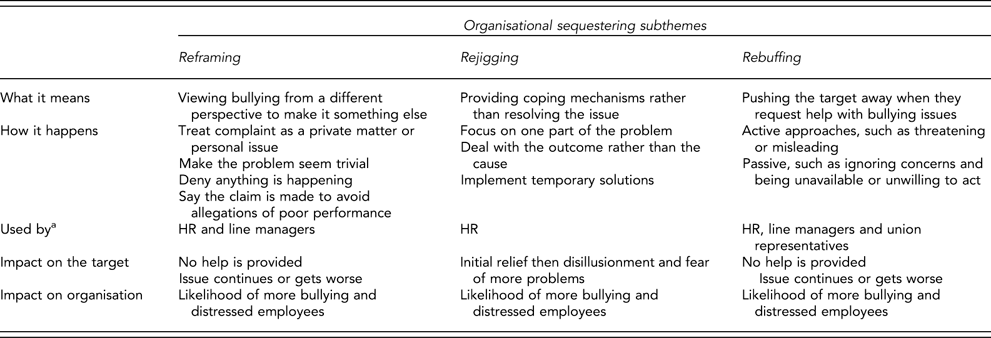
Interviewees and some HR staff reported the persistent use of various types of aggression, unfair work conditions, dishonesty, and ostracism against them as constituting part of their experience of workplace bullying. Several interviewees provided documentary evidence to support their claims, despite this not being requested, and it transpired that when they tried to take action to resolve their difficulties their complaints were routinely set aside or sequestered in some way by their employers and union representatives. Organisational sequestering manifested itself in three key ways: (1) reframing the issue, (2) rejigging the workplace, and (3) rebuffing the target’s complaints, with reframing being the most frequent and complex form. The findings are summarised in Table 1 then discussed in detail, with examples, in the following sections.
Approaches to organisational sequestering: Categorised responses to requests for help to resolve workplace bullying issues

Note. The table shows the categories of organisational sequestering and the variety of approaches that emerged in the study. The details for each subtheme should be read from the top down.
a In this study, but other combinations may be possible.
Reframing
While frames provide patterns for understanding social relations (Fisher, Reference Fisher1997), reframing is a device for viewing situations and people from alternative perspectives (Clair, Reference Clair1993). In this study, reframing comprises the ways in which managers and HR used different perspectives to move the responsibility for bullying outside the organisation or to make the issues appear unworthy of consideration. Reframing occurred when organisations viewed targets’ complaints of bullying as being linked to their private lives or personal views, being easy to resolve or of no importance, denying the existence of bullying and, finally, claiming the target complained to deflect from other issues, such as disciplinary-type action. Both targets and HR workers provided examples of workplace bullying being reframed. These examples are further grouped into (1) reframing as a personal issue, (2) reframing as trivial, (3) reframing through denial, and (4) reframing as defence, as explained below.
Reframing as a personal issue
HR workers and interviewees provided examples of ways in which complaints about workplace bullying were reframed as personal issues. Some HR staff accepted that employees felt bullied but said that this was not due to organisational matters. For example, Kristy remarked ‘There is very rarely just bullying; there’s usually other things, if they’ve got health issues, if there’s been a death in the family, if their workload is particularly high. It tends to put them in a vulnerable place’. This comment appears to blame the complainant’s vulnerability and implies that other issues are at the root of the complaint. Reframing in this way sequesters the issues as personal matters rather than organisational problems, which removes the need for action by HR.
Another way of reframing as a personal issue emerged when several staff complained about a manager’s behaviour; HR worker Evelyn reframed their concerns by saying: ‘If you know the person and you know their background, you can see that it’s not deliberate, it’s kind of in their make-up, the background of that person. The intention is not to bully at all’. This comment suggests that the manager’s negative behaviour was excused as a matter of personal style by HR, rather than being something that the organisation should address, and the staff were at fault for interpreting it incorrectly. Similarly, when manager Rona tried to get help, HR told her: ‘There’s no bullying [here], there’s just misunderstandings and what you need to do is understand people’s personalities and some people do lose their temper before others. It’s a personality difference rather than bullying’. These examples suggest that HR reframed complaints of workplace bullying as the personal traits of targets and perpetrators rather than organisational issues. Reframing in this way removes any imperative for action from the organisation and places it back with the target.
Reframing as trivial
Some interviewees reported that when they aired their concerns with their managers, the responses suggested that the manager did not grasp the seriousness of the problem and did not understand why the target was upset. For example, Tiffany stated ‘My boss wanted me to resolve it over a coffee and directed me to go out with [the perpetrator] for a coffee’. Tiffany said this instruction distressed her greatly because her colleague had been aggressive and she was frightened of him, so it would take more than a simple chat over coffee to correct matters. Similarly, Harry, an HR manager, reported that one of his managers had told two staff members to ‘Go and have a beer and sort it out’, rather than addressing the underlying issue. Reframing removes the need for any official work by managers and HR, so it may appear to be an attractive option. In the short term, the organisation reduces the risk of mishandling the bullying case by deflecting in this way; however, in the long term this approach may backfire, as cases may become more complex and serious over time.
Trivialisation occurred in a slightly different way for two female interviewees who spoke of their experiences of bullying by female staff. In separate interviews about unrelated incidents, they both remarked that their managers appeared to reframe their problems as ‘women’s issues’, which took them out of the range of their male senior managers’ concern. For example, manager Sophia said she was being bullied by a subordinate but when she tried to tell her manager, she was unable to communicate, Sophia explained, ‘I did speak to my manager. When I outlined it to him, I could tell he wasn’t interested. He saw it as a sort of women’s thing, I think’. Rona reported a similar experience; she said, ‘The CEO knew that [my manager] was a bully but I think he thought it was just a catfight between two women’. Trivialising the issues meant interviewees were denied support and their negative experiences appeared to have been viewed as minor, easy to resolve, or women’s issues and thus unworthy of consideration.
Reframing through denial
Denying the existence of bullying emerged as a further form of reframing. For example, after HR told Rona there was no bullying at her ITP, she tried to get help elsewhere within the organisation. Rona said when she spoke with her manager, a member of the executive team, his response shocked her, she explained ‘I said “I’m starting to feel bullied” and he said, “Don’t use that word” and started screaming at me and he said, “Don’t say bullying; we’re not using that term at this institution”’. By refusing to use the term bullying, the senior manager made it much more difficult for Rona to communicate her issues. A different take on denial emerged through the comments of HR worker Freda, who said:
I just wonder whether a lot of what gets reported is really bullying. Quite honestly the people that they’ve described as bullies, I don’t think that they’re that kind of person, and I’m not usually a judge of character, but I’ve never met a manager who I would describe as really grumpy or highly strung.
In this example, Freda appeared to deny that bullying exists because she has not witnessed or experienced behaviour that she considered to be bullying. Indeed, she also framed it as if only grumpy or highly strung people are bullies. People who lack knowledge or experience of bullying are unlikely to understand its impact and consequently, invisibility occurs, that is, observers are unable to understand problems as individuals are experiencing them (Gilbert & Malone, Reference Gilbert and Malone1995). These examples suggest that invisibility may have been a factor in the responses, but also there may have been a deliberate effort to deny the existence of bullying.
Reframing as a defence
A final form of reframing is claiming that bullying is a defence mechanism or a way of deflecting attention from professional short-comings. For example, Freda believed people claimed to be targets to deflect attention from their poor performance; she stated ‘People who had known there was something coming up in the future, where their performance was to be questioned, have seen the approach as bullying’. By treating complaints about bullying as a response to being performance managed, Freda reframes bullying as being a defence mechanism. However, none of the interviewees referred to the performance management process in their stories, despite them providing many personal details during the confidential interviews, which suggests this might be reframing to provide HR and managers with a way of avoiding action and ignoring difficulties. However, not all problems were ignored and sometimes attempts were made to rectify situations. The next section discusses the ways in which organisations tried to address bullying.
Rejigging
The second key way in which organisational sequestering occurred was by rejigging. Rejigging refers to the implementation of temporary or partial solutions that enabled interviewees to continue to work with perpetrators or removed the target from the situation completely but that did not resolve the underlying problems. In this type of sequestering, organisations took some action but this was insufficient to resolve the problems. The label reflects the idea that these actions were either relatively minor adjustments to the workplace to partially accommodate targets’ concerns or more serious arrangements to disguise or remove the issue from the public domain. Rejigging usually dealt with the surface problem, for example, providing support or compensation for a distressed target, but did not manage the perpetrator’s behaviour. Overall, this approach resulted in the problems being partially addressed, rather than completely resolved and increased the likelihood of the perpetuation of bullying, albeit with different targets.
Targets talked about the ways in which they were encouraged to work around abusive managers, either by avoiding direct contact or by taking witnesses into meetings. For example, Ken explained that, after he had complained to the HR manager about his dean’s behaviour, an arrangement was implemented to ensure that anything that was required of Ken by his dean would be requested through the HR manager. He said, ‘We just circumvented the dean and the management relationship because relating to [the dean] was just too difficult; it was too painful’. Despite accepting that a problem existed, HR rejigged the communication lines to protect the target from direct interactions but did nothing to improve the aggressive behaviour of the dean, so the problems continued.
Similarly, Wiremu reported that HR workers were aware of his difficulties with his supervisor, but they only provided minimal support, he explained, ‘On my last two appraisals I asked [HR] to be present as a witness and it’s been all nice and lovely conversations as a result of that’. However, Wiremu received no other support from HR, nor was any action taken to improve the situation, so his other difficulties with his supervisor continued. These are examples of rejigging because HR supplied interim, surface-level solutions to the problems but in each case they did not manage the root cause.
Some targets received counselling or other forms of personal support to address their immediate problems; however, without action to improve the behaviour of the perpetrator, this approach only provided only a partial or temporary solution to the situation. For example, Olga said she had complained about her manager’s behaviour and accepted an offer of in-house counselling. She also requested help to resolve the underlying issues, but her requests went unheeded; Olga explained, ‘[HR] sent me to counselling, which is fair enough, and that was the last I heard of it. I said [my manager’s] behaviour needs to be modified, she needs to be supervised but nothing happened’. In this case, Olga’s difficulties were effectively rejigged as a health issue, and beyond providing a partial solution to help her to cope, the organisation took no other action to resolve the situation thus continuing to leave her exposed to the inappropriate behaviour of her manager.
Finally, and perhaps more seriously, three targets received private financial settlements in recognition of their negative experiences. The offers of money were accompanied by ‘gagging clauses’ that prevented them from discussing their cases and prevented the information reaching the employment court and thus silencing them before their stories of mistreatment reached the public domain.
The examples in this section indicate some of the ways in which HR use partial solutions to rejig problems and prevent targets from discussing their experiences. By treating the immediate difficulties, including public awareness of the issues, but failing to address the underlying problem, HR sequestered bullying, effectively supporting the continued use of abusive behaviours in their organisations.
Rebuffing
The third and final form of organisational sequestering is rebuffing. Rebuffing highlights the different ways in which interviewees said they felt pushed away when they requested help to address bullying. Rebuffs were both active and passive.
Active rebuffs involved specific comments or behaviours that appeared to be made deliberately to deter targets from pursuing their concerns. Several targets talked of how they had expected support and guidance from HR staff but instead they felt pushed away. For example, when he was trying to complain about his manager, Gerry felt that HR was trying to deter him, he explained:
HR said that this would be on my record, this complaint; they went down that road first. They said, ‘This makes it official’ with quotation marks. ‘This will be recorded and will involve a lot of people. Walls are thin.’
Gerry said that this response worried him and he was reluctant to take the matter further. Similarly, Rona explained how the HR manager rebuffed her when she tried to complain about her manager, ‘[She] said, “You can try to do something, you can [complain] then your life will get worse and you will have a black mark against you forever for complaining”’. Finally, manager Perry said he received support from HR initially, but he found that their attitude towards him changed when he decided to make a formal complaint against his executive manager; he explained: ‘The opinions of HR, as an informal discussion, were “Sorry this is going on, don’t agree with it, feel corrupted morally for the comments that they’re making”, this was informal, but formally they would take a very different [unhelpful] tack’. Perry could not understand why HR would provide him with personal support while allowing abusive behaviour to continue. These examples illustrate ways in which HR actively rebuffed targets and appeared to have little interest in defending and supporting bullied employees, even when the complainants were managers. This approach had the effect of deterring the targets from pursuing their complaints and increasing their distress.
Rebuffs were not always so obvious and sometimes passive rebuffs were used. Passive rebuffs usually occurred when interviewees were unable to get responses to their complaints from their manager or HR. For example, Felix explained how difficult it was to contact his HR manager, stating, ‘We send e-mails to make appointments and there’s no way you can see the Human Resource Manager’. HR’s failure to respond to meeting requests resulted in Felix feeling pushed away and ignored, which compounded his sense of abuse. Similarly, Uma’s attempts to resolve problems with her line manager were unsuccessful because he did not respond to her concerns, she said:
I sent very strong letters, but they just didn’t seem to really go anywhere. He’d fob it off [and say] ‘Oh I’ll think about it.’ You know, that kind of thing, ‘I’ll get back to you later’ but he didn’t.
In these examples, the interviewees felt rebuffed by the lack of communication, which made it very difficult for them to take action and pursue their concerns.
Passive rebuffs sometimes occurred owing to an absence of knowledge of how, or perhaps an inability, to support targets. Typically, targets received generalised support but it lacked any action or advice about reaching a resolution. For example, after complaining about repeated verbal abuse from her dean, Ngaire stated, ‘Probably if I’d had better HR advice I think I would have moved to the next level. I think those young women in HR, they were lovely, but they were quite inexperienced as well’. Wiremu, who worked at the same organisation, supported Ngaire’s view; he described his experience as follows:
I went earlier this year to HR and spoke to one of the girls there a few times. They were okay, but I really found them a little bit ineffective; they sit there and nod, you know, and that’s all.
This inaction resulted in Ngaire and Wiremu using alternative, less professional, indirect approaches – such as spreading rumours and undermining their perpetrators – to help them cope with their negative experiences. In this example, bullying only ceased for Ngaire and Wiremu when the perpetrators exited the company of their own volition to work in other organisations; their departures were unrelated to the targets’ complaints.
A few interviewees reported receiving passive rebuffs from union representatives. Tiffany explained how her representative sent her on an unnecessarily circuitous route to get help; she said, ‘I had people along the way going “we can’t be involved in this”, because the union delegates are actually members of staff, and they didn’t want to be involved. It was horrendous’. In this case, multiple rebuffs occurred from people who should have been supporting the target, which caused her considerable and lasting distress.
Union representatives sometimes appeared to lack skills to deal with more complex situations. Rona explained what happened when she took a union representative with her to see the HR manager, ‘He was completely floored by [the HR manager’s response], and he said he didn’t know what to do. He said, “I don’t know what to advise you”’. Rona said the representative’s response meant she was denied the help that she had could reasonably have expected to receive. Both of these targets were left feeling helpless by their union representatives’ passive rebuffs.
In summary, the results identified many ways in which organisations sequester targets’ concerns and complaints about workplace bullying, and typically organisations used a combination of approaches. Some reasons for the use of organisational sequestering are proposed in the next section.
Discussion
Despite recommendations that bullying is stopped promptly (Vartia & Leka, Reference Vartia and Leka2011), the results of this study suggest managers, HR workers, and union representatives prolonged bullying by using organisational sequestering. In contrast to the range of active organisational responses identified by Salin (Reference Salin2009), it appears that organisations did little to rectify workplace bullying and no examples of satisfactory, permanent solutions being implemented by organisations were supplied. All interviewees that reported completed bullying episodes said their problems only ended when they no longer worked with the person that they felt was abusing them. This separation was achieved by either the perpetrator or the target changing the employment relationship, either by leaving the immediate work environment (e.g., changing departments) or leaving the organisation completely. No one reported making-up over a coffee or a beer, becoming friends, or working in a trusting way with the perpetrator again. No other examples of permanent resolutions emerged.
The use of organisational sequestering appeared to prolong bullying and prevent it from being resolved; consequently, this approach created additional problems for targets. Some former targets were still deeply distressed by their experience, despite the episode having ended months or even years earlier. Both HR and targets explained, and sometimes agreed, on the different ways that complaints about bullying were sequestered. The examples in this study suggest that HR practitioners did not work in the interests of employees but instead acted in ways that minimised their own input, for example, reframing issues as the fault of the target or creating temporary solutions to work around perpetrators rather than tackle the underlying cause. A lack of personal experience of bullying may have made it invisible to HR, and this may explain the less effective responses (Branch, Ramsey, & Barker, Reference Branch, Ramsey and Barker2006; Gilbert & Malone, Reference Gilbert and Malone1995). Equally, HR practitioners may have been unwilling to acknowledge the presence or extent of bullying among their workers because it challenged their perceptions of themselves as professionals in partnership with the leadership of the organisation (Harrington, Rayner, & Warren, Reference Harrington, Rayner and Warren2012).
Skills and resources to resolve workplace bullying complaints sometimes appeared to be lacking in HR and union representatives. One HR worker acknowledged the difficulties that targets faced. Jenny explained that sometimes managers simply ‘refused to manage bullying’ and they ignored her attempts to implement her organisation’s anti-harassment policy. This suggests that, even if they do have the necessary knowledge, skills, and motivation, without direction from organisational leaders, HR, and union representatives may fail to implement processes that reduce and rectify bullying.
Furthermore, as union representatives are often workers at the same organisation, they may be fearful for their own jobs if they try to manage bullying, providing another reason why they might be willing to sequester issues. More broadly, New Zealand unions have seen their membership reduce dramatically from 55% of the workforce in the 1970s (Blanchflower, Reference Blanchflower2007; Visser, Reference Visser2006) to the rate of around 27% (Statistics New Zealand, 2012). This reduced powerbase might provide a systemic explanation for the examples of representatives’ reluctance to support union members.
A more culturally specific explanation for the lack of action may be associated with the She’ll be right approach that is prevalent in New Zealand. This phrase is frequently used to express the belief that problems will right themselves without intervention (Burridge & Mulder, Reference Burridge and Mulder1999). Typically, this approach has been considered either an optimistic or apathetic outlook, but more recently has been associated with the acceptance of low quality and its use suggests a casual lack of action (Bayer, Reference Bayer2012; Ewing, Reference Ewing2012). The use of the She’ll be right approach may partially explain the prevalence of organisational sequestering in this context.
Another special feature of New Zealand is the proximity of its population. Much of the country is sparsely populated and settlements are often relatively small or located remotely. This could be a particular problem when HR workers, managers, and union representatives are close to the perpetrator, either as a friend or neighbour, or simply by virtue of working at the same organisation. Close-knit communities, and multiple roles in them, may lead to workers being unwilling to take action, as they have competing priorities; while, as previously noted, invisibility may reduce appreciation of the situation from the target’s perspective (Gilbert & Malone, Reference Gilbert and Malone1995).
Typically, the HR workers interviewed for this study were uncertain about how to manage bullying, similar to the situation noted by Cowan (Reference Cowan2011, Reference Cowan2012), and did not have specific anti-bullying policies. Although guidelines for employers now exist (Worksafe New Zealand, 2014), in the absence of anti-bullying legislation in New Zealand there is no requirement for organisational policies; however, as several researchers have noted, even where policies exist they can be ignored, manipulated, or poorly implemented (Bishop, Korczynski, & Cohen, Reference Bishop, Korczynski and Cohen2005; D’Cruz, Reference D’Cruz2012; D’Cruz & Noronha, Reference D’Cruz and Noronha2010; Harrington, Rayner, & Warren, Reference Harrington, Rayner and Warren2012; Vartia & Leka, Reference Vartia and Leka2011; Woodrow & Guest, Reference Woodrow and Guest2014) and this study suggests that organisations often find ways to avoid dealing with the underlying issues and thus, sometimes inadvertently, perpetuate and compound problems for targets. However, commitment to addressing workplace bullying may improve with increased knowledge and awareness (Vartia & Leka, Reference Vartia and Leka2011), so continuing research and publication in this area may provide hope for its eventual resolution.
Contribution
This study provides an overview of the unhelpful approaches that may be adopted by organisations when dealing with workplace bullying. Denotative hesitancy is still an issue in this field (Lutgen-Sandvik & Tracy, Reference Lutgen-Sandvik and Tracy2012), so the identification of terminology for organisational responses makes an important contribution to workplace bullying research. Specifically, providing names for elements of the bullying process can help people to see a pattern where they did not see anything before (Rheingold, Reference Rheingold2000), so the use of organisational sequestering as a term and the three ways in which this approach can manifest itself (i.e., through reframing, rejigging, and rebuffing) should help draw attention to the negative role of HR, managers, and union representatives in the overall process of bullying and, over time, lead to the development of approaches to remedy it.
Recommendations
Introducing specific anti-bullying policies and gaining legal recognition of bullying in New Zealand may provide an important step towards addressing the problem, because legal protection would offer incentives to organisations to prevent bullying and provide compensation for targets (Yamada, Reference Yamada2010). Any legislation would need to take into account the ways in which organisations sequester issues and address the She’ll be right culture, otherwise it is unlikely to be helpful. However, treating bullying as an extension of sexual and racial harassment, which both have legal remedies in New Zealand, might provide a useful starting-point for policy development and training in organisations.
A more practical alternative might be to sequester complaints away from the organisation by using a separate, impartial, but knowledgeable body to investigate and implement solutions. As previously noted, New Zealand’s small population results in problems associated with employees having multiple roles in the workplace and in the wider local community; so sequestering may provide a pragmatic solution when HR and union representatives are too close to the problems. Furthermore, development of an HR partnership approach with the management team, both in New Zealand and overseas, is likely to present a conflict of interest, especially when HR workers are required to investigate and resolve bullying attributed to their management colleagues (Harrington, Rayner, & Warren, Reference Harrington, Rayner and Warren2012). Therefore, removing the responsibility from the workplace to an independent investigator/consultant might provide organisations with an opportunity to legitimately sequester workplace bullying and result in a greater likelihood of a permanent resolution. This suggestion may also provide opportunities for additional research.
Limitations
Like all research, some aspects of the present study limit its findings. Confidential interviews preclude checks of the veracity of the experiences reported and using mainly self-selecting respondents means the sample is not representative of the general population. The use of self-selection is likely to have affected the nature of the responses, as bullying tends to only be visible to those who have experienced bullying; however, this approach may be appropriate when studying groups that have the most severe experience of a phenomenon (Nielsen & Einarsen, Reference Nielsen and Einarsen2008). Furthermore, unsupported targets may use studies such as this one as an opportunity to air their concerns in the absence of other outlets (Lutgen-Sandvik, Reference Lutgen-Sandvik2006), which may explain the rich vein of experience that the findings reveal. Equally, former targets who were happy with the outcome of their complaint may have felt it unnecessary to participate, which may have caused a bias in the responses. Some interviewees referred to their experiences with union representatives who were also colleagues, but no-one from the union representative group volunteered to participate, potentially limiting the depth of the findings in this area. The narrow industry focus and relatively homogeneous sample may limit generalisations and thus a broader cross-section of workers might well have produced different outcomes.
Conclusion
Organisational responses to requests for help to resolve workplace bullying are usually disappointing and various forms of sequestering are used that do not satisfactorily address the underlying issues. Organisational unwillingness to address the causes of bullying compounds targets’ negative experiences, adding insult to the injuries or harm they have already experienced, and provides antecedents that permit bullying to thrive (Salin, Reference Salin2003; Zapf, Reference Zapf1999).
While it is tempting to simply link these findings to the context of the study and blame New Zealanders’ optimism or apathy, or other special features of the country, the existence of avoidance behaviours in Indian (D’Cruz, Reference D’Cruz2012), Canadian (Ferris, Reference Ferris2004), US (Cowan, Reference Cowan2011, Reference Cowan2012), and UK HR practitioners (Bishop, Korczynski, & Cohen, Reference Bishop, Korczynski and Cohen2005; Harrington, Rayner, & Warren, Reference Harrington, Rayner and Warren2012), suggests that organisational sequestering might be part of a global phenomenon. By naming and defining the sequestering behaviours of managers, HR workers, and union representatives, it is possible to understand the role these workers play in the continuation of workplace bullying. Those with responsibility for providing a motivated and engaged workforce may consider how they can reduce their negative impact on this phenomenon. A helpful start might include taking responsibility for developing and implementing policies, and arranging training programmes to help managers and employees understand more about workplace bullying, especially if these approaches make the problem more visible. Similarly, the senior management team may find ways to provide fair and decisive leadership that leads to an environment where bullying has less chance to thrive. Alternatively, removing conflicts of interest from more strategic HR workers or those with multiple roles, by seeking the support of external, independent practitioners, may provide longer lasting solutions and prove to be a more constructive use of sequestering.
Acknowledgements
I am grateful to Professor Ted Zorn for his support for this study. I would also like to thank the anonymous reviewers for their helpful comments.