Described in a Lucky Strike Cigarette radio advertisement as “the weirdest sound in American business,” the chant of the auctioneer has served as a key component of the U.S. economy since the Civil War, if not before.Footnote 1 Familiar though this “weirdest sound” may be, the musical and improvisatory talents of its practitioners have been too long hidden. The job of an auctioneer is to direct the sale of items at the highest possible price and effect the transfer of goods and capital between buyers and sellers. Although most auctioneers do not view their practice as musical, the sophisticated and interconnected improvisational strategies employed by the auctioneer to enact a transformational ritual of economic exchange can be understood through musical analysis.Footnote 2
The auctioneer's performance navigates between stylized speech and song, extemporized poetry and improvised chant.Footnote 3 Although listeners may be mystified by the stylized communication and sheer speed of the chant, the auctioneer's subtle treatment of meter represents a distinctive improvisational practice, one that engages the bidding audience by both creating and thwarting musical expectation. Metric flexibility and the periodic return of established, or referential, meters thus serve as a primary means by which auctioneers shape the sale of items in a live auction. The study of auctioneering contributes to the converging discourses on music and language, the speech-to-song continuum, and verbal art by revealing the complex and fluid relationship between improvisational strategy and formulaic musical, linguistic, and prosodic structures. In particular, auctioneering stands as a distinctive example of verbal art in which meter itself is subject to improvisation.Footnote 4
Situating the Study of Auctioneering: Sources and Methods of Inquiry
Auction chant blurs the lines between song and speech, but such hybrid practices are not uncommon musicological subjects. Some representative cases will suffice to reveal the range of hybrid practices examined in musicological, anthropological, and linguistic disciplines. In Nigeria, Hausa children's songs are highly speech-like, but are considered song by practitioners.Footnote 5 Southern black Baptist sermons exhibit heightened speech bordering on chant, which emphasizes both “musical” repetition and protracted vowel durations.Footnote 6 British-Jamaican dub and “toasting” styles employ rap-like declamation over recordings, with a heightened speech that features complex rhythmic structures.Footnote 7 Dramatic recitation in the melodramas of Rousseau and Humperdinck employed hybrid characteristics that were later revived in early twentieth-century melodrama as part of a historically informed performance of a “forgotten style.”Footnote 8
To date, the musical and improvisatory practices of the American auctioneer have been scarcely examined. Only one published musicological source directly addresses auctioneering: Geoffrey Miller's 1984 article “‘Are You All Unhappy at a Twenty Dollar Bill?’: Text, Tune and Context at Antique Auctions.”Footnote 9 Miller's primary goal is to describe the musical characteristics of auction chant through transcription and analysis of bid-calls collected from American East Coast antique auctions.Footnote 10 Expanding upon George List's pivotal speech-to-song study, Miller examines pitch stability and scalar structure in the auction chant.Footnote 11 To a more limited extent, he also discusses rhythmic patterns and some improvisational components—specifically, the use of “filler words,” a common practice whereby the auctioneer interjects words or phrases between the numbers or dollar amounts to add variety or otherwise heighten the intensity and pace of the chant.
In the field of linguistics, Koenraad Kuiper has examined the relationship between discourse structures and formulaic interjections along a spectrum of auctioneering types. Discourse structures in auctioneering occur when “the auctioneer creates the verbal framework within which external events, such as the holding of a lot at an antique auction, take place.”Footnote 12 In his analyses, auction discourse structures all possess the same basic characteristics and are best understood as a flowchart directing the auctioneer's performance through the following steps:
Description of the lot
Opening bid search
Bid calling
Bid locator
Interpolations
Bid closingFootnote 13
The auctioneer flows seamlessly through the points of this discourse structure, facilitated by the use of formulaic speech patterns, interpolations, and filler words employed within and between each step.
Richard Bauman's Verbal Art as Performance has informed a great deal of my thinking about the aesthetic qualities and social function of auctioneering. Bauman suggests that a variety of verbal performances can be understood as artistic to varying degrees because it transcends literal communication:
In other words, in artistic performance of this kind, there is something going on in the communicative interchange which says to the auditor, “interpret what I say in some special sense; do not take it to mean what the words alone, taken literally, would convey.” This may lead to the further suggestion that performance sets up, or represents, an interpretive frame within which the messages being communicated are to be understood, and that this frame contrasts with at least one other frame, the literal.Footnote 14
Bauman's concept of the interpretive frame provides a useful model for the understanding of the art of auctioneering, for it is through the art of the bid-call that emotions are excited and bidding behaviors are affected in the process of the sale. The auctioneer's performance provides an interpretive frame for the audience, communicating much more than mere bid increments. Urgency, competition, and social pressure are communicated through the musical style of the auction chant, ultimately conveying coded meanings beyond the literal text. According to Bauman, such verbal performances are “keyed,” providing specific cues that distinguish verbal art as performance from normal speech. Through such devices as special codes, special language, figurative language, parallelism, special paralinguistic features, and special formulae, the verbal artist communicates information beyond the literal spoken text and engages the audience's emotions for specific social purposes.Footnote 15 All the while, the stylization and musicality of the auctioneer's performance affords a level of pleasure to the audience and bidders, providing a wholly different type of aesthetic and emotional experience than a buyer can expect when purchasing an item in a retail store.
Studying a contemporary improvisatory musical system requires the scholar to witness, experience, and engage with the live musical performance and its performers. Ethnographic data thus plays a significant role in my research. When embarking on my own study, I first sought to attain a level of bi-musicalityFootnote 16 by undertaking professional auctioneering training at World Wide College of Auctioneering in Mason City, Iowa.Footnote 17 Over a period of five months following my training in bid-calling, I observed and recorded live auction chants from a variety of auctions throughout the country and interviewed practicing and retired auctioneers from different sub-fields within the profession. My fieldwork and interview materials have been greatly supplemented by research at the National Auctioneers Association archives at the association's headquarters in Overland Park, Kansas. There, I was given access to over one hundred hours of audio and video recordings of live auction chants dating from the 1940s to the present.
The Metrical Basis of Auction Chant: A Practice-Based Pedagogy
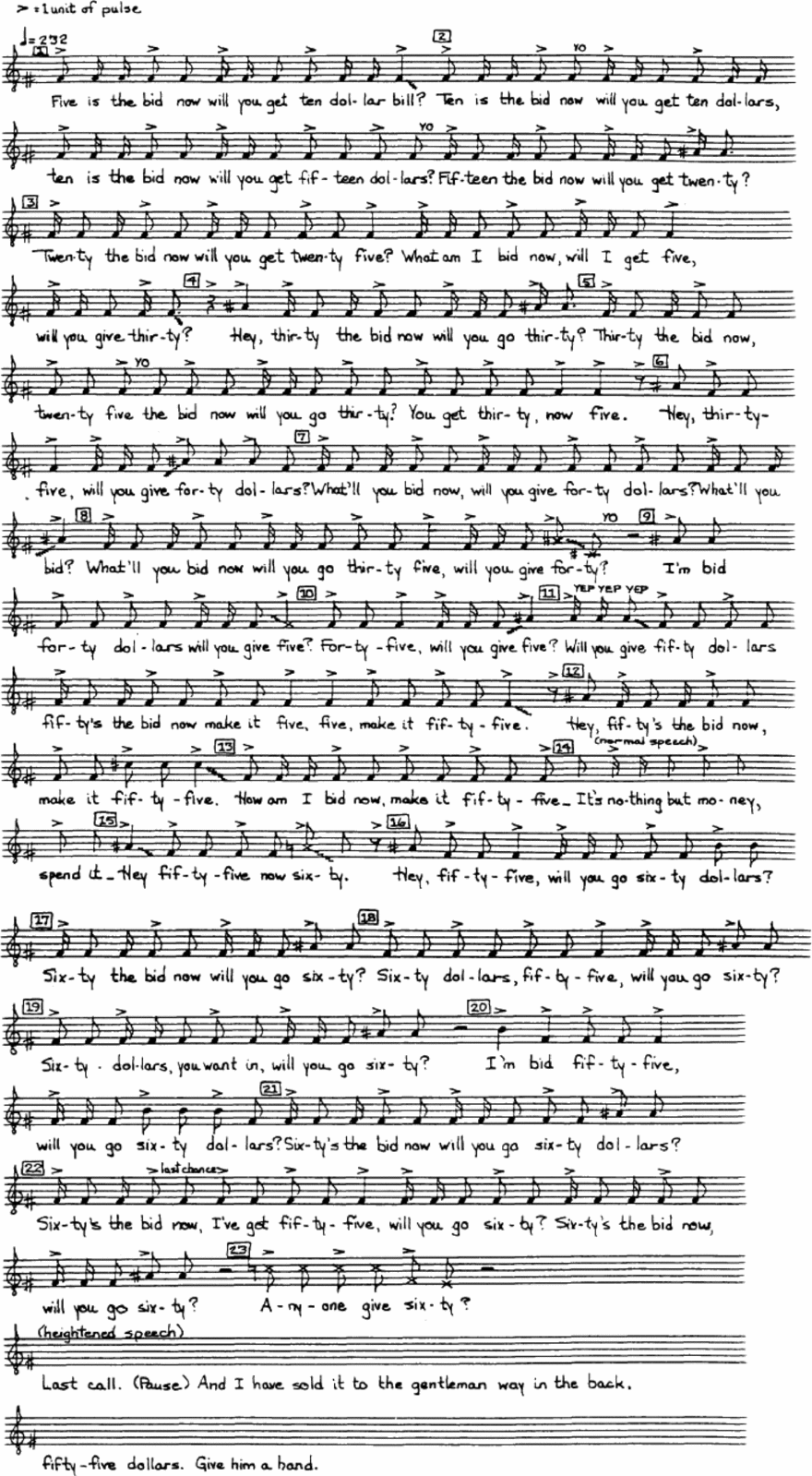
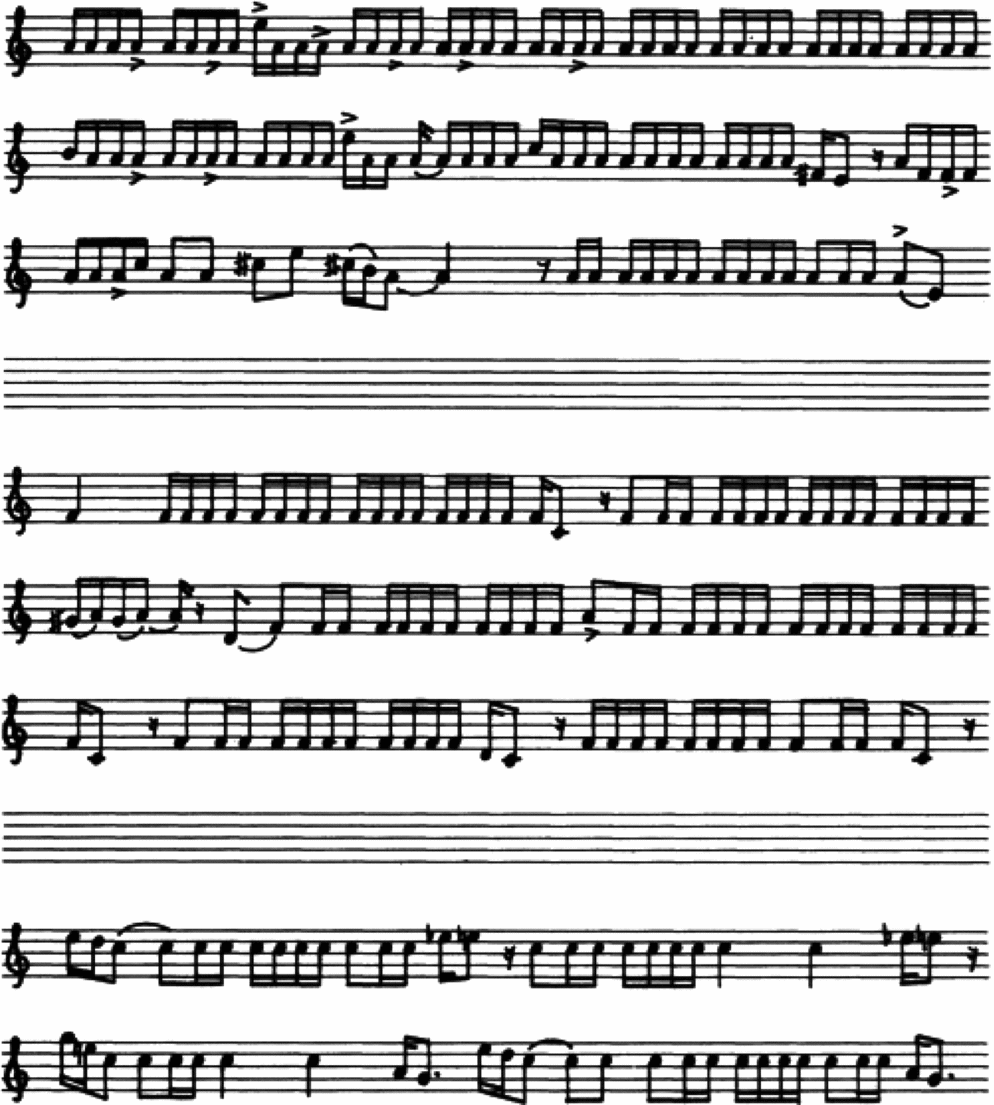
Within the small body of research on the musicality of auctioneering, little attention has been paid to the rhythmic and metric aspects of the practice. For example, Miller's transcription of antique auctioneer Archie Moody's chant (see Figure 1) does not notate a metrical organization, though some regularity is suggested by the repeating accent marks. Likewise, Koenraad Kuiper and Frederick Tillis offer three brief “characteristic” tobacco chants without any indication of text or meter in their study of the rhetorical and musical foundations of tobacco auctioneering (see Figure 2).
Geoffrey Miller's transcription of 1968 Grand Champion Livestock Auctioneer Archie Moody's auction chant. The example used here was recorded in 1980 at the New York Auctioneers Association annual convention. Moody is selling a brooch as part of a fundraising auction for the New York chapter. Geoffrey Miller, “‘Are You All Unhappy at a Twenty Dollar Bill?’: Text, Tune, and Context at Antique Auctions,” Ethnomusicology 28/2 (1984): 190–91.

Characteristic tobacco chants. Koenraad Kuiper and Frederick Tillis, “The Chant of the Tobacco Auctioneer,” American Speech 60/2 (1985): 145. Copyright, 1985, the American Dialect Society. All rights reserved. Republished by permission of the copyright holder, and the present publisher, Duke University Press. www.dukeupress.edu.
Miller, Kuiper, and Tillis choose to represent the auction chant as a string of continuous iterations with little or no metrical organization. Miller does specify that the tempo and pulse are consistent, and both he and Kuiper and Tillis account for accents within the pulse stream. However, such representations suggest that there is no periodicity to the organization of beats within this ongoing stream. In regard to tobacco auctioneering, Kuiper and Tillis go so far as to state, “There are no rhythmic restrictions or boundaries of regularity such as might be found in fixed metrical units or measures in a traditional musical context.”Footnote 18 To the contrary, my experience as a performer and observer of auction chant suggests that a free meter representation fails to capture a fundamental expressive and effective device. Metric organization within the auction chant does indeed exist, but in a way that is distinctive to the practice of auctioneering. Student auctioneers are trained to observe metric organization as a part of the pedagogical process of auction instruction, and professional auctioneers rely on this training as the foundation of a flexible metric practice.
Indeed, metric fluidity and continuity are crucial to the success of an auction chant, for the continuous nature of the bid-call is designed to limit the amount of time a bidder has to consider his or her decisions, consumed, as it were, in the performance of the auction. Although many auctioneers describe the use of silence as a possible strategic device for inciting competition or pressure, the normal state for the auction chant is one of constant rhythmic motion. Auctioneer Peter Gehres comments, “Any time you stop saying things, even if it's just for a second between 25 . . . 25 . . . 25, that little gap in there, accumulated, it's a killer.”Footnote 19 The auctioneer cannot stop and start with each new bid without undermining the very nature of the practice itself, the ongoing, rhythmic chant which elevates the auctioneer's practice from regular or even stylized speech into musical performance.
Student auctioneers are trained to maintain an ongoing chant through a series of practice-based drills designed to develop specific, embodied, technical skills including fluidity, tempo consistency, clarity of communication, speed, and metric regularity. Indeed, auctioneering pedagogy emphasizes a metric organization to the beat at the most basic level of training in the form of tongue twister drills—chant exercises performed each morning and afternoon for fifteen to thirty minutes as a group, in unison. World Wide College president Paul Behr explains the purpose of tongue twisters: “Tongue twisters are words and phrases repeated rhythmically to create the basics for rhythm in an auction chant. They help with developing control and establishing rhythm and cadence in our chant. Also, they help with breathing and building confidence.”Footnote 20
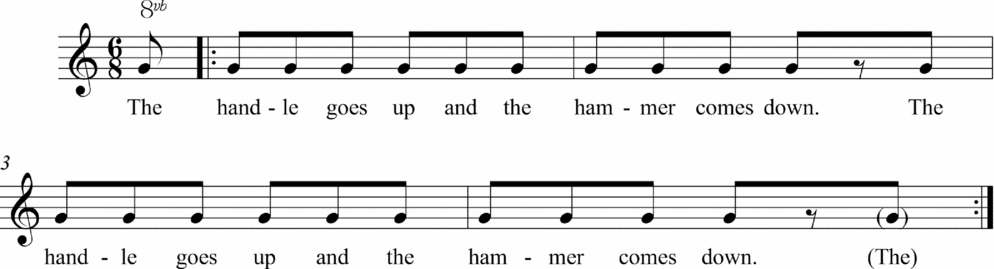
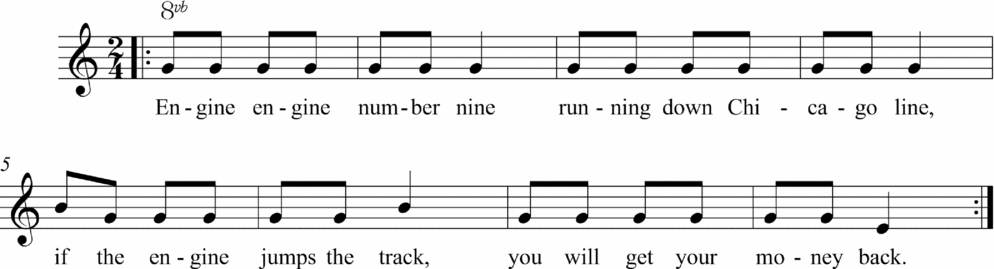
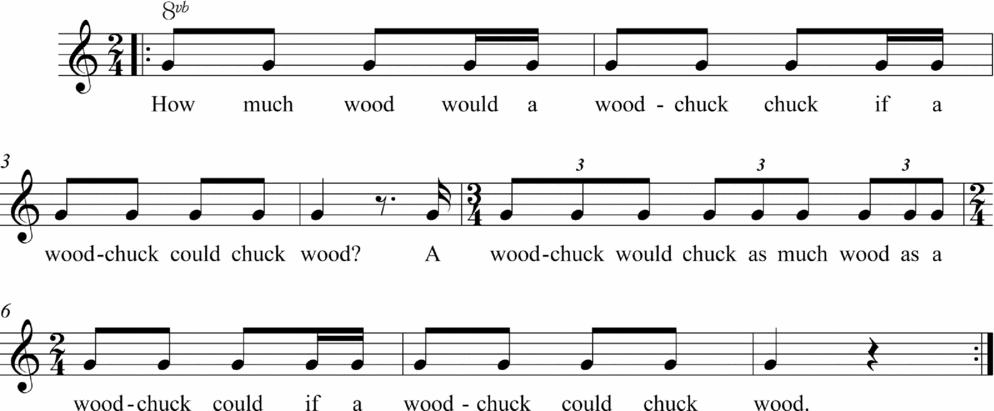
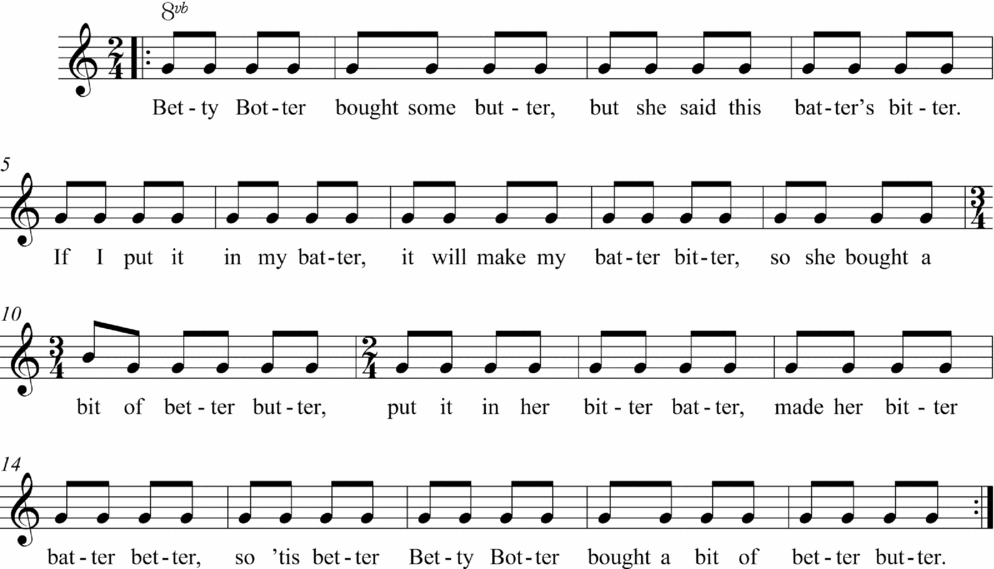
Example 1 provides transcriptions of eight tongue twisters.Footnote 21 The improvising auctioneer, of course, does not perform from a notated score, nor is notation used in teaching the bid-call; the tongue twisters were supplied to students solely as text.Footnote 22 The practice-based acquisition of bid-calling skills imparts the importance of organized groupings of the beat, while never naming these groupings as musical meter.
Tongue twister exercise. Examples 1a–1h were transcribed by the author from Paul C. Behr, Auctioneering Practice Training CD, World Wide College of Auctioneering, CD-ROM, 2007.
Tongue twister exercise.
Tongue twister exercise.
Tongue twister exercise.
Tongue twister exercise.
Tongue twister exercise.
Tongue twister exercise.
Tongue twister exercise.
As a group, the entire class would chant each tongue twister three times in units of ten repetitions, for a total of thirty times through each exercise. Each day, the tempo for the tongue twisters increased slightly; by the end of the nine-day course, students were expected to chant each exercise approximately twice as fast as they had at the beginning. This gradual increase in speed provided an opportunity for students to develop linguistic dexterity, muscle memory, and stamina, all of which enhanced real-life auction chant performance.
In introducing tongue twister exercises to the students on the first day of class, Behr explained that, “tongue twisters create rhythm.” Although the exercises introduce a variety of rhythmic figures, the majority of the drills feature only strings of eighth notes with little or no syncopation. Thus, when Behr discusses the pedagogy of rhythm, he means that the tongue twisters help students develop a consistent pulse and tempo, not that they broaden a student's rhythmic vocabulary. Instructors would emphasize the steady pulse with head nods or by beating time with their hands, and many students picked up on this behavior, moving in time with the exercises to accentuate the pulse stream.
Behr's use of the word rhythm also indicates a more abstract concept echoed by many auctioneers I have interviewed: a specific organization of beats in the steady pulse stream of the auction chant. The tongue twister exercises teach students to chant in consistent meter by emphasizing primarily duple meter constructions (including Examples 1c and 1f, which are both in compound duple meter). Only two exceptions—Examples 1f and 1h (“Woodchuck” and “Betty Botter”)—introduce one 3/4 measure into the otherwise duple meter structure. On the “World Wide College of Auctioneering Tongue Twisters and Number Scales Instructional Sheet,” examples 1e and 1h (“Engine Engine No. 9” and “Betty Botter”) are identified as the best examples for “creating rhythm” and “developing rhythm and flow to a chant.”Footnote 23 Based on the transcriptions above, however, these two exercises exhibit the least amount of rhythmic variety in the collection (with the possible exception of Example 1d, “Rubber Baby Buggy Bumper”). The “rhythm” taught in these examples is, in fact, meter. The goal in these exercises is to teach the student to develop an embodied practice favoring metric organization and become accustomed to a steady pulse organized into consistent groupings as the basic structure of any chant. “Betty Botter” expands on the rhythmic lesson of “Engine Engine No. 9” by adding one alternate meter in the middle of the chant, thus introducing the students to a limited but controlled metric variation. Otherwise, both serve to teach students about the establishment and maintenance of consistent pulse and meter.
Although tongue twisters are not samples of real bid-calls, they serve a crucial function in the education and training of the auctioneering student. These drills embed regular metric practice as a building block for bid-calling, suggesting that consistent meter is a valued rhythmic quality in auction chant.Footnote 24 Furthermore, these drills introduce a limited amount of metric flexibility, challenging students to deviate from the foundational meter of a chant in response to the prosodic structure of the chant text, so long as the original, primary meter returns.
The auctioneer faces the challenge of constructing fluid, logical ideas within an often-shifting musical environment. Change is driven by the receipt of bids from the audience, and when new bids are made, the auctioneer must be poised to jump to the next increment. There is no way to know whether bids will arrive from a raised paddle, a nod, a hand gesture, or any number of other indicators—or with what frequency. Nevertheless, the auctioneer must integrate incremental increases into the chant seamlessly, and must be flexible enough to change at any moment without disrupting the chant's flow. Bidders may or may not signal in time with the auctioneer's chant, and, as a result, the beginning auctioneer frequently trips up—a lesson I learned quickly as a student. If, for example, I had established a steady duple meter, how could I integrate a bid received five-sevenths between beats one and two? In such instances, the cognitive dissonance created between the timing of the bid(s) and the rhythm of the chant caused me and other students to pause our chant entirely, reorient to the new increment, and start up again. A metrically organized, albeit flexible, chant system thus prepares auctioneers to handle the vagaries of the real-world auction.
Hearing Meter in the Auction Chant: Metric Entrainment and Disruption
World Wide College of Auctioneering instructor and retired personal property auctioneer Darrah Williams suggests that a good auctioneer will construct a chant in such a way that the bidding audience will physically respond to the pulse stream with movements such as toe tapping or rocking:
When you look down, and you're the auctioneer, or you're at an auction, and you see people tapping their feet—I mean, you'll see auctioneers who tap their feet—but if you see the crowd tapping their feet, then you know you've kind of got ’em. I mean people don't tap their feet when they're uncomfortable. I mean, you know, they don't kind of move back and forth when they're uncomfortable. So, I always figured if they're tapping their feet and they're coming right along with me, we're doing fine.Footnote 25
I have witnessed just this type of toe tapping, head nodding, and rhythmic rocking in audience members at numerous auctions, and I have found myself tapping my toes along with many of the auctioneers I observed during my fieldwork. Williams's comment suggests that audience members do innately engage with the bid-call in a musical manner, but moreover, that they sense some sort of metric organization to the auction chant. Toe tapping, as a physical reaction to a sounding phenomenon, can be understood as an embodied representation of a hierarchical grouping of rhythmic events in the performance practice being observed. Through physical behavior, then, the engaged listener delineates a hierarchy of pulse, an organizing structure within which the beats occur: a meter.
Christopher Hasty's work on the cognitive and phenomenological perception of meter offers a model with which we may understand the listener's processing and experience of meter in the auction chant. Hasty describes a process of projection wherein the listener quickly develops a set of expectations about upcoming events based on those events that have just occurred.Footnote 26 A listener will be inclined to expect the periodic repetition of groupings of beats that have been heard in the immediate past and this expectation can be realized or confirmed, contradicted, or denied by unfolding events.Footnote 27 If expectations are sufficiently confirmed, then the listener discerns meter. For Hasty, then, projection itself is meter and is both a result of the relationship between what the music prepares us for and what is actually delivered.Footnote 28
Justin London develops Hasty's concept of projection-as-meter through a model of psychological entrainment, or “a synchronization of some aspect of our biological activity with regularly recurring events in the environment.”Footnote 29 London argues that, “entrainment is at times more and at times less than a phase-locking of the listener's attentional rhythms with temporal regularities in the musical surface. . . . Musical meter is the anticipatory schema that is the result of our inherent abilities to entrain to periodic stimuli in our environment.”Footnote 30 For London, the perception of meter is a deeply embedded series of responses to the periodicity of rhythmic (or, by extension, any sounding) events. Like Hasty's model of projection, London's model suggests that listeners develop expectations about upcoming musical events, but also undergo a “training” process through which the musical material predisposes them to receive and interpret upcoming musical stimuli in specific ways.
In light of Hasty and London's theories of projection and entrainment, the auction chant is metrical in the sense that it entrains the listener to perceive it as hierarchically and regularly organized, even though that organization is, at many points, disrupted or contradicted. Collectibles auctioneer Jim Seeck offers a specific description of the metric nature of the auction chant:
When I came out of auction school, Ralph Middleton—he was the guy that pushed me to go to auction school—and he said to me when I came out of auction school, “Jim, if I can do the two-step to you, I'm gonna use you. Not until.” And that was kind of the learning experience I had. To this day, you'll see me at class, I'll sit there and tap my feet to somebody who's chanting, and if I can do it, I enjoy their chant. If I can't, I don't.Footnote 31
Middleton's comment compares a pleasing bid-call to the two-step, or Texas two-step, the U.S. country and western dance in 4/4, characterized by a quick-quick-slow-slow series of feet movements. In doing so, Middleton suggests that a successful chant must have a metric organization such that a person could actually dance to it. Indeed, for any rhythmic pattern to be danceable, it must be both relatively consistent in tempo and repetitive in its groupings of the ongoing stream of beats. Middleton's dance comparison suggests that listeners want to hear metric regularity, and if the auctioneer successfully entrains the listener to expect such metric organization, the chant will be pleasing and successful.
Although tongue twisters primarily teach developing auctioneers to chant in consistent meter and comments such as Middleton's emphasize the importance of metric regularity, auctioneers rarely use only one meter in the performance of actual auction chant. Rather, auctioneers tend to privilege one foundational meter in a chant, but frequently deviate from that meter in the course of performance. As suggested by London's model of entrainment, the perceived effect of deviations from an established meter is not one of a complex multi-meter structure, but rather of brief suspensions of a regular metric flow. Most auctioneers favor either duple- or triple-meter patterns, and settle into a preferred meter right away, but digress from that meter as the emerging events of a sale and the changing prosodic demands of new words and numbers in the chant dictate. Meter is thus, in a sense, flexible. It can expand and contract to facilitate the acquisition of a new bid (and new number), the insertion of a filler word, a protracted repetition of a number meant to get the bidders’ attention, or an emphatic statement meant to stress the qualities of the lot or the urgency with which bidders should act. Such examples of temporary digression from an established meter function as moments of rhythmic and metric contrast and suggest that auctioneers use meter as an improvisational tool to both react to and shape the ongoing sale.
In my fieldwork, it has been most common to find that an auctioneer will quickly establish a meter or meters to which he or she will return again and again. Meter is rarely stable for long periods of time, however. If, for example, an auctioneer establishes a duple meter early in the chant (considered here as 2/4 for purposes of explanation), he or she will frequently deviate from that grouping pattern, expanding a grouping to 3/4 or contracting to 3/8. These expansions and contractions of the established meter continue to unfold at the same tempo, and the pulse stream remains consistent.Footnote 32 Such expansions and contractions of beat groupings do not suspend the ongoing flow of musical time in the chant, but rather represent a sophisticated metrical flexibility that, without fail, returns to the originally established meter.Footnote 33
Formulaic Practice and the Construction of Flexible Meter
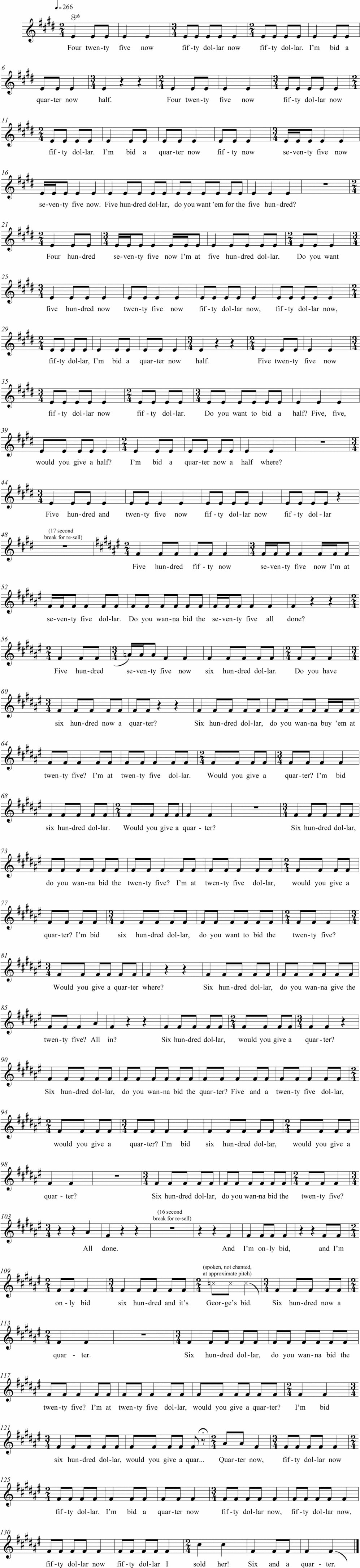
Metric flexibility in auction chant is, in part, a function of formulaic performance practices common to the tradition. Charlie Corkle's 1952 livestock auction chant (Example 2) features a relatively simple rhythmic style with a limited number of rhythmic figures, and as such, offers an opportunity to examine rhythmic formulae and their implications for metric practice in a bid-call.Footnote 34
Charlie Corkle, J.O. Hereford Dispersal Auction, 1952, audio recording, Archives of the National Auctioneers Association. Transcribed by the author.
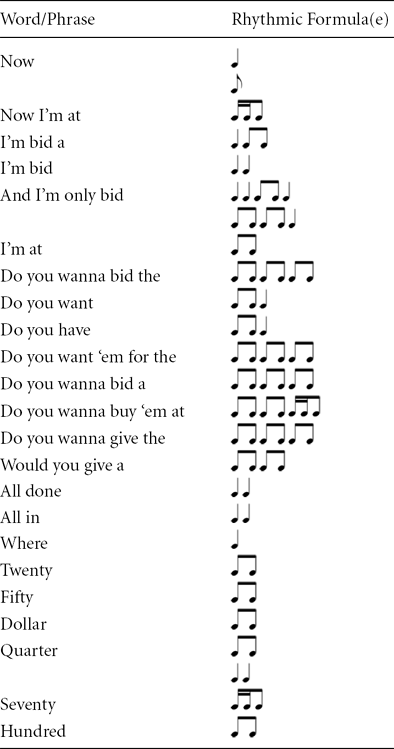
Most words are performed as individual quarter notes or groups of two eighth notes, and only in limited cases does Corkle employ two sixteenths and an eighth note. The majority of words in the chant are given the same rhythmic treatment with each appearance. For example, “four,” “five,” “six,” and “where” always have the duration of one quarter note, while “fifty,” “hundred,” and “dollar” are always chanted as two eighth notes, and “seventy” always takes the form of two sixteenths and an eighth note. Not only individual words but also entire filler phrases are treated with a formulaic rhythmic approach. The phrase-length formulae “Do you wanna” and “Do you want ’em,” are always presented as groupings of four eighth notes preceding at least two additional eighth notes, and “all in” and “all done,” always appear as groups of two quarter notes.
Table 1 presents the pairings of filler words, phrases, and numbers with their corresponding rhythmic gestures in Corkle's chant. Even with Corkle's limited rhythmic vocabulary, some words are bound to more than one rhythmic formula. “And I'm only bid” serves as one example, where the first two quarter notes of the rhythm are, at times, reduced to two eighth notes for a faster rhythmic gesture. “Quarter” is another such example; in most cases, the word is chanted as two eighth notes, but at the end of some phrases (mm. 70, 89, 98, 113, and 134) “quarter” is doubled in duration and stretched out to two quarter notes. The same does not occur with other words, such as “fifty” or “hundred,” which could easily be presented in a similar manner.
Rhythmic Formulae, Charlie Corkle's Bid-Call.
Corkle's metric practice can be attributed in large part to the rhythmic formulae he ascribes to individual words and phrases displayed so consistently in his chant. He places a slight downbeat emphasis on certain words of the chant, which I have correspondingly indicated as the downbeat of individual measures. The chant moves freely between duple and triple metric groupings to the extent that we might characterize this example as having two competing primary meters, with a slight preference for triple meter. Switches between meters are not arbitrary, though, because textual cues and rhythmic patterns coincide with and often necessitate Corkle's metric choices.
In Corkle's chant, 65 percent of the measure's downbeats coincide with a number (“four,” “five,” “six,” “twenty,” “fifty,” “quarter,” or “half”). This suggests a slight tendency toward linking certain kinds of text with metric emphasis, but does not provide conclusive evidence of one consistent formulaic link. Thirty-three percent of the chant's measures begin with syntactical units that are, themselves, the opening statements of complete sentences: “I'm bid / I'm at,” “Do you want,” “Would you give / would you bid.” These units of text would, understandably, feature an inherent emphasis on the first word of the sentence and, as such, suggest a link between a grammatical and a musically metrical emphasis. Three of the most commonly repeated words in the bid-call—“now,” “bid,” and “hundred,” are never placed on the downbeat. Rather, these words act as connectors between numbers or other emphasized words. Additionally, throughout the bid-call, Corkle never chants two numbers back-to-back without inserting a connecting word or phrase between the two.
The fact that many of the word groupings in the text are bound to a specific rhythmic structure (or a limited number of rhythmic structures) through formulaic association reveals patterns in the formation of meter in Corkle's chant. Meter in Corkle's chant arises from the deployment of formulaic rhythmic units that, themselves, result in either duple or triple meter groupings. Corkle almost always starts metric groups with a number or the opening phrase of an independent clause. Once either of these words or phrases is inserted into the ongoing chant, metric organization of the beat arises naturally from the addition of one phrase or word to the next. Phrases such as “five hundred dollar” always create a triple meter organization and “would you give a” almost always creates a duple meter organization.
“Now” fills a particularly special role in the construction of metric organization in Corkle's chant, as the word is used not only to fill in gaps between numbers or numbers and filler phrases, but also often completes the metric grouping of two or three beats, insuring that the chant will continue to move along in one of the two primary meters Corkle employs. For example, “Fifty dollars” fits into duple meter, but “fifty dollars now” (commonly employed throughout) extends the grouping by one beat, shifting the chant into a triple-meter organization. “Now” thus serves one of two metrical functions: first, it can allow for the continuation of a meter by completing the established and ongoing grouping, or, alternately, it can facilitate metrical shifts by extending a duple construction into a triple construction.
Due to the speed and need for continuous flow in auction chant, formulae offer a degree of practical efficiency necessary to maintain the linguistic, rhythmic, and metric demands of the style. Richard Bauman suggests that such a formulaic practice, what he calls “parallelism,” is common among verbal arts, and provides memory aids for the performer:
Parallelism . . . involves the repetition, with systematic variation, of phonic, grammatical, semantic, or prosodic structures, the combination of invariant and variant elements in the construction of an utterance. . . . From a functional point of view, the persistence of the invariant elements and the structural principles underlying the parallel constructions may serve as mnemonic aids to the performer of a fixed traditional text, or enhance the fluency of the improvisational or spontaneous performance. In either case, the fluent use of language marked by extra regularities is an effective vehicle for the display of communicative competence.Footnote 35
In this way, formulaic rhythmic structures, concretized during practice-based pedagogical instruction at auction school, become the building blocks of a metrical style characterized by an emphasis on recurring, regular meter, but flexible enough to allow for changes concurrent with, and in response to, the emerging conditions of the auction. For Bauman, “the emergent structure of performance events is of special interest under conditions of change, as participants adapt established patterns of performance to new circumstances.”Footnote 36 Existing on a continuum between “completely novel” and “completely fixed” texts, verbal artists such as auctioneers employ a host of stylized, patterned, and repetitive structures, the combination and variation of which result in an elastic metrical practice.
Improvised Time: The Strategic Employment of Referential Meter and Metric Deviation
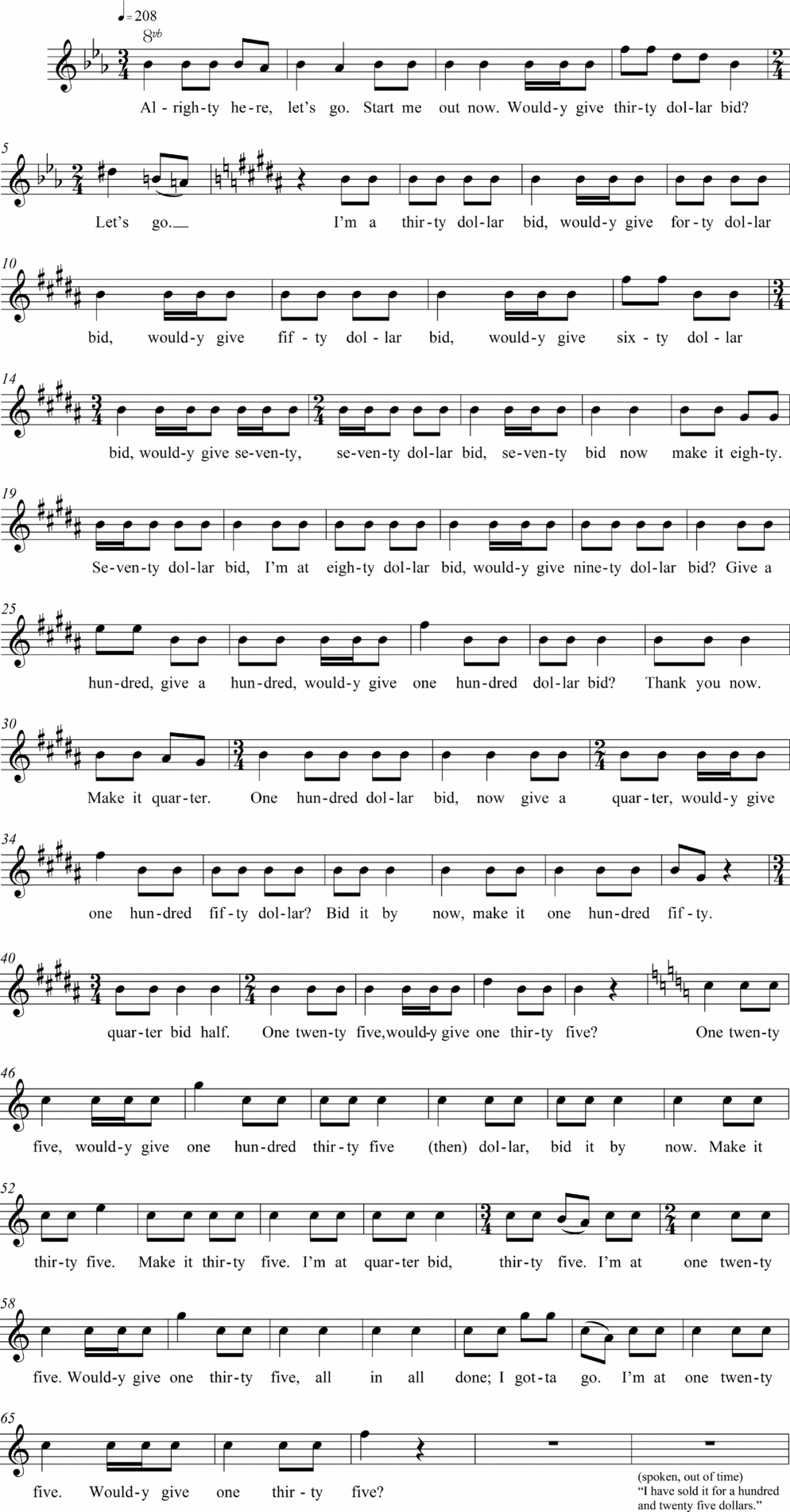
Close analysis of metric practice in other auction chants reveals how fixed and varied meter intertwine in improvised practice. Consider Denise Shearin's winning 2007 International Auctioneer Championship (IAC) performance (Example 3). We can see how Shearin, a real estate and personal property auctioneer, relies primarily on a 2/4 meter but uses 3/4 both to open the chant and to accommodate a longer phrase or additional filler word. With only a few deviations, Shearin begins each metric grouping with the number, filling out the remaining beat or two with connecting words.Footnote 37 The repetition of the number “seventy” in m. 15 causes a momentary shift into 3/4 to accommodate the additional word, and likely indicates the receipt and acknowledgement of a new bid; she immediately reestablishes 2/4 in the next measure, however.
Denise Shearin, “Lot 17a: Wilson leather briefcase in black,” from “Denise Shearin, CAI, CES, 2007 International Auctioneer Champion,” http://www.youtube.com/watch?v=B2uKbeLHQJ8, 00:30-0:1:07. The transcribed chant is one of three lots Shearin sold as part of the 2007 National Auctioneer's Association International Auctioneer Championship. In this chant, Shearin sells a black leather briefcase for an audience of NAA members.
Shearin's next metric shift occurs at “Quarter bid half, quarter bid half,” which serves to emphasize this bid request. An alternate approach to the transcription of her performance might divide the two 3/4 measures into three 2/4 measures with a syncopated accent. Her metric intent is quite clear, however, as she places a strong accent on the triple division, and thus we hear this moment as a brief but clear shift from the recurring 2/4 pattern preceding it. The introduction of 3/4 meter in the beginning and its recurrence at “quarter bid half” establishes it as a meter of secondary importance, providing both variety and punctuation at important structural points in the chant. The hypermeter, on the other hand, is almost entirely consistent, with two-measure units prevailing throughout the chant, regardless of whether the meter is duple or triple.Footnote 38 The primary and recurring nature of the 2/4 meter establishes an expectation that it will continue, but at times, metric prolongations resist the listener's expectation. It is important to note that deviations from the fundamental 2/4 meter are brief, usually no more than three or four measures. Indeed, at some point, prolonged deviation from this meter would challenge and perhaps undermine the listener's metric entrainment.
Hasty characterizes meter as “time continuous” or always evolving for the listener,Footnote 39 but meter in auctioneering resists such a description. A sense of meter in auctioneering is not evolving, but is set or entrained early on. Aided by a consistent tempo, the primary meter in auction chant exerts such powerful control over the listener's experience and expectations that frequent disruptions do not have a jarring effect. London, whose discussion of entrainment expands Hasty's model of projection through the lenses of perceptual and cognitive psychology, suggests, “Composers have long counted on (and exploited) our proclivity to maintain an established metric framework, and the force with which we will impose metric order on an uncooperative musical surface.”Footnote 40 Auction chant surely qualifies as just such an “uncooperative musical surface,” but the primary meter to which the auctioneer returns grounds the listener with a sense of overarching rhythmic and metric structure, a measure of regularity, and an expectation of metrical continuity. Thus, London recognizes that metrical entrainment creates an overwhelming desire on the part of the listener to retain an established sense of meter, even against both contradictions and denials of that very meter.
In the course of performance, it is most accurate to say that the bidder or audience member hears “referential” meters, metrical groupings of the beat that are foundational to the chant. This meter (or meters, in the case of two equally foundational meters), however, is not omnipresent and may be disrupted through hiatus, contradiction, and denial.Footnote 41 The key to understanding when meter is heard as referential is expectation. By consistently returning to a familiar meter after each deviation or disruption, the auctioneer prepares the bidding audience not only to hear a metric foundation, but also to desire its return. The referential meter, then, provides musical consistency for the listener as he or she interprets the emergent musical events of the bid-call. When the meter is consistent, the chant engages the listener and provides pleasure; the listener can tap his or her toes, or, if bold enough, dance the two-step.
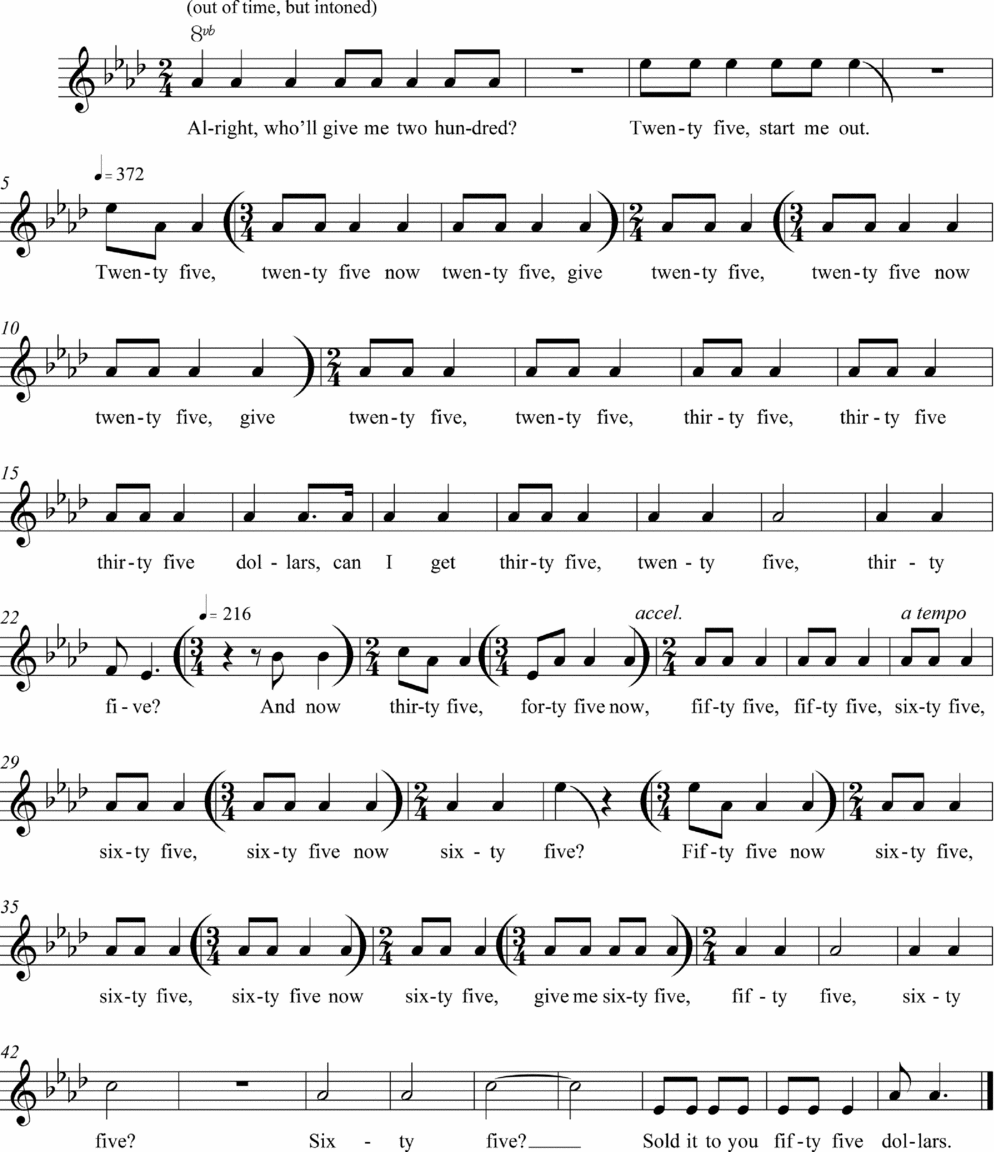
In the transcription below (Example 4), I have adopted an approach that foregrounds referential meter. To depict this effect, I represent all disruptions from the referential meter in parentheses, revealing how deviations are brief, never longer than one or two measures. Like Denise Shearin's IAC competition chant, the sale by Jim Seeck relies on a 2/4 referential meter.Footnote 42 Seeck's metrical contradictions—six in all—always appear in correlation with interjections of the filler words “now,” “give,” and “give me,” expanding the duple-meter nature of each number by exactly one beat. These one-beat expansions do not re-orient the listener to 3/4, but rather, serve to throw the chant off-balance, but only momentarily—just enough to disrupt the audience's musical entrainment and thus grab the listener's attention.
Jim Seeck, “Lot 4: Pinecone saucer-shaped plate in green” (Carnival art glass sale), recorded live by the author, St. Louis, Missouri, 2 October 2010.
In moments of disruption, the listener has only an expectation that the referential meter will continue. When it does not, the listener is unaware of what the new “temporary” meter is. The auctioneer wants the listener to desire a predictable pattern of rhythmic organization, and to achieve such a comfortable pattern, bids need to be coming in consistently. If they are not, the auctioneer will resort to other methods of encouragement such as rhythmic or expressive disruption to excite bidding. The rhythmic indicator that both auctioneer and bidding audience are in sync is the reappearance of referential meter. When the bidders “get in line” with the auctioneer and rejoin the process, the musicality of the chant reappears. With Jim Seeck's auction chant, the listener's entrained expectation for duple meter is satisfied when the bidding is moving at a quick pace. When bidding appears to stall between $55 and $65 after m. 26, Seeck varies both the tempo and the meter in an attempt to excite bidding, but once the close of the sale is imminent, he returns to the referential meter to end the chant. This synchronous rhythmic state is one in which bids are coming in at a rate consistent with both the meter and the tempo established by the auctioneer, and although the bids may not appear in complete metric lockstep with him, they arrive consistently enough that the auctioneer can smoothly incorporate them into a referential meter.
Now We're Rolling: Considering the Function and Purpose of Flexible Meter at the Auction
Auctioneers in my research have suggested that the establishment of a referential meter, evidenced through physical, almost dance-like gestures on the part of the audience, promotes specific kinds of bidding behaviors. As auctioneer Darrell Cannon comments, “You may have ’em rockin’ in their seat, you know, or boppin’ back and forth when they're standing at the tables. Then you know you've got ’em in the palm of your hand. They're gonna do absolutely what you tell ’em to do.”Footnote 43 In particular, referential meter allows the auctioneer to exert a special kind of control over the bidders, encouraging them—in a distinctly musical manner—to bid both quickly and at a consistent rate.
Auctioneers commonly use the term “rolling” to describe a special state of bid-calling performance in which the auction chant is flowing easily and the auctioneer is in sync with the bidding audience. In my time at World Wide College of Auctioneering, the term was used frequently, but defined only once; instructor Jack Hines described rolling as “taking the bids at a fast rate of speed.”Footnote 44 The term seems to have further connotations for auctioneers beyond fast bidding, however. Based on the variety of contexts in which instructors invoked the term, rolling can be described as the ideal performance state: bids are coming in quickly, but not so fast that the auctioneer cannot process them, and items are selling at strong prices.
An auctioneer is capable of rolling when the audience is not just active, but active in a way that conforms to the rhythm established by the auctioneer. Peter Gehres explains this relationship:
The zone for me is, you know, we have an engaged crowd. We have an informed crowd: people know what we're selling and they allow me to control the auction in terms of bid increments. They bid both in a rhythm that works with my chant, works with me, and there's not a lot of waiting. And it's also not a lot of frustration because you actually have auctions where people bid too much—and that's hard to believe, but you have, you know, just this kind of over-enthusiasm for bidding that doesn't really allow you to get any kind of rhythm. You say, “I want a thousand,” and four hands go up. . .Footnote 45
Gehres's description suggests that when an auctioneer is rolling, he or she is experiencing a psychological state of “flow,” what Mihaly Csikszentmihalyi has described as a “sense of effortless action.”Footnote 46 The musical structure of the bid-call facilitates the auctioneer's ability to achieve flow; referential meter(s), recurring rhythmic patterns, and generally steady tempos differentiate the chant from normal speech, placing the auctioneer and the audience in a special, musically structured, time.
Auctioneers do stop the continuous flow of the chant for specific purposes and with specific effects. Moments in which the music of the chant ceases represent a distinct contrast from the referential meter and its deviations. Moving in and out of the musical time of the bid-call, auctions demonstrate what Jonathan Kramer calls “temporal multiplicity,” in which listeners experience three different types of time: virtual, absolute, and social.Footnote 47 By virtual time, Kramer means, “the special type of time we experience when deep listening to music removes us from our everyday world.”Footnote 48 Absolute time is “a linear succession of now-moments, sometimes called ‘real time,’ ‘ordinary time,’ or . . . ‘lived time’ and ‘world time,’” and social time is, “the ordinary time imposed on us by timetables, schedules, and deadlines.”Footnote 49
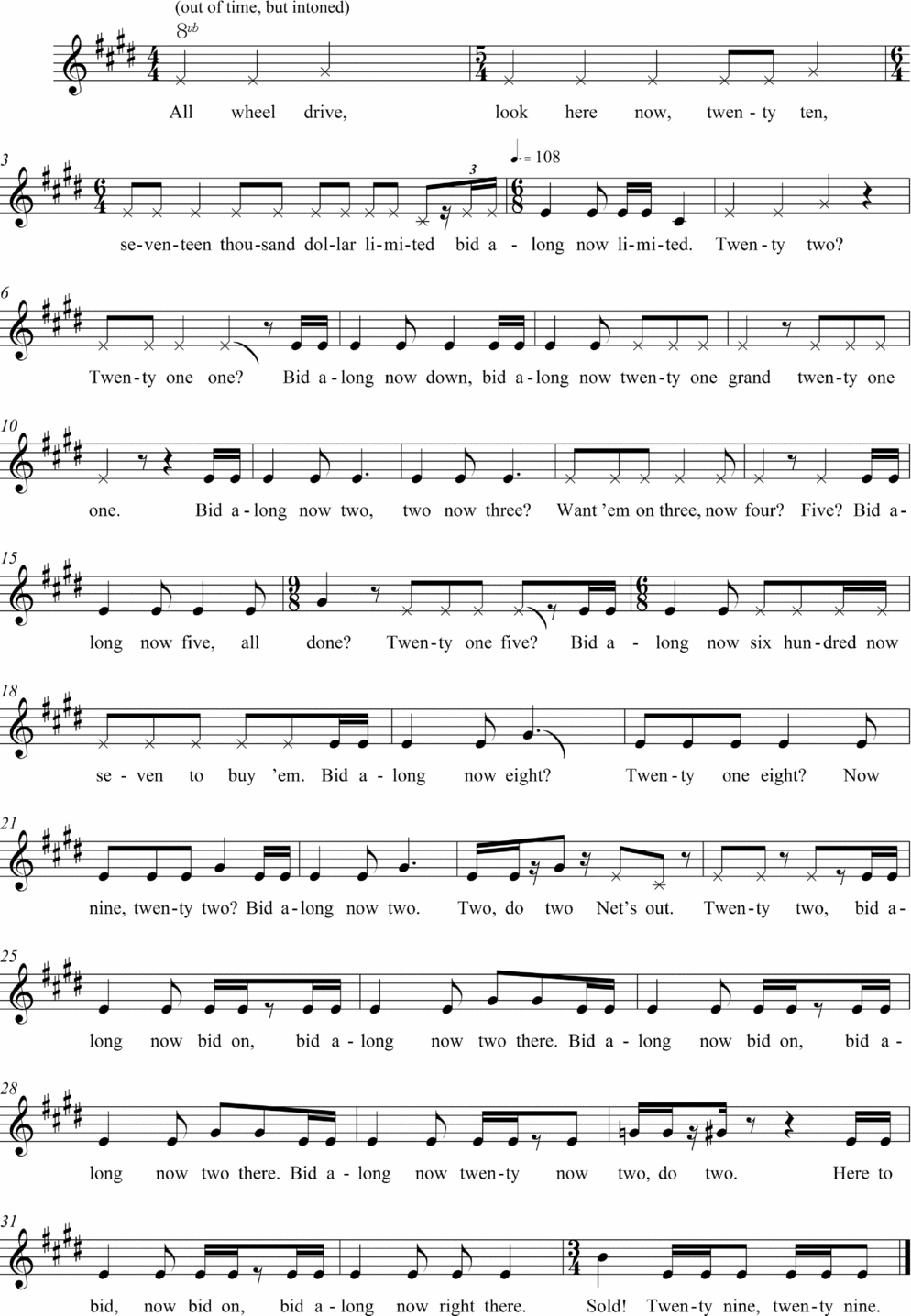
The tempo, rhythm, meter, and sung pitch of the chant may stop for the auctioneer to make a brief comment about an item, to investigate a point of contention or confusion in the bidding process, or to remark on the ongoing sale itself. These moments transport the listener from virtual time to absolute time, as the auctioneer shifts from chant performance to everyday speech. Often, a pause in tempo and meter will be intoned on pitch, but out of time from the music of the chant. In most cases, the “out of time” introduction is pitch-specific and performed in steady tempo, but there may be long pauses between spoken fragments, keeping these intoned passages from being truly metrical or continuous like the chant itself. Paul Behr's chant at the Mannheim Denver automobile auction (Example 5) provides an example of this type of distinction between consistent pulse and hiatus in the alternation of musical time and intoned speech. In my transcription, these instances are indicated with “x” note-heads on the intoned pitches with approximations of the relative durations of the intoned pitches. The rhythmic indications are not intended to suggest that the auctioneer maintains the tempo of the chanted sections during these speech sections.
Paul C. Behr, “Lot No. 77–2010 Ford Escape,” recorded live by the author, Aurora, Colorado, 1 September 2010.
Some auctioneers complicate the temporal multiplicity even more by bringing social time into the fray with phrases like, “oh no, gotta go!,” “The sale's today folks!,” “We gotta go!,” etc. These comments are often performed in the virtual time of the chant (i.e., in meter and tempo with a sung pitch), but they alert the bidder to the fact that social time still exists. Reference to social time creates a tension between the musically constructed virtual time of the chant (a pleasing and exciting musical space where the bidder wants to remain) and the realization that the auction and the bidder's activities are governed by time pressures in the all-too-real world of deadlines and social expectations.
It is this tension between referential and disrupted meter, and among the three species of time—virtual, absolute, and social—that makes the auctioneer's performance engaging and unpredictable. The bidding audience is kept on its toes, entrained to expect and desire a certain organization of time, but this desire is often thwarted, delayed, or otherwise disrupted. These disruptions, of course, heighten the listener's desire for the return of metric stability. When that expectation is again fulfilled, referential meter appears and bids are smoothly incorporated into the virtual time of the auction chant.
The special musical organization of time created by referential meter and flexible, improvised deviations from it imposes order on an otherwise unordered and potentially chaotic social process, providing structure to the community of bidders and potential bidders, and offering the potential for a collective musical experience. As Charles Smith argues:
The truth is that the importance of the chant does not lie in its role as price monitor. Its major function is rather to orchestrate the auction rhythm. The chant controls the temporal order of an auction, the movement of the bids. Its importance is underscored when we remember the extent to which auctions are ripe with uncertainty and ambiguity. The chant introduces form where it is sorely lacking.Footnote 50
Auctioneers who can successfully control the musical flow of the chant by creating a shared rhythmic context can therefore unify the bidding audience.
Engaged with the flow of musical time, the bidder has little time to pause for considerations of personal finance and budget limitations. Mental activity is consumed by the experience of the music, and when the music of the chant holds such sway over an audience, the auctioneer can sweep up bidders into the excitement of the performance, encouraging them to act automatically, bid liberally, and without regard for financial concern. It is unlikely that any of the participants have purely aesthetic or musical goals for the auction performance, however; neither the audience nor the auctioneer is ever completely divorced from the functional reality of the event.
Conclusion
In the case of auctioneering, musical variety, in the form of flexible meter, draws the listener into a specifically musical space where a financial transaction becomes an exciting and unpredictable performance. Periodicity and recurring meter mark the event as musical, but sustained metric regularity would lull the audience into a static sense of time, rendering the chant ineffective. As Darrah Williams explains, metric flexibility functions as a tool for manipulating and controlling audience engagement in the bid-call: “if you're selling at the same pace (‘bingety, bangety, bingety, bangety’), and all of a sudden you change that pace, that sometimes can perk them up, because their ear is not accustomed to that.”Footnote 51 When Williams invokes the concept of “pace,” she is not describing tempo (which remains remarkably consistent during bid-calls among all auctioneers), but rather the organization of time in the chant, and the inclusion of variety into an otherwise formulaic and patterned performance.Footnote 52 The tension created by a surprising interjection or change is a powerful tool for the auctioneer, for it can be used “against” listeners to re-focus them on the sale at hand, to re-energize and re-engage an audience by drawing them into the musical space. Certainly, as I have shown, some metric flexibility arises from the juxtaposition of rhythmic formulae of varying lengths or from momentary reactions to emerging sales conditions. Nevertheless, the auctioneer's improvised contractions and expansions of meter are often, and crucially, strategies employed to affect the sale itself.
Although the auctioneer rarely considers himself or herself a musician, the art of the bid-call is rich in complex musical techniques. The flexible treatment of meter in auctioneering stands as an idiomatic form of rhythmic improvisation. The entrainment of referential meter and the improvised contradiction of referential meter represent improvisatory strategies on the part of the auctioneer that, like the improvisatory practices of all musicians, heighten the emotional experience of the audience. Within this subtly shifting metric context, daily acts of commerce are recast as musical events, experiences rife with excitement, anticipation, tension, and aesthetic pleasure.