Implications
The calves fed milk replacer (MR) and hay only during the pre-weaning period had slower growth rates post weaning compared with calves on other dietary treatments. The calves fed whole milk together with concentrates had higher weaning weights and superior growth rate post weaning as well. Total feeding cost was higher, but cost per kg body weight (BW) gain was lower in milk-fed calves than in MR-fed calves during the pre-weaning period. However, feed conversion ratio and cost per kg of BW gain was similar post weaning. Thus, for better performance during pre- and post-weaning periods, the nutrition of calves is important from the day they are born.
Introduction
The growth potential of livestock remains underutilized because of underfeeding and poor management. Neglect of dairy calves during the pre-weaning or post-weaning periods results in decreased growth rates and a delay in the onset of puberty in the female calves. Calves in Pakistan are generally neglected because of their high feeding costs and low returns from their sale at weaning (Bhatti et al., Reference Bhatti, Khan, Sarwar and Ehsanullah2009). Hence, farmers are not motivated to raise healthy male calves of any breed of cow or buffalo (Ahmad et al., Reference Ahmad, Yaqoob, Hashmi, Zaman and Amjad2009). Raising replacement dairy heifers is costly and no commercial gain is attained until heifers reach lactating age (Greter et al., Reference Greter, Leslie, Mason, McBride and DeVries2010). Strategies to reduce feeding costs during the pre-weaning period are needed to motivate the farmers to raise the young calves for meat or breeding purposes. Low-cost feeding strategies include using milk replacers (MRs), weaning the calves at an early age and increasing concentrate feed intake from a younger age (Hopkins, Reference Hopkins1997; Hill et al., Reference Hill, Bateman, Aldrich and Schlotterbeck2010). This will lead to decreased age at first calving through accelerated growth during the post-weaning phase (Brown et al., Reference Brown, VandeHaar, Daniels, Liesman, Chapin, Keisler and Weber Nielsen2005). However, the growth performance of calves fed MRs, during the pre-weaning period, is inferior to that of milk-fed calves on an equivalent protein and energy basis until 45 days post weaning (Lee et al., Reference Lee, Khan, Lee, Yang, Kim, Ki, Kim, Ha and Choi2009).
Kuehn et al. (Reference Kuehn, Otterby, Linn, Olson, Chester-Jones, Marx and Barmore1994) reported that low-fat (15.6% on dry matter (DM) basis) MRs promote higher starter dry matter intake than do high fat (21.6%) MR fed from 14 to 42 days of age and result in higher liveweight gain of Holstein calves. This suggests that the replacement of energy provided by fat with that in concentrate led to faster growth. Little is known of how tropically adapted breeds such as the Sahiwal respond to different milk feeding regimes and their effect on concentrate intake and long-term growth performance post weaning. To develop an economical calf rearing protocol for this breed, the effects of feeding milk or MR at the rate of 10% liveweight during the pre-weaning period on their post-weaning performance using a single total mixed ration (TMR) were investigated.
Thus, the objective of the study was to assess whether the poor growth response pre-weaning to milk replacer relative to that for milk was offset beyond weaning at 84 to 168 days of age (24 weeks) in Sahiwal calves fed a balanced TMR.
Material and methods
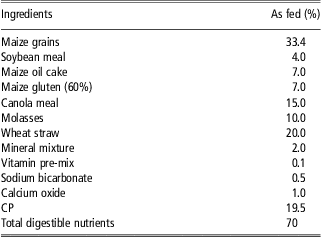
Three-month-old weaned Sahiwal calves procured from the Livestock Experiment Station, Bahadurnagar, Okara, were used for this post-weaning feeding trial. Before weaning, they had been a part of a two by two factorial pre-weaning feeding trial reported by Bhatti et al. (Reference Bhatti, Ahmad, McGill, Sarwar, Afzal, Ullah, Khan, Khan, Bush, Wynn and Warriach2011). The two factors were – liquid feed (milk or MR) and solid feed (starter concentrate ration with H or H only). Thus, the four dietary treatments were: milk with starter ration plus hay (A: Milk + SR + H), milk with Berseem clover hay only (B: Milk + H), MR with starter ration plus hay (C: MR + SR + H) and MR with Berseem hay only (D: MR + H). The milk and MR were fed at 10% of liveweight, whereas the SR and H were fed ad libitum and intake measured. The amount of milk or MR fed was adjusted for body weight (BW) until 56 days of age, and then tapered in weekly increments to zero by 84 days of age. Berseem clover hay (Trifolium alexandrinum) was fed to all the calves from 14 days of age until weaning. Starter ration was fed to groups A and C starting from 14 days of age until weaning at 84 days of age. During the pre-weaning period, initially there were 12 calves in each group with six of each sex; however, one male calf died from each of the B and C treatments and were not replaced. Thus, 46 calves were assigned to the current post-weaning study, comprised of 12, 11, 11 and 12 calves from the original pre-weaning groups A, B, C and D, respectively, as described by Bhatti et al. (Reference Bhatti, Ahmad, McGill, Sarwar, Afzal, Ullah, Khan, Khan, Bush, Wynn and Warriach2011). During the post-weaning period, after 84 days of age, the calves were given a single TMR (Table 1) until 168 days of age. The experiment was conducted from mid-May to mid-August 2009. The ambient daytime temperature during these months ranged from 25.1°C to 40.4°C.
Composition of total mixed ration

Feeding and housing
Animals were housed in separate calf pens (142 × 112 × 112 cm: L × W × H). Calves were fed a TMR containing 16% CP and 70% total digestible nutrients (Table 1) ad libitum from 85 to 168 days of age and had free access to clean water. The composition of the TMR is shown in Table 1. The TMR and water were placed in plastic bowls attached to the pens. Calves were fed twice daily at 0900 and 1700 h, and refusals were measured to calculate feed intake. During the day, calves were allowed access to an open shed to exercise for 2 h.
BW measurement
The animals were weighed weekly using an electronic digital scale early in the morning before feeding. The calves were off feed at midnight before weighing the next morning. The experiment was terminated at the age of 168 days (24 weeks) for each calf.
Data recording
Daily feed intake, refusals and weekly liveweights were recorded. The data recorded were used to calculate total liveweight gain, average daily gain, average daily feed intake, total feed intake, nutrient intake and total feeding cost.
Statistical analysis
The data on weekly weight and TMR intake were analyzed using repeated measures analysis using MIXED procedures of SAS (SAS, 2002), with an AR(1) covariance structure as described by Littell et al. (Reference Littell, Henry and Ammerman1998). The effects of pre-weaning diets were tested in the post-weaning period. The pre-weaning treatments were: A: Milk, SR and H; B: Milk and H; C: MR and SR and H; D: MR and H only (explained in Bhatti et al., Reference Bhatti, Ahmad, McGill, Sarwar, Afzal, Ullah, Khan, Khan, Bush, Wynn and Warriach2011). The calf was used as a random effect. The statistical model used for analysis was

where Yijk is the dependent variable, μ is the overall mean, sex i is the sex of the calf where i is either male or female, F1 j is the fixed effect of factor 1 where j is either milk or MR, F2 k is the fixed effect of factor 2 where k is either SR and H or H only, W l is the repeated measure of weeks l , (sex × F1 × F2 × W) ijkl is the interaction term, calf m is the random effect of calf n and e ijklm is the residual error.
For the other descriptive statistics (average growth rate, weight at the age of 24 weeks, total weight gain, total intake of TMR), the data were analyzed using MIXED procedures. The statistical model was  ; where μ is the overall mean; F1
i
is factor 1 where
i
is either milk or MR; F2
j
is factor 2 where
j
is either SR and H or H only; (F1 × F2)
ij
is the interaction term; calf
k
is the random effect of calf
l
and Eijk
is the residual error. The sex was included in the initial model, but its effect was not significant so it was dropped from the model during final analyses. The results are reported as least squares means. The means were declared significantly different at P < 0.05.
Results
Feed intake
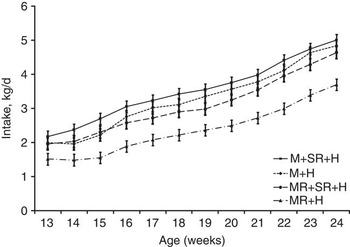
Average daily TMR intake of calves in all groups ranged from 1.5 to 2.2 ± 0.17 kg/day during the 13th week of age (days 85 to 92) and 3.7 to 5.0 kg during 24th week of age (Figure 1). Daily intake of TMR increased with increasing age (P < 0.05). Average daily intake of TMR remained the highest in group A and lowest in group D during the post-weaning period (Figure 1). The average daily intake of calves in groups B and C was not significantly different (P > 0.05). There was no interaction between liquid feed source and solid feed source. However, there was an interaction (P < 0.05) between solid feed source with age, indicating that the response in post-weaning TMR intake to pre-weaning solid feeding regimes period was not linear with age.
Effect of diet before weaning on the intake (kg/day) of total mixed ration (as-fed basis) post weaning in Sahiwal calves. M+SR+H: milk plus starter ration plus hay; M+H: milk plus hay; MR+SR+H: milk replacer plus starter ration plus hay; MR+H: milk replacer plus hay.

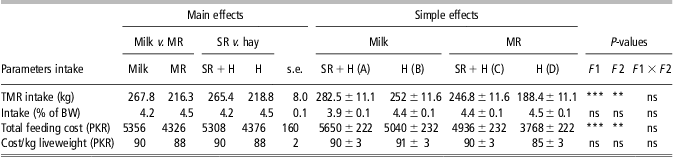
The total TMR intake of calves during the post-weaning period was higher (P < 0.05) in group A followed by groups B, C and D (Table 2). However, there was no significant difference (P > 0.05) between the intake of calves in groups B and C on as-fed basis. The milk-fed calves during the pre-weaning period consumed more TMR post weaning (P < 0.05) than the MR-fed calves (Table 2). Similarly, the SR-fed calves during the pre-weaning period consumed more TMR post weaning (P < 0.05) compared with calves fed hay only. There was no interaction (P > 0.05) among treatments for total TMR intake (Table 2).
Least mean squares of post-weaning intake and feeding cost of Sahiwal calves as affected by different pre-weaning feeding regimens

MR milk replacer; SR = starter ration; H = hay; TMR = total mixed ration; BW = body weight; PKR: Pakistan rupees (1US$ ≈ PKR 87).
ns: non-significant, P > 0.05.
**Statistically significant, P < 0.05.
***Statistically highly significant, P < 0.01.
F1: factor 1, milk v. milk replacer.
F2: factor 2, SR + H v. H only.
F1 × F2, interaction of F1 and F2.
A, B, C and D refers to respective treatment groups.
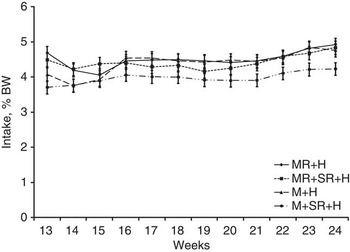
The TMR intake of calves (on as is basis), as a percentage of their BW, ranged from 3.8 in group A to 4.8 ± 0.19 in group C and was not affected (P > 0.05) by liquid feed source or solid feed source (Figure 2). However, the pre-weaning MR-fed calves tended to consume more TMR (P = 0.07) than milk-fed calves, whereas those fed hay before weaning tended to consume more TMR (P = 0.09) than concentrate-fed calves as percentage of their liveweight during the post-weaning period. The incremental differences in TMR intake post weaning as a percentage of liveweight between the treatment groups increased (P < 0.05) with age (Figure 2). There was an interaction (P < 0.05) between source of solid feed before weaning and age, indicating that the addition of SR to H fed before weaning did not influence post-weaning intake.
Effect of diet before weaning on the intake (kg/day) of total mixed ration (as-fed basis) post weaning expressed as a percentage of liveweight in Sahiwal calves. M+SR+H: milk plus starter ration plus hay; M+H: milk plus hay; MR+SR+H: milk replacer plus starter ration plus hay; MR+H: milk replacer plus hay.

Growth performance
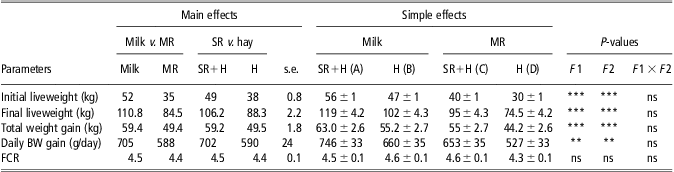
Average daily BW gain of calves during the post-weaning period was highest in group A followed by groups B, C and D (Table 3). However, this did not differ (P > 0.05) between groups B and C. The pre-weaning milk-fed calves grew faster post weaning compared with MR-fed calves (Table 3). Similarly, SR-fed calves during the pre-weaning period grew faster during the post-weaning period than those fed hay only in the same period (Table 3). There was no interaction (P > 0.05) between liquid feed source and solid feed source. Of the two factors, liquid feed source seemed to have the most significant effect on BW gain post weaning.
Least square means of post-weaning liveweight change and daily growth rate and FCR of Sahiwal calves as affected by different pre-weaning feeding regimens

FCR = feed conversion ratio; MR = milk replacer; SR = starter ration; H = hay; BW = body weight.
ns: non-significant, P > 0.05.
**Statistically significant, P < 0.05.
***Statistically highly significant, P < 0.01.
F1: factor 1, milk v. milk replacer.
F2: factor 2, SR + H v. H only.
F1 × F2, interaction of F1 and F2.
A, B, C and D refers to respective treatment groups.
The total weight gain during the post-weaning period, that is, from the 13th to 24th week of age, was 10 kg higher (P < 0.05) in calves fed milk than MR during the pre-weaning period (Table 3). Similarly, the calves fed SR before weaning gained 9.7 kg more post weaning (P < 0.05) than those fed hay only. There was no interaction (P > 0.05) between liquid feed source and solid feed source.
The final BW of calves at 24 weeks of age was 26.3 kg higher (P < 0.05) in calves fed milk before weaning than those fed MR (Table 3). Similarly, the calves fed SR before weaning were 18 kg heavier (P < 0.05) than calves receiving only H before weaning. Similarly, there was no interaction (P > 0.05) between liquid feed source and solid feed source. The post-weaning feed conversion ratio (FCR) of calves was not affected (P > 0.05) by any of the pre-weaning dietary treatments (Table 3).
Feeding cost
Total feeding cost of the calves during the 12 weeks post weaning was Pakistani rupees (PKR) 1030 (1US$ ≈ PKR 87) higher in calves fed milk during the pre-weaning period than those fed MR (Table 2). Calves receiving SR before weaning cost PKRs 932 more to feed post weaning than those fed H only. There was no interaction (P > 0.05) among the treatments. The highest post-weaning total feeding cost during the 12 weeks was observed in calves receiving milk and SR during pre-weaning period and the lowest was in those fed MR and H only for the same period. However, the cost per kg BW gain post weaning did not differ (P > 0.05) among calves receiving any of the pre-weaning dietary treatments (Table 2).
Discussion
In the present study, the total TMR intake of calves post weaning fed milk during the pre-weaning period was higher than in MR-fed calves. Daily feed Intake is a function of BW of the animal. Khan et al. (Reference Khan, Weary and von Keyserlingk2011) have concluded that post-weaning feed intake of calves is governed by rumen volume, metabolic activity of rumen epithelium, rumen motility and feed quality. Higher TMR intake in the milk-fed calves, in the present study, was probably because of their greater digestive capacity (as a result of higher BW at weaning) than in MR-fed calves. The MR-fed calves during the pre-weaning period had lower weaning weights, and thus ate less than heavier calves at weaning. Khan et al. (Reference Khan, Lee, Lee, Kim, Kim, Ki, Ha, Lee and Choi2007) reported that depression in solid feed intake post weaning as a result of increased amount of milk feeding during pre-weaning period could be avoided if the calves are weaned gradually. Gradually weaned calves have no problem of depressed feed intake post weaning (Jasper and Weary, Reference Jasper and Weary2002). In the present study, the calves were gradually weaned from 9 to 12 weeks of age; thus, calves had adjusted to consuming solid feed during this period. This is perhaps another reason for the increased TMR intake post weaning by the calves fed milk during the pre-weaning period compared with other treatments.
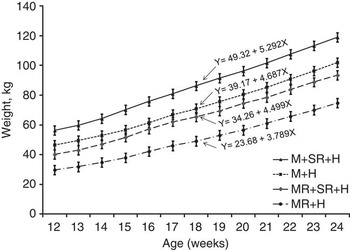
The daily BW gain of milk-fed calves during the pre-weaning period was higher than in MR-fed calves post weaning. The daily BW gain of growing animals is a function of their initial liveweight and nutrient intake. In the present study, the calves were fed ad libitum post weaning. Thus, nutrient availability was not the limiting factor, resulting in lower growth rate post weaning of MR-fed calves during the pre-weaning period. The higher average daily BW gain of milk-fed calves was because of their higher weaning weights. These calves continued to maintain the difference in their liveweight compared with the other groups (Figure 3). Similar results have been reported by Jasper and Weary (Reference Jasper and Weary2002), who reported that weight advantage of ad libitum-fed calves persists after weaning. They further argued that if this early opportunity of rapid growth by calves is missed, high levels of intake later in life may not allow for compensatory growth. Thus, our initial hypothesis that the MR calves may show compensatory growth if fed well after weaning could not be validated in this study with Sahiwal calves.
Effect of diet before weaning on liveweight change (kg) post weaning in Sahiwal calves. M+SR+H: milk plus starter ration plus hay; M+H: milk plus hay; MR+SR+H: milk replacer plus starter ration plus hay; MR+H: milk replacer plus hay.

Similarly, the SR component of the pre-weaning diet was important, with SR-supplemented calves growing faster than comparable groups fed hay only. However, there was no difference in the growth performance of calves receiving MR+SR+H and milk+H only during the pre-weaning period. Presumably, the higher energy component of SR counteracted the superior nutrient availability in milk relative to MR.
This study has confirmed that weaning weight, which was an indicator of pre-weaning dietary treatment, was the main variable influencing post-weaning growth performance. This is consistent with the observation that intake as percent of BW, the FCR and the feeding cost per kg of BW gain post weaning did not differ among calves receiving different pre-weaning dietary treatments. This indicates that, although the efficiency of feed utilization was similar in calves across all groups, calves with higher weaning weight maintained higher BW post weaning than all the other groups. Similarly, the calves receiving MR+H during the pre-weaning period, with lower weaning weights, could not catch up with the BW of calves receiving milk and SR even at the age of 24 weeks. This underlines the importance of pre-weaning feeding for early age at maturity.
The effects of pre-weaning dietary treatments on post-weaning growth performance of Holstein heifers were extended out to 600 days of age in the report of Moallem et al. (Reference Moallem, Werner, Lehrer, Zachut, Livshitz, Yakoby and Shamay2010). In their study, the Holstein heifer calves fed whole milk (CP = 25.9 and fat = 29.4%, on DM basis) ad libitum during their pre-weaning period were heavier than those fed MR (CP = 23.7 and fat = 13%, on DM basis). The liveweight of milk-fed heifers, in their study, was 16.9 and 27.0 kg higher than that of MR-fed heifers at 300 and 600 days of age, respectively (P < 0.04). Similarly with beef breeds, Christian et al. (Reference Christian, Hauser and Chapman1965) reported that heavier weaned Hereford calves reached slaughter grade of ‘High Choice’ in fewer days post weaning compared with lighter weaned calves. In this study, the heavier calves at weaning required more dry feed/kg of BW gain immediately after weaning, which is most likely due to higher body maintenance requirements.
Similar outcomes were observed by Robelin and Chilliard (Reference Robelin and Chilliard1989). They reported that differences in MR intake (1380 v. 819 g/day on DM basis, respectively) up to 95 days of age resulted in a 25% heavier calf; however, subsequent growth rates up to 533 days of age were similar (806 v. 814 g/days), resulting in differential liveweights at this age of 530 and 496 kg, respectively. However, Nocek and Braund (Reference Nocek and Braund1986) reported that Holstein calves receiving either all-milk protein replacer (CP = 24.0 and ether extract = 13.3%, on DM basis) or acidified milk replacer (CP = 23.0 and ether extract = 6.9%, on DM basis) and weaned either abruptly or gradually reached 136 kg of liveweight in approximately the same number of days (91 to 97).
Total feeding costs post weaning were higher in milk-fed calves than in MR-fed calves during the pre-weaning period; the same was true for the calves fed SR+H v. H only. This was because of the higher TMR intake in the respective groups. However, cost per kg BW gain post weaning was similar in calves receiving different pre-weaning dietary treatments. Thus, the higher total feeding costs post weaning in the calves fed milk or SR than those fed MR or H during the pre-weaning period were compensated with their superior growth rates in the same period.
Conclusions
Post-weaning growth performance of Sahiwal calves was established by the intake of nutrients before weaning. Feeding whole milk (CP = 3.35 and fat = 3.5%, on as-fed basis) from birth at the rate of at least 10% of liveweight with concentrates lead to a higher weaning weight and post-weaning growth rate, and hence may have a greater possibility for earlier puberty compared with feeding a milk replacer (CP = 2.22 and fat = 1.8%, on as-fed basis) before weaning. Similarly, feeding the concentrate starter ration before weaning in preference to hay induced faster post-weaning growth rates. The cost per kg BW gain in Sahiwal calves was not different among treatment groups post weaning.
Acknowledgments
This project was supported financially by the Agriculture Sector Linkages Program established by the Pakistani and Australian governments, which is managed by the Australian Centre for International Agricultural Research through Charles Sturt University, Wagga Wagga, Australia. Calves were procured from the Livestock Production Research Institute, Bahadurnagar, Okara.