

Introduction
Mastitis is the inflammation of the mammary gland and udder tissue predominantly due to the effects of bacterial pathogens. It is a major endemic disease of dairy cattle, which causes great economic losses in the dairy industry (Nielsen, Reference Nielsen2009). The occurrence of clinical mastitis (CM) in dairy herds is a multifactorial problem and several aspects such as production level, lactation number, herd management and climate may be considered as risky factors. Heat stress has a negative impact on animal health and several studies indicated a higher rate of CM or higher milk somatic cell counts in dairy cows exposed to hot environment (Morse et al., Reference Morse, DeLorenzo, Wilcox, Collier, Natzke and Bray1987; Cook et al., Reference Cook, Bennett, Emery and Nordlund2002; Bertocchi et al., Reference Bertocchi, Vitali, Lacetera, Nardone, Varisco and Bernabucci2014). The aim of the present study was to assess the relationships between season, month, temperature humidity index (THI) and occurrence of CM in dairy heifers bred in a large commercial dairy farm located in central Italy.
Material and methods
Data on incidences of CM recorded during 2 years (January 2014 to December 2015) from a large Italian dairy farm with 1050 to 1200 Holstein cows milked daily were used to assess the relationships between season, month, THI and occurrence of CM. Only the cases of CM recorded in primiparous cows were considered for the analysis. Recording an occurrence of CM required milker identification and veterinary confirmation. Occurrence of CM was defined by the presence of clinical signs at udder level such as swelling, heat, hardness, redness or pain, and by abnormal changes of the milk such as a watery appearance, flakes, clots or pus. All animals detected with CM received medical treatments. Cases of CM were classified for season and month of the occurrence. The months of December, January, February were defined as winter; March, April and May as spring; June, July and August as summer; September, October and November as autumn. Daily maximum THI was calculated as reported by Kelly and Bond (Reference Kelly and Bond1971) using temperature (°C) and relative humidity (%) recorded at the nearest weather station (6 km) the day before the detection of CM. Although there is not a univocal threshold for the beginning of heat stress in dairy cows, some studies indicated values around 70 unit of THI as the upper limit of thermal comfort zone above which heat stress starts (Bouraoui et al., Reference Bouraoui, Lahmar, Majdoub, Djemali and Belyea2002; Bernabucci et al., Reference Bernabucci, Lacetera, Baumgard, Rhoads, Ronchi and Nardone2010). In light of this, we have set the heat stress threshold at 70 THI units, whereas the other classes were chosen arbitrarily and THI values were grouped into four classes: <70; 70 to 74; 75 to 79; and >79. The incidence rate of clinical mastitis (IRCM) was expressed as the number of clinical cases per 1000 heifers-day at risk. This was calculated as the cases of CM recording for heifers during the time period divided by the number of heifers-days at risk during the same time period×1000 (Gianneechini et al., Reference Gianneechini, Concha, Rivero, Delucci and Moreno López2002). Seasonal, monthly and THI variation of IRCM were evaluated by means of GLM where IRCM was set as the dependent variable and season, month and class of THI as the independent variables. Significance was set for P<0.05.
Results and discussion
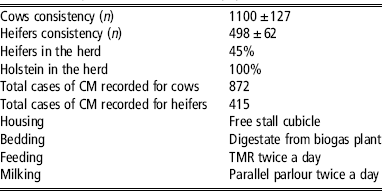
Descriptive statistics of the study is reported in Table 1. The analysis of weather data showed that starting from May (69.8±3.5) until October (70.7±4.1) conditions of heat stress were recorded. During this period July (79.2±3.4) and August (78.8±2.4) were the hottest months.
Descriptive statistics of the study (years 2014–15)

CM=clinical mastitis; TMR=total mixed ration.
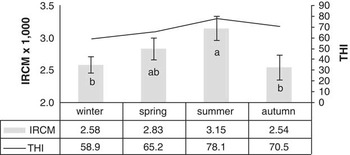
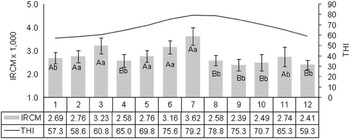
Total cases of CM recorded for dairy heifers during the study period were 415 corresponding to 41 cases for 100 milking heifers/year. Among seasons, summer emerged as the most critical for the occurrence of CM (Figure 1). July showed the highest value of IRCM. Beyond this, March and June resulted the other months with high values of IRCM (Figure 2).
Seasonal incidence rate of clinical mastitis (IRCM) expressed as least squares (LS) means×1000 (±SE) (grey bars). Seasonal average values of maximum temperature humidity index (THI) (black line). The LS means indicated with different letters differed significantly at P<0.05.

Monthly incidence rate of clinical mastitis (IRCM) expressed as least squares (LS) means×1000 (±SE) (grey bars). Monthly average values of maximum temperature humidity index (THI) (black line). The LS means indicated with different letters differed significantly: uppercase at P<0.01 and lowercase at P<0.05.

The lower incidence of CM during the months of August and September suggests a culling effect that may be due to the higher incidence of animals that were sick in early summer months. In addition to this aspect, a certain capacity of the animals to adapt to the heat condition during the hot season cannot be excluded.
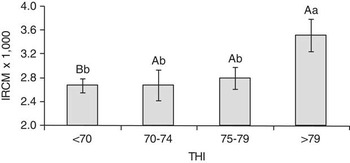
Figure 3 shows the relationships between IRCM and classes of THI. Severe heat stress conditions with THI>79 were significantly associated with the highest IRCM.
Incidence rate of clinical mastitis (IRCM) expressed as least squares (LS) means×1000 (±SE) in relation to classes of maximum temperature humidity index (THI). The LS means indicated with different letters differed significantly: uppercase at P<0.01 and lowercase at P<0.05.

The lower risk for the occurrence of CM in dairy heifers was recorded for thermal comfort zone (THI<70) and for mild heat stress conditions (70<THI<79).
Conclusion
Severe condition of heat stress may affect health status in primiparous cows. Summer was the season with the highest risk of the occurrence of CM, with the highest risk in July. The exposure of primiparous cows to THI values >79 was associated with a higher risk of CM development. These results confirm the negative effects of heat stress on health in dairy cows and they strongly support the implementation of adaptation strategies, which may ensure animal welfare and limit economic losses due to high temperatures.
Acknowledgements
This study was financially supported by Italian Ministry of Agriculture (FACCEMACSUR Projects). The authors gratefully acknowledge the Maccarese S.p.A Società Agricola for provision of the clinical mastitis data and the Servizio Integrato Agrometeorologico della Regione Lazio for provision of the weather data.