Introduction
Maintaining and/or improving quality of life (QOL) has become a major focus in geriatric medicine. Among the geriatric population, the oldest old have received limited attention in clinical investigations. The geriatric population is the most rapidly growing segment of the population in the U.S.A., and the number of older people will increase dramatically from 2011 onward when the baby boomers turn 65 years old. From 2030 onward, this group will become the oldest old population (aged 85 and older), causing a dramatic increase in the number of individuals in this segment of the population.
With more old people living into their 90s, the notion of the old population being the group that is most frail, vulnerable, and most needing care is changing. People are enjoying life following retirement more than ever. In a periodic national survey of mortality, Liao and colleagues compared 1986 with 1993 surveys and noted improved QOL of decedents aged 85 and older in the last year of life. In addition, contrary to the belief that health worsens and morbidity increases as elderly people live longer, Liao provided evidence of a trend of declining morbidity and disability in the overall elderly population (Liao et al., Reference Liao, McGee, Cao and Cooper2000). Despite longer and healthier lives, old age comes with increased disability for many. Sensory deficits, functional decline, cognitive decline, and depressive symptoms have an impact on the QOL, especially in the oldest old who may have the most disabilities.
QOL is not a single entity and no universal definition exists to describe or measure this concept. However, the World Health Organization QOL group developed a useful definition of QOL as “the individuals’ perception of their position in life in the context of the culture and value systems in which they live and in relation to their goals, expectations, standards and concerns” (O'Boyle, Reference O'Boyle1997). Although the concept of QOL is complex, several domains have been identified as playing important roles, including physical, emotional, spiritual, cognitive and social well-being. Pain and coping skills often influence QOL as well.
Measurement of QOL has become a major focus of significant importance in clinical as well as research outcomes. However, measuring QOL in the elderly is often more difficult than measuring QOL in younger people. In older people, changes with aging such as visual and hearing impairment, decreased mobility, and cognitive changes impact the validity of QOL measurements that have been developed for younger people. Numerous instruments have been developed to measure single or multiple dimensions of QOL, but few have been adapted or validated in the elderly, take cognitive functioning into consideration, or focus on the oldest old (De Leo et al., Reference De Leo1998).
The oldest old are felt by many to have a “poor” QOL because of the high percentage of comorbid chronic medical conditions, physical disabilities, and cognitive decline. The relationship of these factors to QOL has not been well delineated. QOL studies are lacking for extremely old individuals in their tenth decade of life. To our knowledge, our study is the first to investigate the relationships between perceived (by the person) and observed (by a caregiver) QOL, and cognitive functioning and depression in individuals 90 years and older. We hypothesized that nonagenarians will demonstrate patterns of QOL similar to each other regardless of cognitive functioning.
Methods
This Institutional Review Board approved study is a part of a larger investigation designed to evaluate cognitive function and QOL in the oldest old (90–99 years) in Rochester, Minnesota, U.S.A. over a three-year period (Boeve et al., Reference Boeve2003). A detailed description of methods has been published elsewhere (Boeve et al., Reference Boeve2003). Individuals in Olmsted County aged 90 and older identified from the Rochester Epidemiology Project (Melton, Reference Melton1996) were asked to participate via mailed materials. Those who agreed to participate from three concentrated locations were interviewed first, and subsequent participants were selected randomly from around the county. Participants identified an informant (typically a spouse or child) and underwent a neuropsychological battery followed by a comprehensive neurologic assessment.
As part of a larger functional and neuropsychologic battery, subjects were administered the Mini-Mental State Examination (MMSE, range 0–30; higher scores indicate better cognitive function) (Folstein et al., Reference Folstein, Folstein and McHugh1975); the Hearing Handicap Inventory for the Elderly – Screening Version (HHIE-S) (Ventry and Weinstein, Reference Ventry and Weinstein1983);the Record of Independent Living (ROIL) (Weintraub, Reference Weintraub1986); the Mattis Dementia Rating Scale (DRS, range 0–144; higher scores indicate better cognitive function) (Mattis, Reference Mattis1988); and the Geriatric Depression Scale short form (GDS, range 0–15; higher scores indicate more depression) (Yesavage et al., Reference Yesavage1982). Additionally, both the subjects and their caregivers were asked to complete a Linear Analogue Self Assessment (LASA) (Grunberg et al., Reference Grunberg, Groshen, Steingass, Zaretsky and Meyerowitz1996; Gudex et al., Reference Gudex, Dolan, Kind and Williams1996; Bretscher et al., Reference Bretscher1999; Rummans et al., Reference Rummans2006; Locke et al., Reference Locke2007), comprising a series of ten questions (Likert analogue scales) to assess overall QOL as well as nine specific dimensions of physical well-being, emotional state, faith, religious involvement, intellectual state, social interactions, pain frequency, pain intensity and coping ability. Each item asks a respondent to rate their perceived level of functioning on a scale of 0 to 10, with 0 being “as bad as it can be” and 10 being “as good as it can be.” The LASA has been shown to be effective for obtaining valid and reliable measures of QOL. Subjects typically required two to four hours to complete the battery administered by a registered nurse with expertise in geriatric neurology.
The comprehensive neurological assessment, performed by a behavioral neurologist who was blinded to the neuropsychological test findings, included medical and neurological history, assessment of best-corrected vision bilaterally using the AMA Near Vision Card (read at a distance of 14 cm from eyes), Short Test of Mental Status (STMS, range 0–38, high score indicates good cognitive function) (Kokmen et al., Reference Kokmen, Naessens and Offord1987; Reference Kokmen, Smith, Petersen, Tangalos and Ivnik1991), language testing, and a full neurologic examination. The neurological interview and examination typically required one to two hours to complete per subject. The neurologist then rendered a clinical diagnosis for each subject based on level of cognitive functioning as previously described (Boeve et al., Reference Boeve2003) using four clinical diagnostic groups: normal (normal), mild cognitive impairment (MCI), dementia (DEM), and dementia with stroke and parkinsonism (DEMSP). The DEMSP group was analyzed separately to distinguish whether the comorbid conditions of stroke and parkinsonism lead to clinical, functional, and psychometric presentations different from the other three cognitive groups. The diagnosis of dementia was based on criteria as specified in the Diagnostic and Statistical Manual of Mental Disorders (American Psychiatric Association, 1987).
Data analysis
The data obtained from the study participants were summarized within groups defined by cognitive status. Quantitative data were summarized with means and standard deviations, and qualitative data were summarized with counts and percentages. Fisher exact tests were used to compare percentages among groups for qualitative variables, and rank sum tests were used to compare the centers of the distributions of the quantitative variables among the study groups. Primary comparisons were based on global assessments of differences among all four cognitive groups. When the global comparisons reached statistical significance, pair wise comparisons were made among the four groups to evaluate which of the groups were significantly different from one another. In addition to comparing data among the four cognitive groups, self-assessed and caregiver-assessed measures of QOL were compared using signed rank tests. Also, associations among the various measures of cognition, depression and QOL were estimated and tested using Spearman correlation coefficients. Differences in the degree of correlation between selected variables were tested using a bootstrap sampling approach. Correlations above 0.5 were considered strong, between 0.3 and 0.5 were considered moderate, between 0.1 and 0.3 were considered weak and below 0.1 were considered to be trivial (Cohen, Reference Cohen1988). These assessments were obtained using data from all subjects, as well as within the groups defined by cognitive status. Tests of hypothesis with a two-tailed p-value less than 0.05 were considered to be statistically significant. All analyses were performed using SAS software (SAS Institute, Cary, NC).
Results
Participant characteristics
In the three-year period from 1997 to 2000, 144 subjects were included in this data analysis. Subjects were divided into four diagnosis groups based on cognitive functioning: 56 (38.9%) were classified as normal, 13 (9.0%) with MCI, 41 (28.5%) with DEM, and 34 (23.6%) with DEMSP.
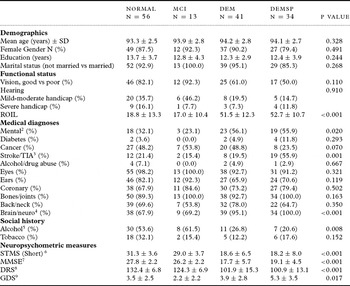
Demographic data, functional assessment, and neuropsychometric performance are summarized in Table 1. Mean ages ranging from 93 to 94 years were similar among all four groups. The majority of subjects were female, had at least high school education, and were not married. Comparison of functional status did not reveal significant differences in vision and hearing abilities among all groups, i.e. the vision and hearing impairments were not higher in the groups with dementia (DEM and DEMSP) compared to those without dementia (normal and MCI). The overall functional ability as measured by the ROIL differed significantly among the groups (p < 0.001), being highest in MCI and lowest in DEMSP. Mental or psychiatric comorbidities were more frequent in the demented (DEM and DEMSP) than nondemented (normal and MCI) groups. Among other medical comorbidities, a history of stroke or transient ischemic attack was expectedly higher in the group with DEMSP. In addition, all subjects in the DEMSP group had neurological comorbidity or diagnosis, which was not true for the other groups. Alcohol use included in the social history pertained to any lifetime history of drinking. History of alcohol use was less frequent in the dementia (DEM and DEMSP) groups and more frequent among the normal and MCI groups.
Demographic, functional and neuropsychometric characteristics

DEM = dementia; DEMSP = dementia with stroke and Parkinsonism; DRS = Dementia Rating Scale (0–144, high is good); GDS = Geriatric Depression Scale short form (0–15, high is bad); MCI = mild cognitive impairment; MMSE = Mini-Mental State Examination (0–30, high is good); ROIL = Record of Independent Living; SD = standard deviation; STMS = Short Test of Mental Status (0–38, high is good); TIA = transient ischemic attack.
1Difference between normal and DEM, normal and DEMSP, MCI and DEM, MCI and DEMSP (all p < 0.001).
2Difference between normal and DEM (p = 0.018), normal and DEMSP (p = 0.027), MCI and DEM (p = 0.038), MCI and DEMSP (p = 0.044).
3Difference between normal and DEMSP (p = 0.001), MCI and DEMSP (p = 0.013), DEM and DEMSP (p = 0.001).
4Difference between normal and DEM (p = 0.001), normal and DEMSP (p < 0.001), MCI and DEM (p = 0.010), MCI and DEMSP (p = 0.001).
5Difference between normal and DEM (p = 0.030), normal and DEMSP (p = 0.005), MCI and DEM (p = 0.049), MCI and DEMSP (p = 0.013).
6Difference between normal and DEM, normal and DEMSP, MCI and DEM, MCI and DEMSP (all p < 0.001), normal and MCI (p = 0.046).
7Difference between normal and DEM, normal and DEMSP, MCI and DEM, MCI and DEMSP (all p < 0.001), normal and MCI (p = 0.019).
8Difference between normal and MCI (p = 0.002), normal and DEM (p < 0.001), normal and DEMSP (p < 0.001), MCI and DEM (p<0.001), MCI and DEMSP (p < 0.001).
9Difference between normal and DEMSP (p = 0.048), MCI and DEMSP (p = 0.013).
Neuropsychometric performance
All four groups demonstrated significant differences in STMS, MMSE and DRS scores, with the demented (DEM and DEMSP) groups scoring lower and nondemented (normal and MCI) groups scoring higher on all measures as expected (p < 0.001). All four groups demonstrated low scores on the GDS, i.e. 6 or less; however, the DEMSP group scored highest on the GDS, and the MCI scored lowest on the GDS.
Quality of life indicators
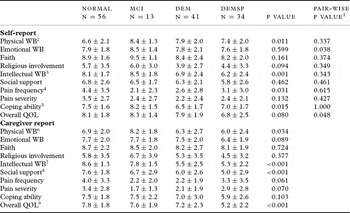
The individual QOL domains and overall QOL scores as measured by LASA are shown in Table 2. While not statistically significant, subjects in general rated their own overall QOL relatively high (range 6.0–8.3 out of 10), regardless of cognitive functioning. In contrast, differences in the overall QOL were statistically significant when rated by caregivers. Overall QOL was perceived highest in the normal group and worst in the DEMSP group (p < 0.001).
Linear Analogue Self Assessment (LASA) quality of life: self- and caregiver-rated

DEM = dementia; DEMSP = dementia with stroke and Parkinsonism; MCI = mild cognitive impairment; QOL = quality of life; WB = well-being.
1p value for comparing self report and caregiver report.
2Difference between normal and MCI (p = 0.005), normal and DEM (p = 0.022).
3Difference between normal and DEM (p = 0.037), normal and DEMSP (p = 0.002), MCI and DEM (p = 0.046), MCI and DEMSP (p = 0.010).
4Difference between normal and MCI (p = 0.024), normal and DEM (p = 0.023).
5Difference between normal and DEM (p = 0.025), MCI and DEM (p = 0.005).
6Difference between normal and MCI (p = 0.030), MCI and DEM (p = 0.041), MCI and DEMSP (p = 0.010).
7Difference between normal and DEM (p < 0.001), normal and DEMSP (p < 0.001), MCI and DEM (p = 0.006), MCI and DEMSP (p = 0.003).
8Difference between normal and DEM (p = 0.007), normal and DEMSP (p < 0.001).
9Difference between normal and DEMSP (p < 0.001), MCI and DEMSP (p = 0.007), DEM and DEMSP (p = 0.009).
When rating their own QOL, the MCI group endorsed better QOL on domains of physical well-being (p = 0.011), intellectual well-being (p = 0.001), pain frequency (p = 0.031), and ability to cope with stress (p = 0.015), compared with the other three groups. When rated by their caregivers, the MCI group scored highest on physical well-being (p = 0.034), and the normal group scored highest on intellectual well-being (p < 0.001), social connectedness (p < 0.001), and overall QOL (p < 0.001). On these specific QOL domains, caregivers consistently rated the demented (DEM and DEMSP) groups lower than the nondemented (normal and MCI) groups. Furthermore, when tests were done between subject and caregiver ratings for all subject-caregiver pairs to look at the difference in their scoring, all subjects combined (regardless of cognitive functioning) showed a significant difference in how subjects and caregivers scored the QOL (p = 0.048). However, when comparing specific cognitive groups, there were no differences found among the normal, MCI, and DEM groups; but the DEMSP group demonstrated a difference in how the patients and caregivers rated the QOL (p = 0.035).
Correlation between cognition, depression, and overall QOL
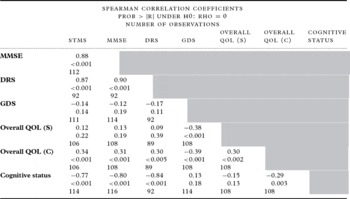
Table 3 shows correlations between cognitive functioning, depressive symptoms, and overall QOL when all four groups were combined. There were strong negative correlations (r < −0.75) between cognitive status and all three neuropsychometric measures, i.e. the greater the level of dementia, the lower the scores on STMS, MMSE, and DRS. Lower scores on the GDS correlated with higher self-reported QOL. When rated by caregivers, higher QOL scores correlate with higher DRS and lower GDS scores. However, GDS scores were moderately negatively correlated with overall QOL, but showed a stronger correlation with overall QOL, in absolute value, than the DRS. When rated by caregivers, the correlations did not differ significantly in absolute value (r = 0.30 vs r = −0.39, p = 0.509). When self-rated the magnitude of the correlations was larger (r = 0.09 vs. r = −0.38), and did reach statistical significance (p = 0.012). Overall QOL is higher, whether self-rated or rated by caregiver, when GDS scores are lower.
Correlation between cognitive function, depressive symptoms, and overall QOL

DRS = Dementia Rating Scale; GDS = Geriatric Depression Scale short form; MMSE = Mini-mental State Examination; NS = not significant; Overall QOL (S) = self-rated overall quality of life; Overall QOL (C) = overall quality of life rated by caregiver; STMS = Short Test of Mental Status; Cognitive status, 1 = Normal, 2 = MCI, 3 = Dementia (with or without stroke/parkinsonism).
There were significant correlations between self-perceived overall QOL scores and lower GDS scores for normal (r = −0.51, p < .001) and DEMSP (r = −0.51, p = 0.035) groups, and between caregiver-perceived overall quality of life and GDS scores for normal (r = −0.61, p < .001) and DEM (r = −0.55, p = 0.008) groups. However, only the MCI group demonstrated a significant correlation between self-reported overall QOL and DRS scores (r = −0.80, p = 0.002).
Discussion
Three main points can be drawn from this study. First, the oldest old in the study group describe a fairly high level of overall QOL, regardless of the level of cognitive functioning. Second, their perception of overall QOL is better than caregivers perceive it. Third, QOL is more strongly correlated with depressive symptoms than dementia severity when measured by self-report.
The study participants represented a community-dwelling oldest-old population who were predominantly female, not married (most were widowed), and had a high school education or higher. Regardless of the level of cognitive functioning, the groups did not differ in vision and hearing abilities. However, cognitive functioning did impact their ability to perform activities of daily living, as demonstrated by higher overall functional abilities among the groups with mild or no cognitive impairment, compared to those with dementia. The two dementia groups also had higher cerebrovascular histories and neurological comorbidities, and more frequent psychiatric histories.
The fairly high level of overall QOL was endorsed by this oldest old group across the board, whether or not cognitive impairment existed. Participants endorsed overall QOL scores in the range of 6.8 to 8.3 out of 10, where higher numbers indicate better QOL. This result suggests they may be finding meaning and enjoyment in later life, which may lead to relatively high levels of satisfaction with life. QOL in old age has been described as a sense of well-being, meaning and value in life (Sarvimaki and Stenbock-Hult, Reference Sarvimaki and Stenbock-Hult2000). Through life experiences, this generation may be better equipped to deal with adversities that contribute to their overall positive response to their QOL. Also, with time, people adapt to their situation and find meaning and enjoyment in their existence even when others see their cognitive and functional limitations as hindering their QOL (Bretscher et al., Reference Bretscher1999).
Correlations between patients’ and caregivers’ ratings of QOL have been studied in a number of settings. In our study, subjects perceived their overall QOL better than their caregivers did. The difference between self-perceived and caregiver-perceived QOL was more pronounced for the DEM and DEMSP groups. Especially for the DEMSP group, there was a significant difference between the patients’ and caregivers’ perception not only of the overall QOL, but also in specific domains of physical well-being, intellectual well-being, and social connectedness, all rated higher by the patient than by the caregiver. Clearly, caregivers often perceive the older person's cognitive decline, physical impairment and emotional lability as adversely affecting the older person's overall QOL more than the older person does.
Finally, depressive symptoms correlate with QOL in a negative way. Those with more severe depressive symptoms had lower QOL. This correlation between overall QOL scores and lower GDS scores remained consistent across all cognitive groups. Depression in the oldest old is often underdiagnosed and inadequately treated, resulting in increased disability and mortality (Penninx et al., Reference Penninx, Geerlings, Deeg, van Eijk, van Tilburg and Beekman1999a; Reference Penninx, Leveille, Ferrucci, van Eijk and Guralnik1999b; Blazer, Reference Blazer2000; Bergdahl et al., Reference Bergdahl2005). Studies have demonstrated an association between QOL and the severity of depression in the elderly (Warner, Reference Warner1998; McKenna et al., Reference McKenna2001; Ceroni et al., Reference Ceroni, Rucci, Berardi, Berti Ceroni and Katon2002; Doraiswamy et al., Reference Doraiswamy, Khan, Donahue and Richard2002). Our findings highlight the importance of screening and treating depression in the oldest old (Nakajima and Wenger, Reference Nakajima and Wenger2007), in order to maintain their QOL (Blazer, Reference Blazer2000).
Although our population illustrated the issues we describe, it is a community-based sample of oldest old who were generally Caucasian from the Midwest. Not all of those with severe impairment in hearing, vision, and cognition could participate in this study. Despite these limitations, our results provide important insight into the relationship between QOL, cognitive functioning, and depression among the oldest old.
Conclusion
Our findings support the hypothesis that the oldest-old individuals have relatively high levels of QOL regardless of cognitive functioning. Depressive symptoms and cognitive functioning may be important predictors of QOL. Interventions designed to address depression and maximize cognitive capabilities may therefore aid in maintaining or improving overall QOL in the oldest old.
Conflict of interest declaration
Ronald C. Petersen has received grant support from NIA.
Description of authors' roles
Maria I. Lapid undertook the analysis and interpretation of the data. Teresa A. Rummans, Bradley F. Boeve, Glenn E. Smith, Robert J. Ivnik, Eric G. Tangalos and Ronald C. Petersen were involved in the study concept and design, acquisition of subjects and data, and the analysis and interpretation of data. Joan K. McCormick assisted with the acquisition of subjects and data; V. Shane Pankratz assisted with the study concept and design, analysis and interpretation of data, and Ruth H. Cha with the analysis and interpretation of data. All authors were involved in writing and preparing the paper for publication.
Acknowledgments
This study was conducted at Mayo Clinic, Rochester, MN. The findings were presented as a poster at the American Geriatrics Society Annual Meeting in Washington, District of Columbia, May 2008. The abstract is published in the Journal of the American Geriatrics Society, 2008, 56 (Suppl.), S62–S63.
This work was supported by the Alzheimer's Association, NIA grants AG16574 and AG06786, and the Robert H. and Clarice Smith and Abigail Van Buren Alzheimer's Disease Research Program of the Mayo Foundation.