Introduction
The local Oravka chicken breed has not been extensively researched on ex situ cryopreservation. This breed was created by crossbreeding local hens in the Orava region with Rhode Island, Wyandotte and New Hampshire breeds (Hanusová et al., Reference Hanusová, Hrnčár, Oravcová and Hanus2014) and was recognized in 1990 (Chmelničná, Reference Chmelničná2004). However, Weis et al. (Reference Weis, Gardiánová, Hrnčár, Mindek, Svobodová and Bujko2010) categorized the Oravka breed as a critical endangered breed under the conditions of the Slovak Republic. Oravka is a dual-purpose breed kept for egg and meat production, respectively. The animals are yellowish-brown in colour and have a rectangular body frame. The live weight of adult females is from 2.2 to 2.7 kg and the weight of males is from 2.8 to 3.3 kg. From 80 to 200 eggs per female per year are produced with the minimum hatching egg weight of 55 g (Hrnčár, Reference Hrnčár2008).
Although numerous trials have been made to develop a suitable procedure for preservation of cock semen, a successful protocol for cryopreservation has not been achieved (Gliozzi et al., Reference Gliozzi, Zaniboni and Cerolini2011; Santiago-Moreno et al., Reference Santiago-Moreno, Castaño, Toledano-Díaz, Coloma, López-Sebastián, Prieto and Campo2012). To date, semen cryopreservation is the only effective method of storing reproductive cells ex situ (Iaffaldano et al., Reference Iaffaldano, Di Iorio, Miranda, Zaniboni, Manchisi and Cerolini2016a) and is extensively researched as a possible effective method of maintaining male genetic material for the establishment of a cryobank. However, cryopreserved cock semen has limits, due to its presumably low spermatozoa motility with the primary role of the sperm being to fertilize the ovum (Hou et al., Reference Hou, Huang, Lai and Lee2008). In this regard, is necessary to improve and standardize germplasm cryopreservation technology for ex situ in vitro conservation programmes. In avians, semen cryopreservation is the only method currently available to develop ex situ cryopreservation programmes, as oocyte cryopreservation cannot be used due to the high content of yolk in the eggs (Blesbois, Reference Blesbois2007). However, this procedure still cannot be successfully used due to cryopreservation-induced damage (Mphaphathi et al., Reference Mphaphathi, Luseba, Sutherland and Nedambale2012, Reference Mphaphathi, Seshoka, Luseba, Sutherland and Nedambale2016; Mosca et al., Reference Mosca, Madeddu, Sayed, Zaniboni, Iaffaldano and Cerolini2016).
There are different interactions that influence successful semen freezing such as the medium, the cryoprotective agent (CPA) used and its concentration, the packaging system or the freezing and thawing system. Among the various factors, the choice of the CPA plays a role of primary importance. Thus, evaluation of semen quality parameters of poultry birds is still available and gives an excellent indicator of fertility potential and subsequent hatchability of eggs (Peters et al., Reference Peters, Omidiji, Ikeobi, Ozoje and Ademambo2004). Semen analyses suitable for the study of cock fertility generally include the evaluation of spermatozoa motility (Rijsselaere et al., Reference Rijsselaere, Van Soom, Tanghe, Coryn, Maes and de Kruif2005) and viability. The spermatozoa motility assessment is repeatable and may then be linked to fertility. Manual and microscopic techniques are commonly used analyses. However, alternatively, more precise options are the computer-assisted sperm analyser (CASA) system that objectively analyses spermatozoa motility parameters (Parker et al., Reference Parker, Yeatman, Schultz, Zumwalt and McDaniel2000) and flow cytometry applications that allow examination of spermatozoa viability because their high sensitivity (Christersen et al., Reference Christersen, Stenvang and Godfrey2005). Moreover, flow cytometric analysis allows the examination of 10,000 cells in a very short time, which makes this analysis very precise.
The aim of this study was to compare the effect of different cryoprotectants, dimethyl sulfoxide (DMSO), ethylene glycol (EG) and glycerol (GL), on the post-thaw quality of Oravka cock semen.
Materials and methods
Animals
Six mature males from the Oravka line (12–18 months) that were kept at the breeding facility (NPPC, VUŽV, Lužianky, Slovak Republic) were used in this experiment. All cocks (n = 6) were housed in individual cages, maintained under an artificial photoperiod (14 h of light at 10 lux and 10 h of dark) and were fed with a commercial standard diet (TEKRO Nitra, s.r.o., Slovak Republic) with water given ad libitum. The experiments were carried out in accordance with the Code of Ethics of the EU Directive 2010/63/EU for animal experiments (http://ec.europa.eu/environment/chemicals/lab_animals/legislation_en.htm).
Experimental design
Semen was routinely collected from six cocks twice a week by dorso-abdominal massage into prepared sterile tubes. Only samples with a minimum total motility of 70% were used in the experiments. Samples containing urine and cell debris were removed. The samples were pooled to avoid the effects of individual differences among cocks. The samples were subdivided into fresh control (non-cryopreserved) and experimental (cryopreserved: DMSO, EG and GL) groups. Semen sample was centrifuged (600 g) at 4°C for 5 min, seminal plasma was removed and aliquots of semen (250 µl) were diluted (1:1; v/v) with Kobidil+ extender (Landata Cobiporc, France) at room temperature and cooled to 4°C. Kobidil+ contributes to maintenance of the osmotic balance of the diluted semen, limits the development of bacteria, meets the energy needs of the spermatozoa, and guarantees the pH stability of the environment. Next, freezing medium composed of Kobidil+ and following cryoprotective agents (CPAs) dimethyl sulfoxide (DMSO, Sigma-Aldrich, Germany) or EG (Sigma-Aldrich, Germany) or glycerol (GL, Sigma-Aldrich, Germany) in a final concentration of 8% were added at a ratio of 1:1 (v/v) into the samples and kept at 4°C for 45 min. CPA concentrations used in our experiment were selected according to the available literature (Hanzawa et al., Reference Hanzawa, Niinomi, Miyata, Tsutsui and Tajima2010; Sasaki et al., Reference Sasaki, Tatsumi, Niinomi, Imai, Naito, Tajima and Nishi2010; Santiago-Moreno et al., 2011; Mphaphathi et al., Reference Mphaphathi, Seshoka, Luseba, Sutherland and Nedambale2016). The semen was packaged into 0.25 ml plastic straws during the equilibration period. The straws were suspended horizontally in liquid nitrogen vapours at 5 cm above the liquid nitrogen level for 15 min (–125 to –130°C) before being plunged into the liquid phase (–196°C) for storage. Following 2–3 days of storage in liquid nitrogen, straws were thawed at +4°C for 2 min. and analysed by CASA and flow cytometry.
Computer-assisted sperm analysis (CASA)
An aliquot taken from the pool of fresh cock semen was used for motility analysis immediately after collection. The rest of the pool was frozen as described above. The fresh or frozen/thawed spermatozoa were diluted at a ratio of 1:100 (v:v) in a saline (sodium chloride 0.9%, B. Braun Medical Ltd, Bratislava, Slovak Republic). A part of this solution (2.5 µl) was placed on a Standard Count Analysis Chamber Leja (depth of 20 µm) (MiniTüb, Tiefenbach, Germany) and evaluated using the CASA software under a Zeiss Axio Scope A1 microscope (Sperm Vision™; MiniTüb). Seven microscopic view fields were analysed for each sample and percentage of total motile spermatozoa (motility >5 µm/s), percentage of progressive motile spermatozoa (motility >20 µm/s), VCL (velocity curved line, µm/s), VSL (velocity straight line, µm/s), STR (straightness – VSL:VAP, velocity average path), LIN (linearity of forward progression – VSL:VCL), and BCF (beat cross frequency, Hz) were assessed in each sample.
Flow cytometry analysis
Viability of fresh and frozen–thawed spermatozoa was determined using Yo-Pro-1 dye and propidium iodide (PI). The evaluation of acrosomal damage was performed using a fluorescein-labelled lectin from peanut agglutinin (PNA; Arachis hypogea). Briefly, the semen samples were washed and centrifuged in saline at 600 g for 5 min and the supernatant was discarded. The staining solution for evaluation of plasma membrane damage contained 20 µmol/l of PNA Alexa Fluor (Molecular Probes, Lucerne, Switzerland). Yo-Pro-1 solution (Molecular Probes, Lucerne, Switzerland) at concentrations of 100 µmol/l and 50 µg/ml PI solution (Molecular Probes, Lucerne, Switzerland) were used for detection of apoptosis. Samples were vortexed and incubated in the dark at room temperature for 15 min. Then, samples were washed in phosphate-buffered saline (PBS; Life Technologies, Slovak Republic) and centrifuged at 600 g for 5 min. The supernatant was discarded and flow cytometry was performed.
The stained semen samples were analysed by flow cytometry (FACSCalibur; BD Biosciences, San Jose, CA, USA). At least 10,000 events (spermatozoa) were analysed in each sample. The emitted green fluorescence of Yo-Pro-1 or PNA-positive cells and red fluorescence of PI-positive cells were recorded in the FL-1 and FL-3 channels, respectively.
Statistical analysis
The experiment with heterospermic samples was replicated four times (from February to May). Comparative analysis was carried out by a one-way analysis of variance (ANOVA) with Dunnett's post test (control vs. experimental) and Duncan's post test (among the experimental groups) SigmaPlot software (Systat Software Inc., Erkrath, Germany) and expressed as the mean ± standard error of the mean (SEM). P-values at P < 0.05 were considered as statistically significant.
Results
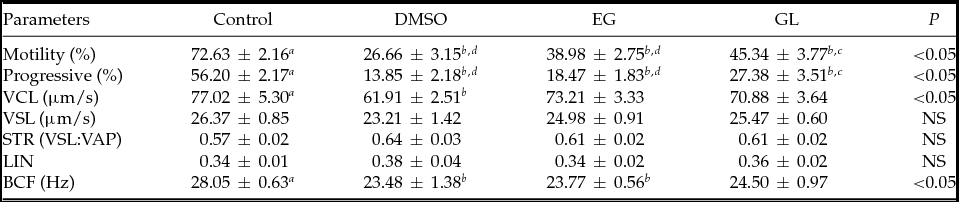
Significant (P < 0.05) reduction in total motility and progressive movement in the experimental groups DMSO, EG and GL compared with the fresh control were observed. Significant (P < 0.05) differences in total motility and progressive movement between GL and DMSO, EG groups were observed. Spermatozoa characteristics such as VCL, VSL, STR, LIN and BCF varied between applied cryoprotectants after cryopreservation (Table 1).
Selected motility parameters evaluated by CASA in the control and experimental groups

Total motility (%): total motile spermatozoa; progressive (%): progressively motile spermatozoa; VCL (μm/s): curvilineal velocity; VSL (μm/s): straight line velocity; STR (%): straightness index [(VSL/VAP) × 100]; LIN (%): linearity of forward progression [(VSL/VAP) × 100].
NS, not significant.
Values are expressed as mean ± standard error of the mean (SEM); different superscripts between groups are significantly different a versus b and c versus d = (P < 0.05).
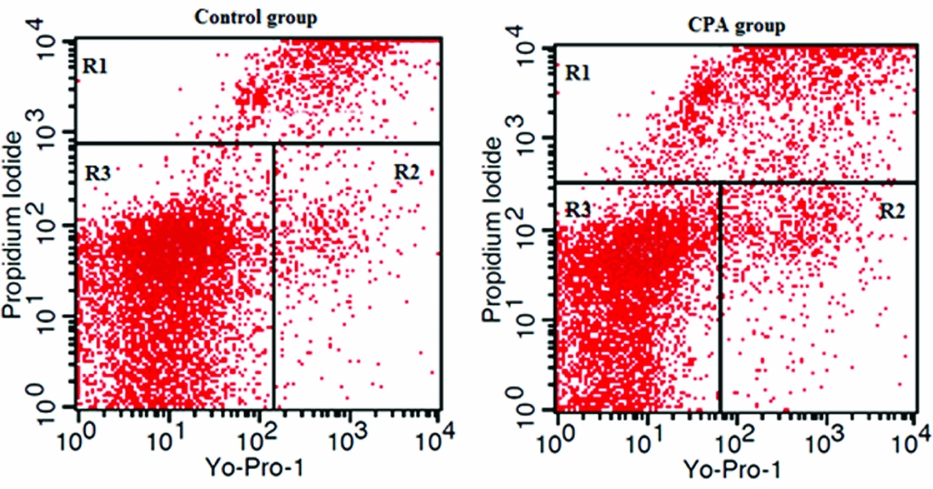
In our study, the different labelling patterns in the Yo-Pro-1/PI staining identified three different cell populations (Fig. 1). Spermatozoa were classified either as viable (Yo-Pro-1– and PI–), apoptotic (Yo-Pro-1+ and PI–) or necrotic. In term of acrosomal damage, only spermatozoa with damaged plasma membranes and exposed acrosome allowed penetration of PNA green dye, while spermatozoa with intact plasma membranes remained unstained.
Representative flow cytometry dot plots for control and experimental groups. R3 region represents viable (Yo-Pro-1– and PI–), R2 region apoptotic (Yo-Pro-1+ and PI–) and R1 necrotic (PI+) spermatozoa.

The incidence of the spermatozoa populations identified using flow cytometry is presented in Table 2. Compared with the control group samples, experimental groups had significantly higher (P < 0.05) numbers of necrotic spermatozoa. No significant difference in the percentage of apoptotic spermatozoa was found between the control and experimental groups. A higher (P < 0.05) proportion of spermatozoa with damaged plasma membranes was found in the DMSO and EG groups and no significant differences were observed in the GL group compared with the control. However, significant differences (P < 0.05) in the numbers of live and necrotic spermatozoa between GL and DMSO, EG groups were observed (Table 2).
Flow cytometry analysis of spermatozoa in the control and experimental groups (Yo-Pro-1/PI; PNA)

NS, not significant.
Values are expressed as mean ± standard error of the mean (SEM), different superscripts between groups are significantly different a versus b and c versus d = (P < 0.05).
Discussion
Cryopreservation is a very stressful thermic and osmotic process that dramatically reduces the viability and motility of spermatozoa. The different types of permeating cryoprotectants, such as dimethylsulfoxide (DMSO), dimethylacetamide (DMA), dimethylformamide (DMF) and EG (Hanzawa et al., Reference Hanzawa, Niinomi, Miyata, Tsutsui and Tajima2010; Sasaki et al., Reference Sasaki, Tatsumi, Niinomi, Imai, Naito, Tajima and Nishi2010; Mphaphathi et al., Reference Mphaphathi, Luseba, Sutherland and Nedambale2012, Reference Mphaphathi, Seshoka, Luseba, Sutherland and Nedambale2016; Mosca et al., Reference Mosca, Madeddu, Sayed, Zaniboni, Iaffaldano and Cerolini2016) were tested for cock spermatozoa cryopreservation. However, due to high result variability in the literature and differences among conditions used, there is a need to standardize a protocol for cock spermatozoa freezing. Therefore, our study focused on the evaluation of different CPAs (DMSO, EG and GL) on the motility parameters of frozen/thawed spermatozoa. As reported in many papers, successful cryopreservation procedures of spermatozoa may depend on the interaction among the type of CPA, the semen freezing, thawing conditions and packaging system used, each one affecting spermatozoa structure and function (Long et al., 2014; Iaffaldano et al., 2016b). Moreover, the spermatozoa number, type of cock (broiler or layer type) and age may affect in vitro storage and fertility rate (Tabatabaei et al., 2012). The current study presents the first attempt to cryopreserve semen from Oravka cocks and focused on semen cryotolerance using DMSO, EG or GL as cryoprotectants. As far as we know, this is the first report on the evaluation of motility parameters, viability and acrosome damage of cryopreserved spermatozoa of the endangered Oravka chicken breed.
Computer-assisted sperm analysis
Total motility is an important trait of sperm quality, as it is essential for the transport of the sperm through the female reproductive tract and for fertilization (Verstegen et al., 2002). The total motility parameters of spermatozoa, which are the main indicators of semen quality, were evaluated by the CASA method. Compared with visual observation, CASA assessment provides a more sophisticated method of spermatozoa analysis. Visual assessment of essential parameters of spermatozoa by light microscopy is still used in most laboratories dealing with artificial insemination (Rowe et al., Reference Rowe, Comhaire, Hargreave and Mahmoud2000). However, these methods are not entirely objective, reliable and repeatable and only a small percentage of the total spermatozoa are evaluated. Using CASA system, more objectivity and repeatability are achieved (Davis & Siemers, Reference Davis and Siemers1995).
This study provided the first characteristics of Oravka cock spermatozoa. We applied CASA analysis to examine parameters of total motility and progressive movement, respectively. The total motility and progressive movement in fresh semen were 72.63 ± 2.16% and 56.20 ± 2.17%, respectively. The percentage of total motile spermatozoa observed for fresh semen was lower than those reported previously by other authors (88–95%) (Barbato et al., Reference Barbato, Cramer and Hammerstedt1998; Chalah et al., Reference Chalah, Seigneurin, Blesbois and Brillard1999; Mphaphathi et al., Reference Mphaphathi, Seshoka, Luseba, Sutherland and Nedambale2016). Although the reason why these differences occur is unknown, they could be due to the animals used in each of the experiments and to the initial quality of semen. However, in our study, total motility (45.34 ± 3.77%) and progressive movement (27.38 ± 3.51%) of frozen/thawed spermatozoa using 8% GL were recorded as the best variant. Nevertheless, percentage of motility in experimental groups decreased with respect to the initial motility in the range from 27 to 46%. This findings are in agreement with previous reports in which it was concluded that between 30 and 60% of spermatozoa motility is lost after cryopreservation (Donoghue & Wishart, Reference Donoghue and Wishart2000; Long, Reference Long2006). It can be because of the interaction among the type of cryoprotectant, the semen freezing, thawing conditions or packaging system used (Long et al., 2014; Iaffaldano et al., 2016b). Conversely, Mphaphathi et al. (Reference Mphaphathi, Luseba, Sutherland and Nedambale2012) observed similar total motility (46.0 ± 8.3%) and progressive movement (25.4 ± 8.8%) of frozen/thawed spermatozoa using 8% DMSO.
Moce et al. (Reference Moce, Grasseau and Blesbois2010) used DMA as a cryoprotectant and recorded a cock spermatozoa motility rate of 38.4% after thawing.
Flow cytometry analysis
In previous studies, flow cytometry protocols were used to analyse specific attributes of spermatozoa quality, including spermatozoa viability, apoptosis, capacitation, mitochondrial membrane potential, lipid peroxidation, acrosomal status, reactive oxygen species generation (ROS) or DNA damage (Martinez-Pastor et al., 2010). Flow cytometry techniques are very popular for the analysis of cell suspensions containing apoptotic and necrotic cells because of their higher sensitivity, greater accuracy and decreased subjectivity (Liegler et al., Reference Liegler, Hyun, Yen and Stites1995).
Moreover, flow cytometric analysis allows the examination of 10,000 cells in a very short time, which makes this analysis sufficiently precise. Using Yo-Pro-1 nuclear fluorochrome can analyse apoptosis in spermatozoa cells (Martin et al., Reference Martin, Sabido, Durand and Levy2004). During the apoptosis, the cell membrane becomes slightly permeable. Apoptotic cells become permeable to Yo-Pro-1 green fluorochrome while remaining impermeable to PI. Thus, the combination of Yo-Pro-1 and PI dyes provides a sensitive detection for apoptosis (Idziorek et al., Reference Idziorek, Estaquier, De Bells and Ameisen1995). Conversely, PI provides one approach to detect necrotic cells based on differences in membrane permeability (Vermes et al., Reference Vermes, Haanen, Steffens-Nakken and Reutelingsperger1995, Reference Vermes, Haanen and Reutelingsperger2000). Cells with intact plasma membranes (viable and early apoptotic cells) exclude PI. In contrast, late apoptotic and necrotic cells (non-viable) readily stain with PI (Darzynkiewicz et al., Reference Darzynkiewicz, Bruno, Del Bino, Gorczyca, Hotz, Lassota and Traganos1992; Vermes et al., Reference Vermes, Haanen, Steffens-Nakken and Reutelingsperger1995, Reference Vermes, Haanen and Reutelingsperger2000). In late apoptotic cells, increased permeability of nuclear pores allows even large proteins and complexes to enter the nucleus (Faleiro & Lazebnik, Reference Faleiro and Lazebnik2000). In necrotic cells, mitochondrial dysfunction results in the disruption of nuclear membrane integrity (Kroemer et al., Reference Kroemer, Dallaporta and Resche-Rigon1998). Therefore, in late apoptotic and necrotic cells, PI enters the cell, passes through the disrupted nuclear membrane, and intercalates into DNA (Darzynkiewicz et al., Reference Darzynkiewicz, Bruno, Del Bino, Gorczyca, Hotz, Lassota and Traganos1992; Vermes et al., Reference Vermes, Haanen, Steffens-Nakken and Reutelingsperger1995, Reference Vermes, Haanen and Reutelingsperger2000).
The integrity of spermatozoa membranes is a necessary condition to maintain spermatozoal functions during storage in the female's reproductive tract and penetration of the oocyte's perivitelline layer (Bongalhardo et al., Reference Bongalhardo, Somnapan-Kakuda and Buhr2002). Integrity of the spermatozoa plasma membrane is less affected by CPA addition and by cryopreservation than motility, according to previous studies (Purdy et al., Reference Purdy, Song, Silversides and Blackburn2009).
In conclusion, it can be said that this study provides the first cryopreservation of Oravka cock semen. Oravka cock spermatozoa had a higher motility and viability rate when the semen was cryopreserved in freezing medium containing 8% GL compared with 8% DMSO and 8% EG. Spermatozoa characteristics such as VCL; VSL, STR, LIN and BCF varied between applied cryoprotectants after cryopreservation. Compared to the fresh control group, the cryopreservation process reduced spermatozoa total motility, progressive movement, viability and acrosomal damage rate, regardless of the cryoprotectant used.
In addition, fertility evaluation in vivo is needed to evaluate their possible contribution to animal genetic resources banks.
Acknowledgements
This study was financially supported by the Slovak Research and Development Agency (No. APVV-14-0043) and VEGA 1/0611/15. This work was also supported by Research Centre AgroBioTech built in accordance with project from the Building Research Centre ‘AgroBioTech’ ITMS 26220220180.
Ethical standards
The authors assert that all procedures contributing to this work comply with the ethical standards of the relevant national and institutional guidelines on the care and use of laboratory animals. The treatment of the animals was approved by the Ministry of Agriculture and Rural Development of the Slovak Republic, no. SK P 28004 and Ro. 1488/06–221/3a.
Conflicts of interest
None.