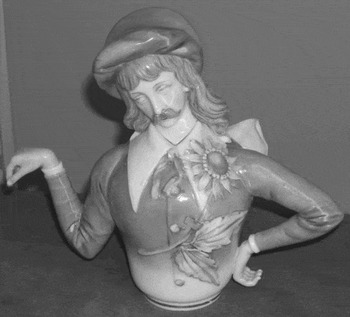
The Aesthetic or “Patience” teapot is renowned as the ultimate parody of Aesthetic sensibilities. Composed of the head and torso of a male and female back-to-back dressed in the “greenery-yallery of the Grosvenor Gallery,” with puce hats and fashionable Pre-Raphaelite red hair, the teapot was designed by James Hadley (1838–1903) for the Royal Worcester manufactory following the success of W. S. Gilbert and Arthur Sullivan's operetta Patience in 1881. Bearing on its base the inscription, “Fearful consequences through the laws of Natural Selection and Evolution of living up to one's teapot,” the vessel took a swipe at Darwin's theories of evolution, as well as Oscar Wilde's famous aphorism. This teapot is certainly not “fit for its purpose,” defying “form must follow function”; rather it is a whim of fashion, novel but transitory. Recognized as a “limited edition” and expensive, its function being primarily for show rather than use, it marks the appearance of the modern “collectable,” in effect a souvenir of Aestheticism and now seen to commemorate its apogee. Yet although loaded with aesthetic signifiers – sunflowers, lilies and gender-bending – no scholar has attempted to unwrap the teapot's meaning, in terms of the identification of china and tea with “life-style aestheticism” (Figure 15).
The Aesthetic or “Patience” teapot, designed by James Hadley for Royal Worcester. Courtesy of the Worcester Porcelain Museum, Worcester.

Clearly the teapot was a neat skit on the craze for being artistic, satirising the dress, manners and obsessions of those who embraced the cult of Beauty, even implying that aesthetes were suffering from a surfeit of culture. Rarefied and hype-sensitive perhaps the aesthete had evolved “too far,” to the point of emasculation or androgyny. Art was now a mysterious religion, its acolytes members of an elite cult but aesthetic men were hardly “manly,” while the female of the species appeared hysterical or fatally ill; according to Harry Quilter of the Spectator, Whistler's “Arry” and the arch-enemy of Aestheticism, neither was fit to bear children. The aesthetic predilection for sunflowers, lilies, peacock feathers and so-called Old Blue china had evidently brought the British Empire to the brink of Decadence. The homage paid to household necessities, such as teapots and coalscuttles, did seem rather extreme to those outside their charmed circle but according to their detractors aesthetes were prone to excess, the collecting of teapots becoming a fetish, a quirk much exploited by contemporary satirists. “Let us Live Up to It!,” Wilde's declaration, was attached to an Old Blue teapot in two Punch or The London Charivari cartoons, in Punch's “Philistia Defiant” and Francis Burnand's The Colonel; what was the encoded meaning of “being like a teapot” at the apogee of Aestheticism?
Blue-and-white china has long been recognised as an essential component of the aesthetic interior but its significance is often taken for granted.Footnote 1 Its rise to cultural and financial prominence has been mapped from Chelsea, where it was idolised as an “Objects d'art” by an artistic elite, to London's exclusive West End. Here it was sold by prominent dealers or knocked down in the salerooms to American millionaires for a king's ransom. Back in the early 1860s Old Blue had been the exclusive preserve of James McNeill Whistler (1834–1903) and Dante Gabriel Rossetti (1828–82); in the following decade Oscar Wilde (1854–1900) appropriated it for the fashion conscious. Old Blue and Blue Willow were central to the phenomenon known as Chinamania, the cult of china collecting, but few have attempted to explain the particular qualities of blue-and-white that made it so appealing to the aesthete. This attempt to unravel the mysteries of the Aesthetic teapot will begin by tracking the rise of Old Blue china and assessing the feminizing effects of tea drinking, followed by a consideration of the cultures of collecting initiated by “life-style aestheticism.” Chinamania will be used to frame the concepts of “good” (masculine) and “bad” (feminine) collecting – “masculine collecting is informed and serious and feminine shopping, while requiring certain skills of selection and communication, is uninformed, trivial and can never lead to greatness without stepping outside of gender roles” (Cheang 57). Using Cheang's definitions, the Aesthetic teapot, representative of an “obsessively collected object,” becomes “an impassioned object.” To understand how the teapot operated as a sign, we have to unpick the implications of china, blue-and-white, and tea drinking to the aesthetes: “It is not through any intrinsic quality of the sign but rather through the interpretive acts of members of the sign community that the sign comes to have meaning” (Stewart 32). The Aesthetic teapot acquires its meaning through ownership within a particular society. An elitist social grouping, the aesthetes adopted specific outward signs to indicate their internalized sensibilities; china collecting would become a sign of their over-acculturation: “Chippendale furniture, dadoes, old-fashioned brass and wrought–iron work, mediaeval lamps, stained glass in small squares, and old china are all held to be the outward and visible signs of an inward and spiritual grace and intensity” (Hamilton, 34).
Chinamania
Gere sees the Aesthetic Teapot as “a triple-attack on Aestheticism, Darwinism and Wilde's pretensions” (93). It was also clearly aimed at Chinamania, which peaked between 1876 and 1881, playing on the feminine connotations of both porcelain and tea drinking to suggest the degenerative nature of the aesthete:
It was, as a matter of fact, a school of prigs. . . . Many of them were unhealthy and even morbid prigs. . . . They lounge about sales of china and bric-a-brac, they take afternoon tea at the Club, and they worship at the Grosvenor Gallery . . . they grow daily sadder and yet more sad over the wretched stuff which the outside world, the babbling, eager fighting world, calls art, poetry, and fiction. (Besant and Rice 31; ch. 3)
Evidently young fellows like Paul Rondelet, in the Monks of Thelema, were too highly cultured, “so much so that he could not possibly avoid pitying his fellow creatures . . . Nature meant him even to be handsome; too much culture spoiled that intention” (31; ch. 3). In Second Thoughts (1880), Rhoda Broughton delineates the consequences of too much culture on the aesthetic physique, Francis Chaloner being a “long pale poet” with an “Early Byzantine face” and “sleepy sorrow” in his “sunken eyes,” who wears the hair of his “Botticelli head” very long (135, 138; Part 2, ch. 5: 156; Part 2, ch. 8: 8; Part 1, ch. 2). Chaloner, in Wildean style, had “a great white lily standing in a large blue vase” (157–58; Part 2, ch. 8).
Like the aesthetic attire adopted by Wilde, gleaned from the pages of Punch, the self-proclaimed Professor of Aesthetics did not invent the fashion for Old Blue, rather he capitalized on an established vogue. But what were the attributes of Old Blue in particular and antique ceramics in general, which made them so appealing to the aesthete? Clearly porcelain and tea were deployed, as they had been in the eighteenth century, to signal refinement and gentility but both were already freighted with femininity. Charles Lamb confessed, “I have an almost feminine partiality for old china. When I go to see any great house, I inquire for the china-closet, and next for the picture-gallery” (148). Tea was gendered feminine from the outset, through its association with china, the elaborate ritual of making it, and the equipage required; it was a part of a woman's world: “With the birth of a consumer culture, women were assumed to be hungry for ‘things’— for dresses and furniture, for teacups and carriages, for all commodities that indulged the body and enhanced physical life” (Kowaleski-Wallace, 4–5).
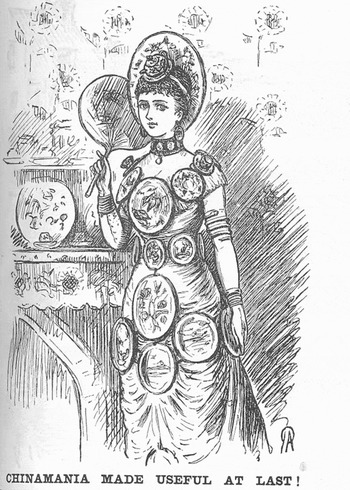
By 1750 all Europe was in the grip of china-fever: “No mania for material objects had ever been so widespread, so general to the rich of all nations” (J.H. Plumb in Kowaleski-Wallace 55). The teapot, made out of rare and expensive china, or porcelain, was equated with its female owner, both being delicate and fragile. China transmits the idea that women are essentially surface with no depth, aesthetically perfect but vacuous; a teapot signals the “empty-headed” women, a void waiting to be filled. Porcelain has to be shaped and moulded before it has any form, painted and fired and affixed with a price. Girls also had to be shaped before they had any value in the marriage market. A woman's love of china was used to mark her as shallow, easily led astray by outward appearances and the vagaries of fashion. “Chinamania Made Useful at Last!” (Figure 16) illustrates the female susceptibility to fads, the victim's dress adorned with hand-painted plates and her hair-do surmounted by a hat in the form of a teapot, again alluding to the vacuity of women.Footnote 2
“Chinamania Made Useful at Last!” Engraving from Punch's Almanack for 1880, 12 Dec. 1879, n.p.

Kowaleski-Wallace has made an extensive study of china as a trope for the feminine in the eighteenth century: “She proposes that men collected china at least as much as women, but gendered meanings associated china with women, effeminate men and negative characteristics” (Vincentcelli 129). It is argued here, that these “negative characteristics” were deployed by its detractors to condemn Aestheticism as a physical and mental sickness that was corrupting the body and soul of the nation, a message that could apparently be contained by a teapot. The need to surround oneself with beautiful things evidently led to unnatural desires; in women, this need resulted in the negation of motherly affection; in men, sexual libido was suppressed by the urge to collect. The hopelessness of the aesthetic position, “consumed” by longings, was communicated by a maudlin expression and aesthetic droop; world-weary aesthetes were simply burnt out. An emaciated physique was the result of “yearnings not to be gratified because they are insatiable” (Wedmore 338). Chinamania unsexed men and women and was therefore a threat to the very species.
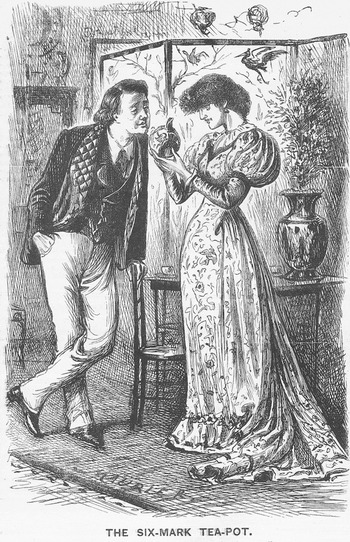
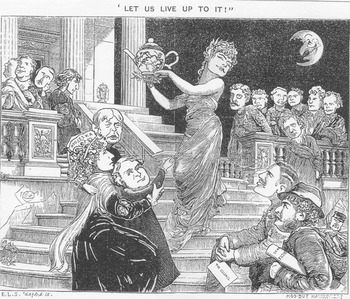
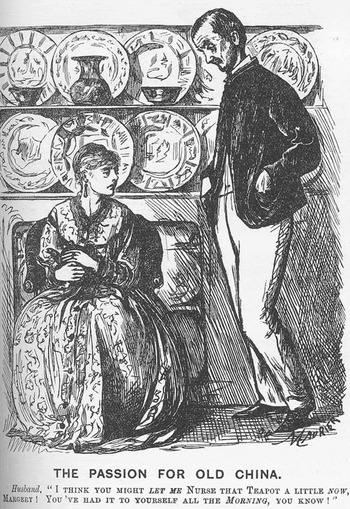
An expression said to have been coined by George du Maurier c.1874, to lampoon the craze for china collecting, Chinamania is most frequently linked to the passion for collecting Old Blue, blue-and-white wares ranging from Oriental porcelains to Delft earthenware, and eighteenth century European porcelains during the last thirty years of the nineteenth century.Footnote 3 Lionel Lambourne maintains that the first Chinamania cartoon, “The Passion for Old China,” appeared in Punch on 2 May 1874 and the last on 30 October 1880, this being the famous “The Six Mark Tea-Pot”Footnote 4 (Figure 17). Although “The Six Mark Tea-Pot” may have been du Maurier's last comment on Chinamania, Edward Linley Sambourne (1844–1910) once more capitalized on the theme in May 1881, following the success of Burnand's The Colonel and Gilbert and Sullivan's Patience. His cartoon also exploits Wilde's aphorism “Let us Live up to It!”, although his satire was not directed specifically at Wilde; rather it was the notion of “Art for the People” that bore the butt of the joke in “A Design for an Aesthetic Theatrical Poster” (Figure 18). The great tragedienne Ellen Terry is shown triumphantly carrying a clearly distressed blue-and-white teapot on a laurel wreath which is to be handed to Helena Modjeska (1840–1909), the fiery Polish actress who arrived in London in 1880 and her “children.”Footnote 5 The authors of The Colonel and Patience look on, with Sir Henry Irving overseeing the proceedings. As the embodiment of culture, the teapot was the ultimate aesthetic trophy.
George du Maurier, “The Six-Mark Tea-Pot.” Engraving from Punch, 30 Oct 1880, 194.

Edward Linley Sambourne, “A Design for an Aesthetic Theatrical Poster” [“Let Us Live Up To It!”]. Engraving from Punch, 7 May 1881, 215.

The term Chinamania achieved wider currency after the publication of Major Herbert Byng Hall's The Bric-A-Brac Hunter or Chapters on Chinamania, published on both sides of the Atlantic in 1875.Footnote 6 During the same year Chinamania took to the stage, with F.C. Burnand's A Tale of Old China lampooning avaricious dealers, gullible collectors and the legend of the Willow pattern. The infection had been recognized in France as early as 1865, when Paul de Saint-Victor defined it as “la potichomanie” following the success of James McNeill Whistler's La Princesse du pays de la porcelaine or Rose and Silver: The Princess from the Land Porcelain (1864–65, Smithsonian, Washington; Merrill 66). Although Murray Marks (1840–1918), “the recognized authority on the subject,” assured the Pennells that “it was Whistler absolutely who invented Blue and White,” Dante Gabriel Rossetti played a large part in establishing the vogue with the aid of others in the Pre-Raphaelite circle, including George Price Boyce, Ford Madox Brown and even William Morris (Merrill 171–72).Footnote 7 But Whistler's enthusiasm was exclusively for K'ang Hsi blue-and-white (1662–1722), or Nankin porcelain as it was popularly called, whereas the Pre-Raphaelite circle were equally attracted to Delft and eighteenth century English porcelains, especially Worcester and Caughley where the Willow pattern was invented in the 1780s (O'Hara). The attraction of K'ang Hsi blue-and-white was primarily its colour: “The very blue and white of the sky . . . ‘simply porcelain tinted like the blue of heaven after rain, such as it appears between the clouds’ . . . ‘Sky blue after rain’” (Hollingsworth 25). Rossetti and Whistler competed for the finest pieces but Rossetti's obsession with Blue Willow actually predates his friendship with Whistler, being traced through a series of works beginning with the painting Girl at a Lattice (1862, Fitzwilliam, Cambridge). The artists shared the same dealer, Emmanuel Murray Marks (Wainwright 161–76), although the notorious Charles Augustus Howell (Angeli 47–127) would also make his mark as a connoisseur, dealer and interior decorator.
Whistler and Rossetti infected a small group of committed collectors: Louis Huth, Frederick Leyland, the Liverpool shipping magnate and the distinguished surgeon Sir Henry Thompson. Oscar Wilde entered the fray around 1876, when the interest in Old Blue was about to peak. With Rossetti now a recluse on Cheyne walk, it was Whistler who brought Old Blue back into the limelight with his decoration of the Peacock Room for Frederick Leyland, for which the owner famously refused to pay the price. Whistler began work on the dining room in 1876, harmonizing the colour scheme, originally red flowers on expensive Spanish leather hangings, to compliment his La Princesse du pays de la porcelaine (1864–65) and “having in view the purpose to which the leather was to be put, namely, to be a becoming background to the valuable blue china” (Thomas Armstrong in Merrill 211). What began as a modest undertaking developed into an elaborate scheme of decoration, based on a peacock theme that may have been inspired by the birds on the rims of Leyland's most spectacular blue-and-white chargers; peacock feathers would become the requisite accessories to Oriental porcelains (Merrill 215). Contemporary journals reported on the progress of the room and selected visitors were allowed access to the “Peacock Palace,” including the Marquis of Westminster and Princess Louise, Queen Victoria's artistic daughter: “they are charming people, and . . . keep the buzz of publicity most pleasantly in London society . . . and I hope good may result” (Whistler in Merrill 226). But the publicity Whistler hoped would enhance his professional reputation was equally sure to offend his retiring patron.8 Leyland believed the artist to have overstepped the terms of the commission and declared, “his dining-room was ruined and Whistler's time wasted” (Merrill 228). The crisis came when Whistler asked two thousand guineas for the decoration of the room and Leyland declined to pay. The debacle put both Whistler and Blue China in the public spotlight.
In the same year Augustus Wollaston Franks, the keeper of antiquities at the British Museum, made an attempt “to distinguish the respective productions of China and Japan” in his The Catalogue of a Collection of Oriental Porcelain and Pottery lent for Exhibition by A.W. Franks, Esq., FRS., FSA, for many years a standard work on the subject; complete with introductory essays, descriptions of pieces and an appendix of marks and symbols.Footnote 9 It was first published in May 1876 and was revised and reissued in 1878. Franks used his substantial private income to build an academic and educational collection of Oriental ceramics, destined for a museum display. His collection was exhibited at the Bethnal Green Museum in 1876, alongside the splendid European paintings and decorative art objects amassed by Lord Hertford and Richard Wallace, now residing in the Wallace collection. Lord Hertford had a particular fondness for Sevres, another pursuit of the chinamaniac. In October 1878 Franks offered the Bethnal Green specimens to the British Museum but the collection was not transferred to Bloomsbury until 1885.Footnote 10
The value of Old Blue as a fashionable collectable was widely appreciated, as George Ashdown Audsley's Catalogue Raisonne of the Oriental Exhibition of the Liverpool Art Club in 1872 attests; Leyland, who resided at Speke Hall from 1867, a magnificent half-timbered manor house just outside the city, may well have seen this display. Audsley and James Lord Bowes, another Liverpool collector, published their Keramic Art of Japan in 1875. George Rae of Birkenhead, better known as a collector of Pre-Raphaelite paintings, was a leading collector in the field, many of his choice pieces being supplied by the Dutch dealer Joel Joseph Duveen, not to be confused with his more famous son Lord Duveen. With so many of Whistler's and Rossetti's clients residing in the North, it comes as no surprise that Duveen built up his trade in Leeds, Manchester, Liverpool and Chester, via the port of Hull.
The Cult of Japan has long been recognized as the root of Aesthetic sensibility, but the new aesthetics are invariably ascribed to the impact of the Japanese print, whereas his Old Blue equally inspired Whistler. Moreover, in the 1870s there was confusion over the ceramics of Japan and China, with Audsley admitting the “Hawthorn pattern,” so-called by Rossetti, who utilized it as the background in his Blue Bower (1865, Barber Institute, Birmingham), had not yet been “authoritatively classed among Chinese or Japanese productions”; Audsley tended to believe that it was Japanese (Audsley in Merrill 171). In the eighteenth century, the distinction between Japanese and Chinese art had been extremely vague and porcelain was often sold simply as “porcelaine des Indes.” The demand for Japanese objects began immediately after the signing of the commercial treaty of 1854. Coloured prints and small personal items, inru, netsuke and sword furniture, were eagerly sought. The Japanese were admired in a completely different way to the Chinese, whose ancient empire was seen to be in a terminal decline fueled by a dependency on opium. Japanese society, when the Samurai and feudal system still prevailed, was seen to be untainted, their love of myth, drama and the fine arts even likened to the ancient Greeks (Reitlinger 216). In addition to their lacquer and ceramics, Europe was also rediscovering the Japanese Tea ceremony, which Franks explained, based on a German account published in 1874 (Franks 3–7). The austerity and refinement of the Japanese teahouse would have a profound effect on the designs of Edward Godwin, Whistler's architect and Christopher Dresser. The “land of cherry blossom” was inadvertently equated with the Hawthorn or prunus jar and cover, fueling the passion for Japonisme.
While Franks and Leyland's collections were well known, Sir Henry Thompson surpassed their efforts with the aid of his dealer, Murray Marks. By 1876 Thompson had become one of the leading physicians in Europe, his patients including Leopold, King of Belgium and Napoleon III of France. Thompson's collection, reportedly begun on Rossetti's advice, consisted entirely of Oriental blue-and-white. While working on the Peacock Room, Thompson commissioned Whistler to illustrate a catalogue of his collection, which became a work of art in itself. The completion of A Catalogue of Blue and White Nankin Porcelain in the spring of 1878 led to a “special private view” of Thompsons's collection held at the premises of Murray Marks on Oxford Street. An eminent critic was swept away by the occasion: “He saw nothing, he could converse about nothing, but this translucent ‘Blue’. ‘Look at that’ he exclaimed. . . . ‘Could France, could England produce anything like it? Observe that exquisite pink on that lovely blue’” (Williamson 46). The “exquisite pink” was none other than pickled salmon!
Old Blue apparently inspired excessive language, as well as abnormal desires. Some were even moved to poetry. The Oxford Don, Andrew Lang (1844–1912), master of the fairy tale, penned the oft-quoted poetical skit, “Ballade in Blue China”:
As originally published, in 1880, the Ballades appeared in “a little white vellum wrapper, with a little blue Chinese singer copied from a porcelain jar. . . . Thirty years ago blue china was a kind of fetish in some circles, aesthetic circles, of which the balladist was not a member” (Lang 3).
Though Marks lost money on the enterprise, the “Blue china book” and exhibition had the desired effect of inducing others into the cult. James Orrock, later known as “Admiral of the Blue” or the “Emperor of China,” credited Thompson's collection with giving him his “first revelation of the manifold splendour of Blue China” (Merrill 176). In turn Orrock would convert Lord Leverhulme, who purchased much of his Old Blue through Agnews. The market for Old Blue would not peak until the sale of the Huth Hawthorn Jar in 1905, evidently prized for its “unearthly blue.” At a modest 18ins, the price of £5,900 was extraordinary, but by then Blue fever had spread to the American millionaires. This upward trend was propelled by Thompson's sale of his Blue china on 1 June 1880, when two Hawthorn jars and covers reputedly made £630 and £525; the 377 lots realized a total of £4,328 7s 6d. According to Reitlinger much of the blue-and-white in this sale had belonged to Whistler, having been sold back to Marks in the 1870s (209).Footnote 12 Three months before the Thompson sale, 160 lots belonging to Dr E. B. Shuldham, including a fine set of three Hawthorne vases and a pair of beakers, came up at Christie's: “The prices to which these were run up were preposterous beyond all precedent, scarce as these old jars may be, one being knocked down at £620 and the other at £650, in neither case reaching the reserve price” (Redford 307; Vol.1). Du Maurier should have privileged the Hawthorn jar rather than a “Six-Mark Tea-Pot” as the aesthetic sign but he was targeting Whistler's “six marks of choice,” which were nothing more than a fraudulent fifteenth-century date, and over acculturation induced by an excessive consumption of tea.
Tea and “Cultchah”
The ritual of tea drinking signaled refinement and gentility. Compared to alcoholic beverages, tea was a civilizing agent: “Both tea and the female tea drinker are thought to ‘civilise’ what is essentially brutish in men” (Kowaleski-Wallace 39). In the eighteenth century tea was literally the drink of the Enlightenment, it ousted wine and ale and the brutish and animalistic behaviour associated with it. Tea was seen to humanize, rescuing the British gentleman from a drunken stupor. When a lady served tea she aided the process of enlightenment, refinement and civilization. A sign of gentrification, the Art of Tea was revived in the aesthetic drawing room, as seen in the elegant tea wares of Christopher Dresser. Based on Japanese rituals, the Art of Tea required simplification, the “elimination of unnecessaries” and called for “harmony,” “reverence,” “purity” and “tranquility,” all essential constituents of an “orderly life” (Suzuki 56). Harmony was also read as “gentleness of spirit,” suggestive of an inward feeling: “the general atmosphere of the tea-room tends to create this kind of gentleness all around-gentleness of touch, gentleness of odor, gentleness of light, and gentleness of sound . . . the room is always soft and restful and conducive to a meditative mood” (Suzuki 56–57). The simplicity of the tea-room, its freedom from vulgarity, “make it truly a sanctuary from the vexation of the outer world. There and there alone can one consecrate himself to undisturbed adoration of the beautiful.” (Okakura 61). The new aesthetics were predicated on achieving harmony and contemplative tranquility, signifiers of the Higher Life connoting the distinction of the aesthete: the Art of Tea was the embodiment of Culture. The emphasis placed on “Cultchah” is even suggestive of a pun, as Cha or Tcahi is the early Chinese dialect names for Tea (Tay).
Ladies are depicted as “Queens of the tea-table,” a “‘feminine’ locus where the civilising process could occur”; here the stream of hot liquid is “carefully mastered and ceremoniously controlled” signaling discipline (Kowaleski-Wallace 21). Embodying restraint, the delicacy of the tea table, with its fragile china cups and saucers, was also easily disrupted; shattered china and spilt liquid denoted ruined virtue. Feminine wiles, the power to entrance and even to entrap, could be fully deployed in the spectacle of pouring tea:
Surely a pretty woman never looks prettier than when making tea. The most feminine and most domestic of all occupations imparts a magic harmony to her very movement, a witchery to her every glance. . . . At the tea-table she reigns omnipotent, unapproachable. . . . To do away with the tea-table is to rob women of her legitimate empire. (Mary Elizabeth Braddon, Lady Audley's Secret (1862) in Kowaleski-Wallace 19)
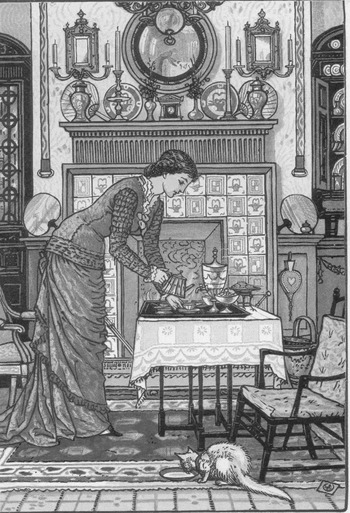
The performance at the tea table, a ritual demonstrating exemplarily taste, privilege and class distinction, would have appealed to a Victorian audience accustomed to the “separate spheres.” In Walter Crane's design for Clarence Cook's text, “My Lady” presides over the House Beautiful, a safe haven from the realities of the exterior world (Figure 19).
Walter Crane, “In My Lady's Chamber,” for Clarence Cook, House Beautiful (New York: Scribner, 1878), frontispiece.

In contrast, the tea-table highlighted men's barbarism, their inept behaviour and clumsiness, their need to be instructed in civilities: “Both tea and woman ‘act upon’ the man in need of humanising, and tea stands only as a partial representation of a larger femininising and civilising force at work in British culture” (Kowaleski-Wallace 25). But this feminising may have gone too far. Du Maurier, describing life at Little Holland House in the 1850s, noted that the great men who visited this famous salon were “adored” by Mrs Prinsep and her famous sisters. Evidently cups of tea were “handed to them by these women almost kneeling. Watts, who is a grand fellow, is their painter in ordinary; the best part of the house has been turned into his studio, and he lives there and is worshipped till his manliness hath almost departed” (Blunt. 80). Women were smothering men with a surfeit of tea; the “beatified” G. F. Watts, England's self-appointed Michelangelo, was on his way to the transcendental. Man may have been tamed by tea, his brutalism suppressed but the cost was unmanly men; “Cultchah” signals feminine dominance and male emasculation.
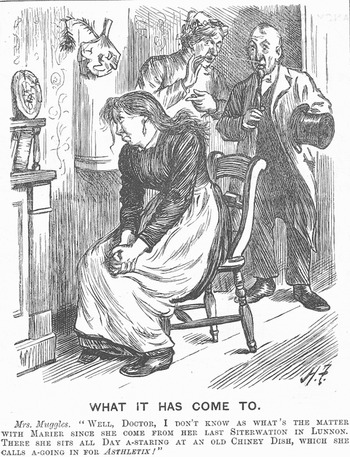
The correlation between tea and a loss of masculinity had also been made in the preceding century, with writers refuting the positive effects of tea drinking. Even Dr Johnson considered that tea drinking weakened a strong, muscular constitution. Being the amusement of the idle, evidently England lost its manly vitality when it succumbed to the affectations associated with tea drinking. Tea, a foreign imported substance, was also blamed for draining the economy. Tea weakened women, or more specifically wet-nurses who spent all their money on tea rather than on nutritious food. As a result their milk was inadequate and the children they raised weak, sickly or prone to die! Tea was equated with the pursuit of luxury, which encouraged a dissipated lifestyle and fostered artificial appetites, even amongst the lower classes. The working-class woman who drank tea was acting subversively or putting on “airs and graces.” Punch exploited such associations in the cartoon “What It Has Come To” (Figure 20) from 1881.
Harry Furniss, “What It Has Come To.” Engraving from Punch, 16 April 1881, 177.

Naturally the teapot was made to appeal to women, and became a barometer of fashion but its comedic potential was also quickly spotted, the novelty teapot assuming many bizarre, often anthropomorphized, forms — teapots can be funny or even “queer.”Footnote 13 Currently queerness primarily denotes sexual difference, but in this context it is used to suggest anything odd, eccentric, quaint, grotesque, comic or even “camp.” Minton's manufactured outlandish Majolica examples, a vulture wrestling with a snake, which forms the spout, and a monkey clutching a coconut. Such vessels were clearly intended to rival eighteenth-century specimens, such as the Chelsea White Chinaman Teapot and Cover modeled as a grinning Buda. This takes the form of a Chinaman, squat on the ground with his legs crossed, his loose robe open to reveal his protuberant stomach, and a snake coiled round his body to form the spout.Footnote 14 The factory also produced a variant, utilizing the same squat body but with a cockerel issuing, lewdly, from between his legs, opened mouthed, to form the spout. These “hideous” objects were clearly amusing, although obscene and vulgar. With only four examples known to exist of the cockerel variety, they were an expensive oddity, appealing to the perverse consumer, like Lady Juliana in Susan Ferrier's Marriage (1818), whose psychopathic need to buy brings her family to the brink of financial ruin. Hopelessly spoiled and accustomed to buying whatever strikes her fancy, Lady Juliana lusts after a novel but monstrous teapot:
‘Please to observe this choice piece – it represents a Chinese cripple, squat on the ground, with his legs crossed. Your ladyship may observe the head and chin advanced forward, as in the act of begging. The tea pours from the open mouth; and, till your ladyship tries, you can have no idea of the elegant effect it produces.’
‘That is really droll’ said Lady Juliana, with a laugh of delight; ‘and I must have the dear, sick beggar, he is so deliciously hideous.’ (Kowaleski-Wallace 66)
The eighteenth century was obsessed with novelty when it came to teapots; Wedgwood produced all manner of vegetal forms. Although humorous, these teapots are also monstrous and signal excess. The teapot was a complex metaphor of femininity and effeminacy long before the aesthetes took it up.
Ridiculing the fads and fancies of the aesthetes, especially the veneration of every-day things, the Aesthetic teapot was transformed from a practical object to a decorative collectable, for, although modern, it was handcrafted, limited in numbers and expensive, thus mimicking the desirable characteristics of the antique. It posits the “antique of the future”; emulating but also rivaling previous ceramic glories, the teapot proved that modern manufactures could “live up” to those of the past. In terms of its wit and high quality, it matches, even surpasses, the highly prized examples of Chelsea and Wedgwood but it is no mere reproduction, rather it mediates between the past and the present, even projects into the future.
Sunflowers and Lilies
An attack on the emasculating effects of Chinamania and tea-drinking, the Aesthetic teapot was a self-parodying satire, neatly expressed through its androgyny, “sickly” sage-green velvet, sunflowers and lilies; the general public would have instantly recognized these signifiers of aestheticism. The teapot took as its starting point the stereotypes seen in Punch and on the stage in Burnand's The Colonel and Gilbert and Sullivan's Patience, both performed in 1881. The cover of the programme for Patience shows the Duke, Colonel, and Major of the Dragoon Guards metamorphosed into aesthetes, donned in breeches and stockings, replete with a lily, sunflower and poppy, as a pictorial design on a blue-and-white plate. The border contains goldfish, a metaphor for female vacuity, and teapots. The dragoons have gone Aesthetic to win back their ladyloves:
You hold yourself like that (attitude)
By hook and crook you try to look both angular and flat (attitude) (Gilbert and Sullivan 39)
Ingenious, yet impractical, the elegantly drooping arm of the figures forming the spout, the teapot strikes a “stained glass attitude.” The hand-on-hip posture and floppy wrist, enacting the swagger of dandies and fops, would be identified with pretentious affectation and effeminacy. The exquisite male, with his drooping moustache, artist's cap, peter-pan collar, floppy bowtie and sage-green velvet coat adorned with a large sunflower, is backed by a dejected female, attired in a smocked dress, which could have been made at home or purchased at Liberty's, her ensemble completed by an over-blown lily. The sunflower and lily, respectively gendered male and female, were the hallmarks of Aestheticism: “‘Cheap builders are possessed of the idea that red brick, a blue pot and a fat sunflower in the window are all that is needed to be fashionably aesthetic and Queen Anne” (The Queen, June 1880 in Lambourne 67). The sunflower ultimately derived its meaning from the Greek myth of Apollo and Clytie, the flower coming to represent the Sun-God although it was Clytie who was transformed, as a punishment, into a “flower that turns with the sun.” Its leonine beauty embodied desire, unconditional love, constancy but also unrequited love, longing, sorrow and finally hope. It was the most expressive emblem of aesthetic longing, although Gilbert, like many, was not too sure what was longed for.
Failure to attain “consummation,” led to the pained, suffering, aesthetic expression. The lily, the flower of purity, implied that Aesthetic desire was chaste and spiritual – leading to all those “High Art Maidens” clutching lilies and mooning over sunflowers. (Anderson 441–62). Although they professed to be in pursuit of Beauty, Gilbert maintained it was the poet they were after rather than his poetry. They were simply lovesick or heartbroken, although their pained expression could be mistaken: “There is a transcendentality of delirium – an acute accentuation of supremest ecstasy – which the earthly might easily mistake for indigestion. But it is not indigestion – it is aesthetic transfiguration!” (Gilbert and Sullivan 10).
Harry Quilter feared this was no transfiguration but degeneration, over acculturation resulting in limp men and sickly women or more worryingly an inability to discern any gender difference at all. The teapot alludes to the tendency for sexual ambiguity, resulting from the “dream of fair men and women,” as seen in the paintings of Edward Burne-Jones, “high-priest” of Aestheticism and the darling of the Grosvenor Gallery. In the popular imagination Aestheticism unmanned men but it also robbed women of their true femininity:
the ultra-sensual school- a school which in its worst development is the morbid outcome of a weakly over-wrought physique-which every man who respects his manhood and every woman who values her honour must regard with disgust, and would destroy everything of value in the national character. For our part we see merely mawkish sentiment, not ‘passion’, in these wan, and haggard faces . . . these limp languors, this hysterical tension. (“The Grosvenor Gallery Exhibition” 415)
By collapsing two feminine commodities, china and tea, into one product and linking this to an erosion of masculinity the Aesthetic teapot may be one of the first “pink” commodities. It is certainly camp, and draws on a distinctly British humour, its hand-on-hip and limp-wrist posture recalling the antics of John Inman in the BBC series Are You Being Served?; it is laden with innuendoes. In 1881 Aestheticism was still a joke; by 1895 the public reaction would be far more vitriolic. The legend, “Fearful consequences . . . of living up to one's teapot,” brings into play Wilde's famous aphorism: “‘I find it harder and harder every day to live up to my blue china’. It remains one of Wilde's most memorable assertions and the earliest to achieve currency’ (Ellmann 43). Oscar Browning records that the budding wit was famous for the remark by 1876; by 1881 it had certainly become a cliché:
Olive: We may learn much from a teapot.
Mrs Blyth: To draw?
Olive: To contemplate the harmony of colour and beauty of form. The nearer to the Great Ideal Perfection it may be the more must we energise to live up to it. (Burnand 36–37)
Mrs Blyth understands “living up to my income, but not to my teapot.” Wilde would be held to account for leading an entire generation astray, especially for robbing men of their manliness.
“Let us live up to it!”: Whistler, Wilde and Old Blue
I feel an irresistible desire to wander, and go to Japan, where I will pass my youth, sitting under an almond tree, drinking amber tea out of a blue cup, and looking at a landscape without perspective
Wilde, 1882 LetterAlthough the hit stage productions of 1881 brought Aestheticism to its widest audience, the stereotypes on which they were based had been current since the mid 1870s, expertly satirised in Punch by Edward Linley Sambourne (1844–1910) and George du Maurier (1834–96).Footnote 15 Both were on the fringe of the Aesthetic clique, du Maurier, even though he had studied with Whistler in Paris, considering himself an outsider: “Their noble contempt for everybody but themselves envelops me I know. . . . I think they are best left to themselves like all Societies for mutual admiration of which one is not a member” (Merrill 51). Rather than harming Aestheticism, Punch's satire spawned a cult and gave the public readily identifiable types; the Cimabue Browns, Postlethwaite, the poet, and Maudle, the artist, who formed the core of the “mutual admiration society.” Such caricatures also trained theatre audiences to recognise their stage counterparts, highlighting aesthetic preferences, especially the passion for china. Wilde's antics gave Aestheticism a new lease of life; the movement peaked in 1882 with his tour of America. Postlethwaite and company left the pages of Punch at the end of 1881.
Anything Wilde took up would be noticed; upon his arrive at Oxford he promptly took to collecting blue-and-white china:
His blue china was supposed by connoisseurs to be very valuable and fine, and there was plenty of it . . . on Sunday nights after ‘Common Room’, his rooms were generally the scene of conviviality, where undergraduates of all descriptions and tastes were to be met. It was at one of these entertainments that he made his well known remark, ‘Oh, would that I could live up to my blue china!’ (Hamilton 99–100)
Ellmann provides an alternative source, involving Wilde's friend Hunter Blair, who apparently went shopping with Wilde on one occasion to help him buy two large vases of blue china, possibly Sevres (but more likely to have been Whistler's Old Blue), to hold lilies; “These vases may have inspired the remark which reverberated first round the university, then round the country” (43). Lambourne asserts that Wilde's pretensions provoked “some undergraduate ‘hearties’ to break up his porcelain collection” (40).Footnote 16
Wilde traded on his memorable remark during his American lecture tour in 1882:
You have heard of me, I fear, through the medium of your somewhat imaginative newspapers as, if not a ‘Japanese young man’, at least a young man to whom the rush and clamour and reality of the modern world were distasteful, and whose greatest difficulty in life was the difficulty of living up to the level of his blue china – a paradox from which England has not yet recovered. (Wilde, “Art and the Handicraftsman” 116)Footnote 17
Wilde's declaration inspired du Maurier's famous cartoon:
Here china is equated with the trope of the effeminate aesthete, as well as with the feminine consumer. Depicted as a laconic, long-haired, velvet clad, slightly debauched aesthete, who due to his world-weariness has to lean on the back of a chair- definitely spineless – du Maurier's parody was an obvious jibe at Wilde, although the Aesthetic Bridegroom bears Swinburne's name. Later this caricature would be likened to the young Archibald Grosvenor, “Idyllic poet” in Gilbert and Sullivan's Patience. Footnote 18 Gilbert's plot centred on two rival poets, the established Bunthorne and the upstart Grosvenor, modelled on Whistler, the artist, and Wilde, the poet. Wilde is normally equated with Bunthorne but in 1881 the audience may have seen more of Wilde in Grosvenor: “As the original of Archibald Grosvenor in Patience, he could well afford to smile at the good-humoured satire of Mr Gilbert's sketch, which assuredly has no malice in it” (Hamilton 108–09)’. In the original production, Grossmith played the part of Bunthorne sporting a monocle and a white streak in his dark hair in homage to Whistler.
Whistler announced his ambition to “reform his painting in the image of porcelain, or to live up to his own blue china” with The Lange Lijzen of the Six Marks (1864, Philadelphia Museum of Art), which du Maurier clearly references in the title of his cartoon: “Casting an ironic eye on the ideals once professed by a society too exclusive to admit him, du Maurier renders the most ordinary of household items an object of extravagant adoration, thereby deflating the cherished source of Whistler's inspiration” (Merrill 53). Merrill suggests that Whistler identified with the porcelain artist by copying onto the picture frame the six Chinese characters or marks “thought at the time to be the artist's signature” (55). Du Maurier may have been aiming his barbs at his erstwhile friend but by the 1860s it was common knowledge that the six-character marks or “nien hao” actually indicate the era of production. Marryat's A History of Pottery and Porcelain (1857), introduces monograms and marks in the text as well as collecting them together in a table for referenceFootnote 19: “Marks upon Chinese porcelain are of two kinds. The first consist of Chinese characters which state the reign or dynasty in which the piece was made, without, however, indicating the exact year” (209). The practice of inscribing porcelain with a reign mark was not regularized until the beginning of the Ming dynasty: “From this period all official wares for the Emperor and his court at government-supervised workshops were inscribed or stamped with a reign mark, as were a certain number of non-imperial or popular wares” (Kerr 43). In 1857 Marryat gives the period characters found on Ming dynasty porcelains from 1368 to 1619, while his1868 edition illustrates the famous Six Marks: “made in the Tching-hoa period of the Ming dynasty – are upon some fine blue and white plates, with various symbols, and in the centre elongated figures of Chinese ladies, which the Dutch call ‘lang lysen’ (long young ladies), and by them are especially esteemed” (Marryat 286). Whistler spent several weeks in Amsterdam during the summer of 1863, giving him the opportunity to substantially augment his collection of Chinese porcelain. Writing to John O'Leary, an Irish revolutionary from his Paris days, Whistler confessed that he has just returned from “another runaway journey into Holland,” where he had “‘ruined’ himself in old china” (Merrill 54). Hence, the title of Whistler's picture refers to the origin of his Nankin wares, as well as to the mode of their decoration. Whistler understood that the Six Marks denoted quality not authorship. In his famous Ten O'Clock lecture, delivered in 1885, Whistler envisioned the studio of a Chinese porcelain painter, “the favourite of the goddess, Art,” who finds him “caressing his blue porcelain, and painting his coy maidens, and marking his plates with her six marks of choice” (Whistler 227).
Du Maurier may be alluding to the vogue for indiscriminately collecting marks, much lamented by Byng Hall: “But why a Worcester cup without beauty, a Plymouth milk-jug, a Bristol teapot, or a Staffordshire figure of a shepherd and a lamb, should command prices formerly paid for a lovely piece of Wedgwood, solely because they bear the mark of the manufactory whence they were issued, is beyond my comprehension. But these acquisitions, although they may make the fortunes of dealers, are not fine art” (Byng Hall vi). Moreover, Byng Hall was well aware that marks could deceive, the inexperienced collector easily duped: “If the bric-a-brac hunter have not the eye for art combined with refined taste, whether as regards ancient or modern works, together with years of practical knowledge, he is a mere child in the hands of the dealers; and even when possessed of taste and experience he is not unfrequently [sic] deceived” (Byng Hall 12).What was not fully understood at the time was the reuse of earlier imperial reign marks on Chinese porcelains. During the very long reign of K'ang Hsi (1662–1722) it had been common practice to use the mark of the Emperor Ch'eng-Hua (1465–87). There was no attempt to copy the types of the fifteenth century, as deception was not the intention, rather the potters added a “nien hao” mark to indicate that the piece was good enough for a king, using the name of a reign that had been particularly distinguished for its porcelains (Reitlinger 191). As early as 1862 the experts began to suspect the dubious dating that relied on the Ch'eng-Hua mark. There were more obvious frauds; at the climax of Burnand's A Tale of Old China, the hoax is revealed by wiping the spurious marks off the teapot – what was thought to be a genuine ancient Chinese teapot turns out to be nothing more than common Willow. Are du Maurier's newlyweds also sham? As possessors of an Imperial tea pot, are they hoping to rise above their station through the acquisition of art, to create the “desired self” or “an ideal self”: “collections provide a material encoding of the collector's desired identity, including a desired positioning within the ideologies of gender and class” (Cheang 58). Clearly those with aesthetic or social pretensions had to decorate their houses with Blue China.
Aesthetic domesticity has been characterized as the “liberal interior,” in contrast to the darker, more masculine, moral interior of the previous generation: “Favoured by progressive people in the late nineteenth century, ‘the liberal interior’ was informed by liberal principles of individuality, elitism, science and cosmopolitanism and was noted for the enlarged role it gave to women in its selection and arrangement” (Neiswander in Walker 123). Neiswander argues that in the 1870s and early 1880s these interiors were not “using the environment to promote English identity” (Walker 136). Yet Old Blue was embedded in the “Queen Anne” interior, a generic term for an eclectic décor, freely selecting and mixing historic styles and goods from around the world, which sought to locate Englishness in the shabby-chic of the period country house. “Queen Anne” was quickly debased by commercial exploitation:
All these fashionable rooms resemble each other. The Queen Anne-mad decorators have but one idea and drive it to death . . . We know that the key-note of all these ‘Queen Anne’ rooms is quiet and mortally ‘severe’. . . . – the papers on the walls, the colours in the carpets. The ‘inescapable’ blue china, the one or two autotypes, photographs, or etchings alone permitted us; the bare comfortless bedroom furniture; the austere dining room furniture . . . we know it is aesthetic, and let us be aesthetic or we are nothing. (Haweis 51–55)
Old Blue signalled English domesticity as much as Oriental “other”: “The dearest associations of old age with childhood are connected to the home table, whether its furniture was the rarest porcelain of China, or the simple and always beautiful blue and white crockery of Staffordshire” (William Cowper Prime in Vincentelli 117). The aesthetic interior was certainly “liberal” but its freedoms also signalled English preferences, distinctions eagerly adopted by our colonial cousins. Wilde signalled his “‘artistic’ sensibility by setting himself up as a collector of Chinese blue-and-white porcelain” but he would also communicate to his American audiences the homely Englishness of Old Blue (Gere with Hoskins 14):
The woodwork is all cane-yellow, and the shelves are filled with blue and white china. . . . When the breakfast-table is laid this apartment, with its light cloth and its dainty blue and white china, with a cluster of red and yellow chrysanthemums in an old Nankin vase in the centre, it is a charming room . . . giving to the guest a sense of joyousness, comfort and rest. (Wilde, “The House Beautiful” 916)
Punch and Teapots
In May 1881, Punch seized on a “monstrosity in Blue” in “Philistia Defiant: a Fragment of the Fiction of the Future,” the story of Mrs Vamp and Mrs Grig of Clapham Park, “a dear creature . . . though a quite too awfully utter Philistine” who concludes that its owner is quite “cracked” (“Philistia Defiant” 221). Their meeting takes place in Mrs Vamp's “crockery” filled boudoir. The pick and pride of this collection was for the moment a teapot, “an entirely too precious monstrosity in Blue, a THING – say rather an ENTITY or PRESENCE – to doat on by day and dream of by night.” Mrs Vamp has long yearned to divert her friend from the pathways of Philistia into the “pleasaunces [sic] of Art's Elect”:
‘Betsinda’ Mrs Vamp returned, with a glare of hollow yearning, ‘this is the finished fictile incarnation of the Utter. It is the Symbol and the quintessence, quite too consummately Too, of what dear MATTHEW ARNOLD sweetly calls ‘the eternal and unseizable Shadow, Beauty!’ A Thing to love, to languish over, to clasp and covertly caress, to yearn intimately into, to classically attitudinise around, to gasp and rapturously groan at, to pat, to pet, to paint, to perorate about, to prostrate one's soul before, to hug in silence, to worship in company. In short the Supreme Symbol of the Supernal, the uttermost utterance of the unutterable Utter, it is a Thing to Live Up To. Oh, my Betsinda, will you not essay to live up to it?’
During this touching address Mrs Grig regarded the Teapot with coldly critical disfavour.
‘Well’ said she, with drawlingly deliberate acerbity, ‘it's dreadfully cracked, and horribly ugly; if that's-what you mean by Utterly Utter and all the rest of it. And, upon my word, Sara, I think you must indeed be living up- or down- to it, for you seem to get more decidedly cracked and more utterly ugly every day’. (221)
Mrs Vamp, following Wilde's command, is “living up-or down” to her teapot; her lust needs curbing before she loses her mind. Like her “horribly ugly” teapot, Mrs Vamp is grotesque, becoming more “ugly every day”; more aesthetic, meaning elevated and rarefied or unhealthy and degenerate:
Mrs Vamp went more deeply, darkly, unbeautifully sea-green, which is the Aesthete's substitute for a flush. For a brief space she seemed to be agonisedly wandering in the spiritual Inane.
Then Mrs Vamp resumed:
‘The Aesthetes, Betsinda – ’
‘Bother the Aesthetes!’ said Betsinda Grig. . . . ‘I don't believe there are any such people!’
Perhaps it was Punch who had invented the Aesthetes.
To emphasize that aesthetic values were skewed Burnand also deployed the metaphor of the “cracked” teapot in The Colonel, to suggest perverse tastes, derangement and even madness:
Mrs Blyth: I've a beautiful cracked teapot down stairs, which has seen plenty of service. Its best days are in store for it when it becomes the property of an intense enthusiast – as cracked as itself – who will bestow on it as much care and attention as she would on an aged and valuable relative in her second childhood, and treat it as carefully as a baby after vaccination. (36–37)
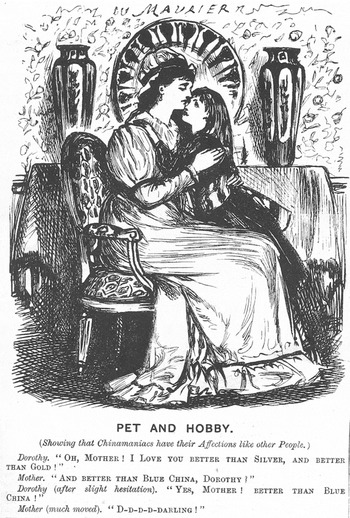
The female aesthete was often characterized by her lack of maternal feelings and the suppression of her biological imperative to bear children. Du Maurier's “The Passion for Old China!” (1874) depicts a woman nursing her teapot as though it is a newborn baby. Her husband demands his turn: “I think you might let me nurse that teapot a little now, Margery! You've had it to yourself all the morning, you know!” (Figure 22). From her haggard eyes, Margory's addiction does not appear to have done her much good; hugging teapots all day was obviously unhealthy. Du Maurier's cartoon highlights the debilitating effect of contemplation and the resulting melancholic introspection; raising a family would be more productive. Conversely, “Pet and Hobby (Showing that chinamaniacs have their affections like other people)” (1876), implied that a whole generation was in danger of being brought up to value objects over people:
George du Maurier, “The Passion for Old China.” Engraving from Punch, 2 May 1874, 189.

Dorothy: ‘Oh, Mother! I love you better that Silver, and better than Gold!’
Mother: ‘And better than Blue China, Dorothy?’
Dorothy: (after slight hesitation) ‘Yes, Mother! Better than Blue China . . . ’
Mother: (much moved) ‘D-d-d-d-darling!’ (Figure 22)
George du Maurier, “Pet and Hobby.” Engraving from Punch, 26 Aug. 1876, 87.

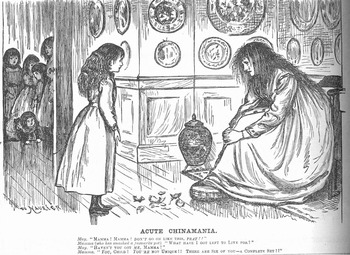
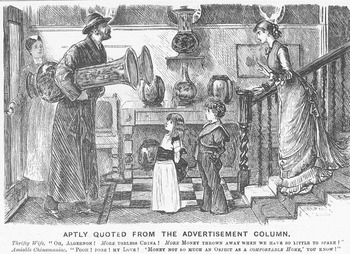
Here du Maurier suggests the “negative characteristics” of the obsessive china lover. An unnatural love for china has warped the normal relations between mother and child. Collectors evidently invest their affections in things rather than people. Aesthetes were invariably accused of solipsism, of thinking only of themselves. This point was taken up in “Acute Chinamania” (1875), in which a mother is shown mourning her broken china. Inconsolable in her grief her daughter asks, “haven't you got me, mama?” But the mother responds, “You Child, You're not Unique!! There are six of you, a complete set!!” (Figure 23). A craving for the exotic and foreign, for Chinoiserie rather than utilitarian tableware, heightens her perversity. Failing to represent “domestic conservatism” and good housekeeping this mother signals lavish display and excessive spending on luxurious and unnecessary items. Women were all too easily swayed by the hype of the salesman but according to Punch, men had also become their prey (Figure 24).
George du Maurier, “Acute Chinamania.” Engraving from Punch's Almanack for 1875, 17 Dec 1874, n.p.

George du Maurier, “Aptly Quoted from the Advertisement Column.” Engraving from Punch, 15 Dec. 1877, 270.

Spectacular display suggests both aristocratic privilege and corruption. Patience attacked aristocratic dilettantism, synonymous with Aestheticism, with the action played out at Castle Bunthorne. Refinement, sensitivity and luxury goods are all equated with the aristocracy, a class also accused of excess and immorality. A delicate balance had to be maintained between the appropriate display of family wealth, demonstrating self-worth, and the wanton pursuit of consumption as a form of self-gratification. More simply “the female china lover takes the fall for what should have been identified as social excess” (Kowaleski-Wallace 68).
Cultures of Collecting
The chinamaniac evidently acquired a voracious appetite for the odd and unusual, even the perverse: “[the collector] is neither true artist nor true man, but a sort of aesthetic hybrid, able to work himself into a phrenzy [sic] of irrational admiration about anything which is sufficiently old, obscure or grotesque” (Quilter, “The Palace of Art” 302). He or she pursued their quarry with a vengeance; appetites could not be sated and underhand strategies were employed to achieve goals. “Old China,” as a form of elite goods, became the basis of expert knowledge through recognition of designs or marks and valued for its intrinsic properties and appearance, nuances not always immediately apparent to the untrained eye (Vincentelli 107). Provenance and authenticity, the ability to recognize the genuine from the fake, were lauded. Collecting antique china became a sign of culture and refinement and contemporary production was often characterized as tasteless and vulgar.Footnote 20
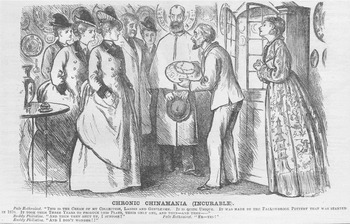
Grant Allen, novelist and journalist, thought the rich “confused a love of beauty with a taste for making collections” (“Cimabue and Coal-scuttles” 71–72), while Quilter observed that aesthetes exhibited a “spurious devotion to whatever is foreign, eccentric, archaic, or grotesque” (“The New Renaissance or Gospel of Intensity” 400). The quest for antiquities and antiques became compulsive and being hand-made, or pre-industrial, offered a unique experience in terms of possession. Increasing financial values encouraged the scouring of bric-a-brac shops in pursuit of a bargain; there was clearly pleasure to be had in the chase. Yet cost was not the guiding principle in the search for “cultural capital,” as it was vital to find rare and unusual objects: “As a reaction to the plenty of the machine came a desire for the unique object, for a one-of-a-kind, I-have-the-only-piece” (Klein, McCelland and Haslam 166). Punch satirized this condition as “Chronic Chinamania” in a cartoon from 1875 (Figure 25). For Allen “the notion of rarity got inextricably and fatally mixed up with that of beauty, or even began to supercede it” (70). The virtuoso was surprised when his pretty plate was admired, “rather than a hideously ugly but very rare pipkin, which is one of the costliest and most vulgar specimens of old Worcester now extant” (Allen 70). Evidently this spirit was prevalent amongst all connoisseurs and collectors: “They want a particular sang de boeuf or old turquoise blue Chinese vase not merely because it is beautiful but also because it is old and rare. The self-same turquoise blue turned out by a modern Japanese or European workman they will not look at it” (Allen 70). Aesthetic snobbery turned its nose up at “cheap and modern things” even if they were pretty.
George du Maurier, “Chronic Chinamania (Incurable).” Engraving from Punch's Almanack for 1875, 17 Dec. 1874, n.p.

Quilter and Allen agreed that Aestheticism laid too much stress on the veneration of age and the collecting of antiques for their own sake. Antiques carried an “emotional value and monetary value, both verified by the story that generations of previous owners have labored to care for the object” (Schaffer, Forgotten Female Aesthetes 81). According to Schaffer, “the buyers of antiques place themselves in the direct line of connoisseur-owners who cared for this special craft. This entrance into a respected series of connoisseurs, this placing of oneself in a symbolic genealogy, is the real pleasure of antique buying” (Forgotten Female Aesthetes 81). In the “fluid” society of the later nineteenth century, the concept of a “genealogy of owners” would have an obvious appeal to the arriviste. Moreover, the acquisition of Old Blue signaled acceptance into a socio-economic group, identifying the owner with a clique: “consumer objects became, with the growth of wide-scale consumption ‘an expression and guide to social identity’” (McKendrick and Brewer in Kowaleski-Wallace 6). Spending, or Veblen's “conspicuous consumption,” was “spurred on by social emulation and class competition.” Scholarship has established that in a modern society goods carry a wide range of meanings. The pursuit of new types of goods in the context of the Aesthetic movement, notably artistic goods, especially china, denotes new social and cultural purposes. The art-object promised the satisfaction of a variety of desires. Moreover the aesthete was willing to be dominated by an object, to see in it the “mirror of his desires.” Objects, such as teapots, were considered not merely useful, but also a valuable indication of who aesthetes were; they were for self-identity or embodied the “desired self,” Kingsley's “conceited dream of self-culture.”
Clearly aesthetes used collecting as a means of identifying the self, falling into the category of the narcissistic collector, that is someone who collects in order to maintain their self-esteem. This is a recognized motivation for collecting (Formanek 332). Through acquisition the collector replaces production with consumption; objects are removed from their original context and located within the collection. The collector replaces the “narrative of production” with the “narrative of the collection,” “the replacement of the narrative of history with the narrative of the individual subject – that is the collector himself” (Stewart, “Objects of Desire” 256). Collecting may be a challenge, a means to display expertise, knowledge or mastery of a subject. Such collectors enjoy having something others do not have or experience pleasure in ordering and controlling their possessions. Collecting traditionally has it origins in forming groups of antiquities and oddities. The motivation was often academic, to increase knowledge and explain the world. Collection forming was clearly an aspect of the leisured life-style of the aristocrat; the objects gathered often trophies of the Grand Tour. Collecting is “rule-governed possession” based on type, provenance and classification. This type of collecting is associated with the male domain.
Few commentators had anything good to say about what women acquired, preferring “the fragility, the bright colours, the ornamental rather than the practical qualities and, no doubt, the extravagance” (Eatwell 128). They acquired things for their decorative appeal, to augment interior décor; sentiment, souvenirs and mementoes, being especially linked with the feminine, often drove accumulation. China was frequently passed down from mother to daughter, Mrs Hawes leaving 300 teapots to her daughter, who created a special display room for them (Marryat, A History of Pottery and Porcelain, 1868, 307–08). This appeared to debase priceless art objects, which were now purchased to mark an event or to fit a decorative scheme and redefined as valuable domestic commodities. When men collected in this manner they were criticized. Howell recognized that Leyland's purchases were governed by the demands of interior decoration; “for he really is not a collector, and only buys a thing when he wants it for a certain place” (CAH to DGR March 1873, Cline Letter 207). Yet the Rev William Loftie did not advocate collecting as “merely money laid by to accumulate” (21), as above all it was a moral duty to provide a beautiful home:
Except for people who are actually artists, much that goes to make home beautiful must of necessity be obtained by judicious collecting . . . it is the duty of everyone who is so fortunate as to possess a home and to be the head of the family, to endeavour, so far as he can, to make his family happy by making his home beautiful. . . . Too many men collect only for their own private gratification. (Loftie 20)
Loftie draws a sharp distinction between “the man who gathers objects in which he alone is interested, and the man who desires to beautify his house with what he buys.” Loftie's Art at Home series, published from 1877, was calculated to “give pleasure to as many as possible in the home and to make its rooms as pretty and as attractive as possible.” Loftie did not admire “private museums”: “I think houses which are ugly and badly furnished and uncomfortable as none the better for being filled with curiosities” (22). Blue-and-white was prized “first as an undeniably exquisite decoration for the interior of our houses, and secondly, as a thing of rare beauty in itself, and apart from all consideration of its adaptability to its surroundings” (Hollingsworth 25). Byron Webber declared:
The decorative beauty of Blue China . . . is beyond compare. Form and colour and pictorial design accord with the appointments of a room or hall exemplifying English Art in a manner that no other order of ceramics could provide. With such a room so furnished and embellished, and with carpets from the old looms of Persia to complete the scheme of colour, nothing else is required to make the picture ‘fortunate.’ (187)
It was as “a fascinating style of decorating” that the aesthete really cherished his Old Blue (Hollingsworth 16).
China was a means of beautifying the home but maintaining aesthetic restraint, the notion of “less is more,” as seen in the interiors devised by Edward Godwin for Whistler, was vital. There was danger in excess, with the display of luxurious china frowned upon by moralists and satirized in Punch (Figure 24). Macaulay had no hesitation in condemning his ancestors:
Almost every great house in the kingdom contained a museum of these grotesque baubles. Even statesmen and generals were not ashamed to be renowned as judges of teapots and dragons; and satirists long continued to repeat that a fine lady valued her mottled-green pottery quite as much as she valued her monkey, and much more than she valued her husband. (Macaulay in Marryat 302)
Macaulay blamed Queen Mary, who formed a “vast collection of hideous images,” for this “frivolous and inelegant fashion” (Macaulay in Marryat 301–02). Manifestly women collected the wrong things, their ungoverned consumption presenting a threat to the stability of the economy. Their relationship with objects was potentially deviant, their “loves of monsters” verging on idolatry or erotic fixation: “There is no inclination in women that more surprises me than this passion for china. When a woman is visited with it, it generally takes possession of her for life. China vessels are playthings for women of all ages” (Addison in Marryat 303).
Quilter reserved his vitriol for the antiquarian, a man who lives on “the bones of dead civilizations,” a well-known type in Victorian literature, from Sir Walter Scott to Wilkie Collins: “Upon the whole, he had a frail, languidly fretful, over refined look something singularly and unpleasantly delicate in its association with a man, and at the same time, something which could by no possibility have looked natural and appropriate if it had been transferred to the personal appearance of a woman” (Collins 29; ch. 6). Here the collector is un-sexed, emasculated, his libido sublimated into his hobby. Collecting is all about coveting and possessing, ruling and ordering, desires that lead both sexes astray. Like Mr Fairlie, aesthetes longed for privacy to gloat over their acquisitions. Shutting oneself off and living in isolation denied any “interest in the affairs of others.” It was this withdrawal that Quilter feared the most: “Do you really think that the world is to be improved, or, indeed it could get on at all, if every one were to do as you are doing, and shut themselves in a sort of aesthetic convent, with dead men's bones for their only companions” (“The Palace of Art” 302).
Quilter charged the aesthetic preoccupation with the past for stifling modern production, for “the art of a tea-cup and a coal-scuttle . . . does not depend upon its age, or the quaintness of its form but upon its being well fitted to perform its office and being decorated in subjection to that office.” First and foremost a house should be a place to live in, not a repository for objects:
Now, life cannot be passed in twilight contemplation of artistic objects belonging to another age. To be life at all, there must come into it some energy of production . . . but what energy could exist here, what work be done in these rooms of yours? Are you going to teach your children to creep in and out in this coloured silence and mummer under their breath of Leonardo and Donatello. And if you do what do you expect to make of them but prigs and milksops, such even as you have made of yourself? (Quilter, “The Palace of Art” 302)
The aesthete's constant measuring of the past against the present, his conviction that it was impossible to match or better the glories of a bygone age, resulted in melancholy, which in turn led to apathy and inertia. Quilter considered depression, which implied the abandonment of any goals, and morbidity, indicative of a diseased mind, to be the aesthetic malaise. The conviction that everything was pointless led to nihilism, a frame of mind normally associated with the modernist viewpoint. Quilter urged the aesthete to “come out into the world and try to make it a little more beautiful,” rather than “stifle your soul in selfish ease and languid repinings” (“The Palace of Art” 303).
Quilter accused the aesthete of living in “selfish isolation and morbid exclusiveness” (302). The Aesthetic set talked constantly about art being “an inspiration and a noble dream and a mysterious energy” but it was all “feeble cackle” (302). Quilter feared that he had not touched on the “darker shades” of the problem, “the effect upon effort, upon healthiness of mind and body, upon genuineness of life” (Quilter, “The Cornhill on Coal-scuttles” 912). A whole generation had been corrupted, men turned into “milksops and prigs,” while women, caught up in a “phrenzy . . . of irrational admiration about anything which is sufficiently old, obscure or grotesque” (Quilter, “The Palace of Art” 302) were “self-immolated upon the altar of their own hearths” (Quilter, “The Cornhill on Coal-scuttles” 912).
Conclusion
Freighted with femininity, Chinamania would inevitably be equated with the trope of the effeminate aesthete, as well as with the feminine homemaker, leading to accusations of “negative characteristics.” Intense longing was likened to a disease, both body and mind exhibiting the ravages of the aesthetic malaise. The quest for beauty, age, oddity and rarity resulted in a loss of reason, even a descent into neurosis and madness. No expense was spared in acquiring the unique; the collector investing in the originality of the object in order to achieve his desired self. But investing in objects robbed aesthetes of normal relations; they cared for things more than people. The male sexual libido was suppressed or “inverted,” while female maternal instincts were supplanted by unnatural and insatiable desires.
What then was Wilde signaling when he claimed that he found it hard to live up to his Old Blue? Clearly he was privileging the aesthetics of the Orient over those of Western Civilization. The aesthetic project desired a repositioning of the arts, with the decorative arts now accorded the same status as fine art but the idea that porcelain could be accorded the same artistic merit as a painting seemed to many absurd. Such a repositioning also challenged what was deemed to be beautiful and demanded the removal of useful objects into the realm of the objects d'art. To those outside the clique, aesthetic tastes appeared perverse and decadent, especially the engagement with Orientalism, deemed to be a feminine taste since the mid eighteenth century. Wilde was clearly declaring his superior sensibility, his ability to appreciate form and colour; the visual aesthetic privileged over subject, meaning or even morality. The new aesthetics demanded an appreciation of formal qualities, seen in Whistler's harmonious tints, and established correspondences between the arts, a unity of production and the emergence of the “gesamtkunstwerk,” the integration of objects with their setting. Objects were no longer seen in isolation but part of a harmonious whole, an interior designed as an expression of the personality of the owner, of the desired self. Aestheticism did not advocate a style, although it must be said that the preference for black and gold furniture, green paint, peacock feathers and Old Blue virtually constitutes a reproducible “look,” rather it was a demonstration of taste. Declaring that one had to live up to one's Old Blue was a conscious desire to reform personal taste, to shift the boundaries of Western art. An Old Blue teapot, consequently, could act as a sign of aesthetic ideals, as the embodiment of culture or the Higher Life.
Aesthetes argued that, at the very least, they had improved the public's taste:
Mrs Philistine Jones pays a visit to the Savoy, or the Prince of Wales's [the theatres where Patience and The Colonel were playing], enjoys the satire, and wonders how people can make such fools of themselves to be aesthetic. Now a dozen years ago Mrs Jones would have appeared at the theatre in a costume hideous in form, and utterly discordant in colour, instead of which she now wears a dress, with at least, some pretensions to artistic design and blending of harmonious tints. To whom is she indebted for the change? Why, to the fools for whom she expresses such disdain. Mr Philistine Jones dubs all aesthetes idiots, while he also adopts their ideas. (Hamilton 140)
Emanating from Chelsea, Aestheticism had started life as a critique of consumerism, scorning the vulgar tastes of the bourgeoisie. Aesthetes valorised the antique, as modern productions were perceived to be ostentatious, representing status, even crass ignorance, rather that art. Under the tutelage of Morris & Co and Liberty's, Aestheticism had promulgated a design revolution and art had now infiltrated the home. The House Beautiful became the outward sign of an inner refinement and sensibility but detractors simply saw a consumer boom. The emerging cult of Celebrity encouraged an elision of art and consumerism, as the fashion conscious adopted the collectables of Rossetti, Whistler and Wilde. As tastemakers their preferences were appropriated by the mass-market. Life-style Aestheticism, located in the home and expressed through display, became a highly contested area. For Quilter this collapse of art into fashion was disastrous, leading to a debasement of art, which was now open to the forces of a market economy. Fashion signaled the superficial, the feminized and was above all fleeting, when art was supposed to embody lasting values. There were obvious dangers in the integration of Art and Life; Aestheticism blended luxury, stylish sophistication and fashion but its emblems were inevitably debased by vulgarization.
The cult of Old Blue being no more than “a decorator's taste” indicated a failure to sever the connection between collecting and domestic consumption (Reitlinger 202–03). With aesthetic and economic value located in its colour, blue-and-white “is allowed to retain its connection with commodity status, failing to sever its link with consumption (Cheang 60). While “good” feminine collecting should integrate with the home, men who engage in accumulation without classification are read as transgressing gender boundaries. Masculine collecting should provide for immortality: “as the materiality of the collection, if preserved intact, can ensure the continuing integrity of the collector's identity after his/her death and mortification” (Cheang 58). Collection forming which emulates the respectability of museum practices offers permanence. Aesthetic display denies academic ordering, objects being placed for their effect rather than systematically arranged by chronology, type or country of origin. Objects reliant on their decorative effect will be subject to the whims of fashion, and soon ousted by the next fashionable commodity. Embedded in life-style Aestheticism, collecting becomes a visible vice; aesthetes are attracted to the sensual materiality of objects, are driven by the immediacy of possession but such fulfillment is short lived. Unquenchable desires ensure that permanence cannot be sustained, things must come and go, the sadness of loss inevitable; invested in the corporality of its owner, enacting possession transcends the collection. The mise en scène may be captured by photography and even paint, but the romance of the aesthetic interior, with its delicate china and paper fans, is its transience.
A binary reading of male collecting and female consumerism collapses under the masculine colonization of domestic space. This annexation of domestic consumption blurs gender boundaries inviting accusations of moral and sexual perversity. As a self-parody, the Aesthetic teapot inscribes “bad” collecting, while simultaneously fracturing the binary constructions of acquisition. The “bad” collector, like the sentimental consumer, invests his persona in things, as mementoes and souvenirs, rather than acquiring objects as a sign of social achievement or furthering academic knowledge. The unmanly collector attracted to china, developed female susceptibilities, acquiring a taste for the costly, the exotic, and above all the novel. If the teapot signals female vacuity, by association the male china collector lacks interiority, he is read as surface without psychic or intellectual depth. Caught up in a “phrenzy [sic] . . . of irrational admiration,” the aesthete lost his intellectual capacity:
Yet the careful selection and blending of objects ancient and modern was a demonstration that people can inhabit and interact with the past. Objects, now regarded as repositories of memories, became romanticized and sentimentalized:
I made friends with many choice specimens, erst the ornament of a palace, and have by good fortune secured some small treasures for the adornment of my cottage home. As I smoke my meditative cigar, and gaze with contemplative eyes upon those precious Sevres cups and groups . . . memory recalls many a quaint record of my wanderings and researches . . .
I should be almost ashamed to confess how much pleasure these fragile treasures afford me. For hours I sit amidst my friends, pen or book in hand. That group before me was purchased under particular circumstances, and not only recalls to mind pleasant days . . . Who will venture to say that the lips of a Pompadour or Du Barry may not have kissed those small but exquisite Sevres cups? Is not Wedgwood paying me a morning visit with his friend Flaxman as I look on those vases. . . . My Chelsea recalls the memory of Addison. . . . My Battersea reminds me of the sceptical Jacobite Bolingbroke. (Byng Hall 16, 19–20)
Collecting was no longer the realm of the academic but as a projection of the owner enhanced daily life. Men could now enjoy a special relationship with the material world, being enabled to invest objects with meaning, a privilege normally accorded to women. Aestheticism offered an alternative masculinity, its androgyny clearly ambiguous, or even a form of sexual emancipation allowing the expression of feelings and emotions. Yet Byng Hall maintained that his passion for china collecting was a pure pleasure, “elevating in its influence on man's nature; for I most fully believe that he who possesses this taste and cultivates it, will soon turn his back on the grosser pleasures and frivolities of life” (18). The “higher order of art . . . the constant handmaid of religion,” was a powerful aid to “meditation and devotion; Art has, and ever will have, a high and noble mission to fulfill” (18). Even china collecting had the potential to reform and improve. Yet it could be argued that Aestheticism ushers in the “spectacular consumerist society” in which objects are acquired because, to paraphrase Walter Pater, “of what they mean to us.”
Byng Hall was describing the culture of the “amateur”; the demonstration of artistry in the selection and display of objects in the interior. Works of art, whose values are timeless, are blended into a fugitive ensemble, in which tonality and balance, as well as ambience, become critical in the creation of the mise en scène. This play and counter play of objects is a self-conscious projection, looking back to the leisurely aristocratic life of the eighteenth century “amateur.” With the setting now a stage, theatricality builds a dialogic relationship; the viewer asks “who might live here?” But this enactment of self suggests contradictions, feminine changefulness. While the quixotic was expected of women, it was not deemed desirable in men. The prerogative of a woman to change her mind was translated into “the perverse desires of the misguided feminine consumer” (Psomiades 136). Wantonness, a trait ascribed to women, was in danger of migrating to men: “All women . . . are perverse in their tastes, driven by foolish, and even dangerous, desires to consume the exotic and the fashionable” (Kowaleski-Wallace 4). This was the “fearful consequences” of evolving into one's teapot.
Designed as a visual pun, the teapot suggests that aesthetic hyper-refinement had gone too far, that, as Quilter feared, something darker lay beneath the preference for sunflowers and Blue china. Drawing on “trans-sexuality” or even cross-dressing, of the type embodied in the pantomime dame who appeals to children and grannies, the teapot is clearly camp. Surrounded by art, the aesthete had evolved into the beautiful but beauty had quelled the beast to the point of emasculation. Robbed of his manliness, the aesthete's reproductive capacity was impaired. Androgyny implied an inability to replicate and that the species had been physically and mentally weakened by a devotion to the Higher Life. The ultimate punishment for leading a self-absorbed, reclusive life would be sterility – no fit children could be born or raised by such degenerates. The aesthete is not only inactive, he is the “end of the line”:
Poetry and music, pictures and statues, amusement and travel, became his idols, and cultivation his substitute for the plain duty of patriotism and wandering luxuriously over the world . . . with a lazy regret that ‘such forms of beauty and nobleness’ were no longer possible in a world of scrip and railroads; but without any notion that it was his duty to reproduce, in his own life or that of his country, as much as he could of the said beauty and nobleness.” (Kingsley 140; Vol. 1, ch. 9, “Am I not a Woman and a Sister?”)
For Quilter, the chief crime of the aesthete was his idleness and inactivity, Kingsley's “apotheosis of loafing” in one's own art paradise (Kingsley 143: Vol.3, ch.5, “The Broadstone of Honour”). As a bad consumer, wallowing in the past, preferring the ornamental to the useful, he was stifling the nation's productivity, and turning his back on a society ideologically driven by progress. The machine promised that manufactures would be available to all at low cost but this threat precipitated a retreat into an elite world of hard-to-come-by antiques. Although liberal, the aesthete was rarely egalitarian; he was by definition distinctive and above the common herd. Like the Aesthetic teapot, the Higher Life was for those who appreciated the finer things in life:
As for the ignorant and the vulgar, we let them alone. That is best for them. We neither help them, nor look at them, nor care about them. Those among them who are worthy will rise; those who are not will remain where they are, groveling and wallowing in their stiles like pigs. . . . This is the secret of the new Morals . . . the new virtue of Pure Selfishness. Every man must find out the Higher Life and live it, regardless of others, all to himself. (Besant and Rice 284; ch. 28)
Aesthetes set an unconscious “example to those who know how to read it; the life in which Art and Culture have the chief-nay, the sole place. . . . If they choose to raise their eyes, they may see walking before them in sweetness and in light the great examples of the age” (Besant and Rice 284). Withdrawn from society, protecting his precious way of life from the rabble, the aesthete became an unproductive parasite; as useless as the Aesthetic teapot. Quilter recognized a subversive element, remnants of the old Bohemianism, of art promising liberation from the constraints of society. Aesthetic “otherness” was expressed through the acquisition of the rare and unusual, qualities mimicked by the Aesthetic teapot. But Chinamania suggested that society was tipping into decadence, the focus now on bodily pleasures at the expense of ethical discrimination, had been feminised and ultimately castrated. No longer useful, elevated and venerated the teapot had evolved into a collectable but at the cost of its original function.
Aesthetes were ambivalent about their position as collectors, on the one hand eschewing indiscriminate consumption and on the other creating “an elite form of consumerism, though it attempted to conceal the agency of the buyer” (Matthews 181). Rather than curtailing productivity, Aestheticism ushered in a consumer boom; the last thirty years of the nineteenth century spawned nearly forty art potteries, companies that primarily manufactured decorative ceramics for the home. Doulton's, Linthorpe and Bretby catered for a market driven by collectables, creating substitutes for the antique, now often beyond the reach of the average buyer. Emulating historical types, in terms of shapes, glazes and decorative techniques, art pottery was used to beautify suburban spaces and enabled Aestheticism to expand into the mass market, providing the buyer with an ever-widening choice. All that was required was discrimination; the consumer needed to adopt “similarities” in order to belong, while fulfilling the demand of “difference.”
Identity was vested in the construction of taste, one's personal style made manifest through interior décor; Hamilton recognized the “essence” of the Aesthetic movement as “the union of persons of cultivated taste to define, and to decide upon, what is to be admired, and their followers must aspire to that standard in their works and lives” (vii). Aestheticism legitimized shopping, seen now as an act of faith, giving women a mandate to beautify the home for “life's sake.” It was woman's mission to inculcate taste in the next generation:
The influence of our surroundings upon our tastes, out habits, our modes of thought and action, is a matter which unconsciously we all acknowledge. . . . Take a child and bring it up surrounded by all kinds of refinement of thought, speech and manner . . . make its home beautiful with pictures, flowers, and soft colours; let it live in pure air, and give it plenty of opportunities of healthful enjoyment; and the child must have come of a bad stock indeed who is not influenced by such surroundings, and who does not show the effects of his environment in his character and habits when he comes to maturity. (“The Kyrle Society” 343)
Extending the boundaries of consumption enabled men to participate in the selection and display of art objects within the home; like women they could enjoy “the pleasurable exercise of taste”: “during the ‘fin de siecle’ male aesthetes expressed a decided preference for connoisseurship, consumerism, and, often non-reproductive or ‘perverse’ sexuality” (Schaffer 48). Ironically the purchaser of the Aesthetic teapot was destined to be a “person of cultivated taste,” the very socio-economic group which it critiqued. Taste has never been a fixed entity; it is constantly shifting, undergoing revision and reconstruction, with objects reclaimed or rejected by ensuing generations. This process of selection determines current patterns of consumption, with identity, in terms of class and gender, still heavily invested in what we buy and display in our houses. Aestheticism ushered in a purely pleasurable, consumerist life-style that sanctioned “extraordinary possessions,” the antique object connoting a taste matured by connoisseurship, cosmopolitanism and well established, perhaps long-descended, associations and surroundings; the Aesthetic teapot embodies the desire for the extraordinary.