The manufactuer of ceramic tiles is evolving constantly, and current trends aim to improve the production process and technical characteristics of products. The industry is dependent on the technical characteristics of the raw materials used; therefore, there is a need to find substitutes that could reduce production costs while maintaining or improving the quality of the final product (do Livramento et al., Reference do Livramento, Nazário, Domingos, de Noni Junior, Tassi and Cargnin2017).
Variability of clay properties within a single mineral deposit is very common and so exploration of mineral deposits can be inefficient. Blending of various clays therefore provides an opportunity to better use clay reserves and increase the miner-ceramist's portfolio for application to the ceramics industry (Sanfeliu & Jordán, Reference Sanfeliu and Jordán2009; Bordeepong et al., Reference Bordeepong, Bhongsuwan, Pungrassami and Bhongsuwan2012).
The thermal behaviour of clays and the phenomena caused by thermal treatment have been studied widely (Jordán et al., Reference Jordán, Boix, Sanfeliu and de la Fuente1999, Reference Jordán, Montero, García-Sánchez and Martínez-Poveda2020; Pardo et al., Reference Pardo, Meseguer, Jordán, Sanfeliu and González2011; Chalouati et al., Reference Chalouati, Bennour, Mannai and Srasra2020; Semiz & Çelik, Reference Semiz and Çelik2020). Thus, assessment of thermal behaviour in mixtures of various clays from a single mineral deposit is pivotal for industrial applications because doing so allows us to make use of all of the variations of the clay in a deposit.
During the ceramic-tile manufacturing process, firing is vital for obtaining the desired properties of the final product as thermal energy is transferred to promote a series of chemical and physical reactions such as thermal decomposition, allotropic transformation, the formation of a liquid phase and sintering (Moreno et al., Reference Moreno, Bartolomeu and Lima2009; Cargnin et al., Reference Cargnin, Ulson de Souza, de Souza and de Noni Junior2011, Reference Cargnin, Ulson de Souza, Ulson de Souza and de Noni Junior2015). By considering the energy changes involved during heat treatment, it is possible to obtain information regarding the reactions that occur during firing of a ceramic body (Vaughan, Reference Vaughan1955).
The implementation of fast firing cycles has contributed significantly to the growth of the ceramic tile sector in recent decades. Products that were once fired in hour-long firing cycles are now fired in just a few minutes (Magalhães et al., Reference Magalhães, Contartesi, dos Santos Conserva, Melchiades and Boschi2014). Another important point regarding the final properties in ceramic materials is the maximum firing temperature; currently, porcelain firing processes at temperatures of ~1160–1230°C are used (Eren et al., Reference Eren, Topate and Kurama2017; Gültekin, Reference Gültekin2018).
In addition, during the firing process, great caution is required to minimize defects in the end products. For example, pyroplastic deformation occurs at this stage and is influenced by stress levels in the sample. Pyroplastic deformation starts at 990°C via the movement of low-viscosity regions and decreases significantly at temperatures >1200°C (Rambaldi et al., Reference Rambaldi, Carty, Tucci and Esposito2007; Frizzo et al., Reference Frizzo, Zaccaron, de Souza Nandi and Bernardin2020).
During firing of a ceramic body, the energy required to raise the sintering temperature and all of the energies associated with the chemical reactions resulting from the heat treatment are consumed (Jouenne, Reference Jouenne1990). This increases production costs in processes that use thermal energy for firing (Sebastião et al., Reference Sebastião, Fernandes and de Souza Nandi2013). In the case of ceramic pastes, these reactions are associated with the decomposition of clay, where the endothermic reaction of water being released from the structure of the clay minerals is predominant (Jouenne, Reference Jouenne1990).
Ceramic materials are classified as isotropic due to the physical phenomena that occur via thermal expansion during their sintering (Cargnin et al., Reference Cargnin, Ulson de Souza, Ulson de Souza and de Noni Junior2015, Reference Cargnin, Kammer, Ulson de Souza, de Noni Junior and Ulson de Souza2019). Therefore, understanding their sintering kinetics helps us to determine the best processing conditions that correspond to the lowest activation energies recorded in each stage of the manufacturing process (Cargnin et al., Reference Cargnin, Ulson de Souza, de Souza and de Noni Junior2011; Santos et al., Reference Santos, Oliveira, Oliveira and Macedo2016). The activation energy represents a potential barrier to the diffusion processes occurring during firing. Low activation energy values indicate easier mass transport during firing, implying rapid mass transport at low temperatures (Santos et al., Reference Santos, Oliveira, Oliveira and Macedo2016).
In this study, three different clays from the same mineral deposit were selected and ten formulations were developed using the mixture-design method. The formulations were characterized chemically and thermally and the most refractory and fluxing formulations were defined using these values. Finally, the apparent sintering activation energy for densification was determined based on the thermal analysis and thermal kinetics results of the three clays. In addition, the most refractory and fluxing formulations were identified for each defined clay to obtain the greatest production efficiencies from an application perspective.
Experimental
Three different clays selected from the same area were used in this study. The mineralogical composition of the clays was determined using X-ray diffraction (XRD) with a Bruker D8 Advance diffractometer with Cu-Kα radiation at 40 kV and 40 mA. All of the measurements were taken in the 2–78°2θ range at a speed of 2°θ min–1. Phase quantification was conducted using the Rietveld method (Rietveld, Reference Rietveld1969). The analysis was performed using Match! 3 software and using the Crystallography Open Database. Ten formulations were developed using the mixture-design method (Table 1). All formulations were chemically characterized using wavelength-dispersive X-ray fluorescence (WDXRF) spectrometry with a Panalytical Axios Max system. The loss on ignition (LOI) of the samples was determined after calcination at 1000°C for 3 h. Subsequently, all formulations underwent differential thermal and thermogravimetric analyses (DTA/TGA) with a simultaneous thermal analyser (Netzsch, STA 409 EP) at 20–1075°C and at a heating rate of 10°C min–1 in a synthetic air atmosphere (60 cm3 min–1). Dilatometric thermal analysis of the formulations was performed using a Netzsch dilatometer (DIL 402) from room temperature to the melting point of the samples at a heating rate of 10°C min–1 under a synthetic air atmosphere.
Compositions of the ten ceramic mixtures consisting of the three selected clays.

Based on the dilatometric test results, the samples were characterized as more fluxing or more refractory, and the apparent sintering activation energy for densification (E a) values of the three natural clay samples and the most fluxing and most refractory mixtures were determined. The dilatometric test was then performed again with the chosen samples by changing the heating rate to 5, 10 or 15°C min–1. To determine the E a values of the samples, isoconversional methods were used to establish the relationships between ln[βi(dα/dT)]α,i and 1/T α,i (K). The linear angular coefficient multiplied by the ideal gas constant (R) provided the E a value for each conversion α and heating rate i according to Equation 1 (Friedman, Reference Friedman2007):

Specimens were conformed to analyse the pyroplasticity index of the compositions. First, water (7 mass%) was added to the mixtures. Then, the compositions were pressed in an electrohydraulic laboratory press (Nannetti Mignon SSN/EA) at 300 kgf cm–2, forming test specimens of 4 cm diameter and 1 cm height. The samples were then dried on a stove at 100°C for 24 h.
The pyroplastic deformation test is crucial in the manufacture of porcelain tiles. The test involves a permanent deviation in the planarity of a material, which occurs at high temperatures due to gravitational force. This deviation occurs because of the large amount of liquid phase formed during firing; the lower the viscosity of a material, the greater the deformation tendency (Milak et al., Reference Milak, Rodrigues, Ricardo, Tertuliano, Jacinto and Gastaldon2007). The method used to perform this test was described by Milak et al. (Reference Milak, Rodrigues, Ricardo, Tertuliano, Jacinto and Gastaldon2007).
Results and discussion
The XRD traces obtained are shown in Fig. 1. Kaolinite, illite and quartz are present in all samples. Clay 1 contains only quartz and kaolinite, whereas illite is also present in Clays 2 and 3. The results of the quantitative analysis are shown in Table 2. The studied samples differ based on their mineralogy in terms of the relative abundances of quartz, kaolinite and illite. Clay 1 is richer in quartz, has a low kaolinite content and is free of illite, indicating greater refractoriness in the ceramic formation processes. Clays 2 and 3 have illite in their compositions. The presence of illite suggests a greater alkali and chromophore oxide (Fe2O3 + TiO2 + MnO) content, resulting in a lower melting point (Perez, Reference Perez2008). Clay 3 has a greater kaolinite content, which is an important component of ceramic formulations as its conformation improves the paste workability of ceramics (Silva et al., Reference Silva, Luna, Chaves and Neves2018).
X-ray traces of the clays used in this study.

Quantitative mineralogical compositions of the three clays.

Silica (SiO2) and alumina (Al2O3) are the main chemical constituents of the ceramic mixtures (Table 3). These oxides are associated with clay minerals and quartz (Dondi et al., Reference Dondi, Guarini, Ligas, Palomba and Raimondo2001; Alcântara et al., Reference Alcântara, Beltrão, Oliveira, Gimenez and Barreto2008). Although the high SiO2 content favours the manufacture of type BIIb ceramic tiles (Santos et al., Reference Santos, Oliveira, Oliveira and Macedo2016), this oxide can lead to low mechanical resistance of the sintered ceramic bodies (Seynou et al., Reference Seynou, Millogo, Ouedraogo, Traoré and Tirlocq2011).
Chemical compositions of ceramic mixtures.

Alkali oxides (Na2O + K2O) and alkaline-earth oxides (MgO + CaO) act as fluxes, thus facilitating the formation of a liquid phase and increasing linear shrinkage during firing (Lopez et al., Reference Lopez, Rodríguez and Sueyoshi2011). K2O and MgO are abundant in mixtures containing Clay 3.
Chromophore oxides impart colouration to a ceramic body during heat treatment (Andreola et al., Reference Andreola, Martín, Ferrari, Lancellotti, Bondioli and Rincón2013; Zanatta et al., Reference Zanatta, Santa, Padoin, Soares and Riella2021). The abundance of these oxides does not exceed 3% in the mixtures. The formulations with the largest amount of Clay 3 (M.3) had the greatest chromophore oxide content. The LOI is attributed to the dehydroxylation of clay minerals and the loss of volatile materials (Vieira et al., Reference Vieira, Sánchez and Monteiro2008; Eliche-Quesada et al., Reference Eliche-Quesada, Sandalio-Pérez, Martínez-Martínez, Pérez-Villarejo and Sánchez-Soto2018; Zaccaron et al., Reference Zaccaron, de Souza Nandi, Dal Bó, Peterson, Angioletto and Bernardin2020).
Among the secondary components, only trace P2O5 was identified.
Thermogravimetric analysis is useful for observing mineral reactions at higher temperatures (Comin et al., Reference Comin, Zaccaron, de Souza Nandi, Inocente, Muller and Peterson2021). Figure 2 shows mass losses corresponding to free and adsorbed water, hydroxides, kaolinite hydroxyls, CO2 from carbonates and mullite nucleation (Mendonça et al., Reference Mendonça, Cartaxo, Menezes, Santana, Neves and Ferreira2012).
TG curves of the ceramic mixtures.

The mass loss due to the adsorbed water occurred at up to ~120°C (Acchar et al., Reference Acchar, Dultra and Segadães2013), while at between 200 and 400°C a mass loss due to dehydroxylation of hydroxides and/or decomposition of organic matter was observed (Soares et al., Reference Soares, do Nascimento, Paskocimas and Castro2014). The mass loss due to kaolinite dehydroxylation occurred at ~500°C (Gardolinski et al., Reference Gardolinski, Martins Filho and Wypych2003; Ferreira et al., Reference Ferreira, Varajão, Morales-Carrera, Peralta-Sánchez and da Costa2012); at ~600°C there was a mass loss associated with probable mica dehydroxylation (Menezes et al., Reference Menezes, de Almeida, Santana, Ferreira, Neves and Ferreira2007).
As many ceramic minerals possess allotropic characteristics, their natural forms can be converted via temperature treatment into other forms with varying reversible and irreversible rearrangements, such as changes in crystalline structure and volume (Vieira & Monteiro, Reference Vieira and Monteiro2003). Figure 3 presents the DTA results for the formulations with their distinct endothermic and exothermic peaks. The formulations exhibited endothermic peaks due to the dehydroxylation of clay minerals and exothermic peaks due to the recrystallization of phases and the formation of new constituent phases.
DTA curves of the ceramic mixtures.

At between 500 and 520°C, an endothermic peak was observed for kaolinite dehydroxylation (Gardolinski et al., Reference Gardolinski, Martins Filho and Wypych2003; Ferreira et al., Reference Ferreira, Varajão, Morales-Carrera, Peralta-Sánchez and da Costa2012), and at ~560°C, a slight endothermic peak occurred, indicating the presence of quartz and its stoichiometric transformation (Galán-Arboledas et al., Reference Galán-Arboledas, Cotes-Palomino, Bueno and Martínez-García2017; Barreto & da Costa, Reference Barreto and da Costa2018; Salah et al., Reference Salah, Sdiri, Jemai and Boughdiri2018). Finally, at between 960 and 980°C, an exothermic peak occurred due to the formation of spinel, which yielded mullite (Becker et al., Reference Becker, Jiusti, Minatto, Delavi, Montedo and de Noni Junior2017; de Oliveira Henriques et al., Reference de Oliveira Henriques, Pedrassani, Klitzke, Mariano, Vargas and Vieira2017; de Sousa et al., Reference de Sousa, Salomão and Arantes2017; Wang et al., Reference Wang, Zhu, Sun, Ji, Liu and Wang2017).
Dilatometric thermal analysis (Fig. 4) initially showed the transition from α-quartz to β-quartz at ~573°C (Schmidt-Mumm, Reference Schmidt-Mumm1991; Doppler & Bakker, Reference Doppler and Bakker2014). At >900°C, some formulations started to retract until reaching ~1300°C. The retraction became more accentuated at 1100°C for some formulations and continued up to 1340°C in some cases, indicating that sintering had already been initiated. The maximum sintering temperature was ~1440°C.
Dilatometric curves of the ceramic mixtures. dL/Lo = relative variation in sample length.

The data obtained from this test indicate that the M.9 and M.4 curves represent the most fluxing and most refractory mixtures, respectively (Table 4). Moreover, intermediate fluxing and refractory curves were observed for the M.6 and M.7 mixtures, respectively. Therefore, use of Clays 1 and 2 (M.1 and M.2) increased the refractoriness of the mixtures and the addition of Clay 3 (M.3) increased the fluxing effects.
Shrinkage, start of sintering and maximum sintering temperatures of the ceramic mixtures studied.

Pyroplasticity depends significantly on the ability to form liquid phases and is thus related to alkali oxides, which may form liquid phases with relatively high viscosities. Quartz in its free form (free silica) is abundant in clay, as is kaolinite, both of which increase the refractoriness of the raw material, minimizing pyroplasticity problems. In contrast, some oxides, such as Na2O, potentially yield less viscous liquid phases, increasing the pyroplasticity index significantly (Bernardin et al., Reference Bernardin, de Medeiros and Riella2006; Bresciani & Spinelli, Reference Bresciani and Spinelli2013; Melchiades et al., Reference Melchiades, Boschi, dos Santos, Dondi, Zanelli, Paganelli and Mercurio2014; dos Santos Conserva et al., Reference dos Santos Conserva, Melchiades, Nastri, Boschi, Dondi and Guarini2017; Güngör, Reference Güngör2018; Frizzo et al., Reference Frizzo, Zaccaron, de Souza Nandi and Bernardin2020).
To analyse the pyroplasticity index (Table 5), the three clays (M.1, M.2 and M.3) and the most refractory (M.4) and most fluxing (M.9) mixtures were further analysed. Clay 2 (M.2) had a lower pyroplasticity index, primarily because of its raw density (its porosity and thus accommodation of liquid phases) and its Al2O3 and SiO2 contents, facilitating the formation of structural mineral phases.
Pyroplasticity index (PI) values of the clay samples (M.1, M.2 and M.3) and of mixtures M.4 and M.9.

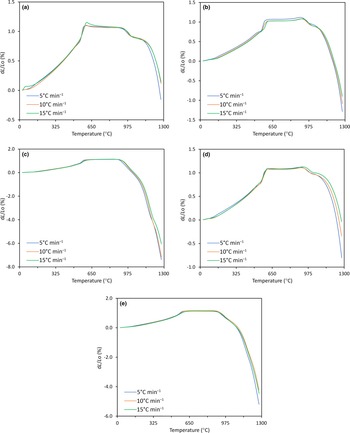
Furthermore, chemical reactions proceed rapidly when the temperature rises. This is the basis for the reactions involved in the firing of ceramic raw materials. Thus, by evaluating linear shrinkage under various heating rates at the same starting temperature (Fig. 5) and the temperatures of the various processes taking place, the various energy rates required to achieve the same degree of maturation for the studied clays were determined.
Dilatometric curves of various ceramic mixtures at various heating rates: (a) M.1, (b) M.2, (c) M.3, (d) M.4 and (e) M.9. dL/Lo = relative variation in sample length.

With the dilatometric data generated, the respective values for densification values for each clay sample and for the most refractory and most fluxing mixtures were obtained (Table 6). This method is very sensitive, thereby highlighting the significant differences between the samples analysed. Compared to the other mixtures, the M.4 mixture exhibited the lowest E a value (~482 kJ) and the M.9 mixture exhibited the greatest E a value (1492.5 kJ).
Apparent sintering activation energy for densification (E a) of the clay samples (M.1, M2 and M3) and of mixtures M.4 and M.9.

Summary and conclusion
Clays with refractory and fluxing characteristics were obtained, as assessed using thermal analyses. The mixture-design method was implemented to obtain results with the potential to expand the application of clays, such as increasing the economic viability of their industrial use.
Clay 1 (M.1) reduced the activation energy when applied in mixtures, indicating that it is a more refractory clay suitable for monoporous-type ceramics.
Clay 2 (M.2) has a low pyroplasticity index primarily because of its raw density (its porosity and thus accommodation of the liquid phases) and Al2O3 and SiO2 contents, facilitating the formation of structural mineral phases. This material exhibits a high activation energy value (1399.844 kJ), demonstrating the highest activation energy value compared to the other clays (754.653 kJ for Clay 1 and 964.315 kJ for Clay 3).
Clay 3 (M.3) presented greater fluxing behaviour compared to the other materials and exhibited a greater value in terms of its pyroplasticity index because of the presence of K2O and MgO, which potentially yield less viscous liquid phases, increasing the pyroplasticity index significantly. The thermal behaviour of this clay indicates it has an average activation energy value compared to the other two clays. When in a mixture composition, M.3 increases the formation of eutectic phases in pastes and can be applied in ceramic tiles that require significant vitrification, such as porcelain tiles.
Knowledge of the technological properties of materials broadens their application prospects. Hence, the use of dilatometry to characterize raw materials for application in ceramic pastes is ideal for studying closely related properties of ceramic materials, such as sintering temperature, linear shrinkage and adverse mineral reactions.
Furthermore, the influence of the kinetic evaluation of the processing data (in this case, the heating rate) of the raw materials opens new horizons for an accurate quantitative evaluation of raw materials due to considerable savings in industrial applications.
The calculation of the activation energy is important for predicting the temperature at which a desired degree of sintering can be achieved at a given heating rate. Other parameters, such as the maximum sintering temperature, may serve as a predictor in the evaluation of clay materials in industrial processes.
Author contributions
ABC: conceptualization, writing – original draft. AZ: formal analysis, writing – reviewing and editing. VdSN: methodology. JMI: validation. TGM: investigation. AGDB: formal analysis, resources. AMB: visualization, resources. MP: supervision.
Acknowledgements
The authors thank CAPES (Brazil) for the financial support of CAPES/Brazil process n. 88887.502321/2020-00 and CAPES/Brazil process n. 88887.356961/2019-00.
Conflict of interest
The authors have no conflicts of interest to declare.