

Introduction
The hunting and exploitation of wild species marked the beginning of complex human-animal relations (Russell Reference Russell2011). The nutritional and economic value of wild animals, in terms of meat, hide and bones, for instance, was highly prized by human societies before and after the origin and spread of domesticates (Davis Reference Davis1987; Fagan Reference Fagan1996; Reitz & Wing Reference Reitz and Wing2008). Wild animals also fulfilled crucial non-subsistence-related roles, such as in the performance of rituals and the consolidation and maintenance of state power (Fagan Reference Fagan1996; Fiskesjö Reference Fiskesjö2001; Russell Reference Russell2011; Sugiyama et al. Reference Sugiyama, Somerville and Schoeninger2015).
An important aspect in the long history of human-wildlife interactions is the decline, extirpation and extinction of wild animals—processes most often associated with unsustainable exploitation and other anthropogenic and natural effects (Fagan Reference Fagan1996; Frazier Reference Frazier2007; Weinbaum et al. Reference Weinbaum, Brashares, Golden and Gets2013; Boivin et al. Reference Boivin, Zeder, Fuller, Crowther, Larson, Erlandson, Denham and Petraglia2016). While such ecological consequences are occurring in the contemporary world, similar processes have been documented archaeologically for wild species, including, but not limited to, Sumatran rhinoceros (Dicerorhinus sumatrensis), Persian gazelle (Gazella subgutturosa) and Père David's deer (Elaphurus davidianus) (Lott Reference Lott2002; Bar-Oz et al. Reference Bar-Oz, Zeder and Hole2011; Russell Reference Russell2011; Lander & Brunson Reference Lander and Brunson2018a & Reference Lander and Brunsonb). Hence, it is crucial that we understand the past interplay between wild animal exploitation and anthropogenic landscape transformation from the perspective of sustainability. This not only facilitates a better understanding of ancient human-wildlife interactions, but also provides insights into issues such as wildlife conservation and biodiversity maintenance in the modern era (Grigg et al. Reference Grigg, Hale and Lunney1995; Lyman & Cannon Reference Lyman, Cannon, Lyman and Cannon2004; Etnier Reference Etnier2007; Frazier Reference Frazier2007; Emery & Brown Reference Emery, Brown, Chacon and Mendoza2012; Boivin et al. Reference Boivin, Zeder, Fuller, Crowther, Larson, Erlandson, Denham and Petraglia2016).
Sika deer (Cervus nippon) are native to the mainland and islands of East Asia (Lister Reference Lister1984; Groves & Grubb Reference Groves, Grubb and Wemmer1987; Guo & Zheng Reference Guo and Zheng1992, Reference Guo and Zheng2000; Cook et al. Reference Cook, Wang and Sensabaugh1999; McCullough Reference McCullough, McCullough, Takatsuki and Kaji2009; Harris Reference Harris2015). Despite the large population of farmed sika deer in modern China, the number of extant wild sikas is small and their habitat is restricted to a limited range of areas (e.g. in Sichuan, Jiangxi and Zhejiang) where nature reserves have been officially established (Sheng Reference Sheng1985; Ohtaishi & Gao Reference Ohtaishi and Gao1990; Geist Reference Geist1998; McCullough Reference McCullough, McCullough, Takatsuki and Kaji2009; Wang & Song Reference Wang and Song2014). As several subspecies of sika deer have been extirpated in China (Guo & Zheng Reference Guo and Zheng1992, Reference Guo and Zheng2000; McCullough Reference McCullough, McCullough, Takatsuki and Kaji2009; Harris Reference Harris2015), the species is now listed in Level 1 state protected animal species in China (Jiang et al. Reference Jiang, Kaji and Ping2016; Ministry of Agriculture and Rural Affairs of the People's Republic of China & National Forestry and Grassland Administration 2021) and in the China red data book of endangered animals (Wang Reference Wang1998). Sika deer, however, were among the most frequently hunted and exploited wild species in ancient China (Yuan Reference Yuan2008; Wang et al. Reference Wang, Wang and Wang2014; Lander & Brunson Reference Lander and Brunson2018a). Extensive and widespread sika deer assemblages from archaeological sites demonstrate their once large population size and distribution (Guo & Zheng Reference Guo and Zheng1992, Reference Guo and Zheng2000; Luo Reference Luo2009). Investigating past sika deer exploitation and its association with sustainability and landscape change thus allows us to reach a better understanding of long-term human-sika relations in China.
Here we present an analysis of sika deer remains from the Bronze Age site of Zaoshugounao in the Guanzhong region of northern China. By analysing the age profile, sex distribution and season of death of the Zaoshugounao sika assemblage, it is possible to reconstruct hunting strategies and evaluate their impact on the sika deer population. It is known that the selective killing of adult females may affect the reproduction rate of ungulates, causing a discernible population decrease, and that hunting strategies can contribute to the sustained availability of wild animal resources (Caughley Reference Caughley1977; Ginsberg & Milner-Gulland Reference Ginsberg and Milner-Gulland1994; Frazier Reference Frazier2007; Emery & Brown Reference Emery, Brown, Chacon and Mendoza2012; Weinbaum et al. Reference Weinbaum, Brashares, Golden and Gets2013). Furthermore, while a number of metrics have been used to measure the sustainability of wild animal hunting in disciplines such as biology and ecology (for a review, see Weinbaum et al. Reference Weinbaum, Brashares, Golden and Gets2013), many of these are not applicable to archaeological materials, due to small sample sizes, taphonomic effects and a lack of contextual information. Taken alongside other relevant zooarchaeological, palaeoenvironmental and textual evidence, our research shows that Bronze Age sika deer hunting at Zaoshugounao was potentially sustainable, despite an overall decline in the sika population and a contraction of habitat range in the Guanzhong region during the following millennia. These findings suggest that habitat loss and population decline in wild species can nevertheless be associated with locally sustainable practices that can contribute to the survival of otherwise declining wild animals.
The biology and ecology of sika deer
Sika deer are medium-sized artiodactyls adapted to various habitats, especially open grassland and forested areas (Feldhamer Reference Feldhamer1980; Geist Reference Geist1998; Smith & Xie Reference Smith and Xie2008). They prefer warmer climates and feed on a variety of plants (Feldhamer Reference Feldhamer1980). Sika deer reach sexual maturity at around 1.5 years of age and are fully grown at approximately five years (Feldhamer Reference Feldhamer1980; Hayden et al. Reference Hayden, Lynch and O'Corry-Crowe1994). Their peak breeding age is between three and eight years old, and they give birth and rear their young in summer (Zhou & Wu Reference Zhou and Wu1981; Li et al. Reference Li, Li, Zheng, Ge and Zhao1998; Harris Reference Harris2015). Male sikas bear antlers that are normally shed in spring (Goss Reference Goss1961; Miura Reference Miura1984; Qin Reference Qin1994; Song & Liu Reference Song and Liu2005). The growing, un-ossified antler tissue is known as velvet antler; its production increases with age up to around ten years, after which it decreases (Zhao et al. Reference Zhao, Chen, Zhang, Chai, Ding, Zhang and Liu1991; Zeng et al. Reference Zeng, Chen, Yang and Zhou2002) and this may, as we shall see, have a bearing on our age-at-death estimates of the Zaoshugounao sika deer assemblage.
The Guanzhong region and the site of Zaoshugounao
The Guanzhong region encompasses the present-day central Shaanxi Province, through which the Wei River and its tributaries flow. It is a key region for understanding the development of social complexity, early state formation and the expansion of imperial power in China (Liu Reference Liu2004; Wang Reference Wang2005; Shelach-Lavi Reference Shelach-Lavi2015; Song Reference Song2018).
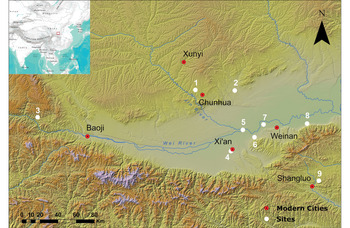
The site of Zaoshugounao (108°30′35″ north, 34°51′22″ east) is located in northern Guanzhong (Figure 1). The landscape surrounding the site is characterised by gullies, hill ridges and loess terraces (Li Reference Li2009; Zhang et al. Reference Zhang, Wang, Yu, Zhang, Liu and Tu2011). Field surveys indicate that Zaoshugounao occupied an area of approximately 100ha, and subsequent excavations between 2006 and 2010 revealed a total area of 0.4ha. The types present in the ceramic assemblages, the configuration of the archaeological features and the results of radiocarbon-dating all suggest that most of the cultural remains from Zaoshugounao belong to the Late Shang period (c. 1250–1050 BC) and slightly post-dating the Shang-Zhou dynastic transition—a political shift crucial to the formation of Chinese civilisation (Qian et al. Reference Qian, Li and Wei2008; Wang & Chen Reference Wang and Chen2010; Li Reference Li2012; Wang et al. Reference Wang, Wang, Hu and Martin2013; Li et al. Reference Li, Zhang, Wang, Dou, Liu, Hou, Ma, Qian and Chen2020).
Location of archaeological sites with available sika deer age data mentioned in the text or in Table 2: 1) Zaoshugounao; 2) Wayaogou; 3) Guantaoyuan; 4) Yuhuazhai; 5) Dongying; 6) Jiangzhai; 7) Kangjia; 8) Quanhucun; 9) Donglongshan (figure by C. Zhang).

Sika deer fossils dating to the Pleistocene have been identified at many locations in the Guanzhong region, suggesting its long history as a habitat for sika deer (Guo & Zheng Reference Guo and Zheng1992, Reference Guo and Zheng2000; Xue et al. Reference Xue, Zhou, Zhou, Head and Jull2000; Li et al. Reference Li, Zhang and Xue2012). While the large quantities of sika deer remains from domestic contexts at such prehistoric sites demonstrate their contribution to human subsistence, the use of sikas for ritual and medicinal purposes have also been recorded in historical texts (Guo & Zheng Reference Guo and Zheng1992, Reference Guo and Zheng2000; Qin Reference Qin1994; Song & Liu Reference Song and Liu2005). As the major prey animal for royal hunting activities, deer (including sika deer) played a crucial role in the social and political life of elites at the capital Anyang during the Late Shang period (Fiskesjö Reference Fiskesjö2001; Flad Reference Flad2008).
Methods
The selection of age-estimation methods depends on the availability and preservation of sika deer remains, and whether destructive techniques, such as thin-section analysis, are feasible (Koike & Ohtaishi Reference Koike and Ohtaishi1985; Uchiyama Reference Uchiyama1999; Yamazaki et al. Reference Yamazaki, Jogahara, Koyasu and Oda2012; Wang et al. Reference Wang, Wang and Wang2014). For this study, we analysed sika deer mandibles and estimated the age at death based on dental eruption and the wear index of each preserved tooth, following Koike and Ohtaishi (Reference Koike and Ohtaishi1985). We then reconstructed the age structure—in the form of both mortality profile and survivorship curve—based on the count of specimens in each age stage (Reitz & Wing Reference Reitz and Wing2008). When a specimen covered multiple age stages, we proportionally distributed the specimens between the groups in order to avoid double counting. We also recorded bone epiphyseal fusion following the methods described by Wang et al. (Reference Wang, Wang and Wang2014), although this may bias against younger specimens due to post-depositional loss of unfused epiphyses (Watson Reference Watson, Brothwell, Thomas and Clutton-Brock1978; Lam et al. Reference Lam, Brunson, Meadow and Yuan2009). The sex of sika deer was inferred from the presence or absence of antlers on the skull (Feldhamer Reference Feldhamer1980; Qin Reference Qin1994; Landesman Reference Landesman1999). We also analysed isolated antlers and skulls to estimate the season of death, on the assumption that non-naturally shed antlers would suggest that these antlers were removed from individuals killed in autumn or winter as sika deer antlers normally shed in spring (Feldhamer Reference Feldhamer1980; Sheng Reference Sheng1992; Nowak Reference Nowak1999; Wang et al. Reference Wang, Wang and Wang2014).
Results
The Zaoshugounao sika deer remains
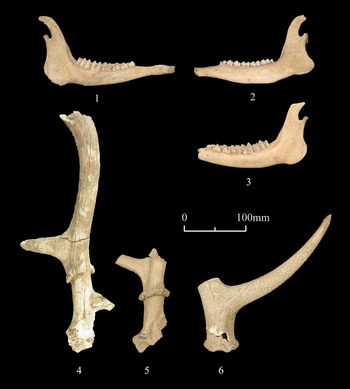
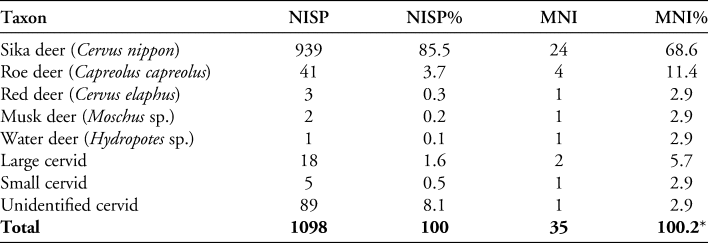
Excluding worked bones, wild taxa account for 15.2 per cent of animal remains from Zaoshugounao by NISP (number of identified specimens) (Li et al. Reference Li, Zhang, Wang, Dou, Liu, Hou, Ma, Qian and Chen2020). Deer (NISP = 1098), including sika deer, red deer, roe deer, musk deer, water deer and other unidentified deer species, constitute the largest proportion of wild animals (NISP = 1299) (Table 1). Over 80 per cent of the deer remains are sika deer (NISP = 939), represented by an MNI (minimum number of individuals) of 24 (Figure 2). All sika deer remains are from domestic contexts (e.g. pits and ditches) and are generally well preserved, exhibiting little taphonomic deterioration from weathering (4.5 per cent of the assemblage), carnivore chewing (5.4 per cent), rodent gnawing (3.0 per cent) or burning (0.2 per cent).
Sika deer mandibles with preserved teeth (1–3), and antlers (4–6) from Zaoshugounao (figure by Y. Han).

NISP and MNI of deer remains from Zaoshugounao (excluding worked bones).

* Due to rounding, the total MNI is greater than 100.0%.
Age structure
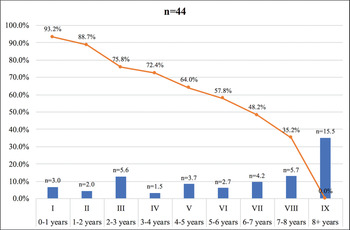
A total of 44 sika deer mandibles with at least one surviving tooth were available for age estimation. A single age stage was assigned to 38 specimens, and multiple age stages were assigned to the remaining six examples (see Table S1 in the online supplementary material (OSM)). The results show that sika deer of various ages were hunted at Zaoshugounao, although more than three-quarters (75.8 per cent) of the sika deer examined were over three years of age, with 35.2 per cent of these over eight years of age (Figure 3). Based on age and body weight, Miura and Tokida (Reference Miura, Tokida, McCullough, Takatsuki and Kaji2009) have divided the life cycle of sika deer into five stages, namely calf (~0–1 years), yearling (~1–2 years), juvenile (~2–3 years), adult (~3–10 years) and senescent (~10+ years). Thus, the majority of sika deer hunted at Zaoshugounao were adult or senescent individuals.
Mortality profile and survivorship curve from sika deer teeth from Zaoshugounao (figure by Y. Li).

Bone epiphyseal fusion data are available for 157 post-cranial skeletal elements (Table S2). These show that only a minority of sika deer in the Zaoshugounao assemblage were killed at less than five years of age. While more sika deer were harvested at five to six years old, about 80 per cent were over six years of age. Thus, bone epiphyseal fusion data are consistent with our age assessments based on tooth eruption and wear.
Sex distribution and season of death
A total of 29 crania were sufficiently well preserved for sex estimation. We identified 28 males from this assemblage based on the presence of antlers—either complete or broken. Only one specimen was identified as female. It is possible, however, that some specimens were from the same individual, thus biasing our results. In terms of seasonality, we identified 25 non-naturally shed antlers, indicating that these individuals were most likely hunted in autumn and winter (Goss Reference Goss1961; Feldhamer Reference Feldhamer1980; Miura Reference Miura1984; Qin Reference Qin1994). We also identified 15 shed antlers, although we do not know when they were collected by the Zaoshugounao residents. The presence of newly growing antlers or coronets with traces of shed antlers would indicate hunting in summer, but there were no such specimens in our assemblage.
Discussion
The adult-dominated age profile for sika deer at Zaoshugounao probably results from an ‘antler-oriented’ hunting strategy. Indeed, more than 200 artefacts, comprising one-third of all worked bones and antlers retrieved from Zaoshugounao, were made of deer antler (mostly arrowheads and awls) (Li et al. Reference Li, Zhang, Wang, Dou, Liu, Hou, Ma, Qian and Chen2020). Most arrowhead production debris is identified as sika deer antler, and sikas comprise the largest proportion of deer remains (by NISP) at the site. We therefore believe that most of the antler products were made from sikas, suggesting their central importance in bone-artefact production at Zaoshugounao. Moreover, we cannot exclude the possibility that velvet antlers were exploited at the site, even though the precalcified stage of antler growth may not be represented on archaeological antler specimens. There is a long tradition in China of using velvet antlers for medicinal purposes with the earliest textual records dating back 2000 years (Song & Liu Reference Song and Liu2005; Wu et al. Reference Wu, Li, Jin, Li, Ma, You, Li and Xu2013). Research on modern farmed sikas in north-eastern and southern China suggests that the yield of velvet antlers increases with age, peaking at seven to eight years of age (Zhao et al. Reference Zhao, Chen, Zhang, Chai, Ding, Zhang and Liu1991; Zeng et al. Reference Zeng, Chen, Yang and Zhou2002). Assuming that modern rearing techniques have not significantly altered the physiological mechanism of antler growth, the focused culling of older sika deer at Zaoshugounao may have been associated with the acquisition of velvet antlers.
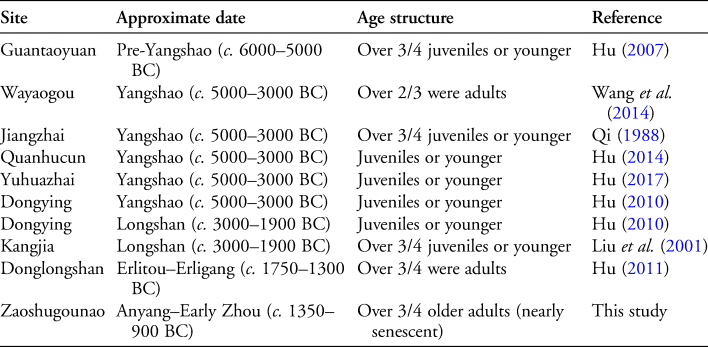
A review of sika deer age data from other archaeological sites in the Guanzhong region yields informative results regarding variations in hunting strategies over time, although in many cases the number of specimens available for age estimation is fewer than ten (Table 2). For consistency, we regroup these data following the age divisions proposed by Miura and Tokida (Reference Miura, Tokida, McCullough, Takatsuki and Kaji2009). At all Neolithic (i.e. pre-Yangshao to Longshan periods, 6000–1900 BC) sites (except Wayaogou), juveniles or younger sikas dominate the assemblages. In comparison, most sika from Bronze Age contexts were killed in adulthood. Hence, there was a general transition in sika deer-hunting strategies in the Guanzhong region, from a focus on young sikas towards a preference for adults. Deer constituted an integral part of human diets in Neolithic northern China (Yuan Reference Yuan1999), and the shorter age range of hunted sika deer assemblages in Neolithic Guanzhong reflects a higher demand for venison, as young deer yield better quality meat (Stevenson-Barry et al. Reference Stevenson-Barry, Drew, Duncan and Littlejohn1999). The development of crop cultivation (e.g. millets) and animal husbandry (e.g. pigs and, later, cattle and caprines) during the Yangshao and Longshan periods in the Guanzhong region provided more stable sources of food (Liu & Chen Reference Liu and Chen2012; Li Reference Li and Underhill2013; Wang et al. Reference Wang, Qian and Liu2013; Zhu Reference Zhu and Underhill2013; Shelach-Lavi Reference Shelach-Lavi2015; Qu et al. Reference Qu, Hu, Yang and Cui2018), with a corresponding reduction in the exploitation of sika deer for meat.
Sika deer data from Neolithic and Bronze Age sites in the Guanzhong region.

While our analysis demonstrates a shift in the Guanzhong region from the exploitation of deer for their meat in favour of their antlers, the data from Zaoshugounao have further important implications. These suggest that the residents of the site preferred hunting older, male sikas in non-breeding and rearing seasons. The apparently small proportion of juveniles and younger sikas in the assemblage provides little evidence for intensification of sika deer exploitation. The absence of a focus on adult females suggests that sika deer hunting at Zaoshugounao did not disrupt their reproduction. Compared with sika deer hunting during earlier periods in the Guanzhong region, the exploitation strategies used at Zaoshugounao were potentially sustainable. Even if the Zaoshugounao residents were not consciously hunting sika deer in a sustainable manner, their preferred strategy may have indirectly helped to sustain the sika deer population. Indeed, human intentionality is often implicitly embedded in the concept of the sustainable use of wild animals (Emery & Brown Reference Emery, Brown, Chacon and Mendoza2012).
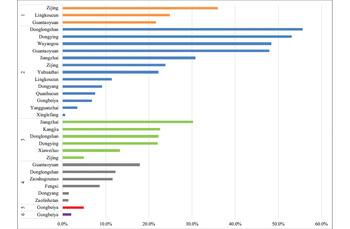
Available NISP data (for references, see Table S3) reveal a decrease in sika deer in animal assemblages from archaeological sites in the Guanzhong region over six millennia (Figure 4). While this trend could be explained by a decline in the demand for sika deer meat, as discussed above, different lines of evidence may point to an alternative explanation. Palaeoenvironmental and historical geography research suggests that, before the late first millennium BC, the Guanzhong region was covered by extensive temperate, broad-leaf deciduous forests and woodlands (Wang Reference Wang2005), which provided a suitable habitat for sika deer. This landscape has since been repeatedly transformed by human population growth, land-use intensification and other anthropogenic and natural effects (Wang Reference Wang2005). Although zooarchaeological data from sites post-dating the Zhou period are fragmentary, textual accounts concerning encounters with and hunting wild sika deer in northern China gradually decreased in number (Wang Reference Wang2002). Today, sika deer are rarely sighted in the wild in the Guanzhong region. In short, there was an overall decline in the wild sika deer population and a contraction of suitable habitats across the millennia in the Guanzhong region. The Zaoshugounao evidence suggests that habitat fragmentation and population decline in wild species over a long period in the region may have been intertwined with sustainable exploitation practices that either intentionally or epiphenomenally contributed to the reproduction of otherwise declining wild animal numbers.
The proportion of sika deer (by NISP) in animal assemblages from archaeological sites in the Guanzhong region: 1) pre-Yangshao period (c. 6000–5000 BC); 2) Yangshao period (c. 5000–3000 BC); 3) Longshan period (c. 3000–1900 BC); 4) Erlitou-Western Zhou period (c. 1900–771 BC); 5) Eastern Zhou period (c. 770–256 BC); 6) Qin-Western Han period (c. 221 BC– AD 8) (figure by Y. Li).

Conclusion
Our zooarchaeological data suggest that sika deer exploitation at Zaoshugounao was focused on the acquisition of antlers. This ‘antler-oriented’ strategy was potentially sustainable, as it was less harmful to the reproduction rate of sika deer, even if this was not an intentional strategy or outcome of the site's population. Although the past few millennia have seen a continuous decline in wild sika deer populations, along with habitat loss in the Guanzhong region, this does not necessarily mean that the history of sika deer exploitation in this region is characterised by unsustainability. It is important that we consider the complexity and diversity of wild animal exploitation strategies. While this research builds on the results from a single site, in its regional context, we demonstrate how we can achieve a better understanding of the exploitation and sustainability of wildlife in the context of human history, and of issues surrounding the extirpation and conservation of wild animal species in China.
Acknowledgements
All zooarchaeological remains recovered from excavations at Zaoshugounao are housed in the Zooarchaeology Laboratory at the School of Cultural Heritage, Northwest University, Xi'an, P.R. China. We would like to thank Huan Liu, Furen Hou, Duo Tian, Xiaoyang Li, Yifu Han and Zexian Huang for their help with data collection and photographs. We are also grateful to the two anonymous reviewers for their insightful comments and suggestions.
Funding statement
This research was supported, in part, by the National Social Science Fund of China (grant 18CKG024) and the Young Scholar Professional Support Program of Northwest University.
Supplementary material
To view supplementary material for this article, please visit https://doi.org/10.15184/aqy.2021.75.