Introduction
Cannabis is the most commonly used illicit drug among patients diagnosed with schizophrenia (Koskinen et al. Reference Koskinen, Lohonen, Koponen, Isohanni and Miettunen2010). Not surprisingly, the relationship between cannabis use and schizophrenia has been investigated extensively (van Os et al. Reference van Os, Kenis and Rutten2010). However, although the relationship between cannabis use and the development of psychotic symptoms is well established (Foti et al. Reference Foti, Kotov, Guey and Bromet2010; Kuepper et al. Reference Kuepper, van Os, Lieb, Wittchen, Hofler and Henquet2011), less is known about the effect of cannabis cessation or continuation after illness onset.
Several retrospective studies in patients with psychosis have examined changes in symptom severity after discontinuation of cannabis use (Negrete & Knapp, Reference Negrete and Knapp1986; Martinez-Arevalo et al. Reference Martinez-Arevalo, Calcedo-Ordonez and Varo-Prieto1994; Maremmani et al. Reference Maremmani, Lazzeri, Pacini, Lovrecic, Placidi and Perugi2004; Hinton et al. Reference Hinton, Edwards, Elkins, Harrigan, Donovan, Purcell and McGorry2007; Baeza et al. Reference Baeza, Graell, Moreno, Castro-Fornieles, Parellada, Gonzalez-Pinto, Paya, Soutullo, de la Serna and Arango2009). In most of these studies, continuation of cannabis use was associated with more positive and general symptoms and lower overall functioning as compared with patients who discontinued their use (Hinton et al. Reference Hinton, Edwards, Elkins, Harrigan, Donovan, Purcell and McGorry2007; Baeza et al. Reference Baeza, Graell, Moreno, Castro-Fornieles, Parellada, Gonzalez-Pinto, Paya, Soutullo, de la Serna and Arango2009; Mullin et al. Reference Mullin, Gupta, Compton, Nielssen, Harris and Large2012). Surprisingly, discontinuation of cannabis use was only associated with a decline in positive symptoms and improvement in global functioning and mood in first-episode patients (FEP), but not in patients with a more established psychotic illness (Mullin et al. Reference Mullin, Gupta, Compton, Nielssen, Harris and Large2012). This may imply that discouraging cannabis use in the first phase of psychotic disorders is particularly important, as cessation during this phase might still help in reversing its long-term negative consequences.
This hypothesis is supported by the few prospective studies that have investigated the effect of discontinuation of cannabis use in the first phase of the illness. While results on the short term are conflicting (Baeza et al. Reference Baeza, Graell, Moreno, Castro-Fornieles, Parellada, Gonzalez-Pinto, Paya, Soutullo, de la Serna and Arango2009; Gonzalez-Pinto et al. Reference Gonzalez-Pinto, Alberich, Barbeito, Gutierrez, Vega, Ibanez, Haidar, Vieta and Arango2011; Faber et al. Reference Faber, Smid, Van Gool, Wunderink, van den Bosch and Wiersma2012), cessation of cannabis use after the first psychotic episode has found to be related to better symptomatic outcome (Grech et al. Reference Grech, Van Os, Jones, Lewis and Murray2005; Gonzalez-Pinto et al. Reference Gonzalez-Pinto, Alberich, Barbeito, Gutierrez, Vega, Ibanez, Haidar, Vieta and Arango2011; Clausen et al. Reference Clausen, Hjorthoj, Thorup, Jeppesen, Petersen, Bertelsen and Nordentoft2014) and fewer psychotic relapses in the longer term (Hides et al. Reference Hides, Dawe, Kavanagh and Young2006).
Results of studies in patients with an established psychotic disorder are less consistent. Increased cannabis use has been related to small increases in psychotic symptoms in one (Degenhardt et al. Reference Degenhardt, Tennant, Gilmour, Schofield, Nash, Hall and McKay2007), but not in another study (Barrowclough et al. Reference Barrowclough, Emsley, Eisner, Beardmore and Wykes2013). The latter study did, however, show an association between increased cannabis use and lower global functioning (Barrowclough et al. Reference Barrowclough, Emsley, Eisner, Beardmore and Wykes2013). In the one study examining the association between cannabis use and relapse in a chronic sample, a relationship was not found (Caseiro et al. Reference Caseiro, Perez-Iglesias, Mata, Martinez-Garcia, Pelayo-Teran, Tabares-Seisdedos, Ortiz-Garcia de la Foz, Vazquez-Barquero and Crespo-Facorro2012).
In the largest sample to date, we aimed to gain more insight into the long-term effect of cannabis use in patients who entered the study within the first 10 years of their psychotic illness. To investigate the relationship between the course of cannabis use and clinical outcome (symptom severity, global functioning and number of relapses) we combined retrospective data on cannabis use before baseline with prospective data on cannabis use from baseline onwards. We compared patients who used cannabis before baseline and who persisted their cannabis use during 3-year follow-up, patients who discontinued their use and patients who never used cannabis. Unlike previous studies that examined never, persistent and discontinuing users, we also evaluated the course of a fourth group, the ‘recently started cannabis users’, referring to individuals who started using cannabis after psychosis onset. This fourth group may provide us with better understanding of the (direct) influence of cannabis use on already existing psychotic symptoms and clinical outcome.
In addition, elaborating on the work of Mullin et al. (Reference Mullin, Gupta, Compton, Nielssen, Harris and Large2012), we explored whether early cannabis discontinuation (i.e. within the first 4 years after psychosis onset) was associated with larger improvement in positive, negative and general symptoms and global functioning, compared with late cannabis discontinuation (>4 years after psychosis onset).
Method
Participants
Data pertain to baseline and 3-year follow-up measures of GROUP (Genetic Risk and Outcome of Psychosis), a longitudinal multi-center study in the Netherlands and Belgium (Korver et al. Reference Korver, Quee, Boos, Simons and de Haan2012). In selected representative geographical areas patients were identified through clinicians working in psychotic disorder services whose caseloads were screened for individuals meeting the inclusion criteria. Additionally, a group of patients presenting consecutively at these services as either out-patients or in-patients was recruited for the study. Inclusion criteria were: (1) being aged between 16 and 50 years; (2) having a diagnosis of non-affective psychotic disorder according to the Diagnostic and Statistical Manual of Mental Disorders, fourth edition (DSM-IV) criteria (APA, 2000); (3) having good command of the Dutch language; and (4) being able and willing to provide written informed consent. The non-affected psychotic disorder was assessed with the Comprehensive Assessment of Symptoms and History (CASH; Andreasen et al. Reference Andreasen, Flaum and Arndt1992) or the Schedules for Clinical Assessment for Neuropsychiatry version 2.1 (Wing et al. Reference Wing, Babor, Brugha, Burke, Cooper, Giel, Jablenski, Regier and Sartorius1990). In the present study, patients who missed data on cannabis use at baseline and/or 3-year follow-up (due to missing interviews and/or drop-out) were excluded. The study protocol was approved centrally by the Ethical Review Board of the University Medical Center Utrecht and subsequently by local review boards of each participating institute. All subjects gave written informed consent in accordance with the committee's guidelines. For a more detailed overview of the study protocol, see Korver et al. (Reference Korver, Quee, Boos, Simons and de Haan2012).
Assessment of cannabis use
Substance use (including cannabis, other illicit drugs and alcohol) was assessed by means of the Comprehensive International Diagnostic Interview (CIDI; World Health Organization, 1990).
Patients were classified into one of four groups according to their cannabis use:
-
(1) Persistent cannabis users – patients who had used cannabis more than five times lifetime prior to baseline and more than five times between baseline and the 3-year follow-up;
-
(2) Recently started cannabis use – patients who had not used cannabis lifetime prior to baseline but did use cannabis more than five times between baseline and the 3-year follow-up;
-
(3) Discontinued cannabis users – patients who had used cannabis more than five times lifetime prior to baseline but who did not use cannabis at all during the 3-year follow-up;
-
(4) Non-users – patients who had never used cannabis.
In addition to the assessment of the CIDI, urine was screened at baseline and at the 3-year follow-up for cocaine, amphetamine/ecstasy and cannabis to verify self-report on cannabis use. Patients whose urinalysis differed from self-report were excluded from the analyses.
Subsequently, we created two groups based on cessation of cannabis use early or late in the course of the disease. Patients with recent-onset psychosis who had discontinued their use at the 3-year follow-up were classified as ‘early discontinuers’ and discontinued cannabis users without a recent-onset psychosis were classified as ‘late discontinuers’. Recent-onset psychosis was defined by a history of a single psychotic episode and illness duration of <1 year at baseline assessment.
Assessment of symptoms
The Positive and Negative Syndrome Scale (PANSS; Kay et al. Reference Kay, Fiszbein and Opler1987) was administered to measure severity of a variety of symptoms, including psychotic symptoms. The PANSS consists of three subscales: positive syndrome scale, negative syndrome scale and general psychopathology scale. In our analyses we used the weighted averages sum scores of the subscales of the PANSS to calculate the difference between baseline and the 3-year follow-up.
Global functioning was assessed with the Global Assessment of Functioning (GAF) scale (Jones et al. Reference Jones, Thornicroft, Coffey and Dunn1995). The GAF contains two subscales: an assessment of symptoms and of disability. Both subscales range from 0 (reflecting severe disability) to 100 (reflecting no disability).
Information about psychotic relapse between baseline assessment and the 3-year follow-up was obtained by asking the patients and by checking medical records. Psychotic relapse was defined according to the following criteria: hospitalization for psychosis and/or a score of 2 or higher according to the CASH (Andreasen et al. Reference Andreasen, Flaum and Arndt1992) (indicating mild but unmistakably present) on the following symptoms: delusions, hallucinations and/or disorganization during the previous 3 years.
For details regarding training, retraining and inter-rater reliability for the different instruments, see Korver et al. (Reference Korver, Quee, Boos, Simons and de Haan2012).
Statistical analyses
Baseline differences in demographic and clinical characteristics between the four patient groups, based on (course of) cannabis use, were tested by means of one-way analysis of variance, Kruskal–Wallis tests and χ2 tests. A p value of 0.05 was considered statistically significant.
The associations between patterns of cannabis use and symptoms, global functioning and relapse were assessed by means of linear mixed-model analyses. In a first step we built separate fixed-effect regression models with each symptom and functional outcome variable as the dependent variable. The cannabis group (persistent, recently started, discontinued and non-user) was entered as a fixed variable.
In the second step, age, gender, use of other substances, alcohol use and baseline clinical outcome measures were added as potential confounders (Zammit et al. Reference Zammit, Moore, Lingford-Hughes, Barnes, Jones, Burke and Lewis2008) into the model. All analyses were performed with SPSS (version 20.0, USA).
Results
Sample characteristics
From 1100 patients included in GROUP, 418 patients (38.0%) were excluded because data on cannabis use at baseline and/or follow-up were missing (i.e. missing interviews at baseline and/or follow-up). Additionally, four patients were excluded because urinalysis differed from self-report cannabis use. Excluded patients differed significantly on the PANSS positive scale (F 1,1040 = 13.064, p < 0.001, d = 0.24), PANSS negative scale (F 1,1039 = 9.922, p = 0.002, d = 0.81), PANSS general scale (F 1,1039 = 16.673, p < 0.001, d = 1.03), GAF symptoms (F 1,985 = 9.726, p = 0.002, d = 0.91) and GAF disability (F 1,985 = 13.573, p < 0.001, d = −0.24), with higher symptoms and worse functioning for the excluded sample, except for GAF disability. The groups did not differ significantly in terms of age, gender, use of antipsychotic medication and number of psychotic episodes before inclusion.
The majority of the 678 subjects with baseline and follow-up measures were male (75.4%) and the mean age was 27.4 (s.d. = 7.24) years. Of the subjects, 146 were persistent cannabis users (21.5%), 266 discontinued cannabis use during follow-up (39.2%), nine started using cannabis after study onset (recently started cannabis use; 1.3%) and 257 reported to have never used cannabis in their lives (non-users; 37.9%).
The majority of persistent users reported to have used cannabis on a daily or weekly basis in the year prior to baseline assessment [daily/weekly, n = 119 (81.5%); less than weekly, n = 27 (18.5%)]. Most of them continued their frequent use up to the 3-year follow-up time point [daily/weekly, n = 106 (72.6%); less than weekly, n = 40 (27.4%)]. Of the discontinued users, 85 patients (32.0%) still used cannabis in the 12 months prior to baseline [daily/weekly, n = 49 (18.4%); less than weekly, n = 36 (13.5%)]. The remaining 177 discontinued users (66.5%) used cannabis in their lifetime, but not in the year prior to baseline [daily/weekly, n = 128 (48.1%); less than weekly, n = 49 (18.4%)].
All recently started cannabis users used cannabis for the first time after baseline assessment and used at least five times in the 12 months prior to the 3-year follow-up assessment. Six of them (66.6%) used daily or weekly and three (33.3%) used less than weekly.
Baseline demographic characteristics
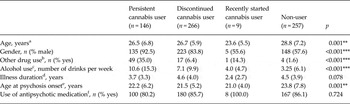
As can be seen in Table 1, the four cannabis groups differed significantly in terms of age and age of psychosis onset (F 3,674 = 5.390, p = 0.001; F 3,657 = 5.716, p = 0.001, respectively), with the recently started user group being younger and having an earlier onset of the first psychotic episode. Also a significant between-group difference was found in alcohol use (F 3,659 = 16.717, p < 0.001). The persistent cannabis user group reported more alcohol use as compared with recently started users and non-users. Both gender and use of other drugs were unequally distributed over the cannabis status groups [χ2 (3, n = 678) = 0.342, p < 0.001; χ2 (3, n = 670) = 0.415, p < 0.001, respectively]. The persistent cannabis users were more often male and more often used other drugs as compared with the rest of the sample.
Baseline demographic characteristics (n = 678)

Data are given as mean (standard deviation) unless otherwise specified.
a Age range 15–54 years.
b Data were missing for eight subjects.
c Alcohol use range 0–100 drinks per week. Data were missing for 15 subjects.
d Illness duration range 0.02–26.07 years. Data were missing for 29 subjects.
e Age at psychosis onset range 8–50 years. Data were missing for 17 subjects.
f Data were missing for 150 subjects.
** p < 0.005, *** p < 0.001.
Associations between cannabis course groups and baseline clinical characteristics
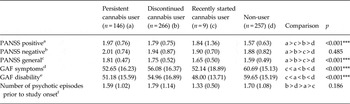
One-way analyses of variance showed between-group differences in nearly all clinical variables at baseline, except for PANSS negative symptoms and the number of experienced psychotic episodes (PANSS positive scale F 3,651 = 9.591, p < 0.001; PANSS general scale F 3,651 = 7.247, p < 0.001; GAF symptoms F 3,620 = 8.220, p < 0.001; GAF disability F 3,620 = 9.326, p < 0.001). Significantly higher symptom scores and lower functioning at baseline were found among persistent as well as recently started users compared with non-users. Baseline clinical characteristics are shown in Table 2.
Baseline clinical and functional outcome characteristics

Data are given as mean (standard deviation). PANSS scores are weighted averages sum scores.
PANSS, Positive and Negative Symptoms Scale; GAF, Global Assessment of Functioning.
a PANSS positive range = 1.00–4.00. Data were missing for 23 subjects.
b PANSS negative range = 1.00–5.57. Data were missing for 23 subjects.
c PANSS general range = 1.00–3.50. Data were missing for 23 subjects.
d GAF symptoms range = 10–100. Data were missing for 54 subjects.
e GAF disability range = 15–100. Data were missing for 54 subjects.
f Data were missing for 17 subjects.
*** p < 0.001.
Relationship between different patterns of cannabis use and functional outcome after the 3-year follow-up
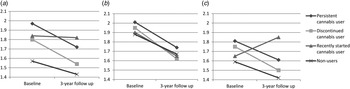
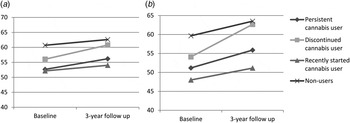
Controlling for baseline measures, we found overall significant differences between the cannabis status groups for all clinical outcome measures at the 3-year follow-up, except for the PANSS negative scale score (PANSS positive scale F 3,622 = 7.734, p < 0.001; PANSS general scale F 3,622 = 7.227, p < 0.001; GAF symptoms F 3,518 = 3.435, p = 0.017; GAF disability F 3,517 = 6.981, p < 0.001; number of psychotic episodes F 3,601 = 2.833, p = 0.038). Post-hoc tests for specific group differences are shown in Table 3. The differences over time in the PANSS positive, PANSS negative, PANSS general, GAF symptoms and GAF disability scores for all cannabis groups are shown in Figs 1 and 2.
Positive and Negative Symptoms Scale (PANSS) weighted averages. (a) Positive symptoms outcome by cannabis group; (b) negative symptoms outcome by cannabis group; (c) general symptoms outcome by cannabis group. PANSS scores are weighted averages sum scores. Means in figures are observed means.

General Assessment of Functioning Scale by cannabis group. (a) Symptoms outcome; (b) disability outcome. Means in figures are observed means.

Post-hoc results of mixed-model analyses: associations between patterns of cannabis use and clinical and functional outcome measures a

CI, Confidence interval; s.e., standard error; PANSS, Positive and Negative Symptoms Scale; GAF, Global Assessment of Functioning.
a Non-user is used as the reference category.
b PANSS scores are weighted averages sum scores.
c Corrected for age, gender, other drug use, alcohol use, age at psychosis onset and the baseline measure.
d Baseline measure = PANSS positive baseline.
e Baseline measure = PANSS negative baseline.
f Baseline measure = PANSS general baseline.
g Baseline measure = GAF symptoms baseline.
h Baseline measure = GAF disability baseline.
i Baseline measure = number of psychotic episodes between onset of the study and follow-up.
* p < 0.05, ** p < 0.005, *** p < 0.001.
Additionally, we analysed the potential moderating effect of frequency of cannabis use on clinical outcome for both the persisting users and the recently started users. For the recently started cannabis users, we found that frequency of cannabis use in the 3 years between baseline and the 3-year follow-up only had a moderating effect on the number of psychotic relapses. That is, in this group, daily or weekly cannabis use in the 3 years between baseline and the 3-year follow-up was significantly associated with more psychotic relapse (F 1,5 = 22.86, p = 0.005). However, the group that recently started using cannabis was small and the moderating effect of frequency in this group could therefore not be examined.
For the persistent users group, we found a moderating effect of frequency of cannabis use on GAF disability, with worse functioning for daily/weekly users (F 1,109 = 4.66, p = 0.033). However, we did not find significant associations for any other clinical outcome variable. Furthermore, we analysed the effect of frequency of cannabis use in the year prior to the 3-year follow-up with similar results (non-significant associations except for GAF disability: F 1,109 = 5.92, p = 0.017).
Difference between persistent cannabis users and discontinued cannabis users on clinical outcome after the 3-year follow-up
We subsequently focused in more detail on differences in clinical outcome at the 3-year follow-up between those who persistently used cannabis and those who had discontinued their cannabis use during follow-up. With the exception of PANNS negative symptoms, persistent users reported more symptoms and worse functioning as compared with the discontinuation group (PANSS positive scale F 1,403 = 8.04, p = 0.007, d = 0.28; PANSS general scale F 1,403 = 5.12, p = 0.024, d = 0.24; GAF symptoms F 1,355 = 6.195, p = 0.013, d = −0.28; GAF disability F 1,355 = 14.69, p < 0.001, d = −0.43; number of psychotic episodes F 1,390 = 5.51, p = 0.019, d = 0.24). Clinical outcome characteristics are shown in online Supplementary Table S1.
Difference between early and late discontinuation of cannabis use on clinical outcome after the 3-year follow-up
Finally, we examined whether early or late discontinuation of cannabis was associated with course of clinical outcome. From the 266 individuals who stopped using cannabis during follow-up, we could classify 257 patients according to timing of cannabis cessation. Among those, 47 patients stopped using cannabis within the first 3 years of psychosis onset and 210 patients stopped using cannabis later in the illness. We did not find significant differences between early versus late discontinuation on clinical outcome, although there was a non-significant tendency for worse clinical outcome for late discontinuation (for results, see online Supplementary Table S2).
Discussion
Main findings
In a large sample of patients diagnosed with a psychotic disorder, we prospectively examined the relationship between different patterns of cannabis use and clinical and functional outcome. Our results suggest that persistent cannabis use has an overall harmful effect. Patients who started using cannabis after baseline were characterized by less improvement over time compared with non-users.
Timing of cannabis cessation (i.e. early in the course of the disorder, versus later in the course of the disorder) was not significantly associated with clinical outcome. Importantly, our results suggest that the negative impact of cannabis use on the severity of symptoms may be reversible; discontinuation of cannabis use was associated with more improvement in positive symptoms, general symptoms and global functioning compared with continued use at any stage of the illness.
Persistent cannabis use
Patients who reported using cannabis at baseline and follow-up were characterized by more symptoms and lower functioning compared with the rest of the sample at both time points, which is in contrast to findings in studies of FEP, in which persistent users did not differ from non-users and discontinued users at baseline (Stirling et al. Reference Stirling, Lewis, Hopkins and White2005; Gonzalez-Pinto et al. Reference Gonzalez-Pinto, Alberich, Barbeito, Gutierrez, Vega, Ibanez, Haidar, Vieta and Arango2011). In our sample, we included both FEP and patients in a later stage of their psychotic disorder. A longer average history of cannabis use in our sample compared with FEP studies may have resulted in an increase in symptoms and decrease of functioning already present at baseline.
In congruence with Gonzalez-Pinto et al. (Reference Gonzalez-Pinto, Alberich, Barbeito, Gutierrez, Vega, Ibanez, Haidar, Vieta and Arango2011), our results indicate a decrease in positive symptoms over time for all groups. However, in line with Clausen et al. (Reference Clausen, Hjorthoj, Thorup, Jeppesen, Petersen, Bertelsen and Nordentoft2014), we found this improvement to be less substantial for persistent users compared with discontinued users and non-users. This is possibly due to direct psychotomimetic effects of recent cannabis use (D'Souza et al. Reference D'Souza, Perry, MacDougall, Ammerman, Cooper, Wu, Braley, Gueorguieva and Krystal2004), caused by increased striatal dopamine release (Howes et al. Reference Howes, Montgomery, Asselin, Murray, Valli, Tabraham, Bramon-Bosch, Valmaggia, Johns, Broome, McGuire and Grasby2009; Kuepper et al. Reference Kuepper, van Winkel and Henquet2013). This may also explain why in discontinued users the effect of cannabis use on positive symptoms is no longer recognizable. The persistent cannabis-using group reported significantly more relapses compared with both non-users and discontinued users. This finding is in concordance with Linszen et al. (Reference Linszen, Dingemans and Lenior1994) and Zammit et al. (Reference Zammit, Moore, Lingford-Hughes, Barnes, Jones, Burke and Lewis2008), who also found cannabis use to be associated with increased relapse or rehospitalization and in concordance with Hides et al. (Reference Hides, Dawe, Kavanagh and Young2006) who found continued users to have a higher rate of psychotic relapse. Furthermore, all groups (except for the recently started users) improved on general symptoms and overall functioning, but again the persistent users improved less substantially compared with discontinued users and non-users. These results further emphasize the negative longer-term effect of cannabis on outcome.
Findings regarding the relationship between cannabis use and negative symptoms are less clear. Some previous studies found that especially persistent users tended to report more negative symptoms in the long term (Gonzalez-Pinto et al. Reference Gonzalez-Pinto, Alberich, Barbeito, Gutierrez, Vega, Ibanez, Haidar, Vieta and Arango2011), while FEP studies found fewer negative symptoms in cannabis users compared with non-users (Burns et al. Reference Burns, Jhazbhay and Emsley2010). Of note, these studies only reported differences on a trend level. In the present study, no specific associations between cannabis use patterns and negative symptoms were found, which is in agreement with Clausen et al. (Reference Clausen, Hjorthoj, Thorup, Jeppesen, Petersen, Bertelsen and Nordentoft2014). Overall, this suggests that effects of cannabis on negative symptoms may not be as strong as previously thought.
Apart from the effect that cannabis has on the dopaminergic system, there may be several other explanations for the fact that especially continued cannabis use is associated with worse outcome: cannabis use has been associated with reduced effectiveness of antipsychotics (Knudsen & Vilmar, Reference Knudsen and Vilmar1984; Swartz et al. Reference Swartz, Wagner, Swanson, Stroup, McEvoy, Reimherr, Miller, McGee, Khan, Canive, Davis, Hsiao and Lieberman2008), less access to non-pharmacological interventions (Regier et al. Reference Regier, Farmer, Rae, Locke, Keith, Judd and Goodwin1990; Wilk et al. Reference Wilk, Marcus, West, Countis, Hall, Regier and Olfson2006), problems in therapeutic alliance (Dixon, Reference Dixon1999; Wilk et al. Reference Wilk, Marcus, West, Countis, Hall, Regier and Olfson2006) and early discharge from hospital independent of psychopathology (Brunette et al. Reference Brunette, Mueser, Xie and Drake1997). More research to disentangle these various explanations is needed.
Discontinued use
In our study, discontinued users were characterized by worse outcome compared with non-users. However, compared with persistent users, discontinued users showed more improvement in positive symptoms, general symptoms and global functioning (symptoms and disability). In addition, discontinued users had significantly fewer psychotic relapses compared with persistent users.
We could not demonstrate a significant association between timing of cannabis cessation and clinical outcome. Therefore, we cautiously imply that timing of cannabis cessation (early versus late cessation in the course of the disorder) does not play a crucial role in the extent to which symptoms could still diminish after cannabis cessation. Further research is needed to increase our knowledge concerning the influence of timing of discontinuation.
Recently started cannabis use
We found that patients who started using cannabis after first assessment did already function worse at baseline. Furthermore, the recently started user group was also the only group showing a further increase in general symptoms (including depression and anxiety) over time, even more than persistent users. This might be a result of their cannabis use, since cannabis with a high dose of Δ−9-tetrahydrocannabinol (THC), the type of cannabis most frequently used in the Netherlands (Pijlman et al. Reference Pijlman, Rigter, Hoek, Goldschmidt and Niesink2005), is known to be associated with an increase in anxiety and depression (Agosti et al. Reference Agosti, Nunes and Levin2002; Fergusson et al. Reference Fergusson, Horwood and Swain-Campbell2002; Rey & Tennant, Reference Rey and Tennant2002; Poulin et al. Reference Poulin, Hand, Boudreau and Santor2005). In turn, this increase in anxiety and depression could make patients more inclined to continue their cannabis use, since cannabis has an anxiolytic effect in the short term. Our results are concordant with the interpretation that a subgroup of patients starts using cannabis for reasons of self-medication after psychosis onset (Peralta & Cuesta, Reference Peralta and Cuesta1992).
Although this group is very small (n = 9) and our results should be interpreted with great caution, these results indicate that the onset of cannabis use, after a psychosis has occurred, may worsen clinical and functional outcome.
Limitations
Our findings should be interpreted in light of some limitations. First, although we corrected for the use of other illicit substances and alcohol abuse, it is possible that a group of ‘pure’ cannabis users would have shown different results with regard to clinical outcome. However, this study was designed to take place in a naturalistic context in which single drug use is exceptional and therefore a group of pure users would make generalization difficult. Subsequently, although our sample constitutes a clinically representative group, the study does not allow conclusions about the role of cannabis in specific stages of the illness. Second, we did not have information on the age of onset of cannabis use, prior to psychosis onset, and the exact time of cannabis cessation between baseline and the 3-year follow-up. Consequently, we cannot state with certainty that cannabis cessation precedes symptom reduction, or the other way round. Future studies are recommended to use more detailed information concerning timing of cannabis use in relation to symptom severity (both before and after the onset of psychosis), to better distinguish between the different patterns of cannabis use. Additionally, we recommend future studies to have more follow-up moments and shorter times between follow-ups, so that the timing of cannabis cessation can be better studied. This could help to further disentangle causality between the course of cannabis use and clinical outcome. Furthermore, although every classification is arbitrary, the CIDI uses a rather crude division for assessing cannabis use patterns (e.g. more than five times in the last 12 months/lifetime). Future studies are recommended to use a more continuous measure (e.g. number of times used, total amount used). Additionally, we could not differentiate between types of cannabis used, since this was not assessed. However, as stated above, cannabis with a high concentration of THC (skunk) is by far the most commonly use type of cannabis in the Netherlands (Pijlman et al. Reference Pijlman, Rigter, Hoek, Goldschmidt and Niesink2005) and we render it unlikely that variation in cannabis has largely affected our results. Both a continuous measure of cannabis use and type of cannabis use are needed to investigate possible dose–response effects. Since differences in dose–response have been found (Hides et al. Reference Hides, Dawe, Kavanagh and Young2006; Caseiro et al. Reference Caseiro, Perez-Iglesias, Mata, Martinez-Garcia, Pelayo-Teran, Tabares-Seisdedos, Ortiz-Garcia de la Foz, Vazquez-Barquero and Crespo-Facorro2012; Barrowclough et al. Reference Barrowclough, Emsley, Eisner, Beardmore and Wykes2013), this issue should be further addressed in future studies.
Furthermore, in the construction of our cannabis groups we did not take into account characteristics as early versus late onset of cannabis use and duration of use. Earlier studies found especially early onset of cannabis use (DeLisi, Reference DeLisi1992; Wade et al. Reference Wade, Harrigan, McGorry, Burgess and Whelan2007) and long-term cannabis use (Barbeito et al. Reference Barbeito, Vega, Ruiz de Azúa, Saenz, Martinez-Cengotitabengoa, González-Ortega, Bermudez, Hernanz, Corres and González-Pinto2013) to be associated with clinical outcome. It is possible that discontinuation in these patterns of cannabis use could have a different effect on clinical outcome. Future research should address this issue in more detail.
Moreover, other studies have shown that medication non-adherence is associated with relapse (Hides et al. Reference Hides, Dawe, Kavanagh and Young2006; Caseiro et al. Reference Caseiro, Perez-Iglesias, Mata, Martinez-Garcia, Pelayo-Teran, Tabares-Seisdedos, Ortiz-Garcia de la Foz, Vazquez-Barquero and Crespo-Facorro2012; Barrowclough et al. Reference Barrowclough, Emsley, Eisner, Beardmore and Wykes2013). In our sample, use of antipsychotic medication did not differ between the cannabis groups. However, future studies should take into account more elaborate assessment of medication as well as medication adherence. Furthermore, illness insight could be taken into account in future research, since this has been associated with outcome in psychosis (Lincoln et al. Reference Lincoln, Lullmann and Rief2007).
Lastly, loss to follow-up was larger for individuals with a more severe disorder, which could have distorted our results.
These limitations notwithstanding, our study allowed us to expand on existing literature by following a large cohort of patients with a non-affective psychotic disorder and by evaluating the course of the disorder in recently started users. To our knowledge, this is the largest study to date prospectively investigating the course of cannabis use in patients with non-affective psychotic disorders. Furthermore, because of the naturalistic nature of our study, results can be generalized to patients seen in everyday practice.
Clinical implications
Our findings have implications for treatment approaches, in particular with regard to psycho-education. Our results indicate that an important focus should be on the association between different patterns of cannabis use and clinical outcome. Better-grounded and individually tailored advice on the possible consequences of cannabis use, collaborative explorations of both reasons for cannabis use and obstacles for quitting may all contribute to the intrinsic motivation for patient to discontinue their cannabis use. In two recent studies, Smeerdijk et al. (Reference Smeerdijk, Keet, Dekker, van Raaij, Krikke, Koeter, de Haan, Barrowclough, Schippers and Linszen2012, Reference Smeerdijk, Keet, de Haan, Barrowclough, Linszen and Schippers2014) showed that it is feasible to teach motivational interviewing to parents of persistently cannabis-using patients with schizophrenia. Motivational interviewing is a well-studied method to overcome resistance and increase the motivation to change substance use (Hettema et al. Reference Hettema, Steele and Miller2005) and is one of the most promising approaches for the treatment of co-morbid cannabis use in psychotic patients (Baker et al. Reference Baker, Hides and Lubman2010). Our results emphasize the significance of ongoing research into interventions aimed at the reduction of cannabis use in patients with schizophrenia and related disorders.
Conclusions
The results of our study suggest that while cannabis has an overall harmful effect regardless of illness severity at baseline and illness duration, its effects vary depending on the long-term pattern of use.
Our results provide further evidence for the idea that cannabis use should be discouraged for all patients with a psychotic illness and that treatment should focus on reducing cannabis use or preventing novice cannabis use in these patients. Future research should focus in more detail on the long-term effects of different patterns of cannabis use and psychotic disorder, ideally in large prospective studies investigating the psychosis continuum.
Supplementary material
For supplementary material accompanying this paper visit http://dx.doi.org/10.1017/S0033291714003092
Acknowledgements
The infrastructure for the GROUP study is funded through the Geestkracht programme of the Dutch Health Research Council (ZON-MW, grant number 10-000-1001), and matching funds from participating pharmaceutical companies (Lundbeck, AstraZeneca, Eli Lilly, Janssen Cilag) and universities and mental health care organizations [Amsterdam: Academic Psychiatric Center of the Academic Medical Center and the mental health institutions GGZ Ingeest, Arkin, Dijk en Duin, GGZ Rivierduinen, Erasmus Medical Center, GGZ Noord Holland Noord; Maastricht: Maastricht University Medical Center and the mental health institutions GGZ Eindhoven en de kempen, GGZ Breburg, GGZ Oost-Brabant, Vincent van Gogh voor Geestelijke Gezondheid, Mondriaan Zorggroep, Prins Clauscentrum Sittard, RIAGG Roermond, Universitair Centrum Sint-Jozef Kortenberg, CAPRI University of Antwerp, PC Ziekeren Sint-Truiden, PZ Sancta Maria Sint-Truiden, GGZ Overpelt, OPZ Rekem; Groningen: University Medical Center Groningen and the mental health institutions Lentis, GGZ Friesland, GGZ Drenthe, Dimence, Mediant, GGNet Warnsveld, Yulius Dordrecht and Parnassia Psycho-Medical Center (The Hague); Utrecht: University Medical Center Utrecht and the mental health institutions Altrecht, GGZ Centraal, Riagg Amersfoort and Delta]. This work was supported by EU-GEI. EU-GEI is the acronym of the project ‘European Network of National Schizophrenia Networks Studying Gene–Environment Interactions’. The research leading to these results has received funding from the European Community's Seventh Framework Programme under grant agreement no. HEALTH-F2-2010-241909 (Project EU-GEI). J.M. has received funding from Top Institute Pharma (http://www.tipharma.nl; includes co-funding from universities, government and industry).
We are grateful for the generosity of time and effort by the patients and their families, healthy subjects, and all researchers who make this GROUP project possible.
Declaration of Interest
None.
Appendix: GROUP investigators
Richard Bruggeman, M.D., Ph.D., Department of Psychiatry, University Medical Center Groningen, University of Groningen; Wiepke Cahn, M.D., Ph.D., Department of Psychiatry, Rudolf Magnus Institute of Neuroscience, University Medical Center Utrecht; Lieuwe de Haan, M.D., Ph.D., Department of Psychiatry, Academic Medical Center, University of Amsterdam; René S. Kahn, M.D., Ph.D., Department of Psychiatry, Rudolf Magnus Institute of Neuroscience, University Medical Center Utrecht, Utrecht, the Netherlands; Carin Meijer, Ph.D., Department of Psychiatry, Academic Medical Center, University of Amsterdam; Inez Myin-Germeys, Ph.D., South Limburg Mental Health Research and Teaching Network, European Graduate School of Neuroscience (EURON), Maastricht University Medical Center; Jim van Os, M.D., P.hD., South Limburg Mental Health Research and Teaching Network, EURON, Maastricht University Medical Center, Maastricht, the Netherlands, and King's College London, King's Health Partners, Department of Psychosis Studies, Institute of Psychiatry, London, UK; and Durk Wiersma, Ph.D., Department of Psychiatry, University Medical Center Groningen, University of Groningen, Groningen, the Netherlands.