

The Xinjiang Uyghur Autonomous Region (XUAR) is located in the north-west of the People's Republic of China (PRC) and comprises one-sixth of the nation's total landmass. It is a diverse region of tall mountains and vast deserts. At the time of the latest national census in 2000 the Uyghur nationalityFootnote 1 made up 45 per cent of the population and the Han Chinese 41 per cent.Footnote 2 Both populations live predominantly in a string of oases around the arid Zhungar and Tarim Basins, although Han people are more concentrated in the north. Uyghurs are Turkic Muslims who are linguistically and culturally distinct from Han people.
Xinjiang is one of the least healthy regions in China. While the life expectancy in 2000 for the PRC was 69.63 years for men and 73.33 years for women (overall 71.4),Footnote 3 in the XUAR it was only 65.98 years for men and 69.14 years for women (overall 67.41).Footnote 4 The infant mortality rate (IMR) and maternal mortality ratio (MMR) also show a striking contrast between the XUAR and the rest of China. In 2000 the national IMR was 21.4 per 1,000, but in the XUAR it was 64.7 per 1,000.Footnote 5 This is the second highest rate in the country. The current national MMR (2006) is 56 per 100,000 births, but in Xinjiang it is nearly three times as high, at 161 per 100,000.Footnote 6
This health disparity seems to be more ethnic than regional. Disaggregated data for the XUAR reveal that there is a major divide between the health outcomes of the Uyghur and Han populations. While the IMR for Han in the XUAR is 13.1 per 1,000 – a figure that is lower than the national average – for Uyghurs it is 101.7 per 1000.Footnote 7 Differences in life expectancy are also extreme. The life expectancy at birth for Han people in China is 73.34 years, yet for Uyghurs in the XUAR it is 63 years, fully a decade less.Footnote 8
The causes of this divide are not immediately obvious, but analyses performed on data published by the Chinese government suggest that underlying health determinants such as socio-economic, cultural and historical factors may be to blame. This article will use regression analysis to question, analyse and evaluate correlations between health predictors, outcomes and nationality.
Public Health Indicators: Ethnicity or Residency?
All data for this analysis were taken from the China 2000 Population Assembly Census, the China and Xinjiang 2005 Statistical Yearbooks, and the China 2005 Yearly Macroeconomic Statistics. All calculations are original and were generated using the R statistical package. The dependent variable, or the public health indicator of interest, is the infant mortality rate (IMR). Data were logged into 96 rows according to county/township, and then classified according to development index.Footnote 9
Residency and IMR
Uyghurs are over-represented in rural areas and under-developed counties. The least developed regions of Xinjiang are 83–99 per cent Uyghur. Because rural areas in China have poorer health outcomes and lower levels of development when compared to urban centres, it seems possible that the disparity between Uyghur and Han people could be greatly explained by residency.
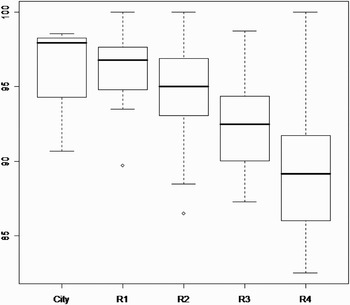
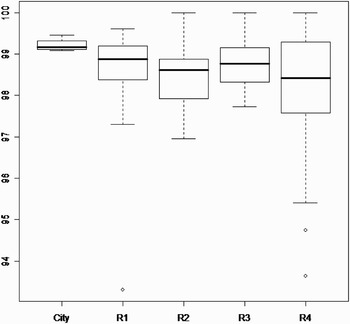
However, when infant survival is disaggregated by ethnicity and separated by region it suggests that while Uyghur population data may be related to residency, Han data are definitely not. The rate of infant survival among Uyghurs decreases steadily from the highly developed to the less developed regions (Figure 1), but there is only a negligible relationship between infant survival and residency among Han (Figure 2).
Uyghur Infant Survival by Region

Han Infant Survival by Region

Variation in Han infant survival among the five areas is only 8/1000 to 12/1000 at the top end and 9/1000 to 25/1000 at the bottom. There may be some benefit correlated with urban residency since Han infant survival in cities is very high and shows little variation. On the other hand, because there are only four counties in this calculation, this lack of variation is most likely to be the result of a small sample size.
Within the Uyghur population the dynamic is quite different. Averages of infant survival range from 55/1000 to 25/1000 in the cities to 140/1000 to 80/1000 in Rural 4. A downward trajectory from the city development index to Rural 4 is very clear.
Residency, education and unemployment
Data on education concur with this trend. Uyghur people are more likely to have no more than a primary education in less developed regions, but this regional effect is not evident for Han.Footnote 10 Similarly, although both groups have a much higher rate of tertiary education in urban areas, for Han people the effect of residency is not as strong as it is for Uyghur.Footnote 11 There is a slight tendency towards unemployment in less developed areas for both populations.
Linear Regression and the Linear Mixed Effect Model
Uyghur and Han populations in Xinjiang differ according to education, residency and employment. The first study question, therefore, is: are these differences correlated with poor health, and if so, will we still see a relationship between Uyghur nationality and the health indicator if we control for their effects?
To understand the effect these variables have on infant survival in Xinjiang the researcher ran a serious of linear and multiple regressions. The linear mixed effect model (lme), a more robust form of a basic multiple regression, was used to check those results. In addition to testing the degree of correlation between a dependent variable and a number of independent variables to determine the strength of the association, the lme equation controls for both a fixed effect and random effect. The random effect controls for the random and unknown differences that are inherent in any two independent populations, and the fixed effect controls for the cross-effects that result from the populations' interaction and co-residency. Before running the lme the researcher reshaped the dataset into 192 rows, each one comprising a combination of Han/Uyghur and region (City, Rural 1, 2, 3, 4). Doubling the number of rows gives more accuracy, and testing the groups (Han and Uyghur) separately allows the regression to calculate the degree of association that nationality has when compared to other variables.
The formula for the linear mixed effect model that controls for residency, employment and education and then tests for the relationship between the infant survival rate and nationality is:

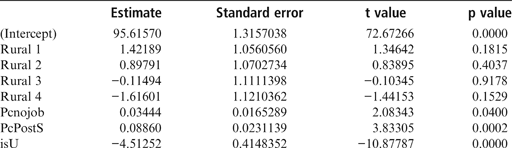
where PcStoL is the infant survival rate, PcPostS is the percentage of the population aged six and over who have tertiary education (either in a specialized secondary school, junior college, vocational school, university or graduate school), Pcnojob is the percentage of the population aged 15 and over who are unemployed, and isU is Uyghur nationality. The results of the lme are shown in Table 1.
PcStoL ~ U.R + PcPostS + Pcnojob + isU
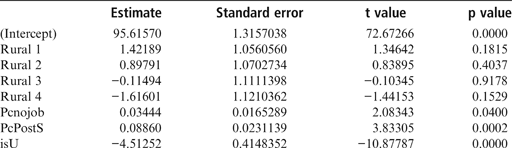
Note: Standard deviation ri: 0.0002223875 (estimate 2.565706).
The lme shows with 95 per cent confidence that the infant survival rate is highly dependent on Uyghur nationality and post-secondary education, and somewhat dependent on unemployment. When these results are compared to a standard linear regression there is very little difference, and the shift produced by the fixed effect is only marginal. This shows that the Han and Uyghur populations are highly segregated and do not influence one another's health to any significant degree.
Subsequent calculations of the same lme formula that replace PcPostS with pre-primary, primary, junior and secondary levels of education show significance only for primary (p = 0.0262) and secondary (p = 0.0387) education levels. The significance of primary and secondary education is much lower than that for post-secondary education. For all calculations, there is no relationship between the infant survival rate and residency.
The high proportion of Han people who have migrated to the XUAR or who live there temporarily may also account for some of the ethnic discrepancy. It is possible that long-term residency in Xinjiang is a risk factor that disproportionately affects the Uyghur people because they have been there longer.Footnote 12 According to linear regression output, the IMR is strongly correlated with the percentage of the population that is a migrant or temporary resident (p = 0.168), suggesting that residency in Xinjiang is an important factor. However, after controlling for nationality and re-running the regression, that correlation disappears and Uyghur nationality is again shown to be the primary risk factor.
The final variable that has a major impact on health is income. Because per capita income data disaggregated by nationality and region are not available for the XUAR, this study substitutes “quality of life” development indicators (access to running water, toilet and bath) as an approximate measure of economic status.
Residency should not affect any correlation between IMR and nationality because low economic status is not a county-specific phenomenon. Although rural incomes are typically lower than urban, the cost of living is much higher in urban areas and urban poverty is a growing concern throughout China. Lack of access to toilet facilities, for example, is evenly 38–40 per cent through the province (excluding two urban centres), with wide confidence intervals.
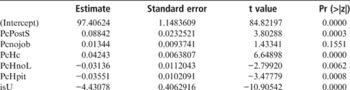
Using the linear mixed effect model to determine the relatedness of the socioeconomic variables on the IMR shows that reliance on coal, lack of a toilet and reliance on outside pit latrines are, at a high confidence level, predictors of low infant survival (all are p = 0.0000). Despite the strong relationship between use of coal fuel and pit latrines and Uyghur nationality (p = 0.0000), controlling for their effects still does not remove the effect that Uyghur nationality has on the IMR (p continues to be 0.0000).
Limitations
This preliminary data analysis has a number of limitations. First, the data may be flawed or incomplete. China is an enormous country and many international observers have questioned the accuracy of the published 2000 Census results.Footnote 13 Second, the proxy measures for income and living standard cannot fully substitute for true measures of economic status. A regression performed with income differentials could give a very different picture of the relationship between living standard and the IMR. Third, this analysis only uses one measure for population health. Although the IMR is generally an accurate indicator, it may lose its precision in this study because it attempts to evaluate populations with very different fertility rates.Footnote 14
Finally, there could be confounding variables that mask the relationship between a set of variables. For example, education and income are confounded to the extent that the lack of one will lead to the lack of the other. Residency and income/living standard have a similar connection because, although the cost of living in less developed areas is lower, their economies are generally poorer. Last, there could also be an unknown variable that is actually responsible for what appears to be a correlation between two other variables. For example, there may be some factor that, once calculated into the equation, would erase the nationality effect.
Conclusion
In conclusion, this multivariate statistical analysis contends that the difference in health outcomes between the Uyghur and Han populations is a result of differences in education (primarily tertiary education), income, living standard and nationality. Poor health is not dependent on urban/rural residency or long-term residency in Xinjiang, and it is only partially dependent on employment status. Most importantly, after controlling for all the variables that predict poor health (Table 2), the nationality effect does not disappear.
PcStoL ~ PcPostS + Pcnojob + PcHc + PcHnoL + PcHpit + isU

Notes: Standard deviation rij: 0.0001756633 (estimated 2.555682). PcHc: percentage of households using coal as primary fuel; PcHnoL: percentage of households without a toilet; PcHpit: percentage of households using an outside pit latrine.
Discussion
There is substantial evidence that the Uyghur people's poor health outcomes are tied directly to their ethnicity. Although rural status does play a role in public health, the relationship between rural status and health outcomes that is discernible among the Uyghur is not evident among the Han. This was clear in a fluorosis and dental caries study conducted in Wusu county, where Uyghur and Han children lived in the same place and attended the same school, yet Uyghur children ingested more fluoride and had more tooth decay than their Han classmates.Footnote 15
When calculated in a multiple regression, the only variables tied to public health are education, income and living standard, and Uyghur ethnicity. Among Uyghurs, poor education, high fertility and low income may persist in a mutually reinforcing pattern; more children supported with lower income derive lower education for all, and lower education results in lower income.
One of the most important findings of this study is the disparate correlation between residency, health predictors and outcomes: variables that appear correlated to residency for Uyghur people do not appear to be correlated among Han. There are two convincing explanations for this. First, the less-developed an area is the more rigid a Uyghur community's gender roles and norms are. Adolescent marriages, unequal access to nutritious foods and medical care, and women's decreased mobility and agency within and without the home may be largely responsible for the residency-dependent gradient that we see in public health outcomes. Second, it is possible that resource allocation differs between the two groups. Can it be the case that the quality of education and medical care is lower in majority-Uyghur areas? Regressive spending policies would not be visible in urban areas, where populations are mixed and there is a range of healthcare providers and schools to choose from, but they would have serious repercussions in rural communities whose choices and incomes are restricted.
China has seen astounding gains in public health since the founding of the People's Republic in 1949. In fact, the Chinese model is a frequently cited example of the social improvements that can be made in spite of a less-developed economy. Since the economic reforms of the early 1980s, however, the pace of these improvements has slowed and growing socio-economic disparities predict that stagnation, if not a reversal, in public health trends could be looming in the future.
Economic reform decreased social benefits and welfare schemes, encouraged competition and vitiated the progressive policies that had targeted the poorest regions for economic support. As a result of the ensuing socio-economic disparities, China is experiencing a boom in social problems: disillusionment and anger, corruption, crime, juvenile delinquency, social unrest, and a growing HIV epidemic. These social problems are inextricable from public health problems in that they weaken social and familial bonds and increase mortality, all-cause morbidity and stress.Footnote 16
The Chinese central government seems to be taking steps to improve this situation. The 11th Five-Year Plan (2006–10) includes public health provisions in its list of actions. In these five years the government plans to increase its share of overall healthcare expenditure, improve the public healthcare system, improve the sentinel surveillance system and disease prevention (especially HIV, schistosomiasis and hepatitis B), bolster maternal and child healthcare and community health services, reform the healthcare system and re-allocate healthcare resources, regulate the pharmaceutical sector, and aid the traditional Chinese medicine industry.Footnote 17
Although these initiatives are excellent and, if implemented, will have a great and positive impact on public health improvements, in light of this study it is worth questioning if the central government's emphasis on healthcare and disease prevention will be enough to overcome the ethnic imbalance in the Xinjiang Uyghur Autonomous Region. Because this health disparity is not a simple equation of rural versus urban and educated versus uneducated, it will require a more sophisticated and broad-based action plan to counteract it. Moreover, for such policies and interventions to be effective they will need to be based on a more in-depth study, and ideally on quantitative and qualitative surveys of population-size cluster samples.