Different strands of literature have established that violence has the power to shape people’s social and political preferences and behaviors. In the last decade, a rapidly growing body of research on the effects of wartime violence has established that exposure to violence can make people more cooperative and altruistic (see Bauer et al. Reference Bauer2016 for a meta-analysis). Similarly, a well-developed literature on political legacies has shown that experiences of violence can have a long-term impact on electoral behavior (Balcells Reference Balcells2012; Bellows and Miguel Reference Bellows and Miguel2009; Costalli and Ruggeri Reference Costalli and Ruggeri2019; Rozenas et al. 2017; Zhukov and Talibova Reference Zhukov and Talibova2018). In addition, an emerging field, the “politics of crime,” has found that victimization can shape policy preferences regarding how to combat crime (García-Ponce et al. 2018; Masullo and Morisi Reference Masullo and Morisi2019b; Visconti Reference Visconti2019). If exposure to violence has such power to transform peoples’ political preferences and behaviors, does variation in experiences of violence also translate into different attitudes toward peace?
This study explores this question in the context of Colombia’s 2016 peace referendum, in which a razor-thin majority opposed a peace agreement painstakingly reached by the government of Juan Manuel Santos (2010–18) and the Revolutionary Armed Forces of Colombia (FARC). The spatial pattern of the vote and the geographical variation in violence during the war offer a rich opportunity to explore whether different experiences of violence have a differential impact on attitudes toward peace.
Rather than looking at violence in general, we contend that the identity of the perpetrator—who shot the bullets—matters when it comes to the effect of exposure to violence on attitudes toward peace. We argue that civilians’ decisions about whether to support peace are guided by their desire to minimize post-agreement violence. In multiparty conflicts, when peace agreements involve some armed groups and not others, civilians’ expectations of post-agreement violence are shaped by an interplay between which armed group has been their main victimizer and which group is sitting at the negotiation table. When civilians have been victimized mostly by the group negotiating peace, support for the agreement will be higher, as they have good reason to believe that violence by that group will decrease. However, if their main victimizer is not sitting at the negotiating table, civilians not only lack reasons to believe that violence by that group will decrease, but they could also fear violent retribution for supporting peace with another faction. Consequently, support for the agreement will be lower among this subset of the population.
Our empirical analysis provides supporting quantitative and qualitative evidence for this argument. We find that support for the 2016 peace referendum in Colombia was conditional on who inflicted the harm: people living in areas mostly affected by FARC violence were more supportive of the peace deal, while support was lower among those inhabiting localities mostly affected by paramilitary violence. This finding holds against different model specifications and several robustness checks. Qualitative evidence from conflict-affected areas provides support for the internal logic of the proposed argument.
This study makes two core contributions. First, it shows that “who shot the bullets” matters, suggesting that a more disaggregated treatment of “violence” can help to further advance research on both the effects of exposure to violence and citizens’ support for peace. Second, it proposes a new relevant outcome—attitudes for peace—to be explored in the growing literature on the effects of exposure to violence. In doing so, and by proposing a theoretical explanation for why experiences of violence by different groups can have a differential effect on peace attitudes in multiparty conflicts, this study adds nuance to recent efforts to explain the unexpected outcome of Colombia’s 2016 peace referendum.Footnote 1 A better understanding of the determinants of support for peace is crucial for the prospects of securing peace in Colombia and in other countries transitioning from war to peace, as the successful implementation of peace agreements is likely to require high levels of public support and local buy-in (Hayes and McAllister Reference Hayes and McAllister2001; McKeon Reference McKeon, van Tongeren, Brenk, Hellema and Verhoeven2005; Nilsson Reference Nilsson2012).
The article first reviews broadly the literature on the link between exposure to violence and attitudes toward peace and summarizes the historical roots of the Colombian conflict and the political context in which the peace referendum took place. It then proposes a theoretical argument as to why the identity of the perpetrator should matter for attitudes toward peace, deriving and specifying observable implications for the Colombian case. Descriptions of the data and methodology, and the presentation and discussion of the main results of empirical analysis follow.
Exposure to Violence and Attitudes Toward Peace
The emerging literature on violence exposure and attitudes toward peace has so far yielded mixed results. On the one hand, several studies have contended that experiences of violence are central to understanding people’s attitudes toward peace. However, findings do not converge when it comes to the nature of the relationship. On the other hand, other studies have cast doubt on the centrality of exposure to violence all together.
Among the first group, some studies have found that violence reduces support for key dimensions related to peace and conflict termination. For example, Canetti et al. (Reference Canetti, Hall, Rapaport and Wayne2013) and Hirsch-Hoefler et al. (Reference Hirsch-Hoefler, Canetti, Rapaport and Hobfoll2016) found that in the Israeli—Palestinian conflict, individual-level exposure to violence has shifted people away from compromise and conciliatory policies. Similarly, studying Northern Ireland, Hewstone et al. (Reference Hewstone, Cairns, Voci, Hamberger and Niens2006) found that people who had negative experiences of “The Troubles” reported lower levels of forgiveness. In stark contrast, other studies have found that violence exposure can spur pro-peace attitudes. For example, Hazlett (Reference Hazlett2020) found that refugees from Darfur who were directly affected by the wave of violence in the early 2000s were less supportive of harsher punishment and more likely to believe that peace was possible. Still other studies have yielded mixed results. In the ethnic republics of the North Caucasus, for instance, Bakke et al. (Reference Bakke, John and Ward2009) found that while personal experiences of violence decreased people’s willingness to forgive, living in the proximity of communities with high levels of violent incidents made preferences for forgiveness more likely.
Among the second group, studies have contended that variables other than violence take the front seat when it comes to explaining attitudes toward peace. For example, focusing on the 2001 Macedonian civil conflict, Dyrstad et al. (Reference Dyrstad, Buhaug, Ringdal, Simkus and Listhaug2011) found that ethnicity trumped all other individual and contextual factors—including exposure to violence—in explaining people’s support for the Ohrid Framework Agreement, the deal that brought the conflict to an end. Exploring citizens’ attitudes toward peace in the Israeli-Palestinian conflict, Newman (Reference Newman2012) found that present conditions—largely related to lack of trust in Arab aspirations—rather than past experiences of conflict were what really helped to understand Israeli unwillingness to make concessions for peace.
Findings similarly conflict in the literature on the Colombian civil war. This became readily clear in the days immediately after the 2016 peace referendum, when analysts and scholars offered preliminary analysis of the spatial patterns of the vote. While some argued that support for the peace referendum was generally higher in war zones and that people who had suffered the most from violence tended to vote in favor of it (Fergusson and Molina Reference Fergusson and Molina2016), others contended that people living under the FARC’s control voted against the deal because strongly negative attitudes toward the group prevailed in these areas.Footnote 2 Still others insisted that the presence or absence of conflict was not a central factor explaining vote choice (Morelo Reference Morelo2016).
If we look beyond the referendum, evidence is equally conflicting. For example, analyzing the 2014 presidential elections, Weintraub et al. (2015) found that Juan Manuel Santos—the pro-peace candidate—performed well in communities with moderate levels of violence but poorly in communities with very high and low levels. Relying on 2014 AmericasBarometer survey data, which included a question about support for the then-ongoing peace process, Liendo and Braithwaite (2018) found that existing political preferences overwhelmingly drove attitudes toward the peace process with the FARC, not experiences of violence (see also Brodzinsky Reference Brodzinsky2016).
Not being able to adjudicate between these competing accounts is unfortunate, given the theoretical and policy importance of the debate. How can future research help overcome this impasse? We contend that one way forward is to further disaggregate the key terms of the relationship; that is, exposure to violence and peace. Some scholars have begun to disaggregate peace, finding that, for example, the peace agreement overall was more popular than some of its specific provisions (Matanock and Garbiras-Díaz Reference Matanock and Garbiras-Díaz2018; Tellez Reference Tellez2019a). However, few studies have attempted to unpack exposure to violence.Footnote 3 This study disaggregates exposure to violence by “who shot the bullets.” To be sure, we are not the first to examine the effects of perpetrator identity on civilian attitudes (see, e.g., Gallego Reference Gallego2018; Lupu and Wallace Reference Lupu and Wallace2019; Lyall Reference Lyall2010; Lyall et al. Reference Lyall, Blair and Imai2013). However, to the best of our knowledge, this is the first study to do so in the specific context of attitudes toward peace.
Context
The Colombian Civil War
The ongoing Colombian civil war dates back to the 1960s, being one of the longest in the world. Throughout the last five decades, the war has involved several active left-wing guerrilla groups, right-wing paramilitary armies, and the forces of the Colombian state. Throughout the 1970s and early 1980s, guerrilla groups managed to significantly expand their territorial control and notoriously increased their military capacity. Among the several guerrilla groups operating in the country, the FARC, founded in 1964, rapidly became the largest and most powerful.Footnote 4
The geographical expansion of guerrilla groups increasingly threatened the (largely economic) interests and security of local and regional elites. Tired of extortions, kidnappings, and assassinations, in the 1980s large landowners, cattle ranchers, agroexporters, and drug traffickers responded to the threat by setting up private self-defense armies.
Although initially organized as various independent local and regional units and coalitions, some of the most prominent of these armies unified under the umbrella of the United Self-Defense Forces of Colombia (AUC) in 1997. The AUC, a right-wing, anti-insurgent paramilitary federation of national scope, quickly became the FARC’s fiercest enemy. With the overt support of local and regional elites, and (sometimes) operating in collusion with the Colombian army, the AUC’s counterinsurgent campaign led to one of the bloodiest periods of the Colombian conflict (Romero Reference Romero2003).
Competing for civilian loyalties, armed groups fighting in the Colombian civil war have disproportionally victimized civilians. According to the National Center of Historical Memory, about two hundred thousand people were killed between 1958 and 2012, of whom over 80 percent were civilians (Centro Nacional de Memoria Histórica, CNMH 2013).Footnote 5 While every nonstate and state armed group has played its part in this bloody war, the FARC and the paramilitaries—especially the latter—have accounted for a disproportionate number of civilian casualties (Restrepo et al. Reference Restrepo, Spagat and Vargas2004).
In the mid-2000s, the AUC demobilized. However, the demobilization process spawned several smaller armed groups, known as criminal bands (BACRIM, from the Spanish bandas criminales), which are still active in various regions. Many BACRIM were formed by former AUC members and controlled some of the same areas the paramilitaries had held. Given these continuities, some analysts refer to them as neoparamiltiaries (Granada et al. Reference Granada, Restrepo, García and Aponte2009), and many civilians on the ground actually call them paracos (Colombian slang for paramilitaries).
These groups are mostly interested in profiting from illegal markets; they do not have a clear anti-insurgent agenda, and most lack the military capacity to directly confront larger armed groups. Nevertheless, to control the areas where their economic interests are settled, they have competed for civilian loyalties against other armed groups, including the FARC, and have recurrently used violence to ensure civilian collaboration and prevent defections. More important for this study, they have openly declared their opposition to the peace process (Arjona Reference Arjona2016a, 90).
The Peace Process with the FARC
During the eight years of the administration of Álvaro Uribe (2002–10), the Colombian military was able to severely weaken the rebels, undermining their military capacity and killing some of the organization’s most prominent leaders. Peace negotiations began when Uribe’s defense minister and successor, Juan Manuel Santos, took office in 2010.Footnote 6 Following secret rapprochements between the Santos government and a militarily weakened FARC, peace talks formally began in October 2012.
The intense negotiation process eventually led to the announcement of a bilateral ceasefire in June 2016. In September 2016, a final agreement was reached and signed. This included important provisions for a comprehensive rural reform, permission for the FARC to participate in elections, a strategy to curb coca cultivation and stop drug trafficking, and truth and justice for victims.Footnote 7
Santos called for a referendum to give Colombians the opportunity to directly ratify and legitimize the agreement. Despite polls predicting wide support for the agreement, Colombians rejected it by a razor-thin margin of 0.5 percent on October 2, 2016. Santos and the FARC returned to the negotiation table, revised the document, and signed an amended version in November 2016. Deciding against popular ratification this time, Santos finally passed the agreement through the Colombian Congress. Despite deep challenges in the implementation of the agreement, the end of the conflict with the FARC today seems irreversible: combatants have disarmed and demobilized, and the FARC has become a legal political party.
Paradoxically, the decision to have a democratic consultation to seal the deal provided a platform for elites seeking to upend the peace process (Matanock and García-Sánchez Reference Matanock and García-Sánchez2017), transforming the referendum campaign into “a battle of narratives between divided elites” (Matanock and Garbiras-Díaz Reference Matanock and Garbiras-Díaz2018, 15). In the runup to the referendum, while Santos and his national coalition strongly promoted the agreement, a political faction led by Uribe fiercely campaigned against it, framing the final agreement as excessively lenient with the FARC.
The promoters of “the No” criticized the agreement as being too indulgent and giving unjustified concessions to the rebels, charging that it promoted a culture of impunity. The opposition managed to frame the agreement successfully as a gift to the FARC, “rewarding” them for decades of war and violence. Voting in favor of it came to be seen, for many, as a signal of FARC support.
Given this intense campaign leading up to the referendum, the high levels of political polarization that characterized the peace process, and the complexity of the agreement (laid out in a three-hundred-page document), scholars have looked at how both the referendum campaign and the agreement’s design shaped people’s vote. In fact, some of the agreement’s provisions and concessions (Matanock and Garbiras-Díaz Reference Matanock and Garbiras-Díaz2018; Tellez Reference Tellez2019a) and the role of campaign information and arguments (Masullo and Morisi Reference Masullo and Morisi2019a) have been found to have shaped Colombians’ attitudes toward the peace agreement. This study takes a different perspective and explores whether exposure to violence shaped vote choice in the 2016 referendum. In particular, it investigates whether exposure to violence by the FARC—as opposed to violence by the paramilitaries and BACRIM—had an observable impact on vote choice.
The Identity of the Perpetrator
Why should the identity of the perpetrator matter for civilian attitudes toward peace agreements? In civil wars—especially those fought irregularly—violence against civilians is unequally distributed throughout the territory and thereby affects the population unevenly (Kalyvas Reference Kalyvas2006). Civilians going through the same war can have diametrically different experiences of violence. Depending on where they live, they might experience high, low, or negligible levels of violence. Moreover, civilians might be affected more by one faction than by others. We contend that these different experiences have differential effects on people’s attitudes toward peace.
Our argument rests on a minimal assumption: civilians living in war zones have a baseline preference for reducing harm against them and their communities. As recent research on civilian agency in conflict settings has consistently found, civilians appreciate safety and make choices they believe will help them minimize the chances of further violence. We contend that a desire to reduce the possibility of future victimization shapes civilian attitudes toward peace because achieving peace—or at least ensuring a definitive ceasefire or having armed actors give up their weapons and demobilize—will probably have a strong impact on the safety conditions of those living in war zones.Footnote 8
Populations that have experienced violence in their localities and anticipate that violence may plausibly be directed at them in the future are particularly likely to be willing to bring the conflict to an end. Because a negotiated settlement can be an expedient way to do so, it is reasonable to expect that people living in war zones will exhibit a positive attitude toward peace agreements.Footnote 9 However, deriving the expectation that exposure to violence in general translates into more support for peace implies assuming that the effects of violence are symmetrical and that civilian attitudes are indifferent to the identity of the perpetrator. The theoretical argument that we advance here moves away from this “symmetric effects assumption” (as in work by Lupu and Wallace Reference Lupu and Wallace2019; Lyall Reference Lyall2010; Lyall et al. Reference Lyall, Blair and Imai2013) and contends that “who shot the bullets” mediates the effect of exposure to violence on civilians’ support for peace.Footnote 10
In multiparty conflicts—that is, where more than one nonstate armed group operates—governments commonly negotiate peace with a specific armed group or set of groups but rarely include every fighting armed faction. In this sense, peace agreements are normally “incomplete,” and the peace they bring about is “partial” at best (Franke and Öztürk Reference Franke and Öztürk2015; Prem et al. Reference Prem, Rivera, Romero and Vargas2018). Successfully sealing peace will probably lead to a decrease in violence by the group(s) involved in the negotiations, but other factions may continue to operate, and civilians may therefore remain at risk of violence. Given civilians’ safety-seeking considerations, what shapes how exposure to violence affects civilians’ attitudes toward peace is the interplay between the groups that victimized civilians in the recent past and the groups that are sitting at the negotiating table.
A stylized version of our argument runs as follows. Two opposing nonstate armed groups, Group A and Group B, are operating in a civil war. The government is in peace negotiations only with Group A. If the negotiations are successful, violence perpetrated by Group A is likely to decrease drastically or even cease completely. In this situation, civilians will probably believe that their safety situation will significantly improve. Therefore, they are likely to support the agreement. However, this reasoning will be particularly applicable for civilians living in areas where Group A has had a violent presence in the recent past and therefore would be expected to continue causing harm in the absence of an agreement.
At the same time, civilians have no reason to believe that violence from Group B will decrease. On the contrary, as the agreement is likely to grant concessions to
Group A, civilians supporting it may fear retaliatory violence by Group B, which might see pro-peace civilians as sympathetic to Group A. This will be the case particularly for civilians living in areas where Group B has committed violence in the recent past and is expected to continue harming civilians.Footnote 11
The dynamics of a multiparty conflict and civilians’ natural desire to minimize future violence push civilians to think strategically when deciding to support a peace agreement. Even if someone has an underlying preference for bringing a conflict with one armed group to an end via a peace agreement, that person might not support peace, so as to avoid potential retribution from those groups that still operate in the conflict. As we have seen in other repressive contexts, safety-seeking considerations and fear are likely to push civilians to publicly falsify their private preferences, with important social and political consequences (Kuran Reference Kuran1991, Reference Kuran1995).
From this theoretical logic, we derive two expectations, reflecting observable asymmetries in how exposure to violence can shape support for peace agreements.
• In areas where Group A has committed most of the violence, residents are more likely to support a peace agreement with Group A.
• In areas where Group B has committed most of the violence, residents are more likely to refrain from supporting a peace agreement with Group A.Footnote 12
The Colombian case fits the basic structure of the argument well. First, the Colombian civil war is a multiparty conflict in which several nonstate enemy factions are active. Second, the 2016 peace agreement involved only one of these armed groups, the FARC. Third, among the other nonstate armed groups active in the country, there were factions that opposed the FARC and competed with it for civilian allegiances. Although the AUC—the FARC’s quintessential enemy—had demobilized in 2006, several BACRIM, or neoparamilitaries, were still active during the negotiation period and the referendum. Fourth, the 2016 peace agreement granted important concessions to the FARC that were seen as incommensurate and unjustified by the opposition, including the BACRIM.
Under these circumstances, it would have been reasonable for people living in war zones to believe that FARC violence would largely recede, or even stop fully, if a peace agreement were reached. Equally, it would have been reasonable to believe that paramilitary or BACRIM violence would be left unaffected or even increase. Because opposing forces could easily take supporting the peace agreement as a sign of support for the FARC, civilians could well believe that the paramilitaries and BACRIM might punish perceived pro-peace individuals. As had happened in the past, it would not have been unreasonable for civilians to believe that the paramilitaries and BACRIM could use electoral results as a proxy of civilian allegiances and target “disloyal” individuals—an unintended consequence of democratization in conditions of persistent conflict (Steele Reference Steele2017; Steele and Schubiger Reference Steele and Schubiger2018; Fergusson et al. Reference Fergusson, Querubin, Ruiz and Vargas2020).
Therefore, instead of expecting exposure to violence to have a uniform, symmetrical effect on attitudes toward the 2016 peace agreement, we argue that the effect on attitudes is conditional on which armed group had victimized civilians in the recent past. We expect that municipalities that were exposed mostly to FARC violence would see stronger support for the peace agreement in the 2016 referendum. By extension, we expect that municipalities that were exposed mostly to paramilitary or BACRIM violence would exhibit stronger opposition to the agreement.
Data and Methods
Our outcome variable is the percentage of votes per municipality supporting the peace agreement in the 2016 referendum.Footnote 13 Our independent variable, Exposure to violence, is displayed in two different ways. The first is a set of variables that allow us to capture overall exposure to violent attacks in each municipality. Second, in order to tap into “who shot the bullets,” we use two independent variables, (ln) FARC attacks and (ln) paramilitary/BACRIM attacks. These measure the mean number of violent attacks carried out by each of these actors in each municipality between 1988 and 2010.Footnote 14
To estimate the effect of exposure to violence on preferences for peace, we rely on ordinary least squares (OLS) estimators, given the structure of our dependent variable, with departmental fixed effects to capture any unobserved heterogeneity. In addition, we ran several robustness checks, including a matching procedure and an instrumental variable estimation for exposure to FARC attacks (see tables A3 to A14 in the online appendix).
All the models include a set of relevant variables to control for different factors that could have an impact on preferences over peace or armed group actions. These controls are divided into three groups. The first group includes variables related to past political behavior and political preferences, which have been argued to be central in explaining both attitudes toward peace in Colombia (Liendo and Braithwaite 2018; Weintraub et al. 2015) and voting behavior in Latin American referendums more generally (Breuer Reference Breuer2007; Durán-Martínez Reference Durán-Martínez2012). In particular, we control for the percentage of votes per municipality supporting Santos in the second round of the 2014 presidential elections and for referendum turnout.Footnote 15 In additional robustness models (see tables A5 and A6 in the online appendix), we control for the potential effect of longstanding ideological political preferences and attachments, including variables capturing the support for several political parties in four presidential elections: 1958, 1966, 1974, and 1986.
Second, we control for a set of socioeconomic and demographic factors. We include measures of poverty and “rurality” (i.e., the percentage of the population in the municipality living in rural areas), since preliminary analysis of the referendum results indicated that both affected the vote, with residents of poorer (Fergusson and Molina Reference Fergusson and Molina2016) and more rural (Arjona Reference Arjona2016b; Idler Reference Idler2016) areas more strongly supporting the peace agreement.Footnote 16 Moreover, previous studies have found that high levels of population may increase the number of potential rebels (Fearon and Laitin Reference Fearon and Laitin2003). Therefore, we also include a variable capturing population.Footnote 17 In addition, we include a variable on education coverage (i.e., the percentage of matriculated students in primary and secondary education, given the school-age population) as a measure of economic isolation, a factor that has also been argued to shape conflict dynamics (Collier and Hoeffler Reference Collier and Hoeffler2004).Footnote 18
The third set of variables includes the availability of natural resources, as these have been argued to affect both conflict onset and municipal-level political preferences (Ross Reference Ross2004). The key variable is the percentage of the municipal area with coca crops. Given that coca eradication and substitution was a central clause in the final peace agreement, the presence of coca crops could have played an important role in shaping citizens’ preferences. In addition, we use a dummy variable on oil availability and municipality elevation, which have been found to affect conflict onset and violence dynamics (Fearon and Laitin Reference Fearon and Laitin2003; Ross Reference Ross2006).Footnote 19
Results and Discussion
The main models provide clear evidence that the identity of the perpetrator does matter when it comes to estimating the effect of exposure to violence on attitudes toward peace. While overall levels of violent attacks by all armed groups in each Colombian municipality do not have an impact on citizens’ support for the peace agreement, clear (and statistically significant) effects emerge when we disaggregate by the identity of the perpetrator (see figure 1).Footnote 20 This vindicates our claim for the importance of disaggregating Exposure to violence, since we could have easily rushed to the conclusion that exposure to violence was not relevant in affecting preferences about the peace agreement if we had only looked at aggregated exposure.
Exposure to Violence and Vote Choices in the Referendum

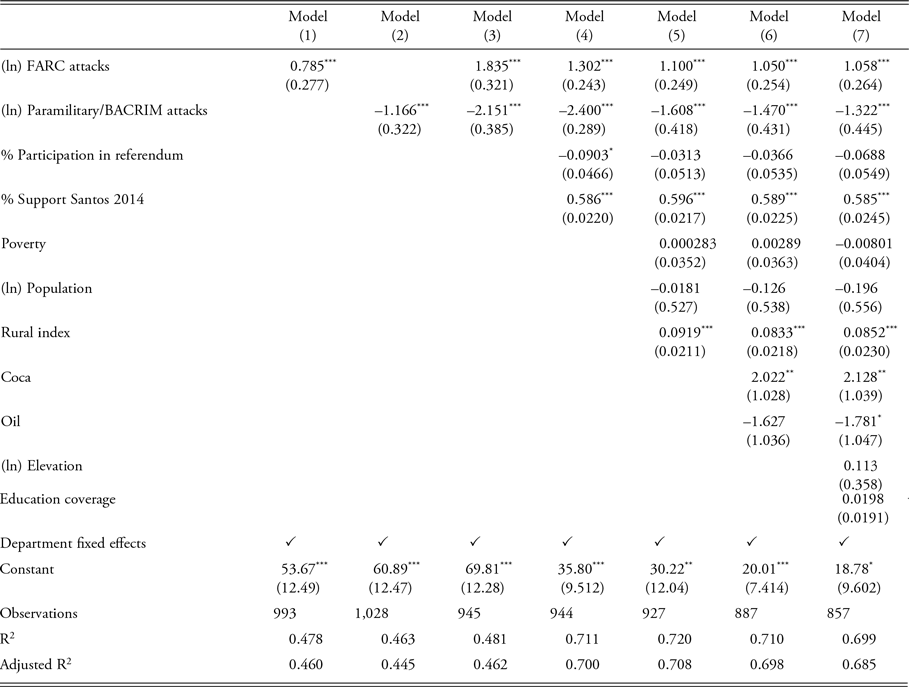
Following our expectations, “who shot the bullets” seems to have played a key role in shaping the outcome of the 2016 referendum. As table 1 reports, attacks by the FARC ((ln) FARC attacks) had a positive and significant effect (p < 0.01) on the yes vote in the 2016 referendum. If the mean of FARC attacks in a given municipality increases by 1 percent, the yes vote in the referendum increases by approximately 1.06 points. By contrast, attacks by the paramilitaries and their successors ((ln) paramilirary/BACRIM attacks) have a statistically significant (p < 0.01) negative effect on support for the peace agreement. If the mean of paramilitary/BACRIM attacks in a municipality increases by 1 percent, the yes vote in the referendum decreases by approximately 1.32 points. After the inclusion of all relevant control variables, these effects hold with the same level of statistical significance.
OLS Identity Perpetrator

*p < 0.10, ** p < 0.05, ***p < 0.01
Standard errors in parentheses
Dependent variable: % Yes 2016 Referendum
Our results are consistent with claims made by several conflict scholars immediately after the shocking results of the referendum. Weintraub (reported in Meléndez Reference Meléndez2016), for example, notes that communities that had been affected by FARC violence had a stronger tendency to vote yes in the referendum. Similarly, but using a measure of armed group presence (rather than violence), Arjona (Reference Arjona2016b) found that support for the agreement was 14 percent higher in communities with FARC presence than in communities with only paramilitary presence. Moreover, these results are also consistent with findings from other studies that have explored the differential effects of FARC versus paramilitary violence on Colombians’ voting behavior more generally (Gallego Reference Gallego2018).Footnote 21
The analysis also shows that other factors had an impact on support for the peace agreement. First, and in line with previous findings (Fergusson and Molina Reference Fergusson and Molina2016; Liendo and Braithwaite 2018; Weintraub et al. 2015), municipalities with higher levels of support for Santos in the 2014 presidential elections were more prone to vote yes in the referendum (p < 0.01). This was to be expected, as both the 2014 elections and the 2016 referendum were marked by a strong cleavage over the peace process, with Santos as the “pro-peace” candidate. Second, as noted early on by Arjona (Reference Arjona2016b), rural municipalities (p < 0.01) and municipalities with more coca cultivation (p < 0.05) were more prone to support the peace agreement. These results were also to be expected, as concrete measures included in the final agreement aimed explicitly at improving the conditions of rural Colombia and involved a comprehensive strategy for crop substitution that could reduce the violent externalities of the coca trade. However, the substantive effect of exposure to violence from either armed group was significantly higher than the impact of these other variables.Footnote 22
Moreover, in additional model estimations (table A11 in the online appendix), we included a series of additional control variables that speak to a series of potential alternative explanations. In dialogue with Pechenkina and Gamboa (Reference Pechenkina and Gamboa2019), we included a measure of exposure to attacks from the government (and its interaction with FARC attacks) to explore the role of government counterinsurgency efforts. In addition, we included attacks from the ELN (the second-largest guerrilla group active in the period of analysis), levels of land inequality, geographical characteristics (land area), and access to other natural resources (gemstones). Across all of these additional specifications, the main coefficients of interest (exposure to FARC and paramilitary/BACRIM violence) remain significant and in the expected direction.
In sum, our results show a clear trend: municipalities affected by FARC and paramilitary/BACRIM attacks had different preferences over the peace agreement. Those municipalities with higher levels of FARC-related violence were more prone to support the agreement, while those municipalities mostly exposed to paramilitary/BACRIM violence tended to vote no in the 2016 referendum.
Robustness Checks
Concerns about the reliability and robustness of the effects that we have found might persist despite the supportive evidence provided so far. First, it could be reasonably argued that the asymmetric effects we observe emerge from existing group biases driven by prevailing political ideological attachments (Lyall et al. Reference Lyall, Blair and Imai2013).Footnote 23 While in the original specifications (models 4–7) we control for political preferences in the 2014 elections, we further address this concern by examining citizens’ political preferences in four different presidential elections covering a period of almost 30 years—1958, 1966, 1974, and 1986—and a wider variety of left-wing parties, including the Communist Party of Colombia (PCC) and a coalition party that involved the FARC, the Patriotic Union (UP).Footnote 24
When we take our last model from table 1 (model 7) as a baseline and control for the level of support for left-wing political parties in each of these elections, the results cast doubt on the potential impact of long-lasting political preferences on the support for the yes vote in the 2016 referendum. None of the variables follows a common pattern, and few of them are statistically significant (see table A6 in the online appendix).Footnote 25 This provides additional confidence that our main findings are unlikely to be driven by the impact of this omitted variable.
A second concern is that the location of FARC attacks arguably is influenced by their expected electoral outcomes (Weintraub et al. 2015) or by other strategic considerations related to the negotiations of the peace agreement. In other words, that our results might be affected by reverse causality. While this is a generally valid concern, given that our models only include measures of violence exposure before the beginning of the peace negotiations, the likelihood of this affecting our results is deemed low. Nevertheless, to deal with these concerns more directly, we followed a matching procedure and employed an instrumental variable estimation for FARC attacks.Footnote 26
Matching allowed us to compare pairs of municipalities that are similar in the set of covariates found significant in our main estimations but that differ in their levels of exposure to FARC and paramilitary/BACRIM violence.Footnote 27 The results of the matching tests are consistent with our main models: coefficients remain in the expected direction and retain statistical significance in most of the model specifications (see tables A7 to A9 in the online appendix). The effect of FARC violence remains positive, with a coefficient ranging between 0.67 and 0.82 (p < 0.05), similar to the OLS estimates. Paramilitary/BACRIM violence keeps its expected negative coefficients but achieves a lower level of significance (p < 0.05 to p < 0.1), and the estimated effects are not as similar to the ones yielded by the OLS models (they range between –0.44 and –0.8).Footnote 28
As for the instrumental variable estimation (table A10 of the appendix), we use distance of each municipality to its departmental capital as an instrument for exposure to FARC attacks. The underlying logic of this instrument is that while it is reasonable to expect that the government has more difficulty reaching more distant places, and therefore that these areas might be more prone to FARC actions, this should not have a direct effect on support for the peace agreement, other than through the impact of exposure to FARC attacks—especially when controlling for the set of variables included in the main models. The first-stage regressions (table A10) show that the distance of each municipality to its departmental capital is indeed positively and highly correlated with the frequency of FARC attacks, and the results of the second stage show that the instrument remains positive and significant (p < 0.05).
In sum, these different analyses and robustness checks provide added confidence that exposure to FARC and paramilitary/BACRIM violence had asymmetric effects on people’s support for the peace agreement in the directions predicted by our theoretical argument.
Internal Logic
Did citizens living in municipalities mostly affected by FARC violence support the peace agreement because they thought peace would improve their security conditions? Did those who had been mostly exposed to paramilitary/BACRIM violence express less support for the agreement because they feared paramilitary retribution? While the results reported so far strongly support the theoretical expectations proposed above, the evidence does not speak directly to the logic underlying the expected effects according to our theoretical argument. Providing systematic evidence for this is an important task we leave for future research. However, here we offer qualitative evidence from different regions of Colombia that support the logic outlined in the argument.Footnote 29
We first adduce evidence from the Catatumbo region in the northeast of the country. Historically abandoned by the Colombian state, Catatumbo has experienced continuous guerrilla group presence since the 1970s. The FARC arrived in the territory in the mid-1980s and since then has fought for territorial control, mostly with other nonstate armed groups, and has engaged in numerous violent attacks. In fact, in seven out of the ten municipalities that constitute the region, our measure of FARC violence is well above the mean. In line with our quantitative findings, support for the peace agreement in the region was also very high. Especially in those municipalities that had been most exposed to FARC violence (e.g., Teorama, Hacarí, El Tarra, and San Calixto), levels of support were over 85 percent.Footnote 30
In early 2019, we had the chance to visit Catatumbo and ask residents about their attitudes toward the peace agreement. Almost every single person we spoke to reported having voted yes in the referendum. When asked why, some noted that they saw the agreement as an opportunity to pacify, and therefore develop, the region. One resident of Teorama explicitly noted that she saw the agreement as a chance to finally live in her village without the fear of the FARC victimizing residents or dictating to them what to do.Footnote 31 A social leader from El Tarra noted that during the various ceasefires that the FARC unilaterally declared during the negotiations and the bilateral ceasefire that both sides agreed on toward the end of the process, his community observed an important deescalation of violence, and this convinced them to support the peace agreement. In his words, “This [the decline of violence due to the ceasefires] showed us that we had no other option than going for the yes.”Footnote 32 In fact, support for the peace agreement in El Tarra was 91.5 percent. In general, most people in El Catatumbo saw the agreement as something that would not only benefit the FARC but would also improve their living standards (Ávares Vanegas and Garzón 2016).
This was not the case, however, in the entire region. Some residents noted that things were different in Ocaña, a more urban municipality, where the paramilitaries where particularly ruthless in the late 1990s and early 2000s and where, according to the official Registry of Victims (RUV), a large number of paramilitary victims live. One social leader explicitly noted that after the demobilization of the AUC, Ocaña became a “center of operations” of different BACRIMs, which allowed them to influence the vote in the referendum via threats and extortion—an underexplored expression of paramilitarism acting as a spoiler of peace (Maher and Thomson Reference Maher and Thomson2018).Footnote 33 Here, support for the agreement was minimal: only 30 percent voted yes. These accounts are largely consistent with our theoretical argument.
Our argument also holds in places where the FARC is infamous for having committed some of the most brutal acts of violence in the group’s history. This is the case, for example, in the Afro-Colombian town of Bojayá in the Department of Chocó on the Pacific coast. In Boyajá, against all odds (but in line with our argument), residents overwhelmingly supported the peace agreement: 95.7 percent of the population voted yes in the 2016 referendum. Explaining the community’s vote choice, one resident noted, “We had all the reasons to vote no. But we have suffered [from the FARC’s violence] more than anyone else. We saw in the ballots the possibility to put an end to 52 years of conflict” (Revista Semana 2016). As in various municipalities of Catatumbo, residents who had been highly affected by FARC violence in the past saw in the agreement an opportunity to improve their security conditions.
The story in the municipality of Apartadó, where we also conducted field research, is quite different. In this area, in northwestern Colombia, the AUC successfully managed to rip control away from the FARC back in the mid-1990s and deeply terrorized the population by selectively killing leaders and collectively targeting residents (Masullo Reference Masullo2017, chap. 5; Steele Reference Steele2017, chap. 6). Since the AUC’s demobilization in 2005, the Gaitanista Self-defense Forces (AGC) have increasingly taken control of the area.Footnote 34 While the government considers the AGC a “criminal band,” the population largely sees it as “the same old paramilitaries.”Footnote 35 The AGC has caused the most harm to the civilian population in the last decade, engaging in extortions, forced displacement, death threats, and selective killings. Unlike El Tarra or Bojayá, but in line with our argument, support for the agreement in Apartadó was only slightly over 50 percent.
Levels of violence from both the guerrillas and the paramilitaries have historically been high in Apartadó. However, in the years leading up to the 2016 referendum, residents were mostly concerned with paramilitary violence. When asked about their take on the then-ongoing peace agreement in 2015, inhabitants of the village of San José told us that while they hoped the government could achieve peace with the FARC, they were seriously concerned about what could happen in the aftermath of the agreement. “Real peace will only come to Apartadó if peace is negotiated with all armed groups, including the paramilitaries, not only with the FARC,” stressed a member of a “peace community” located in the rural village of San José de Apartadó.Footnote 36 Similarly, a leader of a peasant association from the same village noted,
There are some actors sitting [at the negotiation table] and we have seen an improvement [of security conditions] in the territory. We don’t see that intimidation, the bombs, the combats; but we want those actors that aren’t taking part in the negotiations to take part, so we can feel a form of peace in which peasants don’t see weapons in our lands anymore. (Cited in Verdad Abierta 2016b)Footnote 37
In line with the logic outlined in our argument, villagers of Apartadó feared retaliation from the AGC if they supported the peace agreement, and this fear grew stronger as a potential agreement with the FARC became more plausible. During the referendum campaign, peasant associations from the area constantly reported to the government and international agencies the increased presence of members of the AGC in their territories and noted that the paramilitaries were coercing them into rejecting the peace agreement.Footnote 38 Residents of Apartadó had already experienced brutal paramilitary violence in the past for voting for a left-wing political party linked to the FARC, the Unión Patriótica, UP (Steele Reference Steele2011, Reference Steele2017, chap. 6). Despite being generally supportive of the peace agreement, they feared suffering the same fate with the 2016 referendum. As a consequence, to avoid credible violent retribution, many did not express their private preferences regarding the agreement at the ballot box and voted against the agreement.
Conclusions
This study has analyzed how exposure to violence affects attitudes toward peace in the context of the Colombian 2016 referendum. It has found that the identity of the perpetrator matters. Concretely, as formulated by our theoretical argument, while municipalities mostly affected by FARC violence were more prone to support the peace agreement, those mostly affected by paramilitary/BACRIM attacks were more prone to vote against the agreement. We argue that the driving force behind these asymmetric effects is safety-seeking considerations. These findings contribute to a better understanding of the shocking outcome of the Colombian referendum and the underlying conditions that shape support for peace in the country—something that remains important today for the successful implementation of the final agreement. In addition, this study makes a theoretical and methodological contribution to the growing literature on the effects of wartime violence on peoples’ preferences and behaviors, revealing the benefits of disaggregating “exposure to violence” and looking at “who shot the bullets.”
Despite the strongly supportive quantitative and qualitative evidence offered, our study has certain limitations that should be acknowledged. First, we focused on violence alone, when we know that civilian attitudes and choices that could definitely affect support for peace can also be shaped by nonviolent interactions, such as rebel governance (Mampilly Reference Mampilly2012; Arjona Reference Arjona2016a, b), which are a central part of irregular civil wars.
Second, our examination focused on the municipality, with violence and voting behavior data aggregated at this level of analysis. Some important variation in the way local communities experience violence and other wartime dynamics, which does shape civilian choices (Arjona Reference Arjona, Giraudy, Moncada and Snyder2019; Masullo forthcoming) and could have had an impact on their vote choice in the referendum, is likely to get lost at this level of aggregation. Moreover, while there is evidence suggesting that direct (self-reported) and indirect (contextual) victimization can have differential effects on civilian preferences (Masullo and Morisi Reference Masullo and Morisi2019b), our focus on the municipality does not allow us to tap into this difference. All in all, as much as we would have liked to explore these other nonviolent dynamics and disaggregated beyond the municipality, here we were limited by data availability.
Furthermore, as with most data on wartime violence, there is room for reporting bias in the datasets we relied on to measure our independent variables. Systematic under- or overreporting of attacks by different factions included in our analysis would directly affect our results. Nevertheless, when compared to other datasets compiling violent events in the Colombian civil war, the data that we used (from the Observatorio) have been found to suffer less from this type of bias (Albertus and Kaplan Reference Albertus and Kaplan2013).
While referendums to ratify peace agreements are not a common occurrence, the coexistence of elections and ongoing civil war is much more frequent. While there is ample evidence that armed actors are often involved in electoral politics (e.g., Matanock and Staniland Reference Matanock and Staniland2018; Staniland Reference Staniland2015), this study shows that when both phenomena coexist, citizens have the opportunity to boost or freeze peace efforts by voting for or against pro-peace candidates. Beyond having a direct impact on war trajectories, this realization can also have important implications for citizens’ security. As our theory suggests, asking civilians to participate in public political decisions in an unstable environment, such as that of internal armed conflict, can put people at grave risk of suffering violent retribution by armed actors (Steele Reference Steele2017; Steele and Schubiger Reference Steele and Schubiger2018). In the absence of strong and effective protection measures, civilians will have incentives to falsify their private political preferences at the ballot box or not to participate in democratic processes at all, posing an obstacle to peace and ultimately undermining democratic institutions.
Supporting Information
Additional supporting materials may be found with the online version of this article at the publisher’s website: Supplementary Materials. For replication data, see the authors’ file on the Harvard Dataverse website: https://dataverse.harvard.edu/dataverse/laps