The birth rate is not simply an index of the progressive power of the nation; it is not simply, as Spengler, suggests, “Italy’s only weapon”; it is also that which will distinguish the Fascist people from the other peoples of Europe as an index of vitality and the will to pass on this vitality over the centuries.
—Benito Mussolini
In his book Fatal Misconception, Matthew Connelly explains how transnational institutions and organizations promoting family planning during the twentieth century tried to impose their own ideas about reducing human fertility over different parts of world population. In his own words, Connelly’s book tells the story of “how some people have tried to control others without having to answer to anyone.”Footnote 1 But family planning or population control was not the only set of demographic ideas that were being imposed, as Connelly himself mentions in his introduction. There were others trying to impose exactly the opposite idea. This article tells the story of two authoritarian regimes that also tried to shape, or at least influence, reproductive decisions but in a different way than those transnational organizations studied by Connelly: it is the shared story of state-sponsored pronatalism in Mexico and Spain.
The history of population policy in the first half of the twentieth century has focused mainly on the history of eugenics, and a long and useful literature has developed on that topic.Footnote 2 However, in this article I look at something that is deeply connected to eugenics but a bit different: the obsession with population growth as a measure of “social health” and a requirement for economic development. In this sense, this article follows Andres Reggiani’s work on pronatalism in France, since one of the main goals is to treat pronatalism as an intellectually independent trend, although recognizing that there were many particular cases in which pronatalism and eugenics could become allies and even just the same thing.Footnote 3 It is important to mention that while Reggiani’s work tells the history of pronatalism in French political culture, I will focus on official pronatalism. In other words, this article tells the story of how pronatalism became an official policy, but it does not follow the role of nonstate actors in the evolution of pronatalism, something that would be desirable but would need further research.
This article is also part of a bigger new trend in which we study the transit of ideas across the Atlantic in the 1930s directly from Southern Europe to Latin America.Footnote 4 Most of what has been written about ideas and people interacting across the Atlantic usually focuses on the relationship between Northern European intellectuals or activists and their counterparts in the United States.Footnote 5 I will focus on the intellectual relationship among Italian, Spanish, and Mexican demographers who shared a common set of policy goals.
Comparing population policies in Mexico and Spain is not random since these countries represent an interesting case of similar policies and radically different outcomes. Between 1930 and 1974, the populations of Mexico and Spain grew at very different rates. Mexico grew from just over 17 million inhabitants in 1930 to almost 60 million in 1974. By contrast, Spain grew from around 23.5 million inhabitants to a little more than 35 million in the same period. While these growth trends remained relatively constant over the subsequent decades, the period in question is interesting because the divergence in population growth coincided with a convergence in population policy. This article explains the link: between the 1930s and the 1970s, Mexico and Spain both promoted openly expansive population policies, albeit with different emphases, different timing, and, most important, different outcomes.Footnote 6
The comparison is also interesting because we have similar ideas driving specific policies in two regimes that are assumed to be very different in ideological terms. The similarities are not limited to a concurrence of public policies with similar objectives, but include policies that shared a common intellectual root. In other words, it was not only the policies implemented that resembled one another, but also the way in which they were justified, and in general there existed a shared conception of which social goals should be taken up by both governments. This is particularly interesting because of the important ideological differences between Spanish authoritarianism and that of Mexico: while the Mexican Revolution (1910–20) created a reformist, although authoritarian, regime that by the 1930s had already tried to limit church influence and had started a massive agrarian reform, at the end Spanish Civil War the triumphant general Franco tried to rebuilt a hierarchical society where the old landowners and the church would recover the traditional and privileged position that had been challenged by the second Spanish Republic.Footnote 7 The coincidence of population policy came to an end in 1974, when Mexican president Luis Echeverría adopted a family-planning policy and created the Consejo Nacional de Población (National Population Council). In Spain, although the use of contraceptives was legalized in 1978, the low birth rate allowed government incentives encouraging procreation to continue apace.
This article argues that the convergence of the population policies of Mexico and Spain can be explained by the influence of Italian pronatalism in the 1920s and 1930s, and in particular the influence of the Italian demographer Corrado Gini on the most important demographers of both countries. I will explore the influence of Corrado Gini and his theory on the study of demographic matters and on the policymaking process in Mexico and Spain. Although Gini might have influenced policymaking somewhere else, it would be hard to find countries where his influence was as deep as it was in Mexico and Spain. I will also show how in the mid-1960s pronatalist policies began to be questioned in Mexico and how this discussion opened the way for a radical change in population policy in 1974. Meanwhile, in Spain, the pronatalist policies survived the democratic transition with only a few minor modifications, motivated not by a change in necessity or population concerns but uniquely reflecting the end of Francoist puritanism.Footnote 8
Corrado Gini, His World and His Ideas
Corrado Gini was an Italian academic fundamentally interested in demographic and statistical matters. He was president of various Italian statistics and sociology associations, among them the International Institute of Statistics. By 1912, Gini had already claimed a place in the history of statistics and modern economics when, following from the work of Lorenz and Pareto, he published a series of articles from which was taken what is known today as the Gini index, which measures inequality.Footnote 9 However, between 1911 and the end of World War II, Gini became better known worldwide as a demographer and, without a doubt, as a loyal defender of Italian fascism.Footnote 10
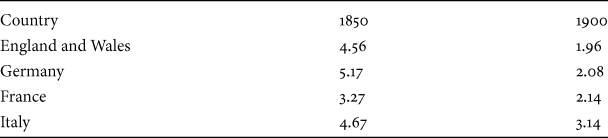
At that time, the debate about what a state was supposed to do with respect to the size of its population had evolved around three schools: neo-Malthusianism, pronatalism, and eugenics.Footnote 11 In a discussion focused on the social usefulness of having accelerated population growth, the first two currents cover both sides of the debate. Appearing in the 1830s in France, neo-Malthusians dedicated their efforts to the promotion of contraceptive methods as policy for the reduction of poverty.Footnote 12 Pronatalists would appear at the end of the nineteenth century out of military concerns. According to data collected by Massimo Livi Bacci, the number of children per woman dropped sharply during the second half of the nineteenth century in many European countries (see Table 1). This process worried the elites and governments in countries like France, Germany, England, and even Italy, because of what they perceived as the military consequences of the reduction in human fertility: fewer people meant smaller armies and that consequence would endanger national security. During the first decades of the twentieth century, the argument also included economic concerns: many pronatalists assumed that a high rate of population growth was necessary for accelerated economic growth.Footnote 13 When the discussion includes the matter of the “quality” of this population, eugenics invades the debate and blurs the line between the pronatalists and neo-Malthusians: eugenicists interested in promoting the sterilization of those who were considered “unfit” were usually allied with neo-Malthusians.Footnote 14 Some eugenicists would argue that quality could be a consequence of quantity and they would usually ally with pronatalists.Footnote 15 The history of eugenics has been well documented and there is an important literature about it that should always be included in a discussion about population policy in the first half of the twentieth century.Footnote 16 However, it is important to mention that this article focuses on the margins of that literature, since the main debate presented here is between pronatalism and neo-Malthusianism and their policy implications. Most of the Spanish, Italian, and Mexican demographers and thinkers mentioned in this article had an ambivalent relationship with eugenics depending on whether eugenics promoted birth control or not. In the 1930s the debate about demographic policy would break other ideological barriers since liberals, conservatives, fascists, social democrats, and communists got divided with respect to population policies.Footnote 17
Average children per woman in Europe, 1850–1900

Source: Massimo Livi Bacci, Historia Mínima de la Población Mundial, 167.
Corrado Gini was a pronatalist close to the eugenics side that believed in big numbers, since he was opposed any kind of sterilization.Footnote 18 In 1911, in Trieste in northeast Italy, Gini explained his cyclic theory of population.Footnote 19 He continued to work on the theory over the next three decades and in 1930 a collection of essays was published in which Gini was rightly called “a leading statistician” in Europe and the world. In those essays we can find the most elaborate version of Gini’s cyclic theory.Footnote 20
According to this theory, human groups, whether nations, races, or countries,Footnote 21 have a life cycle parallel to that of an organism.Footnote 22 To Gini, this was not a metaphor as one might assume, for he believed that the same laws that governed the development and death of all living things also applied to human groups. To him, human groups were just biological organisms. Gini claimed that, during an initial stage, societies grew rapidly until they reached a maximum population size. From that moment, they entered a cycle of decline: the fertility level would be reduced and the population would eventually die out or be substituted by a new nation formed by new groups of humans with a higher propensity for reproduction. During this stage of development, according to Gini, the poorer classes in society tended to replace the better-off because of the difference in birth rate between the two classes. This continued until the lower classes began to be confronted with the same problem of low fertility as the higher classes, a change that signaled the beginning of the end for a society. This phenomenon, which Gini named “demographic metabolism,” seems to have been taken from Vilfredo Pareto’s theory on the circulation of elites.Footnote 23
The death of a nation could be delayed, noted Gini, if “more solicitous and rational care” was taken, but while the process may be slowed, according to Gini such a fundamental biological inevitability could not be prevented.Footnote 24 Gini saw the emergence of Neo-Malthusianism not as the cause of the fall in birth rates in Northern Europe, but as a consequence of the biological decline of those peoples, races, or nations. As such, he thought it likely that the people of southern Europe would eventually dominate Europe entirely. However, it was by extension also probable that Asian groups or others with higher rates of fertility would eventually invade all of Europe. The first conclusion fed his nationalism and justified his political positions; the second was useful fuel for his fascist paranoia about the future of Western civilization.
Nevertheless, Gini argued that just as nations die, nations are born. New nations are usually a product, he said, of the successful combination of two parent nations, one in biological decline, with low fertility, and the other in the stage of rapid population growth. The first is the bearer of culture and civilization, and the second the bearer of biological life. It was with this last part of his theory that Gini, not without reason one of the most influential demographers under Mussolini, asserted that Italian fascism was the product of Italian vitality, as Italy was created by the combination of different nations that merged during the unification and risorgimiento: “If this be the case, then the hope—and more than the hope, the intimate feeling which many have—that the Italian nation is now [1929] renewing itself to write new and glorious pages in its history is not without biological foundations.”Footnote 25
Gini’s theory was highly criticized in his time, not only outside Italy but also within his own country.Footnote 26 Although today it would be difficult to defend any part of his theory, at the time Gini’s critics focused mainly on his explanation for the fall in fertility. Gini denied that the apparent decrease in births was a voluntary matter; to him it was simply a reflection of biological decline. During the 1930s, criticism of this aspect of Gini’s theory was so great that Gini himself gradually began to accept that the circulation of contraceptive methods explained, at least in part, the drop in fertility. The idea of biological decline was eventually abandoned, but not the idea that human groups were born, developed, and died. Even if Gini had been wrong in his postulation of the reason for the final fall in fertility, the idea that birth rates could be used as a measure of the state of social health did not seem to be considered wrong.
This claim is especially relevant to this investigation. On the one hand, eliminating the fatalist notion of biological decline opened the possibility that through public policy the state would be able to promote population growth. On the other hand, even while leaving the biological argument aside, Gini’s theory continued to be useful to Italian fascism, as it claimed to provide scientific justification for the extreme nationalist policies of the Duce. It linked perfectly with the military concerns of the regime, and it coincided with the population policy of the Vatican.
Even more, although the state’s capacity to mold the dynamic Italian population depended on this debate over the origins of the decline in fertility, Gini did not leave any doubt that there were some things that could be done and that Italian fascism was doing well. In fact, according to Gini, who was in a way contradicting himself, the failure of pronatalist measures in other parts of Europe was explained by the delay in their implementation and not necessarily by biological arguments.Footnote 27 Gini believed that Italian fascism had paid attention to the fall in the birth rate even before it had developed into a serious problem, and as such there was a possibility of avoiding population decline.Footnote 28 From 1928, Mussolini’s population policy included: fiscal exemptions for large families; measures to discourage remaining single and to discriminate against couples without children; the creation of the Opera Nazionale Della Maternità dell’ Infanzia (National Charity for Maternity and Childhood) to protect mothers and children of preschool age, and which included the prevention and treatment of syphilis; measures to protect illegitimate children; severe punishments for abortion; restrictions on external migration; restrictions on internal migration to control the rate of urbanization in the country; prizes for fertility; propaganda campaigns with religious messages that showed large families as prosperous and happy, and so forth. Although it was still very early to measure the results of these policies, for Gini it was clear that they had been able to build a blockade against neo-Malthusianism, which he believed was destroying the futures of other nations: “If it meets with adequate response in the national consciousness it will prove a great advantage to Italy in the contest of nations for survival.”Footnote 29
Ipsen is right in that this school of thought, and the corresponding population policy, contains both Fascist and Catholic elements. He is also right in that more than an explicitly fascist theory, Gini’s was a nationalist one that was convenient for fascism and that was thus adopted by the movement. However, Ipsen is wrong in saying that “as fascism fell, so too did its demographic policy.” Neither Gini’s theory nor the policies that it supported ended with the death of Mussolini. During the debate over the reason for the fall in fertility during the 1920s and 1930s, Gini also successfully influenced population policy in other countries, where, for historical reasons, his theoretical model fell on attentive ears. In Mexico as in Spain, the idea that population growth determined the strength of a nation, and that a nation’s role in global history depended on population dynamics, was very influential. It is no coincidence, then, that despite the profound ideological differences that existed between the Mexican revolutionaries and Francoist Spain, both countries shared two fundamental elements with Italian fascism: a distinct nationalist discourse and a strong Catholic heritage.Footnote 30 Andres Reggiani explains how pronatalism was appealing in France in part because it shared most of the Catholic Church’s views. During the first years of Franco’s rule in Spain, any social policy required the church’s endorsement. In Mexico, by the 1930s, any policy that could help to improve the relationship between the church and the revolutionary state was useful since neither the church nor the revolutionary leadership was interested in going back to the open conflict between both of them in the 1920s.Footnote 31
In addition, Gini’s theory was useful to satisfy, at least partially, another necessity shared by Mexico and Spain: the construction of an efficient political discourse for the reconstruction of a national state. A population theory considered scientific, capable of justifying almost any nationalist policy, and of drawing together the policies of the state with the position of the Catholic Church would have been similarly attractive to Mexican revolutionaries and to Spanish conservatives. Finally, the fact that Gini’s theory did not need a commitment with “racial purity” allowed Mexicans and Spaniards to keep paying attention to him even after the end of World War II.Footnote 32
Gini’s Influence in Mexico
During the second half of 1933, some strange things happened in Mexico. In Sonora, the corpses of sixteen “Seris,” an indigenous group from northern Mexico, were exhumed, packed up, and sent to Mexico City. In Hidalgo, teachers from various primary schools were interviewed to identify the differences between the academic performance, cleanliness, and behavior of the state’s “mestizo” and indigenous children. An Italian doctor named Luigi Mazzotti, the same Mazzotti who later took charge of packing the remains of the Seris, investigated and reported the most important causes of death in Tuxpan, Jalisco. In Michoacán, a group of young Otomies, an indigenous group from central Mexico, were measured and subjected to intellectual aptitude tests. The occurrence of all these events had one very simple explanation: Corrado Gini was in Mexico.Footnote 33
As Gini announced in 1930, the Comitato Italiano per lo Studio Dei Problemi Della Popolazione (Italian Committee for the Study of Population Problems) organized a series of “scientific expeditions” to those countries that were thought to contain new races in the process of formation.Footnote 34 The committee set about collecting demographic and anthropometric statistics on isolated populations and populations in which different races were being mixed, both of fundamental importance to Gini’s theory. Although the expedition to Mexico was not their only trip, it was, according to Gini, the most extensive and complete of those organized by his committee.Footnote 35
After visiting Palestine and attending the Genetics and Eugenics Congress in New York, Gini took advantage of his location to travel to Mexico, where he led several research groups as they collected fundamental anthropometric data on indigenous Mexicans. But why did Gini choose Mexico not only as a destination but also as the location for the most ambitious of his expeditions? We can only speculate about the reason given the evidence available. While Gini and his theory were widely criticized in their time, as much within as outside Italy, his reputation and prestige as a demographer was beyond any doubt.Footnote 36 It was because of him that the University of Rome was one of the most important centers in the world for the study of statistics. In the years leading up to his expedition, Gini taught a Mexican named Gilberto Loyo, who was to become the most influential demographer of the postrevolutionary period. It would be hard to disregard the possibility that Loyo himself influenced Gini’s decision to include Mexico in his research agenda. However, it is also certain that other factors made Mexico very receptive to Gini’s theory, thus making it an attractive location for his investigation. While in Europe Gini’s demographic arguments were not the most popular, nor the most defendable, in Mexico they were not considered strange or incorrect. The argument on which they were based was very convenient for the Mexican revolutionaries, as it coincided completely with their revolutionary plans.
In fact, there is reason to believe that Gini was on the radar screen of Mexican revolutionaries and intellectuals even before Loyo went to study in Rome. In 1926, fifteen years after Gini first explained his theory in Trieste, José Vasconcelos, first minister of education after the Mexican Revolution and a very famous intellectual and politician in the first half of the twentieth century in Mexico, published a very influential essay entitled “The Cosmic Race,” in which he argued that the “mestizo” race was a new race that emerged from the combination of the four great human races that preceded it, and from which it inherited its virtues. Vasconcelos argued, therefore, that mestizos were a race that was potentially superior and which would eventually move to the forefront of civilization.Footnote 37 While Gini would have had difficulty in accepting the idea of “mestizo” superiority, Vasconcelos’s reasoning—the way in which he constructed his argument and even some of the examples he used—coincided with the argument that Gini put forward during the same period. It is difficult to know whether Vasconcelos was inspired by Gini, but it seems likely that he had read Gini’s theory by the time he wrote his essay. Even if this was just an unlikely coincidence, the point is that Gini’s argument was not unfamiliar for the Mexican postrevolutionary leadership.
Whatever the motivations behind Gini’s choice of Mexico as the location for part of his investigation, it is certain that in Mexico many influential people paid attention to the Italian professor and close associate of Mussolini. Upon his arrival in Mexico City, Gini was received by a delegation, which included the anthropologist Manuel Gamio, a member of the Instituto de Investigaciones Sociales (Institute of Social Investigations, IIS) of the Universidad Nacional Autónoma de México (National Autonomous University of México, UNAM); Juan de Dios Bojorquez, Minister of Labor; as well as the young demographers Loyo and Alanís.Footnote 38
Although Gini’s visit was of great importance to the Mexican government, Gini himself was not at all content with their collaboration. From the start, the costs of the expedition were supposed to be shared between the Italian committee and the Mexican government. However, Gini wrote in his notes that a series of Mexican bureaucratic impediments delayed the start of the expedition by a week. In addition, Gini complained about the additions to his team that were imposed by the Mexican government.Footnote 39 At the time Gini hoped to accelerate Mexican cooperation by meeting with the president, Abelardo L. Rodríguez, the secretary of public education, Narciso Bassols, the secretary of the economy, Primo Villa Michel, the secretary of education, Eduardo Vasconcelos,Footnote 40 the president of UNAM, Roberto Medellín, and the national director of statistics, Ramón Beteta. If Gini had complaints, they could not be about a lack of attention from the Mexican government.
On September 9, 1933, Gini began training those who were to work with him. Later, between September 30 and October 3, four research groups left Mexico City headed for Oaxaca, Guerrero, Jalisco, and Michoacán. Gini later visited Isla Tiburón in Sonora, and joined one of these groups to help with their survey. Some of the notes and data Gini obtained are available in his archive, but it is not the intention of this investigation to analyze these documents exhaustively. The aim is instead to demonstrate that in some ways this project revealed all of Gini’s flaws and virtues as a demographer. While it is clear that his intention was to generate systematic information on various subjects, Gini’s racial prejudices were the leitmotiv of this investigation. In other words, the interpretation of all the information collected in this study assumed that race was the main explicative variable and any other possible variable was just marginal. For instance, in one of the notes that Gini received from an unidentifiable member of his team, an interview with a rural teacher from Hidalgo is cited to show that there was a clear difference in intellectual capacity, personal hygiene, and conduct between “mestizos” and indigenous people. Obviously the disadvantage was on the side of the indigenous children. The fact that they came from poorer families is only mentioned as a minor extenuating circumstance.Footnote 41
Gini’s expedition shows clearly that he was not unknown in Mexico. However, the investigation carried out during the expedition was not the main reason for his influence on population policy in Mexico. Gini’s presence served to endorse Gilberto Loyo, whose influence in matters of public policy was, actually, the most effective vehicle for Gini’s influence in Mexico in the long term. Loyo took advantage of Gini’s presence to advocate the creation of the Comité Mexicano para el Estudio de los Problemas de la Población (Mexican Committee for the Study of Population Problems). Only two years later Loyo published La Política Demográfica de México (Demographic Policy in Mexico), edited by the Partido Nacional Revolucionario (National Revolutionary Party, PNR) and considered to be the demographic section of the Six-Year Plan.Footnote 42 From then on, Loyo was considered the most influential demographer of the revolutionary family.
In Demographic Policy in Mexico, Loyo adapts Gini’s arguments to the Mexican context. He attempts to justify an expansionist population policy but did so using a different argument:
In some countries like France, population policies tend to stop the falling birth rate that threatens its political and economic position. In some states there can even be the explicit tendency toward overpopulation, in order to be able to have greater manpower at the service of the governing aristocracy’s imperialist program, and in countries that cannot ensure their integration and their organic development into modern societies because of underpopulation, this policy of promotion is nothing but a struggle, noble and justified, to safeguard the life of the nation. This last case is that of Mexico.Footnote 43
Loyo replaced Gini’s demographic justification for Italian fascism in Europe with a less offensive argument presenting population growth as a sine qua non element of national viability: Mexico’s future depended on having more Mexicans to occupy its territory and to strengthen its economy. While Gini explained the territorial expansion under Mussolini as a logical consequence of the Italian demographic “vitality,” Loyo resorted to using the same methods, while arguing that the ends pursued were nobler than those pursued by the Italians. As one might suspect, the war against the United States in 1847–48 and the resultant loss of half of Mexico’s territory was a fundamental part of the pronatalist argument Loyo supported: he was convinced that if Mexico had had more people in 1846, Mexico would still control Texas, California, and so on.
Despite referring to the expansionism of certain empires, Loyo never directly mentioned his teacher’s Italy. In this case, Loyo’s genius is apparent in his manipulation of the theoretical apparatus used for Italian fascism, creating a more palatable propaganda for the Mexican political culture. Thus the theory became acceptable in a nation without ambitions of territorial expansion, or at least without the slightest possibility of realizing any such ambition. However, Gini’s megalomania was not wholly absent in Loyo’s book: “a people, who for centuries have proceeded with difficulty under the burden of depressing complexes, aspires, a few years after the start of its Revolution, to take advantage of the western technique to improve its defense and development, aspires to incorporate into its own life the culture of the West, and wants to improve its demographic organism in order to integrate itself and fulfill its destiny.”Footnote 44
References to Gini and his cyclic theory of population are recurrent throughout the text. For example, Loyo explains the history of Mexico in the nineteenth century as a product of Mexico’s “demographic metabolism”: the constant civil wars are explained as an ongoing fight between a privileged but decadent elite, which was fighting to maintain those privileges, and the popular sector, including “mestizos” and indigenous people, which became more powerful as the nineteenth century advanced and which would eventually become the ruling class. In this version of Mexican history, the 1910 Revolution is the concluding chapter, when the popular sector finally breaks through the institutional obstructions to a natural social metabolism.Footnote 45 Later Loyo’s references to Gini and defense of his theory become more explicit. He suggests that from before the publication of Spengler’s book The Decline of the West,Footnote 46 new “scientific and historical [data] fortified the cyclic theory of population, that of which Professor Gini is the principal supporter.”Footnote 47 However, perhaps nowhere does Loyo show his alignment with Gini and his theory more than in his criticism of Adolf Weber.Footnote 48 Even though, in Loyo’s opinion, Weber understood and demonstrated the errors of Malthusians and neo-Malthusians, he did not follow his own argument to its ultimate consequences. The reason for this defect was obvious to Loyo: “[Weber] does not arrive at the important conclusions that are logically deduced from his observations and from the facts he presents, because the cyclic theory of population does not illuminate his study, which is fundamentally obscured by Malthus’ now obsolete lineal or statistical theory.”Footnote 49
Within his argument, Loyo is very clear about his opinions on neo-Malthusianism. At best, Mexican neo-Malthusians are mistaken and uninformed. At worst, they are worse than the most terrible villains in nineteenth-century Mexican history: “Some bookish Mexican socialists, who have fervently accepted neo-Malthusianism, are much more responsible, as people ignorant of our serious demographic problem and of the great danger that our demographic anemia brings with it, than our leaders who precipitated the disaster of 1848.”Footnote 50
The constant criticism of neo-Malthusianism in some ways allowed Loyo to get around Gini’s contradiction about the capacity of the state to slow the decline in the birth rate. Loyo suggests, near the end of his book, a series of methods to obtain an integral population policy. These methods are similar to those set out in Gini’s plan for Italy: financial penalties for people who remain single, fiscal incentives to procreate, family wages, Mother’s Day as a national holiday, and so forth.Footnote 51
Loyo was certainly not the first Mexican pronatalist, but he was the first to adopt Gini’s organicist argument. He was also the first who had the necessary influence to transform his own pronatalism into policy. Several pronatalist elements were contained in the General Population Law of 1936. This law, and later that of 1947, contained clearly pronatalist aspects and Loyo, whose career in Mexican public service was taking off at the time, was considered to be the principal promoter and ideologue of both.Footnote 52 The pronatalist line included, as in Europe, plans to protect mothers and children, promote marriage at a young age, and give prizes to large families. By 1947, the sanitary code also prohibited the promotion and sale of contraceptives.Footnote 53
As elsewhere, the idea was to maximize the difference between birth rates and mortality rates, that is, to maximize the first and minimize the second. In terms of lowering mortality rates, the success of postrevolutionary policies is unquestionable. In terms of raising the birth rate, it is harder to measure its success, and even questionable whether it could have been considered a success. What is certain is that the numbers of births in Mexico was so high by international standards that, toward the end of World War II, Mexican government officials realized that they no longer needed to worry about fertility and they focused on combating mortality, particularly infant mortality.Footnote 54
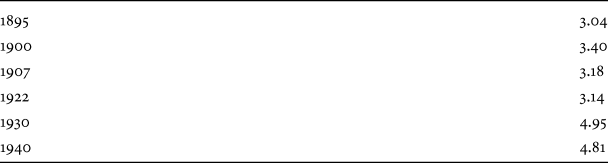
Gini and his theory were echoed in Mexico for several reasons. First, as Table 2 shows, births in Mexico increased during the twenty years following the Mexican Revolution. In spite of the poor quality of the Mexican censuses, the increase in the birth rate between 1922 and 1930 allowed Mexican politicians to make an argument about the success of the revolution they were leading. Measured by the rate of population growth, Mexico had not only recovered the strength of prerevolutionary times, but it was even stronger than before the Revolution. If these arguments about population growth and social performance had to be valid in France or Italy during this period, why did they not have to be so in Mexico? Pronatalism justified optimism in a country that was trying to reinvent itself.Footnote 55
Birth rates in Mexico as percentage of total population

Source: INEGI, Estadísticas Históricas de México.
Second, racial arguments like Gini’s were not uncommon in Mexico, a country accustomed to overlap nation with race, and fit perfectly with the most influential Mexican postrevolutionary political literature, particularly the texts of Vasconcelos and Molina Enriquez. Until the mid-1960s, it was very difficult to find an argument in Mexico against the pronatalism that Loyo and those who followed him promoted.Footnote 56 Gini’s influence in Mexico was longer lasting than the empire he supported at home.
But by 1960, demographic conditions in Mexico were such that even Loyo started reviewing his theoretical assumptions and his policy recommendations. In 1935, Loyo argued that “humans produce to live, and when they are greater in number they work and cooperate better in order to overcome the obstacles in production. For this reason population size is an important economic factor, and population policy is only part of economic policy.”Footnote 57 Twenty-five years later, in 1960, Loyo saw the relationship between economic development and population growth as something more complex. Although he did not consider Mexico’s rapid population growth a problem, Loyo pointed out that this growth would force them to make the economic system more efficient. He assumed that the population dynamic would not change and that this growth would generate progress, but also obstacles: economic planning was inevitable. What was important was that population growth served as a catalyst for the social reforms that the Mexican Revolution had initiated, that demography would awaken the people.Footnote 58 By then, Loyo no longer shared Gini’s view of the population as a means of progress. However, he still agreed that population growth was far from being the cause of underdevelopment. Loyo continued to believe that it would be wrong to promote methods of birth restriction prior to 1980 in Mexico, but he argued that other economic measures had to be taken in order for the accelerated population growth not to be a problem. In the end he continued to be pronatalist, but he began to constrain his pronatalism and was clearly skeptical about the capacity of the state to reduce the birth rate.
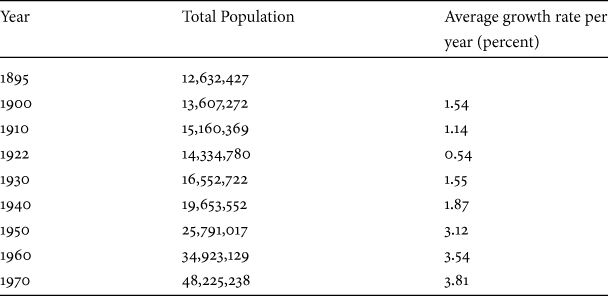
Between the censuses of 1930 and 1960, the Mexican population increased from a little more than 16.5 million inhabitants to a little less than 35 million. During these same years there was a global war, in the wake of which, in 1945, the United Nations was created. The Mexican political system was consolidated, and by 1960 it had proved to be an exception in Latin America in matters of political stability and economic development. Finally, during the years leading up to the publication of this last article by Loyo, a neo-Malthusian “opposition” began to emerge in Mexico. It was made up of a few private organizations, which began to promote contraceptive methods, and of some intellectuals—including demographers—who began to oppose the official pronatalist policies that Loyo had proposed in 1935.Footnote 59 All this came together to provoke a subtle but remarkable change in Loyo’s position. For the first time, Loyo had to respond to critics who had begun to worry about the rapid population growth, and he had to recognize that the population had doubled in just thirty years; that the United Nations programs demonstrated concern over the accelerated growth of the population; and that the Mexican population had doubled at a very high pace. Loyo’s response in 1960 was simple: this growth was practically inevitable; it represented a challenge, but it was not an obstacle that would be impossible to overcome (see Table 3).
Population in Mexico

Source: INEGI, Estadísticas Históricas de México.
Nonetheless, during the 1960s this worrying growth accelerated. In the 1960 article, Loyo made some projections for population size in 1965, 1970, 1975, and 1980. However, the census of 1970 showed numbers that exceeded even Loyo’s highest predictions. The prediction of 65 million by 1980, which seemed improbable to Loyo in 1960, was difficult to defend ten years later. By then some new predictions claimed that Mexico would reach 80 million inhabitants by 1980. Loyo had to change his approach, and by 1966 he even began to suggest at his conferences that it was necessary to promote responsible parenthood. To him the speed of population growth seemed very high.Footnote 60 In 1969, Loyo published an article in which he stated unequivocally the importance of promoting family planning. The demographer, who as a thirty-four-year-old had accused Mexican neo-Malthusians of doing more damage to their country than had the leaders in 1848, was then in his sixties, celebrating the achievements of the Soviet Union, the United States, and China in reducing their birth rates. The title of that article shows that Loyo’s opinion had changed: “Too Many Men, Human Values and Population Explosion.”Footnote 61 In this article, Loyo described the difficulties that rapid population increase can generate in terms of economic development. Faster growth, Loyo argued then, can reduce the country’s capacity to save, and as such there is a greater need to invest in public services, reducing the disposable capital for productive investments. In particular, Loyo mentions that rapid population growth makes it difficult to guarantee the right to work and the right to be educated, rights contained in Mexican law and in the Universal Declaration of Human Rights.Footnote 62 Loyo did not adopt a position that completely contradicted his previous one; he continued to believe that Mexico was living in a “demographic desert” at the start of the century, and he continued to argue that rapid population growth was desirable in the 1930s. But by 1970, Loyo thought that Latin America, and especially Mexico, was growing too fast.Footnote 63
Between 1960 and 1970, a series of institutions were consolidated that the young Loyo, as much as his teacher Gini, would call depreciatively “neo-Malthusian.” Private associations opened the first family-planning clinics in Mexico City, and a figure as influential as Loyo, Victor Urquidi, quickly embraced family planning as an important part of all economic development programs.Footnote 64 The intellectual environment was changing, but nonetheless Loyo’s change in position was fundamental in a political system that, as Raymond Vernon described well, usually preferred ambiguity or immobilization when confronted with any type of political resistance.Footnote 65
Pronatalism as a theory was deeply entrenched in Mexico, and in the prevailing political discourse family planning was at best described as an error, or at worst a trap set by imperialist foreigners.Footnote 66 The arrival of Luis Echeverría to the Mexican presidency does not seem to have made a good impression on Loyo, in part because of the new president’s population discourse.Footnote 67 But Loyo’s activism advocating changing a policy that he himself had initiated in General Cárdenas’s time, and the result of the census of 1970, facilitated urgent, radical change.
On April 10, 1973, Gilberto Loyo died, just a few months after the Mexican government announced its intention to change its population policy. Loyo did not see the new general population law enacted, which created a public organism aimed at reducing the pace of population growth. If the pronatalist laws of 1936 and 1947 cleared away the worries of the Gilberto Loyo in his youth, that law of 1973 certainly cleared away those of the older Loyo. With the creation of the Consejo Nacional de Población (National Population Council, CONAPO), the Minister of Interior introduced the new policy in the same terms that the aging Loyo had called for: “We reject the idea that a purely democratic criteria aimed at reducing the birth rate could substitute the complex undertaking of development, but we would commit a serious error if we did not recognize the serious gravity of the population increase and the necessities it generates.”Footnote 68
Gini’s influence in Spain
Gini’s influence outside Italy, however, was not limited to Mexico. In Spain the influence of the Italian demographer was also important. While the relation between Italian fascism and Franco’s regime in Spain is well known, the influence of particular fascist intellectuals on some key figures of Franco’s Spain has not been broadly studied. Gini influenced Spanish demographic studies in the years after the Civil War, and there is no doubt that Spain was another example of a country where Gini’s demographic studies survived World War II.
On November 27, 1957, the Board of Administrators of the Instituto Nacional de Prevención (National Institute of Prevention, INP) met in Madrid. This institution was crucial for Franco’s social policy, and it administered, among other things, the programs charged with supporting large families. When the session had only just begun, the entrance of Don Severino Aznar suddenly interrupted the president of the Board of Administrators as he spoke. The entire board stood up to greet the man who the secretary described in the minutes of the meeting as “the illustrious sociologist.”Footnote 69 No one was surprised by this reception. Aznar, then eighty-seven years old, had been a key player in the reconstruction of the institute since the Civil War, and his journalistic and academic work was well known in Spain even decades before the outbreak of the Civil War.
At the end of his life, Aznar was recognized as an expert on demographic questions. However, for a good part of his career he was more concerned with issues of labor policy. His main goal was the formation of an organized Catholic workers’ movement to counterbalance the socialist movements. He was, thus, an intellectual Catholic and promoter of social Catholicism with participation in journalistic activities, who occasionally participated directly in politics. It was only toward the end of his life that he began to focus on the study of demographic questions, and it was then that he encountered a man who, although fourteen years his junior, was already an established demographer: Corrado Gini.
It is difficult to know when it was that Aznar came into contact with Gini for the first time. It is unlikely that they met before May 1924, as Gini is not mentioned in Aznar’s reports of his trip to Italy of that year.Footnote 70 During this trip Aznar’s worries were still more connected with his Catholic roots than his interest in demographics. However, only three years later it is certain that Aznar already knew Corrado Gini and shared his opinions on the danger of neo-Malthusianism. In these same reports Aznar described his experience at the Global Conference on Population in Geneva in 1927. To Aznar, what seemed at the start to be a genuine and scientific effort to discuss the population problems facing the world ended up as an expression of “barbaric neo-Malthusianism that does not defend itself, but passes to the offensive” and that represents “the most surprising sign of the decadence of Western civilization.”Footnote 71 At the end of the meeting, the declaration that the congress would continue to function but only with scientific criteria and without any type of propagandist aims was a considered triumph for Aznar. According to his memoirs, a small group of anti–neo-Malthusians, all originally from Latin countries like France and Italy, had managed to stop the propaganda efforts of an overwhelming neo-Malthusian majority.
The congress continued its work in Vienna for a few more days, and Aznar mentioned in his memoirs that they had agreed with neo-Malthusians in that the procreation of children was actually an economic burden. The difference was that while neo-Malthusians proposed to alleviate this economic burden by limiting human fertility, Aznar and the other pronatalists at the conference suggested creating mechanisms for the state to alleviate those burdens. Aznar celebrated in his report the triumph of pronatalists in the debate. The conference then focused its work on designing such mechanisms, and the Spanish sociologist and expert on labor issues had much to add. The idea that, through labor compensation funds and the creation of family insurance policies, the family—an institution considered under attack by neo-Malthusians—could be saved seemed to be a perfect solution for a Catholic like Aznar, who found inspiration in the Pope’s encyclical “Rerum Novarum.”
Both congresses, in Vienna and Geneva, formed committees of experts to continue working on the matters discussed. Aznar was part of both committees. In Geneva they created a provisional commission to be in charge of creating a global organization for the scientific study of the population. The first nine members were selected, and they in turn chose the remaining six members. Within this second group was Severino Aznar. In the first group, which selected Aznar and others, was Corrado Gini.Footnote 72
Aznar and Gini followed different paths to arrive at demographics. While in Gini’s case everything began with the grandeur of the Italian state and the historical prominence of the nation, for Aznar it began with the nuclear family, the cornerstone of the Catholic doctrine. Gini believed that Italy could only carry out its historical role if the population increased in size, and from this his interest grew in questions of demography. To Aznar, protecting procreation was protecting the nuclear family, and from this grew his pronatalism. In both cases, there was no greater enemy than neo-Malthusianism.
Politically, also, the two demographers were different. As his reports show, Italian fascism left Aznar with many doubts. He was skeptical of the Duce, and he did not like dictatorship. However, he had no qualms in supporting Primo de Rivera during the dictatorship, and did not hesitate to join the national side during the Civil War in Spain, as in both cases the alternative option was more threatening to his profound Catholicism than Franco or Primo de Rivera. In contrast, by 1927 Gini thought that fascism was the best thing that could befall Italy and believed it to be a logical consequence of European history, with scientific bases to prove it. He could disagree with the Duce on some details, but he considered himself a fascist.Footnote 73 Even with these differences, over thirty years an important intellectual collaboration between two very influential men developed, in two countries that found a common enemy in neo-Malthusianism.
In 1938, when Francisco Franco organized his first government, he entrusted Aznar with reorganizing the INP. As National Head of Prevention, Aznar drew up the Law of Family Subsidies that Franco enacted on July 18, 1938. The idea was simple: not all the burden of procreation should be placed on the shoulders of the workers; the state and businesses should collaborate to create funds to share among workers according to the size of their families. Aznar was against the idea of simply defining the salaries according to family size, as he argued that businesses would be less inclined to hire workers with big families. Instead he favored awarding a subsidy. A fund would be established for the state to administer and to distribute in direct relation to family size in order to subsidize family income. The INP was in charge of the administration of this subsidy during the first twenty years of Francoist rule. Aznar was considered the creator of this Spanish law of 1938, but even those closest to Aznar saw in it an echo of the Italian law of 1937.Footnote 74
However, the war against neo-Malthusianism was not confined to public policy and the creation of institutions. In the world of ideas, Aznar launched a direct attack against neo-Malthusianism in Spain through the Instituto “Balmes” de Sociología (“Balmes” Institute of Sociology, IBS), which was part of the Consejo Superior de Investigaciones Científicas (Higher Committee of Scientific Investigations, CSIC).Footnote 75 This institution’s main publication was the Revista Internacional de Sociología (International Journal of Sociology, RIS), run jointly by Aznar and Corrado Gini. In the first publication of the journal Aznar clarified its purpose: it was a journal dedicated to sociological and demographic matters where nothing would be published that went against the Catholic faith. However, the journal also recognized that other countries had overtaken Spain in the development of both subjects, sociology and demography, which “also explains that we wanted to strengthen its authority by bringing to the forefront,Footnote 76 as one of its directors, the distinguished professor from the University of Rome, Corrado Gini, Dean of the Faculty of Demographic and Actuarial Statistical Sciences of that same university; an original and tireless investigator, sociologist and economist, President and soul of the National Institute of Statistics of Italy, and one of the most prestigious men of science in his specialty in the world.”Footnote 77
Two articles by Gini were printed in the journal’s first publication. In the first, “Hacia una economía laborista” (Toward a Labor Economy), Gini argued that the differences between civilized and uncivilized nations were not found in head size or skin color but in their prevailing psychologies with respect to work. Following this logic, he described the United States as the most advanced nation with the most advanced labor psychology. This meant that in the United States productive work arose spontaneously, voluntarily, and could be enjoyable. To Gini, this provided an explanation for the economic power of the United States. According to him, the only European countries that seemed to be on the road toward this new phase of development were, of course, Italy and Germany, where work had already been made a civil obligation thanks to totalitarianism. In the second article, “The Pulse of the Nation,” Gini described and commented on the work of George Gallup and Vladimir Rak at the American Institute for Public Opinion at Princeton. Here Gini again mixed his political stance with his knowledge of statistical methodology, arguing that Gallup and Rak’s polls showed the deficiency of American democracy vis-à-vis European totalitarianism. In addition, two articles by disciples of Aznar were published in the section on population problems. Their names were José Ros Gimeno, perhaps the most influential demographer of the first Francoism after Aznar, and Jesús Villar Salinas.
Among Aznar’s young disciples who wrote articles for this journal, José Ros Gimeno was the one who dedicated the most time to demographic issues. In one article, which was published as part of the Demographic Studies collection, another Balmes Institute publication, Ros Gimeno laid out his theory explaining the decline in the birth rate, which had befallen Spain.Footnote 78 In his explanation he cited Gini several times, contradicting him only on those points that, by 1940, Gini had himself retracted, for example, the biological explanation for the fall in the birth rate. However, there is one clear difference between Ros Gimeno and Gini: while both shared the view that the fall in the birth rate was a threat, the Spanish were more worried by the idea of antireligiousness as an explanation than the Italians.
The fundamental threat for Ros Gimeno was evident: “A nation whose birth rate is insufficient to make up for the number of deaths must disappear, even if it turns to immigration, because the incorporation of foreign elements can transform it in such a way as to change its physiognomy, its make-up, its soul.”Footnote 79 Later he affirms, “We find ourselves, thus, confronted by a dilemma: Spain either raises its birth rate or sees its ascension to the rank of great power detained.”Footnote 80 Through these fears, his vision of society as an organism becomes apparent; an organism threatened by foreign bodies, and with a historical mission in danger of being cut short by the fall in the birth rate. This understanding of society is directly in line with Gini’s teachings.
The years after the end of World War II must have been difficult for Gini, as they were for many in Spain, but the difficulties seem to have fortified the relationship between Gini and his Spanish counterparts. Carl Ipsen suggests that Gini did not go back to discussing demography after the end of the war, or at least he did not publish anything new about his cyclic theory.Footnote 81 This is understandable because Gini’s demographic writings were without doubt the part of his work most closely linked to fascism. However, in Spain, Gini later found refuge for his demographic ideas, even after the defeat of Nazi Germany. In 1946, the International Journal of Sociology published the article “Contemporary Demography,” where Gini emerged again to criticize the idea that economic conditions could explain the fall in fertility. Although Gini did not continue to push the biological explanation for the decline, which he had defended in 1930, he proposed another alternative: the fall had a psychological origin; the war reduced rationality in favor of instincts and as such, in difficult economic conditions, Europe witnessed a recuperation of its birth rate. In short, Gini conceded that there was no physiological reason, but in exchange proposed a psychological explanation.
As well as his courses on anthropological and economic statistics, Gini continued to teach courses and hold conferences about population in Spain, always with the support of Aznar and his disciples. Aznar himself, along with Ros Gimeno, took charge of convincing the academic authorities to commission Gini’s courses.Footnote 82 Ros Gimeno, in addition, arranged for Gini’s articles to be translated.Footnote 83 José María Alcobeda, secretary of the CSIC, was in charge of coordinating Gini’s activities in Madrid and Barcelona, and he collaborated with Gini in planning an academic exchange program with the University of Rome.Footnote 84 Gini presented this project in Rome in July 1949, arguing the importance of preventing Spain’s political and ideological isolation from allowing the Anglo-Saxon cultural penetration of Spain. It seems that in some ways Gini tried to re-create, twenty years later, the Latin alliance of the Geneva Conference.Footnote 85
Gini continued to collaborate with Spanish academics until his death. However, his influence in the journal faded. His appearances in the RIS were more sporadic as time went on, and when Aznar died Gini left his position as coeditor of the journal in order to share the editorial board with Aznar’s disciples: Carmelo Viñas, Antonio Perpiña, Ros Gimeno, and Salustiano del Campo. Gini’s death in 1964 passed without comment in the journal. In the January–March 1965 edition, Gini only disappeared from the editorial board. Not a single note was written about it, much less a long obituary like the one published in the journal about the Aznar’s death. Francoism’s population policies were also being diluted. Industrial growth in the 1960s required women to be recruited as workers and that became more important than their reproductive role. They never relinquished the discussion, never changed the pronatalist discourse, but the policies were adapted to the needs of the regime. For instance, the ban on married women working was eventually abolished and women recovered the right to have property. By the mid-1960s, Spanish women had recovered a social role beyond housekeeping just because Spanish industrialization required it.Footnote 86 Eventually, the institutions Aznar created were used for purposes that were very different from those the old Catholic demographer had originally envisioned.Footnote 87
Conclusion
The similarities between the demographic programs of Spanish Francoism, Italian Fascism, and the Mexican Revolutionaries might seem counterintuitive. However, even with political discourses masked by diverging ideologies, there existed profound similarities between the necessities, strengths, and weaknesses of all three regimes, which meant that the same stance on matters of population was adopted in each country.
The low birth rate did not destroy Spain as Aznar had feared, or as Gini had predicted, but it did allow the development of a pronatalist spirit. In Mexico, the story had a very different ending. Extremely dynamic population growth did not guarantee national unity, as the young Loyo would have wanted, nor did it convert Mexico into a global power as Gini would have expected. Gini’s theory, clearly, did not make accurate predictions. However, it was not his capacity to predict that made Gini attractive to Spanish conservatives and Mexican revolutionaries. His appeal was a sum of other factors, about which Spaniards and Mexicans agreed, despite the different ideological cloaks with which they disguised their speeches.
First of all, it is important to keep in mind that, although Gini could consider himself a eugenicist, he was, if at all, a moderate eugenicist who opposed sterilization of any kind and whose argument was not committed to racial purity. “Pronatalist” might be a better category for him. In any case, the point is that Gini opposed sterilization and the idea of racial purity and that contributed to his popularity among Mexican revolutionaries and Spanish nationalists and to the survival of his influence after 1945.
The histories of Mexico and Spain in the first half of the twentieth century are deeply marked by civil war and the collapse of the state in both countries. Once peace was reached, both countries focused on reconstruction. A theory like Gini’s was very useful in reconstructing a viable state after a civil war because it was a theory that required foundational moments. In both countries it was argued that the civil war or the revolution had finally removed the obstacles that had been preventing each nation from becoming a global power. Gini’s idea of demographic metabolism and its importance in the health of a nation thus served as a scientific foundation for both arguments.
In contrast, a pronatalist policy justified the state’s actions in many different areas. From collecting accurate demographic information, which in both countries improved substantially thanks to the pronatalist obsessions, to the repression of contraceptive propaganda, both states found in Gini and his theory theoretical backing to expand their fields of action.
In addition, Gini and his writings coincided with the promotion of two ideas that were fundamental to the formation of the new states. The idea of a “mestizo” Mexico was a central part of the new political discourse after the revolution; indigenous Mexico and Spanish Mexico were to disappear gradually to give way to a “mestizo” Mexico more powerful than either of its predecessors. “Spain, unique and indivisible,” the war cry of militant Francoism, was in the end a similar idea: when all the nations that make up Spain are mixed together and only one nation remains, Spain will be stronger.
But above all, both countries liked the idea of seeing society as an organism, just as Gini proposed. Of course, as an organism it required a brain (the state) to watch over its interests. Thus, even in Mexico, as in Spain, there is a political system that does not see the state as a subordinate agent of its citizens, but rather as an autonomous entity, which watches over the health of its society. This health is defined, of course, by the state itself. Gini was not the first to propose this idea in either country, but there was no doubt that he lent legitimacy to the idea.
The specific policies that Gini proposed, and that in different forms were adopted, disappeared to satisfy the economic and demographic reality of both countries. In Mexico, in the most radical case, Gini’s policies had to be discarded and replaced by policies that he never would have supported. Population growth, and the incapacity of the Mexican state to respond to the demands of this growth, made this change unavoidable. In Spain, the discourse never changed, but institutions that tried to promote procreation ended up serving other, more urgent ends, related to the dynamic Spanish economic growth of the 1960s.Footnote 88
Even though the names Gini and Aznar have been forgotten in Spain, pronatalism prevails at least in the political discourse. Reggiani describes French pronatalism as a “demographic obsession of remarkable historical continuity.” It seems like Spain shares the same obsession and the same historical continuity.Footnote 89 For instance, in July 2007, the prime minister of Spain, José Luis Rodríquez Zapatero, announced a 2,500-euro subsidy for new babies.Footnote 90 The opposition, on both the left and the right, criticized the measure as being insufficient but in the right direction. There was not a word in Parliament questioning the pronatalist approach.Footnote 91 In Mexico, family-planning policy is already forty years old and, in spite of political changes in Mexico, it is difficult to imagine a radical change in this field.