Introduction
Opisthorchiasis, caused by the liver fluke Opisthorchis viverrini, a food-borne trematode, is an important public health problem, with 8 million people being infected in Cambodia, Lao People's Democratic Republic (Lao PDR), Thailand and Viet Nam (Keiser & Utzinger, Reference Keiser and Utzinger2005; Fürst et al., Reference Fürst, Keiser and Utzinger2012a; Sithithaworn et al., Reference Sithithaworn, Andrews, Van De, Wongsaroj, Sinuon, Odermatt, Nawa, Liang, Brindley and Sripa2012). The infection is associated with hepatomegaly, cholangitis, periductal fibrosis, cholecystitis and, most importantly, cholangiocarcinoma (Sripa & Pairojkul, Reference Sripa and Pairojkul2008; Keiser & Utzinger, Reference Keiser and Utzinger2009; Sripa et al., Reference Sripa, Kaewkes, Intapan, Maleewong and Brindley2010).
Since treatment and control of this neglected tropical disease is solely based on praziquantel and drug resistance remains a threat, we have in the past years evaluated the opisthorchicidal properties of different marketed drugs, including the antimalarial agents artemether, artesunate and mefloquine, and the Chinese anthelminthic tribendimidine in vitro and in vivo (Keiser & Utzinger, Reference Keiser and Utzinger2010) and in clinical testing (Soukhathammavong et al., Reference Soukhathammavong, Odermatt, Sayasone, Vonghachack, Vounatsou, Hatz, Akkhavong and Keiser2011). Promisingly, in a Phase 2 exploratory trial in Lao PDR, the highest cure and egg reduction rates of 70.4 and 99.4%, respectively, were achieved when a single oral dose of 200 mg (below the age of 14 years) or 400 mg (above the age of 14 years) tribendimidine was administered to school-aged children. Artesunate, mefloquine and artesunate–mefloquine showed only low activities, while cure and egg reduction rates of 56 and 98.5% were documented for a double dose of praziquantel (Soukhathammavong et al., Reference Soukhathammavong, Odermatt, Sayasone, Vonghachack, Vounatsou, Hatz, Akkhavong and Keiser2011).
While combination chemotherapy treatment is commonly used in different therapeutic fields, including the treatment of malaria, cancer and tuberculosis (Keiser & Utzinger, Reference Keiser and Utzinger2010), to our knowledge the effect of combination chemotherapy against infections with O. viverrini has not been studied to date. The most compelling rationale for combination chemotherapy is an increased efficacy at lower doses, a decreased toxicity and a delay of drug resistance.
The aim of the present study was to investigate tribendimidine–praziquantel combinations against O. viverrini in vitro and in vivo. Note that synergistic effects were recently observed when this drug combination was used to treat infections with Clonorchis sinensis, a closely related liver fluke, in the rat model (Keiser et al., Reference Keiser, Xiao, Smith and Utzinger2009).
Materials and methods
Maintenance and experimental infection of hamsters
In vivo studies were licensed by the local government (permit no. 2070) and followed Swiss national regulations and the ARRIVE recommendations (Kilkenny et al., Reference Kilkenny, Browne, Cuthill, Emerson and Altman2010). Syrian Gold hamsters (male, 3 weeks old) were purchased from Charles River (Sulzfeld, Germany). Hamsters had free access to water and rodent diet and were kept in groups of four in environmentally controlled conditions (temperature: ~25°C; humidity: ~70%; 12 h light and 12 h dark cycle). Hamsters were acclimatized for several days before oral infection with 45 O. viverrini metacercariae, obtained from the digestion of local fish in Khon Kaen province, Thailand (Keiser et al., Reference Keiser, Xiao, Xue, Chang, Odermatt, Tesana, Tanner and Utzinger2006).
Drugs
Praziquantel was purchased from Sigma (Buchs, Switzerland) and tribendimidine was provided by Xinhua Pharmaceuticals (Zibo, China). Drugs were dissolved in 100% dimethyl sulphoxide (DMSO) (Fluka, Buchs, Switzerland) and prepared as suspensions in 7% (v/v) Tween 80 and 3% (v/v) ethanol for the in vitro and in vivo studies, respectively.
In vitro studies
Opisthorchis viverrini worms obtained from untreated animals were incubated in 2 ml RPMI 1640 culture medium (supplemented with 100 U/ml penicillin and 100 μg/ml streptomycin (Invitrogen, Carlsbad, USA)) and exposed to concentrations of 0.001, 0.01, 0.1 and 1 μg/ml tribendimidine or praziquantel. Three worms were used per concentration. Based on the calculated IC50 values at the 24-h examination time point (0.16 μg/ml for praziquantel and 0.05 μg/ml for tribendimidine) drugs were combined at a fixed dose ratio 1:3.2 and twofold dilutions carried up and down (0.1 and 0.32 μg/ml; 0.05 and 0.16 μg/ml; 0.025 and 0.08 μg/ml; 0.0125 and 0.04 μg/ml of tribendimidine and praziquantel, respectively). In addition, in a second experiment drug addition was spaced by the respective half-lives of the drugs (1 h for praziquantel and 4 h for tribendimidine) (Yuan et al., Reference Yuan, Xu, Qu, Wang, Zhang, Wei and Guo2010; Botros et al., Reference Botros, El-Lakkany, Seif El-Din, Sabra and Ibrahim2011). In more detail, O. viverrini were incubated with (1) praziquantel (0.16, 0.08 and 0.04 μg/ml) followed by tribendimidine (0.05, 0.025 and 0.0125 μg/ml) 1 h post-incubation; and (2) tribendimidine (0.05, 0.025 and 0.0125 μg/ml) followed by praziquantel (0.16, 0.08 and 0.04 μg/ml) 4 h post-exposure. The effect of each drug concentration (monotherapy and combination chemotherapy) was assessed in duplicate and repeated once. Opisthorchis viverrini incubated in medium containing the highest solvent concentration used (1% DMSO) served as controls in all experiments. Worms were incubated at 37°C and 5% carbon dioxide (CO2) for 24 h, and their viabilities recorded using a viability scale (4 = very active (similar movements as control flukes); 3 = active (reduced motility when compared to control; however, entire body still moving); 2 = reduced viability (only movements of the sucker visible); 1 = death of worms (non-motile, elongated shape)) under the microscope (8- to 40-fold magnification; Carl Zeiss AG, Germany). The average of motility scores for one drug was calculated for each concentration and normalized into a percentage, relative to the control. IC50 values, defined as the concentration of a drug required to decrease the mean worm's motility to 50% at the 24-h time point, were expressed based on the median effect principle, using CompuSyn (version 1.0 ; Combosyn, Paramus, New Jersey, USA). We used the Chou–Talalay method to document whether tribendimidine–praziquantel combinations behave additively, antagonistically or synergistically (Chou, Reference Chou2010). The CompuSyn software package was used to calculate median-effect dose (ED50) values, the combination index (CI) and dose reduction index (DRI) values, and to draw the dose–response curve and isobologram plots.
In vivo studies
For the monotherapy in vivo experiments 4 weeks post-infection, four hamsters each were treated with single oral doses of 100 and 200 mg/kg praziquantel. Tribendimidine was administered to four hamsters at a dose of 400 mg/kg. For the calculation of the ED50 values a worm burden reduction obtained with a dose of tribendimidine (200 mg/kg) in a recent study was included (Keiser et al., Reference Keiser, Xiao, Chollet, Tanner and Utzinger2007). To determine the combination dose–effect, four hamsters each were treated (five weeks post-infection) simultaneously with combinations based on their ED50 values (191 mg/kg for praziquantel plus 147 mg/kg tribendimidine, and 382 mg/kg praziquantel plus 294 mg/kg tribendimidine). To evaluate whether the administration schedule has an influence on the activity, one group of hamsters was treated with 147 mg/kg tribendimidine followed by 191 mg/kg praziquantel on the next day. Four untreated hamsters served as controls. Hamsters were killed by the CO2 method and dissected one week post-treatment. All O. viverrini were removed from the liver, gall bladder and bile ducts and counted. A difference in the median of the worm burdens in the control and treatment groups was considered to be significant at a significance level of 5% using the Kruskal–Wallis (KW) test (version 2.4.5 StatsDirect (Altrincham, Cheshire, UK)).
Results
In vitro studies
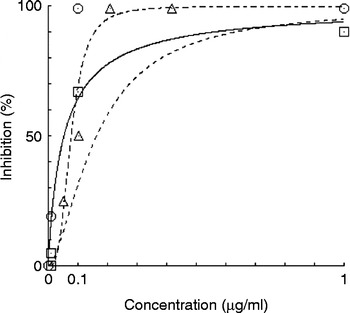
We first studied the effect of both drugs separately in vitro. The drug effect was assessed 24 h post-incubation. IC50 and IC95 values of 0.16 μg/ml and 0.99 μg/ml, respectively, were determined for praziquantel in vitro. At a dose of 0.05 μg/ml tribendimidine reduced the viability of O. viverrini by 50% (IC50). The corresponding IC95 value was 1.22 μg/ml. The dose–response curves of praziquantel and tribendimidine are presented in fig. 1.
Dose–response curves of tribendimidine and praziquantel and combined tribendimidine–praziquantel (IC50:IC50) against adult O. viverrini in vitro. Circles (solid line) represent tribendimidine, squares (broken line) praziquantel and triangles (broken line) the tribendimidine–praziquantel combination.

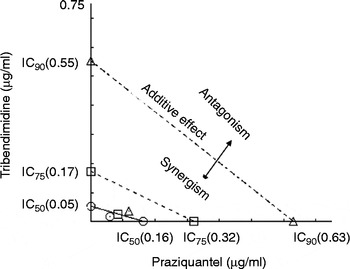
For the combination chemotherapy experiments, O. viverrini were incubated simultaneously in the presence of both tribendimidine and praziquantel at a ratio based on their IC50 values (1:3.2). The dose–effect curve of this combination at the 24-h examination point is shown in fig. 1. A synergistic effect was calculated for this combination against O. viverrini in vitro (CI = 0.7 at the IC50 (synergism) and 0.19 at the IC95 (strong synergism)). An isobologram for this combination is presented in fig. 2. The two highest concentrations tested (0.1 μg/ml tribendimidine and 0.32 μg/ml praziquantel and 0.05 μg/ml tribendimidine and 0.16 μg/ml praziquantel) resulted in death of all worms 24 h post-incubation. A 50% viability reduction was achieved with 0.018 μg/ml tribendimidine plus 0.059 μg/ml praziquantel (corresponding to DRI values of 2.9 and 2.8 for tribendimidine and praziquantel, respectively). In the next step, in two sets of experiments O. viverrini was exposed to the drugs spaced by their respective half-lives. All O. viverrini incubated with 0.16 μg/ml praziquantel followed by tribendimidine (0.05 μg/ml) after 1 h were dead after 24 h. When half of these doses were used, a strongly reduced viability (viability score = 1.75) was observed at the 24-h examination time point. At the lowest concentrations tested (0.04 μg/ml praziquantel followed by 0.0125 μg/ml tribendimidine) no effect was observed 24 h post-incubation. For this spaced co-administration (first praziquantel followed by tribendimidine) a CI of 0.78 at the IC50 (synergism) was determined. A similar picture was observed when the flukes were first exposed to tribendimidine followed by praziquantel 4 h later. At the highest concentrations (0.05 μg/ml tribendimidine and 0.16 μg/ml praziquantel) all worms were dead. At the medium concentrations, viability of worms was highly affected. Finally, at the lowest concentrations (tribendimidine (0.0125 μg/ml) followed by praziquantel (0.04 μg/ml)) worms were still alive, although they were slightly less active than the control worms. For this spaced tribendimidine–praziquantel combination a CI of 0.47 was calculated at the IC50, hence the combination also shows strong synergistic effects.
Isobologram showing the synergistic interaction of a tribendimidine–praziquantel combination against O. viverrini (simultaneous exposure) using the IC50:IC50 ratio in vitro at the IC50, IC75 and IC90. The circle (IC50), square (IC75) and triangle (IC90) are the combination data points.

In vivo studies
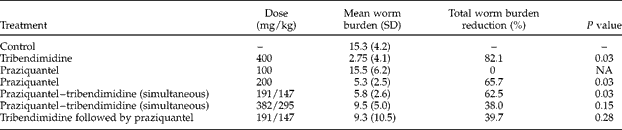
Given the promising in vitro results, which document synergistic properties of a tribendimidine–praziquantel combination regardless of the treatment schedule used, in vivo studies were launched. In a first step, monotherapy studies were carried out. Worm burden reductions of 0 and 65.7% (P= 0.03) were achieved by treating O. viverrini-infected hamsters with 100 and 200 mg/kg praziquantel (table 1). An ED50 of 191 mg/kg was determined for praziquantel. For the ED50 calculation of tribendimidine we included a result obtained from a previous experiment. At 200 mg/kg tribendimidine a worm burden reduction of 61.4% was recorded (Keiser et al., Reference Keiser, Xiao, Chollet, Tanner and Utzinger2007). In the present work, tribendimidine given at 400 mg/kg to O. viverrini-infected hamsters resulted in a significant worm burden reduction of 82% (P= 0.03). Of four hamsters investigated per group, one was cured following tribendimidine at 400 mg/kg. We calculated an ED50 of 147 mg/kg for tribendimidine.
Effect of praziquantel and tribendimidine monotherapies and praziquantel–tribendimidine combinations using a constant ratio design based on the ED50 values against O. viverrini in hamsters.

NA, not applicable.
Next, combination chemotherapy studies were conducted in vivo. A constant ratio design based on the ED50 values of both drugs (1:1.3) was used to analyse whether a praziquantel–tribendimidine combination reveals additive, antagonistic or synergistic effects in hamsters. When both drugs were administered simultaneously at a dose of 191 mg/kg praziquantel and 147 mg/kg tribendimidine a moderate worm burden reduction of 62.5% (P= 0.03) was observed. None of the hamsters was cured. Doubling both doses even lowered the efficacy and low, not significant worm burden reductions of 38% were documented. The ED50 dose of the combination was calculated as 493 mg/kg (279 mg/kg praziquantel and 214 mg/kg tribendimidine). A CI of 2.9 was determined at the median dose effect level, revealing antagonistic effects of this combination in vivo. We therefore tested whether the timing of drug co-administration might have an influence on the opisthorchicidal activity of the tribendimidine–praziquantel combination. However, when the drugs were administered on subsequent days, first tribendimidine followed by 191 mg/kg praziquantel after 24 h, a low worm burden reduction of 39.7% (P= 0.28) was documented.
Discussion
An estimated 8 million people are infected with O. viverrini, accounting for 74,000 disability-adjusted life years (DALYs) (Fürst et al., Reference Fürst, Keiser and Utzinger2012a). Heavily infected individuals often present with a series of symptoms, including severe consequences such as obstructive jaundice, biliary colic and cholangiocarcinoma (Fürst et al., Reference Fürst, Sayasone, Odermatt, Keiser and Utzinger2012b). Yet only a single drug is available for treatment of this neglected tropical disease. To our knowledge, tribendimidine is the only alternative drug development candidate for the treatment of infections with O. viverrini.
In the present work we studied the effect of praziquantel–tribendimidine combinations against O. viverrini in vitro and in vivo. While synergistic to highly synergistic effects were documented when O. viverrini were exposed to tribendimidine–praziquantel in vitro, disappointingly only low, antagonistic activities were observed in vivo using a ratio based on the ED50 values of the drugs. Interestingly, these contradictory effects were not only observed when the drugs were administered simultaneously but also following a spaced drug administration. The striking differences between the in vitro and in vivo observations cannot be explained at the moment. It is worth emphasizing that synergistic effects were observed against the closely related liver fluke, C. sinensis, although in a rat and not in a hamster model (Keiser et al., Reference Keiser, Xiao, Smith and Utzinger2009). Pharmacokinetic or pharmacodynamic drug interactions are likely to occur, which should be further studied. In addition, studies have shown that whether combinations of anticancer drugs interact synergistically or antagonistically can depend on the ratio of the combined agents (Harasym et al., Reference Harasym, Liboiron and Mayer2010). Hence, it might be worthwhile to assess tribendimidine–praziquantel in vivo using other ratios besides a ratio based on the ED50 values used in the present study.
In conclusion, a tribendimidine–praziquantel combination does not offer therapeutic benefit over tribendimidine or praziquantel monotherapy in the hamster model. Nonetheless, the opisthorchicidal properties of tribendimidine should be further studied in great detail as presently there is no other trematocidal drug candidate on the horizon. Dose-finding and pharmacokinetic studies with tribendimidine in O. viverrini-infected patients have been launched in Lao PDR.
Acknowledgements
J.K. and M.V. are grateful to the Swiss National Science Foundation (project nos PPOOA-114941 and PP00P3-135170) for financial support.