INTRODUCTION
Advance care planning (ACP) at the end of life is beneficial for patients, as well as for their caregivers and health providers. Previous studies have shown that ACP, including the completion of an advance directive (AD), is related to greater patient satisfaction and hospice use, fewer communication concerns with healthcare providers about end-of-life decision making, and better mental health outcomes among surviving caregivers (Detering et al., Reference Detering, Hancock and Reade2010; Teno et al., Reference Teno, Gruneir and Schwartz2007; Tierney et al., Reference Tierney, Dexter and Gramelspacher2001; Garrido & Prigerson, Reference Garrido and Prigerson2014; Garrido et al., Reference Garrido, Balboni and Maciejewski2014). However, nearly 20 years of research have continued to show suboptimal ACP rates among patients with progressive life-limiting diseases. In particular, the reported rates of AD completion among these patients vary widely, ranging from 17 to 40% (Astrow et al., Reference Astrow, Sood and Nolan2008; Emanuel et al., Reference Emanuel, Barry and Stoeckle1991; Halpern et al., Reference Halpern, Pastores and Chou2011; Holley et al., Reference Holley, Hines and Glover1999; Kumar et al., Reference Kumar, Aronow and Alexa2010; Morhaim & Pollack, Reference Morhaim and Pollack2013; Tajouri et al., Reference Tajouri, Ottenberg and Hayes2012; Wilkinson et al., Reference Wilkinson, Wegner and Shugarman2007).
There is a growing body of literature describing the characteristics of patients who plan for the end of life. For example, studies have consistently shown that patients with minority racial or ethnic backgrounds are less likely to engage in ACP (Johnson et al., Reference Johnson, Kuchibhatla and Tulsky2008; Kwak & Haley, Reference Kwak and Haley2005; Rao et al., Reference Rao, Anderson and Lin2014; Triplett et al., Reference Triplett, Black and Phillips2008). In addition, some findings suggest that AD completion is more likely among male patients (Bravo et al., Reference Bravo, Dubois and Paquet2003) and in those with higher socioeconomic status (Rao et al., Reference Rao, Anderson and Lin2014), higher educational level (Hirschman et al., Reference Hirschman, Abbott and Hanlon2012; MacIver et al., Reference MacIver, Rao and Delgado2008; Rosnick & Reynolds, Reference Rosnick and Reynolds2003), of older age (Bravo et al., Reference Bravo, Dubois and Paquet2003; Rosnick & Reynolds, Reference Rosnick and Reynolds2003; Triplett et al., Reference Triplett, Black and Phillips2008), or with a regular source of healthcare (Rao et al., Reference Rao, Anderson and Lin2014). Although there is an established body of literature describing important patient characteristics associated with ACP and AD completion, little research has examined caregiver characteristics associated with AD completion among patients who are terminally ill.
The Institute of Medicine defines caregivers as those who play a significant role in providing care and who assist with the crucial activities of daily living (Institute of Medicine, 2014). Caregiver participation is important in end-of-life care and decision making (Rabow et al., Reference Rabow, Hauser and Adams2004), and patients with life-threatening illnesses often express a preference for involving their caregivers in making decisions about their healthcare (Sulmasy et al., Reference Sulmasy, Hughes and Thompson2007). However, the majority of existing caregiver research primarily focuses on caregivers' experience (e.g., caregiver burden, care satisfaction, and end-of-life care) and communication preferences (Parker et al., Reference Parker, Clayton and Hancock2007), and few studies have examined how different caregivers (e.g., based on their race/ethnicity, age, education, or income) may influence objective end-of-life care planning or decision-making outcomes (e.g., completion of AD) among the patients they care for. Understanding the demographic correlates of AD completion, including those of patients as well as their caregivers, will help palliative care professionals target their efforts to promote AD completion in underrepresented groups. Further, understanding these associations is imperative to the design, implementation, and evaluation of interventions developed to improve family-centered ACP.
The purpose of this study was to understand the factors that may influence AD completion among terminally ill patients by examining both patient and caregiver characteristics that are associated with a patient's completion of AD. We defined AD completion as a patient having completed a living will and/or identified a healthcare power of attorney.
METHODS
This cross-sectional analysis examined baseline data from a larger, prospective five-year randomized controlled trial to evaluate the efficacy of the TAILORED (Trial of Ascertaining Individual preferences for Loved Ones' Role in End-of-life Decision) nurse-led guided discussion intervention on patient and family healthcare decision-making outcomes. The intervention was designed to prepare caregivers for the proxy decision-making role and to initiate or promote advance care planning discussions between patients and their caregivers.
Between 2010 and 2014, a convenience sample of patient–caregiver dyads was enrolled from Johns Hopkins medical institutions (Baltimore, MD) and the University of Chicago Hospital (Chicago, IL). The eligibility criteria for patient enrollment were: (1) a diagnosis of amyotrophic lateral sclerosis (ALS), stage III/IV gastrointestinal/pancreatic cancer, or New York Heart Association class III/IV congestive heart failure (CHF) with an internal cardioverter-defibrillator; (2) at least 18 years of age; (3) English-speaking; (4) able to identify a caregiver who is involved in healthcare decision making; and (5) a willingness of the identified caregiver to participate in the research study. The three disease groups were chosen to obtain a sample of patients in the terminal phase of illness, as evidenced by a prognosis of at least 50% 2-year mortality (American Joint Committee on Cancer, 2002; del Aguila et al., Reference del Aguila, Longstreth and McGuire2003; de Vita et al., Reference de Vita, Hellman and Rosenberg2001). The three groups were also chosen because they reflect different end-of-life disease trajectories during the advanced stage of illness near death (i.e., ALS patients exhibit gradual decline in health status, advanced cancer patients exhibit a rapid decline, and CHF patients exhibit fluctuating changes in health status at the end of life). The eligibility criteria for caregiver enrollment were: (1) is at least 18 years of age; (2) speaks and reads English; and (3) identified by the patient as someone with whom the patient makes healthcare decisions. All patients and caregivers over 80 years of age completed the Short Portable Mental Status Questionnaire (Pfeiffer, Reference Pfeiffer1975), and those who made five of more errors (indicative of moderate cognitive impairment) were excluded. The study was approved by the institutional review boards at both institutions.
In the parent study, trained research nurses consented and administered a self-report paper-and-pencil survey battery to all participants at study baseline. All patients and caregivers completed the instruments independently. The data employed in this analysis were abstracted from participants' background forms. The variables included in the analysis included patients' and caregivers' demographic information (i.e., age, sex, race/ethnicity, education level, marital status, and individual annual income). Patients' diagnoses and reports of their AD completion were also recorded. Patient AD completion was assessed by their response to the following questions: (1) Have you completed a living will? and (2) Have you chosen a healthcare agent (durable power of attorney for healthcare)? Patients were considered to have completed an AD if they responded yes to either or both of these questions. Data collected from dyads in both treatment groups in the parent study (i.e., intervention and control) were analyzed as an aggregate. The final sample for this analysis consisted of 206 patient–caregiver dyads (i.e., 412 individual participants).
Statistical Analysis
Analyses were performed using Stata 13® software (StataCorp, 2013). Descriptive statistics were used to describe patient and caregiver characteristics. Bivariate analyses (i.e., t and chi-square tests) were employed to determine whether patient or caregiver characteristics differed between patients with and without AD. Multivariate logistic regression was utilized to assess which patient and caregiver variables were associated with a patient's completion of an AD. Stepwise logistic regression was conducted by entering candidate predictor variables one by one into the model and choosing the “best” or the most parsimonious model based on the lowest Akaike information criterion (AIC). This model selection procedure was run using the “swaic” command. A value of alpha of 0.05 was used for all statistical tests. Model accuracy has been assessed using threefold cross-validated area under the ROC curve (Picard & Cook, Reference Picard and Cook1984).
RESULTS
The patient and caregiver characteristics of the full sample (206 patient–caregiver dyads) are listed in Table 1. Patients reported a mean age of 60.91 years (SD = 11.95). Most patients were male (59.71%), non-Hispanic Caucasian (62.62%), married (72.82%), and had obtained a college or higher degree (57.28%). The distribution of patients with ALS, cancer, and heart failure was 31.07, 45.63, and 23.30, respectively. Over half of the patients (61.65%) reported earning an individual income of $40,000 or more in the previous year.
Patient and caregiver demographic characteristics (N = 206)

The majority of caregivers were female (73.30%) and reported being the patient's spouse or significant other (66.02%). The mean age of caregivers was 55.52 years (SD = 12.76). Similar to the demographic characteristics of the patients, the caregivers were primarily non-Hispanic Caucasian (64.08%), married (81.55%), and had obtained a college or higher degree (61.17%). More than half of the caregivers (66.99%) also reported earning an individual annual income of $40,000 or more in the previous year.
Patient Characteristics Related to AD Completion
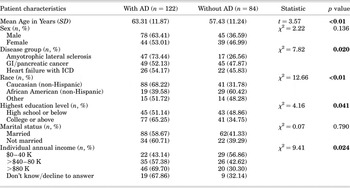
Of the 206 patients enrolled in the study, 122 (59.22%) reported having completed a living will and/or identified a healthcare power of attorney. Those who completed an AD were significantly more likely to be older (t(204) = 3.57, p < 0.01), non-Hispanic Caucasian (χ2(df = 2) = 12.66, p < 0.01), have ALS (χ2(df = 2) = 7.82, p = 0.02), or have a higher annual income (χ2(df = 3) = 9.41, p = 0.02). Patient sex or marital status was not related to patient completion of AD in bivariate analyses. Patients' demographic characteristics by AD completion are presented in Table 2.
Patient characteristics and completion of an advance directive (AD)

Caregiver Characteristics Related to Patient's AD Completion
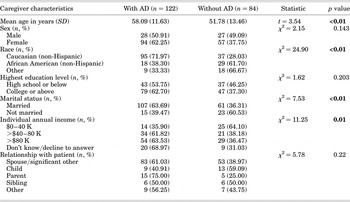
Certain caregiver characteristics were associated with patients' completion of an AD. In our sample, patients were significantly more likely to have an AD in place if the caregiver was older (p < 0.01), non-Hispanic Caucasian (χ2(df = 2) = 24.90, p < 0.01), married (χ2(df = 1) = 7.53, p < 0.01), or reported a higher annual income (χ2(df = 3) = 11.25, p = 0.01). Caregiver sex, level of education, and relationship to the patient were not related to patient AD completion in the bivariate analyses. Comparisons of caregiver demographic characteristics by patient AD completion are presented in Table 3.
Caregiver characteristics and patient completion of an advance directive (AD)

Model for AD Completion
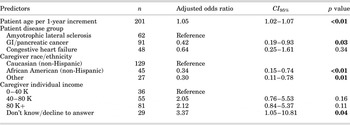
After deletion of 5 cases with missing values, data from 201 dyads were used for multivariate logistic regression analysis to construct a predictive model for AD completion. Based on the forward-selection procedure, the model associated with the smallest AIC (i.e., the most parsimonious model) included patient age, patient disease group, caregiver race/ethnicity, and caregiver annual income (Table 4). The multivariate model had acceptable out-of-sample discrimination between patients who did and did not have an AD; the cross-validated area under the ROC curve was 0.72 (CI 95% = 0.65–0.80).
Predictors of advance directive (AD) completion based on the most parsimonious model

In terms of patient characteristics, the odds of completing an AD were 5% higher (p < 0.01, CI 95% = 1.02–1.07) per year increase in patient age after adjustment for patient's diagnosis, and caregiver annual income and race. On the other hand, the odds of completing an AD were 58% lower among those with cancer compared to those with ALS after adjustment for patient age and caregiver race and annual income (p = 0.03, CI 95% = 0.19–0.93); the odds of AD completion did not significantly differ between those with CHF and ALS.
Two caregiver characteristics were included in the model: caregiver race/ethnicity and reported individual annual income. Caregiver race was associated with patient AD completion in the multivariate logistic regression model (χ2(df = 2) = 6.46, p = 0.04). The odds of patient completion of AD were 66% lower (p < 0.01, CI 95% = 15–0.74) among those with non-Hispanic African-American caregivers and 70% (p = 0.01, CI 95% = 0.11–0.78) lower among those with caregivers who self-identified as belonging to another racial/ethnic group as compared to those with non-Hispanic Caucasian caregivers after adjustment for patient age, diagnosis, and caregiver annual income. Patients' adjusted odds of completing an AD were 3.37 times higher among those whose caregivers reported “don't know” or “decline to answer” for individual annual income (p = 0.04, CI 95% = 1.05–10.81) compared to those whose caregivers reported earning less than $40,000. Since no differences in the odds of patient AD completion was found between other caregiver annual income groups in this model, characteristics were compared between caregivers who reported an actual annual income level and those who did not report an income level (i.e., “don't know” or “decline to answer”). In this post-hoc analysis, caregivers who did not report an individual annual income level were significantly older (p < 0.01) compared to those who reported an annual income level. No other differences were found based on caregiver sex, education level, marital status, or relationship to the patient.
DISCUSSION
The present analysis examined patient and caregiver characteristics associated with completion of an advance directive (AD) in terminally ill patients. Similar associations between patient characteristics and AD completion have been reported in the literature (see Wilkinson et al., Reference Wilkinson, Wegner and Shugarman2007). However, to our knowledge, ours is the first dyadic study to include caregiver characteristics as predictors for patient completion of AD. We aimed to develop the “best” model using patient- and caregiver-specific characteristics as candidate predictors of AD completion. For this purpose, an automatic forward-selection procedure was employed to select the most parsimonious list of predictors, and the final multivariate logistic regression model included patient age, patient disease group, caregiver race/ethnicity, and caregiver annual income. Our findings support the need to increase efforts in counseling patients and their caregivers from underrepresented groups to promote AD completion. Additionally, continued exploration into the social determinants of health and other factors that may explain discrepant AD completion tendencies among different patient groups at the end of life are warranted.
More than half of our patients reported having completed an AD at study baseline. Consistent with prior research, patients were more likely to have completed a living will and/or identified a durable healthcare power of attorney as they got older. It is plausible that older adults are more likely to complete an AD because they have had more illness experiences or more opportunities to come into contact with ACP advocates in their healthcare. Therefore, our findings suggest a need for targeted counseling to promote AD completion among younger patients who are diagnosed with a life-limiting disease.
Patients with ALS were also more likely to have completed an AD compared to patients with cancer. This finding may be related to the differences in disease trajectory—that is, compared to patients with cancer, patients with ALS may be more likely to believe that their health decline and the likelihood of losing decision-making capacity are imminent as the disease progresses. It is also possible that AD completion rate in our sample of patients with ALS was comparatively high because we recruited these patients from a clinic where providers strongly subscribe to the ACP model and integrate it into the care of their patients upon diagnosis. Nonetheless, it has been suggested that patients with advanced cancer may be less likely to have documented ACP compared to patients with ALS despite having worse survival outcomes due to the hopefulness and optimism commonly encouraged among patients with cancer (Astrow et al., Reference Astrow, Sood and Nolan2008). Because different diseases present different trajectories and illness experiences, qualitative research in this area is needed to fully understand ACP preferences and practices among patients with different diseases and at different stages of their disease progression.
Our results suggest that caregiver characteristics play a role in AD completion among terminally ill patients. Since we expected a strong correlation between patient and caregiver race/ethnicity and income, we avoided including both patients' and caregivers' race/ethnicity or income variables in the same model. Instead, we allowed the automatic selection procedure to select the best set of predictors, which included caregiver, rather than patient, race/ethnicity and income. These findings point to the importance of including caregivers in ACP discussions, particularly for patients with caregivers in underrepresented groups. Furthermore, more dyadic studies including both patients and their caregivers are needed to understand caregiver influence on patient AD completion and use, and how caregivers can best be included in ACP for patients at the end of life.
The findings from previous studies primarily point to differences in AD completion based on patient race (i.e., nonwhite patients are less likely to have an AD in place; Zaide et al., Reference Zaide, Pekmezaris and Nouryan2013), yet we found that caregiver race/ethnicity was a strong predictor for patient AD completion, and that AD completion was significantly lower among patients with caregivers who were not Caucasian. These findings suggest that palliative care professionals should actively engage minority caregivers in end-of-life discussions to improve ACP among terminally ill patients.
We also found that the odds of AD completion among patients whose caregiver did not report an income level were more than three times higher compared to patients with caregivers who reported an actual income level. We offer two possible explanations for this finding. First, our post-hoc analysis suggests that this may be related to caregiver age—that is, those who declined to report their income tended to be older and, possibly, retired, so that they did not know what their income was. Another possibility is that those who declined to report their income have an inherently stronger desire to control how their private or health information will be used and, in turn, influenced the patient to complete an AD to assure their ability to assert control over their healthcare preferences at the end of life.
Our study revealed important patient and caregiver characteristics associated with patient AD completion. However, AD completion only serves as a surrogate quality outcome of advance care planning. Therefore, palliative care professionals must continue their efforts in communicating, documenting, and implementing AD, and include caregivers in these important discussions to assure that patients' wishes are honored at times of decisional incapacity.
Three limitations of our study should be noted. First, we used a convenience sample of patient–caregiver dyads, thereby limiting the generalizability of our results. However, we recruited patients in multiple disease categories and from two geographically distinct locations to improve sample variability. Second, this analysis was limited to the variables employed in the parent study, and it is possible that other patient or caregiver characteristics essential to a patient's decision for AD completion were not included. For example, previous studies have suggested differences in ACP based on a patient's source of healthcare, comorbidities, and recent changes in health status (Hirschman et al., Reference Hirschman, Abbott and Hanlon2012; Rao et al., Reference Rao, Anderson and Lin2014). However, much of our findings corroborate the existing knowledge of patient characteristics related to AD completion, and they generate new insight into caregiver characteristics in relation to patient AD completion at the end of life.
Finally, our best model was developed using one dataset. The model has not been tested on another dataset that would assess the external accuracy of our model. To address this concern, we attempted to control model overfitting by using a limited set of variables and by employing explicit model selection criteria. In addition, we also report threefold cross-validated area under the curve to assess model performance accuracy.
CONCLUSIONS
Both patient and caregiver characteristics may influence a patient's completion of an advance directive at the end of life. When possible, caregivers should be included in advance care planning for patients who are terminally ill. Our findings call for the need to further explore characteristics related to patient use of an AD, and how caregivers may influence patients' decisions to exercise ACP and to complete an AD. A holistic understanding of these relationships will help palliative care professionals target their efforts to promote AD completion and inform the design, implementation, and evaluation of interventions so as to improve family-centered ACP.
DISCLOSURES/ACKNOWLEDGMENTS
The authors gratefully acknowledge the support of the National Institute of Nursing Research of the National Institutes of Health under award number R01NR010733.