Introduction
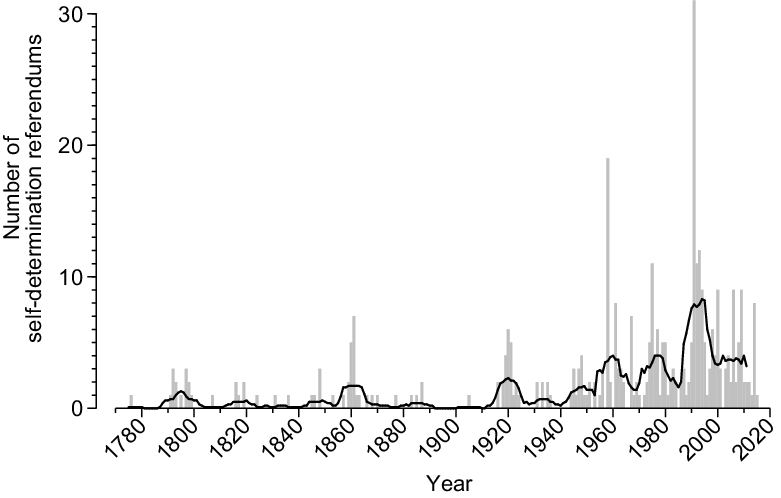
In early May 1776, the Province of Massachusetts Bay embarked on what at the time could only be described as an extraordinary exercise: a popular consultation on whether Massachusetts, along with the remaining twelve American colonies, should declare its independence from Britain (Maier, Reference Maier1997, pp. 59–61). Since then, the idea of consulting the people in questions of territorial self-determination has spread around the world, first to Europe and then to Africa, Asia, and Oceania. The popularity of self-determination referendums, here defined as direct popular votes on whether one or more of a state’s regions should gain increased autonomy or secede, has surged especially in recent decades. Footnote 1 According to data collected by Mendez and Germann (Reference Mendez and Germann2018), more than 75% of all 360 known self-determination referendums occurred after 1945; and around 40% were held over the course of the past three decades alone (see Figure 1).
Annual frequency of self-determination referendums including 10-year moving average, 1776–2015.

The recent mushrooming of referendums on self-determination is likely owed to a multitude of factors including the increasing diffusion of democratic norms and ethno-nationalist ideals. Another likely reason is the increased promotion of self-determination referendums through the international community. As explained by Tierney (Reference Tierney2012), there seems to be a common perception among diplomats, conflict mediators, and democracy activists that ballots can prevent bullets. As a result, international actors such as the UN, the EU, or the USA have increasingly started to promote the use of referendums as they intervene in self-determination conflicts around the world (e.g., Northern Ireland, East Timor, Montenegro, and South Sudan). However, contrary to the seemingly widespread belief among practitioners, the ability of self-determination referendums to bring about peace remains uncertain.
To date, the conflict resolution potential of self-determination referendums has only rarely been systematically investigated (though see Qvortrup, Reference Qvortrup2014). Furthermore, the existing, largely case-based literature on the conflict resolution potential of self-determination referendums remains sharply divided, with some expressing highly optimistic views while others issue stark warnings. According to the former view, self-determination referendums are a highly beneficial mechanism of conflict resolution because they lend popular legitimacy to decision outcomes (e.g., Farley, Reference Farley1986). By contrast, the critics suggest that self-determination referendums are deeply problematic because they are ‘zero sum’, creating winners and losers in situations where compromise would be needed. Therefore, the critics argue that self-determination referendums are likely to exacerbate societal polarization and increase the risk of violent conflict rather than reduce it (Rudrakumaran, Reference Rudrakumaran1989; Mac Ginty, Reference Mac Ginty2003; Reilly, Reference Reilly, Darby and Mac Ginty2008; Lee Mac Ginty, Reference Lee and Mac Ginty2012). According to this view, self-determination referendums amount to no less than ‘the most damaging form of democratic legitimation’ (Reilly, Reference Reilly, Darby and Mac Ginty2008, p. 236).
In this article, I revisit the debate on the conflict resolution potential of self-determination referendums. While the existing literature has frequently cast these referendums in black-or-white terms, I argue that the relationship between self-determination referendums and peace is more complex. While it is true that referendums on self-rule offer stark and potentially polarizing choices, as some of their critics have argued, stark choices cannot always be avoided. A region cannot be both autonomous and not autonomous; or secede and not secede. Combining insights from the broader literatures on procedural fairness, democratic theory, and ethno-nationalist conflict, I argue that self-determination referendums have basic value as a tool for conflict resolution because they can instill perceptions of fair decision-making and a willingness to accept unfavorable decision outcomes. However, I suggest that the conflict resolution potential of self-determination referendums is conditional, depending on whether or not they are held under the mutual agreement of the conflict parties. For referendums to generate peace, they need to instill fairness perceptions among both winners and losers. And, in the context of separatist conflicts, that is likely only when referendums are mutually agreed by representatives from the relevant minority and majority groups. By contrast, if self-determination referendums are initiated in the absence of such mutual agreement, ethno-nationalist grievances are likely to increase rather than decrease, and with them the risk of violence. Therefore, the critics’ gloomy predictions may well come true when self-determination referendums are unilaterally initiated.
Two things are important to add. First, I am not suggesting that mutual agreement is the only factor which could influence the conflict resolution potential of self-determination referendums. For example, factors such as electoral integrity or the timing of referendums in peace processes are likely to shape the effects of self-determination referendums (He, Reference He2002; Laponce, Reference Laponce2004; Loizides, Reference Loizides2014). However, I do contend that mutual agreement is a particularly important basic condition that needs to be met for self-determination referendums to act as a catalyst for peace, which makes it a good point of departure for more in-depth study. Second, I am not the first to suggest that the conflict resolution potential of self-determination referendums depends on mutual agreement of the conflict parties. Indeed, already Sarah Wambaugh in her seminal 1933 treatise of the international plebiscites in the aftermath of the First World War made a similar recommendation (Wambaugh, Reference Wambaugh1933, p. 506). Similar arguments have occasionally been made in subsequent years (e.g., Bogdanor, Reference Bogdanor and Ranney1981; Wheatley, Reference Wheatley and Marxer2012; Collin, Reference Collin, Norris, Frank and Coma2015). However, the reasons why mutual agreement on self-determination referendums is so important, as well as its exact meaning, have remained under-theorized and under-specified. Even more importantly, the argument that the conflict resolution potential of self-determination referendums depends on mutual agreement has never been put to a systematic empirical test.
Accordingly, this paper contributes to the literature in three main ways. First, I clarify why mutual agreement on self-determination referendums is so important and, building on extant literature, I propose clear causal mechanisms linking self-determination referendums to both peace and war depending on whether they are mutually agreed or not. Second, I propose a definition of mutual agreement that is sufficiently precise to be amenable to empirical research. Finally, I present the first systematic empirical test of the theory that self-determination referendums’ conflict resolution potential depends on mutual agreement.
To be sure, testing of this argument is not easy. Mutual agreement on self-determination referendums is possible only where the state is willing to accept at least a small risk of losing some of its territory or sovereign powers, and where states and separatists can agree on the terms of a referendum. Conversely, unilateral self-determination referendums emerge in situations where the parties show no such willingness to compromise. Almost by definition, then, mutually agreed referendums are more likely to emerge in situations where the risk of future violence is already comparatively low whereas unilateral referendums are more likely to emerge where the risk of future violence is already comparatively high. I argue that the introduction of a mutually agreed or unilateral self-determination referendum is likely to reinforce preexisting conflict dynamics and further increase or decrease the chances for peace, respectively; however, the endogeneity of self-determination referendums to conflict processes makes it difficult to test this argument empirically. To nevertheless address endogeneity concerns to the extent possible, I pursue a three-pronged empirical strategy involving a cross-national large-N comparison, short case studies, and a survey experiment. Importantly, none of the three approaches is able to fully resolve problems of causal inference. However, by combining three different methodological approaches I can test a range of theoretical implications at different levels of analysis and, therefore, conduct a stronger test of my theory.
More specifically, I first conduct a statistical analysis of the global experience with self-determination referendums since the end of the Second World War. This analysis allows me to explore correlations between self-determination referendums and macro-level conflict outcomes (i.e., separatist war) based on a large set of cases and while controlling for a range of alternative explanations for separatist war. Using fixed effects models, I find that mutually agreed self-determination referendums are associated with a reduced probability of new separatist wars breaking out and an increased probability of ongoing separatist wars ending. Consistent with theoretical predictions, I also find that unilateral self-determination referendums increase the risk of new separatist wars emerging.
Second, I conduct a more in-depth qualitative comparison of self-determination referendums held in Northern Ireland and the former Yugoslavia. In addition to illustrating the findings from the statistical analysis, the case studies allow me to assess the basic plausibility of my postulated causal mechanisms. Drawing on secondary sources, I find that mutually agreed self-determination referendums made important contributions to peace processes in both Northern Ireland and the former Yugoslavia by furthering the mutual acceptance of decision outcomes. Consistent with theoretical expectations, I also find that unilateral self-determination referendums held in the same contexts tended to exacerbate ethnic grievances and may thereby have contributed to violent outcomes.
Finally, I leverage the ongoing debate about a second Scottish independence referendum to test important micro-level predictions of my theory using a survey experiment. The results suggest that whether or not a hypothetical second Scottish independence referendum had the agreement of the UK government matters relatively little to Scots, who tend to see a referendum as fair even if it was unilaterally initiated by the Scottish government. By contrast, English individuals see a Scottish independence referendum as much fairer if it was mutually agreed by the Scottish government and the UK government. Importantly, I also find that mutual agreement translates into a much higher willingness to accept a Scottish vote for independence among English individuals and, especially, among English unionists. Overall, these findings suggest that as predicted by my theory, shared perceptions of fair decision-making and a shared willingness to accept the referendum outcome are much more likely to emerge when self-determination referendums are mutually agreed by representatives from the relevant minority and majority groups.
Self-determination referendums, procedural fairness, and conflict resolution
Clearly the most desirable way to resolve societal conflicts involves a compromise which satisfies all sides. However, consensus solutions are often not possible and, therefore, decisions which favor one side while disadvantaging another have to be frequently made. Procedural fairness theory suggests that when consensus solutions cannot be reached, the key consideration becomes how decisions are made. More specifically, procedural fairness theory holds that when decisions are made in a fair way, they are likely to become broadly accepted, which in turn reduces both violent and nonviolent opposition to decision outcomes (Tyler, Reference Tyler2000).
The idea that fair decision procedures can help to resolve conflicts peacefully goes back to the ancient Greeks, but it has more recently been formalized by various strands in political science (e.g., Levi, Reference Levi1988) and social psychology (e.g., Thibaut and Walker, Reference Thibaut and Walker1975; Lind and Tyler, Reference Lind and Tyler1988). The central assumption behind procedural fairness theory is that fairness constitutes a universal social norm (Esaiasson et al., Reference Esaiasson, Persson, Gilljam and Lindholm2019). Therefore, procedural fairness theory suggests that people who experience a decision-making process will assess the fairness of the procedural arrangements; and that this assessment then causes reactions. Most directly relevant in this context, procedural fairness theory suggests that perceptions of fair decision-making cause individuals to perceive a moral obligation to accept a decision outcome, even if it is against their preferences (Levi, Reference Levi1988; Lind and Tyler, Reference Lind and Tyler1988; Beetham, Reference Beetham1991). Fair decision procedures should therefore increase the cooperation of decision losers (Thibaut and Walker, Reference Thibaut and Walker1975).
There is extensive empirical evidence confirming the basic intuition behind procedural fairness theory. In brief, it is well established that people from different cultural contexts engage in procedural fairness evaluations; that broadly similar criteria tend to be used in fairness assessments, including impartiality and voice; and that positive fairness evaluations increase people’s willingness to voluntarily comply with decisions (Tyler, Reference Tyler2000). At the same time, increasing evidence links individual-level fairness considerations to macro-level conflict outcomes. For example, due process in domestic or international human rights courts has been shown to help stabilize post-conflict countries (Meernik et al., Reference Meernik, Nichols and King2010). Similarly, Gibson (Reference Gibson2006) found that truth commissions can provide a valuable avenue for victims to air past injustices and thereby induce pacification. Furthermore, the literature on the internal democratic peace argues that democracies tend to avoid war in part because of the fairness of their decision procedures (Hegre, Reference Hegre2014). In particular, the role of elections as a mechanism for the peaceful allocation of power has been widely studied (Diamond, Reference Diamond2006; Brancati and Snyder, Reference Brancati and Snyder2013).
If elections have potential to help resolve conflicts peacefully, then so should referendums. In fact, the conflict resolution potential of referendums could even be higher than that of elections. Participatory democrats have long argued that decision mechanisms which give citizens a direct rather than merely an indirect say are likely to generate higher fairness perceptions (Pateman, Reference Pateman1970; Barber, Reference Barber1984). Procedural fairness theory would therefore lead to the expectation that direct forms of democratic decision-making, such as referendums, lead to a higher willingness to (peacefully) accept unfavorable political decisions (Esaiasson et al., Reference Esaiasson, Gilljam and Persson2012).
Until recently, this basic contention has rarely been put to a systematic test. However, in recent years, the empirical evidence in favor of the superior ability of referendums to generate fairness perceptions and decision acceptance has started to mount. For example, survey experimental evidence from several Western countries including Germany, the Netherlands, Sweden, and the USA suggests that citizens think of political decisions as fairer, and are more willing to obey decision outcomes they oppose, if the decision is made by referendum instead of by elected representatives, experts, or judges (Esaiasson et al., Reference Esaiasson, Gilljam and Persson2012; Gash and Murakami, Reference Gash and Murakami2015; Towfigh et al., Reference Towfigh, Goerg, Glöckner, Leifeld, Llorente-Saguer, Bade and Kurschilgen2016; Esaiasson et al., Reference Esaiasson, Persson, Gilljam and Lindholm2019; Werner and Marien, Reference Werner and Marien2022). At the same time, a unique field experiment conducted in several dozen Indonesian villages suggests that citizens perceived selections of development projects as significantly fairer and were more willing to make personal contributions, such as labor or materials, if projects were chosen in a referendum rather than by elected representatives (Olken, Reference Olken2010). Finally, observational evidence from Switzerland suggests that higher degrees of direct democracy increase government legitimacy and boost compliance with tax laws (Torgler, Reference Torgler2005).
Given the close connection between fairness perceptions, decision acceptance, and social cooperation, these findings provide clear indications that referendums should have basic value as a tool for conflict resolution. However, referendums’ conflict resolution potential is likely to be conditional, much like that of elections. For example, existing research suggests that obviously rigged elections are unlikely to produce fairness perceptions and may be violently contested (Daxecker, Reference Daxecker2012). Others have stressed the importance of the timing of elections in democratization processes (Mansfield and Snyder, Reference Mansfield and Snyder2007). Analogously, factors such as electoral integrity and the timing of referendums are likely to shape the conflict resolution potential of referendums (He, Reference He2002; Laponce, Reference Laponce2004; Loizides, Reference Loizides2014). However, I argue that in the case of referendums on self-determination, another, even more fundamental factor comes into play: whether or not referendums are mutually agreed by the conflict parties.
Mutual agreement on self-determination referendums
Democracy requires prior agreement on the rules. Only when there is prior agreement on when a vote should take place, what it will be about, who is eligible to vote, and how it is decided who wins and who loses can democratic contests generate perceptions of fair decision-making and thereby convince the losers that they should respect the decision outcome (Dahl, Reference Dahl1990; Beetham, Reference Beetham1991). Now, prior agreement on democratic rules is frequently less of a concern because democratic rules tend to be regulated in constitutions and electoral laws, which themselves are likely a result of democratic decision-making and often have broad societal acceptance. In stark contrast to this, broad societal agreement on the rules of self-determination referendums and, even more generally, broad agreement that a self-determination referendum should take place at all, are frequently lacking.
Unlike many other, more standard kinds of democratic contests, self-determination referendums are only rarely regulated in constitutions and electoral laws. What is more, their rules tend to be deeply contested even if they are regulated. Fundamentally, this is because disputes over self-determination necessarily involve a conflict over the right to make political decisions over the same territory. On the one hand, there are the separatists, who claim the right to make political decisions for their own people, typically a peripheral minority. On the other hand, there is the majority group, which claims the right to make decisions for the entire existing state, including the minority’s claimed territory (Gellner, Reference Gellner1983; Hechter, Reference Hechter2000). These claims need not be absolute; majority groups may be willing to share power with the minority group in an autonomy arrangement, and vice versa. Still, the right to have a say on whether, when, and how a decision on the fate of (part of) one’s claimed territories is made is integral to the idea of self-determination. Therefore, self-determination referendums are only likely to generate perceptions of fair decision-making on both sides if they, including their terms, have been mutually agreed by the relevant minority and majority groups.
At this point it is important to clarify the exact meaning of mutual agreement. Mutual agreement could be seen as requiring that referendums have the support of all members of the relevant majority and minority groups. Of course, though, universal support is rarely realistically achievable. I argue that it is also not necessary. Departing from the idea of ethno-national representation (Cederman et al., Reference Cederman, Wimmer and Min2010), I instead suggest that a sufficient level of mutual agreement exists if a self-determination referendum, including its terms, is publicly supported by key representatives of both the minority and the majority group. At a minimum, this should include the central government and representatives of the separatist group, such as a regional government or the leaders of a separatist movement.
However, even if universal support is not necessary, mutual agreement on a self-determination referendum is often hard to find. Some states, such as more democratic states (Gurr, Reference Gurr2000) or states which face a low number of potential future separatist challenges (Walter, Reference Walter2006), may be more willing to accommodate separatists compared to others. Yet, the general unwillingness of states to part with sovereignty and especially states’ unwillingness to part with territory is well documented (Hechter, Reference Hechter1992). At the same time, the outcomes of referendums can be difficult to predict. Therefore, mutual agreement on self-determination referendums can generally only emerge if states are willing to accept at least a small or, depending on the separatists’ level of popular support, also a high risk of losing partial or full control over some of their territory.
A second important roadblock for mutually agreed self-determination referendums is that the parties need to be able to agree on the terms of a referendum (Germann, Reference Germann2017). This can be difficult to achieve if, for example, the separatists demand a vote on secession while the state is only willing to consider a vote on internal autonomy. Furthermore, states and separatist groups may disagree on formal rules, particularly those that could affect their respective chances of winning. Perhaps most obviously, this includes majority requirements and the timing of referendums. In addition, eligibility criteria can constitute a key source of conflict as states may demand that all of a state’s citizens are eligible to vote including members of the majority group while separatists may demand that only residents of the separatist region are allowed to vote (Goodhart, Reference Goodhart and Ranney1981). Similarly, questions such as the voting rights of ethnic minorities or settlers can constitute major stumbling blocks, as in the long-awaited referendum on the independence of Western Sahara.
Overall, mutually agreed self-determination referendums are therefore only likely to emerge in situations where at least the state and, in many cases, both parties show a significant willingness to compromise. Such conditions are far from omnipresent; yet, as the examples of Montenegro and Northern Ireland discussed below illustrate, they do exist. The key argument of this paper is that where mutual agreement on a self-determination referendum can be found, they can make important contributions to conflict resolution by instilling shared perceptions of fair decision-making among members of both the majority and the minority group. As a result, both the winners and losers are likely to accept and honor the decision outcome, which should increase the probability of peace.
Unilateral self-determination referendums
In many cases, though, a compromise on a self-determination referendum is likely to remain elusive. Under such circumstances, self-determination referendums may still be held, but they are likely to be unilaterally initiated. Importantly, both states and separatists can launch unilateral self-determination referendums, albeit typically with diametrically opposed motivations. The separatists, on the one hand, may launch a unilateral referendum in the hope of establishing a popular mandate for their demands and, thereby, force concessions from the state or at least increase international pressure on the state to address the situation. In addition, the separatists may hope to create a basis on which other states are willing to recognize a unilateral secession; and also hope for a mobilization effect and increased support for their cause among their constituents (Cortés Rivera, Reference Cortés Rivera2020; Kelle and Sienknecht, Reference Kelle and Sienknecht2020; Kosienkowski, Reference Kosienkowski2021). On the other hand, states may use unilateral referendums to generate a popular mandate for the status quo or some minimal form of accommodation in an effort to legitimize their unwillingness to meet the more maximalist demands of separatists vis-‘a-vis both domestic and international audiences (Germann, Reference Germann2017).
As demonstrated by the recent examples of Catalonia and Iraqi Kurdistan, unilateral self-determination referendums are relatively common. At least in part, this is likely because appeals to democratic values are widely perceived to be an effective bargaining tactic in an increasingly democratic world. One prominent example of where the initiators of a unilateral referendum were able to reach their core goal is Bosnia, whose 1992 independence referendum was cited by the international community as justification for its unilateral secession from Yugoslavia (Peters, Reference Peters1995). Another is Tatarstan, a Russian ethnic republic which was granted an improved autonomy arrangement after its unilateral autonomy referendum of the same year (George, Reference George2009). However, I argue that bargaining by unilateral referendum constitutes a dangerous act of brinkmanship. Almost by definition, unilateral referendums tend to occur in situations where the risk of future violence is already comparatively high. I suggest that the introduction of a unilateral referendum is likely to make a bad situation worse and further raise the spectre of violent conflict.
The fundamental reason unilateral self-determination referendums are dangerous is that they are unlikely to generate a shared willingness to respect their results. Instead, unilateral self-determination referendums are likely to further increase perceptions of unfair treatment and ethnic grievance, which can directly contribute to violent outcomes. To be sure, unilateral self-determination referendums may be seen as fair by the initiating side. However, the unilateral decision to hold a referendum violates the noninitiating side’s claim to self-determination. Therefore, unilateral referendums are unlikely to be seen as fair by the noninitiating side. Moreover, the rules in unilateral referendums usually favor their initiators. As a result, unilateral self-determinations are likely to be rejected as unfair by members of the noninitiating side. If states organize a unilateral referendum, they thereby render more visible imposed ‘alien’ rule. Conversely, if the separatists organize a unilateral referendum, members of the majority group are likely to be infuriated by what they consider to be illegal posturing. As is well established in the literature, ethnic grievances of this sort are conducive to emotional responses including anger and resentment (Petersen, Reference Petersen2002), further radicalization, and increase perceptions that violence is justifiable or even necessary (Gurr, Reference Gurr1970; Cederman et al., Reference Cederman, Wimmer and Min2010; Germann and Sambanis, Reference Germann and Sambanis2021). Overall, unilateral self-determination referendums are therefore likely to exacerbate conflicts instead of helping to resolve them peacefully.
Global statistical analysis
I begin to evaluate my theory using cross-national regression analyses. This analysis allows me to establish whether, as my theory would predict, self-determination referendums are associated with peace when they are mutually agreed and with large-scale violence when they are not. To address the endogeneity of self-determination referendums to conflict processes, I control for possible correlates of self-determination referendums and separatist civil war as well as unobserved dispute-level heterogeneity.
Data
The analysis is based on a global sample of disputes over self-determination (1946–2012). Disputes over self-determination are defined as violent and nonviolent conflicts between states and ethnic groups that make claims for increased autonomy or outright secession. Mimicking the approach pioneered by Germann and Sambanis (Reference Germann and Sambanis2021), I include all self-determination disputes which (1) are included in Sambanis et al.’s (Reference Sambanis, Germann and Schädel2018) Self-Determination Movements (SDM) dataset and (2) are also included in the Ethnic Power Relations dataset (EPR) (Vogt et al., Reference Vogt, Bormann, Rüegger, Cederman, Hunziker and Girardin2015). The key advantage of this approach is that by merging SDM with EPR, I gain access to EPR’s large library of data on pertinent control variables (e.g., political exclusion or regional autonomy levels), thus significantly improving my ability to account for alternative explanations. However, as explained by Germann and Sambanis (Reference Germann and Sambanis2021), this approach also comes at a cost because some self-determination disputes cannot be included. On the one hand, neither SDM nor EPR provide data on groups engaged in anti-colonial liberation struggles. On the other hand, EPR does not include some of the self-determination groups included in SDM, such as groups defined over their region of origin (e.g., Lombards in Italy). Footnote 2 That said, my approach still allows me to investigate the consequences of self-determination referendums based on a diverse set of cases covering all world regions. Overall, my sample includes 290 of the 464 noncolonial self-determination disputes coded by the SDM dataset, or around two-thirds. The unit of analysis in all analyses reported below is the country-group dyad-year.
Following convention in the civil war literature, I run separate models explaining the onset and the termination of separatist war, respectively. The onset of separatist war is defined as a transition from no separatist war to separatist war, with cases of ongoing war dropped. The termination of separatist war is defined as a transition from separatist war to no separatist war, with cases of ongoing peace dropped. This combination of dependent variables allows me to study the consequences of self-determination referendums held during both peace and war time. The data on separatist war is drawn from the SDM dataset and includes both major civil wars and armed conflicts with lower intensity (Sambanis et al., Reference Sambanis, Germann and Schädel2018). Overall, my data includes 183 cases of separatist war onset and 159 cases of separatist war termination.
The main independent variables reflect the incidence of (1) mutually agreed and (2) unilateral self-determination referendums in the context of a self-determination dispute. The referendum variables are coded 1 in the year a referendum is held and the following year, 0 otherwise. I identified self-determination referendums based on the Contested Sovereignty dataset, which includes data on all sovereignty-related referendums held since 1776 (Mendez and Germann, Reference Mendez and Germann2018). Next, I added information on whether self-determination referendums were mutually agreed in line with the above definition. Most of the cases were straightforward to code as they either resulted from inclusive negotiations and/or were triggered based on uncontested constitutional rules (indicating mutual agreement); or were clearly and publicly disavowed by one side through calls for boycotts or declarations that a referendum is illegal or unconstitutional (indicating lack of mutual agreement). Section 1.2 of the Supplementary Material includes case-by-case notes explaining all coding decisions. Overall, my sample includes 106 self-determination referendums, 45 of which were mutually agreed and the remaining 61 unilateral. Footnote 3 Mutually agreed referendums are more likely to deal with internal autonomy, but a substantial number also deal with outright secession (11 of 45 cases). By contrast, unilateral self-determination referendums more often deal with outright secession (36 of 61 cases). Three quarters of the unilateral referendums are initiated by separatists and the remaining quarter by central states.
Method
I estimate both the war onset and the war termination models using linear probability models including dispute fixed effects. Many known correlates of separatist war are (close to) time-invariant including the relative population size of separatist groups (Cederman et al., Reference Cederman, Wimmer and Min2010), whether separatist groups are regionally concentrated (Toft, Reference Toft2003), or the ruggedness of terrain (Fearon and Laitin, Reference Fearon and Laitin2003). Several of the same approximately time-invariant variables have also been linked to the incidence of mutually agreed and/or unilateral self-determination referendums (Germann, Reference Germann2017). Dispute fixed effects allow me to account for all time-invariant confounders without measuring them explicitly. Notably, this includes potential confounders which would be difficult to measure directly, such as long-standing ethnic antagonisms.
In addition, I control for several time-varying variables which have been associated with mutually agreed and/or unilateral self-determination referendums, separatist war, or the severity of separatist conflicts more generally (cf. Toft, Reference Toft2012; Cederman and Vogt, Reference Cederman and Vogt2017; Germann, Reference Germann2017; Germann and Sambanis, Reference Germann and Sambanis2021; Harguindéguy et al., Reference Harguindéguy, Sánchez and Sánchez2021). The list includes the following group-level variables: political exclusion, regional autonomy, autonomy restrictions, cross-border separatist kin, and presence of hydrocarbon reserves. In addition, I control for the following country- and system-level variables: level of democracy, country wealth (logged), presence of peacekeeping operations, and a Cold War flag. It is worth noting that the control for regional autonomy ensures that estimates of the effects of self-determination referendums are independent of changes in groups’ autonomy status in the wake of a referendum (see e.g., the case of Northern Ireland discussed below). Self-determination referendums can also lead to secessions (see e.g., the Yugoslav examples discussed below). Separatist conflict is no longer possible after secessions and cases therefore leave the sample. Sections 1.3 and 1.4 of the Supplementary Material include additional information on the coding of control variables, data sources, and summary statistics. Finally, to account for time dependence, the onset model includes cubic polynomials of the number of years a group and its host state have lived in peace. Analogously, the termination model includes cubic polynomials of the number of years a group and its host state have been engaged in war (Carter and Signorino, Reference Carter and Signorino2010). Standard errors are clustered by country.
Results
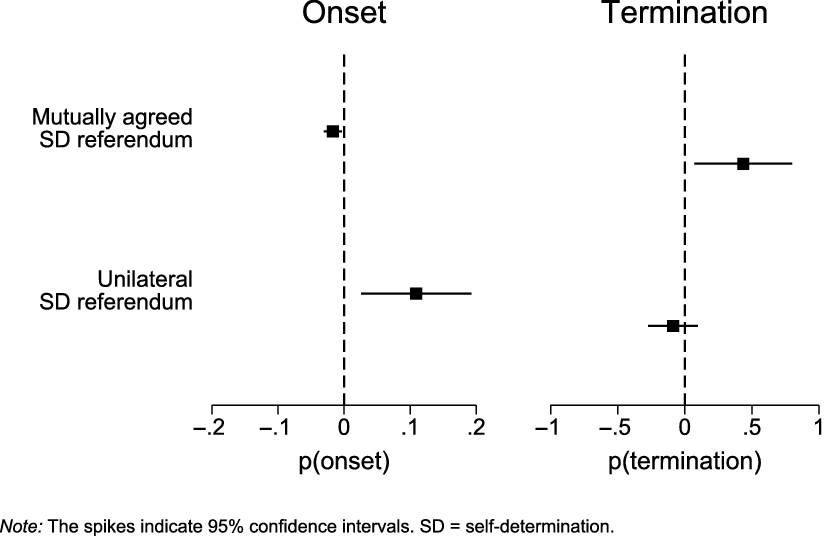
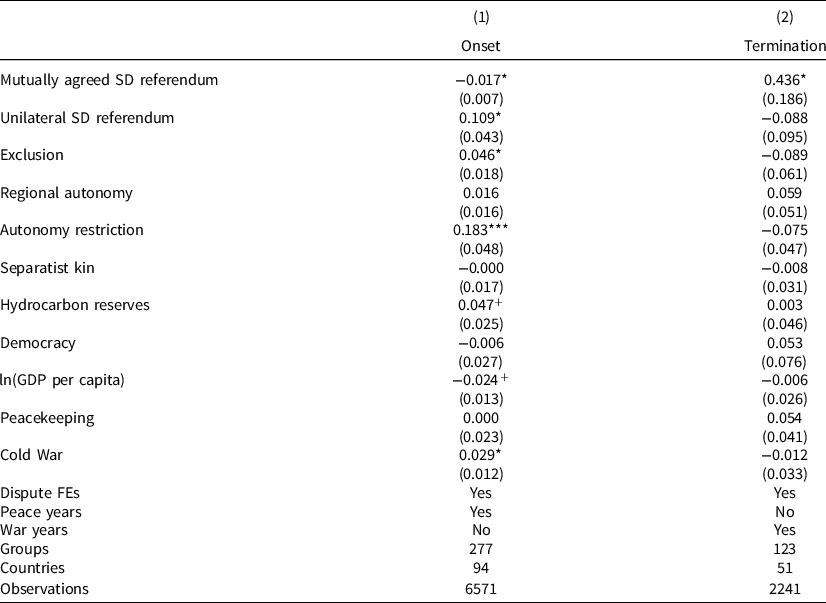
I begin by evaluating the correlations between self-determination referendums and the onset of separatist war. Model 1 in Table 1 shows the results (also see Figure 2). In line with expectations, I find that the risk of separatist war onset decreases by around two percentage points in the wake of a mutually agreed self-determination referendum. By contrast, the onset of a new separatist war becomes around 11 percentage points more likely in the aftermath of a unilateral self-determination referendum. Both effects are statistically significant at the conventional 5% level.
Marginal effects plots.

Model 2 in Table 1 shows analogous results for separatist war termination. The results are again broadly consistent with my argument, but should be interpreted with care because the number of referendums held during separatist wars is relatively small (6 mutually agreed and 15 unilateral referendums). With this caveat in mind, the results suggest that the probability that a separatist war terminates increases by more than 40 percentage points in the wake of a mutually agreed self-determination referendum (P < 0.05). By contrast, unilateral self-determination referendums are negatively correlated with war termination, though the coefficient is not statistically significant. A possible reason is the small number of referendums. More importantly, mutually agreed and unilateral self-determination referendums again clearly behave differently, in line with expectations.
Fixed effects models explaining separatist war onset and termination, 1946–2012

Note: All models include a constant (not shown). Standard errors clustered by country in parentheses. FEs = fixed effects; GDP = gross domestic product; SD = self-determination. + p < 0.10, * p < 0.05, ** p < 0.01, *** p < 0.001.
I report several robustness checks in section 1.5 of the Supplementary Material. First, I find similar results when adding additional time-varying controls to the models, including measures of the government’s military strength, nonviolent protest, and conflict mediation. Furthermore, I find similar results in models not including any controls; when considering different temporal cutoffs for the referendum variables, including both shorter and longer time frames compared to the 2-year cutoff used above; and, finally, also when limiting the analysis to major separatist wars as defined by Doyle and Sambanis (Reference Doyle and Sambanis2006).
Overall, these results suggest that self-determination referendums are associated with different macro-level conflict outcomes depending on whether they are mutually agreed or not. Unilateral self-determination referendums increase the risk that new wars break out while mutually agreed self-determination referendums decrease that risk. Mutually agreed referendums also increase the chance that ongoing wars end. Notably, these results apply while controlling for a large set of known determinants of self-determination referendums and separatist war as well as unobserved dispute-level heterogeneity.
Qualitative evidence
Next, I report a series of brief case studies in which I draw on the existing case-based literature to illustrate my theoretical predictions and assess the basic plausibility of my suggested causal mechanisms. First, I will consider the case of Northern Ireland, which offers a rare opportunity to compare a unilateral and a mutually agreed self-determination referendum within the same case context. After that, I proceed to a shorter discussion of referendums held in one of the most frequently referenced country contexts in the literature on self-determination referendums, the former Yugoslavia.
Northern Ireland
The first self-determination referendum in Northern Ireland was held in March 1973 and involved the question whether Northern Ireland should join the Republic of Ireland or remain with Britain. The decision to hold this referendum was made by the British government in a context of escalating violence and without any involvement of Northern Ireland’s separatist minority, the Northern Irish Catholics (McKittrick and McVea, Reference McKittrick and McVea2012; Qvortrup, Reference Qvortrup2014). In line with the above theoretical narrative, the 1973 referendum was therefore less a sincere attempt at peaceful conflict resolution and more a bargaining tactic. Indeed, when the referendum was debated in the British parliament, several British MPs openly explained their hope that the vote would yield a clear expression of popular support for continued union with Britain and thereby undermine the position of those ‘extreme’, ‘intransigent’, and ‘bigoted’ Catholics who were making calls for Irish unification (Dixon, Reference Dixon1997, p. 4). Footnote 4 However, that tactic clearly failed and, in a clear illustration of the dynamics predicted by my theory, the unilateral 1973 referendum ended up further exacerbating tensions rather than decreasing them.
To be sure, in line with the hopes of its initiators the 1973 referendum came out in favor of continued links with Britain as a whopping 99% of votes were cast in favor of union with Britain and against unification with Ireland. However, this overwhelming margin was not owed to many Irish Catholics voting against unification with Ireland—or, in fact, many Irish Catholics voting at all. Indeed, from the most radical to the most moderate, all Irish nationalist parties had called for the referendum to be boycotted. Therefore, the result largely reflected the opinion of Protestants in Northern Ireland, who were generally opposed to unification with Ireland (Tierney, Reference Tierney2012, p. 73).
Notably, Northern Ireland’s Catholics were not fundamentally opposed to the idea of holding a referendum. However, Catholics would have liked a different referendum, namely, a referendum in which all Irish can vote, including those in the Republic (O’Leary, Reference O’Leary2019, p. 36). (Contrary to Northern Ireland, the island of Ireland as a whole, including the Republic, has a Catholic majority.) The referendum that was actually held was widely rejected by the Catholic side because it did not give a vote to all Irish and, even more importantly, because the Catholic side was not in any way involved in the decision to hold a referendum (Qvortrup, Reference Qvortrup2014, p. 66). Accordingly, Catholics tended to see the 1973 referendum as an imposition of alien rule, a ‘propaganda exercise’, or even ‘a democratic farce’ (Bogdanor, Reference Bogdanor and Ranney1981, pp. 149, 153; Tierney, Reference Tierney2012, p. 73). Consistent with my theory, the 1973 referendum therefore served to increase, rather than decrease, ethnic grievances and, notably, it is therefore also frequently held to have contributed to further bloodshed in the case-based literature (Tierney, Reference Tierney2012, pp. 73, 242; Tonge, Reference Tonge2000, p. 45; Wheatley, Reference Wheatley and Marxer2012, p. 71).
In May 1998, almost exactly 25 years after the 1973 referendum, another self-determination referendum was held in Northern Ireland. However, this time a second referendum was held simultaneously in the Republic of Ireland. Even more importantly, the 1998 twin referendum was a result of inclusive negotiations involving key representatives from both the Catholic and Protestant side as well as the governments of both the UK and Ireland. Chaired by US special envoy George Mitchell, the negotiations concluded in April 1998 with the signing of the Good Friday Agreement, which promised the return of devolved government to Northern Ireland with guaranteed representation of both ethnic communities. As part of the deal, the Good Friday Agreement was subjected to popular ratification in both Northern Ireland and the Republic (Evans and O’Leary, Reference Evans and O’Leary2000, p. 79; McGarry and O’Leary, Reference McGarry, O’Leary and Taylor2009, p. 25; Wheatley, Reference Wheatley and Marxer2012, p. 71). Seventy-one percentage of voters in Northern Ireland and 94% of voters in the Republic ended up voting in favor of the Good Friday Agreement, upon a turnout of 81% and 56%, respectively.
Consistent with my theory, the mutually agreed twin referendum tends to be seen in a much more positive light in the case-based literature. Apart from the occasional outburst, violence largely receded in the aftermath of the 1998 referendums, and there has been no return to armed conflict to this date (McGarry and O’Leary, Reference McGarry, O’Leary and Taylor2009, 51ff). Of course, the sharp decline in violence cannot be singularly attributed to the 1998 referendums. By stipulating ethnic power-sharing and providing Northern Ireland with substantial autonomy, the Good Friday Agreement made a major contribution to peace in Northern Ireland (O’Leary, Reference O’Leary2019, 178ff). Nevertheless, the 1998 referendums are often held to have made an independent contribution to the peace process by helping to stabilize a fragile peace process (e.g., Qvortrup, Reference Qvortrup2014, p. 66; Wheatley, Reference Wheatley and Marxer2012, 71f).
While the Northern Irish civil war was no longer as intense in the mid- and late-1990s as it had been in the early 1970s, significant violence continued and the road to the Good Friday Agreement was all but a smooth ride (O’Leary, Reference O’Leary2019, 135ff). The talks had stretched over years, with many ups and downs, and when a deal was finally reached, the terms were far from universally popular. This applied in particular to the Protestant side. According to survey evidence, Protestants were about equally divided on the Good Friday Agreement (Evans and O’Leary, Reference Evans and O’Leary2000; Tierney, Reference Tierney2012, p. 281) and Northern Ireland’s second-largest Protestant party, the Democratic Unionist Party (DUP), campaigned for a ‘no’ vote (McKittrick and McVea, Reference McKittrick and McVea2012). Meanwhile, support for the agreement was more robust on the Catholic side, but still, splinter groups such as the Real Irish Republican Army (RIRA) remained starkly opposed. In keeping with predictions from my theory, the case-based literature suggests that putting the Good Friday Agreement to a mutually agreed vote helped to generate shared perceptions of fair decision-making. As a result, even strong opponents of the agreement came to accept the agreement, including the DUP, which subsequently even proceeded to join Northern Ireland’s power-sharing government (McGarry and O’Leary, Reference McGarry, O’Leary and Taylor2009, pp. 72, 82). At the same time, the RIRA and other armed groups decided to lay down their arms in the aftermath of the referendums (Collin, Reference Collin, Norris, Frank and Coma2015, 117ff; Loizides, Reference Loizides2009, p. 5).
Former Yugoslavia
Support for my theory can also be deduced from another prominent set of self-determination referendums: the independence referendums held in Slovenia (1990), Croatia (1991), and Bosnia (1992) in the context of the breakup of the former Yugoslavia. These referendums have been recognized as contributing factors to the Yugoslav civil wars (e.g., Kalyvas and Sambanis, Reference Kalyvas, Sambanis, Collier and Sambanis2005, p. 193; Tierney, Reference Tierney2012, 71ff, 238) and are therefore frequently cited by the critics of self-determination referendums in support of their argument that self-determination referendums are best avoided (Lee and Mac Ginty, Reference Lee and Mac Ginty2012, pp. 47–48; Reilly, Reference Reilly, Darby and Mac Ginty2008, p. 237). However, it is important to note that the referendums in Slovenia, Croatia, and Bosnia were all unilaterally initiated by the respective regional governments (Radan, Reference Radan2002, 207ff). In keeping with my theory, their results were therefore rejected not only by the Yugoslav state, but also by the respective regions’ Serbian minorities, who had largely boycotted the referendums. In the case of Croatia and Bosnia, local Serbs even proceeded to organize their own unilateral referendums, thus proclaiming their intentions to join Serbia. Overall, the referendums in Slovenia, Croatia, and Bosnia in the early 1990s should therefore not be held against self-determination referendums in general, given their unilateral origins.
Indeed, the Yugoslav context (broadly defined) also provides an example of a more benign self-determination referendum: Montenegro’s 2006 independence referendum. Often overlooked by the critics, this consensually initiated referendum helped to usher in a peaceful resolution to a high-stakes ethno-nationalist dispute in a deeply divided society. While the region had clearly been in a different place by 2006, a scenario not too dissimilar from the one in the early 1990s unfolded when the Montenegrin authorities started to make a push for independence in the early 2000s. Unsurprisingly, this was fiercely rejected by Serbia and, similar to the situation in Bosnia and Croatia 15 years prior, there was strong opposition to independence also within Montenegro, most notably from the Serbian minority. However, in this case, the Montenegrin authorities did not launch their own, unilateral referendum. Instead, they chose to engage in inclusive negotiations with representatives from all sides (Friis, Reference Friis2007). Under EU mediation, the parties were able to agree on a referendum with a 55% super-majority requirement, a threshold which allowed both sides to have some hope of winning the referendum. The campaign was fierce and the result slim: upon a high turnout of 86%, 55.5% of voters ended up voting for independence, a margin of just 2,000 votes (Huszka, Reference Huszka2014, 136ff). Nevertheless, in keeping with my theory, both Serbia and (after some initial rumblings) the pro-unionists within Montenegro accepted the decision and allowed Montenegro to secede peacefully (International Crisis Group, 2006).
Survey experiment
Finally, I report evidence from a survey experiment which was designed to test important micro-level predictions of my theory, namely, that the extent to which self-determination referendums are seen as fair and their results accepted by members of both the minority and the majority group depends on whether or not they are mutually agreed. The design of the experiment builds on existing studies from the procedural fairness literature that have used randomized vignettes to test the legitimacy-generating potential of different political decision-making mechanisms, such as referendums (Esaiasson et al., Reference Esaiasson, Gilljam and Persson2012; Gash and Murakami, Reference Gash and Murakami2015; Towfigh et al., Reference Towfigh, Goerg, Glöckner, Leifeld, Llorente-Saguer, Bade and Kurschilgen2016; Esaiasson et al., Reference Esaiasson, Persson, Gilljam and Lindholm2019; Werner and Marien, Reference Werner and Marien2022). As previously mentioned, this literature has tended to find that decision-making by referendum generates comparatively high fairness perceptions and decision acceptance. The evidence presented here complements existing studies by demonstrating that in the case of referendums on self-determination, mutual agreement by representatives from the relevant minority and majority groups is necessary to generate shared fairness perceptions as well as a shared willingness to accept the decision outcome.
Case context
The context for the experiment is provided by the ongoing debate in the UK on a second Scottish independence referendum. In September 2014, Scots voted in their first independence referendum. That referendum had been a result of negotiations between the (regional) Scottish and the (central) UK government, and it resulted in a relatively narrow victory for the unionist side, with 45% of Scots voting in favor of independence and 55% against. In keeping with my theory, the separatists accepted the referendum outcome. However, calls for a repeat referendum started to emerge in the aftermath of the UK’s 2016 referendum on leaving the European Union. The reason was that while the UK as a whole had voted to leave the European Union, Scotland had voted to stay by almost a two-thirds margin. Pointing to changed circumstances and emboldened by increasing support for independence in surveys, the Scottish National Party (SNP) made increasingly vocal claims for a second referendum. However, in late 2019, when the data for this experiment was collected, it remained highly uncertain whether the UK government would agree to a second independence referendum; and there notably was speculation that the Scottish regional government might go its own way and unilaterally call a referendum on Scottish independence if the UK government does not agree to one. Footnote 5
Experimental design
The experiment exploits the uncertainty about a second Scottish independence referendum to provide ecologically valid causal estimates of the effects of mutual agreement on self-determination referendums on fairness perceptions and decision acceptance. Similar to existing experiments in the procedural fairness literature, the experiment took the form of a vignette experiment with two randomly assigned conditions. First, subjects were reminded about the lingering uncertainty concerning a second Scottish independence referendum. Next, subjects were asked to imagine that another referendum on Scottish independence is held. Fifty percentage of respondents were randomly shown a scenario in which the referendum was mutually agreed by the Scottish and UK governments. The other 50% saw a scenario in which the Scottish government proceeds unilaterally without the agreement of the UK government. All subjects were then asked the same two outcome questions. First, subjects were asked to rate the fairness of the referendum on a scale from 0 to 10. Second, subjects were asked to rate their willingness to accept a Scottish vote for independence, again on a scale from 0 to 10. The wordings of the outcome questions were adapted from prior vignette experiments (Esaiasson et al., Reference Esaiasson, Gilljam and Persson2012; Esaiasson et al., Reference Esaiasson, Persson, Gilljam and Lindholm2019; Werner and Marien, Reference Werner and Marien2022). The complete vignettes and question wordings are contained in section 2.1 of the Supplementary Material.
The data for the experiment was collected as part of an online voter information tool called WhoGetsMyVoteUK, which was made freely available in the run-up to the 2019 UK general election and promoted through a slew of channels including print, broadcast, and social media. The purpose of WhoGetsMyVoteUK was to allow British voters to learn about their ideological congruence with the various parties contesting the election. To this purpose, users had to indicate their opinions on a series of political issues, which the tool then matched with expert-coded party positions. Furthermore, WhoGetsMyVoteUK also asked subjects about their demographic profile and, for a total of 12 days in late November and early December, it featured the scenario experiment described above.
Overall, around 25,000 individuals participated in the experiment. Footnote 6 However, my analytical interest here is not in the consequences of mutual agreement in the full sample, but in two theoretically informative subsamples: (1) members of the relevant majority group; and (2) members of the relevant minority group. If my theory is correct, prior agreement by the UK government should matter comparatively little to the relevant minority group, that is, the Scots, but make a large difference to the fairness evaluations and willingness to accept a Scottish vote for independence of the UK’s majority group, that is, the English. In the data, I identify individuals as English/Scottish if they indicated that the label English/Scottish perfectly describes them prior to the experiment, which leaves me with around 7,500 and 1,300 observations, respectively. In the online appendix, I show that the results are substantively similar when applying more lenient definitions of ethnic identity which also retain individuals with less than perfect identification as English/Scottish and, therefore, larger numbers of participants.
It is important to note that the samples are self-selected and that online voter information tools like WhoGetsMyVoteUK are known to appeal more to certain segments of voters, including younger and more educated voters (Germann and Gemenis, Reference Germann and Gemenis2019). Nevertheless, the samples are diverse and include substantial numbers of both highly and less highly educated subjects as well as significant numbers of subjects from all but the oldest (60+) age group. Furthermore, the samples are well balanced in terms of gender and include substantial numbers of voters from across the political spectrum (see section 2.2 of the Supplementary Material). As such, the samples used here are quite typical of those used in online experiments more generally and, notably, significantly more diverse compared to student samples.
Results
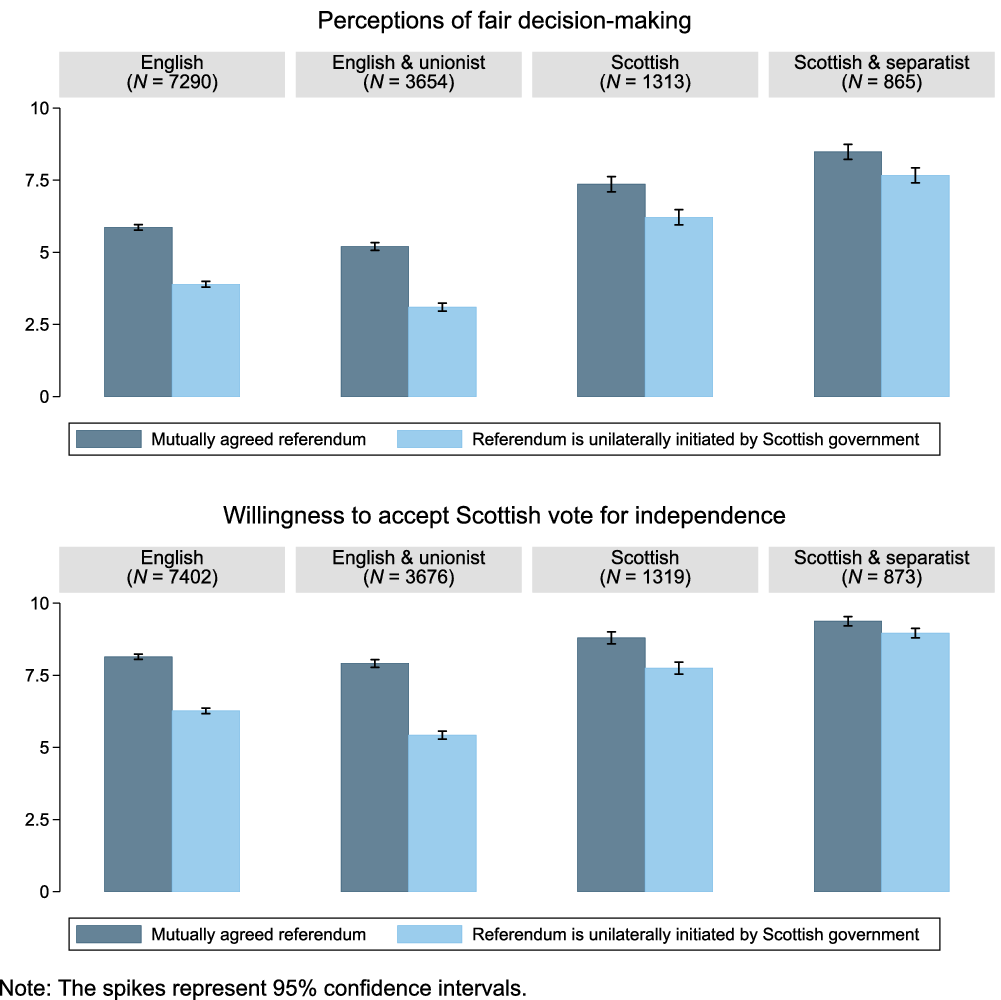
I begin by discussing the consequences of mutual agreement for fairness perceptions (see Figure 3). Consistent with my theory, whether or not the fictitious second Scottish independence referendum was agreed by the UK government makes a large difference to members of the UK’s majority group. On average, English subjects see a Scottish independence referendum as only moderately fair if it is unilaterally initiated by the Scottish government (M = 3.9), but they give a referendum a two-point higher mean fairness rating if it was agreed by the UK government (M = 5.9). This represents a highly substantial increase in perceived fairness of around 50% (p < 0.001). By contrast, Scottish subjects see a Scottish independence referendum as relatively fair even if it is held without UK consent (M = 6.2). Like English subjects, Scots also rate the referendum as fairer when it is mutually agreed (M = 7.4); however, while statistically significant (p < 0.001), the difference is a lot smaller: a plus of around 1.2 points or an increase of less than 20%. In keeping with my theory, whether or not a self-determination referendum is agreed by the other side therefore matters less for members of the initiating side.
Fairness perceptions and decision acceptance in hypothetical second Scottish independence referendum.

Mutual agreement also affects decision acceptance, again especially among the English. First, though, it is worth noting that English subjects show a perhaps surprisingly high willingness to accept a Scottish vote for independence even when the referendum is unilaterally initiated. A likely reason is the comparatively unusual circumstance that the UK government has previously signaled its openness to grant Scotland independence. That said, in keeping with my theory the willingness of English subjects to accept a Scottish vote for independence strongly depends on whether the referendum was agreed by the UK government, with the English’s mean acceptance score increasing by around two points from 6.3 to 8.1 when the referendum was mutually agreed, a plus of almost 30% (p < 0.001). By contrast, UK agreement to the referendum is again far less consequential for Scottish subjects and while there continues to be a statistically significant increase, the difference to a unilateral referendum is only around one point (M = 7.7 vs. M = 8.8), or a plus of around 15% (p < 0.001).
Of course, ethnic groups are not homogeneous and not all Scots favor independence while not all English oppose it. Due to outcome favorability, Scots in favor of independence should be particularly indifferent to how a Scottish vote for independence came about (Esaiasson et al., Reference Esaiasson, Persson, Gilljam and Lindholm2019). Conversely, mutual agreement should make a particularly large difference to English subjects who oppose Scottish independence. To test these more refined expectations, Figure 3 reports additional analyses in which I further restrict the samples to (1) subjects who identify as English and are opposed to Scottish independence; and (2) subjects who identify as Scottish and support Scottish independence. Subjects are treated as supporters/opponents of Scottish independence if they agreed or completely agreed/disagreed or completely disagreed with the following (pretreatment) statement: ‘Scotland should become an independent country’.
In keeping with expectations, I find that English unionists are particularly unlikely to see the referendum as fair if it was unilaterally initiated by the Scottish government (M = 3.1) and are also only moderately likely to accept a Scottish vote for independence after a unilateral referendum (M = 5.4). Yet, mean fairness evaluations and decision acceptance increase significantly (p < 0.001) to 5.2 (+70%) and 7.9 (+50%), respectively, if the referendum was mutually agreed. This is an important finding because English unionists are the group that is most likely to oppose Scottish independence. Furthermore, as expected, mutual agreement makes an especially small difference to Scottish secessionists, with the mean fairness evaluation increasing by only 10% from a mean of 7.7 to 8.5 (p < 0.001) and acceptance of Scottish independence by just 5% from a mean of 9 to a mean of 9.4 (p < 0.001).
I report three robustness checks in section 2.3 of the Supplementary Material. First, I repeat all analyses while adjusting for a series of covariates including age, gender, education, political interest, and general political orientation. Second, I repeat all analyses while dropping speeders. Finally, I repeat all analyses while using a more lenient definition of ethnic identity which also includes subjects who indicated less than perfect identification as English/Scottish. In each case, the results remain similar.
Overall, these results provide support to the micro-level foundations of my theory. While previous literature has established that referendums generally lead to high fairness perceptions, the current experiment showed that mutual agreement significantly improves the chances that self-determination referendums generate shared fairness perceptions. As a result, the losing side (in this case, the English and especially English unionists) became much more likely to accept a vote for Scottish independence if the referendum was mutually agreed. These micro-level findings lend support to the idea that mutually agreed but not unilateral self-determination referendums are likely to contribute to peaceful conflict resolution at the macro level. Furthermore, the low fairness ratings observed among English subjects when the referendum was unilaterally initiated by the Scottish government illustrate how unilateral self-determination referendums may serve to increase ethnic grievances about unfair treatment.
Conclusion
By combining a global statistical analysis with short case studies and a survey experiment, this study amassed the most extensive evidence yet on the conflict resolution potential of self-determination referendums. The results paint a clear picture. Irrespective of the method applied, I found support for the idea that the conflict resolution potential of self-determination referendums is shaped by whether or not the vote was mutually agreed by the conflict parties. First, the global statistical analysis suggested that mutually agreed self-determination referendums are associated with peace even after controlling for a large set of potential confounders including unobserved dispute-level heterogeneity. By contrast, unilateral self-determination referendums were associated with an increased risk of new separatist wars breaking out. Second, the qualitative analysis provided clear indications that mutually agreed and unilateral self-determination referendums thus tend to produce diametrically opposed dynamics. For example, while Catholic parties in Northern Ireland universally called for the unilaterally initiated 1973 referendum to be boycotted, rebel groups decided to lay down their arms in the aftermath of the mutually agreed referendum on the Good Friday Agreement which was held 25 years later. As a result, many observers of Northern Ireland suggested that the unilateral 1973 referendum was directly responsible for additional bloodshed while the mutually agreed 1998 referendum was able to stabilize a fragile peace process. Finally, the survey experiment provided micro-level evidence that a shared perception of fair decision-making and, therefore, a shared willingness to honor the decision outcome is only likely to emerge when self-determination referendums are mutually agreed.
Despite these clear results, caution remains warranted. The study of self-determination referendums presents formidable challenges in terms of causal inference which this study could only partly overcome despite its multipronged methodological approach. While ruling out many important confounders, the global statistical evidence remains correlational. Similarly, while demonstrating the basic plausibility of hypothesized causal mechanisms, the case-based evidence is susceptible to confounding and, moreover, limited to just two case contexts. Finally, while providing causal evidence that mutual agreement matters at the individual level, the survey experiment cannot speak to the macro-level relationship between self-determination referendums and conflict outcomes. Furthermore, questions of generalizability remain, given especially the unique context of Brexit and that Scotland has already voted on independence relatively recently. Therefore, more evidence remains needed to substantiate the consequences of mutual agreement on self-determination referendums for conflict outcomes.
Several other avenues for future research emerge. On the one hand, whether or not democratic contests are held under the mutual agreement of relevant majority and minority groups may matter beyond self-determination referendums. In particular, referendums on new constitutions and power-sharing arrangements often involve similar conflicts pitting ethnic groups against each other, and their potential to further peaceful relations may therefore similarly depend on prior negotiations on their terms between relevant minority and majority groups. On the other hand, future research should extend the focus beyond mutual agreement and study in more detail the extent to which the conflict resolution potential of self-determination referendums depends on other factors. Particularly promising avenues include the extent to which electoral integrity is guaranteed, the role of peacekeepers and the international community more generally, and design factors such as majority requirements, eligibility criteria, and campaigning rules.
While more work needs to be done, it is nevertheless worth considering the implications of this study for policy assuming its results are true. First and most importantly, the results of this study suggest that self-determination referendums cannot create a consensus where none exists to begin with. Therefore, the first priority of peace-makers who are considering a self-determination referendum should be the facilitation of mutual agreement on the referendum between the conflict parties. Second, self-determination referendums should only proceed where mutual agreement is feasible. Self-determination referendums are an improbable measure for conflict resolution in highly polarized, volatile situations. For example, it is highly unlikely that an agreement between Bosniaks and Serbs on a referendum would have been possible in the early 1990s. Nevertheless, European powers promised quick recognition after a referendum. This study suggests that self-determination referendums have limited value as a tool for conflict resolution and should not therefore be promoted at all costs. Finally, if a self-determination referendum is nevertheless held in the absence of mutual agreement, that could provide an early warning for separatist war and diplomatic or other interventions aimed at conflict de-escalation should be considered.
Supplementary material
To view supplementary material for this article, please visit https://doi.org/10.1017/S1755773922000169.
Acknowledgments
Earlier versions of this paper were presented at the 2015 APSA Annual Meeting, the 2019 IPSA Joint Colloquium, the 2020 SPSA Annual Congress, an online conference organized by the European Centre for Minority Issues in 2021, and seminars at the Catholic University of Lublin and the University of Zurich. I would like to thank all conference and seminar participants for helpful comments and suggestions and, in particular, Daniel Bochsler, Lars-Erik Cederman, Kanchan Chandra, Anja Giudici, Dominik Hangartner, Simon Hug, Marcin Kosienkowski, Fernando Mendez, Brendan O’Leary, Matt Qvortrup, Nicholas Sambanis, Uwe Serdült, Marco Steenbergen, Jonathan Wheatley, Julian Wucherpfennig, as well as three anonymous reviewers and the editors of this journal. I gratefully acknowledge funding by the Swiss National Science Foundation (135127 and 162220) and the Economic and Social Research Council (ES/W000598/1). The experimental study was approved by the University of Bath’s Social Science Research Ethics Committee (S19-076). Replication files can be found at https://doi.org/10.7910/DVN/UAVN8Q.
Conflict of interests
The author declares none.