Introduction
Introduction of jointed goatgrass (Aegilops cylindrica Host) into the U.S. wheat-growing regions was suggested to be the result of contaminated seed of hard red winter wheat (Triticum aestivum L.) cultivars collectively known as ‘Turkey’ wheat brought to the United States by Russian immigrants (Mayfield Reference Mayfield1927). The rapid expansion of jointed goatgrass was likely through contaminated seed sources in the early 1900s when the U.S. Department of Agriculture (USDA) was promoting the production of Turkey cultivars (Carleton Reference Carleton1915; Johnston and Heyne Reference Johnston and Heyne1960). By 1922, these cultivars were planted on approximately 8.6 million hectares in 33 states (Clark et al. Reference Clark, Martin and Ball1922). Other introductions occurred, including one attributed to a USDA researcher at Washington State University, Pullman, WA, who worked with jointed goatgrass in the 1890s (Mayfield Reference Mayfield1927).
Ogg (Reference Ogg1993) reported the results of a survey of weed scientists from 14 western U.S. states who estimated the area of winter wheat (Triticum aestivum L.) production infested by A. cylindrica. Infestation estimates ranged from 1,200 ha of lightly infested winter wheat in California and South Dakota to nearly 138,000 ha of moderate to dense infestations in Oklahoma. Moderate to dense infestations were considered to cause significant economic yield loss. Total area infested by A. cylindrica across the 14 states included slightly more than 1.5 million hectares of light infestations and 454,000 ha of moderate to dense infestations. Economic loss at that time was estimated to exceed $145 million.
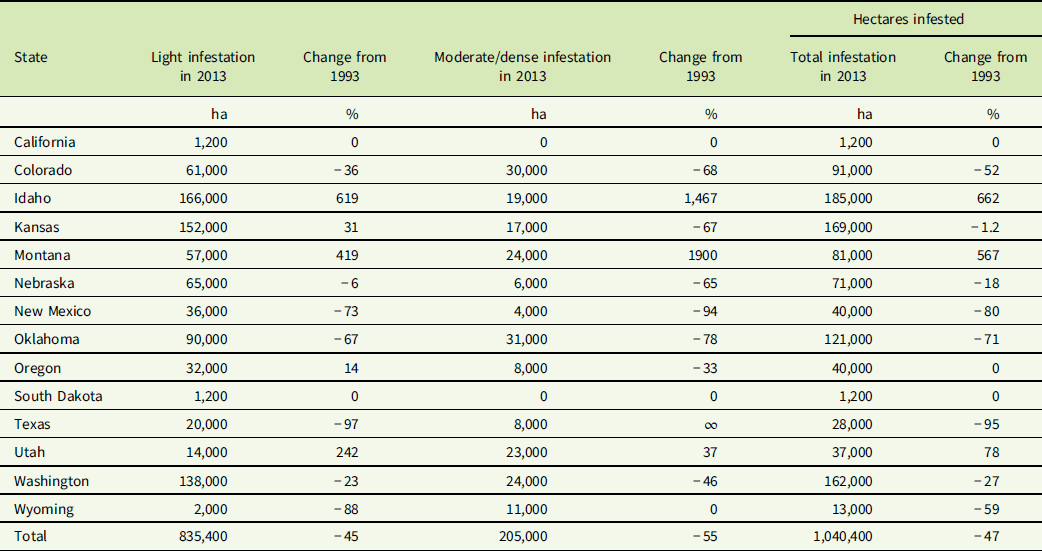
In 2013, weed scientists in the same 14 states surveyed by Ogg (Reference Ogg1993) were asked to update the 1993 estimates (Table 1). In some states, the weed scientist was the same as in 1993, but this was not the case in the majority of the states surveyed. Across the western United States, light infestations of A. cylindrica were estimated to have decreased by 45% from 1993 to <840,000 ha, while moderate to dense infestations decreased by 55% to about 205,000 ha. The most frequently mentioned reasons given for decreased infestations were more diverse crop rotations, improved cultural control practices, and use of imazamox-resistant (Clearfield®) wheat technology. Although the overall trend was for decreased A. cylindrica infestations, Idaho, Montana, and Utah reported an increase in A. cylindrica infestations since 1993.
Percent change from 1993 to 2013 in the number of hectares reported to be infested with Aegilops cylindrica.

Since a review by Donald and Ogg (Reference Donald and Ogg1991), new data have been generated about the biology and ecology of A. cylindrica, particularly its vernalization, genetics, and hybridization with wheat as well as its management. This review updates the previous review.
Biology and Ecology
Reproductive Biology
Aegilops cylindrica is a predominately self-pollinating species that begins to flower before the spike emerges. Outcrossing rates of four A. cylindrica populations were measured at four locations, three in Oregon and one in Colorado, over 2 yr (Cannon Reference Cannon2006). Outcrossing rates were 1.28% and 1.19% for years 1 and 2, respectively. The rates ranged from 0.99% to 2% in year 1 and 0.65% to 2.24% in year 2. In the same study, average wheat outcrossing rates ranged from 0.01% to 0.3% in year 1 and 0% to 0.06% in year 2. At all sites and in both years, A. cylindrica outcrossing rates were greater than for wheat.
In a greenhouse study, viable A. cylindrica seeds were produced 2 d after anthesis, although the percent germination was less than 3% for seed harvested within 7 d of anthesis (Quinn et al. Reference Quinn, Morishita and Price2006). The rapid production of viable seed indicates that if a control measure such as tilling or mowing is used, it must be done early in the life cycle, preferably by the early boot stage.
Vernalization
Donald (Reference Donald1984) reported that vernalization requirements for A. cylindrica were quantitative, that increasing the length of vernalization reduced the days to flowering, and that nonvernalized plants would flower under greenhouse conditions. Walenta et al. (Reference Walenta, Yenish, Young and Ball2002) used a controlled environment study to investigate the vernalization response of A. cylindrica grown from fall and spring cohorts. They described A. cylindrica as a facultative rather than obligate winter annual and stated that rotating to spring-seeded crops may not eliminate A. cylindrica seed production. Spring-germinating A. cylindrica produced viable seeds when planted as much as 2 to 3 wk after the recommended spring wheat-seeding dates in Washington and Oregon (Young et al. Reference Young, Yenish, Walenta, Ball and Alldredge2003).
Following up on the Donald (Reference Donald1984) and Walenta et al. (Reference Walenta, Yenish, Young and Ball2002) studies, six paired A. cylindrica populations collected from winter or spring wheat systems in Oregon and Washington were grown in common gardens at three locations in Oregon (Fandrich and Mallory-Smith Reference Fandrich and Mallory-Smith2006a). Seeds from each population were planted monthly from October through March. Although there were differences in the populations in response to vernalization duration, none of the populations were vernalization insensitive. A greenhouse study evaluated the vernalization requirements of winter wheat, spring wheat and reciprocal hybrids between the wheat types and A. cylindrica (Fandrich et al. Reference Fandrich, Mallory-Smith, Zemetra and Hansen2008). If spring wheat was used to produce the hybrids, the plants were vernalization insensitive. However, if winter wheat was used to produce the hybrids, the results varied. One A. cylindrica population, wheat and the wheat × A. cylindrica hybrids were unlikely to reproduce without vernalization. Plants of the other A. cylindrica populations reproduced in the absence of vernalization, but the plants from the different populations did not have synchronous reproductive behavior between production of the first reproductive node and anthesis.
When using spring crops in rotations to control A. cylindrica, delayed seeding of the spring crops was suggested to minimize viable spikelet production by spring-germinating A. cylindrica; however, it was noted that delayed seeding might result in reduced grain yields (Walenta 2002). Fandrich and Mallory-Smith (Reference Fandrich and Mallory-Smith2006a) noted that if spring temperatures were cool, minimum conditions for vernalization of A. cylindrica may be satisfied and the benefits of adding spring crops to control A. cylindrica would be reduced.
Seed Dormancy and Germination
According to Donald and Ogg (Reference Donald and Ogg1991), most spikelets contain two seeds, one they designated as basal and the other as terminal or subterminal. Fandrich and Mallory-Smith (Reference Fandrich and Mallory-Smith2006a) designated these seeds as the primary and secondary seed. The primary (basal) seed is dormant upon release from the parent plant. Fandrich and Mallory-Smith (Reference Fandrich and Mallory-Smith2006b) quantified seed production and germination by floret position in the spikelet as well as by spikelet position within a spike among six A. cylindrica collections grown in common garden nurseries at two locations over two growing seasons. Spikelet position on the spike affected germination of the secondary seed in dormant samples in some collections. It also affected germination of the primary seed in dormant samples of one collection and in non-dormant samples of three collections. Two of the populations were analyzed to quantify seed production per spikelet and position on the spike and per floret position within the spikelet. Seed number by floret position was dependent on the spikelet position but varied depending on the number of spikelets per spike and by population. As the spike length increased, fewer secondary and tertiary seeds were produced. The authors suggested that the differential seed dormancy and germination based on position within the spike could lengthen the time or conditions over which A. cylindrica seed germinated, which might provide an ecological advantage under field conditions.
Aegilops cylindrica germination at various temperature regimes (5/5, 15/10, 15/15, 25/15, 25/25, or 30/20 C day/night temperatures with a 12-h photoperiod) was studied to determine the optimum temperature for freshly harvested seed (Fandrich and Mallory-Smith Reference Fandrich and Mallory-Smith2005). Germination of both the primary and secondary seeds was greatest when incubated at 25/15. However, the primary seed did not germinate at temperatures of 5/5 or 30/20 C, while the secondary seed germinated in all temperature regimes. Because the primary seed is dormant in freshly harvested seed, germination might not occur until cooler autumn temperatures and moisture create an environment more suitable for plant establishment and survival. Factors that impact seed quality and seedling vigor of seed collected from plants from three populations exposed to different lengths of vernalization periods under field conditions were evaluated (Ingegneri et al. Reference Ingegneri, Quinn, Hulting and Mallory2015). Seeds from the three populations were sown in October (long vernalization period) and the following February (short vernalization period), with all plants harvested for seed in July. Seeds from the secondary florets were used in the study. Evaluations were conducted in the laboratory and the greenhouse. Seed mass, percent germination, and emergence and seedling height, biomass, and root growth were negatively impacted by the shorter vernalization period. Therefore, plants produced under shorter growing seasons may produce less competitive seedlings.
Soil Seedbank
In a seed-burial study conducted in western Nebraska, A. cylindrica seed buried at a soil depth of 20 cm had a germination rate of 1% or less after 4 or more years of burial (Burnside et al. Reference Burnside, Wilson, Weisberg and Hubbard1996). Aegilops cylindrica buried at a depth of 15 cm for 10 yr in eastern Wyoming had a viability rate of 2% at one of four locations, with no viable seed found at the other three locations (Wilson and Miller Reference Wilson and Miller2002). These studies support earlier reports of relatively short seed longevity in the soil, which may be exploited for A. cylindrica management (Donald Reference Donald1991; Donald and Ogg Reference Donald and Ogg1991).
Plant Growth and Development
Dotray and Young (Reference Dotray and Young1993) found the root growth of A. cylindrica and wheat differed. Aegilops cylindrica produced roots directly below the seed, while winter wheat produced roots that spread to a greater diameter, especially in the top 10 cm of soil. A greenhouse study also was conducted to study the root growth of the two species. Compared with A. cylindrica roots, winter wheat roots were three and two times the width at the crown and at 5 cm, respectively. The researchers speculated that the rooting differences might be exploited for fertilizer placement to give a competitive advantage to the wheat crop. They also speculated that A. cylindrica might be more difficult to control with a soil-applied herbicide if it did not move deep enough to reach A. cylindrica roots.
Crop Interference
Replacement series experiments were conducted to compare the competitiveness with winter wheat plants produced from either the primary or secondary floret position within A. cylindrica spikelets (Cannon Reference Cannon2006). The study compared pairwise combinations of the three plant types grown in five planting ratios. Aegilops cylindrica plants produced from seed in the secondary floret position were more competitive than plants produced from seed in the primary floret position. Plants produced from seed in the secondary floret position were equally competitive with winter wheat.
Aegilops cylindrica Genetics
Aegilops cylindrica is an allotetraploid species with a 2n chromosome number of 28. The two donor species for A. cylindrica are Aegilops markgrafii (Grueter) Hammer for the C genome and Tausch’s goatgrass (Aegilops tauchii Coss.) for the D genome (Kimber and Sears Reference Kimber and Sears1987). Hybridization and gene transfer between A. cylindrica and wheat is possible, because the two species have the D genome in common. It was believed that the cytoplasmic (female) parent of A. cylindrica was A. tauchii, and based on a genetic diversity study using chloroplast DNA, this was found to be true for most of the germplasm tested. However, several accessions were identified with the chloroplast genome from the C genome donor A. markgrafii, indicating that the cross that produced A. cylindrica occurred with either diploid species as the maternal parent and that the origin of tetraploid A. cylindrica occurred more than once (Gandhi et al. 2005, Reference Gandhi, Vales, Mallory-Smith and Riera-Lizarazu2009). In diversity studies of A. cylindrica accessions collected in the United States, it was found that there was a low level of polymorphism in the nuclear DNA among the accessions, regardless of the molecular marker method used (Gandhi et al. Reference Gandhi, Vales, Mallory-Smith and Riera-Lizarazu2009; Pester et al. Reference Pester, Ward, Fenwick, Westra and Nissen2003). This result indicated that there was a genetic bottleneck event when A. cylindrica was introduced into the United States. Little genetic variation is not unusual, because the introduction of a nonnative weed may involve a single genotype or closely related genotypes.
Hybridization between Aegilops cylindrica and Wheat
Hybrids between A. cylindrica and wheat were reported in the United States in the 1920s (Johnston and Parker Reference Johnston and Parker1929; Mayfield Reference Mayfield1927). Initially, these hybrids were considered not to be a major issue, because it was believed that the hybrids were sterile and posed no risk for gene flow between the two species (Donald and Ogg Reference Donald and Ogg1991; Johnston and Parker Reference Johnston and Parker1929; Mayfield Reference Mayfield1927). In 1990, seed was found on A. cylindrica × wheat hybrids collected in a wheat field in Idaho, which led to a series of studies on the origin and fertility of hybrids between the two species (unpublished data from the authors). Either wheat or A. cylindrica had the potential to serve as the female parent of the hybrids in the field, which was confirmed in multiple studies. The studies included greenhouse-controlled crossing (Zemetra et al. Reference Zemetra, Hansen and Mallory-Smith1998), natural crossing in the field (Seefeldt et al. Reference Seefeldt, Zemetra, Young and Jones1998; Snyder et al. Reference Snyder, Mallory-Smith, Hansen, Balter and Zemetra2000), molecular studies of the cytoplasmic genome of hybrids found in the field and on seed of hybrids in the field (Morrison et al. Reference Morrison, Riera-Lizarazu, Cremieux and Mallory-Smith2002). Low seed set on the hybrids in the field was due to a low level of female fertility (2%), allowing for cross-pollination with either A. cylindrica or wheat (Zemetra et al. Reference Zemetra, Hansen and Mallory-Smith1998). Based on meiotic analysis of the hybrids, the D genome chromosomes of the two species were homologous and underwent normal meiotic chromosome pairing and separation, allowing for a partially normal chromosome distribution. The homology of the D genome chromosomes allows a low level of viable female gametes to be produced despite an uneven distribution of the chromosomes of the A, B, and C genomes in the reduction division of meiosis. Male sterility would be expected in this case, because male gametes are less tolerant of aneuploid conditions (Khush Reference Khush1973). The discovery of partial female fertility in the A. cylindrica × wheat hybrids raised the question of whether the presence of A. cylindrica × wheat hybrids in the field could lead to the potential for gene flow between the two species. Hybrid production was found not to be wheat cultivar specific, and the hybrids could usually be identified in the field, because they tended to be taller than either parent and their spikes were intermediate between wheat and A. cylindrica (Rehman et al. 2006a, Reference Rehman, Hansen and Zemetra2006b).
Hybrids between wheat and A. cylindrica became a greater concern with the development of herbicide-resistant wheat, because the hybrids would be herbicide resistant and could act as a bridge for movement of the resistance gene into A. cylindrica. Field studies determined that hybrids carrying the resistance gene were produced, and the frequency of occurrence is a function of distance and wind direction from the source of the resistance gene (Gaines et al. Reference Gaines, Henry, Byrne, Westra, Nissen and Shaner2008; Hanson et al. Reference Hanson, Mallory-Smith, Price, Shafii, Thill and Zemetra2005).
For gene flow to occur between the two species, two steps need to occur. First, backcrossing would need to occur with A. cylindrica as the recurrent parent, and the hybrid and the backcross generation would need to maintain the level of female fertility. Second, at some point in the backcrossing generations, self-fertility would need to be restored. In the greenhouse, it was found that backcrossing could occur between the hybrids and A. cylindrica, and a low level of female fertility was maintained in the BC1 generation, and that subsequent backcrossing resulted in an increase in female fertility (Wang et al. Reference Wang, Zemetra, Hansen and Mallory-Smith2001). Production of BC1 and BC2 seed was also demonstrated in the field (Snyder et al. Reference Snyder, Mallory-Smith, Hansen, Balter and Zemetra2000). Self-fertility was found to be partially restored after only the second backcross (BC2 generation), and complete self-fertility was restored through subsequent backcrossing or selfing. With each backcross generation, the chromosome number gradually returned to the chromosome number of A. cylindrica (28 chromosomes) (Wang et al. Reference Wang, Zemetra, Hansen and Mallory-Smith2001). The backcross occurred with wheat as the recurrent parent, but restoration of partial self-fertility did not occur until the BC3 generation. This difference in self-fertility may be due to the presence of a gametocidal gene in the A. cylindrica genome that produces deletions and chromosome rearrangements in the first postmeiotic mitotic division, leading to further chromosome and gene imbalances in the resulting gametes as the number of A. cylindrica chromosomes decreases, resulting in reduced potential for viable gametes (Endo Reference Endo1988). Because backcrossing could occur in either direction, the potential for gene flow from wheat to A. cylindrica would depend on backcrossing with A. cylindrica as the recurrent parent.
In situ hybridization was used to determine the recurrent parent in field-collected BC1 plants using the number of C genome chromosomes in the BC1 plant to determine the paternal parent. A backcross to A. cylindrica would provide 7 C chromosomes, while a backcross to a hybrid would provide 0 to 7 chromosomes; therefore, the paternal parent of a BC1 plant with 8 or more C genome chromosomes was A. cylindrica (Wang et al. 2000, Reference Wang, Zemetra, Hansen, Hang, Mallory-Smith and Burton2002). This system worked even when chromosome restitution occurred in the hybrid, so a 2n (35-chromosome) gamete was produced, resulting in a 49-chromosome BC1 plant with 14 C genome chromosomes if A. cylindrica was the recurrent parent and a 56-chromosome BC1 plant with 7 C genome chromosomes if wheat was the recurrent parent. This technique was tested with greenhouse-produced backcross generations and was found to work on field-collected material as well, demonstrating that backcrossing to A. cylindrica does occur in the field (Rehman et al. Reference Rehman, Hansen, Mallory-Smith, Hang, Burton and Zemetra2010).
After fertility restoration, the next requirement for gene flow is recombination between the chromosomes of the two species, and the genes from wheat need to be retained in the A. cylindrica genome. With the presence of related genomes (D) and unrelated genomes (A, B, and C), the potential for recombination and retention differs depending on the genome. Because pairing between the D genomes of the two species was observed during meiosis in the hybrids, recombination between the chromosomes of the D genomes would be expected but might vary among the chromosomes, because rod bivalents were observed, indicating differences in the level of homology/pairing between the D genome chromosome arms of the two species.
Research using both random amplified polymorphic DNA and microsatellite markers demonstrated that introgression of wheat DNA into A. cylindrica was possible (Guadagnuolo et al. Reference Guadagnuolo, Savova-Bianchi and Felber2001). Using molecular markers associated with each D genome chromosome arm, recombination between all the D genome chromosome arms was confirmed, which would allow for the potential transfer of genes on the D genome between wheat and A. cylindrica (Kroiss et al. Reference Kroiss, Tempalli, Hansen, Vales, Riera-Lizarazu, Zemetra and Mallory-Smith2004). Using a herbicide-resistant gene located on chromosome 6D of wheat (Anderson et al. Reference Anderson, Matthiesen and Hegstad2004) and selection for herbicide resistance between each generation of backcrossing to A. cylindrica, it was possible to demonstrate both recombination and retention of this gene in the BC2S1 and subsequent generations (Perez-Jones et al. Reference Perez-Jones, Mallory-Smith, Hansen and Zemetra2006a). To test this theory, BC2S1 plants were evaluated for the presence of Pch1, a gene for Pseudocercosporella foot-rot resistance located on chromosome 7D (Law et al. Reference Law, Worland, Hollins, Koebner and Scott1988) that was present in the original donor wheat parent ‘Madsen.’ The gene was transferred into A. cylindrica and was stably inherited (Perez-Jones et al. Reference Perez-Jones, Mallory-Smith, Riera-Lizarazu, Watson, Wang, Rehman and Zemetra2006b), indicating that genes on the D genome could be transferred and retained with or without selection pressure. In a field study with A. cylindrica derived from these BC2S1 lines, a gene or genes for stripe rust resistance (Puccina striiformis) from wheat appeared to have been transferred based on plant resistance response of the BC2S1 lines to the pathogen.
Gene flow of genes found on the unrelated genomes of wheat (A and B) to A. cylindrica would be expected to either not occur or to occur at a very low level due to the lack of pairing of these chromosomes during meiosis. In the hybrid, this lack of pairing is controlled by the presence of the Ph1 gene in wheat that is found on chromosome 5B. There could be nonhomologous pairing in BC1 and subsequent backcross generations where A. cylindrica is used as a recurrent parent if the 5B chromosome was lost during gamete formation in the hybrid, but this has not been demonstrated to date.
In a study of gene flow in relationship to genome location of the glyphosate-resistance gene, it was found that locating the gene on the D genome enhanced the potential for transfer of the gene from wheat to A. cylindrica (Rehman et al. Reference Rehman, Hansen, Mallory-Smith and Zemetra2016 ). However, retention of the herbicide-resistance gene also occurred after restoration of self-fertility, even when the resistance gene was located on the A or B genome of wheat. The retention of the resistance gene in gametes carrying the A or B genome chromosome may have been related to selection pressure from a glyphosate application. This led to the retention of the chromosome for the resistance gene in BC2S1 and BC2S2 plants that were resistant to glyphosate but also carried more than 28 chromosomes. In the BC2S2 generation, plants were identified with only 28 chromosomes that were resistant to glyphosate. This result indicated recombination occurred between the unrelated genomes of wheat (A or B) and A. cylindrica (C) or that a chromosome substitution had occurred, resulting in transfer and retention of the herbicide-resistance gene even when it originated from an unshared genome (Rehman Reference Rehman2005). The impact of selection pressure on gamete survival would play a role in retention of the gene, because application of a herbicide provides selection pressure resulting in gametes or plants that carry the resistance gene surviving to produce the next generation.
The impact of selection pressure from a herbicide or a disease on the transfer of resistance genes from resistant A. cylindrica to susceptible A. cylindrica was studied under field conditions (Martins et al. Reference Martins, Leonard, Sun, Zemetra and Mallory-Smith2016). Results of that study indicate that, with selection pressure, the odds of an allele being herbicide resistant were 1.6 times the odds of the allele being resistant without selection pressure. With selection pressure, the gene will increase with each generation until fixation. Management of the hybrid generation is critical to prevent the gene from being introgressed into a A. cylindrica population.
In a survey of fields with a history of Clearfield® wheat production conducted in 2009 and 2010, 1,100 of 1,400 hybrid plants sampled carried the Imi1, which endows imidazolinone (IMI) resistance (Martins et al. Reference Martins, Sun and Mallory-Smith2015). Thirteen of the plants were homozygous for the gene, indicating that the gene had moved beyond the first generation. A greater number of resistant hybrids were collected on field edges, at Conservation Reserve Program sites, and in nonagricultural areas. Therefore, more emphasis should be placed on the control of A. cylindrica in these sites. Gene flow cannot be prevented in natural or agricultural environments; however, steps should be taken to reduce movement, especially in agricultural settings.
Herbicide-Resistant Aegilops cylindrica
Imazamox resistance in A. cylindrica × wheat hybrids and in BC1 plants was documented under field conditions even before the commercial release of the technology (Seefeldt et al. Reference Seefeldt, Zemetra, Young and Jones1998; Tan et al. Reference Tan, Evans, Dahmer, Singh and Shaner2005). Since then, additional studies have documented hybridization and introgression of the resistance trait into BC1 generations under field conditions (Gaines et al. Reference Gaines, Henry, Byrne, Westra, Nissen and Shaner2008; Perez-Jones et al. Reference Perez-Jones, Martins and Mallory-Smith2010). Gaines et al. (Reference Gaines, Henry, Byrne, Westra, Nissen and Shaner2008) observed that the maximum distance over which hybridization occurred between IMI-resistant wheat and A. cylindrica was 16 m. Hybridization rates were as high as 1.6%, but on average, the rate was approximately 0.1% over 2 yr of sampling. To minimize the risk of hybridization and introgression of the resistance trait into A. cylindrica, individuals must be controlled when IMI-resistant wheat cultivars are grown. This recommendation is supported by results of a long-term field study described by Kniss et al. (Reference Kniss, Lyon and Miller2008), where imazamox use in IMI-resistant cultivars reduced A. cylindrica density in the subsequent cropping year by up to 48%. This reduction in A. cylindrica density would decrease the opportunity for hybridization and backcrossing to occur, but it is important to control A. cylindrica in subsequent crops and adjacent areas.
Simulation models have been used to predict the effect of various management practices on the evolution of A. cylindrica resistant to imazamox. In a simulation study by Hanson et al. (Reference Hanson, Ball and Mallory-Smith2002), spontaneous evolution of imazamox resistance in a no-till, continuous IMI-resistant wheat system appeared only a few years later than if hybridization between A. cylindrica and wheat was assumed to occur at 0.1%. This is important, because although hybridization between wheat and A. cylindrica is a likely source of IMI-resistant A. cylindrica individuals, spontaneous evolution of A. cylindrica likely will occur in continuous IMI-resistant wheat systems. Although it is possible for A. cylindrica to evolve resistance without hybridization, hybridization represents an increased risk (Hanson et al. Reference Hanson, Ball and Mallory-Smith2002; Perez-Jones et al. Reference Perez-Jones, Martins and Mallory-Smith2010); therefore, controlling A. cylindrica individuals when IMI-resistant wheat cultivars are grown is required to minimize the risk of hybridization and introgression of the resistance trait into A. cylindrica.
Another simulation study predicted similar IMI-resistant A. cylindrica density in an IMI-resistant wheat–fallow rotation as with an IMI-resistant wheat–fallow–conventional wheat–fallow rotation (Rainbolt et al. Reference Rainbolt, Thill, Yenish and Ball2004). However, the total A. cylindrica seedbank in Rainbolt’s simulation was estimated to be much greater when conventional wheat was used, due to a lack of A. cylindrica control in the standard wheat crop. Hanson et al. (Reference Hanson, Ball and Mallory-Smith2002) predicted that using a non–IMI resistant wheat in rotation with IMI-resistant wheat would significantly slow the rate of resistance development by reducing herbicide selection pressure for the spontaneous evolution of the trait within A. cylindrica. For similar reasons, using fallow and tillage was predicted to greatly reduce the rate of resistance evolution in A. cylindrica (Hanson et al. Reference Hanson, Ball and Mallory-Smith2002).
A 6-yr study conducted in southeast Wyoming between 2000 and 2006 (three cycles of a winter wheat–fallow rotation) to evaluate the long-term impacts of IMI-resistant winter wheat cultivars supported the prediction (Kniss et al. Reference Kniss, Lyon and Miller2008). At two separate locations in this study, the IMI-resistant system reduced A. cylindrica density significantly, such that the impacts were observed in the next cropping year, even if a conventional wheat cultivar was grown in the subsequent season. This result has important implications for reduced selection for imazamox-resistant A. cylindrica. IMI-resistant cultivars can effectively reduce the A. cylindrica population in a relatively short period, so that it may not be necessary to use IMI-resistant cultivars in consecutive cropping seasons. Alternating the use of IMI-resistant and non–IMI resistant cultivars would reduce the frequency of imazamox use in the winter wheat–fallow rotation, thereby reducing the potential for increasing biotypes resistant to acetolactate synthase inhibitors. This would be particularly true if IMI-resistant cultivars were used in conjunction with other management practices, such as extended crop rotations.
The first case of A. cylindrica with evolved resistance to imazamox was reported in Washington state in 2017 (Burke Reference Burke2017). The resistance was determined not be the result of gene flow, although the exact mechanism of resistance has not been determined.
Management and Control
Biological Control
In their review paper, Donald and Ogg (Reference Donald and Ogg1991) stated that the selective control of emerged A. cylindrica shoots with phytotoxic microorganisms should be explored. Several studies have investigated the use of soil microorganisms for selective control of annual weeds, including A. cylindrica. Laboratory bioassays using bacteria isolated from soil and plant roots identified 162, 202, and 129 isolates that inhibited root growth of downy brome (Bromus tectorum L.), Japanese brome (Bromus japonicas Houtt.), and A. cylindrica (Harris and Stahlman Reference Harris and Stahlman1996). Of 2,450 naturally occurring bacteria tested for their effect on A. cylindrica and winter wheat, only four isolates had no effect on wheat in the in vitro bioassays and growth chamber studies and inhibited A. cylindrica more than 30% in the field (Kennedy and Stubbs Reference Kennedy and Stubbs2007). These inhibitory bacteria maintained higher populations in conventional tillage systems than in no-till systems. Rhizoctonia solani AG-8, the fungus causing bare-patch disease, reduced shoot dry weight of A. cylindrica by 20% to 30% in a preliminary greenhouse study (reviewed in Quimby et al. Reference Quimby, King and Grey2002). Although the concept of biological control of A. cylindrica is attractive, much work remains to be done to translate this work to practical applications in the field.
Mechanical Control
Aegilops cylindrica has been reported as more common in conservation tillage than conventional tillage systems (Donald and Ogg Reference Donald and Ogg1991). Deep moldboard plowing has been proposed as a possible means of suppressing A. cylindrica. In fallow tillage studies conducted in Colorado, moldboard plowing provided 95% control of A. cylindrica compared with 75% control with V-blade sweeping and disking (Westra Reference Westra1989). In a continuous winter wheat system in Oklahoma, 35 L of harvested grain contained an average of 817, 1,816, and 4,744 A. cylindrica spikelets for moldboard, disk, and sweep primary-tillage treatments, respectively (Peeper et al. Reference Peeper, Kelley, Stone, Roberts, Solie and Armstrong1999).
In a winter wheat–fallow rotation in Utah, a fall or spring chisel-plow treatment followed by summer rod weeding in a conventional tillage system reduced A. cylindrica infestations by nearly 50% compared with conservation tillage involving a fall chisel plow or subsoiler treatment followed by a spring skewtreader treatment (Evans et al. Reference Evans, Morishita and Maxwell1999). In this same study, conservation tillage reduced A. cylindrica infestations by about 50% compared with no-till. A single V-blade sweeping during summer fallow in eastern Colorado increased seedling emergence of A. cylindrica by 74% but did not affect emergence in subsequent years (Anderson Reference Anderson1998).
Integrated, multicomponent systems for A. cylindrica management in winter wheat were investigated in several field studies conducted in the Central Great Plains (Pester et al. Reference Pester, Westra, Anderson, Stahlman, Wicks, Lyon and Miller1999). The tillage treatment effects on A. cylindrica in these studies were not consistent across locations or years. Young et al. (Reference Young, Yenish, Ball and Thill2009) found that a onetime deep plowing followed by annual reduced-tillage crops decreased A. cylindrica spikelets more than a onetime deep plowing followed by annual no-till crops.
In a greenhouse study, the incorporation of crop residues into the soil reduced A. cylindrica fresh weight by 70% to 85% (Anderson Reference Anderson1993). The application of nitrogen fertilizer diminished the residue effect, suggesting that crop residue stimulated microbial immobilization of nitrogen. Anderson (Reference Anderson1993) suggested that producers may want to incorporate crop residues with tillage before seeding wheat and then band nitrogen fertilizer with the wheat seed.
Tillage, particularly inversion tillage, seems to be an effective tool for the control of A. cylindrica, but negative consequences of tillage (e.g., increased soil erosion by wind and water, negative effects on soil quality, and reduced soil water capture and retention) must be balanced with the weed control benefits. Intermittent tillage as part of an integrated weed management (IWM) system may be a viable option for growers with significant A. cylindrica infestations.
Harvest weed seed control (Walsh et al. Reference Walsh, Newman and Powles2013) may be an option that has not yet been extensively explored for A. cylindrica. The integrated Harrington Seed Destructor (de Bruin Engineering, Mount Gambier, South Australia) provided control of feral rye (Secale cereale L.), downy brome, and A. cylindrica (N Soni, personal communication).
Chemical Control
Before the development of IMI-resistant winter wheat, herbicide control of A. cylindrica in winter wheat was primarily limited to time periods when the wheat crop was not present, such as the fallow period of the winter wheat–fallow rotation. Nonselective herbicides, glyphosate in particular, have been shown to be effective for A. cylindrica control in fallow (Beck et al. Reference Beck, Sebastian and Chapman1995; Wiese et al. Reference Wiese, Salisbury and Bean1995). Residual herbicides such as atrazine have shown good efficacy in the fallow period (reviewed by Donald and Ogg Reference Donald and Ogg1991) but can cause injury to following crops in some rotations.
Several herbicides have been investigated for selective control of A. cylindrica in winter wheat, with limited success. Aegilops cylindrica showed greater sensitivity to sulfosulfuron compared with winter wheat, but was two- to threefold more tolerant than Bromus species (Geier and Stahlman Reference Geier and Stahlman1996). Metribuzin has also been investigated with limited success (reviewed by Donald and Ogg Reference Donald and Ogg1991). In general, efforts to find herbicides that provide commercially acceptable levels of A. cylindrica control in non–IMI resistant winter wheat under field conditions have been largely unsuccessful.
IMI-Resistant Wheat
Wheat cultivars with resistance to the IMI herbicide imazamox were first marketed in 2001 (Tan et al. Reference Tan, Evans, Dahmer, Singh and Shaner2005), and for the first time, highly efficacious selective control of A. cylindrica in winter wheat was possible. Early field studies in Washington and Oregon showed imazamox could be applied at up to 54 g ai ha−1 with <10% wheat injury, and rates of 36 g ha−1 controlled A. cylindrica 61% to 97% (Ball et al. Reference Ball, Young and Ogg1999). Other studies found similar results. A. cylindrica was controlled ≥96% regardless of rate (35 to 53 g ha−1) or timing (early fall, late fall, early spring, late spring) in field studies in Kansas, Nebraska, and Wyoming (Geier et al. Reference Geier, Stahlman, White, Miller, Alford and Lyon2004). In these field studies, A. cylindrica was more susceptible to imazamox compared with feral rye. The difference in susceptibility between winter annual grasses is probably due to differences in imazamox absorption and metabolism. Pester et al. (Reference Pester, Nissen and Westra2001) showed that absorption of imazamox in A. cylindrica was very rapid under experimental conditions, with absorption being nearly complete within several hours after treatment. Metabolism of imazamox also was slower in A. cylindrica compared with feral rye.
Several studies found that both the adjuvant system and application timing affected both A. cylindrica control and winter wheat injury with imazamox. Adjuvants can affect absorption of imazamox in both A. cylindrica and feral rye; when applied with either methylated seed oil (MSO) or urea ammonium nitrate (UAN) + nonionic surfactant (NIS) in the greenhouse, more than 95% of applied imazamox entered the plant, greater than the absorption in either downy brome or feral rye (Pester et al. Reference Pester, Nissen and Westra2001). Under field conditions, Geier et al. (Reference Geier, Stahlman, White, Miller, Alford and Lyon2004) found that imazamox reduced height of IMI-resistant wheat at several locations across Kansas, Nebraska, and Wyoming. Early imazamox application times tended to produce greater wheat yield compared with later application timings; late spring applications, in particular, seemed to have a negative effect on wheat yield. Even with the injury observed, wheat yield at all locations was greater in imazamox treatments than nontreated controls. The experimental design used did not allow for separating the effects of weed competition from herbicide injury for wheat yield response; however, imazamox rate did not have a significant effect on wheat yield, suggesting weed competition was a more likely explanation for reduced yields than herbicide injury.
In Wyoming, Frihauf et al. (Reference Frihauf, Miller and Alford2005) evaluated the response of five winter wheat cultivars to imazamox rate, adjuvant system, and application timings under nearly weed-free conditions. Adding MSO (1% v/v) + UAN to imazamox caused greater wheat injury to all cultivars compared with NIS (0.25% v/v) + UAN. Early fall applications of imazamox (at the 2- to 3-leaf stage of winter wheat) injured wheat and reduced yield more than late fall (3- to 4-leaf stage with 2 tillers) or spring treatments. In a Kansas field study, A. cylindrica control was greater with fall treatments; imazamox controlled A. cylindrica >80% when applied in fall, but control was reduced at least 30% when imazamox treatment was delayed until spring.
The magnitude of wheat injury and yield reduction was cultivar dependent in the field study conducted by Frihauf et al. (Reference Frihauf, Miller and Alford2005), but Hanson et al. (Reference Hanson, Shaner, Westra and Nissen2006) found few differences in tolerance between wheat cultivars under greenhouse conditions, provided the cultivars had the same number and location of resistance genes. The differences observed by Frihauf et al. (Reference Frihauf, Miller and Alford2005) did not seem to relate to resistance gene location, and instead may have been related to other aspects of the genetic background. Hard red wheats responded similarly to imazamox application timing, whereas a soft red wheat was more tolerant, and a soft white wheat appeared less tolerant to imazamox applied in early fall. Hanson et al. (Reference Hanson, Shaner, Westra and Nissen2006) found winter wheat cultivars with the IMI-resistance trait were more resistant compared with spring wheat cultivars if only one copy of the resistance gene was present. Adding a second gene increased the level of resistance in spring wheat, but 2-gene winter wheat cultivars were not included in the study. Similarly, imazamox delayed growth of 1-gene IMI-resistant wheat cultivars under greenhouse conditions, but little effect was observed in 2-gene resistant cultivars (Hanson et al. 2007).
Increasing the concentration of urea ammonium nitrate (UAN) in the imazamox spray mixture increased A. cylindrica control in field studies in Kansas (Geier and Stahlman Reference Geier and Stahlman2009). Rates of UAN up to 25% of the total spray volume increased A. cylindrica control, but increasing the concentration beyond 25% had little effect. Wheat yields in this study may have been related to A. cylindrica competition, as fall applications resulted in greater yield compared with spring applications. The first commercial 2-gene IMI-resistant wheat cultivar, AP503 CL2, was released in 2007. Since 2010, all new IMI-resistant wheat cultivars have 2-gene resistance. Methylated seed oil or crop oil concentrate, both of which have been shown to improve weed control but also increase the risk of crop injury in 1-gene IMI-wheat (Frihauf et al. Reference Frihauf, Miller and Alford2005), may be used in place of nonionic surfactant when treating 2-gene IMI-resistant wheat with imazamox. While there is a lack of research with 2-gene IMI-resistant wheat in the literature, the expectation is that the efficacy of imazamox on A. cylindrica will be the same or better than in 1-gene IMI-resistant wheat.
Hanson et al. (Reference Hanson, Ball and Mallory-Smith2002) predicted exponential growth of imazamox-resistant A. cylindrica populations in less than 10 yr of continuous, no-till imazamox-resistant wheat production systems. This prediction has not been borne out, but there is little doubt that imazamox will be less effective for the control of A. cylindrica in wheat. When that time arrives, growers will need additional control options. It is likely that these options will involve many of the IWM concepts discussed in this paper, but new novel approaches also are needed.
Cultural Control
Crop Rotations
Donald and Ogg (Reference Donald and Ogg1991) listed long-term crop rotations with winter wheat grown only once every 3 or 4 yr as one cultural control method that might reduce the severity of A. cylindrica; however, they stated that supporting documentation for this recommendation was limited. Subsequently, several studies were conducted to document the impact of crop rotation on A. cylindrica density in winter wheat. Aegilops cylindrica densities in 3-yr rotations that included winter wheat, a late spring–planted crop, and summer fallow were less than 10% of the A. cylindrica densities recorded in 2-yr rotations of winter wheat and fallow (Lyon and Baltensperger Reference Lyon and Baltensperger1995). This study was continued for an additional cycle of the 3-yr rotations, and after 6 yr, A. cylindrica densities in the 3-yr rotations were only about 1% of those in the 2-yr rotations (Daugovish et al. Reference Daugovish, Lyon and Baltensperger1999). Winter wheat yields were greater in the 3-yr rotations than in the 2-yr rotations, and the 3-yr rotations were economically competitive with the 2-yr rotations.
Using empirical life-cycle simulation based on the demographics of A. cylindrica, Anderson (Reference Anderson2004) found rotations that included a 2-yr interval with no weed seed production, such as winter wheat–corn (Zea mays L.)–fallow, reduced weed densities almost 800-fold after 12 yr compared with a 1-yr interval with winter wheat–fallow. He recommended arranging four different crops in sequences of two cool-season crops followed by two warm-season crops; however, if the same crop was grown 2 yr in a row (e.g., winter wheat), the rotation benefits were reduced considerably. Fallow can serve in either life-cycle category.
Adding grain sorghum [Sorghum bicolor (L.) Moench] or grain sorghum and sunflower (Helianthus annuus L.) into the winter wheat–fallow rotation reduced A. cylindrica densities more than other cultural practices tested in an integrated management study conducted in western Kansas (White et al. Reference White, Stahlman and Northam2004). However, no specific combination of crop rotation, fallow weed management (mechanical vs. chemical), and wheat variety (tall, competitive vs. shorter, less competitive) consistently reduced A. cylindrica density more than other combinations.
In an IWM study conducted in Washington, Idaho, and Oregon, two crop rotations (winter wheat–fallow–winter wheat and spring wheat–fallow–winter wheat) were combined with stubble burning and planting treatments to create eight IWM systems (Young et al. Reference Young, Ball, Thill, Alldredge, Ogg and Seefeldt2010). The best IWM system at two locations with moderate and high A. cylindrica densities (Washington and Oregon, respectively) included the spring wheat–fallow–winter wheat rotation and a onetime stubble burn. In a similar 7-yr study conducted in Washington, three crop rotations (winter wheat–fallow, spring wheat–fallow–winter wheat–fallow, and spring barley (Hordeum vulgare L.)–fallow–winter wheat) were combined with stubble burning and planting treatments to create 12 IWM systems (Walters et al. Reference Walters, Young and Young2012). The two best systems in this study for improving crop yield and quality, reducing A. cylindrica populations and dockage, and producing the greatest profitability included the spring wheat–fallow–winter wheat–fallow rotation.
Young et al. (Reference Young, Gallandt and Alldredge2000) used a rectangular hyperbolic model to describe the impact of first-year A. cylindrica densities on second-year wheat yield loss. They found that 1 to 5 A. cylindrica plants m−2 in the first-year wheat crop resulted in a 3% to 30% yield loss in the second-year wheat crop. Growers were advised to use these data along with their knowledge of yield potential, price dockage, and profitability of alternative crops to initiate an action threshold for rotating to a spring crop rather than growing another winter wheat crop.
Since the publication of the 1991 review by Donald and Ogg, there have been ample data collected throughout the western United States to support their recommendation of using crop rotation to control A. cylindrica in winter wheat. Crop rotation, with winter wheat grown only once every 3 or 4 yr, should be the foundation for any A. cylindrica control program. However, economics and federal farm programs often serve as major obstacles to the adoption of sound crop rotations.
Cultivar Selection
Donald and Ogg (Reference Donald and Ogg1991) identified crop cultivar competitiveness as a knowledge gap with respect to A. cylindrica management. Since that time, several studies have attempted to identify winter wheat cultivars or traits that increased competitiveness with A. cylindrica. Anderson (Reference Anderson1997) reported that a tall cultivar ‘Lamar’ provided greater A. cylindrica suppression but yielded less compared with the semidwarf cultivar ‘TAM 107’ (Porter et al. Reference Porter, Worrall, Gardenhire, Gilmore, McDaniel and Tuleen1987). In an attempt to characterize traits that resulted in greater competitive ability with A. cylindrica, Ogg and Seefeldt et al. (1999) determined that winter wheat height development (centimeters per growing degree days) was important in predicting competitive ability. In a wet year, however, no wheat traits were identified that had a critical impact on competitive ability with A. cylindrica. Although wheat height was undoubtedly an important trait for competitiveness with A. cylindrica, the relationships among wheat height, yield, and competitiveness is complex. Seefeldt et al. (Reference Seefeldt, Ogg and Hou1999) used near-isogenic wheat lines that differed with respect to reduced height genes (Rht 1 , Rht 2 , or Rht 1 + Rht 2 ). The tallest cultivar (containing neither of the Rht genes) did not result in the greatest A. cylindrica suppression or always produce the greatest yield in the presence of A. cylindrica.
Seefeldt et al. (Reference Seefeldt, Ogg and Hou1999) pointed out that even if A. cylindrica suppression was inconsistent, tall wheat cultivars may allow raising the combine header to reduce the amount of A. cylindrica seed being harvested and potential dockage penalties. Subsequent research by Yenish and Young (Reference Yenish and Young2004) provided evidence to support this idea; although mature A. cylindrica height was not altered by the height of the wheat, dockage due to A. cylindrica contamination was decreased by 30% to 80% in a tall cultivar (130 cm) compared with a shorter cultivar (100 cm). Aegilops cylindrica was taller (110 cm) than the short wheat, but shorter than the tall cultivar. The taller cultivars also reduced A. cylindrica biomass, total spikelet biomass per unit area, and spikelet weight compared with the shorter wheat cultivars. No differences in A. cylindrica density were observed between wheat cultivars, however.
In an IWM study from Kansas, wheat cultivar had little impact on A. cylindrica density in a study looking at the combined effects of crop rotation, fallow management, and crop cultivars (White et al. Reference White, Stahlman and Northam2004). Over the 6-yr study, differences in A. cylindrica density were only observed between cultivars in one year.
Wheat-seeding Practices
Donald and Ogg (Reference Donald and Ogg1991) make no mention of the impact of wheat-seeding rate on A. cylindrica competition or control. Anderson (Reference Anderson1997) investigated wheat-seeding rate effects on A. cylindrica and feral rye reproductive potential as part of cultural systems that included seeding rate (45 vs. 73 kg ha−1), wheat cultivar (standard height vs. semidwarf), and nitrogen fertilizer application (single vs. split). Increased seeding rate of the standard-height cultivar consistently reduced spikelet production of A. cylindrica, but increased seeding rate did not reduce spikelet production with the semidwarf cultivar when a single nitrogen application was made.
Field studies conducted in Kansas, Nebraska, and Wyoming investigated the effect of wheat plant density in the fall on A. cylindrica competitiveness (Kappler et al. Reference Kappler, Lyon, Stahlman, Miller and Eskridge2002). Increased wheat density reduced A. cylindrica reproductive tillers in four of six location-year combinations and biomass in two of four location-year combinations. They suggested that despite a lack of consistent results, increased seeding rates might be a good, low-cost, long-term investment as part of an integrated control program. Yenish and Young (Reference Yenish and Young2004) studied the effect of wheat plant height, seeding rate, and seed size on A. cylindrica competitiveness in eastern Washington. They found that an increased wheat-seeding rate reduced A. cylindrica head density, total biomass, and spikelet biomass in one of two years. Seeding rate had the most consistent effect on wheat yield, with about a 10% greater yield at the higher seeding rate when competing with A. cylindrica. Individual A. cylindrica plant biomass was consistently greater when grown with small-seeded wheat.
Using data obtained from multiyear field experiments conducted in eight winter wheat–producing states in the western United States, Jasieniuk et al. (Reference Jasieniuk, Maxwell, Anderson, Evans, Lyon, Miller, Morishita, Ogg, Seefeldt, Stahlman, Northam, Westra, Kebede and Wicks1999) fit A. cylindrica fall seedling density, spring seedling density, and reproductive tiller densities to the rectangular hyperbolic yield-loss function. Site-to-site and year-to-year variation in the winter wheat–A. cylindrica yield-loss parameter estimates suggested that a bioeconomic model cannot use a single yield-loss function with the same parameter values across the entire western U.S. wheat production region. Working with these same data sets, Jasieniuk et al. (Reference Jasieniuk, Maxwell, Anderson, Evans, Lyon, Miller, Morishita, Ogg, Seefeldt, Stahlman, Northam, Westra, Kebede and Wicks2001) evaluated three models for the prediction of crop yield from crop and weed density. The different models each had strengths and weaknesses, but all would have benefited from larger sample sizes than provided by most of the data sets and the addition of crop and weed time of emergence data, which were lacking in the field studies.
Donald and Ogg (Reference Donald and Ogg1991) reported that planting geometry did not enhance winter wheat competitiveness with A. cylindrica; however, the citation for this work was a proceedings paper from 1986 that reported the results from a 1-yr field study. This study was subsequently repeated, and the combined results were published by Young et al. (Reference Young, Seefeldt and Barnes1999). They compared single (25 cm between rows) and paired (13 cm between paired rows and 38 cm between sets of paired rows) row geometries with three different A. cylindrica placements and a weed-free treatment. They reported that wheat grown in paired rows was more competitive against A. cylindrica, that is, fewer spikelets were produced, than when grown in single rows.
Delayed winter wheat seeding in the fall to allow emerged A. cylindrica to be killed with herbicides or tillage before seeding wheat was suggested (Donald and Ogg Reference Donald and Ogg1991); however, subsequent research has not always supported this recommendation. Westra (Reference Westra1999) stated that altering the wheat-seeding date was only effective in years when timely rain stimulates an early flush of A. cylindrica that can be killed before seeding wheat. Evans et al. (Reference Evans, Morishita and Maxwell1999) reported that wheat seeded in September had 45% fewer A. cylindrica seedlings than wheat seeded in October, and the earlier seeded wheat yielded 25% more than the later-seeded wheat. Seeding wheat earlier or later than the recommended seeding dates can adversely affect wheat yields and may have minimal impact on A. cylindrica.
Although the impacts of various wheat-seeding practices have been inconsistent or only moderately effective, the cost of adopting these practices is often small. Growers should consider using some of these practices as part of an IWM system.
Seed Purity
Aegilops cylindrica was found in 25%, 29%, and 20% of all wheat samples collected as part of a grain elevator sampling survey conducted in western Nebraska following wheat harvest in 1990, 1991, and 1992, respectively (Lyon et al. Reference Lyon, Smith and Jones1994). Nebraska counties bordering Colorado were found to have the highest percentage of wheat samples contaminated with A. cylindrica spikelets, ranging from 23% in Cheyenne County in 1992 to 61% in Keith County in 1991. Results of this study highlight the importance of planting seed certified to be free of A. cylindrica. In many but not all states, A. cylindrica is a prohibited noxious weed.
Nitrogen Fertility
Nitrogen management has little impact on A. cylindrica plant density, but can affect the competitive relationship between wheat and A. cylindrica (Mesbah and Miller Reference Mesbah and Miller1999). Applying nitrogen 5 mo before wheat planting decreased A. cylindrica seed production compared with nitrogen application near planting time, but only if used in combination with other cultural practices (Anderson Reference Anderson1997). When an early application of nitrogen was combined with increased seeding rate and a tall wheat cultivar, A. cylindrica seed production per plant was reduced by >40%. Timing of nitrogen application, by itself, was not a good management option, however. Early nitrogen application actually increased A. cylindrica seed production if done in combination with a short-statured cultivar and reduced wheat-seeding density.
Mesbah and Miller (Reference Mesbah and Miller1999) reported that placement of nitrogen fertilizer can favor wheat at the expense of A. cylindrica. Wheat yield was reduced more by A. cylindrica when nitrogen fertilizer was broadcast applied compared with application with a spoke-wheel injector (10-cm deep) or banding (5-cm deep) at the time of planting. Broadcast nitrogen fertilization increased the number of spikelets per plant compared with the nonfertilized check, whereas deep banding or spoke-wheel fertilization decreased spikelets per plant compared with the nonfertilized check. A. cylindrica biomass production exhibited a similar trend.
Field Burning
Young et al. (Reference Young, Ogg and Dotray1990) reported that germinability of A. cylindrica seed on the soil surface was reduced 89% to 97% by field burning (also reviewed by Donald and Ogg Reference Donald and Ogg1991). Between 43% and 64% of A. cylindrica spikelets on the soil surface were destroyed by field burning (Young et al. Reference Young, Ogg and Dotray1990). Even spikelets that had a minimally burned appearance exhibited 30% to 60% reduced germination compared with nonburned controls. Soil temperatures at 5-cm depth, however, were not increased significantly by fire, and thus burning will have little effect on buried seed. After burning, A. cylindrica emerged at a density of 0.6 seedlings m−2 from the natural infestation. Further research on the impact of field burning on A. cylindrica seed has been limited, as burning of fields may have environmental impacts or may even be prohibited in some areas.
Preventative Control
Wheat grain infested with A. cylindrica spikelets is often price discounted and may be reduced to feed grade or rejected by the elevator. This grain may be fed to cattle (Bos taurus L.). Wheat grain contaminated with A. cylindrica spikelets was fed to fistulated steers, and 75% and 76% of the seed collected from the rumen and feces, respectively, was viable (Lyon et al. Reference Lyon, Baltensperger and Rush1992). In a subsequent study, Lyon and Rush (Reference Lyon and Rush1993) reported that processing A. cylindrica spikelets with a roller or hammer mill reduced but did not eliminate germination and emergence. However, spikelets fine-ground with a hammer mill and placed in the rumen of a fistulated steer for 24 h did not germinate, suggesting that the hammer mill may be used to reduce the risk of disseminating A. cylindrica when feeding contaminated grain to cattle.
Integrated Weed Management
Young et al. (Reference Young, Ball, Thill, Alldredge, Ogg and Seefeldt2010) conducted a 6-yr, multistate, integrated A. cylindrica management systems study in the Pacific Northwest to investigate the impact of stubble burning, crop rotation, and seeding practices on A. cylindrica density, wheat yield, and grain dockage. At the Idaho location, with very low A. cylindrica densities, no system consistently had the greatest yield, least grain dockage, and reduced weed densities. At the Washington location, the system with a onetime stubble burn, spring wheat in the rotation, and the standard seeding practice consistently provided the best results for all three parameters. The Oregon location had a high weed density, and the best system there included a one-time stubble burn, spring wheat in the rotation, and the integrated seeding practice, which included an increased seeding rate and seed size, fertilizing at seeding, and starter fertilizer with seed. The benefits of these integrated systems for Pacific Northwest growers in the wheat–fallow areas included decreased dockage, decreased farm inputs, and reduced herbicide resistance in A. cylindrica.
In a similar 7-yr study conducted only in Washington (Walters et al. Reference Walters, Young and Young2012), IWM systems were the same as described in Young et al. (Reference Young, Ball, Thill, Alldredge, Ogg and Seefeldt2010), but included an additional rotation of fallow–winter wheat–spring barley. The best systems for improving crop yield and quality and reducing A. cylindrica populations and dockage included the spring wheat rotation with or without a one-time stubble burn and the standard seeding practice. These systems also had the greatest profitability. In a 4-yr study in Colorado and a 6-yr study in Kansas, no single combination of practices had an obvious benefit for A. cylindrica management (Anderson Reference Anderson1997; White et al. Reference White, Stahlman and Northam2004). Nevertheless, the combined effect of several cultural practices reduced A. cylindrica seed production and, over time, reduced the impact of A. cylindrica on winter wheat. However, Anderson (Reference Anderson1997) reported wheat yield from the more competitive wheat cultivar was 14% less than that of the shorter-statured wheat cultivar. White et al. (Reference White, Stahlman and Northam2004) reported that winter wheat cultivar selection had minimal impact on A. cylindrica density, although wheat yields between cultivars were similar. These studies indicate that while there are wheat cultivars with greater competitive ability with A. cylindrica, other cultural practices provide relatively greater benefit for A. cylindrica management. Extended crop rotations had the greatest impact in the Kansas study, and there was some indication that using herbicides for fallow weed control may be more beneficial in dry years compared with tillage (White et al. Reference White, Stahlman and Northam2004).
Interestingly, the variable nature of A. cylindrica appears to confound many long-term integrated management studies. Aegilops cylindrica densities have “crashed” in several of these long-term projects without any clear cause (Kniss et al. Reference Kniss, Lyon and Miller2008; White et al. Reference White, Stahlman and Northam2004). These unexplained crashes make the long-term, integrated studies reported here even more valuable, as short-term density fluctuations may have a much greater impact on results from studies of shorter duration.
Practical Applications
The practical applications of the research conducted during the 15-yr National Jointed Goatgrass Research Program were summarized in regional Extension Bulletins for the Central Great Plains (Schmale et al. Reference Schmale, Anderson, Lyon and Klein2008), the Intermountain region (Quinn et al. Reference Quinn, Morishita, Evans, Whitesides and White2007), Pacific Northwest (Yenish et al. Reference Yenish, Ball and Schirman2009), and Southern Great Plains (Schmale et al. Reference Schmale, Peeper and Stahlman2009). These four Extension Bulletins provided wheat growers with region-specific strategies for the integrated management of A. cylindrica in winter wheat production systems.
The results from the National Jointed Goatgrass Research Program highlighted the need for multiple, integrated approaches for the control of A. cylindrica. No single control strategy provided effective, long-term control of A. cylindrica. Preventing A. cylindrica from being introduced into fields is a critical component of any A. cylindrica management program. Once introduced, growers need to use an array of strategies to manage A. cylindrica infestations. Tillage, particularly moldboard plowing, can be an effective tool in the management of A. cylindrica, but once the A. cylindrica seed is buried, no more deep tillage should be done for at least 4 yr to allow buried seed to lose viability. Cultural practices that increase crop competitiveness, such as deep placement of nitrogen fertilizer, increased wheat-seeding rates, and use of tall-statured wheat cultivars, are useful management strategies. Crop rotation was identified as a very effective means of controlling A. cylindrica, particularly when summer crops were used to lengthen the time between winter wheat crops. The insertion of summer crops into crop rotations in the Pacific Northwest is more difficult than in the Great Plains because of the lack of summer rainfall in the Pacific Northwest. The judicious use of Clearfield® wheat technology is also a key component in the management of A. cylindrica in winter wheat; however, growers are cautioned against overuse of this technology for fear of losing the effectiveness as a result of selecting for A. cylindrica biotypes resistant to imazamox.
As the 2013 survey of weed scientists in 14 states indicated, the implementation of more diverse crop rotations, improved cultural practices, and use of Clearfield® wheat technology resulted in a 55% decrease in moderate to dense infestations of A. cylindrica across much of the western United States since the 1993 survey by Ogg. This is evidence that the practical implications of this research program have been implemented by growers throughout the western United States.
The National Jointed Goatgrass Research Program supported 15 to 20 research and extension projects per year for 15 yr. Because of the program, viable management strategies were developed and are being implemented by farmers in at least 10 western states (Ogg Reference Ogg2012). This review summarized the research on A. cylindrica published after Donald and Ogg (Reference Donald and Ogg1991), most of which was conducted as part of the USDA-funded National Jointed Goatgrass Research Program.
Acknowledgments
This research received no specific grant from any funding agency, commercial or not-for-profit sectors. No conflicts of interest have been declared.