INTRODUCTION
Health inequities among racial minorities are pronounced, persistent, and pervasive (Sondik et al., Reference Sondik, Huang, Klein and Satcher2010). Racism may be one cause of these inequities. Studies find that individuals who report experiencing racism exhibit worse health than people who do not report it (Williams and Mohammed, Reference Williams and Mohammed2009). While this line of research has been invaluable in shifting the discussion from innate differences in biology or culture to social exposures, it is limited by inadequate attention to the multiple dimensions of racism, particularly structural racism. The goal of this article is to encourage new research on forms of structural racism that may contribute to health inequities.
RACISM AND HEALTH INEQUITIES
Health inequities are seen in many outcomes, including infant mortality, heart disease, and cancer (Sondik et al., Reference Sondik, Huang, Klein and Satcher2010). A century ago, W. E. B. Du Bois (Reference Du Bois2003) recognized the connection between societal inequities and health inequities, raising several central arguments related to racism, poverty, and other social problems. He noted, “The Negro death rate and sickness are largely matters of [social and economic] condition and not due to racial traits and tendencies” (p. 276). There have been many similar accounts since then, but little attention to racism's role. For instance, in 1985, the influential Report of the Secretary's Task Force on Black and Minority Health alluded to racism in stating, “Blacks, Hispanics, Native Americans and those of Asian/Pacific Islander heritage have not benefited fully or equitably from the fruits of science or from those systems responsible for translating and using health sciences technology” (Heckler Reference Heckler1985, p. 1). Despite this promising introduction, the report failed to develop this theme further.
Given that racism shapes the lives of people of color, it seems not only reasonable but necessary to study the hypothesis that racism influences health inequities. Two decades ago, Becker (Reference Becker1986) noted the reluctance to address structural factors: “Doing something about poverty, racism … involves notions of planned social and economic change, alternations not likely to be achieved by lowering the public's cholesterol level” (p. 19).
The serious study of racism and health did not gain traction until the 1990s, but now this body of work has become more commonplace. Racism may be one explanation for many of the health disparities identified in Healthy People 2010, the compendium of the nation's health objectives. As James (Reference James2008) argues, “the elimination of disparities—the magnificently democratic goal of Healthy People 2010—cannot be achieved without first undoing racism” (p. S16). The updated Healthy People 2020 lists discrimination and residential segregation as examples of social determinants of health.Footnote 2
Reviews consistently find that persons who self-report exposures to racism have greater risk for mental and physical ailments (Brondolo et al., Reference Brondolo, Halen, Pencille, Beatty and Contrada2009; Williams and Mohammed, Reference Williams and Mohammed2009). These associations are seen among many racial/ethnic minority populations, including African Americans (Mays et al., Reference Mays, Cochran and Barnes2006) American Indians (Chae and Walters, Reference Chae and Walters2009), Arab Americans (Padela and Heisler, Reference Padela and Heisler2010), Asian Americans (Gee et al., Reference Gee, Ro, Shariff-Marco and Chae2009), and Latinos (Araujo and Borrell, Reference Araujo and Borrell2006). Yet, self-reported measures have their limitations and they disproportionately focus on individual experiences (Krieger Reference Krieger1999). The more fundamental and broad-reaching aspects of structural racism remain under-studied.
Structural Racism
Researchers have long argued that racism operates at multiple levels, ranging from the individual to the structural (Carmichael and Hamilton, Reference Carmichael and Hamilton1967; Jones Reference Jones2000). The metaphor of an iceberg is useful for describing the levels at which racism operates (Gee et al., Reference Gee, Ro, Shariff-Marco and Chae2009). The tip of the iceberg represents acts of racism, such as cross-burnings, that are easily seen and individually mediated. The portion of the iceberg that lies below the water represents structural racism; it is more dangerous and harder to eliminate. Policies and interventions that change the iceberg's tip may do little to change its base, resulting in structural inequalities that remain intact, though less detectable.
Structural racism is defined as the macrolevel systems, social forces, institutions, ideologies, and processes that interact with one another to generate and reinforce inequities among racial and ethnic groups (Powell Reference Powell2008). The term structural racism emphasizes the most influential socioecologic levels at which racism may affect racial and ethnic health inequities. Structural mechanisms do not require the actions or intent of individuals (Bonilla-Silva Reference Bonilla-Silva1997). As fundamental causes, they are constantly reconstituting the conditions necessary to ensure their perpetuation (Link and Phelan, Reference Link and Phelan1995). Even if interpersonal discrimination were completely eliminated, racial inequities would likely remain unchanged due to the persistence of structural racism (Jones Reference Jones2000). In the next section, we describe a few examples of structural racism and their potential connections with health inequities.
STRUCTURAL RACISM: SELECTED EXAMPLES
Social Segregation
Segregation refers to the separation of social groups. Most research on segregation and health disparities examines racial residential segregation, the geographic separation of racial groups' homes. A recent review identified thirty-nine studies that tested associations between segregation and health outcomes (Kramer and Hogue, Reference Kramer and Hogue2009). Residential segregation remains pervasive and may influence health by concentrating poverty, environmental pollutants, infectious agents, and other adverse conditions (Gee and Payne-Sturges, Reference Gee and Payne-Sturges2004; Williams and Collins, Reference Williams and Collins2001). For instance, Morello-Frosch and Jesdale (Reference Morello-Frosch and Jesdale2006) found that segregation increased the risk of cancer related to air pollution. Studies using multilevel modeling that simultaneously accounts for individual and structural factors also find associations between segregation and illness (Bell et al., Reference Bell, Zimmerman, Almgren, Mayer and Huebner2006; Subramanian et al., Reference Subramanian, Acevedo-Garcia and Osypuk2005).
Segregation within schools, workplaces, and health care facilities may also contribute to health disparities. For example, Walsemann and Bell (Reference Walsemann and Bell2010) found that school segregation is related to health behaviors (e.g., alcohol use) among students. Just as importantly, they found that segregation was associated with decreased educational aspirations among Black males. An innovative feature of their work is the focus, not on the uneven distribution of students across schools, but on segregation within the curriculum (i.e., racial disparities in enrollment in advanced vs. less advanced courses). Hence, it is not only the composition of students that may create health disparities but also the design of the curriculum.
Similarly, while de jure segregation of drinking fountains is now illegal, de facto segregation of water coolers in offices continues because of workplace segregation. Segregation of workplaces tracks minority workers into jobs with fewer benefits and more dangers (Elliott and Smith, Reference Elliott and Smith2001). For instance, Angelon-Gaetz et al. (Reference Angelon-Gaetz, Richardson and Wing2010) found that not only were Black workers segregated from Whites at a federal nuclear weapons site, but also that Black workers had a greater level of radiation exposure. Racial and ethnic segregation may also occur by immigration status. De Castro et al. (Reference de Castro, Fujishiro, Schweitzer and Olivia2006) reported that immigrant employees often work in segregated environments that are dangerous (e.g., buildings with no fire exits) and stressful (e.g., no breaks at work). They even encounter blatantly illegal actions by their employers, including not being paid for work and systematic manipulation of work hours to avoid compensation for overtime. Other research shows that physical hazards and stressors are related to numerous health problems, including heart disease (Darity Reference Darity2003).
The Civil Rights Act of 1964, in combination with many grassroots efforts to enforce it, helped reduce hospital segregation (Quadagno Reference Quadagno2000). After the integration of Mississippi hospitals, Black-White disparities in infant mortality were cut in half in just six years (Almond et al., Reference Almond, Chay and Greenstone2006). Despite these signs of progress, segregation within the health care system continues. Clarke et al. (Reference Clarke, Davis and Nailon2007) found substantial segregation in hospitals in Pennsylvania and Virginia; about 58% of Black and White patients admitted for acute myocardial infarction in Pennsylvania would have to switch hospitals to achieve integration. A similar level, 53%, is apparent for hospitals serving elderly Medicare patients nationwide (Smith Reference Smith2005). Segregation in nursing care may also remain a significant issue (Smith et al., Reference Smith, Feng, Fennell, Zinn and Mor2007). Relatively little work has focused on contemporary segregation in health care, and the findings appear to be complex; segregation may increase or decrease the use of services, depending on the types of services and communities considered (Gaskin et al., Reference Gaskin, Price, Brandon and LaVeist2009).
The segregation of social networks may contribute to racialized patterns in the spread of infectious diseases (Freeman Reference Freeman1978). Disparities in the spread of some diseases reflect existing patterns of social isolation in which Blacks are more socially segregated than members of other groups are. In groundbreaking work that redirected researchers from hypothesizing that disparities in sexually transmitted diseases (STDs) are due to some yet unexplained behavioral or other characteristic of Blacks, Laumann and Youm (Reference Laumann and Youm1999) found that segregation in social and sexual networks—not high rates of risky sexual behavior among Blacks as had previously been assumed—explained racial disparities in STDs. This also suggests that disparities in the spread of disease can partially reflect existing patterns of social segregation.
Future Research Regarding Social Segregation
First, researchers should study the various types of segregation and their potential connections to health disparities. As a general phenomenon, segregation influences health by simultaneously isolating racial groups from one another and by concentrating exposures and resources. This rationale has been well articulated for residential segregation (Acevedo-Garcia Reference Acevedo-Garcia2000; Gee and Payne-Sturges, Reference Gee and Payne-Sturges2004; Williams and Collins, Reference Williams and Collins2001) but can be extended to other forms of segregation. Studies should continue to test the general hypothesis that segregation is related to illness and health disparities. Just as important, studies should examine the mediating mechanisms. For instance, is workplace segregation related to heart disease? Is this relationship due to exposure to physical hazards, psychosocial stress, diminished wages, lack of insurance, or some combination of these factors?
Second, research should consider interactions across these different forms of segregation. Little work has documented how segregation occurs across contexts and how different types of segregation may interact with one another to influence health. For instance, are individuals who live in residentially segregated communities and work in segregated worksites at “double jeopardy” of illness? Creating a holistic index of “segregated life” may be useful for summarizing multiple contexts of segregation. This index could be constructed at specific points in time, and across the entire life course, to evaluate how segregation can influence trajectories of social disadvantage and health disparities.
Third, studies should attend to scale. The processes that generate segregation and health effects likely differ by the level of analysis. This is most clearly conceptualized with regard to residential segregation. Reardon et al. (Reference Reardon, Farrell, Matthews, O'Sullivan, Bischoff and Firebaugh2009) found that Black-White segregation declined at the microlevel (local neighborhoods) from 1990–2000. Yet, this microlevel decline was not seen at the macrolevel; metropolitan segregation remained relatively stable (Reardon et al., Reference Reardon, Farrell, Matthews, O'Sullivan, Bischoff and Firebaugh2009). These findings suggest that local level changes may yield little effect on the broader distributions of power and resources. Thus, despite the growing interest in neighborhood effects, it remains an important unanswered question whether local neighborhoods are necessarily the best unit of analysis or the appropriate place to intervene on health disparities (Kramer and Hogue, Reference Kramer and Hogue2009). These arguments about scale can be generalized to other settings: For instance, to what extent are disparities generated within segregated worksites versus across segregated occupations?
Measures that allow for variations in scaling, such as the spatially modified information theory index (Lee et al., Reference Lee, Reardon, Firebaugh, Farrell, Matthews and O'Sullivan2008) provide a novel way of considering segregation beyond traditional measures. These measures can allow for the decomposition of effects across various levels and are encouraged for future research.
Immigration Policy
Immigration policy provides another form of social segregation. Since its inception, U.S. immigration policy has defined racial groups, reinforced the social hierarchy, and influenced the health of populations. A critical aspect of immigration policy is its connection to citizenship and privileges, such as the ability to vote in federal elections.
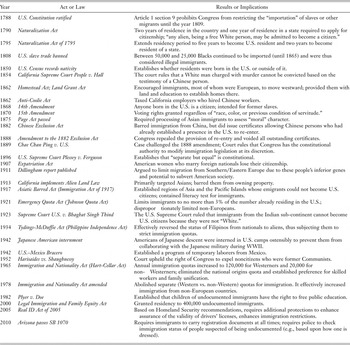
The exclusion of non-Whites from citizenship has been a defining characteristic of U.S. immigration policy. The 1790 Naturalization Act, which specified some of the earliest rules for citizenship, only allowed free Whites to apply. As Table 1 shows, the nation's racial and ethnic composition and restrictions on the rights of racial minorities were heavily influenced by immigration policy. Boswell (Reference Boswell2003) argues, “Every group which struggled against oppression in the United States had to, in effect, ‘become White’ because Whiteness was the measure of full membership in the American community. As a legal matter, in order for an immigrant to naturalize he would have to be White” (p. 319).
Selected actions related to immigration/naturalization with bearing on race/ethnicity

The restriction of immigration and defense of White-only citizenship came from many sectors, including public health and medicine; these sectors have been integral in supporting racialized immigration policy by providing “scientific evidence” in support of such policies (Barkan et al., Reference Barkan, Diner and Kraut2008). A major rationale for excluding non-Whites has been that immigrants and minority races are—by nature—unclean, diseased, unintelligent, and morally degenerate (Barkan et al., Reference Barkan, Diner and Kraut2008; Park Reference Park2004). The development of germ theory showed that illnesses can spread across populations. Because the origins of many health and social problems were largely unknown, this theory was broadened to include many other issues that we would today not consider infectious, such as “insanity” and poverty. These ideas led to fears that immigrants and minorities would infect the “good people” and, thus, should be controlled. As Molina (Reference Molina2006) noted, “By the 1870's, public health officials had sufficient credibility to construct what being ‘Chinese’ meant—namely, dirty, depraved and disease ridden. These stereotypes in turn justified segregating Chinese people so that they would not taint White city residents” (p. 26).
These fears, rationalized by social Darwinism and germ theory, were operationalized directly into immigration control. For instance, concerns over the influx of undesirable persons were evident when Congress established the first Bureau of Immigration in 1906 and disqualified individuals with “loathsome” or “dangerous” diseases, “moral turpitude” and other vices, or persons who were likely to become public charges. Physicians were enlisted to screen for these traits. The Immigration Restriction League, a group tied to the eugenics movement, successfully lobbied Congress in 1917 to require that immigrants pass a literacy test (Wright Reference Wright2008).
Anti-immigrant actions became increasingly restrictive throughout most of the nineteenth century (Table 1). These actions included redefining the racial category of “White,” imposing quotas, retroactively removing citizenship, and deportation (Wright Reference Wright2008). Federal policies were not reversed until the Immigration and Naturalization Act of 1965, which removed many (but not all) of the past barriers. Since then, however, commentators have suggested that immigration reforms have been backsliding (Boswell Reference Boswell2003).
Minority groups challenged many of the restrictive policies in U.S. courts throughout the 1900s, but with little success. A lasting consequence of these challenges was the “plenary power doctrine,” whereby the judiciary defers to Congress in matters of naturalization and citizenship (Chae Chang Ping v. United States in 1889 provided an important precedent for this deference). This means that immigrants must “rely on the beneficence of the legislative branch in order to obtain relief. This leaves non-citizens with very few choices or avenues for garnering protection … they cannot exert their power at the ballot box or in the courts” (Boswell Reference Boswell2003, p. 339).
It is sobering to realize that immigration control today retains many of the actions (e.g., the use of quotas, screening for undesirable traits, exclusion of those likely to be public charges) developed during one of America's most xenophobic and racist periods. Today, the emphasis has shifted, but in many ways, the effect is the same. The tenor of discussions around securing our borders continues to have racial overtones. The term “illegal aliens” often implies persons from Mexico and Central America, while “terrorist” often connotes persons from the Middle East (Nacos and Torres-Reyna, Reference Nacos and Torres-Reyna2006; Nevins Reference Nevins2002).
Hence, immigration policy is a form of structural racism: exclusionary policies provide the most permanent and broad-scale type of segregation by prohibiting groups from entering the country, deporting those already here, and limiting the rights of those deemed to be threats.
Immigration policy influences health disparities in several ways. First, these policies can contribute directly to our understanding about population health. For instance, foreigners applying for entry into the United States are required to pass a medical exam that screens for certain infectious diseases, substance use, and mental disorders. This screening not only denies entry for those who are less healthy but also may serve as a deterrent for some contemplating migration. Thus, these policies can contribute to the “healthy immigrant effect,” the finding that immigrants generally have lower morbidity than non-immigrants. These screening policies would also distinguish documented from undocumented immigrants. By definition, undocumented immigrants do not undergo the medical screening, and hence, should show less healthy selection than documented immigrants. The literature generally suggests that undocumented immigrants fare worse than documented immigrants because of socioeconomic factors, but the screening practices may play an independent and complementary role. Consistent with this argument, Kelaher and Jessop (Reference Kelaher and Jessop2002) found that undocumented Latinas were more likely to have a low-birth-weight infant than documented Latinas, even after accounting for education, country of origin, and other risk factors. Future studies using a similar approach could quantify the contribution of these screening practices on health estimates.
Historic policy can influence some key “facts” about several racial or ethnic groups. For instance, historic restrictions on Asian immigration affect our inferences about Asian Americans today. Had these policies not been established, the current-day Asian American population would likely be numerically larger. This implies that part of the current-day data gaps for Asian Americans is due to historically racist policies. Furthermore, there would be presently a greater proportion of non-immigrant Asians (currently, 76% of Asian Americans are immigrants). Because non-immigrants generally have higher morbidity than immigrants, it is possible that current health estimates for Asian Americans would show greater morbidity.
Current policies that place greater scrutiny on persons from Middle-Eastern countries and other “undesired” places may have similar effects. That is, structural racism in the form of restrictive policies directly influences population size, our inferences about health, and the resources available for the study of a given population. Hence, health statistics that show an immigrant advantage and/or an economic paradox should consider that these estimates are not simply a neutral or natural phenomenon, but they also partially reflect the legacy of racially discriminatory policies. For the sake of completeness, researchers studying the healthy immigrant effect and similar phenomena should use a broad historical lens that incorporates the legacy of immigration policy.
Second, some policies impact immigrants' access to health and other social services, both directly and indirectly. For instance, the Deficit Reduction Act of 2005 required that Medicaid applicants provide documentation of citizenship; this requirement appears to have contributed to a decrease in insurance coverage among noncitizens (Sommers Reference Sommers2010). The 2010 Affordable Care Act continues this trend of excluding undocumented immigrants and imposing restrictions on documented immigrants.
Research on the 1996 Personal Responsibility and Work Opportunity Act (PRWORA) suggests that these policies exert not only direct effects via means testing but also indirect effects through discouragement. PRWORA's restriction of the eligibility of immigrants for Medicaid and Temporary Aid to Needy Families (TANF) was associated with a 10% increase in the uninsured among low-educated, foreign-born single women (Kaushal and Kaestner, Reference Kaushal and Kaestner2005). Moreover, PRWORA's effect on immigrant uninsurance was seen even in states that provided alternative sources of coverage. This suggests that legislation can harm immigrants, not only directly via eligibility standards but also indirectly via a climate of fear, even among those legally eligible to receive services.
Third, the broader anti-immigrant climate can contribute to experiences with discrimination, stress, and illness. For instance, Lauderdale (Reference Lauderdale2006) documented an increased risk of preterm birth and low birth weight among Arab-named women following the September 11 attack. No increase was seen among other women, and this disparity was attributed to a climate of anti-Arab sentiment. This study raises numerous questions about how the current immigration legislation arising from Arizona (Senate Bill 1070) and other states may contribute to health outcomes among Latinos. Arizona SB 1070 requires that immigrants have registration documents in their possession at all times and encourages police to check for a person's immigration status if there is “reasonable suspicion” that the person is an illegal alien during a “lawful stop, detention, or arrest.” Criticism maintains that the legislation leads to racial profiling, particularly among Latino populations. The bill is currently being challenged in court. Regardless of whether the bill is ultimately upheld, it would be of interest to see if the climate that the bill generated contributes to poor health outcomes among Latino populations.
More generally, racism may manifest as xenophobia. Experiences of racism based on language and nativity can be just as important as experiences based on race (Viruell-Fuentes Reference Viruell-Fuentes2007; Yoo et al., Reference Yoo, Gee and Takeuchi2009). Latino and Asian immigrants were more likely than non-immigrants to report discrimination in health care (Lauderdale et al., Reference Lauderdale, Wen, Jacobs and Kandula2006). Yet, few existing instruments of racism explicitly account for anti-immigrant sentiment, potentially understating the level of concern for immigrant communities (Gee et al., Reference Gee, Ro, Shariff-Marco and Chae2009). The literature is replete with research on acculturation and health, but these studies may fail to account for discriminatory experiences faced by immigrants (Finch et al., Reference Finch, Frank and Vega2004; Viruell-Fuentes Reference Viruell-Fuentes2007). Proxies for acculturation, such as years in the United States, can indicate not only cultural adaptation but also exposure to racial bias (Gee et al., Reference Gee, Ro, Shariff-Marco and Chae2009). Hence, studies of immigrants should do a better job of accounting for racism, and vice versa.
Fourth, research should investigate disparities not only by race and ethnicity but also by citizenship. Noncitizens were more likely to report discrimination in health care and less likely to have health insurance and a usual place for care than citizens (Yu et al., Reference Yu, Huang, Schwalberg and Nyman2006). Noncitizens often work in occupations without insurance benefits (Goldman et al., Reference Goldman, Smith and Sood2005). The literature on citizenship and health has focused on access to health care. Yet, it is important to acknowledge that citizenship extends far more deeply into fundamental rights, such as the ability to vote. Scholars have recognized that studies of race and health must also consider socioeconomic position (Krieger et al., Reference Krieger, Williams and Moss1997). We believe this argument should be extended to nativity and citizenship.
We should also develop a more granular analysis between immigrant types. This can take several forms, including between documented versus undocumented migrants, between citizens and noncitizens, and even within classes of legal noncitizen immigrants. For instance, it is unknown whether there are disparities across different classes of visa holders, such as between those who hold an H-1B visa (professionals, such as accountants) versus those with an H-2B visa (non-agricultural seasonal/temporary workers). While it is a concern that individuals may be reluctant to provide such information, the California Health Interview Survey has shown that undocumented persons from Mexico are willing to provide this information under the right circumstances (Ortega et al., Reference Ortega, Fang, Perez, Rizzo and Carter-Pokras2007).
Regardless of identity or social status in their countries of origins, immigrants are often viewed on the basis of their fit within the United States' existing racial hierarchies. Ford and Harawa (Reference Ford and Harawa2010), therefore, proposed that ethnicity be conceptualized as a two-dimensional construct in research on health disparities: an attributional dimension that describes characteristics (e.g., culture) of the group to which one is socially tied, and a relational dimension that indexes a group's location (e.g., minority vs. majority status) within the social hierarchy. According to this model, immigrants racialized as Black (e.g., Haitians) may have different experiences and trajectories than those considered non-Black (e.g., Cuban). This pattern may hold within groups: for example, among darker-skinned Latinos (e.g., Puerto Ricans) and lighter-skinned Latinos (e.g., Spaniards) (Borrell Reference Borrell2005).
Therefore, we suggest that studies should: (1) take a historical lens that incorporates structural racism when interpreting contemporary health statistics; (2) continue to document how immigration legislation directly influences one's access to social resources (e.g., health insurance) and indirectly contributes to a climate of uncertainty and fear that could influence health disparities; and (3) focus more directly on citizenship and examine heterogeneity across and within immigrants.
Intergenerational Drag
A comprehensive research program on racism and health must account for key ways that historical factors influence present outcomes. The racist actions and inequities experienced by one generation may be felt across subsequent generations. Indeed, key characteristics of structural forms of racism (e.g., policies) include that they (1) persist over time, (2) adapt to new sociopolitical contexts as they unfold, and (3) impact population level patterns of disease more fundamentally than do proximal factors (Bonilla-Silva Reference Bonilla-Silva1997). Seemingly inexplicable disadvantages that persist across conditions, subpopulations, and time may be attributable to historical traumas (Brave Heart and DeBruyn, Reference Brave Heart and DeBruyn1998), or to what some have called intergenerational drag.
The intergenerational drag hypothesis posits that “Ethnic or racial groups pass social assets and liabilities on to their descendants” (Darity et al., Reference Darity, Dietrich and Guilkey2003, p. 439). Intergenerational drag views contemporary disparities as the cumulative effects of macrolevel systems interacting with one another in ways that generate and sustain racial inequalities. Intergenerational drag research attempts to determine what fraction of a contemporary disparity is attributable to an historical event. It examines not only the losses of one group but also the corresponding gains by another group.
Prior research on intergenerational drag has focused on how factors such as educational attainment or wealth of one generation contribute to population level socioeconomic disparities in a subsequent generation (Heckman and Payner, Reference Heckman and Payner1989; Margo Reference Margo1990). Studies have also examined whether racially differential allocations of resources during the U.S. antebellum period have had lasting impacts on Black-White differences in socioeconomic status (Sacerdote Reference Sacerdote2005; White Reference White2007). This type of research helps in assessing the long-term effects of policies and other societal characteristics on disparities. Margo's (Reference Margo1990) seminal study demonstrated that structural racism played an important role in the intergenerational transmission of educational disparities in the South. Census data reveal an initial and dramatic reduction in states' investments in schools for Black children in the late nineteenth century. Following this initial reduction, literacy rates steadily increased for Black children through the mid-twentieth century. Disparities in the quality of the educational opportunities available to Black relative to White children persisted, however. Margo concludes that Black-White educational disparities of the mid-twentieth century were attributable to the cumulative effects of four intersecting factors: poorer quality schools for Blacks; demands for Black labor; activism by Whites in the early 1900s against Blacks' education; and activism by educated Blacks after the 1940s for more investment in Blacks' education (Margo Reference Margo1990).
While this literature generally suggests that past events can have material consequences for subsequent generations (Collins and Margo, Reference Collins and Margo2001; Heckman and Payner, Reference Heckman and Payner1989), few studies target health outcomes or health disparities. Applying intergenerational drag approaches to the study of health disparities could help to clarify how contemporary mechanisms, baseline differentials between groups, and the cumulative accrual of advantages and disadvantages from one generation to the next influence various health disparities.
The idea of intergenerational drag provides an empirical foundation for the study of historical trauma, the “soul wounds” against an entire community that occur from events such as the Wounded Knee Massacre or the Holocaust (Brave Heart and DeBruyn, Reference Brave Heart and DeBruyn1998). This idea is also consistent with a growing body of theoretical and empirical work on life course and health. This evidence indicates that health outcomes vary depending on the developmental stage(s) at which exposures occur, and that biological or social factors inherited from parents or grandparents can influence an individual's health. For instance, research indicates that stressors encountered by parents while an infant is in utero may increase the risk of heart disease and other illnesses when the child becomes an adult (Barker Reference Barker2002; Seckl and Holmes, Reference Seckl and Holmes2007). Other studies suggest that environmental traumas, such as famine, may alter gene expression in subsequent generations (Pembrey et al., Reference Pembrey, Bygren, Kaati, Edvinsson and Northstone2005).
Diverse theory-based strategies may be used to model intergenerational trends. The simplest models specify a standard rate of change across multiple generations. To improve the precision and accuracy of overall estimates, however, one may specify a different rate of transfer for each generation. Consider the post-World War II period when the government assisted veterans in purchasing homes. The amount needed to purchase a home and the resultant net wealth transferable to the next generation differed substantially during this period from either the period preceding or following it. These ideas could be extended to health disparities. For instance, studies could examine how racial disparities in the transfer of wealth across generations contribute to inequities in morbidity.
In addition, the rates should be calculated with baselines that carefully consider potentially important racialized events. Some of these baselines may refer to specific historic events. For example, using a baseline of 1865 (i.e., the formal end of U.S. enslavement of Blacks), researchers have estimated the proportion of current Black-White wealth inequalities that are attributable to differences in wealth at emancipation (White Reference White2007). Other baselines may represent specific traumatic events (e.g., the Wounded Knee Massacre). At the same time, these events may serve as the focus for the investigation of period-specific events (see, for instance, Lauderdale Reference Lauderdale2006).
The comprehensive study of racism and health should account for the impact of historical factors on present outcomes. Both baseline traumas and intergenerational effects encourage the persistence of racial disparities through time. The structural nature of these mechanisms means they may affect multiple outcomes. For instance, passage of the 1964 Civil Rights Act, which prohibited employment discrimination, helped to change the complexion of the health care workforce, by increasing the number of people of color pursuing medical and other degrees. It also increased the numbers who were hired upon completion of their training, and many of these persons serve underserved communities. The Civil Rights Act and subsequent efforts, therefore, directly and indirectly influenced the health of African Americans (Williams et al., Reference Williams, Costa, Odunlami and Mohammed2008).
Intergenerational drag may be a useful tool for investigating structural racism's contribution to health disparities across time. This approach can guide research on the long-term implications of policies and other social forces. Examples of timely applications to the study of health disparities include mapping the effects of current anti-immigrant policies on future health disparities among racially and ethnically diverse recent immigrants. Large segments of the Caribbean, African, Asian, and Latin American populations arrived after immigration reform in 1965. Thus, that year marks one of several appropriate baselines to track the extent to which racially and ethnically diverse groups differentially advance in U.S. society, and to note their experiences with racism.
We offer the following recommendations for incorporating intergenerational drag into a comprehensive research agenda on racism and population health: (1) conceptualize and measure structural racism in period-specific ways; (2) develop standardized approaches and statistical models for estimating trends over time; and (3) expand institutional support for intergenerational research.
First, conceptualize and measure structural racism in period-specific ways. Racism may manifest in ways that are time- and context-specific; researchers should be careful to not assume that structural racism functions the same way and has similar impacts regardless of when and where it occurs. When estimating cumulative racism effects, each measure should be historically relevant because a concept's meaning could change over time. Prejudicial attitudes, for example, are expressed less overtly today than in decades past (Bobo Reference Bobo, Smelser, Wilson and Mitchell2000). Similarly, tools used to perpetuate residential segregation in some respect have softened (e.g., arson and lynchings are no longer commonplace); nonetheless, the existing tools (e.g., racial steering) help maintain a high level of segregation (Ross and Turner, Reference Ross and Turner2005; Turner et al., Reference Turner, Freiberg, Godfrey, Herbig, Levy and Smith2002). Prior to the Voting Rights Act of 1965, disfranchisement of Blacks directly reflected de jure and de facto policies of racial discrimination. Presently, this disfranchisement largely reflects high rates of Black felonization, which has implications for both voting power and disease distributions (Wakefield and Uggen, Reference Wakefield and Uggen2010). Expanding the vocabulary for discussing subtle differences among racism concepts is essential for advancing this knowledge base (Ford and Airhihenbuwa, Reference Ford and Airhihenbuwa2010).
Second, develop standardized approaches and new statistical models for estimating intergenerational effects. Few, if any, U.S. data sources provide optimal data for directly calculating the intergenerational effects of such historical traumas as slavery, genocidal treatment of American Indians, or the internment of Japanese Americans. Much research uses census data, yet, a major challenge is that the racial categories and methods for assessing these categories change over time (LaVeist Reference LaVeist1994). The scientific literature has provided a rich discussion on the effects of these changes for assessing trends over time (Institute of Medicine, 2009). There is yet no clear guidance on how changing racial categories can impact research across generations.
Third, expand support for intergenerational research. Currently, funding for public health research and practice is primarily organized by disease or condition. This approach limits possibilities for studying intergenerational effects across multiple health outcomes. Structural racism impacts numerous outcomes that may interact with one another, and it occurs through time; therefore, support must expand to increase the study of multiple outcomes, and not merely specific diseases. Funding entities could permit studies to be carried out over longer periods of time and examine multiple outcomes. Although some of this work can be completed retrospectively, to incorporate the current knowledge requires the prospective collection of data.
FUTURE SETTINGS: STRUCTURAL RACISM IN CYBERSPACE
The legacy of structural racism continues to evolve into new arenas, including computer access and cyberspace. The ability to access and manipulate information provides new avenues to gain power, as illustrated by President Obama's successful Internet-based presidential campaign.
As with many other social settings, parts of cyberspace serve as a medium for the reproduction of extant race relations. Some have noted the rise of “cyber racism” (Daniels Reference Daniels and Everett2010) and “White flight” from online social networking sites like MySpace (Boyd Reference Boyd, Nakamura and Chow-White2009). Many video games are racialized; Leonard (Reference Leonard2009) argues that “the dominant discourse concerning youth and video games rationalizes the fear and policing of Black and Brown communities” (p. 248). Some games, like the popular World of Warcraft, allow individuals to play characters of various “races” (e.g., Trolls, Elves), which differ in innate attributes, such as resistance to disease. Some attributes have racial overtones: trolls are known for their rage and possess an ability called “da voodoo shuffle.” These games reinforce the notion that traits are racialized, essentialized, and related to health. In short, cyberspace and video games can contribute to the perpetuation of status quo conceptualizations of racial hierarchy (Daniels Reference Daniels and Everett2010; Leonard Reference Leonard2009).
Further, the “digital divide”—the inequities in access to computers and the Internet—represents a contemporary form of social stratification. Currently, 51% of African Americans, compared to 65% of Whites, own a computer (Smith Reference Smith2010). Certainly, computer use and Internet access are important because of their utility as educational and informational resources. In this sense, the digital divide might be viewed as a contemporary marker of socioeconomic position (SEP).
Thus, future research on health disparities should consider cyberspace among the “places” that contribute to health disparities. It should examine how cyber-interactions can directly influence behavior, as with cyberbullying (Vanderbilt and Augustyn, Reference Vanderbilt and Augustyn2010). Victims of cyberbullying appear to have greater risk of depression than victims of physical bullying (Wang et al., Reference Wang, Iannotti and Nansel2009). Further research should also include markers of digital access along with standard measures of SEP. And most fundamentally, future work should consider how cyberspace reinforces our ideologies of race relations.
CONCLUSION
To investigate racism seriously as a fundamental determinant of health disparities requires attending to the multiple manifestations of racism. Structural racism operates on the macrolevel of the socioecologic framework; therefore, it more fundamentally influences outcomes than do proximal factors. To date, research has focused on the relatively narrow band that emphasizes self-reported racism and residential segregation. We encourage research on additional forms of racism, including other dimensions of social segregation, immigration policy, and the intergenerational transfer of assets and liabilities. There are many other forms of racism that we did not have space to discuss, including the prison industrial complex, historical trauma, emotional rules, and media portrayals. Some of these ideas are developed more fully elsewhere in this issue of the journal.
Research on structural racism should not only focus on independent effects but also should address interactions among multiple forms of racism. Further, it is likely that forms of racism may reinforce one another, and efforts to dismantle one system may yield little effect without simultaneous efforts on another system. For example, part of the segregation that occurs across and within occupations is related to immigration policy (Catanzarite Reference Catanzarite2000). The study of single forms of racism would lead to an incomplete understanding and, potentially worse, biased estimates. For instance, assume that five forms of racism fully account for health disparities, but an intervention only targets one form. That intervention may show no effect simply because it is incomplete, and potentially lead to the erroneous conclusion that anti-racism efforts fail. Hence, it is absolutely critical to consider the multiple forms of racism. Further, our analysis highlights the importance of time and its dimensions—historical period, age, cohort, and placement in the life course. Given this complexity, conventional tools of regression analyses, and even their extensions such as multilevel analysis, would likely be inadequate. Such study may benefit from simulation models, such as agent-based modeling (Bruch and Mare, Reference Bruch and Mare2006).
Accomplishing these goals requires adequate tools and data. This should be assisted via ongoing surveillance, using both qualitative and quantitative methods, to monitor the endemics of racial bias. We should integrate assessment of racial bias into core data systems, such as in the National Health Interview Survey (NHIS) and the American Community Survey. Agencies should cross link their data systems, for instance, by merging data from the Home Mortgage Disclosure Act (HMDA) (which monitors racial bias by lending institutions) to NHIS (see Gee (Reference Gee2002) for an example). Further, a major limitation is that federal agencies have historically varied in their collection of data related to racial and ethnic groups, making it very difficult to conduct the types of historical and intergenerational research we have described. The collection of race and ethnicity information is regulated by Directive 15 of the Office of Management and Budget (OMB) (OMB, 1997). While this directive specifies how federal agencies should collect racial and ethnic data and indicates that “programs should adopt the standards as soon as possible”, it does not mandate that federal agencies actually collect these data. Yet, without this information, one would not be able to inquire about the basic question of disparity, much less racism. Accordingly, researchers should call upon the OMB to require that all federal agencies collect racial data and, further, to create new data systems analogous to the HMDA to monitor racial bias (e.g., monitoring of civil rights abuses within hospitals).
In short, the study of racism as a potential cause of health disparities should be significantly expanded. This expansion should include under-studied forms of racism, their intersections, and integration of data systems. Only through such an expansion might we see below the tip of the iceberg and effectively change the course of health disparities.