Infections due to extended-spectrum β-lactamase producing Enterobacteriaceae (ESBL-E) are a major health concern worldwide.Reference Huttner, Harbarth and Carlet 1 Until the late 1990s, most ESBL-E were related to healthcare settings, typically Klebsiella pneumoniae, and predominantly carried mutant forms of the long-established TEM or SHV penicillinases. However, since the turn of the century, ESBL-Es have become widespread outside the hospital, and strains of Escherichia coli with CTX-M ESBL have become prominant.Reference Livermore, Canton and Gniadkowski 2 The dissemination of some successful strains, such as E. coli sequence type ST131, often in the presence of CTX-M1-15 resistance genes, has been reported in association with healthcare settings and elderly hosts.Reference Banerjee, Johnston and Lohse 3 Nursing homes (NHs) may become reservoirs of ESBL-producing Enterobacteriaceae (ESBL-E) because the residents frequently require medical care and antimicrobial therapy.Reference Rooney, O’Leary and Loughrey 4 , Reference Jans, Schoevaerdts and Huang 5 Residents colonized with ESBL-E in the gastrointestinal tract may serve as reservoirs for others.Reference Lautenbach, Han and Santana 6 Once resistance is present in an NH, resistant strains tend to persist and become endemic because the length of stay is much longer than in acute care hospitals and infection control practices are less stringent.Reference Strausbaugh, Crossley, Nurse and Thrupp 7
A cross-sectional survey, performed in an NH in the southern Netherlands, revealed a high proportion of residents with rectal ESBL-E carriage.Reference Willemsen, Nelson-Melching and Hendriks 8 The results of this survey were further investigated, and an outbreak of ESBL-E. coli sequence type ST131 was detected. We further investigated risk factors for rectal carriage of ESBL-E and transmission of the outbreak strain, E. coli ST131.
METHODS
Study Design, Setting, and Participants
In June 2012, a cross-sectional survey was performed in an NH in the southern Netherlands. All residents, both elderly people and younger adults with physical or mental disabilities, required constant nursing care and had limitations with regard to activities of daily life. All somatic, psychosomatic, and rehabilitating residents present in the NH on the day of the surveillance were included in the survey.
The motivation to execute this survey was to determine the current state of infection control; there was no indication of a clinical problem.
The NH consisted of 4 semiseparate buildings (A, B, C and F), whereby each of these buildings was divided into 2 or 3 separate departments (ie, A1 and A-2, B1–B3, C1–C3, and F1 and F2).
Microbiological Investigation of ESBL-Producing Enterobacteriaceae (ESBL-E)
Sampling, growth conditions, and species identification
Rectal carriage of ESBL-E was determined by culture of perianal swabs (Eswab, Copan, Italy) or fecal samples. Swabs, transported in Eswab medium, were placed in a selective tryptic soy broth containing cefotaxime (0.25 mg/L) and vancomycin (8 mg/L) (TSB-VC). After 18–24 hours incubation (35–37°C), the TSB-VC was subcultured on an extended-spectrum β-lactamase screening agar (EbSA) plate (AlphaOmega, 's-Gravenhage, Netherlands). This EbSA ESBL screening agar plate consists of a double MacConkey agar plate containing ceftazidime (1.0 mg/L) on one side and cefotaxime (1.0 mg/L) on the other side. Both sides contain cloxacillin (400 mg/L) and vancomycin (64 mg/L) for inhibition of AmpC β-lactamase-producing bacteria and Gram-positive bacteria, respectively. Both sides of the screening agar were inoculated with 10 μl TSB-VC and were subsequently incubated aerobically at 35–37°C for 18–24hours in an inverted position.Reference Overdevest, Willemsen, Elberts and Verhulst 9 Species identification and susceptibility testing was performed from each morphologically distinct oxidase-negative colony that grew on either side of the agar by MALDI-TOF (bioMérieux, Marcy l’Etoile, France) and VITEK 2, AST N199 (bioMérieux, Marcy l’Etoile, France), respectively.
Phenotypic confirmation of ESBL production
For all ESBL-suspected Enterobacteriaceae isolates (MIC ceftazidime and/or MIC cefotaxime>1 mg/L), the presence of ESBL was phenotypically confirmed with the combination disk diffusion method for cefotaxime, ceftazidime, and cefepime, both alone and with clavulanic acid (Rosco). Test results were considered positive if the inhibition zone around the disk with clavulanic acid increased by at least 5 mm compared with the disk without clavulanic acid.Reference Bernards, Bonten and Cohen Stuart 10
Characterization of ESBL genes
Identification of the ESBL genes, for all phenotypically ESBL-positive isolates, was performed using the Check-MDR CT103 microarray (Check-Points, Wageningen, The Netherlands).Reference Cuzon, Naas, Bogaerts, Glupczynski and Nordmann 11 This assay identifies the β-lactamase genes of TEM, SHV, and CTX-M and is able to detect single nucleotide polymorphisms in TEM and SHV genes, thus discriminating between ESBL and non-ESBL TEM and SHV variants.
Molecular typing amplified fragment length polymorphism (AFLP)
AFLP typing was performed as described by Savelkoul et al. (VU Medical Centre, Amsterdam, The Netherlands).Reference Savelkoul, Aarts and de Haas 12 Restriction was performed with of EcoR1 and MseI. After adapter ligation, primers EcoA (FAM-labeled) and MseC were used for polymerase chain reaction (PCR). DNA fragments were separated on an ABI PRISM 3130 sequencer (Applied Biosystems, Foster City, CA, USA). Data were analyzed using Genescan analysis software (Applied Biosystems) and the BioNumerics software package, version 6.6 (Applied Maths, Sint Martens Latem, Belgium). Similarity coefficients were calculated using Pearson correlation, and dendrograms were obtained using the unweighted pair group method with arithmetic averages (UPGMA) clustering. The analysis was performed for fragments with lengths between 60 bp and 600 bp. Genetic relatedness was determined on basis of both visual and computerised interpretation of AFLP patterns.
Multilocus sequence typing (MLST)
MLST was performed on at least 1 randomly chosen ‘representative’ E. coli isolate in each AFLP cluster according to methods described previously by Wirth et al.Reference Wirth, Falush and Lan 13
Definitions
Nosocomial transmission was considered to have occurred if genotypically related strains (based on both AFLP and MLST) were detected≥2 residents living in the NH. For each cluster, the cluster size was used as a marker for transmission.
Infection-Related Outcomes, Patient Characteristics and Risk Factors
Health Care Associated Infections (HAI)
Presence of the HAIs (ie, lower respiratory tract infections, urinary tract infections, gastrointestinal infections, or bacterial conjunctivitis 14 ) were determined using criteria defined by the Centers for Disease Control and Prevention (CDC).Reference Horan, Gaynes, Martone, Jarvis and Emori 15 To be counted as having an HAI, the resident had to be either symptomatic and/or on antimicrobial treatment on the day of the survey.
Patient characteristics
The following population characteristics were investigated: age, gender, ward, admission indication, single or multiple bedroom, intensity of care needed (on a scale from 0 to 10), 16 multimorbidity (defined as the presence of ≥2 chronic diseases), 17 presence of pressure ulcer sores, fecal and/or urinary incontinence, use of medical devices, and use of antimicrobial therapy.Reference Willemsen, Nelson-Melching and Hendriks 8
Environmental contamination
By measuring the adenosine triphospate (ATP) level in each ward in the NH, the level of environmental contamination was determined.Reference Sherlock, O'Connell, Creamer and Humphreys 18 The ATP samples were taken using an ATP device (3M, St. Paul, MN, USA) after the routine cleaning procedure in the morning. Samples were taken from 10 predefined objects or surfaces (ie, bathroom sink, bedside cabinet, living room table, kitchen microwave, medicine cabinet, bedside commode, scullery, sterile storage shelf, toilet seat, and washing bowl) for each ward within the institute. A surface area of interest of 15 cm2 was thoroughly swabbed according to the manufacturer’s protocol. The result was expressed in relative light units (RLUs).Reference Willemsen, Nelson-Melching and Hendriks 8
Shortcomings in infection prevention preconditions
Shortcomings in a number of essential infection prevention constraints were investigated: availability of hand alcohol, gloves, isolation gowns, needle containers, scullery, plastic aprons for employees working in civilian clothes, and the presence of at least 1 handwashing basin, at least 2 toilet groups, and at least 1 single room with private bathroom per 15 residents.
Availability of local infection prevention guidelines
The Dutch Health Care Inspectorate considers the National Infection Prevention Guidelines as developed by the Dutch Working Group for Infection Prevention as the professional standard. These guidelines have to be adapted and defined to the local setting. We selected 26 guidelines related to infection prevention and checked the local availability/conformity in each ward of the institute.
Data Collection and Statistical Analysis
Two trained infection control practitioners (ICP) collected all data using standardized digital and paper case-record forms. The attending nursing home physicians assisted with the surveillance for HAI, use of medical devices, and antimicrobial use. The NH physician and the other ICP discussed and validated all (possible) HAIs. The institutional infection control committee and the board of directors approved the survey. As noninvasive samples were taken and the data were analyzed in an anonymous way, informed consent was not deemed necessary.
The outcome variable of the statistical analyses was the presence of ESBL-E. Candidate explanatory variables were first separately related to that outcome by means of the χ2 test for categorical nominal variables or the Mann-Whitney test for variables with at least an ordinal scale. Explanatory variables with a univariate P values <.40 were selected to simultaneously enter a multiple logistic regression analysis. A second stepwise selection process followed in which we eliminated the variable with the highest P value >.30 at each step, eventually resulting in a model with all variables having a P value <.30.
Observations in the data set represent individual residents living together in distinct nursing departments. In the multiple logistic regression analysis of ESBL prevalence, this clustering was taken into account by treating each distinct department as a cluster and the individual residents within that department as members of the cluster. In line with this clustering, robust sandwich variance estimates of the estimated coefficients (log odds ratios) were calculated. A conditional maximum likelihood method was used to estimate the coefficients.
The continuous ATP variables were log-transformed (natural logarithm) before analysis; a percentage change of ATP was considered proportional to a percentage change of the ESBL odds.
Data were analyzed using the Statistical Package for Social Sciences software (SPSS version 19) and SAS analytics, version 9.2. (SAS Institute Inc, Cary, NC, USA). All 95% confidence intervals (CIs) of proportions were calculated using CIA software (CIA version 2.1.2).
RESULTS
Population
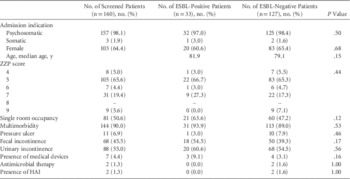
A total of 189 residents were included in the survey, the majority of whom (n=185) had a psychosomatic indication (Table 1). Of these, 117 (63%) were female, and the median age was 81 years. The median duration of stay on the day of the survey was 38 days (range, 8–428 days).
Patient Characteristics and Risk Factors for ESBL-E Colonization

NOTE. ESBL-E, extended spectrum β-lactamase–producing Enterobacteriaceae; ZZP, Betrouwbaarheid van de Zorgzwaartepakket; HAI, hospital-associated infection.
Prevalence of ESBL-E and ESBL Genes
Of the total 189 residents, 160 (84.7 %) residents were screened for ESBL-E carriage and 33 of these residents harbored ESBL-E, resulting in a prevalence of ESBL-E carriage of 20.6%. Reasons for nonresponse were mainly unconcern and lack of interest. Resident characteristics are described in Table 1. No statistically significant differences in resident characteristics were observed between responders and nonresponders (data not shown).
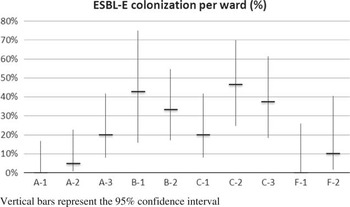
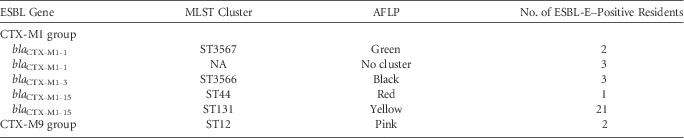
The majority of ESBL-E (n=32) were E. coli, and 1 Klebsiella pneumoniae was detected. Table 2 shows the diversity of ESBL genes. The bla CTX-M1-15 gene was the most prevalent ESBL gene (n=22). The mean prevalence of ESBL-E carriage per ward is shown in Figure 1 (with 95% CI). In some wards, almost 50% of the cultured residents were ESBL carriers, while in other wards no carriers were detected.
Prevalence of extended spectrum β-lactamase–producing Enterobacteriaceae (ESBL-E) colonization per ward.

Diversity of ESBL Genes, MLST Clones and Clonal Clusters Based on AFLP within the ESBL-E–Positive E. coli Strain Collection

NOTE. ESBL-E, extended spectrum β-lactamase–producing Enterobacteriaceae; MLST, multi-locus sequence typing; AFLP, amplified fragment length polymorphism; NA, not applicable.
Risk Factors for Colonization
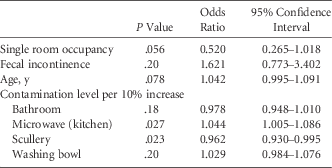
Risk factors for ESBL-E colonization (ie, ward, admission indication, sex, Betrouwbaarheid van de Zorgzwaartepakket [ZZP] score, multiple room occupancy, multimorbidity, presence of pressure ulcer, fecal incontinency, urinary incontinency, presence of medical device, antimicrobial therapy, and HAI) are shown in Table 1. Heavily contaminated surfaces were most frequently found on the bedside commode, kitchen microwave, and toilet seat. ATP levels >50,000 RLU were not exceptional. The most frequently observed shortcomings were the absence of protective gowns, the availability of a bedside commode, and the absence of at least 1 private bathroom per 15 residents. No significant risk factors associated with ESBL carriage were detected using univariate analyses (Table 1). In multiple logistic regression analysis using conditional logistic regression, single room occupancy tended to be protective (risk reduction, 50%; P=.056), whereas higher age was associated with increased risk (4.2% per year; P=.078) but was not statistically significant (Table 3). Analyses of contamination level in relation to ESBL carriage revealed conflicting results. An increase in contamination of the microwave was significantly associated with higher risk of ESBL carriage (OR, 1.044; P=.027; 95% CI, 1.005–1.086), and an increase in contamination level of the scullery was protective (OR, 0.962; P=.023; 95% CI, 0.930–0.995).
Multiple Logistic Regression Analysis Using the Conditional Maximum Likelihood Method

Nosocomial Transmission
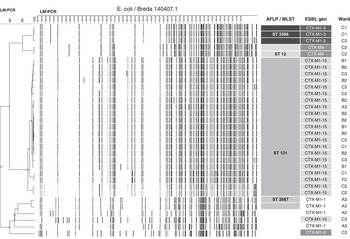
Results from the AFLP and MLST showed 4 clusters of nosocomial transmission in the NH (Figure 2, Table 2). The number of residents within a cluster varied from 2 in clonal cluster ST3567, 2 in clonal cluster ST12, and 3 in clonal cluster ST3566, to 21 in clonal cluster ST131. Wide distribution occurred over the wards, especially ST131, which was found in 7 different wards (Figure 2). Furthermore, ST131 was significantly associated with the presence of bla CTX-M1-15. The cluster size for ST131 was 21, and the cluster size for the 3 other clusters was significantly lower (3 for ST2566, 2 for ST3567, and 2 for ST12).
Identification of extended spectrum β-lactamase–producing (ESBL) genes in ESBL-positive E. coli isolates and genotypic typing results from amplified fragment length polymorphism (AFLP) and multilocus sequence typing (MLST).

Multiple logistic regression analysis to identify risk factors for transmission of the outbreak strain, E. coli ST131, resulted in similar results as for carriage of all types of ESBL-E.
DISCUSSION
The results of this study reveal a high prevalence (20.6%) of rectal ESBL-E carriage in Dutch NH residents in an NH in the southern Netherlands. A remarkable finding was the difference in ESBL-E carriage rates among wards within this NH. Unfortunately, aggregated data on ward level, patient characteristics and risk factors, did not provide insight into the ward-specific dynamics that could explain these differences.
Genotypic detection of the ESBL isolates showed extensive clonal dissemination of a bla CTX-M-15-positive, E. coli, sequence type 131, throughout the whole institute. This outbreak of E. coli ST131 was by far the largest reported outbreak with Gram-negative microorganisms in a Dutch healthcare setting to date. E. coli ST131 is known as an antimicrobial-resistant clonal group associated with healthcare settings, elderly hosts, and persistent or recurrent symptoms.Reference Banerjee, Johnston and Lohse 3 Although ST131 has been reported globally, it has received comparatively little attention in the Netherlands.Reference Johnson, Johnston, Clabots, Kuskowski and Castanheira 19 , Reference Peirano and Pitout 20 Within the hospital setting, no outbreaks of ST131 have been described. The prevalence of ESBL, and ST131 in particular, in Dutch NHs have not yet been investigated. Only 1 observational study on ESBL carriage in urine samples among nursing home residents has been published. In this study, ST131 was observed as the most prevalent sequence type, and ST131 was present in all NHs.Reference van der Donk, Schols, Driessen, Hagenouw, Meulendijks and Stobberingh 21
In theory, a culture on admission is needed to determine acquisition. However, in the Netherlands, the ESBL-E prevalence is low in hospitals as well as in the community. In a large nearby hospital, the ESBL-E prevalence (perianal carriage) has been measured repeatedly and has remained between 4% and 5% for the past 4 years. In addition to lower prevalence, a great diversity of ESBL genes is found within ESBL-positive isolates, indicating limited clonal spread (unpublished data). In this specific NH, 21 of the residents (13%) were carriers of 1 specific clone, bla CTX-M1-15 ST131 E. coli. This resistant clone is not common in the Netherlands and is rare in Dutch hospitals.Reference Rodriquez, Thomas and Van Essen 22 Considering these facts, it is very likely that transmission within the NH occurred.
The high prevalence of the ST131 clonal group and the large cluster size in our surveillance suggests that ST131 can spread very easily and is more prevalent in the Netherlands than is currently known. The rapid emergence and successful spread of E. coli ST131 is strongly associated with several factors, including the production of the CTX-M1-15 ESBL, as was the case in our surveillance.Reference Petty, Ben Zakour and Stanton-Cook 23 , Reference Johnson, Urban and Weissman 24 However, instead of increased transmissibility, the duration of gastrointestinal colonization ESBL-E may play a role in the spread of these organisms. Titelman et alReference Titelman, Hasan and Iversen 25 showed that persisting carriage may be associated with E. coli phylogroup B2 (including all ST131 strains) and CTX-M-group 9. Prolonged duration of ST131 colonization is currently under investigation in our setting.
No infections with ESBL-E were observed in this study; all patients were asymptomatic carriers. The risk of asymptomatic carriage of ESBL-E is that it can be transmitted to other residents imperceptibly. In general, NHs do not perform microbiological investigations frequently, and most antibiotic prescriptions are given empirically without knowledge of the pathogens involved or their antibiotic susceptibility. It is therefore likely that extensive antibiotic exposure supports selection of resistant clones and ongoing transmission within an NH. However, a relation between antibiotic exposure and ESBL carriage, on a patient level, could not be shown in this cross-sectional study.
No risk factors associated with ESBL-E carriage were detected. Higher age of residents and rooms with >1 bed approached statistical significance in a multivariate analysis. The level of contamination of some objects was identified as a risk factor, but for others it was protective. Firm conclusions cannot be drawn from these conflicting results. Particularly, the ATP-level test of the microwave did not reveal meaningful results. In most microwaves, food particles were visible with bare eyes, and the ATP level due to food particles is considerably higher than the ATP level caused by microbiological contamination. In future surveys for environmental contamination, the microwave has been replaced by another object.
Another potential risk factor for transmission of ESBL-E could be inadequate performance of hand hygiene procedures by healthcare employees. During and after the survey, we visited this NH on a regular basis. During these visits, the overall compliance to hand hygiene was observed; we did not note any differences among the wards in this regard. However, the number of observations was not large enough to produce reliable estimates, which is a limitation of the study. A French multicentre prevalence study on ESBL prevalence suggested, but could not prove, an association between high ESBL-E carriage rates, intra-NH ESBL-E spread, environmental contamination, and poor conformity with good hygiene practices.Reference Cochard, Aubier, Quentin and van der Mee-Marquet 26
In conclusion, our findings provide insight into the prevalence and spread of ESBL-E, and in particular ST131 clonal group, in a large Dutch NH. Active surveillance of rectal swabs revealed a large outbreak, but significant risk factors for transmission could not be identified. Unexplained differences in ESBL-E prevalence were detected among the wards. Undetected resistant clones, such as the ST131 clonal group, in NHs will become sources for outbreaks in hospitals, due to the frequent institutional care of NH residents, and will likely lead to a hidden expansion of resistance in the community. The endemic presence of these resistant Gram-negative bacteria in NHs will become more problematic when carbapenemases are introduced. To gain a better understanding of the risks and transmission routes, more research must be performed, preferably standardized and at a national level. In the described NH, repeated prevalence surveys for ESBL-E carriage will be performed to gain more insight into the duration of carriage and the transmission routes between residents. Furthermore, teaching activities targeting better understanding of hand hygiene and cleaning are performed in regular training programs at this NH.
Acknowledgments
The authors are indebted to the healthcare workers of the NHs for the collection of the fecal samples and perianal swabs, to the nursing home physicians for their time and assistance collecting the patient data, and to the analysts of the Laboratory for Microbiology and Infection control of the Amphia hospital for performing the microbiological analyses.
Financial support: This survey was funded without any external financial support.
Potential conflicts of interest: All authors report no conflicts of interest relevant to this article.