Introduction
Over the next 50 years, farmers will be called upon to produce more food than has been produced in the past 10 000 years, and to do so in environmentally sustainable ways (FAO, Reference Rischkowsky and Pilling2007a,b). The population size of many local livestock breeds is in decline and local breeds (local breeds) may become endangered because they cannot compete with cosmopolitan (cosmopolitan breeds) and selected breeds. Preserving the local populations is important: many have unique traits, such as hardiness and disease resistance, may be vital for future livestock production (FAO, Reference Rischkowsky and Pilling2007a). One way to ensure their survival is to sell products from these breeds to niche markets in which higher prices can be achieved compared with conventional markets.
The development of markets for animal products obtained from local populations might increase the added value (AV) to the products as suggested by Global Plan of Action for Animal Genetic Resources (AnGR) of the FAO (2007b). Therefore, an important strategy to increase AV for animal products, to preserve the environment and biodiversity and to orientate tourism and food consumptions would be the promotion of the link among three key factors: breed, environment and product.
Several links between breed and product are available in Italy for local dairy cattle: Reggiana breed and Parmigiano Reggiano cheese (Gandini et al., Reference Gandini, Maltecca, Pizzi, Bagnato and Rizzi2007), Rendena breed and Spressa cheese, Valdostana breed and Fontina cheese, Burlina breed and Morlacco cheese (Pretto et al., Reference Pretto, De Marchi, Dalvit and Cassandro2009).
Methane emissions contribute significantly to the greenhouse effect; indeed, methane has many times the global warming potential of carbon dioxide (IPPC, 2001, Kebreab et al., Reference Kebreab, Johnson, Archibeque, Pape and Wirth2008). Among human activities, the FAO (2006) declared that agriculture sector accounts for 22 percent of total greenhouse gases (GHG) emissions and 3 percent is due to the livestock sector (Cassandro et al., Reference Cassandro, Cecchinato, Battagin and Penasa2010). In Italy, cattle breeds account for 78 percent of total GHG emissions from livestock species; 54 percent is produced by dairy cattle and 24 percent by beef cattle. Typically, 2–12 percent of the gross energy intake in cattle is lost through the emission of enteric methane (Johnson and Johnson, Reference Johnson and Johnson1995). As methane concentration in the atmosphere is increasing, there is a strong interest in developing strategies to reduce emissions, particularly from the livestock sector. A mitigation action to reduce the emission might be to reduce the GHG emission per kg of milk yield or per kg of metabolic weight. The CH4 emission per unit of metabolic weight might be considered as a measure at net of the selection effect, while the CH4 emission per unit of milk yield is a measure at gross of the selection effect.
The aim of this study was to compare AV of milk yield and estimated methane emissions of cows from local and cosmopolitan breeds reared in Italian circumstances.
Materials and methods
Added value for dairy chain
The definition, in a broad sense, of the AV can be the difference between the final selling price of a product and the direct and indirect inputs used to manufacture it. Therefore, the AV can be defined as the measurement of increment of gross value for a product made following a specific process.
In dairy chain the AV can be calculated as
 $${\rm AV} = V - K\comma \;$$
where V is the price value of final product (e.g. value of cheese produced by 1 kg of milk) and K is the price value of input (e.g. value of 1 kg of milk used as fluid milk).
If the AV is positive, the product has AV, whereas if the AV is negative, the product has reduced value. In other terms, if the AV is greater than the cost, the process is profitable; otherwise the process is not profitable.
The milk price used in this study was based on a standard milk payment of the north-east part of Italy, where the values for protein, fat and whey yield are 7 747, 2 582 and €0.01962/kg, respectively (Bozza, Reference Bozza2007). Cheese price was assumed €8/kg considering the Parmigiano Reggiano cheese yield.
Added value for environmental chain
In an environmental chain, the AV may be defined as the minimum air pollution due to enteric methane emissions. In this case, the AV is a measurement of an environmental mitigation and might be used as a new brand for the product deriving from the breed for a valorization project. Using an approach proposed by Cassandro et al. (Reference Cassandro, Cecchinato, Battagin and Penasa2010), with an indirect method, predicted methane emissions in cattle might be estimated using predicted dry matter intake through the best equation for dairy cattle proposed by Ellis et al. (Reference Ellis, Kebreab, Odongo, McBride, Okine and France2007). Predicted dry matter intake was derived by milk yield, fat percentage and estimated body weight of cows, as reported by Chase and Sniffen (Reference Chase and Sniffen1985) and Cassandro et al. (Reference Cassandro, Carnier, Canavesi, Miglior and Bittante1997).
Results and discussion
Added value for dairy chain
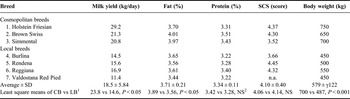
Table 1 summarizes milk yield and composition performances of seven cattle breeds, three cosmopolitan breeds and four local, reared in Italy (Bozza, Reference Bozza2007), along with the relative average body weight. Average values of 18.5 ± 5.84 kg/day of milk yield, 3.71 ± 0.21 percent of fat, 3.34 ± 0.11 percent of protein, 4.10 ± 0.40 of somatic cell count and 579 ± 122 kg of body weight were chosen as reference. The cosmopolitan breeds, namely Holstein Friesian, Brown Swiss and Simmental, produced 9.2 kg/day (P < 0.05) more milk compared with local breeds, namely Burlina, Rendena, Reggiana and Valdostana Red Pied. Fat percentage was significantly (P < 0.05) higher for cosmopolitan breeds (3.89 percent) compared with local breeds (3.56 percent), whereas no significant differences were found for protein percentage and somatic cell count. Regarding body weight, cosmopolitan breeds were 213 kg (P < 0.001) heavier than local breeds.
Average values of milk yield and composition, and body weight of seven cattle populations.

1One-way analysis of variance using the breed grouping in two levels as a fixed effect (local and cosmopolitan).
2NS = not statistically significant.
SCS = somatic cell count, CB = cosmopolitan breeds, LB = local breeds.
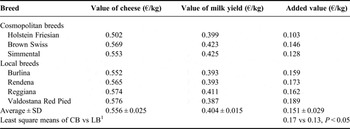
Table 2 reports the AV per kg of milk yield estimated assuming a standard milk and cheese prices adopted in Italy, and cheese yield as reported by Bozza (Reference Bozza2007). The average AV for milk yield was €0.15 ± 0.03 per kg and it was lower for cosmopolitan breeds than local breeds (€0.13 vs €0.17 per kg; P < 0.05). Hence, because of higher AV, for milk yield of the local breeds, respect to cosmopolitan breeds, the milk yielded by local breeds is more suited to be destined to cheese production compared with milk from cosmopolitan breeds. Indeed, the highest AV was reported by Valdostana Red Pied with €0.189 per kg, whereas the lowest AV was reported by Holstein Friesian with €0.103 per kg.
Added value per kg of milk yield of seven cattle populations.

1One-way analysis of variance using the breed grouping in two levels as a fixed effect (local and cosmopolitan).
CB = cosmopolitan breeds, LB = local breeds.
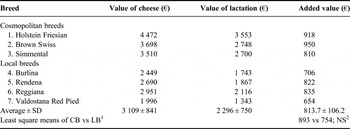
However, in terms of lactation yield (Table 3), the overall average of AV was €813.7 ± 106.2 and the comparison between the AV of cosmopolitan breeds and local breeds showed that local breeds compared with cosmopolitan breeds in terms of AV was higher for cosmopolitan breeds than local breeds (€893 vs €754; NS). Assuming no variation on milk composition, price and cheese yield performances, the Brown Swiss, with an AV of €950 per lactation, could reduce its lactation yield of 221 kg to realize the same AV than Holstein Friesian, whereas the Valdostana Red Pied would need to increase its lactation yield of 1401 kg to realize the same AV than Holstein Friesian breed.
Added value per 305-day lactation yield of seven cattle populations.

1One-way analysis of variance using the breed grouping in two levels as a fixed effect (local and cosmopolitan).
2NS = not statistically significant.
CB = cosmopolitan breeds, LB = local breeds.
Added value for environmental chain
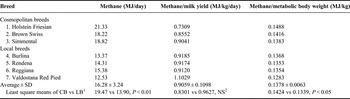
In Table 4, predicted methane production was 16.28 ± 3.24 MJ/day with a maximum value of 21.23 MJ/day for Holstein Friesian and a minimum of 12.53 MJ/day for Valdostana Red Pied; the local breeds showed better AV than cosmopolitan breeds for environmental chain, because of lower predicted methane production (13.90 vs 19.46 MJ/day; P < 0.01). In terms of methane emission per kg of milk yield, the average value was 0.9059 ± 0.1098 MJ/day with a maximum value of 1.1029 MJ/day for Valdostana Red Pied and a minimum of 0.7309 MJ/day for Holstein Friesian; no statistically differences were found between local breeds and cosmopolitan breeds for daily methane production per kg of milk yield (0.9627 vs 0.8301 MJ/kg/day; P > 0.05). This result is very important, and it shows that GHG is a parameter to be used carefully when comparing the breeds. Moreover, in terms of methane emission per kg of metabolic weight, the average value was 0.1378 ± 0.0063 MJ/kg with a maximum value of 0.1488 MJ/kg for Holstein Friesian and a minimum value of 0.1283 MJ/kg for Valdostana Red Pied; the local breeds showed a better AV for environmental chain than cosmopolitan breeds, because of lower predicted methane emission (0.1339 vs 0.1424 MJ/kg of metabolic body weight; P < 0.05).
Added value for environmental chain, expressed as predicted methane emission (MJ/day) in absolute value, as predicted methane emission per kg of milk yield and as kg of metabolic weight.

1One-way analysis of variance using the breed grouping in two levels as a fixed effect (local and cosmopolitan).
2NS = not statistically significant.
CB = cosmopolitan breeds, LB = local breeds.
Comparisons at farm/system levels should be done, but in previous studies no data were available to do so. Moreover, indices based on production or emission per hectare of land used might be another important aspect for comparing local and cosmopolitan breeds, as the value of beef/veal/meat production may be higher for dual purpose and local breeds, with respect to cosmopolitan breeds.
Conclusions
Analyses on AV for dairy chain showed that AV for dairy breeds is around €0.15 per kg of milk. All local breeds showed a highest AV value, with respect to cosmopolitan breeds, suggesting that milk produced by local breeds is better for cheese yield than for milk fluid production. However, in terms of milk production in 305 days, the AV was on average equal to €814 per 305 days with the best value for Brown Swiss and lowest for Valdostana P.R. Assuming, no variation in milk composition and cheese yield, the local breeds with an average increment of 951 kg of milk yield in 305 days have shown to have the same AV of HF. The two local breeds that showed the lowest increment of milk yield to have the same AV equal to the HF breed were Rendena and Reggiana with only +500 and +550 kg/305 days, respectively.
Analyses on AV for environmental chain showed that AV for dairy breeds is around 16 MJ/day/cow, with all local breeds that showed to cope better with mitigation of predicted total CH4 emission and per unit of metabolic weight than for unit of milk. Knowing that CH4 emission per unit of metabolic weight might be considered a measure at net of the selection effect, while the CH4 emission per unit of milk yield is a measure at gross of the selection effect, this study showed that AnGR have a dual role not only in food production but also in the provision of public good objectives including, biodiversity and landscape values and diffuse pollution to air and water.
AnGR need to be evaluated not only per unit of output but for the others direct and indirect units of output related to social and human returns.
Hence, AnGR should be evaluated in terms of environmental efficiency and not only in terms of economic efficiency. In this study, prices of cheeses are not varying a lot, but if local actors try to differentiate their products according to the breed, they may expect larger differences. Therefore, valorization projects based on AV for cheese yield, environment mitigation and other social and public goods, as territory preservation, consumer habits, tourists' requests and history and cultural aspects of link between breed and food should be considered.
Acknowledgements
The author would like to thank Mauro Penasa and Sipke Hiemstra for valuable comments to improve this paper and Christina Ligda for the useful support to stimulate this work and for the invitation at the dedicated session on Added Value at EAAP of Crete Island, Greece (2010). The opinions reported in the paper do not necessarily reflect those who supported this study.