Antimicrobial resistance is a major problem worldwide. According to reports by the World Health Organization (WHO), antimicrobial resistance could affect up to 24 million people with a projected 700,000 deaths annually. In India, medical tourism generates close to 2 billion dollars annually; and antimicrobial resistance affects this adversely.1,2 The ongoing emergence of antimicrobial resistance is a concern in the large and diverse population of India.3 Our survey interviewed providers in India to try to better understand and quantify the factors which may be drive antimicrobial resistance.
Materials and methods
An electronic survey was sent to a select distribution list of intensive care units (ICUs) and hospital inpatient (medicine ward) providers from India (using Google forms). Outreach was conducted via e-mail, phone, and social media messaging applications. Physicians were surveyed regarding their unit of practice, demographics, availability of the electronic medical record (EMR), access to microbiological testing, antimicrobial prescribing strategies, familiarity with infection prevention and control, and nosocomial infection reporting programs. The survey is provided in the supplementary materials (online).
Results
We received 90 responses from unique facilities, across 18 states in 65 ZIP codes in India. These facilities had a median of 187.5 beds (interquartile range [IQR], 40–470). The practice settings were ICUs (n = 58, 53%) and medicine wards (n = 42, 48%). Representative responders had a median age of 40 years (IQR, 31–53) and 73 responders (81%) were men.
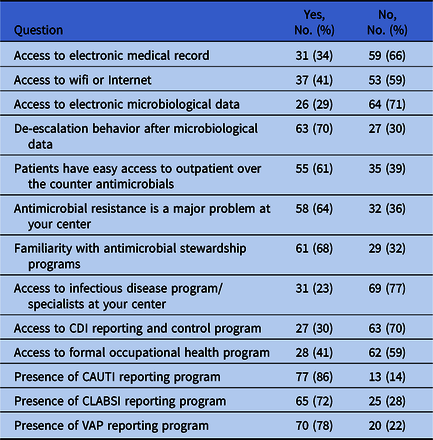
We observed overall familiarity with antimicrobial stewardship programs and principles in the responses. Nevertheless, lack of access to EMR, wifi/Internet, electronic microbiological data, infectious diseases consultation, were major challenges, as was the lack of easy over-the-counter access to antimicrobials. Access to nosocomial infection reporting programs was fair (Table 1).
India Antimicrobial Stewardship and Resistance (INTEREST) 2018 Survey Responses

Note. CDI, Clostridium difficile associated infection CAUTI, catheter-associated urinary tract infection; CLABSI, central-line–associated blood stream infection; VAP, ventilator-associated pneumonia.
Discussion
In this cross-sectional survey, we identified easy access to over-the-counter antimicrobials and antimicrobial resistance as major problems in India, despite general familiarity with the concept of antimicrobial stewardship. Lack of EMR was identified as a potential contributor to this issue.
The Centers for Disease Control and Prevention (CDC) defines antimicrobial stewardship as a set of commitments and actions designed to “optimize the treatment of infections while reducing the adverse events associated with antibiotic use.”4 Infectious Diseases are more widely prevalent in India than most countries in the world.3 India is a country of >1 billion people, yet it has only ~50 infectious diseases board-certified physicians.5 This scarcity, combined with easy access to over-the-counter antimicrobials, lack of government-mandated regulations for antimicrobial prescribing practices, and lack of EMR, contribute to antimicrobial resistance. To add to this complexity, there is a gross mismatch in the population burden when compared to resources available for public health.6
Past surveys have shown that antimicrobial stewardship programs (ASPs) are not available in more than half of the country. However, there is a national commitment to combat antimicrobial resistance via “The Chennai Declaration.”7
The lack of access to an EMR was reported to be a major issue, especially for microbiological data. Electronic storage of microbiological data helps clinicians when choosing antimicrobials for patients, whether that is empiric antimicrobials or antimicrobials on de-escalation.8,9 In the absence of such data, clinicians often feel the need to treat their patients with a broader spectrum of antimicrobials. An EMR may allow clinicians to communicate with other healthcare systems for easy exchange of information. However, it will take time to overcome these challenges. Some immediate solutions are to have government mandates to prevent over-the-counter availability of antimicrobials. Another approach would be to streamline diagnosis- and syndrome-based reporting of prescribing strategies to local state health departments.
Improved and rapid microbiological identification can enable clinicians to deploy efficient antimicrobial therapy. In our survey, only 70% of physicians reported the de-escalation of antimicrobials after getting microbiological data. One hypothesis is that this is due to the lack of availability of real-time and accurate microbiological diagnostic techniques, leading to empiric antimicrobials and de-escalation based on clinical signs, and not objective data. Also, the rate of unfamiliarity with the concept of antimicrobial stewardship in out survey was 30%, which indicates an opportunity for education. Microbiology laboratories can also help formulate local and regional antibiograms that can aid clinicians in selecting appropriate antimicrobials.
Another unexplored avenue is the potential for specialized countrywide infectious diseases training. Few programs exist for specialized infectious diseases training in India, mainly All India Institutes of Medical Sciences and Christian Medical College.10 For a population of >1.3 billion, greater consideration should be given to specialized infectious diseases training. This could be accomplished by the National Center for Disease Control and/or the Ministry of Health.
The next steps should be policy making followed by tracking, reporting, and education. Potential avenues include the development of national database for tracking antimicrobial prescribing by state. This data collection can be followed by prospective audit and feedback for local state health departments. These actions will help educate prescribers with real-time data and trends over time.
This survey had several strengths. The lack of contact between the core team and the participants helped decrease observer bias. Secondly, this was a unique survey of large centers in several geographically distinct locations including a large variety of hospital and ICU locations.
Our study has several limitations. The study was based on a survey without any intervention; thus, it risked identifying problems already known without offering valuable suggestions for improvement. Another limitation of this study is it focused on inpatient prescriber practices only. The over-the-counter prescription of antimicrobials is rampant. A similar survey in outpatient settings is needed.
In this cross-sectional pan-India survey, antimicrobial resistance was reported to be a major issue. Easy availability of over-the-counter antimicrobials and lack of electronic storage of medical and microbiological records were identified as major barriers. To counter antimicrobial resistance, ID training, antimicrobial stewardship education, and policy changes are needed.
Acknowledgments
We thank the survey respondents in these India healthcare centers.
Financial support
No financial support was provided relevant to this article.
Conflicts of interest
All authors report no conflicts of interest relevant to this article.
Supplementary material
To view supplementary material for this article, please visit https://doi.org/10.1017/ice.2020.1242