Introduction
Although termite pests constitute a minority of the Isoptera, this group is well known to cause large-scale economic damage. In several regions of Brazil, the family Rhinotermitidae comprises most of the economically important termite species, and the genera Heterotermes Froggatt, 1896 and Coptotermes Wasmann, 1896 include the largest numbers of pest species. Moreover, Coptotermes is a pest of global importance (Bandeira et al., Reference Bandeira, Gomes, Lisboa and Souza1989; Lelis, Reference Lelis1995; Su & Scheffrahn, Reference Su and Scheffrahn1998; Costa-Leonardo, Reference Costa-Leonardo2002, Reference Costa-Leonardo, Vilela, Santos, Schoereder, Serrão, Campos and Lino-Neto2008; Costa-Leonardo et al., Reference Costa-Leonardo, Casarin, Camargo-Dietrich, Pinto, Rossi and Salmeron2007). Heterotermes tenuis (Hagen, 1858) is a native species of Brazil, where it is described as a notable pest in both rural and urban areas. At agricultural sites, this termite infests the stems of aged corn, live Eucalyptus and sugar cane, and in urban areas, it attacks wooden structures, newspapers and books (Araújo, Reference Araújo, Mariconi, Zamitti, Araújo, Oliveira Filho and Pinchin1986; Pizano & Fontes, Reference Pizano and Fontes1986; Mill, Reference Mill1991; Almeida et al., Reference Almeida, Alves, Moino and Lopes1998; Costa-Leonardo, Reference Costa-Leonardo2002; Garcia et al., Reference Garcia, Macedo and Botelho2004). Coptotermes gestroi (Wasmann, 1896), the Asian subterranean termite, is an exotic species native to Southeast Asia (Kirton & Brown, Reference Kirton and Brown2003). In urban areas, this species damages structural wood and cellulosic materials; in rural areas, such as those in Singapore and Malaysia, this insect also attacks crops (Kirton & Wong, Reference Kirton and Wong2001; Lee, Reference Lee2007). Although subterranean termites are economically important, little is known about how they locate their food sources. This is most likely because of their cryptic existence, which renders behavioral studies difficult (Costa-Leonardo, Reference Costa-Leonardo2002, Reference Costa-Leonardo, Vilela, Santos, Schoereder, Serrão, Campos and Lino-Neto2008).
Optimal foraging theory suggests that animals are able to choose their food according to their nutritional requirements (Emlen, Reference Emlen1973) to optimize their fitness (Krebs, Reference Krebs, Krebs and Davies1978). Therefore, similar to other animals, termite strategies for locating food are related to basic considerations such as the efficient allocation of energy. Termite foraging behavior is a collective activity composed of integrated individual actions, and their feeding biology is undoubtedly the most relevant factor in the life history and social evolution of these insects, as the nutritional value of food sources is very significant for the food choices made by workers and also for the colony foundation by alate reproductives (Traniello & Leuthold, Reference Traniello, Leuthold, Abe, Bignell and Higashi2000). The foraging process is dynamic and changes over time according to the nutritional requirements of the colony and the amount of food resources available (Grace & Campora, Reference Grace, Campora, Lee and Robinson2005). Waller & La Fage (Reference Waller and La Fage1987a ) confirmed this dynamism for Coptotermes formosanus Shiraki, 1909. These authors observed that this termite can modify its recruitment behavior according to the quality and quantity of food available.
Currently, it is widely accepted that wood consumption in Rhinotermitidae is affected by a combination of abiotic and biotic factors, including humidity and temperature, colony population size, vigor, preferred and available food types, and the mortality rate of the individuals in the colony (Jones et al., Reference Jones, Trosset and Nutting1987; Fei & Henderson, Reference Fei and Henderson2002, Reference Fei and Henderson2004; Lenz & Evans, Reference Lenz, Evans, Jones, Zhai and Robinson2002; Arab & Costa-Leonardo, Reference Arab and Costa-Leonardo2005; Green et al., Reference Green, Scharf and Bennett2005; Costa-Leonardo, Reference Costa-Leonardo, Vilela, Santos, Schoereder, Serrão, Campos and Lino-Neto2008; Wong & Lee, Reference Wong and Lee2010). Additionally, a significant contribution to the knowledge of termite foraging dynamics would be addressed by the investigation of the following question: ‘how do subterranean termites behave when they locate equivalent food resources?’ Delaplane & La Fage (Reference Delaplane and La Fage1987) suggested that when forager individuals of C. formosanus find equivalent food sources, they concentrate their efforts on the first food encountered, i.e., there is a chronological priority in relation to the discovery. According to these authors, when different food items are available, selection is based more on the food's quality than on chronology. However, this fact remains a paradigm of the nutritional ecology of subterranean termites because it has never been contested.
Delaplane & La Fage (Reference Delaplane and La Fage1989a ) also observed the foraging tenacity of C. formosanus and Reticulitermes flavipes (Kollar, 1837) by the percentage of dry weight of a food consumed before the termites began eating other food resources. The authors suggest that this tenacity changes according to the species; however, this requires clarification because there are few studies on the movement of termite foragers among food sources, which generates uncertainty about whether the termites move randomly or exhibit fidelity to food (Su et al., Reference Su, Tamashiro, Yates and Haverty1984; Evans, Reference Evans2002; Lenz & Evans, Reference Lenz, Evans, Jones, Zhai and Robinson2002; Su & Scherer, Reference Su and Scherer2003; Su & Bardunias, Reference Su, Bardunias, Lee and Robinson2005; Long & Thorne, Reference Long and Thorne2006).
A better understanding of the foraging strategies of subterranean xylophagous termites may contribute to the improvement of management and control programs based on the use of toxic baits. Therefore, the purpose of this study was to analyze and compare the feeding behaviors of H. tenuis and C. gestroi in the presence of equivalent food resources (same shape, size and origin) using bioassays. This study also investigated whether these species concentrate their efforts on the first food resource encountered and move randomly or whether they exhibit fidelity to the food. The comparison of foraging behaviors between the termite species is important because both H. tenuis and C. gestroi live in urban environments and consume similar cellulosic sources.
Material and methods
Termite collections
Foraging workers and soldiers of the species H. tenuis and C. gestroi were collected from field colonies in Rio Claro, SP, Brazil (22°23′S, 47°31′W) using corrugated cardboard traps. Two colonies of H. tenuis located 1.5 km apart and 2 colonies of C. gestroi located 2.5 km apart were used in this study. The termites were placed in experimental arenas immediately after being collected.
Bioassays
The experimental arenas were used to verify the foraging behavior of the termites in the presence of equivalent food resources (multiple-choice tests). These arenas were composed of a central release chamber (250 ml) connected by small plastic tubes (10 cm long and 0.5 cm in diameter) to 4 food chambers (145 ml) equidistant from one another. All chambers had a lid and contained a moistened matrix of sterile sand (6% moisture content), which completely covered the insertion holes of the connecting tubes. Five hundred workers and 30 soldiers of H. tenuis or 500 workers and 50 soldiers of C. gestroi were placed in the central chambers, and the termites could enter the food chambers immediately following their introduction. Following a previous study conducted by Lima & Costa-Leonardo (Reference Lima and Costa-Leonardo2012), one block of Pinus elliottii Engelmann (Pinaceae) (27 cm3, i.e., 3×3×3 cm) was placed inside each food chamber and was completely buried in the substrate. Ten replicates were established for each termite species, and all experiments were maintained at 25±2 °C. In order to verify whether there is a chronological priority in relation to the discovery of food resource, the behavior of the termites has been observed until the arrival of at least one individual in one of the four food chambers. After 4 weeks of experimentation, the consumption of each wood block was determined by the percentage variation of dry weight (before and after the test period). The number of live individuals present in each chamber was also counted. Afterward, the percentage of workers and soldiers recruited to each food chamber in relation to the total survival rate was calculated for each replicate.
Two different treatments were developed to evaluate the foraging tenacity of H. tenuis and C. gestroi. In the first treatment, the experimental arenas were composed of a release chamber (250 ml) connected by a small plastic tube (15 cm long and 0.5 cm in diameter) to the first food chamber (145 ml), which was in turn connected to a second food chamber (fig. 1a). In the second treatment, the experimental arenas were similar to those described above except that there were three food chambers (fig. 1b). All chambers were covered with a lid and contained a moistened matrix of sterile sand (6% moisture content). Five hundred workers and 30 soldiers of H. tenuis or 500 workers and 50 soldiers of C. gestroi were placed in the release chambers, and the termites could enter the food chambers immediately following their introduction. One block of P. elliottii (27 cm3) was placed inside each food chamber and was completely buried in the substrate. Ten replicates of both treatments for each termite species were established, and all experiments were maintained at 25±2 °C. The behavior of the termites was observed every 24 h, and the end of the experimental period was defined as when the termites had been consuming the last food resource for 7 days. Similarly to the multiple-choice tests, the consumption of each wood block was measured and the number of live individuals present in each chamber was counted. Subsequently, the percentage of workers and soldiers recruited for each food chamber in relation to the total survival rate was calculated for each replicate. Considering that the experimental periods differed among the replicates, the feeding rate was also calculated for each of them, i.e., the relationship between the total amount of each food consumed and the total feeding time.
A schematic of the experimental arenas used in the bioassays concerning the foraging tenacity tests. (a) First treatment with two food resources; and (b) second treatment with three food resources.

A non-parametric Kruskal–Wallis test was performed, followed a posteriori by a Student–Newman–Keuls test when necessary. The data were also analyzed using Spearman's rank correlation test to determine the correlation between the consumption percentage and the recruitment rate of the workers and soldiers observed for both species. In addition, the results obtained for the species H. tenuis were compared to those for C. gestroi to determine whether the species behaved similarly when presented with equivalent food resources. The previously described statistical analyses were performed on these; a significance level (α) equal to 0.05 was adopted for all analyses (BioEstat 5.0 statistics package, Ayres et al., Reference Ayres, Ayres, Ayres and Santos2007).
Results
Multiple-choice tests
Heterotermes tenuis
The mean rate of total survival±standard error for all individuals was high (72.15±4.06%); the mean survival rate was 71.34±4.19% for workers and 85.67±2.80% for soldiers. The percentage of each wood block consumed by the end of the test period indicated that the initial food located by the termites (1.31±0.15%) and the food resources subsequently located (1.58±0.22%) were consumed similarly, with no significant differences between them (H=1.4843; P=0.2231). The chambers containing the food initially located by the termites presented a mean recruitment equal to 22.03±9.35%, with 21.97±9.34% of all live workers and 22.54±9.52% of all live soldiers. The chambers containing the food resources subsequently located showed a mean recruitment equal to 24.00±8.12%, with 24.30±8.26% for workers and 19.70±6.57% for soldiers. These rates of recruitment were not statistically different for either workers (H=0.0478; P=0.8269) or soldiers (H=0.0120; P=0.9129). Finally, Spearman's rank correlation test (table 1) indicated a positive correlation between the percentage of food consumed and the recruitment of workers (r S=0.5623; P=0.0012) and soldiers (r S=0.6418; P=0.0001) in the chambers with food subsequently located by the termites.
Multiple-choice tests: Spearman's rank correlation test between the consumption percentage of food and the percentage of individuals present in each food chamber.

r S, Spearman's rank correlation coefficient; P, probabilities; *, positive correlation (P<0.05).
Coptotermes gestroi
The mean rate of total survival was high (80.22±1.94%); the mean survival rate was 79.02±2.19% for workers and 92.20±1.64% for soldiers. The percentage of each wood block consumed by the end of the test period indicated that similar amounts of all food resources were consumed, with no significant differences among the initial food located by the termites (3.37±0.49%) and the food resources subsequently located (2.79±0.47%; H=1.3356; P=0.2478). The chambers containing the food initially located by the termites presented a mean recruitment equal to 36.65±12.81%, with 36.53±12.83% of all live workers and 37.97±12.90% of all live soldiers. The chambers containing the food resources subsequently located showed a mean recruitment equal to 20.56±6.52%, with 20.67±6.58% for workers and 19.53±6.16% for soldiers. These rates of recruitment were not statistically different for either workers (H=1.2229; P=0.2542) or soldiers (H=1.5616; P=0.2114). Finally, Spearman's rank correlation test (table 1) indicated a positive correlation between the percentage of food consumed and the recruitment of workers (r S=0.8442; P=0.0021) and soldiers (r S=0.8817; P=0.0007) in the chambers with the initial food located by the termites as well as in the chambers with the subsequently located food resources (workers: r S=0.7385; P<0.0001 and soldiers: r S=0.7499; P<0.0001).
Heterotermes tenuis vs. Coptotermes gestroi
The comparison of the percentages consumed between the initially located food resource and those subsequently located showed that the behavioral results differed between the two species. C. gestroi consumed more wood in the chambers with initially located food source (R 1H=6.70; R 1C=14.30; H=8.2514; P=0.0041), and H. tenuis had a higher consumption in the chambers containing the subsequently located food (R 2H=22.62; R 2C=38.38; H=12.2277; P=0.0005). No significant differences between H. tenuis and C. gestroi were observed in the percentages of recruited workers (H=0.2057; P=0.6501) and soldiers (H=0.5714; P=0.4497) for the chambers containing either the initially or the subsequently located food (workers: H=1.9936; P=0.1580 and soldiers: H=1.6545; P=0.1983).
Foraging tenacity tests
Heterotermes tenuis
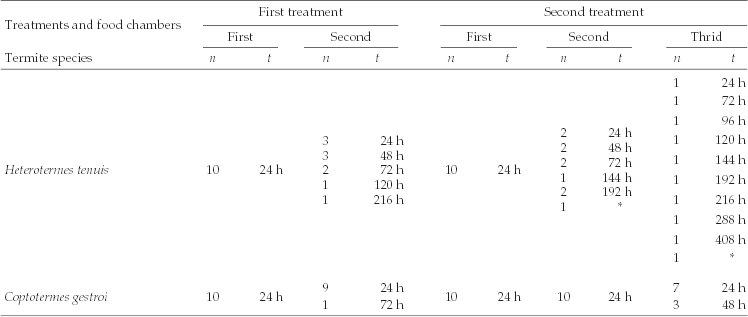
The total survival rate in the first treatment was high (77.98±4.24%); the mean survival rate was 77.76±4.48% for workers and 82.18±3.59% for soldiers. The total survival rate in the second treatment was 91.88±2.05%; 91.92±2.04% for workers and 92.11±1.92% for soldiers. The results concerning the behavioral observations performed every 24 h are listed in table 2. The movement of workers and soldiers among the chambers through the connecting tubes was also observed in both treatments. These data showed that many individuals moved from the release chamber to the first food chamber and from the first to the second food chamber during the entire experimental period. In the case of the second treatment, individuals also moved into the third food chamber during the entire period. In the first treatment, based on the estimated feeding rates for each wood block (percentage of consumption per day of experimentation) over the test period, it was observed that this rate was higher for the first food (0.21±0.02%) than the second food (0.15±0.01%). These results were confirmed by the statistical analysis (R 1=13.10; R 2=7.90; H=3.8658; P=0.0494). In the second treatment, the feeding rate was higher for the first food (0.17±0.02%) than for both the second (0.08±0.02%; P=0.0092) and third food (0.09±0.02%; R 1=22.10; R 2=11.85; R 3=12.55; H=8.4626; P=0.0153). The feeding rates for the second and third food did not differ (P=0.8589).
Number of replicates and time required by the termites (hours of experimentation) to reach each food chamber during the foraging tenacity tests for both termite species in the first and second treatments.

N, number of replicates; t, time required to reach each food chamber (in hours); *, termites did not reach the food chamber.
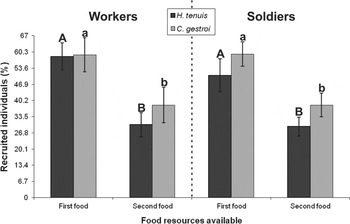
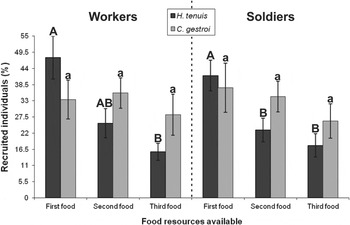
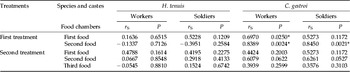
According to the results for the first treatment, the chambers containing the first food exhibited a higher total mean recruitment (57.96%) with 58.45% of all live workers (R 1=14.20; R 2=6.80; H=7.8229; P=0.0052) and 50.61% of all live soldiers (R 1=13.30; R 2=7.70; H=4.4834; P=0.0343) in comparison to the chambers containing the second food, which had a total mean recruitment of 30.11%, with 30.20% for workers and 29.40% for soldiers (fig. 2). The data concerning the second treatment showed that a higher total mean recruitment (47.39%), with 47.68% of all live workers and 41.53% of all live soldiers, occurred in the chambers containing the first food, followed by the chambers containing the second food (total: 25.25%; workers: 25.36%; soldiers 22.99%). The chambers with the third food were associated with the lowest total mean recruitment (15.70%), with 15.61% of all live workers and 17.79% of all live soldiers (fig. 3). A significant difference was observed between the recruitment of workers in the first and third food chambers (R 1=21.90; R 3=9.65; H=9.7400; P=0.0019). However, no significant differences were observed between worker recruitment to the first and second chamber (P=0.0775) or between the second and third chamber (P=0.1782). In relation to the recruitment of soldiers, significant differences were observed between the first and second food chamber (P=0.0092) and the first and third chamber (R 1=22.85; R 2=12.60; R 3=11.05; H=10.6299; P=0.0027). However, no significant difference was observed between the second and third food chamber (P=0.6938). Finally, Spearman's rank correlation test (table 3) indicated a non-significant correlation between the feeding rates for each food resource and the recruitment of workers and soldiers to all food chambers corresponding to the first treatment. Similar results were observed in the second treatment.
Foraging tenacity tests with two food resources available: the means and standard errors of the percentages of termites (workers and soldiers) observed in each food chamber. The columns capped with identical capital letters (H. tenuis) and small letters (C. gestroi) are not significantly different (P>0.05).

Foraging tenacity tests with three food resources available: the means and standard errors of the percentages of termites (workers and soldiers) observed in each food chamber. The columns capped with identical capital letters (H. tenuis) and small letters (C. gestroi) are not significantly different (P>0.05).

Foraging tenacity tests with two (first treatment) or three (second treatment) food resources available: Spearman's rank correlation test between the feeding rates for each food resource and the percentage of individuals present in each food chamber.

r S, Spearman's rank correlation coefficient; P, probabilities; *, positive correlation (P<0.05).
Coptotermes gestroi
The total survival rate in the first treatment was high (95.53±0.63%); the mean survival rate was 95.36±0.66% for workers and 97.20±1.12% for soldiers. The total survival rate in the second treatment was 95.13±0.79%; 95.14±0.79% for workers and 95.00±1.20% for soldiers. The results concerning the behavioral observations performed every 24 h are also listed in table 2. In relation to the movement of workers and soldiers among the chambers, it was possible to determine that many individuals were primarily moving from the release chamber to the first food chamber and from the first to the second food chamber during the first 72–96 h of experimentation. In the second treatment, the individuals also primarily moved to the third food chamber during the first 72–96 h. After this period, a decrease was observed in the movement of the termites. In the first treatment, based on the estimated feeding rates for each wood block, it was observed that the rate for the first food was higher (0.16±0.02%) than that for the second food (0.09±0.01%; R 1=13.60; R 2=7.40; H=5.4956; P=0.0191). In the second treatment, the feeding rate for the first food was higher (0.16±0.02%) than for the third food (0.08±0.02%; R 1=20.50; R 2=14.80; R 3=11.20; H=4.8057; P=0.0284) but not significantly different from the second food (0.10±0.01; P=0.1123). Additionally, the feeding rates for the second and third food did not differ (P=0.2897).
According to the results for the first treatment (fig. 2), the chambers containing the first food exhibited a higher total mean recruitment (59.17%), with 59.15% of all live workers and 59.45% of all live soldiers, in comparison to the chambers containing the second food, which had a total mean recruitment of 38.33%, with 38.32% for workers (R 1=13.40; R 2=7.60; H=4.8057; P=0.0284) and 38.32% for soldiers (R 1=13.25; R 2=7.75; H=4.3247; P=0.0376). The data concerning the second treatment showed that a higher total mean recruitment (35.54%), with 35.65% of all live workers and 34.38% of all live soldiers, occurred in the chambers containing the second food, followed by the chambers containing the first food (total: 33.81%; workers: 33.45%; soldiers: 37.44%). The chambers with the third food presented the lowest total mean recruitment (28.10%) with 28.30% of all live workers and 26.11% of all live soldiers (fig. 3). However, no significant differences were observed among the three food chambers in the recruitment of workers (H=1.2800; P=0.5273) or soldiers (H=1.5704; P=0.4560). Finally, Spearman's rank correlation test (table 3) indicated a positive correlation between the feeding rate and the recruitment of workers for the chambers containing both the first (r S=0.6970; P=0.0250) and the second food (r S=0.8389; P=0.0024) in the first treatment. However, a positive correlation between the feeding rate and the recruitment of soldiers (r S=0.8450; P=0.0021) was observed only for the chambers containing the second food. No significant correlation was observed between the percentage of food consumed and the recruitment of workers and soldiers for any of the food chambers corresponding to the second treatment.
Heterotermes tenuis vs. Coptotermes gestroi
The behavioral data indicated that the termite species presented some differences in foraging behavior, as C. gestroi reached the last food chamber faster than H. tenuis. The comparison of the feeding rates for each food resource showed that the two species exhibited similar behaviors in both treatments, with a higher rate of feeding on the first food encountered by both H. tenuis and C. gestroi compared to the other available food sources. In the first treatment, it was also observed that H. tenuis exhibited a higher feeding rate for the second food (R 2H=14.30; R 2C=6.70; H=8.2763; P=0.0041) than C. gestroi. In the second treatment, no significant differences between H. tenuis and C. gestroi were observed in the feeding rates obtained for all available food resources. Data for both termite species regarding the numbers of workers and soldiers observed in each food chamber in the first treatment showed a higher mean recruitment in the chambers containing the first food encountered. No significant differences between H. tenuis and C. gestroi were observed in the percentages of recruited workers (H=0.0914; P=0.7624) and soldiers (H=0.5719; P=0.4495) for the chambers containing either the first or the second food sources (workers: H=0.5714; P=0.4497 and soldiers: H=1.9572; P=0.1618). The results of the second treatment indicated that the recruitment of H. tenuis workers was higher in the chambers containing the first food and the recruitment of C. gestroi workers was higher in the chambers with the second food. The recruitment of soldiers was similar for both species because higher mean recruitment occurred in the chamber containing the first food. No significant differences between H. tenuis and C. gestroi were observed in the percentages of recruited workers (H=1.2857; P=0.2568) and soldiers (H=0.9664; P=0.3256) for the chambers containing either the first food, second food (workers: H=1.2857; P=0.2568 and soldiers: H=2.2874; P=0.1304) or third food resource (workers: H=0.9657; P=0.3258 and soldiers: H=1.0430; P=0.3071).
Discussion
The feeding habits of subterranean termites involve the simultaneous consumption of different food resources. According to Hedlund & Henderson (Reference Hedlund and Henderson1999), C. formosanus displays different patterns of behavior when the food sizes are variable; when food size was increased, the consumption and the survival of the termites also increased. Similar results were observed by Waller (Reference Waller1988) and Lenz (Reference Lenz, Hunt and Nalepa1994). However, there have been few studies concerning termite feeding behavior when equivalent food sources are available. Delaplane & La Fage (Reference Delaplane and La Fage1987) reported that C. formosanus displays a chronological priority in relation to the discovery of food sources because the foragers concentrate their consumption efforts on the initial food visited. Nevertheless, in the present study, the multiple-choice tests showed that H. tenuis and C. gestroi display the same behavioral patterns in relation to the consumption and the recruitment of foragers for equivalent food sources, and these facts suggest that subterranean termites did not concentrate their efforts on the consumption of only one food when multiple resources are available. Hapukotuwa & Grace (Reference Hapukotuwa and Grace2012) verified that C. gestroi continues to shift from one food source to another, rather than remaining until each food resource is consumed, confirming the idea that this species does not display a chronological priority in relation to the location of food.
The termite diet is nutritionally poor, as their food sources are rich in carbon and hydrogen but are lacking in nitrogen compounds (Waller & La Fage, Reference Waller, La Fage, Stansly and Rodriguez1987b ; Traniello & Leuthold, Reference Traniello, Leuthold, Abe, Bignell and Higashi2000). In natural habitats, subterranean termites are able to choose and consume different cellulosic sources, which may be complementary in relation to their nutrient requirements. For this reason, it is important that control technologies consider termite biology, foraging and feeding behavior, nutritional physiology, ecology and environmental factors (Ahmed & French, Reference Ahmed and French2008). The toxicant baiting systems used for termite control can be compared to equivalent food sources for these insects. Although the baits are not the only cellulosic resources available in the environment, they need to be as attractive to termites as the alternative food items.
The positive correlations verified in the multiple-choice tests indicated that the number of recruited foragers (workers and soldiers) was correlated to the percentage of the food source consumed (table 1). These results show that soldiers, although they do not feed themselves, actively participate in the foraging process. However, the workers consume the cellulosic source and then feed the other colony members by trophallaxis. Additionally, a non-significant correlation was observed for some chambers, most likely because the number of individuals present in these chambers was greater than the consumption that occurred. These results suggest that the termites did not have sufficient time to consume an amount of wood consistent with such recruitment. Comparing the consumption percentages of each wood block for both termite species, it was observed that C. gestroi consumed more food than H. tenuis in the multiple-choice tests, which had identical experimental periods. Such results suggest that C. gestroi consumes available cellulosic sources faster than other species, even when worker and soldier recruitments are identical. This fact confirms the voracity of C. gestroi and its status as a pest that causes severe damage in the urban areas of São Paulo State, Brazil (Fontes, Reference Fontes, Berti-Filho and Fontes1995; Costa-Leonardo, Reference Costa-Leonardo2002, Reference Costa-Leonardo, Vilela, Santos, Schoereder, Serrão, Campos and Lino-Neto2008; Costa-Leonardo et al., Reference Costa-Leonardo, Casarin, Camargo-Dietrich, Pinto, Rossi and Salmeron2007). Furthermore, the higher biomass of C. gestroi in relation to H. tenuis may explain the different consumption rates during identical experimental periods (Su & La Fage, Reference Su and La Fage1984). This may be another advantage of C. gestroi, which was introduced to Brazil, over the native species when competing for foraging territory (Lima & Costa-Leonardo, Reference Lima and Costa-Leonardo2006, Reference Lima and Costa-Leonardo2012).
It is known that subterranean termites choose randomly among available food sources (Su et al., Reference Su, Tamashiro, Yates and Haverty1984; Jones et al., Reference Jones, Trosset and Nutting1987). On the other hand, according to Delaplane & La Fage (Reference Delaplane and La Fage1987) and Jones et al. (Reference Jones, Trosset and Nutting1987), when these insects discover a favorable food site, they exhibit great tenacity, i.e., feeding is not random, even if the initial conditions change (Delaplane & La Fage, Reference Delaplane and La Fage1989b ). Monitoring and toxicant baiting systems are processes that are usually applied in the control of subterranean termites (Woodrow et al., Reference Woodrow, Sheldon, Oshiro, Grace and Wagner2008). Nevertheless, to increase baiting success, it is important that the termites exhibit fidelity to these toxicant baits. According to Su et al. (Reference Su, Tamashiro, Yates and Haverty1984), Su & Scherer (Reference Su and Scherer2003) and Su & Bardunias (Reference Su, Bardunias, Lee and Robinson2005), subterranean termites do not display fidelity to feeding sites. However, other researchers suggest that individuals exhibit resource fidelity (Evans, Reference Evans2002; Lenz & Evans, Reference Lenz, Evans, Jones, Zhai and Robinson2002; Long & Thorne, Reference Long and Thorne2006).
In relation to the results corresponding to the foraging tenacity of H. tenuis, the chambers with the first food presented a higher feeding rate and a higher recruitment of individuals in both first and second treatments (figs 2 and 3). These data suggest that both feeding rate and recruitment are always greater for the initial food source, whereas a decrease occurs in these behaviors according to the number of food resources that subsequently become available. Similar results concerning the feeding rate were observed for C. gestroi because the chambers with the first food presented higher rates in both treatments. Such data corroborate the idea that there is a chronological priority in relation to food discovery (Delaplane & La Fage, Reference Delaplane and La Fage1987). However, it is important to note that foragers of both species only concentrate their efforts on the consumption of initially located food when they do not have direct access to other food resources simultaneously, i.e., when they are required to locate sequential sources of food. In relation to the recruitment of C. gestroi individuals, a significant difference was observed between the food available in the first treatment (fig 2). These results suggest that different forager groups are allocated to each available food source, and that after these individuals have established their feeding sites, they begin feeding but with different consumption rates. Yang et al. (Reference Yang, Su and Bardunias2009) observed that not all foragers of C. formosanus participated in tunnel excavation and they suggested that these ‘non-excavating’ individuals might be responsible for other foraging-related tasks, e.g., feeding and digesting of their food (Evans, Reference Evans2006). This division of labor in tunneling behavior was also verified by Bardunias et al. (Reference Bardunias, Su and Yang2010), who suggest that not all individuals of C. formosanus contribute equally to the creation of tunnels, although this behavior in termites is a group effort.
The behavioral data on the movement of workers and soldiers of C. gestroi through the connecting tubes showed that the foragers decreased their traveling after 72–96 h of experimentation. This result suggests that after the discovery and selection of a food resource, the individuals exhibited resource fidelity, ceasing to search and consume other food sources. Such data confirm the results obtained by Evans (Reference Evans2002), Lenz & Evans (Reference Lenz, Evans, Jones, Zhai and Robinson2002) and Long & Thorne (Reference Long and Thorne2006). However, the behavioral data of H. tenuis foragers indicated that the movement of workers and soldiers was intense during the entire experimental period. This suggests that most H. tenuis individuals did not prioritize the consumption of the initially located food resources over the search for other food sources, i.e., some termites did not exhibit fidelity. Another possible explanation for this pattern is the existence of labor differentiation among groups of the same termite caste. If this is true, some individuals would be responsible for searching and discovering food resources, and when the food was located, other foragers would be recruited to begin consumption. Simultaneously, the initial group would leave the colony to search for new food sources, which could explain the constant movement of the termites through the connecting tubes. These results differ from those observed for C. gestroi, which indicate more homogeneous behavior compared to H. tenuis and corroborate the idea that tenacity is modified according to termite species (Delaplane & La Fage, Reference Delaplane and La Fage1989a ).
Esenther (Reference Esenther1979) and French et al. (Reference French, Robinson and Ewart1986) suggest that the best social and nutritional conditions in laboratory studies are those that simulate natural colonies most accurately. However, many factors influence food choice by subterranean termites in the field, including the resources available in different habitats (Lenz et al., Reference Lenz, Kard, Evans, Mauldin, Etheridge and Abbey2009). According to these authors, R. flavipes modifies its wood consumption rate in relation to the size of the resources available to the colony. This species also uses stake bundles as nests and consequently presents a slower rate of wood consumption in food-poor habitats. This is not the case in this study because although H. tenuis does not build individual nests, its workers do not relocate but rather care for larvae at the feeding sites, which also occurs with Reticulitermes spp. (Grace, Reference Grace1996; Lenz et al., Reference Lenz, Preston, Creffield, Archer, Kard, Vongkaluang and Sornnuwat1998, Reference Lenz, Creffield, Evans, Kard, Vongkaluang, Sornnuwat and Preston2003; Thorne et al., Reference Thorne, Traniello, Adams and Bulmer1999). In addition, the reproductive strategy of H. tenuis is different from that of Reticulitermes because this species never raises neotenics in foraging groups (Costa-Leonardo, personal observation). Nevertheless, this strategy may not be true for other species of Heterotermes. Only H. tenuis workers, soldiers and occasional nymphs were located in the foraging population sampled with field traps during an entire year in Rio Claro, SP, Brazil. A better understanding of the foraging biology of H. tenuis and C. gestroi is important for future experiments on the feeding behavior of both species. Additionally, knowledge about the foraging behavior of subterranean termites is indispensable for improving control strategies.
Acknowledgements
Support was provided by Fundação de Amparo à Pesquisa do Estado de São Paulo – FAPESP (Proc. 06/55828-0) and Conselho Nacional de Desenvolvimento Científico e Tecnológico (CNPq).