INTRODUCTION
Most second language (L2) educators would agree that L2 students may delay their learning of a L2 and avoid investing efforts when they are unmotivated. In contrast, motivated learners are active in pursuing their language goals and attending to the learning tasks that are necessary to attain them. As such, researchers have explored different perspectives of motivation to better understand its association with the attainment of an L2 (Alamer, Reference Alamer2021; Alamer & Lee, Reference Alamer and Lee2019; Al-Hoori, Reference Al-Hoorie2017; Alrabai, Reference Alrabai2016; Clément & Dörnyei, Reference Clément, Dörnyei, Dörnyei and Schmidt2001; Dörnyei & Ryan, Reference Dörnyei and Ryan2015; Gardner, Reference Gardner2010; Noels, Reference Noels, Apple, Da Silva and Fellner2013; Tremblay & Gardner, Reference Tremblay and Gardner1995). Recent studies have witnessed greater importance being given to the “self” component in motivating language learning. The L2 motivational self-system is one of the most dominant motivational theories, focusing on two competing possible selves: the “ought-to L2 self” and the “ideal L2 self” (Dörnyei, Reference Dörnyei2009; Dörnyei & Ushioda, Reference Dörnyei and Ushioda2009). It is often reported that the ideal form of the self is more closely related to positive linguistic outcomes than the ought-to self (see Dörnyei & Ushioda, Reference Dörnyei and Ushioda2011 for a review). Another motivation model that utilizes the “self” component in the discipline is self-determination theory (SDT; Ryan & Deci, Reference Ryan and Deci2000, Reference Ryan and Deci2017). Although previous studies have employed SDT to examine its association with different linguistic outcomes, there is a lack of empirical research that has tested a comprehensive model that explains why motivated learners can be more successful in learning English vocabulary (as an L2) than their counterparts from an SDT perspective.
Fundamentally, SDT postulates that some learners may learn simply because they find learning a language to be inherently enjoyable, important, and interesting (i.e., they are autonomously motivated). Others, however, may be compelled by instrumental and external goals (i.e., they are controlled motivated). In addition, SDT proposes a mechanism through which learners can exhibit autonomous forms of motivation. Specifically, the theory suggests that three basic psychological needs (BPN) should be satisfied among learners for optimal functioning and learning; that is, learners should have a sense of autonomy, competence, and relatedness. SDT-based research has shown that when these needs are satisfied, L2 learners exhibit autonomous forms of motivation (Alamer & Almulhim, Reference Alamer and Almulhim2021; Alamer & Lee, Reference Alamer and Lee2019; Hiromori, Reference Hiromori2003; Jang et al., Reference Jang, Reeve and Deci2010; Noels et al., Reference Noels, Clément and Pelletier1999; Oga-Baldwin et al., Reference Oga-Baldwin, Nakata, Parker and Ryan2017). Although it is often reported that autonomous motivation is associated with various language outcomes, some suggest that the link is not always direct. That is, additional factors (such as effort) can mediate this relationship and unfold the underlying processes in the relationship among BPN, SDT, and the attainment of vocabulary (Alamer & Lee, Reference Alamer and Lee2019; Cerasoli et al., Reference Cerasoli, Nicklin and Ford2014). However, there is little systematic evidence devoted to disentangling the relationships among BPN, SDT orientations, effort, and vocabulary knowledge in one comprehensive model in the field. Including these constructs in one model would allow us to meaningfully substantiate the mechanisms that underlie the relationship between BPN and vocabulary learning.
Accordingly, this study aims to (1) examine the factorial structure of BPN and SDT orientations among Saudi undergraduate students of English based on the most recent formulation developed by Ryan and Deci (Reference Ryan and Deci2017) and (2) examine a theory-driven model based on SDT to explain learners’ vocabulary knowledge. In particular, we focused on assessing how BPN facilitate learners’ autonomous motivation and hinders controlled motivation (from SDT), which, in turn, predicts increased effort and, ultimately, the attainment of L2 vocabulary. Such an examination may unpack the nature of the mediational processes of SDT orientations and effort in the relationship between BPN and vocabulary knowledge. These objectives were addressed using the structural equation modeling (SEM) approach to examine the direct, indirect, and total effects.
LITERATURE REVIEW
BASIC PSYCHOLOGICAL NEEDS AND LANGUAGE LEARNING
SDT advocates the importance of BPN for sustained and enhanced autonomous motivation (autonomous motivation will be discussed further in the “Autonomous and Controlled Motivation in Language Learning” section). SDT postulates that autonomy, competence, and relatedness are essential conditions for learners to thrive in their learning environment (Deci & Ryan, Reference Deci and Ryan1985; Ryan & Deci, Reference Ryan and Deci2017). Autonomy refers to the sense of control and freedom that individual develops when s/he can elect to engage in an activity that is personally meaningful and interesting. Social learning contexts (usually provided by instructors, parents, or peers) should nurture learners’ need of autonomy by allowing them to choose language activities that are personally relevant. Competence refers to a state in which the learner feels effective, competent, and capable of successfully performing the target activities. For learners to develop a sense of competence, a clear structure and learning goals should be provided from the beginning of their language learning activities. Relatedness refers to connectedness with other people and the development of a sense of warmth with others. It has been suggested that the psychological need for relatedness is important for the internalization of learning processes as well as for taking ownership of learning and engagement (Niemiec & Ryan, Reference Niemiec and Ryan2009).
Few studies have been conducted to date on the role of BPN in language learning outcomes. For instance, Noels et al. (Reference Noels, Clément and Pelletier1999) presented correlations between students’ final L2 course grades and their perceptions of their language teachers as supportive of their competence and autonomy. The results showed that neither students’ perceived autonomy nor competence were correlated with final grades. A more recent study (Alamer & Lee, Reference Alamer and Lee2019) has shown a link between BPN and L2 achievement through the mediation of SDT orientations. Alamer and Lee (Reference Alamer and Lee2019) illustrated that BPN are only indirectly related to L2 achievement by means of intrinsic motivation, goal setting, and language positive emotions. These studies suggest that motivated behaviors related to language learning (such as engagement and expended effort) might elucidate the relationship between BPN and language learning outcomes. Furthermore, SDT researchers have used aspects of BPN to assess their direct associations with SDT orientations (Alamer & Lee, Reference Alamer and Lee2019; Noels et al., Reference Noels, Clément and Pelletier1999, Reference Noels, Lascano and Saumure2019; Oga-Baldwin et al., Reference Oga-Baldwin, Nakata, Parker and Ryan2017; Wu, Reference Wu2003). In these studies, BPN variables were set as exogenous for autonomous motivation because SDT postulates that satisfying the three basic needs is expected to yield a positive derivative in the form of the embodiment of autonomous motivation (Ryan & Deci, Reference Ryan and Deci2020). Research indicates that perceived competence often outperforms other BPN variables in predicting autonomous motivation and that perceived autonomy shows a positive, albeit slightly weaker, relationship with autonomous motivation (see, Noels, Reference Noels, Apple, Da Silva and Fellner2013, for a review).
Overall, empirical studies investigating the underlying process of BPN in relation to vocabulary knowledge are scarce. Another issue in L2 literature is the lack of evidence for the underlying factor structure of BPN. This is an important methodological issue to consider because it permits researchers to determine, for example, whether a global BPN construct could coexist with the three constructs of autonomy, relatedness, and competence in one measurement model, a conceptualization that has been empirically supported in previous studies outside the language learning domain (e.g., Guay et al., Reference Guay, Morin, Litalien, Valois and Vallerand2015; Gunnel & Gaudreau, Reference Gunnel and Gaudreau2015; Tóth-Király et al., Reference Tóth-Király, Morin, Bőthe, Orosz and Rigó2018). Hence, understanding the factorial structure helps researchers utilize the theory more accurately in the field. Therefore, another goal of the present study was to test and assess the BPN dimensionality.
AUTONOMOUS AND CONTROLLED MOTIVATION IN LANGUAGE LEARNING
The concepts of autonomous and controlled motivation in SDT (Deci & Ryan, Reference Deci and Ryan1985; Ryan & Deci, Reference Ryan and Deci2020) are drawn from the notion that different types of orientations can be delineated by varying degrees of self-determination or relative autonomy, expressed as personal and impersonal. A key concept of SDT is that when learning is integral to the learner’s sense of self, an intrinsic motivation toward the task will develop. SDT posits that individuals can hold a diverse range of orientations to and reasons for engaging (or not engaging) in tasks. The different types of motivational orientations can illuminate learners’ purpose and manner of approaching, doing, and completing L2 tasks.
An individual may pursue learning an L2 because it is interesting, fun, and enjoyable (intrinsic orientation), that is, the activity is pleasurable in and of itself. Alternatively, an individual may feel that learning an L2 aligns well with other pursuits and desires in life (identified orientation), that is, the activity is seen as valuable and important to achieve. These two orientations can be described as autonomous motivation because they indicate personal volition (Ryan & Deci, Reference Ryan and Deci2017). Language learners, however, may learn an L2 in a controlled fashion. An individual may undertake a task because they feel obligated, that is, not because the task is personally important but rather to avoid feeling guilty or disappointing others (introjected orientation); learning involves some external source(s) that push one to behave in a certain way, although the reason is relatively internal. An individual may also learn an L2 to receive rewards for engaging in learning tasks and/or to avert punishments or rejection from others (external orientation); for example, the reason for learning may be to pass course exams or perhaps get a job at a prestigious organization in the future. These two reasons can be described as controlled motivation because they are based on external pressures (Ryan & Deci, Reference Ryan and Deci2017).
METHODOLOGICAL ISSUES
Previous research has assessed the multidimensionality of intrinsic, identified, introjected, and external orientations to determine whether two general constructs (i.e., autonomous and controlled motivation) could coexist with these four more specific orientation constructs. For example, Howard et al. (Reference Howard, Gagné, Morin and Forest2018) recently investigated the underlying factor structure of SDT orientations using the bifactor exploratory structural equation modeling (ESEM) method and provided precise information about the presence of the global constructs, which yielded a better fit to the data than the first order confirmatory factor analysis (CFA) model (see Alamer, Reference Alamerin press for an introduction to ESEM in L2 domain). Generally, empirical research supports the coexistence of these two general factors over the specific factors (e.g., Alamer & Almulhim, Reference Alamer and Almulhim2021; Alamer & Lee, Reference Alamer and Lee2019; Behzadnia et al., Reference Behzadnia, Adachi, Deci and Mohammadzadeh2018; Howard et al., Reference Howard, Gagné, Morin and Forest2018; Olafsen et al., Reference Olafsen, Deci and Halvari2018).
Among the early studies, Noels et al. (Reference Noels, Clément and Pelletier1999) modified an SDT orientations scale to assess L2 (French) learning orientations among anglophone Canadian university students. The study claimed to provide some evidence for the construct validity of the SDT instrument by demonstrating positive correlations between intrinsic and identified motivation, combined with students’ intention to continue learning, their self-evaluation as individual learners, and their final grades in the L2. However, Noels et al. (Reference Noels, Clément and Pelletier1999) presented a less than acceptable internal consistency of reliability (α = .67) for the introjected orientation subscale. This issue often occurs when limited number of observed items (e.g., only two) presumed to represent the latent variable (Hair et al., Reference Hair, Black, Babin and Anderson2019). This issue has been further observed in subsequent studies that used introjected subscale items, with some researchers reporting alpha (α) values as low as α = .57 (see, e.g., Alamer & Lee, Reference Alamer and Lee2019; Joe et al., Reference Joe, Hiver and Al-Hoorie2017; Noels et al., Reference Noels, Clément and Pelletier2001; Zhang et al., Reference Zhang, Lin, Zhang and Choi2017). These results seem to warrant modifications of the instrument, as well as an examination of the factorial structure of the SDT orientations, which has not been considered in the field. Moreover, a measurement’s lack of internal reliability will have a certain impact on the estimated relationship in bivariate and multivariate analyses and may yield biased results (Hair et al., Reference Hair, Black, Babin and Anderson2019).
Establishing the measurement model of SDT orientations is therefore important for gaining a better understanding of the nature of SDT constructs. For instance, examining the extent to which the existence of autonomous and controlled motivation as two global factors over and above the four specific factors of intrinsic, identified, introjected, and external orientations would be useful for L2 researchers and educators. It should be noted that relying on EFA cannot fully substantiate the underlying measurement model because it lacks the fixability that CFA offers in testing competing models (Alamer, Reference Alamerin press; Hair et al., Reference Hair, Black, Babin and Anderson2019).
With regard to the predictive power of SDT orientations, previous studies have supported the associations between autonomous motivation and different learning outcomes (Ryan & Deci, Reference Ryan and Deci2020), such as with regard to intention to persist (McEown et al., Reference McEown, Noels and Saumure2014; Noels, Reference Noels2001; Noels et al., Reference Noels, Clément and Pelletier1999), engagement in the language process (Noels et al., Reference Noels, Lascano and Saumure2019; Spratt et al., Reference Spratt, Humphreys and Chan2002; Woodrow, Reference Woodrow, Mercer, Ryan and Williams2012), and teacher assessment (Oga-Baldwin et al., Reference Oga-Baldwin, Nakata, Parker and Ryan2017). However, past research has made few attempts to extend the utility of SDT in a comprehensive mediational pathway leading to increased vocabulary knowledge, considering BPN and effort as antecedents and consequences, respectively.
EFFORT AS A MEDIATIONAL VARIABLE
It is more likely that language learners will be successful in completing language tasks and will acquire the language more efficiently when they expend efforts on the learning process. Motivated learners are persistent and dedicated in terms of their time, and they practice the language whenever they have the opportunity (Hiver et al., Reference Hiver, Al-Hoorie and Mercer2020). In general, motivation seems to have a substantial effect on the frequency of L2 use and the expenditure of consistent effort (Clément et al., Reference Clément, Dörnyei and Noels1994; Dörnyei & Ushioda, Reference Dörnyei and Ushioda2009; Gardner, Reference Gardner2010; Gardner & MacIntyre, Reference Gardner and MacIntyre1993; Hiver et al., Reference Hiver, Al-Hoorie and Mercer2020; Noels, Reference Noels, Apple, Da Silva and Fellner2013). It is further suggested that the nature and quality of the expended effort will have an overall effect on L2 outcomes (Alamer, Reference Alamer2021) (e.g., whether learners continue to use the L2, achieve higher levels of L2 fluency, and/or engage more with the L2 community). Thus, effort can be said to operate as a proximal variable that mediates the effect of motivation on L2 outcomes.
Although this paradigm might seem obvious, it has mostly been researched within the socioeducational model of motivation (Gardner, Reference Gardner1985, Reference Gardner2010). In fact, no study has attempted to show how BPN and SDT orientations can be linked to vocabulary knowledge by means of effort. It seems that both motivation and effort are necessary for attaining a satisfactory level of vocabulary knowledge and that a lack of either one may result in unsatisfactory learning. For example, Kim (Reference Kim2006) noted that Korean students spent a relatively long time learning English as an L2 and practiced the required materials regularly to enter and complete higher studies. However, the Test of English as a Foreign Language scores of these dedicated students do not live up to expectations. The author suggested that psychological variables, such as interest, instrumentality, and attitudes, seem to explain the situation and identify possible means of increased success in English language learning. Therefore, some learners may invest effort even though they have no strong motivation to learn and engage, but they are less likely to succeed in the learning process (Alrabai, Reference Alrabai2017; Gardner, Reference Gardner2007; Oxford & Shearin, Reference Oxford and Shearin1994). This is because each variable, taken individually, is seen as necessary to distinguish between learners who are more and less successful in learning an L2. From this perspective, it is proposed that orientations serve as the foundation of effort and that effort mediates the relationship between motivation and increased linguistic and nonlinguistic outcomes (Gardner, Reference Gardner2010). So far, however, it is only implicitly maintained that autonomous motivation (from SDT) facilitates increased effort and that effort may mediate this effect on L2 outcomes (Gardner, Reference Gardner1985; Noels et al., Reference Noels, Clément and Pelletier1999, Reference Noels, Lascano and Saumure2019). However, such processes have remained largely unproven.
VOCABULARY KNOWLEDGE AND MOTIVATION
Despite the importance given to vocabulary knowledge for successful language learning, few studies have attempted to link different motivational variables to vocabulary knowledge in a comprehensive manner. Among these, Zhang et al. (Reference Zhang, Lin, Zhang and Choi2017) found support for the joint effects of autonomous motivation and vocabulary learning strategies on vocabulary knowledge. Their results revealed that 53% of the total variance was accounted for by autonomous motivation and learning strategies. Fontecha and Gallego (Reference Fontecha and Gallego2012) also found a positive correlation between integrative motivation (Gardner, Reference Gardner2010) and vocabulary knowledge among Spanish students of English. However, neither study assessed the relationship between BPN and vocabulary knowledge in one comprehensive model. Consequently, it remains unclear how this complex relationship can be understood through plausible mediators, such as motivational orientations and effort.
THE PRESENT RESEARCH
This study uses a motivational process based on the SDT framework to assess the interrelationships among BPN, SDT orientations, effort, and vocabulary knowledge. Based on previous studies, the BPN were set as exogenous variables in the model because they have been confirmed as the antecedents of autonomous types of motivation (McEoen, Reference McEown, Noels and Saumure2014; Niemiec & Ryan, Reference Niemiec and Ryan2009; Noels, Reference Noels, Apple, Da Silva and Fellner2013; Olafsen et al., Reference Olafsen, Deci and Halvari2018). The BPN were also allowed to be directly linked to effort and vocabulary knowledge because this would provide us with the extent to which the influence of BPN on these variables can be direct or indirect. Next, the two global types of motivation (i.e., autonomous and controlled motivation) were set as mediators in the relationships among BPN, effort, and vocabulary knowledge. Similar to BPN, the two general motivational orientations were allowed to be directly linked to vocabulary knowledge to assess their ability to predict variance in the outcome variable over and above the effect that can be explained by effort (Noels et al., Reference Noels, Lascano and Saumure2019; Oga-Baldwin & Nakara, Reference Oga-Baldwin and Nakata2017). Finally, it has been well established that effort plays a key role in translating the effects of the motivational orientations into actual learning (Gardner Reference Gardner2007, Reference Gardner2010; Hiver et al., Reference Hiver, Al-Hoorie and Mercer2020; Jang et al., Reference Jang, Reeve and Deci2010; Oga-Baldwin et al., Reference Oga-Baldwin, Nakata, Parker and Ryan2017). Therefore, in the present study, we used effort as a final mediator in the model. The postulated relationships of the SDT process model are depicted in Figure 1. The intention here, however, is not to establish the temporal causality of BPN on the eventual vocabulary learning but rather to assess the mediational pathways that might explain the complex relationship between the predictor variables (i.e., BPN) and the predicted variable (i.e., vocabulary knowledge).
The structural (conceptual) model of the relationships among BPN, SDT, efforts, and vocabulary knowledge.

METHOD
PARTICIPANTS
The study sample consisted of 366 Saudi students learning English as their L2. The participants were aged between 18 and 22 years, with a mean age of 19.3 years (SD = .46). The sample was 42% male and consisted of undergraduate foundation-year students from the Department of English at two Saudi universities. A convenience sample strategy was used, and an e-mail was sent to all students in the English department, inviting them to participate in the study by completing an online survey. Students at these universities were required to pass an English placement test to enter the foundation year and those who show extraordinary results were allocated to the next level. Thus, students’ language levels at the first level of the foundation year are believed not to be unsimilar.
MEASURES
The instruments used in the current study are scales that have been developed in the context of English language learning. The scales were originally developed in English-speaking countries and written in English, and thus translation to Arabic was necessary. Although the research participants were English learners, it was deemed appropriate to translate the English version of the survey into Arabic to avoid any confusion or difficulty in answering the survey among students with low proficiency levels. The translation was done by the researcher. Two additional Saudi professors who did their research in English-speaking countries were involved in the back-translation. They were asked to translate the Arabic version of the survey back to English. The researcher then addressed any issues that persisted in the questionnaire (e.g., the clarity of some questionnaire items).
Basic Psychological Needs
The Basic Psychological Needs of Second Language (BPN-L2) Scale was formulated based on Ilardi et al.’s (Reference Ilardi, Leone, Kasser and Ryan1993) subscale. Changes were made to measure the three main constructs of the BPN: autonomy, competence, and relatedness. The scale is designed to elicit self-reports. It consists of a total of 12 items in a 5-point Likert-type response format. The 12 items are divided equally across the three constructs (autonomy, competence, and relatedness), with four items in each construct. Students were asked to indicate to what extent they agreed or disagreed with each statement. Example items are as follows: for autonomy, “I am able to freely decide my own pace of learning in English”; for competence, “I feel I am capable of learning English”; and for relatedness, “My English teacher cares about my progress.”
Self-Determination Theory
The Self-Determination Theory of Second Language (SDT-L2) Scale is a revised 20-item scale adapted from Noels et al. (Reference Noels, Clément and Pelletier1999). It was employed to measure the motivation for L2 learning. There are four main subconstructs used in this study to assess students’ autonomous and controlled motivation: intrinsic, identified (for autonomous motivation), introjected, and external orientation (for controlled motivation). These four subscales were aggregated into two general factors, that is, autonomous and controlled motivation (Ryan & Deci, Reference Ryan and Deci2017). The scale is a self-reported measure, and a 5-point Likert-type response format was used. Each subscale of motivation consists of five items. Participants were asked to ponder the question “Why are you learning English?” and then indicate the extent to which they agreed with the statements that followed. Example items are as follows: for intrinsic orientation, “because I enjoy learning English”; for identified orientation, “because learning English is important for my personal growth”; for introjected orientation, “because I would feel ashamed if I am not successful in English learning like my friend(s)/family”; and for external orientation, “because I just want to pass the English exam.”
Effort
To assess the degree of effort expended by the participants when learning the L2, three items taken from Gardner’s (Reference Gardner2010) measure of effort were used. Participants were asked to choose one of three levels of expended effort while learning the language. An example item is “I really work hard to learn English.”
Vocabulary Knowledge
The outcome variable in the present study was students’ vocabulary knowledge. Vocabulary knowledge was assessed using the vocabulary levels test (Schmitt et al., Reference Schmitt, Schmitt and Clapham2001). It was chosen as a criterion variable because it represents an essential component of language use and comprehension (Schmitt et al., Reference Schmitt, Schmitt and Clapham2001; Schmitt, Reference Schmitt2010). The test assesses students’ vocabulary knowledge with 30 items based on the 2,000-, 3,000-, and 5,000-words level. Each cluster of items consists of six English words and three definitions. The students were asked to choose the correct word from each six-word list and match its meaning from a set of three definitions. For example, they were given equivalent, financial, forthcoming, primary, random, and visual and asked to match them to most important, concerning sight, and concerning money. Participants were awarded one point for each correct answer and zero for incorrect matches. The maximum and minimum possible scores for vocabulary knowledge were 90 and 0, respectively. The vocabulary test was administered to the participants after the study had been conducted. Permission was obtained from the participants and the head of the English department.
STATISTICAL ANALYSES
SEM was used in the present study because it allows for complex relationships to be assessed in one comprehensive analysis. It includes two major parts: measurement and structural models. Because SEM entails the assessment of measurement models, researchers need to first evaluate the factor structure of the variables involved through CFA, which tests the relationship between observed and latent variables (e.g., how the observed variables of autonomy belong to their presumed latent variable, autonomy). Part of establishing the construct validity of the measures is the assessment of convergent validity, which is obtained by evaluating the average variance extracted (AVE). It is suggested that AVE be .50 or preferably higher (Hair et al., Reference Hair, Black, Babin and Anderson2019). Upon confirming the measurement models in the CFA, researchers are then able to assess the structural part of the model (Alamer, Reference Alamerin press).
To evaluate the quality of the model (in both CFA and the structural model), χ2 statistics were first assessed. However, χ2 statistics produce a higher value with an increasing number of observed variables. Therefore, it is customary to evaluate several alternative model fit indices in SEM (Hair et al., Reference Hair, Black, Babin and Anderson2019). The alternative fit indices that were used were the comparative fit index (CFI), the Tucker–Lewis Index (TLI), the root mean square error of approximation (RMSEA) fit index, and the standardized root mean residual (SRMR). It is suggested that CFI and TLI are in the region of .90, but values above .95 reflect a good fit (Hair et al., Reference Hair, Black, Babin and Anderson2019). In contrast, both RMSEA and SRMR are recommended to be around .07 or less. These guidelines depend on the complexity of the model and the sample size (Hair et al., Reference Hair, Black, Babin and Anderson2019). Because the data appear to be relatively nonnormally distributed (see the “Univariate and Multivariate Normality” section), a maximum likelihood estimation with robust standard errors was employed using lavaan software, which is an SEM package based on R (Yves, Reference Yves2012).
RESULTS
PRELIMINARY ANALYSES
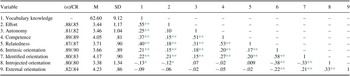
Descriptive statistics, reliability estimates, and bivariate correlations for the variables included in the BPN, SDT orientations, effort, and vocabulary knowledge are displayed in Table 1. A reliability estimate of the variables was calculated using two indices: Cronbach’s alpha (α) and composite reliability (CR). CR is recognized as more advantageous because it accounts for model parameters, especially in measurement errors, and it considers the different loadings of items. It is based on the assumption that each item should be weighted in terms of its individual item reliability, which results in different weights for individual items (Hair et al., Reference Hair, Black, Babin and Anderson2019). With regard to effect size, Plonsky and Oswald (Reference Plonsky and Oswald2014) noted that correlation coefficients (r) in L2 research can be used as indicators of effect size; correlation coefficients that are close to .25, .40, and .60 are indicative of small, medium, and large effect sizes, respectively. Similarly, beta (β) values of predictor variables can be used as effect sizes, following Cohen et al. (Reference Cohen, Manion and Morrison2011) guidelines, such that β values in the ranges of 0–.1, .1–.3, and .3–.5 and those that are >.5 are indicative of weak, modest, moderate, and strong effect sizes, respectively.
Descriptive statistics and zero-order correlations for the variables

Abbreviation: CR, composite reliability.
* Correlation is significant at the 0.05 level.
** Correlation is significant at the 0.01 level.
STATISTICAL ASSUMPTIONS AND CONSIDERATIONS OF STRUCTURAL EQUATION MODELING
Data Distribution
The normality of data was tested before conducting the analyses. To determine univariate normality, the skewness and kurtosis of the data distribution were examined. Values exceeding the 3.0/−3.0 guideline are considered severely skewed and kurtosis values exceeding the 10.0/−10.0 guideline are considered severely peaked or flat (Kline, Reference Kline2016). Assessing univariate normality using these guidelines yielded three cases under identified orientation, which were deemed to be distinctly different from the rest. These cases were removed based on empirical justifications, as recommended (Kline, Reference Kline2016).
Outliers
Outliers are data points that are substantially different from the rest of the data points (Tabachnick & Fidell, Reference Tabachnick and Fidell2013). The boxplot technique was employed to check for potential extreme values. Following Hoaglin and Iglewicz (Reference Hoaglin and Iglewicz1987), any values that exceeded three interquartile ranges from the end of a box were considered to be extreme outliers. However, the examination failed to identify any outliers. In addition, visual examination of the collected data yielded no concerns about systematic or intentional carelessness in completing the questionnaire (e.g., providing the same answer throughout the questionnaire). Therefore, it was concluded that outliers’ data points were not evident in the dataset. Multivariate outliers were tested using the Mahalanobis D 2 measure. Any data point that has a D 2 value that deviates substantially from the D 2 values of the dataset at p < 0.001 should be considered for removal (Hair et al., Reference Hair, Black, Babin and Anderson2019). Accordingly, our results showed that six cases exceeded the acceptable threshold and they have been removed from the analysis.
EXAMINING THE FACTOR STRUCTURE OF THE CONSTRUCTS
Factor Structure of the Basic Psychological Needs (BPN-L2) Scale
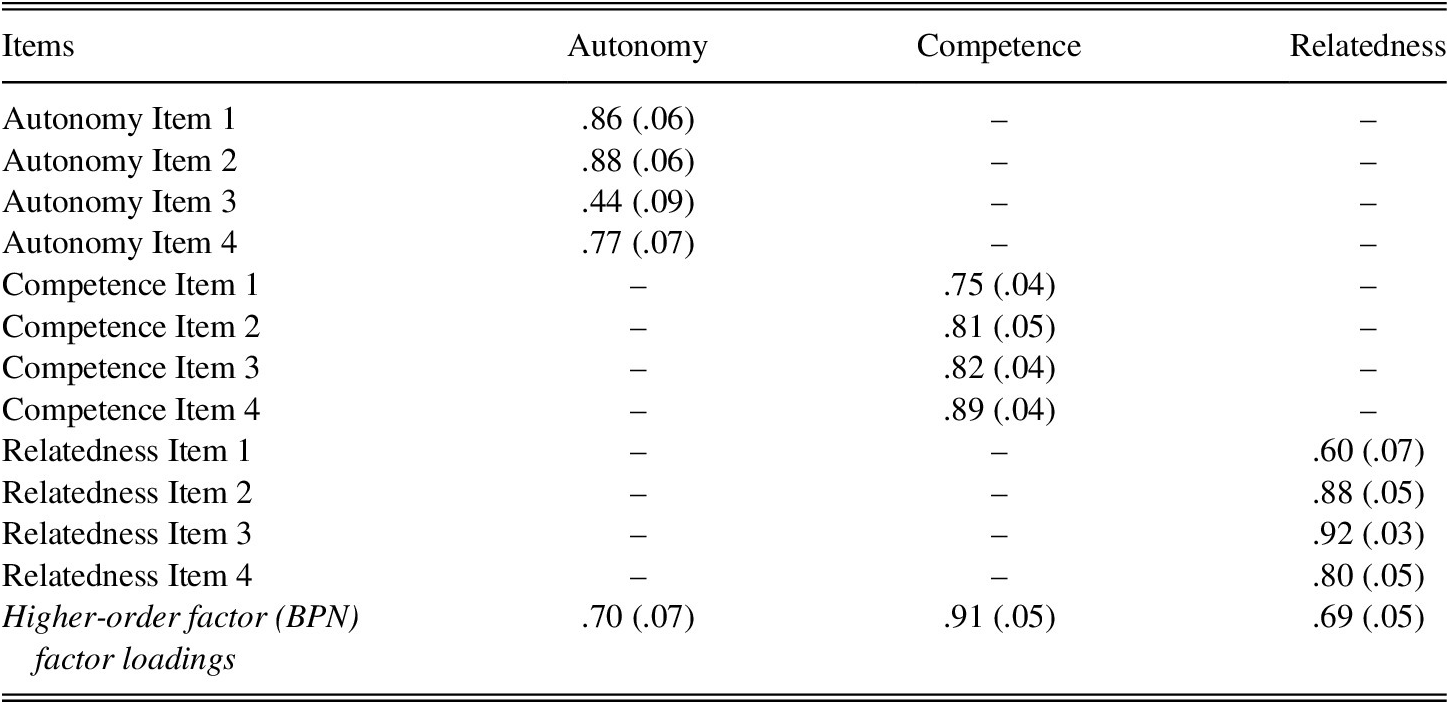
The factor structure of the BPN consisted of three constructs representing autonomy, competence, and relatedness. Because these factors are highly correlated and to avoid multicollinearity issues a higher-order CFA was conducted to conceive an empirically and theoretically supported model that accounts for the general BPN construct in the measurement model. The model fit indices are listed in Table 2. The results showed that the model provided a satisfactory fit to the data. The factor loadings of the subscale items are listed in Table 3. The AVE of autonomy, competence, and relatedness were .52, .68, and .66, respectively. Thus, the measures of BPN-L2 have shown acceptable levels of convergent validity.
Model fit indices for basic psychological needs (BPN-L2) scale

Factor loadings for basic psychological needs

Notes: Standard errors are shown in parentheses. All values are significant at p > 0.001.
Factor Structure of the Self-Determination Theory Orientations (SDT-L2) Scale
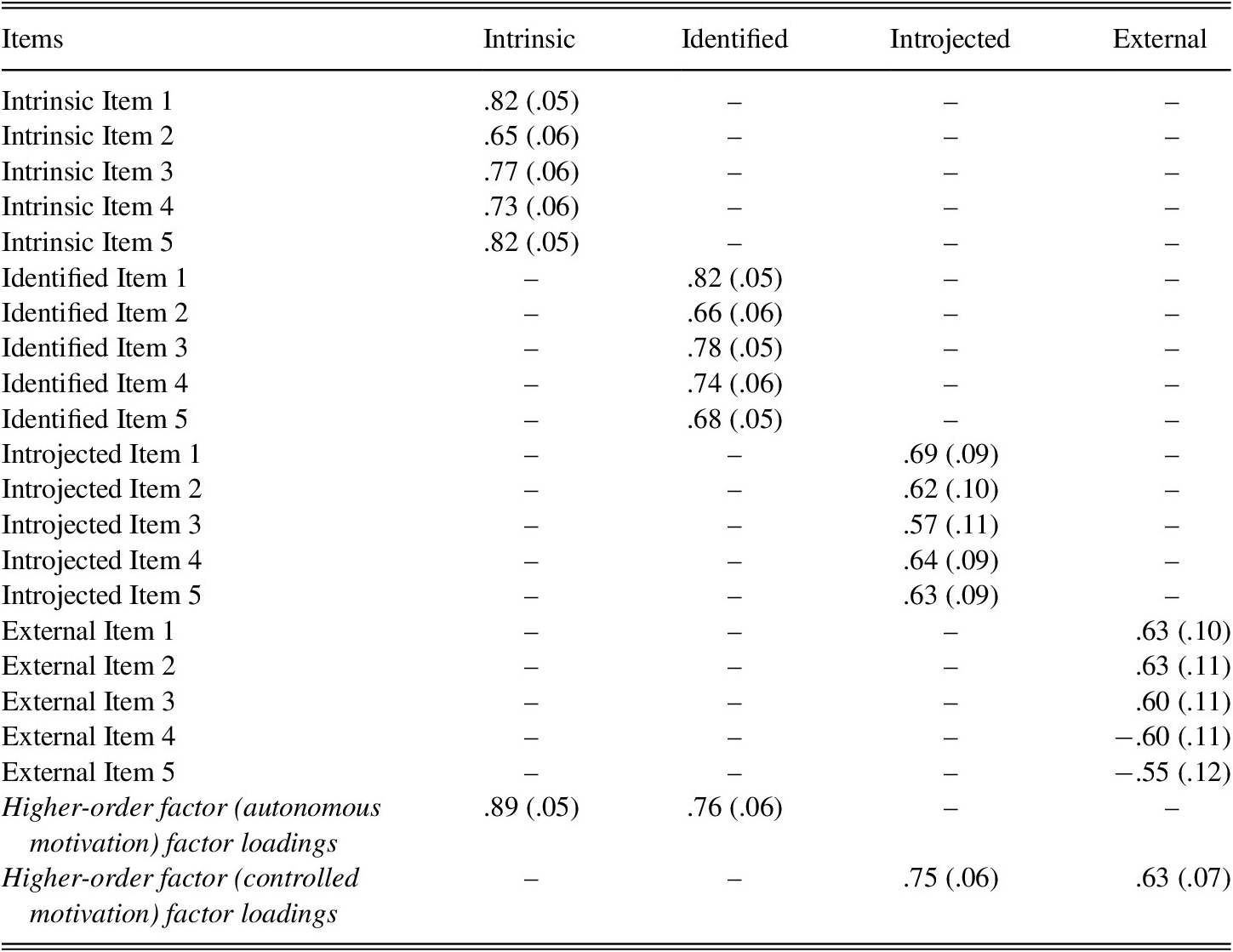
The factor structure of SDT orientations consisted of four constructs representing intrinsic, identified, introjected, and external orientation. A higher-order CFA was conducted to conceive a parsimonious model that empirically accounts for the general autonomous and controlled motivation constructs in the measurement model. That is, intrinsic and identified orientation were loaded on the higher-order factor of autonomous motivation. Similarly, introjected and external orientation were loaded on the higher-order factor of controlled motivation. The model fit indices are shown in Table 4. The results showed that the solution fit the data moderately, with RMSEA approaching the conventional cutoff value (RMSEA = .08). The factor loadings of the subscale items are listed in Table 5. The correlation between autonomous and controlled motivation was negative, r = −.06, and insignificant at p = 0.42. The AVE of autonomous motivation and controlled motivation were .64 and .51, respectively. Thus, the measures of SDT-L2 have shown acceptable levels of convergent validity.
Model fit indices for the self-determination theory orientations

Factor loadings for the self-determination theory orientations (SDT-L2) scale

Notes: Standard errors are shown in parentheses. All values are significant at p > 0.001.
ANALYSES OF THE STRUCTURAL MODEL
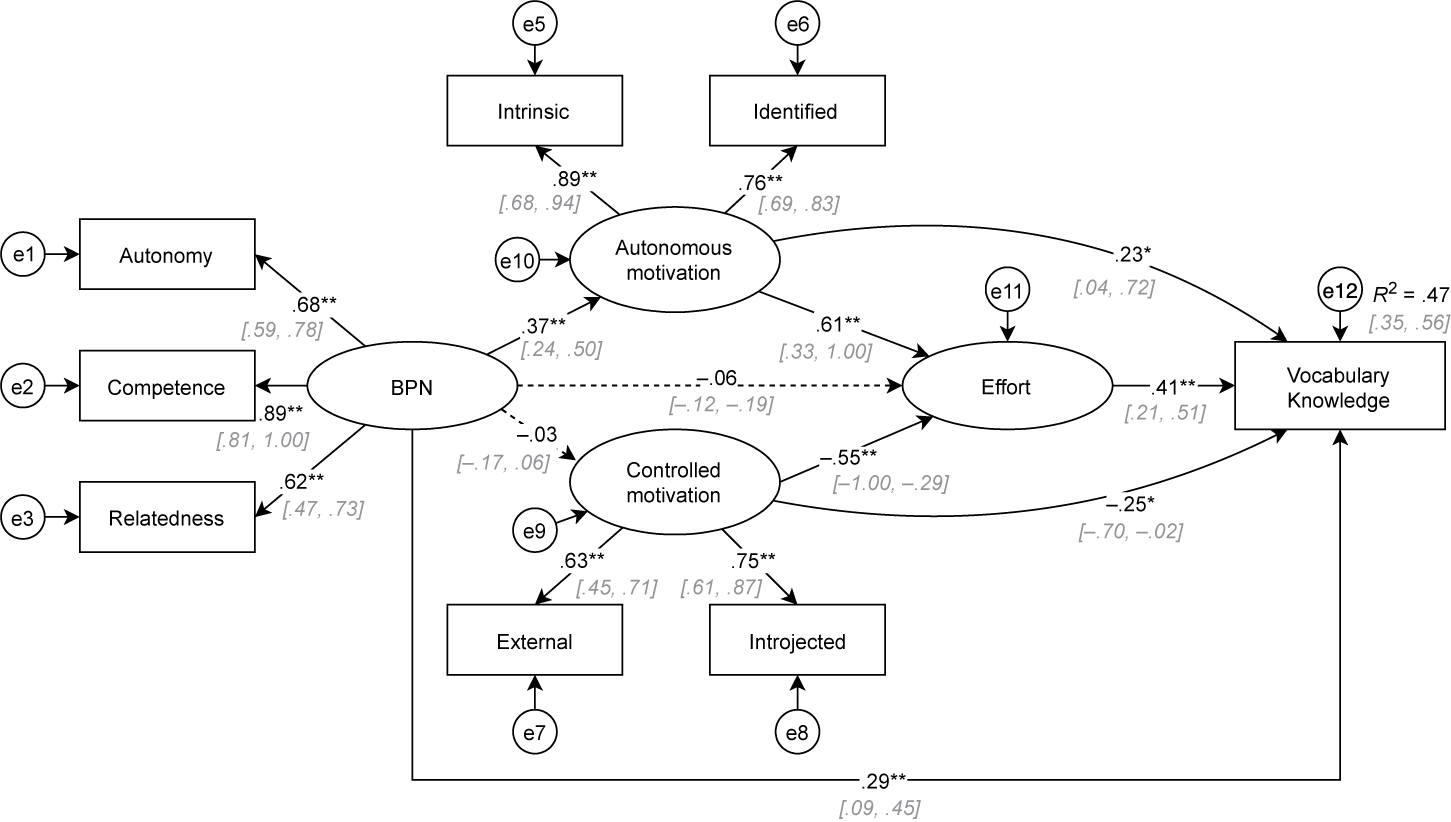
As shown in Figure 2, the hypothesized model was formulated based on the results of the measurement models described earlier. The model yielded an acceptable fit: (χ2 = 305.52, p = 0.001, df = 123, SRMR = .06, RMSEA = .06, RMSEA 90% CI: [.05, .07], CFI = .95, TLI = .93). The results showed that the SDT process model explained about 47% of the variance in vocabulary knowledge with a 95% confidence interval varying from 35 to 56. Because the data were not perfectly normal the path coefficients were assessed through a 5,000-bootstrap analysis with 95% confidence interval to confirm whether path estimates fall within the interval’s range, thus normalizing the data (Kline, Reference Kline2016). The results of the bootstrap showed that the significant paths in the model have fallen within the 95% confidence interval and did not include zero. The path coefficients results indicated that BPN positively predicted autonomous motivation (i.e., intrinsic and identified orientation), which was of a moderate effect size (β = .37, p < 0.01). However, BPN were not correlated with controlled motivation (β = −.03, p > 0.05) or effort (β = −.06, p > 0.05). Instead, BPN were directly and positively correlated with vocabulary knowledge (β = .29, p < 0.01), with a moderate effect size. Next, it was observed that autonomous motivation was positively associated with effort (β = .61, p < 0.01), which exerted a great effect. In contrast, controlled motivation was negatively and moderately correlated with effort (β = −.55, p < 0.01). Finally, effort was moderately associated with vocabulary knowledge (β = .41, p < 0.01).
The SDT process model linking BPN, SDT orientations, effort, and vocabulary knowledge.
* Path is significant at the p < 0.05 level.
** Path is significant at the p < 0.01 level.
Note: Italic and gray values are the 95% confidence interval.

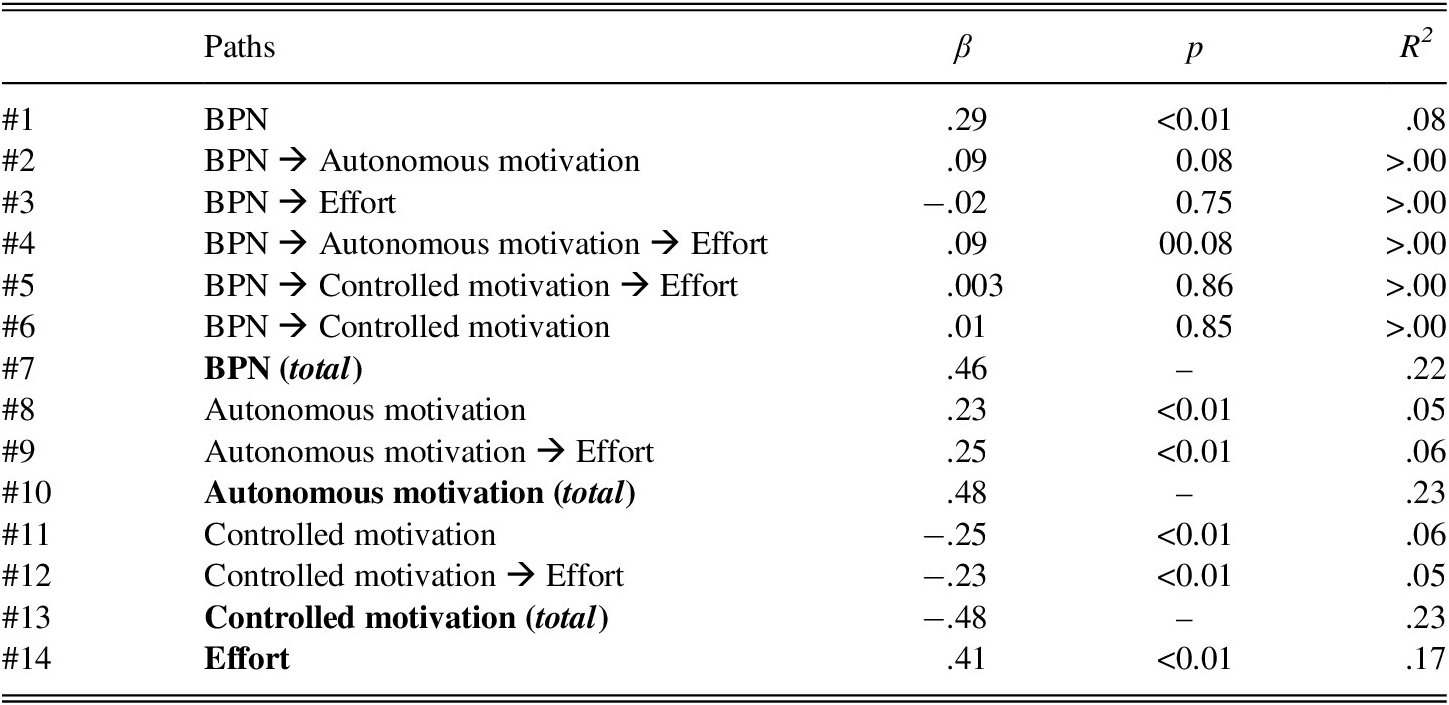
The results of the indirect effects of BPN and SDT variables revealed positive and negative patterns of associations. Detailed results are reported in Table 6. First, the results of BPN did not support the mediating role of autonomous motivation in the relationship between BPN and vocabulary knowledge (see #2 in Table 6) nor did the mediation role of controlled motivation between BPN and vocabulary knowledge (see #6 in Table 6). Overall, no mediational pathways were found to be significant in the relationship between BPN and vocabulary knowledge (see #2–#6 in Table 6). Notwithstanding, the overall indirect effect of BPN on vocabulary knowledge showed a strong positive effect (see #7 in Table 6).
Standardized direct and indirect effects of the motivational variables on vocabulary knowledge

Furthermore, the results showed that the indirect effect on the mediating role of effort in the relationship between autonomous motivation and vocabulary knowledge was significant (see #9 in Table 6). The total indirect effects of autonomous motivation on vocabulary knowledge were moderate (see #10 in Table 6). In contrast, the relationship between controlled motivation and vocabulary knowledge was negatively mediated by the indirect effect of effort (see #12 in Table 6). Finally, the results indicated that controlled motivation had moderate negative total indirect effects on vocabulary knowledge (see #13 in Table 6).
DISCUSSION
Language learners whose BPN are satisfied are more likely to exhibit autonomous motivation and less likely to act on controlled motivation (Alamer & Lee, Reference Alamer and Lee2019; Noels, Reference Noels2001; Noels et al., Reference Noels, Clément and Pelletier1999, Reference Noels, Lascano and Saumure2019; Oga-Baldwin et al., Reference Oga-Baldwin, Nakata, Parker and Ryan2017; Wu, Reference Wu2003). Moreover, autonomously motivated L2 learners are expected to expend further effort in their learning and become involved in tasks at hand to succeed in the language learning process (Alrabai, Reference Alrabai2017; Dörnyei & Ushioda, Reference Dörnyei and Ushioda2011; Hiver et al., Reference Hiver, Al-Hoorie and Mercer2020). Consequently, when learners put effort into their learning, they are more likely to learn the language successfully (Gardner, Reference Gardner2010; Gardner & MacIntyre, Reference Gardner and MacIntyre1993; Tremblay & Gardner, Reference Tremblay and Gardner1995). Such arguments, however, have not been discussed in a comprehensive framework within the SDT perspective, and thus this study was able to shed light and elaborate on the described motivational mechanisms.
Before testing the SDT motivational model, it was necessary to establish the factorial structure of both the BPN-L2 and SDT-L2 scales. Although the factor structures of the BPN and SDT orientations have been examined in classroom educational research, this study is, to the best of the author’s knowledge, the first of its kind in the L2 domain to test the dimensionality of these constructs. By considering a higher-order CFA model, the study provided evidence of construct validity and more precisely represented the BPN-L2 and SDT-L2 scales using a fine-grained measurement approach (Alamer & Almulhim, Reference Alamer and Almulhim2021; Alamer, Reference Alamerin press). The results suggested that BPN might be better conceptualized as three separate needs (autonomy, competence, and relatedness), with those needs belonging to BPN as an overarching construct. Similarly, the results supported the CFA model of the SDT-L2 scale, indicating that intrinsic and identified orientation belong to the overarching construct of autonomous motivation, whereas introjected and external orientation belong to the overarching construct of controlled motivation. These results aligned with recent studies that have discussed these two global constructs (Alamer & Lee, Reference Alamer and Lee2019; Guay et al., Reference Guay, Morin, Litalien, Valois and Vallerand2015; Ryan & Deci, Reference Ryan and Deci2017; Tóth-Király et al., Reference Tóth-Király, Morin, Bőthe, Orosz and Rigó2018).
The major goal of the present research was to assess a motivational model in which BPN were set to predict increased vocabulary knowledge through the mediational processes of SDT orientations and effort. Specifically, the motivational model explained approximately 47% of the variance in vocabulary learning and provided support for the theoretical assumption of SDT, which posits that satisfying BPN leads students to exhibit autonomous motivation and ultimately to an increase in various language learning outcomes (Deci & Ryan, Reference Deci and Ryan1985; Guay et al., Reference Guay, Morin, Litalien, Valois and Vallerand2015; Noels, Reference Noels2001; Noels et al., Reference Noels, Lascano and Saumure2019). The resultant motivational process of this study might seem logical, but it has not been previously evaluated using SDT in the L2 learning domain.
The findings indicated that BPN were directly responsible for increased vocabulary knowledge. Although no specific indirect effect was evidenced, the total effect of BPN on the outcome variable was relatively strong. A noticeable finding here is perhaps the direct effect of BPN on vocabulary knowledge, which remained significant even after controlling for the other paths in the structural model. As such, this study is the first to empirically detect such a plausible association between the two variables, and it may yield further directions in the form of research and classroom implications.
Similarly, the SDT orientations (i.e., autonomous and controlled motivation) were found to be directly and indirectly associated with vocabulary knowledge in distinct ways. These findings showed that autonomous motivation facilitated vocabulary knowledge through effort, but it was also directly responsible for greater attainment of the vocabulary over and above the effects of expended effort (see Figure 2 and Table 6). In contrast, controlled motivation seemed to have a negative effect on vocabulary knowledge directly and indirectly through effort. These results expanded on Alamer and Lee (Reference Alamer and Lee2019), Noels (Reference Noels, Clément and Pelletier2001), and Zhang et al. (Reference Zhang, Lin, Zhang and Choi2017) to show the nature of the association between SDT and vocabulary learning and suggest that motivation is a substantial predictor of vocabulary knowledge over and above the effects of the amount of effort being invested in learning. This does not imply that motivated learners should not invest effort, but it is probably the quality and nature of the expended effort that matter the most (Alamer, Reference Alamer2021). As the results have suggested, students’ efforts do not operate in isolation of motivation; what is important is how students’ motivation translates. More so, it is crucial to note whether effort and motivation together lead to an increase in the size of students’ vocabulary.
Nevertheless, the direct negative effect of controlled motivation on effort and vocabulary knowledge indicates that this motivational outlook may inversely impact the amount of effort invested in learning, specifically vocabulary learning. Although controlled types of motivation can be considered motivating, their eventual effects on optimal learning processing are minimal and could even be negative in some situations (Ryan & Deci, Reference Ryan and Deci2017). Our findings with regard to the effects of controlled motivation on language learning matched those observed in the field (Alamer, Reference Alamer2021; Alamer & Lee, Reference Alamer and Lee2019; Noels et al., Reference Noels, Clément and Pelletier1999, Reference Noels, Clément and Pelletier2001, Reference Noels, Lascano and Saumure2019; Oga-Baldwin et al., Reference Oga-Baldwin, Nakata, Parker and Ryan2017) and expanded on them to show the relationship between controlled motivation and vocabulary knowledge. The findings, nonetheless, contradicted other studies that show positive relationship between these variables (Noels et al., Reference Noels, Pelletier, Clément and Vallerand2000; Zhang et al., Reference Zhang, Lin, Zhang and Choi2017). The discrepancies between our findings and these may be attributed to the learning contexts and the types of participants being surveyed.
Overall, our findings are in substantial agreement with the SDT argument that satisfying BPN can promote more self-determined forms of motivation, which, in turn, leads to optimal and desirable learning outcomes (Alamer & Lee, Reference Alamer and Lee2019; Alrabai, Reference Alrabai2017; McEown et al., Reference McEown, Noels and Saumure2014; Noels et al., Reference Noels, Lascano and Saumure2019; Ryan & Deci, Reference Ryan and Deci2017; Spratt et al., Reference Spratt, Humphreys and Chan2002).
PEDAGOGICAL IMPLICATIONS
The findings of the present study suggest that language teachers should place particular importance on their students’ needs of autonomy, competence, and relatedness because they relate directly to the greater attainment of L2 vocabulary. Moreover, according to the total effects of these three needs on better vocabulary learning, teachers may also need to recognize what motivational outlooks students hold with regard to their L2 learning and ensure that they properly embody autonomous motivation. This link appeared to be critical to students’ expanded effort and ultimately to vocabulary learning. Therefore, educational interventions aimed at satisfying students’ needs would do well and would prove to be fruitful. To accomplish this, language teachers should consider less controlling teaching approaches and provide students with meaningful choices about language subjects (fostering autonomy), set reasonable expectations for language tasks, provide structure in an informational and noncontrolling fashion (fostering competence), and attempt to understand students’ concerns and become interpersonally involved with them (fostering relatedness).
LIMITATIONS AND CONCLUSION
There are a few limitations to the present study. First, because this research pertained to Saudi learners of English as an L2, the findings can only be generalized among Saudi learners of English. It would be interesting to assess the usefulness of the study’s model in different cultural contexts or with learners of languages other than English (such as Arabic) to see if the language or the learning context could contribute to a deeper understanding of the SDT process model.
Second, the present research employed a cross-sectional survey design with one sample of participants. Hence, although the study’s motivational model clarified how motivational subtypes, together with effort, can be understood, it does not identify cause-and-effect relationships among the variables involved in the model. Most importantly, the outcome measure (i.e., the vocabulary knowledge test) was administered at nearly the same time as the study’s other measures. Accordingly, we have not collected data about students’ previous BPN or SDT orientations, which apparently prevents us from coming to a clear conclusion about whether previous endorsement led to an increase in the outcome variable, later on or perhaps something else besides the predicted variance can predict the increase in the outcome variable. Only a longitudinal research design can clearly test the plausible propositions concerning the cause-and-effect relationships between motivation and vocabulary learning.
Overall, the present study validated the BPN-L2 scale to measure language learners’ BPN and the SDT-L2 scale to measure language learners’ motivational orientations based on SDT. The higher-order CFA models supported Ryan and Deci’s (Reference Ryan and Deci2017) theoretical argument of the BPN and SDT orientations. By understanding these scales’ factorial structure, it was possible to more precisely test a motivational process model linking BPN, SDT orientations, and effort to vocabulary knowledge. I hope that these findings have enriched our understanding of the complex role of motivation in the acquisition of vocabulary knowledge and that they have yielded theoretical and pedagogical implications for L2 researchers and educators. I also encourage quantitative researchers to utilize the BPN-L2 and SDT-L2 scales in their empirical research and use advanced measurement assessment methods (Alamer, Reference Alamerin press) to enhance and improve the validity of these measures of motivation.
APPENDIX
Basic Psychological Needs of Second Language Scale*

Self-Determination Theory of Second Language Subscale*
Why are you learning English?

Effort Subscale*