Introduction
Pituitary adenomas comprise more than 10% of all primary brain tumors and are the third common intracranial tumors after gliomas and meningeomas (Kuratsu & Ushio, Reference Kuratsu and Ushio1997; Surawicz et al., Reference Surawicz, McCarthy, Kupelian, Jukich, Bruner and Davis1999). As shown in autopsy and imaging studies, approximately 10–20% of the general population is diagnosed with pituitary adenoma (Ezzat et al., Reference Ezzat, Asa, Couldwell, Barr, Dodge, Vance and McCutcheon2004). Although the majority of these adenomas remains small and does not lead to clinically relevant symptoms, a significant number of pituitary adenomas cause hormonal and neurological disturbances. Clinically relevant adenomas comprise endocrine-active pituitary tumors, which cause clinical syndromes due to an excessive hormone production, such as hyperprolactinemia, acromegaly, and Cushing's disease. In contrast, non-functioning pituitary adenomas may result in clinical signs resulting from mass effects on adjacent structures, including headache and visual impairments, or pituitary insufficiency (Chanson & Salenave, Reference Chanson and Salenave2004). Pituitary adenomas show gender- and age-specific frequencies. Prolactinomas are the most common pituitary adenomas in women and occur mainly at a young age, whereas non-functioning adenomas prevail in men who are predominately affected in later life (Mindermann & Wilson, Reference Mindermann and Wilson1994). On average, pituitary adenomas peak between the third and fifth decade (Aron & Howlett, Reference Aron and Howlett2000). All pituitary adenomas causing clinical symptoms require a treatment including adenoma resection by a transsphenoidal or, less common, by a transcranial approach, a drug therapy aiming to reduce the excessive hormone secretion, substitution of hormone deficiencies, and, in rare cases, tumor radiation.
Many of the anatomic structures which are located in close proximity to the pituitary gland play important roles in the regulation of neurocognitive functions and are at risk through a tumor at this site (Tooze, Gittoes, Jones, & Toogood, Reference Tooze, Gittoes, Jones and Toogood2009). Untreated pituitary adenomas may impair cognition by mass effects or by an excessive hormone secretion that is found, for instance, in patients with Cushing's disease (Dorn et al., Reference Dorn, Burgess, Dubbert, Simpson, Friedman and Chrousos1995; Starkman & Schteingart, Reference Starkman and Schteingart1981). Furthermore, previous studies point to an increased risk of cognitive dysfunctions also in patients with successfully treated pituitary adenomas (Grattan-Smith, Morris, Shores, Batchelor, & Sparks, Reference Grattan-Smith, Morris, Shores, Batchelor and Sparks1992; Guinan, Lowy, Stanhope, Lewis, & Kopelman, Reference Guinan, Lowy, Stanhope, Lewis and Kopelman1998; Peace et al., Reference Peace, Orme, Thompson, Padayatty, Ellis and Belchetz1997). In these studies, however, patients with pituitary adenomas were compared with healthy controls and not with other chronically ill patients. This is important to note as a large number of chronic diseases and, in particular, endocrine disorders are associated with cognitive impairments (Attree, Dancey, Keeling, & Wilson, Reference Attree, Dancey, Keeling and Wilson2003; Hailpern, Melamed, Cohen, & Hostetter, Reference Hailpern, Melamed, Cohen and Hostetter2007; von Ammon & Wettstein, Reference von Ammon and Wettstein1989; Walker et al., Reference Walker, McMahon, Inabnet, Lazar, Brown, Vardy and Silverberg2009). For instance, patients receiving l-thyroxin replacement therapy for primary hypothyroidism showed disturbances in psychosocial well-being and cognitive performance despite euthyroidism (Leyhe et al., Reference Leyhe, Müssig, Weinert, Laske, Häring, Saur and Gallwitz2008; Saravanan et al., Reference Saravanan, Chau, Roberts, Vedhara, Greenwood and Dayan2002; Wekking et al., Reference Wekking, Appelhof, Fliers, Schene, Huyser, Tijssen and Wiersinga2005).
Therefore, one cannot exclude that the cognitive impairments in patients with pituitary adenomas are consequences of unspecific psychological factors which are associated with the life circumstances of chronically ill patients. For this reason, the present study aimed to investigate whether the cognitive deficits in patients in long-term remission after successful surgery for pituitary adenomas exceed those in other chronically ill patients, and patients receiving L-thyroxin replacement therapy after thyroid surgery were chosen as the comparison group. As previous studies have shown impairments in memory and executive function in patients treated for pituitary adenomas (Tooze et al., Reference Tooze, Gittoes, Jones and Toogood2009), we hypothesized that these cognitive domains are deteriorated in comparison to the comparison group.
Methods
Patients and Recruitment
Patients were consecutively recruited from the endocrine outpatient clinics of the University Hospital of Tübingen. Inclusion criteria were successful definitive treatment for pituitary adenoma (pituitary surgery with or without subsequent radiotherapy), with absence of a tumor residue, no evidence of biochemical excess of growth hormone (GH), adrenocorticotrophic hormone (ACTH), prolactin, thyroid-stimulating hormone (TSH), or gonadotropins, and appropriate doses of hormone replacement as measured by endocrine tests on the day of neuropsychological testing. Thyroid, glucocorticoid, sex steroid, and growth hormone replacement therapies were considered adequate if free thyroxine (fT4) and free tri-iodothyronine (fT3) plasma levels were within the normal range; if the patient was receiving between 20 and 30 mg of hydrocortisone or between 25 and 37.5 mg cortisone acetate per day; if plasma levels of testosterone or estradiol, respectively, were within the normal range; and if insulin-like growth factor (IGF) -1 levels were within the age-related normal range. Thirty-eight euthyroid patients receiving L-thyroxin replacement therapy after thyroid surgery formed the chronic ill comparison group. L-thyroxine replacement therapy was considered adequate if fT4 [19.6 (SD 4.7) pmol/L, normal: 12–23], fT3 [4.7 (SD 0.5) pmol/L, normal: 3.5–6.5], and TSH [1.2 (SD 0.7) mU/L, normal: 0.4–2.5] plasma levels were within the normal range.
According to the definition of the U.S. National Center for Health Statistics (http://www.cdc.gov/nchs/) stating that a chronic disease is one lasting 3 months or more, only patients diagnosed at least 1 year earlier were included in the study.
Exclusion criteria comprised psychiatric and neurological disorders, relevant comorbidities known to affect neurocognitive function, such as liver abnormalities [aspartate amino transferase (AST), alanine amino transferase (ALT), or gamma-glutamyl transferase (γGT) levels 2 or more times the upper reference range], chronic renal failure (creatinine >1.5 mg/dl), marked anemia (hemoglobin, Hb) <8.0 g/dl), history of thyroid cancer requiring suppression of TSH secretion, thyroid autoimmune diseases, and visual deficits associated with intellectual impairments despite visual correction.
Approximately one-third of the patients asked declined to participate and less than 10% of the patients who agreed to participate were excluded because they failed the exclusion criteria.
The local ethics committee had approved the protocol (protocol number: 249/2006 V), all procedures involved were in accordance with the latest version of the Declaration of Helsinki. Informed written consent was obtained from all participants.
Laboratory Methods for Hormone Concentrations
Cortisone-binding globulin (CBG), cortisol, estradiol, follicle-stimulating hormone (FSH), fT3, fT4, luteinizing hormone (LH), testosterone, and TSH were measured by an immunometric assay on the ADVIA Centaur analyzer (Siemens Medical Solutions Diagnostics, Los Angeles, CA). ACTH, GH, IGF-1, and sex hormone-binding globulin (SHBG) were measured by an immunometric assay on the Immulite 2500 analyzer (Siemens Medical Solutions Diagnostics).
Neuropsychological Testing and Quality of Life
Established and validated neuropsychological tests have been applied.
General Verbal Intelligence
General verbal intelligence was tested by the Multiple Choice Word Fluency Test (MWT-B), which requests a subject to identify the correct word within 37 items with five word creations of which one is meaningful (Lehrl, Reference Lehrl2005).
Executive Function and Attention
Executive function was examined with the Trail-Making Test (TMT), which requires a subject to connect as quickly as possible 25 consecutive targets distributed over a sheet of paper, without lifting the pencil from the paper. In part A, encircled numbers have to be connected consecutively by drawing lines (1 to 25) and, in part B, numbers and letters have to be connected consecutively by alternating between numbers and letters in alphabetical order (1-A-2-B-3-C to K-12-L-13). Results for both TMT A and B are reported as time in seconds required to complete the task. While TMT A examines attentional speed, TMT B is a measure of executive control and attention (Reitan, Reference Reitan1992).
Acoustic working memory was examined with the digit span test, a subtask of the German version of the Wechsler Adult Intelligence Scale (WAIS), which asks a subject to repeat a series of numbers with increasing length in the same order or in the reversed order (Tewes, Reference Tewes1999).
Attention was assessed with the digit symbol subtest of the German version of the WAIS, in which digits and symbols are presented as pairs and test takers then must pair additional digits and symbols as fast as possible (Tewes, Reference Tewes1999).
Memory
Verbal memory was assessed with the German version of the Auditory Verbal Learning Test (VLMT), which consists of five presentations with recall of 15 semantically independent words, one presentation of a second 15-word list (interference test), a sixth recall trial of the first word list, and a delayed recognition test after 30 min (Helmstaedter, Lendt, & Lux, Reference Helmstaedter, Lendt and Lux2001).
Below average performance was defined as a score above 39 s for TMT-A, above 85 s for TMT-B (Reitan, Reference Reitan1992), below 40 for VLMT (T-scores; Helmstaedter, Lendt, & Lux, Reference Helmstaedter, Lendt and Lux2001), and below 16 for digit span and digit symbol tests (percent ranges; Tewes, Reference Tewes1999).
Psychosocial Well-Being and Quality of Life
Symptomatic distress was assessed with the Symptom Checklist-90-Revised (SCL-90-R), a 90-item multidimensional self-report symptom inventory using a 5-point rating scale. The measured nine primary dimensions include somatization, obsessive-compulsive symptoms, interpersonal sensitivity, depression, anxiety, hostility, phobic anxiety, paranoid ideation, and psychoticism (Franke, Reference Franke2002). In addition, there are three global indices: The Global Severity Index (GSI) measures overall psychological distress, the Positive Symptom Distress Index (PSDI) measures the intensity of symptoms, and the Positive Symptom Total (PST) reports number of self-reported symptoms. SCL-90-R values (T-scores) below 60 are normal.
Quality of life was examined with the standardized questionnaire QLS-H (Questions on Life Satisfaction-Hypopituitarism), which allows individual weighting of different aspects of quality of life and for which country-specific normative data are available (Rosilio et al., Reference Rosilio, Blum, Edwards, Shavrikova, Valle, Lamberts and Attanasio2004). A QLS-H Z-score of 0 is normal, and a negative Z-score indicates below normal quality of life.
Data Analysis
Data are given as mean±standard deviation (SD). Statistical comparison between groups was performed by two-sided Wilcoxon test for continuous data and χ2 test for nominal data. Loge-transformation of non-normally distributed parameters was performed before simple and multiple linear regression analyses. Distribution was tested for normality using the Shapiro-Wilk W test. To identify potential associations between psychological factors and neurocognitive performance, stepwise regression analyses were performed using a backward elimination approach. A statistical threshold of p < .05 was considered statistically significant. Correction for multiple comparisons was not performed, because our study was hypothesis-driven based on recent clinical observations (Grattan-Smith et al., Reference Grattan-Smith, Morris, Shores, Batchelor and Sparks1992; Guinan et al., Reference Guinan, Lowy, Stanhope, Lewis and Kopelman1998; Peace et al., Reference Peace, Orme, Thompson, Padayatty, Ellis and Belchetz1997). The statistical software package JMP 7.0 (SAS Institute, Cary, NC) was used.
In the performed analyses for tumor size and radiation therapy, the effect sizes were ≥97% and ≥42%, respectively. Power calculation was performed by two-tailed t tests (1-β > 0.8) using G*power software available at http://www.psycho.uni-duesseldorf.de/aap/projects/gpower.
Results
Patients’ Characteristics
The patients’ characteristics are summarized in Table 1. The mean age of the 38 patients (21 females, 17 males) who had received transsphenoidal surgery for pituitary adenomas was 50 years and mean school education comprised 10 years. The mean time since diagnosis and initiation of treatment was 12 years. These parameters did not differ significantly between patients and comparison group.
Characteristics of the patients with successfully treated pituitary adenomas and other chronically ill patients

Shown are means ± standard deviations (SD) with ranges in square brackets. f, female; m, male. Statistical comparison between groups was performed by two-sided Wilcoxon test for continuous data and Chi-square test for nominal data. In addition to p values, Z values for continuous data and χ2 values for nominal data are given.
The underlying causes for pituitary surgery were non-functioning pituitary adenomas in 6 patients, prolactinomas in 9 patients, Cushing's disease in 10 patients, and acromegaly in 13 patients. The tumor size ranged from 2 to 55 mm (mean, 16 mm; SD, 13 mm). Eleven patients received two or more interventions, three of which were operated by a transfrontal approach. Radiation therapy was performed in 14 patients. Participants received a mean total dose of 47.7 (SD 2.6) Gy, with a minimum of 45 Gy and a maximum of 50.4 Gy. All doses were delivered in fractions, with a mean of 28 (SD 3) fractions ranging from 25 to 31 fractions.
Neuropsychological Testing: Patients versus Comparison Group
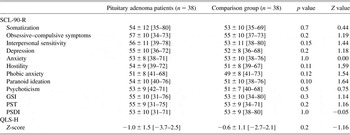
Quality of life, examined with the QLS-H questionnaire, was diminished in patients successfully treated for pituitary adenomas as well as in the comparison group (Table 2). Mean values of symptomatic distress, as assessed with the SCL-90-R, and verbal intelligence, as tested by the MWT-B, were within the normal range in both groups. Measures of quality of life, symptomatic distress, and verbal intelligence did not significantly differ among the groups (all p ≥ .10).
Symptomatic distress and quality of life in patients with successfully treated pituitary adenomas and other chronically ill patients

Shown are mean values ± standard deviations (SD) with ranges in square brackets. GSI = Global Severity Index; PSDI = Positive Symptom Distress Index; PST = Positive Symptom Total; QLS-H = Questions on Life Satisfaction-Hypopituitarism; SCL-90-R = Symptom Checklist-90-Revised. GSI measures overall psychological distress, PSDI measures the intensity of symptoms and PST reports number of self-reported symptoms. SCL-90-R values are given as standardized T-scores and QLS-H values as Z-scores, which adjust for age, gender, and country. SCL-90-R values below 60 are normal. A QLS-H Z-score of 0 is normal, and a negative Z-score indicates below normal quality of life.
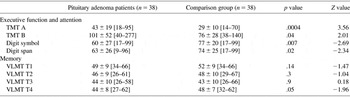
As shown in Table 3, patients with pituitary adenomas displayed attention and executive functioning deficits, as assessed by increased mean values of the TMT A and TMT B tests compared with a normal reference population. Approximately half of the subjects showed results below the average in both tests. Although mean values of the VLMT, the digit symbol test, and the digit span test were within the normal range, in the VLMT subtests, which assess verbal memory, up to one-third of patients showed results below the average range.
Neurocognitive functions in patients with successfully treated pituitary adenomas and other chronically ill patients

Shown are mean values ± standard deviations (SD) with ranges in square brackets. TMT A = Trail-Making Test Part A; TMT B = Trail-Making Test Part B; VLMT = German version of the Auditory Verbal Learning Test, T1 = immediate recall; T2 = delayed recall after 30 minutes, T3 = loss after 30 min; T4 = recognition. TMT values are given in seconds, VLMT values as T-scores, values of digit span and digit symbol tests as percent ranges. Below average performance was defined as a score above 39 s. for TMT-A, above 85 s. for TMT-B, below 40 for VLMT, and below 16 for digit span and digit symbol tests.
In comparison to other chronically ill patients, in patients with pituitary adenomas, attention, as assessed by the digit symbol test (p = .007), attentional speed, measured by the TMT A (p = .0004), and executive control, examined by the TMT B (p = .04), were significantly reduced. Furthermore, pituitary adenoma patients performed significantly worse in the digit span test, which examines the acoustic working memory, than the comparison group (p = .01; Table 2). In contrast, no differences between the two groups were detected for verbal memory, tested by the VLMT (all p ≥ .06).
To identify potential associations between psychological factors, as assessed by SCL-90-R, and cognitive variables, we performed stepwise regression analyses with results in neurocognitive tests as dependent variables and SCL-90-R results as independent results. The analyses showed that Positive Symptom Total (PST) independently contributed to predict TMT-A performance (p = .006); obsessive–compulsive symptoms and GSI to predict TMT-B performance (p = .02 and p = .008, respectively); PST to predict results in digit symbol test (p = .0202); somatization, interpersonal sensitivity, and hostility to predict digit span test results (p = .02, p = .04, and p = .02, respectively); depression and hostility to predict VLMT T1 performance (p = .009 and p = .04, respectively); obsessive–compulsive symptoms and hostility to predict VLMT T2 performance (p = .01 and p = .05, respectively); obsessive–compulsive symptoms and GSI to predict VLMT T3 results (p = .006 and p = .0008, respectively); and interpersonal sensitivity to predict VLMT T4 (p = .01). Adjusting the comparison of neurocognitive functions between both groups for the respective correlating psychological distress measures revealed that the differences between both groups regarding performance in TMT-A, TMT-B, and digit symbol test remained significant (p = .0002, p = .03, and p = .005, respectively), whereas the difference in the digit span test between both groups reached only boarder line significance (p = .05). After adjustment, again no differences between the two groups were detected for verbal memory, tested by the VLMT (all p ≥ .10).
Neuropsychological Testing: Influence of Tumor Size and Radiation Therapy
In patients with pituitary surgery, no associations were found between tumor size and results in neuropsychological testing (all p ≥ .3).
Of the 38 patients with pituitary surgery, 14 had received radiation therapy and 24 had not received radiation therapy. Comparison of both groups, that did not significantly differ in age, gender distribution, years of education, premorbid intelligence, quality of life, and psychosocial well-being (all p ≥ .07), did not reveal differences in neurocognitive testing (all p > .2).
Discussion
Patients in long-term remission after successful surgery for pituitary adenomas show significant deficits in certain aspects of executive function, including attention, and working memory, compared with patients receiving l-thyroxin replacement therapy after thyroid surgery, despite similar psychosocial well-being and quality of life in both groups. Thus, we were able to show that in pituitary adenoma patients, cognitive functions are diminished not only compared with healthy controls confirming previous studies (Grattan-Smith et al., Reference Grattan-Smith, Morris, Shores, Batchelor and Sparks1992; Guinan et al., Reference Guinan, Lowy, Stanhope, Lewis and Kopelman1998; Peace et al., Reference Peace, Orme, Thompson, Padayatty, Ellis and Belchetz1997), but also compared with chronically ill patients at increased risk for cognitive dysfunctions (Saravanan et al., Reference Saravanan, Chau, Roberts, Vedhara, Greenwood and Dayan2002; Wekking et al., Reference Wekking, Appelhof, Fliers, Schene, Huyser, Tijssen and Wiersinga2005). Our results clearly indicate that cognitive deterioration in patients with successfully treated pituitary adenomas are due to the brain lesion and not to the psychosocial distress of a chronic disease.
The causes of these impairments might be multifactorial. Previous investigations (Guinan et al., Reference Guinan, Lowy, Stanhope, Lewis and Kopelman1998; Peace et al., Reference Peace, Orme, Thompson, Padayatty, Ellis and Belchetz1997; Peace, Orme, Padayatty, Godfrey, & Belchetz, Reference Peace, Orme, Padayatty, Godfrey and Belchetz1998) have already indicated the surgical intervention as an independent risk factor for neurocognitive impairments in patients with pituitary adenomas. The assumption that the tumor per se must not be deleterious, is supported by our finding that tumor size, an additional parameter with a potential impact on cognitive function, was not associated with performance in neuropsychological testing. Besides, no differences were detected in cognitive function between operated patients who received additionally radiation therapy and those without radiation therapy. Although this result confirms previous studies that did not find a deleterious effect of radiation therapy on cognitive function of patients treated for pituitary adenomas (Guinan et al., Reference Guinan, Lowy, Stanhope, Lewis and Kopelman1998; Peace et al., Reference Peace, Orme, Thompson, Padayatty, Ellis and Belchetz1997, Reference Peace, Orme, Padayatty, Godfrey and Belchetz1998), this subgroup analysis was sufficiently powered to detect only large effect sizes. Therefore, we cannot rule out that smaller effect sizes may have been missed.
Anatomically the hypophysis is located in the sella turcica of the sphenoid bone close to diencephalic structures. The relation to frontal lobe areas usually associated with executive function is not very close. However, our data particularly point to impairment of attentional speed and working memory after transsphenoidal surgery for pituitary adenomas.
Recent studies suggest that working memory is a function that is usually distributed widely in the brain, with the prefrontal cortex (PFC) acting as an executive controller. During working memory tasks, the PFC engages with cortical and subcortical regions that process sensory information, motor information, information about internal state, or stored memories. The extensive, reciprocal anatomical connections of the PFC with most cortical and many subcortical regions are consistent with this view (Knudsen, Reference Knudsen2007).
As well neuroimaging methods have demonstrated that besides involvement of the frontal lobes, and specifically the PFC, executive functions are distributed over a wide cerebral network which includes subcortical structures and thalamic pathways (Jurado & Rosselli, Reference Jurado and Rosselli2007).
Moreover, it has been recognized that the frontal cortex is strongly linked with the limbic region of the medial temporal lobe, which includes the hippocampus, the amygdala, and the entorhinal/parahippocampal cortex, and these connections are critical for mnemonic interactions and the regulation of emotional responses. The PFC and the hippocampus both are interconnected with the nucleus accumbens, which is essential for integrating cortical and limbic information into goal-directed behavior. Furthermore, it is connected with the globus pallidum, the substantia nigra, and the hypothalamus (Leh, Petrides, & Strafella, Reference Leh, Petrides and Strafella2010).
Thus, our data point to an impairment of cerebral networks necessary for certain aspects of executive function after surgery for pituitary adenomas. It is worth noting that these brain lesions may underlie recovery, given that we have recently shown that younger age is a good predictor of better executive function after surgery for pituitary adenoma in adults (Müssig et al., Reference Müssig, Leyhe, Besemer, Saur, Häring, Gallwitz and Klingberg2009).
While the majority of studies on cognitive function in patients with pituitary adenomas were retrospectively designed, only two studies were found in literature investigating prospectively neurocognitive functioning in patients with pituitary adenomas (Armstrong et al., Reference Armstrong, Hunter, Ledakis, Cohen, Tallent, Goldstein and Phillips2002; Torres et al., Reference Torres, Mundt, Sweeney, Llanes-Macy, Dunaway, Castillo and Macdonald2003). Both of these studies which tested patients before radiotherapy pointed to early course cognitive deficits in pituitary adenoma patients, with improvement of visuospatial learning and memory after radiotherapy. In light of the lack of prospective data in surgically treated pituitary adenoma patients, prospective studies with neuropsychological testing and functional imaging before and after surgical treatment of pituitary tumors may clarify the above mentioned associations and hypotheses further. In particular, extensive investigation of executive and memory functions in combination with functional magnetic resonance imaging and diffusion tensor imaging could be helpful to determine the influence of the tumor itself and its treatments on cognitive functions and neuronal networks.
In conclusion, patients with successfully treated pituitary adenomas show significant impairments in certain aspects of executive function compared with other chronically ill patients at increased risk for cognitive deficits, supporting the relevance of the brain lesion and its treatment for these dysfunctions. Although minimally invasive, transsphenoidal surgery for pituitary adenomas may affect cerebral networks necessary for executive function.
Acknowledgments
Conflict of Interest: The authors declare that there is no conflict of interest. Financial Support: This research received no specific grant from any funding agency, commercial or not-for-profit sectors.