


Introduction
Turfgrass systems are ubiquitous in the United States and are used for a variety of societal and functional purposes. Recreational activities are commonly performed on approximately 700,000 managed athletic fields and more than 15,000 golf courses in the United States (NTEP 2003; RAGCSA 2016). As a result of this widespread use, weed encroachment from turf canopy thinning can compromise surface strength/uniformity. Previous research has shown that poor footing conditions may increase the risk of lower body injuries (Orchard Reference Orchard2002; Steffen et al. Reference Steffen, Anderson and Bahr2007). To mitigate weed encroachment, synthetic herbicides such as 2,4-dimethylamine salt (2,4-D) are applied to athletic fields to maintain desired quality and functionality. 2,4-D is a selective broadleaf herbicide often sold as a component of herbicide mixtures. In 2005, more than 660 products containing 2,4-D were registered in various agricultural and residential settings (US EPA 2005).
Currently, human carcinogenic, neurological, and reproductive effects related to acute 2,4-D exposure are inconclusive; however, it has been established that 2,4-D is a severe eye irritant and can induce toxic effects to kidney, liver, and blood (Bus and Hammond Reference Bus and Hammond2007; Garabrant and Philbert Reference Garabrant and Philbert2002; Loomis et al. Reference Loomis, Guyton, Grosse, El Ghissasi, Bouvard, Benbrahim-Tallaa, Guha, Mattock and Straif2015; Munro et al. Reference Munro, Carlo, Orr, Sund, Wilson, Kennepohl, Lynch, Jablinske and Lee1992; Smith et al. Reference Smith, Smith, La Merrill, Liaw and Steinmaus2017; US EPA 2005, 2007). As a result of its extensive use combined with mammalian toxicity, human health concerns associated with 2,4-D exposure are common (Loomis et al. Reference Loomis, Guyton, Grosse, El Ghissasi, Bouvard, Benbrahim-Tallaa, Guha, Mattock and Straif2015; Smith et al. Reference Smith, Smith, La Merrill, Liaw and Steinmaus2017). Human pesticide exposure can occur via multiple pathways including dermal absorption, inhalation (dust/vapor), or nondietary ingestion (Needham et al. Reference Needham, Ozkaynak, Whyatt, Barr, Wang, Naeher, Akland, Bahadori, Bradman, Fortmann, Liu, Morandi, O’Rourke, Thomas, Quackenboss, Barry and Zartarian2005). A common route of exposure for humans following application to turfgrass is via dermal contact with treated vegetation, as a pesticide can be dislodged from a treated surface and transferred to a nontreated surface, including human skin (Nishioka et al. Reference Nishioka, Lewis, Brinkman, Burkholder, Hines and Menkedick2001; US EPA 2007).
The US EPA classifies 2,4-D as mobile to moderately mobile in soil because of its very high water solubility (KS=796,000 mg L–1; 20 C), a low soil organic carbon–water partition coefficient (KOC=20 ml g–1), and short soil half-life (T1/2=6.2 d) (Shaner Reference Shaner2014; US EPA 2005). Collectively, these properties suggest that 2,4-D may readily dislodge from treated vegetation onto humans; confirmation has been supplied by multiple sources, notably Nishioka et al. (Reference Nishioka, Lewis, Brinkman, Burkholder, Hines and Menkedick2001), who detected 2,4-D in several areas within homes in the week following application to home lawns. Thompson et al. (Reference Thompson, Stephenson and Sears1984) were among the first researchers to investigate management practices to reduce dislodgeable 2,4-D from treated Kentucky bluegrass (Poa pratensis L.), including the use of granular- in lieu of liquid-formulated products as well as the effect of water inputs following application. Thompson et al. (Reference Thompson, Stephenson and Sears1984) reported a 15-times reduction in 2,4-D dislodged with granular-applied 2,4-D compared to liquid-applied 2,4-D following an application and a rainfall event 1 h after application reduced dislodgeable 2,4-D to 0.01% of the applied liquid formulation. Jeffries et al. (Reference Jeffries, Gannon, Brosnan and Breeden2016b) reported that 0.2% to 6.3% of applied 2,4-D was dislodged from perennial ryegrass (Lolium perenne L.) at 7:00 AM Eastern Standard Time (EST), whereas no more than 0.1% was dislodged at 2:00 PM EST 1 through 6 d after treatment (DAT), suggesting that dislodgeable 2,4-D may be influenced by conditions favoring canopy moisture development.
Though previous research has been conducted evaluating the effect of surfactants on foliar absorption and other factors, minimal research has been published investigating the effect of surfactant inclusion on dislodgeable pesticide residues. This variable has real-world implications, as many selective POST herbicide labels recommend the addition of a nonionic surfactant to the spray solution (Anonymous 2012, 2014). Surfactants have been shown to increase herbicidal efficacy as a result of enhanced foliar absorption (Stevens et al. Reference Stevens, Kimberley, Murphy and Policello1993). Increased foliar absorption is attributed to surfactants decreasing the surface tension of spray solutions, thereby facilitating greater retention of the solution on foliage (Stevens et al. Reference Stevens, Kimberley, Murphy and Policello1993).
The objectives of this research were to evaluate the effect of nonionic surfactant inclusion on dislodgeable 2,4-D foliar residue and to quantify dissipation in turfgrass vegetation over two time scales, within a day and over days after treatment. With such efforts, 2,4-D human exposure may be reduced via improved application strategies. We hypothesize that 2,4-D dislodgeability would decrease with surfactant inclusion and vary based on sample collection time within a day.
Materials and Methods
Site Description
Field experiments were initiated on May 24, 2016 and June 6, 2016 at Lake Wheeler Turfgrass Field Laboratory, Raleigh, NC (35°44’12.34” N, 78°40’49.75” W) on a Cecil sandy clay loam soil (fine, kaolinitic, thermic Typic Kanhapludult) with a pH of 6.2 and 1.7% (wt/wt) organic matter. Research was performed on weed-free established, dormant ‘Tifway 419’ hybrid bermudagrass [Cynodon dactylon (L.) Pers.×Cynodon transvaalensis Burtt-Davey] that had been overseeded with ‘Carly’ perennial ryegrass (broadcasted at 732 kg pure live seed ha–1) in the fall prior to trial initiation, and 2,4-D had not been applied for 2 yr or longer. Research areas were managed in accordance with recommendations provided by Turgeon (2008) regarding fertilization (147 kg N ha–1 yr–1), irrigation (provided to supplement rainfall), and mowing (1.9 cm height of cut; three events per week).
Experiment Initiation
One day prior to trial initiation, research areas were mown (clippings collected) and irrigated to field capacity. At initiation, 2,4-D amine (Amine 400 2,4-D Weed Killer™; PBI/Gordon Corp., Kansas City, MO) was applied at 2.1 kg ae ha–1 either alone or in combination with a nonionic surfactant at 0.5% (vol/vol) to 1- by 2.75-m main plots. Alleys (1 m) were included between blocks to minimize incidental 2,4-D transfer during sample collection. The surfactant selected for evaluation was Induce® (Helena Chemical Co., Collierville, TN), a nonionic wetter/spreader adjuvant containing 90% active agents (alkyl aryl polyoxyalkane ethers, dimethyl polysiloxane, alkanolamides, and free fatty acids). Treatments were applied with a hand-held CO2-pressurized sprayer equipped with four 80015 VS XR flat-fan nozzles (Teejet® Nozzles; Spraying Systems Co., Wheaton, IL), calibrated to deliver the lowest labeled carrier volume (187 L ha–1; Anonymous 2014) to promote foliar herbicide spray retention (Knoche Reference Knoche1994). It should be noted that the application rate selected was approximately 24% greater than the current allowable rate for athletic field, golf course, or home lawn use (1.6 kg ae ha–1; Anonymous 2014). The increased application rate was necessary to ensure 2,4-D detection through 6 DAT based on analytical limitations from preliminary testing. To ensure that 2,4-D was applied at the intended rate, recovery check sheets (350 cm2, 0.35 mm Fisher™ Pure Cellulose Chromatography Paper; Thermo Fisher Scientific, Inc., Pittsburgh, PA) were randomly placed in each experimental block, collected less than 5 min after application, stored temporarily on ice in the field, and then transferred to a freezer (–12 C) within 2 h. Following 2,4-D application, plots were covered during rainfall events for 6 d. Further, plots were not mown for 24 d to better elucidate the research variables of interest. Finally, air temperature, dew point, relative humidity, time from sunrise, and wind speed were recorded throughout the research period to quantify the relationship of these parameters and dislodgeable 2,4-D.
Sample Collection
Dislodgeable 2,4-D
Dislodgeable 2,4-D was quantified using a cotton-glove hand-wiping method, and details, written as well as visual, are provided by Jeffries et al. (Reference Jeffries, Gannon and Maxwell2017). Sampling was performed by wiping a unique treated area (420 cm2) with a cotton glove for 30 s in a repeated pattern (left-to-right followed by up-and-down) at a target pressure of 2.0 kPa. Wiping pressure was representative of one-third the pressure exerted by a toddler’s hand (~5.8 kPa) while crawling on hands and knees (Yozu et al. Reference Yozu, Haga, Tojima, Zhang, Sumitani and Otake2013). This process was repeated with a second glove over the same area, and all hand-wipe samples were generated by the same person to minimize variability. Following collection, the gloves were combined in a glass jar (473 cm3) to create one composite sample, stored on ice in the field, and then frozen (–12 C) until extraction and residue analysis. The development of the cotton-glove hand-wipe method was derived from previous pesticide risk assessments that utilized cotton gloves to quantify pesticide loading to hands in specialty crops such as fruit-bearing trees and vineyards (Zweig et al. Reference Zweig, Leffingwell and Popendorf1985). Dislodgeable 2,4-D residue concentrations are presented as a percent of the nominal application rate applied at trial initiation using Equation 1:
 $$\eqalignno{&{\rm \,\%\,}\,{\rm dislodged}\,{\rm of}\,{\rm applied \, {\equals}}\cr&\qquad\left[ {\left( {{\rm HW}\,{\rm \mu g}\,{\rm 2,4{\hbox{-}}D}\,{\rm cm}^{{{\rm -2}}} {\rm \,/\,20}{\rm .9}\,{\rm \mu g}\,{\rm 2,4{\hbox{-}}D}\,{\rm cm}^{{{\rm -2}}} } \right){\times}{\rm 100}} \right]{\rm ,}$$
where HW represents 2,4-D residue from hand-wipe samples relative to the nominal 2,4-D application rate (20.9 µg 2,4-D cm–2).
2,4-D in/on Turfgrass Vegetation
Aboveground vegetation was collected in combination with each composite cotton-glove sample to quantify 2,4-D dissipation in/on (hereafter referred to as “in”) turfgrass vegetation over time. Core samples were collected utilizing a golf course cup cutter (10.8 cm diam; 92 cm2 Model 1001-1; Par Aide® Product Co., Lino Lakes, MN) in a manner that prevented contact between sampling equipment and treated vegetation. Following core collection, all samples were stored on ice in the field, then frozen (–12 C), aboveground vegetation harvested (from soil surface up), fresh weight recorded (g), homogenized (Cuisinart Compact Portable Blending/Chopping System Model CPB-300; Conair Corp., Stamford, CT), and stored at –12 C until extraction and residue analysis. 2,4-D in turfgrass vegetation was calculated relative to the nominal 2,4-D application rate applied at trial initiation using Equation 2:
 $$\eqalignno{{\rm \,\%\,}\,{\rm of}\,{\rm applied\,{\equals}} \cr& \hskip-30pt \left[ {\left( {{\rm AV}\,{\rm \mu g}\,{\rm 2,4{\hbox{-}}D}\,{\rm cm}^{{{\rm -2}}} {\rm \,/\,20}{\rm .9}\,{\rm \mu g}\,{\rm 2,4{\hbox{-}}D}\,{\rm cm}^{{{\rm -2}}} } \right) {\times}{\rm 100}} \right]{\rm ,}$$
where AV represents 2,4-D residue from each aboveground vegetation sample as a percent of the nominal 2,4-D application rate (20.9 µg 2,4-D cm–2).
Experimental Design
The experiment was arranged as a split-plot randomized complete block design. Whole-plot factor was surfactant treatment with subplot combinations of sample collection times within a day and days after treatment. Research evaluated four replicates of a full factorial treatment arrangement. Each experimental run included appropriate nontreated checks in all experimental blocks to confirm that research areas were not contaminated. At 0 DAT, dislodgeable foliar residue and aboveground vegetation samples were also collected immediately following application and after a 2-h drying period; however, these samples were analyzed separately from samples collected 1 through 24 DAT because of differing sample collection timings.
Residue Analyses
2,4-D residue was quantified for all matrices using high-performance liquid chromatography–diode array detector (HPLC-DAD) instrumentation (Agilent-1260 Infinity; Agilent Technologies, Inc., Wilmington, DE). All reagents and solvents used for extraction and residue analysis were HPLC-grade. 2,4-D residue analysis was conducted via methods described by Jeffries et al. (Reference Jeffries, Gannon, Brosnan, Ahmed and Breeden2016a) with respect to sample preparation, extraction, and analytical parameters, with the addition of one cleanup step prior to injection. Specifically, 1 ml of each sample was filtered through C-18 solid-phase extraction columns (HyperSep™ C18 200 mg/3 ml; Thermo Fisher Scientific Inc., Pittsburgh, PA). This step was added as a result of preliminary efforts suggesting that surfactant may suppress analyte concentrations. Analyte concentrations were quantified using peak area measurements (OpenLAB CDS ChemStation, version C.01.04; Agilent Technologies Inc., Wilmington, DE), and concentrations above the calibration curve were diluted and re-injected for analysis. Limits of quantification and detection were 1.0 and 0.3 mg L–1 (ppm), respectively. Standard solutions were included with each injection, and fortification recovery checks ranged from 88% to 106% and 87% to 95% for cotton-glove and vegetation matrices, respectively. Finally, application recovery check sheets determined that 2,4-D was applied at 92% to 106% of the nominal rate across experimental runs.
Statistical Analyses
Statistical analyses were performed by subjecting data to ANOVA (α ≤ 0.05) using MIXED procedures in SAS® (Version 9.3, SAS Institute, Inc., Cary, NC). Surfactant inclusion, day after treatment, and sample collection time within a day were considered fixed effects, whereas experimental run and replication were analyzed as random effects as described by Carmer et al. (Reference Carmer, Nyquist and Walker1989). Mean separation was conducted using Fisher’s Protected LSD (α=0.05), and Pearson correlation coefficients (α<0.05) were calculated to quantify the relationship between environmental parameters and dislodgeable 2,4-D.
Results and Discussion
Across all sample matrices and experimental runs, 2,4-D residue was not detected in any control sample (i.e., no contamination of research areas).
2,4-D Dislodgeability
2,4-D was not detected in dislodge samples collected 12 and 24 DAT; therefore, these data were excluded from statistical analysis. Nondetection may be due to rainfall that occurred after the 6-d covering period [run 1: 10 DAT (0.2 cm of rainfall) and 11 DAT (2.5 cm); run 2: 9 DAT (0.7 cm), 10 DAT (0.4 cm), and 11 DAT (0.2 cm)], as previous research has shown that rainfall can reduce dislodgeable 2,4-D (Thompson et al. Reference Thompson, Stephenson and Sears1984). ANOVA did not detect significant interactions between experimental run and surfactant inclusion (P=0.658), DAT (P=0.054), or time within a day (P=0.122); therefore, data were pooled for statistical analysis. The main effect of DAT (P<0.0001) and its interactions with all fixed effects (P ≤ 0.003) were significant; therefore, data were sorted by DAT and presented accordingly.
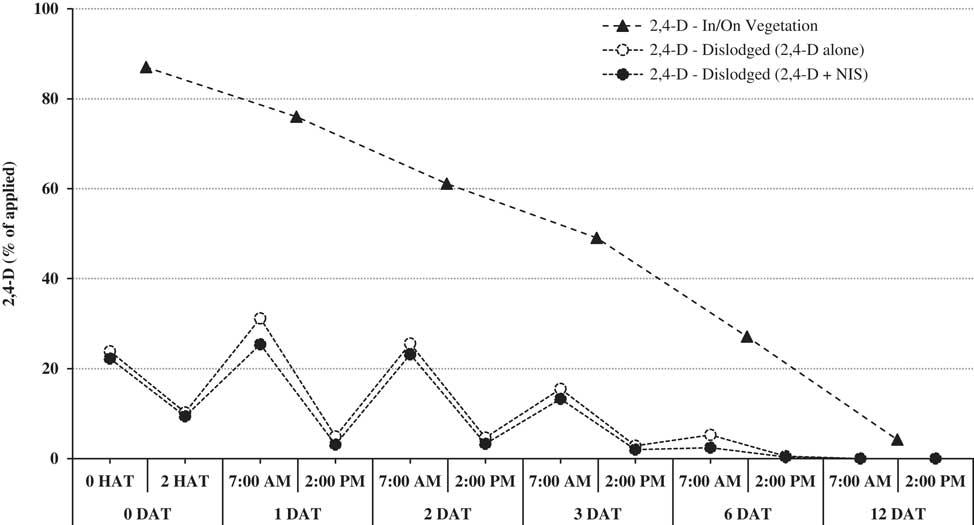
At 0 DAT, surfactant inclusion did not affect dislodgeable 2,4-D (P=0.501); however, ANOVA did reveal a significant sample collection time within a day main effect (P=0.0003). Pooled over surfactant treatments, samples collected immediately following application 0 DAT resulted in twofold greater 2,4-D dislodged (23.1% of applied) compared to samples collected 2 h later (9.8%) (Table 1). This result aligns with previous research conducted by Jeffries et al. (Reference Jeffries, Gannon and Maxwell2017), who reported that greater 2,4-D was dislodged from hybrid bermudagrass immediately following application (19.3% of applied) and declined to 9.6% 1 h after application, using the same cotton-glove hand-wipe method. Within collection timings 0 DAT, samples collected immediately or 2 h after application resulted in no difference in dislodgeable 2,4-D when applied alone or with surfactant. Minimal separation between surfactant treatments 0 DAT is probably the result of inadequate time between application and sample collection (2 h or less) necessary to capture increased foliar absorption resulting from surfactant inclusion. Although foliar absorption is variable depending on multiple factors, research evaluating amine 2,4-D foliar absorption following application to ground-ivy (Glechoma hederacea L.) has shown that most 14C-labeled 2,4-D absorption occurred in the first 6 h (12.5% of applied) and continued to 13.4% and 18.2% of applied at 24 and 72 h, respectively (Kohler et al. Reference Kohler, Throssell and Reicher2004).
Effect of surfactant and sample collection time on dislodgeable 2,4-D residue from perennial ryegrass.Footnote a – Footnote f

a Abbreviations: DAT, days after treatment; HAT, hours after treatment; AM, 7:00 AM Eastern Standard Time (EST); PM, 2:00 PM EST.
b Experiments initiated May 24, 2016 and June 6, 2016 in Raleigh, NC.
c Data pooled over two experimental runs.
d Nondetectable (<0.3 mg L–1) dislodgeable 2,4-D residue at 12 and 24 DAT.
e Measured spray application rate was 92% to 106% of the nominal application rate across experimental runs.
f Data from 0 DAT analyzed separately because of differing sample collection time from subsequent timings.
g Sample collection time within a day main effect presented for data at 0 DAT.
h Surfactant-by-sample collection time within a day interaction presented for data from 1 through 6 DAT.
i Percent of the nominal 2.1 kg ae ha–1 spray application rate.
ANOVA revealed a significant interaction of surfactant-by-sample collection time within a day (P=0.021) on dislodgeable 2,4-D from 1 through 6 DAT. Within each DAT, greater amounts of 2,4-D were dislodged in the AM than in the PM, regardless of surfactant inclusion or absence (Table 1). Samples collected 1 DAT resulted in 25.4% to 31.2% of applied 2,4-D dislodged in the AM compared to 3.1% to 4.9% in the PM. This trend continued 2, 3, and 6 DAT, where dislodgeable 2,4-D was greater in the AM (2.4% to 25.6% of applied) compared to PM (0.4% to 4.7%) at each respective DAT. Within AM collection timing, samples collected 1 DAT produced the greatest separation in 2,4-D dislodged applied alone (31.2% of applied) compared to applied with surfactant (25.4%). Similarly, at 2 and 3 DAT, less 2,4-D was dislodged in the AM applied with a surfactant (13.3% to 23.2% of applied) compared to when applied alone (15.5% to 25.6%); this trajectory continued through 6 DAT, at which point a 2-times reduction in dislodgeable 2,4-D was observed with surfactant (2.4%) compared to when applied alone (5.3%).
Dislodgeable 2,4-D tended to be numerically greater in the AM on a given day compared to PM sample collection the previous day, including samples collected 0 DAT compared to samples collected 1 DAT-AM and continued through 6 DAT (Table 1). Data suggest that 2,4-D may become re-suspended on treated turfgrass vegetation overnight as canopy moisture increases and therefore becomes available to be dislodged. Moreover, declining differences between surfactant treatments as DAT increased may be partially due to decreased canopy moisture formation, as surfactants have been shown to suppress canopy moisture in the mornings following application (McDonald et al. Reference McDonald, Dernoeden and Bigelow2006; Williams and Powell Reference Williams and Powell1995). Within PM collection timing, dislodgeable 2,4-D did not vary between 2,4-D applied alone or with surfactant, which may be a consequence of the notable reduction in 2,4-D dislodged at PM collection timings compared to AM timings. Specifically, samples collected in the PM resulted in a 5- to 10-times reduction in dislodgeable 2,4-D compared to samples collected in the AM across surfactant treatments at each DAT from 1 through 6 DAT.
One notable occurrence within this research was that the two sampling events that yielded the greatest dislodgeable 2,4-D were 1 DAT-AM (25.4% to 31.2% of applied) followed by 2 DAT-AM (23.5% to 25.6%), which were both numerically greater than samples collected immediately following application 0 DAT (23.1%) (Table 1). Current 2,4-D label guidelines permit re-entry when the product has air dried, which is generally within the day of application. Results from this research suggest that this re-entry period may not encompass the time when potential human exposure is greatest (e.g., canopy moisture present in the days following application).
Previous research evaluating dislodgeable 2,4-D has reported less 2,4-D dislodged than the presented research. Namely, Thompson et al. (Reference Thompson, Stephenson and Sears1984), Gannon and Jeffries (Reference Gannon and Jeffries2014), and Jeffries et al. (Reference Jeffries, Gannon, Brosnan, Ahmed and Breeden2016a, Reference Jeffries, Gannon, Brosnan and Breedenb) reported that dislodgeable 2,4-D never exceeded 10% of the nominal application rate. Differing reports may be a result of differences in sampling method intensity, turfgrass species, application parameters, or environmental conditions among other factors, as described by Jeffries et al. (Reference Jeffries, Gannon and Maxwell2017). Specific to sampling methods, Gannon and Jeffries (Reference Gannon and Jeffries2014) and Jeffries et al. (Reference Jeffries, Gannon, Brosnan, Ahmed and Breeden2016a, Reference Jeffries, Gannon, Brosnan and Breedenb) used a less aggressive ball roll method compared to the hand-wipe method used in the presented research (Jeffries et al. Reference Jeffries, Gannon and Maxwell2017). Thompson et al. (Reference Thompson, Stephenson and Sears1984) used a shoe-wiping method by wrapping a pair of shoes with cheesecloth and scuffling back and forth across a 1-m2 treated area for 1 min. It should be noted that the sampling area used by Thompson et al. (Reference Thompson, Stephenson and Sears1984) was approximately 20 times larger (10,000 cm2) than the sampling area used in the presented research (420 cm2), which may have contributed to differing results.
Environmental Parameters Correlations with Dislodgeable 2,4-D
Data from 1 through 6 DAT suggest that dislodgeable 2,4-D may be affected by environmental conditions influencing turfgrass canopy moisture development and duration. Baier (Reference Baier1966) and Wilson et al. (Reference Wilson, Bland and Norman1999) reported maximum dew formation occurred at, or shortly after sunrise; therefore, the time from sunrise and sample collection was recorded at each sample timing. Further, previous research has shown that increasing relative humidity and decreasing differences between air temperature and dew point favor 2,4-D dislodge (Jeffries et al. Reference Jeffries, Gannon, Brosnan and Breeden2016b).
Pooled over data from 1 through 6 DAT, 2,4-D dislodgeability was negatively correlated with air temperature – dew point (r=–0.66; P<0.0001), time from sunrise (r=–0.73; P<0.0001), and wind speed (r=–0.65; P<0.0001), suggesting that 2,4-D dislodgeability increased as air temperature approached dew point, time from sunrise decreased, and wind speed lessened (Table 2). Positive correlations were detected between dislodgeable 2,4-D and relative humidity (r=0.67; P<0.0001), suggesting that 2,4-D dislodgeability increased as atmospheric moisture increased.
Pearson correlation coefficients quantifying the relationship between environmental parameters and dislodgeable 2,4-D residue on perennial ryegrass.Footnote a – Footnote d

a Experiments initiated May 24, 2016 and June 6, 2016 in Raleigh, NC.
b Average of hourly environmental parameters from 5:00 AM to 7:00 AM Eastern Standard Time (EST) and 12:00 PM to 2:00 PM EST prior to sample collection starting at 7:00 AM and 2:00 PM EST.
c Environmental parameters recorded on site at the Lake Wheeler Turfgrass Field Laboratory (Raleigh, NC).
d Data pooled over two experimental runs, 1 through 6 d after treatment, sample collection times within a day and surfactant treatments.
e Percent of the nominal 2.1 kg ae ha–1 spray application rate.
f *** denote significance at P<0.0001.
2,4-D in Vegetation
2,4-D detection did not occur in perennial ryegrass aboveground vegetation collected 24 DAT; therefore, data were excluded from statistical analysis. ANOVA determined that 2,4-D persistence in vegetation did not vary between 2,4-D applied alone or with surfactant (P=0.459) or between sample collection times within a day (P=0.105). However, ANOVA did reveal a significant DAT main effect (P<0.0001) for 2,4-D persistence in vegetation from 0 through 12 DAT (Table 3). Pooled over sample collection times within a day and surfactant treatments, samples collected 0 DAT resulted in 87% of applied 2,4-D in aboveground vegetation and declined to 76%, 61%, 49%, 27%, and 4% at 1, 2, 3, 6 and 12 DAT, respectively. These data suggest that 2,4-D dissipates rapidly from perennial ryegrass vegetation (T1/2=3.5 d), as residue declined threefold from 0 through 6 DAT, despite there being no water inputs during this period. 2,4-D dissipation trends from perennial ryegrass align with results from Jeffries et al. (Reference Jeffries, Gannon, Brosnan and Breeden2016b), who reported maximum observed 2,4-D in perennial ryegrass of 96% of applied at 0 DAT, which declined to 51% and 5% at 6 DAT and 12 DAT, respectively. Further, the ~6-times decline from 6 through 12 DAT in 2,4-D in vegetation is probably due to plots receiving irrigation or precipitation that occurred after the 6-d covering period. Coupling water inputs with 2,4-D’s very high water solubility, 2,4-D residue remaining on plant foliage 6 DAT may have transferred into turfgrass thatch and/or soil prior to sample collection 12 DAT. The lack of difference in 2,4-D aboveground vegetation between surfactant treatments may be due to no distinction made between 2,4-D in and on vegetation (e.g., a foliar wash treatment). Thompson et al. (Reference Thompson, Stephenson and Sears1984) separated 2,4-D in versus on vegetation using organic solvents, an approach not utilized in this research, and reported that 2,4-D on Kentucky bluegrass was 72.0% to 60.1% of applied, whereas 2,4-D in vegetation was 14.3% to 13.9% 1 through 4 DAT. The presented research cannot elucidate the reason for similar 2,4-D dissipation rates in vegetation when applied alone or with surfactant, but it is known that amine 2,4-D formulations are not as readily absorbed by foliage as other 2,4-D formulations, so the particular formulation may have reduced the effect of surfactant aiding foliar absorption (Walters Reference Walters2004). Overall, 2,4-D in turfgrass vegetation continuously declined as time between application and sample collection increased as a result of innate dissipation and plant metabolism, among other factors. Data suggest that reductions in dislodgeable 2,4-D 1 through 6 DAT when applied with a surfactant were not due to differing persistence in aboveground vegetation (Figure 1). Across surfactant treatments, dislodgeable samples collected in the AM resulted in 2.4% to 31.2% of applied 2,4-D dislodged, whereas samples collected in the PM resulted in 0.4% to 4.9% dislodged from 1 through 6 DAT (Table 1). When dislodgeable 2,4-D is calculated as a percent of the total 2,4-D in vegetation and data pooled over surfactant treatments, 36.0% of the total 2,4-D was dislodged 1 DAT-AM and numerically increased 2 DAT-AM (39.8%) (data not shown). Pairing dislodgeable 2,4-D data with 2,4-D recoveries in vegetation suggests that potential human 2,4-D exposure from treated turfgrass does not align with dissipation rates but may be highly variable depending on the time within a day the area is used and the amount of canopy moisture present, among other factors.
Data presented are the main effect of day after treatment (DAT) on 2,4-D in aboveground vegetation, and the surfactant-by-sample collection time within a day interaction (sorted by DAT) on dislodgeable 2,4-D. Data are presented as a percent of the nominal application rate (2.1 kg ae ha–1). The application occurred at 2:00 PM Eastern Standard Time (EST), and sample collection ensued 0 h after treatment (HAT) (2:00 PM) and 2 HAT (4:00 PM) following application on 0 DAT, and also at 7:00 AM and 2:00 PM EST from 1 through 12 DAT. NIS, nonionic surfactant.
2,4-D persistence in perennial ryegrass aboveground vegetation over time.Footnote a – Footnote e

a Abbreviations: DAT, days after treatment.
b Experiments initiated May 24, 2016 and June 6, 2016 in Raleigh, NC.
c Data pooled over two experimental runs, sample collection times within a day and surfactant treatments.
d 2,4-D residue was nondetectable (<0.3 mg kg-1) at 24 DAT.
e Measured spray application rate was 92% to 106% of the nominal application rate across experimental runs.
f Percent of the nominal 2.1 kg ae ha–1 spray application rate.
g 0 DAT data were not included because of differing sample collection time from subsequent timings.
h Irrigation did not occur following application at 0 DAT through 6 DAT sample collection.
This research built on preceding efforts to further identify and elucidate factors affecting dislodgeable 2,4-D from treated turfgrass. Findings from this research support the proposed hypothesis that surfactant inclusion can reduce dislodgeable 2,4-D foliar residue. Data from the presented research agrees with previous reports that 2,4-D can dislodge from perennial ryegrass up to 6 DAT when mowing and water inputs are withheld, as residue detection occurred for this duration across all evaluated treatments and sample collections timings. Likewise, 2,4-D residue detection in vegetation 12 DAT suggests that clipping management strategies should be exercised for at least this duration following application.
In conclusion, surfactant inclusion may slightly reduce dislodgeable 2,4-D, which would inherently reduce potential human 2,4-D dermal exposure. Further, 2,4-D dislodgeability can fluctuate over time within a day following application, which agrees with previous reports. Therefore, turfgrass managers and athletic field event schedulers should coordinate events to minimize human activity in the mornings following 2,4-D applications, when potential human exposure is heightened. Pairing data from the presented research with prior reports indicating that dislodgeable 2,4-D is elevated in the presence of canopy moisture suggests that actions to reduce canopy moisture, including surfactant inclusion, may reduce 2,4-D dislodgeable foliar residue. Additionally, incorporating surfactants into herbicide spray solutions may increase efficacy, which may lead to an overall reduction in herbicidal inputs. Ultimately, cumulative benefits resulting from surfactant inclusion further warrant its use in spray solutions applied to turfgrass. Future research should investigate dislodgeable pesticide residue in turfgrass systems as affected by surfactant inclusion with additional pesticides, primarily those not traditionally applied with a surfactant, as well as the effect of mowing and other common management practices to further elucidate factors influencing dislodgeable pesticide residues from turfgrass.
Acknowledgments
The authors would like to thank Matthew Jeffries, Khalied Ahmed, Scott Brinton, and Laney McKnight for their efforts in this research, as well as the Lake Wheeler Turfgrass Field Laboratory support staff, including Marty Parish and Dustin Corbett, for maintaining research areas. Funding for this research was provided by the North Carolina State University Center for Turfgrass Environmental Research and Education. No conflicts of interest have been declared.



