Introduction
Prevention of new affective episodes is the essential goal of maintenance therapy already after the first lifetime episode of depression. Nevertheless, little is known about predictors of the course of illness following first-episode depression, and the basis for individualized secondary prevention is therefore sparse. Most studies on the outcome of affective disorders are retrospective or include mixed samples of patients with one or more previous affective episodes. This implies a significant risk of recall bias and selection bias (the ‘clinician's illusion’ or Neyman's bias; Cohen & Cohen, Reference Cohen and Cohen1984) and might further result in confusion of predictors and secondary consequences of repeated affective episodes. Only a few studies including small sample sizes (up to 154 participants at 5 years of follow-up; Simpson et al. Reference Simpson, Nee and Endicott1997) have recorded data on patients suffering exclusively from a single depressive episode and assessed the effect of explanatory variables on the prevalence of recurrence, indicating that incomplete recovery (Judd et al. Reference Judd, Paulus, Schettler, Akiskal, Endicott, Leon, Maser, Mueller, Solomon and Keller2000), younger age of onset (Eaton et al. Reference Eaton, Shao, Nestadt, Lee, Bienvenu and Zandi2008), prior suicide attempts and ‘trait depression’ (Wilhelm et al. Reference Wilhelm, Parker, Whurst-Savellis and Asghari1999) increase the rate of recurrence after the first episode of depression. In addition, a review (Burcusa & Iacono, Reference Burcusa and Iacono2007) of risk factors for new episodes among patients with one or more previous depressive episodes pointed out that clinical markers of severity – as reflected in the severity of symptoms, early age of onset, co-morbidity and a family history of psychopathology – might be inherent in recurrent depression already from onset of the first episode.
No study has investigated predictors of conversion to bipolar disorder prospectively from onset of first-episode depression. However, a recent historical follow-up on data from 2146 depressed patients treated in a mood disorder centre between 1977 and 2013 has pointed to family history, substance abuse, cyclothymia, younger age of onset and male gender as possible predictors of conversion to bipolar disorder (Tondo et al. Reference Tondo, Visioli, Preti and Baldessarini2014). Further, studies on recurrent depression have suggested that an increased severity of a depressive episode might also be associated with subsequent development of manic or hypomanic episodes (Holma et al. Reference Holma, Melartin, Holma and Isometsä2008; Gilman et al. Reference Gilman, Dupuy and Perlis2012).
The experience of first lifetime episode of depression is traumatic for the individual and associated with great perplexity, confusion and indecisiveness in relation to the future. In addition, clinicians taking care of patients with first-onset depression are left with poor guidance from the literature on recurrent depressions and later development of bipolar disorder. There is an urgent need to identify clinical characteristics at first-onset depression that can guide patients and clinicians for individualized tailored treatment.
The present study aimed for the first time prospectively to assess the natural course of illness in a 5-year period following the first lifetime depression in terms of remission, recurrence and conversion to bipolar disorder, and to identify clinical predictors, present at onset, of these long-term outcomes. We hypothesized that a worse prognosis of depression (decreased rate of remission and increased rates of recurrence and conversion to bipolar disorder, respectively) would be associated with gender (especially a higher risk for conversion to bipolar disorder among men), a higher prevalence of a family history of affective disorders, and clinical characteristics indicating a higher illness severity in terms of earlier age of onset, longer duration of the first episode and more severe depressive symptoms, psychiatric co-morbidity (anxiety disorders and alcohol or drug abuse), psychotic and melancholic features, suicidal ideations and antidepressant treatment resistance.
Method
Study design
The present study is a 5-year follow-up of a cohort of patients initially treated for first-episode depression. We have previously described the baseline study in details (Bukh, Reference Bukh2009; Bukh et al. Reference Bukh, Bock, Vinberg, Gether and Kessing2010, Reference Bukh, Bock, Vinberg, Gether and Kessing2011). In short, a total of 301 ethnically Danish patients aged 18–70 years and recently discharged from their first admission or out-patient contact ever to a psychiatric hospital in eastern Denmark (Sealand) with the diagnosis of a single depressive episode according to The International Classification of Diseases, 10th revision (ICD-10) (World Health Organization, 1992) were sampled consecutively in a 2-year period from 2005 to 2007 via the Danish Psychiatric Central Research (DPCR) register (Munk-Jorgensen & Mortensen, Reference Munk-Jorgensen and Mortensen1997). The DPCR register comprises information on all psychiatric hospitalizations and out-patient contacts in Denmark. Patients can be referred to psychiatric hospital care by general or specialist practitioners, and there is free access to psychiatric emergency rooms throughout the country from which hospitalization can occur. The participants were invited to the study 1–3 months after discharge from admission or completion of ambulatory care and interviewed by two experienced medical doctors using standardized semi-structured interviews. Individuals with significant physical illness, dementia or mental retardation were excluded.
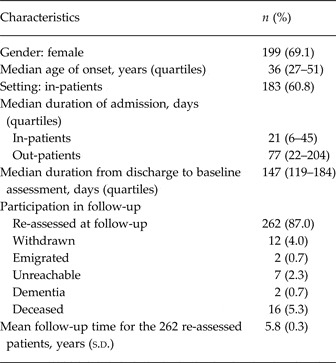
Approximately 5 years after the baseline assessment, all participants with a validated diagnosis of first-episode depression in the baseline study and still alive at that time were invited to the follow-up study. After informed consent, 262 out of the 301 participants at baseline (follow-up rate 87.0%) were re-interviewed by one senior researcher and specialist in psychiatry (J.D.B.), who also assessed half of the patients at the baseline interview (see Table 1 for details about the reasons for loss to follow-up). One patient developed a manic episode shortly after discharge; thus his diagnostic outcome was established at the baseline assessment, although he committed suicide before follow-up. A total of three patients committed suicide, 11 died of natural causes before follow-up, and two died outside Denmark from unknown causes. The number of suicides was too small for further analyses of associations with other variables.
Characteristics of the sample of 301 patients with first-episode depression

Data are given as number of patients (percentage) unless otherwise indicated.
s.d., Standard deviation.
The Danish Ethical Committee (H-3-2011-100) and the Data Inspection (2011-41-6577/2014-331-0644) approved the study.
Assessments
At the baseline assessment, ICD-10 diagnoses were established for the episode leading to psychiatric hospital care and for the lifetime before by the World Health Organization Schedules for Clinical Assessment in Neuropsychiatry (SCAN), previously known as the Present State Examination (Wing et al. Reference Wing, Babor, Brugha, Burke, Cooper, Giel, Jablenski, Regier and Sartorius1990). A complete medical treatment history was assessed using the Treatment Response to Antidepressants Questionnaire (TRAQ) (Posternak et al. Reference Posternak, Young, Sheeran, Chelminski, Franklin and Zimmerman2004). Family history of psychiatric illness was evaluated using a modification of the family history method (Andreasen et al. Reference Andreasen, Endicott, Spitzer and Winokur1977). The severity of depressive symptoms at baseline was assessed with the 17-item Hamilton Depression Rating Scale (HAM-D 17-items) (Bech et al. Reference Bech, Kastrup and Rafaelsen1986).
At the follow-up assessment, the longitudinal course of illness was evaluated by the life chart method (Post et al. Reference Post, Roy-Byrne and Uhde1988). Discharge summaries from all hospital contacts were available electronically from a nationwide database. In cases of doubt about diagnoses or treatments, complete case reports were requested. If the patient was not in remission at baseline (HAM-D 17-items ⩽7), the date of remission of the first depressive episode was determined retrospectively as the time either when the patient was without significant depressive symptoms for a minimum of 2 months and had returned to his or her usual functional capacity, or when the patient developed a bipolar disorder. Any period with signs of psychiatric illness after remission of the first depressive episode was marked on the life chart, and diagnoses were established for representative periods by means of the SCAN interview. Medical treatments in the follow-up period were recorded using the TRAQ (Posternak et al. Reference Posternak, Young, Sheeran, Chelminski, Franklin and Zimmerman2004) based on information from the patient and case reports. Treatment resistance was defined in a pragmatic way as three or more successive failed antidepressant trials (meaning treatment with different antidepressants, different combinations of antidepressants, or different add-on treatments with lithium, anticonvulsants or antipsychotics). Depressive symptoms at the time of follow-up were assessed by the HAM-D 17-items.
Outcomes and predictor variables
Based on the life chart and SCAN interview we ascertained the date of the following outcomes: (1) remission from the first depressive episode sustained for 8 weeks or more; (2) recurrence of a new depressive episode after remission of the first episode; (3) bipolar disorder: onset of either a manic, hypomanic or mixed episode; (4) onset of a psychiatric illness of diagnostic precedence over affective disorder (i.e. schizophrenia).
A priori, the following predictor variables were identified: gender, age of onset, a family history of affective disorder, duration and severity of the first episode, initial treatment resistance, the presence of psychotic or melancholic features, and co-morbidity of anxiety disorders, alcohol or substance abuse (all assessed at baseline) based on the literature (Akiskal et al. Reference Akiskal, Walker, Puzantian, King, Rosenthal and Dranon1983; Holma et al. Reference Holma, Melartin, Holma and Isometsä2008; Hardeveld et al. Reference Hardeveld, Spijker, de, Nolen and Beekman2010).
Statistical analyses
The occurrence of remission, recurrence (for those who obtained remission) and conversion to bipolar disorder was studied using survival analysis techniques (Kalbfleisch & Prentice, Reference Kalbfleisch and Prentice2002). Censoring was done in the following ways in the analyses of the three outcomes. (a) Remission: the participants were followed from onset of the first depression. For participants who were in remission already at the baseline assessment we assumed that remission had been reached during the period between discharge and baseline; hence, the time to remission was interval-censored between discharge and baseline, where ‘interval-censoring’ means that the time to remission was known only up to a certain interval. Participants who did not obtain remission at any time during the follow-up period had their times to remission right-censored at follow-up, and patients with non-remission at baseline and no further information on remission were right-censored at baseline. Because of the presence of interval-censored observations, the Turnbull estimator (Kalbfleisch & Prentice, Reference Kalbfleisch and Prentice2002) was used to estimate the cumulative incidence of remission. However, since the curve obtained using the Turnbull estimator (not shown) was virtually identical to that obtained using the standard Kaplan–Meier estimator on a dataset where the interval-censored observations were replaced by a time to remission at the mid-point of the interval, we decided to use the Kaplan–Meier estimator when presenting the results. This mid-point imputation also allowed us to use the Cox regression model for assessing the association between the rate of remission and explanatory variables. (b) Recurrence: the participants were followed from the date of remission of the first depression. Time to recurrence was studied taking the competing risk of converting to bipolar disorder into account. Participants who obtained remission in the interval between discharge and the baseline assessment and later experienced recurrence of depression had interval-censored times to recurrence. Participants with no recurrence during the follow-up period were right-censored at follow-up. Non-participants in the follow-up who were in remission at baseline and later got a diagnosis of recurrent depression at a psychiatric hospital contact according to DPCR register information had their times to recurrence interval-censored between baseline and the date for the subsequent hospital contact. Non-participants in the follow-up with no information on recurrence and patients who did not obtain remission at any time during the follow-up period were excluded from the analyses. For patients with interval-censored times to recurrence, mid-point imputation was used, whereby the cumulative incidence of recurrence (taking the competing risk of conversion to bipolar disorder into account) could be estimated using the Aalen–Johansen estimator (Kalbfleisch & Prentice, Reference Kalbfleisch and Prentice2002). Similarly, the Cox regression model could be used to study predictive factors for the rate of recurrence. (c) Conversion to bipolar disorder: the participants were followed from the date of discharge with the diagnosis of single-episode depression. Non-participants in the follow-up were right-censored at the time of the baseline interview (unless, of course, they developed bipolar disorder before baseline, that is, between discharge and the baseline interview). The cumulative incidence of bipolar disorder was estimated using the Kaplan–Meier estimator and the Cox regression model was used to study predictors.
Finally, all time intervals were right-censored at the time of onset of a disorder with diagnostic precedence over affective disorder (schizophrenia). Details on censoring in the analyses of time to remission, recurrence of depression and conversion to bipolar disorder, respectively, can be seen in online Supplementary Table S1 in the online Supplementary material.
Results
Sample characteristics
The population characteristics can be seen from Tables 1 and 3 (for further details, see Bukh, Reference Bukh2009; Bukh et al. Reference Bukh, Bock, Vinberg, Gether and Kessing2010, Reference Bukh, Bock, Vinberg, Gether and Kessing2011).
During the entire follow-up period, a total of 230 of the participants in the follow-up study (87.5%) received antidepressant medications, 68 (25.9%) got a mood stabilizer [lithium: 17 (6.5%), antipsychotics: 52 (19.8%), antiepileptics: 37 (14.1%)], while 32 participants (12.2%) did not get any psychopharmacological treatment after the baseline interview, and seven participants (2.7%) received electroconvulsive therapy.
Course of illness
All 301 participants were included in the analyses of the rate of remission (261 patients with an ascertained date of remission, 19 patients with no remission at any time of during the follow-up period, and 21 non-participants in the follow-up with no further information on remission who were right-censored at baseline). All 301 participants were included in the analyses of the rate of conversion to bipolar disorder (27 patients who developed bipolar disorder, 235 patients who stayed unipolar during the follow-up period, 38 non-participants in the follow-up with no further information on conversion to bipolar disorder who were right-censored at baseline, and one patient who was censored at the time of development of schizophrenia). A total of 246 patients could be included in the analyses of the rate of recurrence [145 patients remitted from the first depressive episode and had no further episodes during the follow-up period, 80 patients experienced a recurrent episode of depression after remission of the first episode, 18 patients had a manic or hypomanic episode after the first depression (competing risk), two non-participants in the follow-up were admitted with recurrent depression after baseline according to register information, and one patient developed schizophrenia after remission of the first depression], whereas 19 patients without remission at any time during the follow-up period and 36 non-participants in the follow-up with no further information on recurrence were excluded from the analyses.
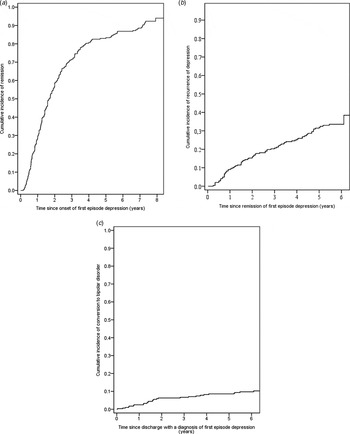
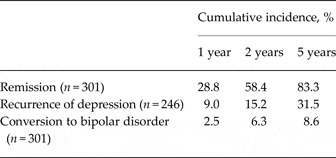
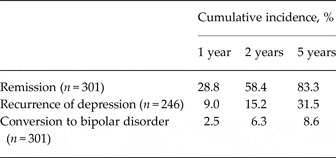
Fig. 1 shows the cumulative incidences of remission (Fig. 1a ), recurrence after remission (Fig. 1b ) and conversion to bipolar disorder (Fig. 1c ), respectively, as a function of time. Table 2 presents the cumulative incidences of (1) remission 1, 2 and 5 years after onset of depression, (2) recurrence 1, 2 and 5 years after remission, and (3) conversion to bipolar disorder 1, 2 and 5 years after discharge (from in- or out-patient hospital care).
(a) Cumulative incidence of remission after onset of the first lifetime episode depression (n = 301). (b) Cumulative incidence of recurrence after remission of the first lifetime episode depression (n = 246). (c) Cumulative incidence of conversion to bipolar disorder after discharge with a diagnosis of first lifetime episode depression (n = 301).

Cumulative incidence of (1) remission 1, 2 and 5 years after onset of first-episode depression, (2) recurrence 1, 2 and 5 years after remission of first-episode depression, and (3) conversion to bipolar disorder 1, 2 and 5 years after discharge from in- or out-patient hospital care with a diagnosis of first-episode depression
Predictors of the course of illness
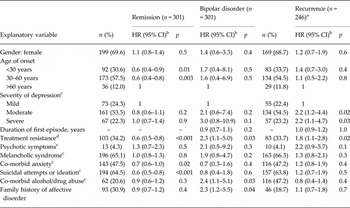
Table 3 shows predictors of remission, recurrence and conversion to bipolar disorder, respectively. Failure to respond to two initial antidepressant treatments of the first episode was associated with an 80% increased rate of depressive recurrence, a more than twofold increased rate for conversion to bipolar disorder, and (as would be expected) a decreased rate of remission. Age of onset less than 60 years and the presence of suicidal ideations or attempts both reduced the rate of remission with 40%, and a co-morbid anxiety disorder at baseline was associated with 30% lower remission rate. Severity of the first depressive episode had a significant effect on rate of recurrence (2.2 times increased for patients with a moderate and severe first episode as compared with mild depression). There was a trend for increased severity of first-episode depression to predict also conversion to bipolar disorder, numerically of the same size as the effect on recurrence, however not statistically significant. Further, a family history of affective disorder and co-morbid alcohol or drug abuse predicted conversion to bipolar disorder. A total of eight participants (3.0%) had a family history of bipolar disorder among first-degree relatives, and two of them (25.0%) developed bipolar disorder during follow-up; however, the influence of a family history exclusively of bipolar disorder on the rate of diagnostic conversion did not reach statistical significance (hazard ratio = 3.1, 95% confidence interval 0.7–13.6, p = 0.1).
Predictors of the rate of remission, recurrence and conversion to bipolar disorder after the first lifetime episode of depression

HR, Hazard ratio; CI, confidence interval.
a Only participants, who obtained remission, could be included in these analyses.
b HRs with 95% CIs in Cox's regression models. The effect of gender is adjusted for age of onset and vice versa, and the effects of all other variables are adjusted for gender and age of onset. In the analyses of dichotomous variables, the group negative for the variable in question is the reference.
c According to International Classification of Diseases, 10th revision diagnostic criteria.
d ⩾3 v. <3 failed treatments trials with different antidepressants, different combinations of antidepressants, or different add-on treatments with lithium, anticonvulsants or neuroleptics.
In the online Supplementary material, the risks of remission (online Supplementary Fig. S1), recurrence (online Supplementary Fig. S2) and conversion to bipolar disorder (online Supplementary Fig. S3) are presented stratified by the categorical variables, which significantly predicted the outcomes (age of onset, co-morbid anxiety, suicidal ideations or attempts, severity and treatment resistance of first episode, and family history of affective disorder).
Discussion
Main findings
After onset of the first lifetime episode of depression treated in psychiatric hospital settings, 25–30% of the patients remitted during each of the first 2 years, and 83.3% were in full remission after 5 years. The cumulative incidence of recurrence was 9.0% during the first year, 15.2% after 2 years, and 31.5% 5 years after remission of the first depression. The conversion to bipolar disorder was highest in the first 2 years after discharge (2.5% after 1 year and 6.3% after 2 years), and additionally 2.3% developed bipolar disorder in the following 3 years, summing up to a total of 8.6% after 5 years.
The rate of remission decreased with younger age of onset (<60 years), a co-morbid anxiety disorder, suicidal ideations or attempts, and initial treatment resistance to two or more antidepressant treatment trials. The rate of recurrence was increased among patients with a moderate–severe and treatment-resistant first episode. Finally, the rate of conversion to bipolar disorder was increased by a family history of affective disorder, treatment resistance of the first episode, and co-morbid alcohol or drug abuse. Hence, we confirmed our hypothesis concerning the prognostic effect of a family history of affective disorder and some of the clinical variables assessed at baseline (severity of the first depressive episode, co-morbid anxiety and alcohol or drug abuse, suicidal ideations, early onset, and treatment resistance) on the long-term course of depression, whereas gender and other clinical variables (duration of the first episode, psychotic and melancholic features) showed no significant effect on any of the outcomes.
Comparison with previous findings
Remission
In the National Institute of Mental Health Collaborate Depression Study (CDS) (Simpson et al. Reference Simpson, Nee and Endicott1997) (n = 154) the rate of non-remission in 5 years after the first episode of depression was a little lower (approximately 10%) compared with the results from the present study (16.7%). The Baltimore Epidemiological Catchment Area (ECA) Follow-up (Eaton et al. Reference Eaton, Shao, Nestadt, Lee, Bienvenu and Zandi2008) (n = 92) recorded the presence or absence of a depressive episodes in each year during the follow-up, and 15% of the participants did not achieve recovery (defined as a year free of depression) even 20 years after the first depressive episode; however, using that definition of recovery, some patients might have been in remission in almost a year without being classified as recovered.
In the CDS cohort there was no difference in the rate of remission between men and women in accordance with our findings. The ECA study found no effects of either demographic variables, family history of depression, co-morbid alcohol and drug abuse, or panic attacks on the rate of recovery. In contrast, we found an influence of co-morbid anxiety on the cumulative incidence of remission. In studies on recurrent depression, the impact of anxiety on remission rate is inconsistent (O'Leary et al. Reference O'Leary, Costello, Gormley and Webb2000; Spijker et al. Reference Spijker, de, Bijl, Beekman, Ormel and Nolen2002; Riihimäki et al. Reference Riihimäki, Vuorilehto, Melartin and Isometsä2014), possibly because the effect of co-morbid anxiety varies across repeated depressive episodes.
Recurrence
Three studies (Simpson et al. Reference Simpson, Nee and Endicott1997; Mattisson et al. Reference Mattisson, Bogren, Horstmann, Munk-Jorgensen and Nettelbladt2007; Eaton et al. Reference Eaton, Shao, Nestadt, Lee, Bienvenu and Zandi2008) have investigated the rate of recurrence prospectively after remission from first-episode depression. The CDS (Simpson et al. Reference Simpson, Nee and Endicott1997) reported a rate of recurrence after 5 years of 59% for men and 64% for women, which is both considerably higher than in the present study. In the non-clinical ECA sample (Eaton et al. Reference Eaton, Shao, Nestadt, Lee, Bienvenu and Zandi2008), the initial recurrence rate was lower (approximately 25% after 5 years and 50% after 15 years), and in the Lundby cohort (Mattisson et al. Reference Mattisson, Bogren, Horstmann, Munk-Jorgensen and Nettelbladt2007) around 40% experienced recurrence during 30 years of follow-up, possibly reflecting a higher proportion of milder depressions in community samples. Studies of patients with recurrent depression at intake have provided various, but generally higher, rates of further recurrences (Mueller et al. Reference Mueller, Leon, Keller, Solomon, Endicott, Coryell, Warshaw and Maser1999; Solomon et al. Reference Solomon, Keller, Leon, Mueller, Lavori, Shea, Coryell, Warshaw, Turvey, Maser and Endicott2000; Kanai et al. Reference Kanai, Takeuchi, Furukawa, Yoshimura, Imaizumi, Kitamura and Takahashi2003) (estimated to be 60% after 5 years; Hardeveld et al. Reference Hardeveld, Spijker, de, Nolen and Beekman2010), which is not surprising, since the history of previous episodes itself is a strong predictor of new episodes (Kessing et al. Reference Kessing, Hansen and Andersen2004a , Reference Kessing, Hansen, Andersen and Angst b ).
In agreement with our results, gender did not influence the recurrence rate after first-episode depression in the CDS (Simpson et al. Reference Simpson, Nee and Endicott1997). In the ECA follow-up (Eaton et al. Reference Eaton, Shao, Nestadt, Lee, Bienvenu and Zandi2008), age of onset was a significant predictor of recurrence, whereas other demographic variables, family history of depression, and panic attacks had no effect on recurrence. Wilhelm et al. (Reference Wilhelm, Parker, Whurst-Savellis and Asghari1999) reported an increased risk of recurrence among patients with previous suicide attempts and ‘state depression’ (according to the Costello and Comrey scale; Costello & Comrey, Reference Costello and Comrey1967) in a non-clinical sample of patients (27 patients with single depression compared with 27 with recurrent depression during 15 years of follow up), but no effect of co-morbid anxiety.
Among patients with recurrent depression, residual symptoms and the number of previous episodes have been identified as the strongest predictors of new episodes (Hardeveld et al. Reference Hardeveld, Spijker, de, Nolen and Beekman2010). Further, increased severity of the last episode (Kennedy et al. Reference Kennedy, Abbott and Paykel2003; Hardeveld et al. Reference Hardeveld, Spijker, de, Nolen and Beekman2013) is probably a risk factor for further depressive episodes, whereas the duration of last episode and demographic factors generally appear to have less impact on recurrence (Hardeveld et al. Reference Hardeveld, Spijker, de, Nolen and Beekman2010). The present study importantly indicates that severity is a predictor of subsequent episodes already after the first episode, and thus, not solely a result of the progression of the illness.
Conversion to bipolar disorder
Highly diverse rates of conversion from first-episode depression to bipolar disorder have been reported in other studies (Simpson et al. Reference Simpson, Nee and Endicott1997; Angst et al. Reference Angst, Sellaro, Stassen and Gamma2005; Mattisson et al. Reference Mattisson, Bogren, Horstmann, Munk-Jorgensen and Nettelbladt2007; Tondo et al. Reference Tondo, Visioli, Preti and Baldessarini2014). However, only one of these studies has investigated the rate of diagnostic conversion prospectively using survival statistics (Angst et al. Reference Angst, Sellaro, Stassen and Gamma2005), which make the results difficult to compare. Angst et al. (Reference Angst, Sellaro, Stassen and Gamma2005) included a mixture of patients with first-episode depression followed prospectively (n = 97) and a larger subsample (n = 212) with recurrent depression at baseline, who were studied both retrospectively and prospectively. The conversion rate in the prospective group was 15.5% over an average observation period of 14 years compared with 50% over an average observation period of 23.4 years in the group with recurrent depression at baseline. Though partly explained by different observation times, these results illustrate the importance of taking previous illness history into consideration. In the total sample, the rate of conversion was estimated to be 10% during the initial 4 years and afterwards constant with a change rate of 1.25% per year. The conversion rate for the prospective subgroup was not reported; however, the inclusion of patients with recurrent depression at baseline in the study by Angst et al. (Reference Angst, Sellaro, Stassen and Gamma2005) might have resulted in an overestimation of the conversion rate after the initial 4 years, because patients with more depressive episodes before inclusion have an increased risk of subsequent conversion to bipolar disorder (Kessing et al. Reference Kessing, Hansen and Andersen2004a , Reference Kessing, Hansen, Andersen and Angst b ). In the CDS, 13.7% of 197 study participants converted to bipolar disorder during 15 years of follow-up (Simpson et al. Reference Simpson, Nee and Endicott1997); however, a considerable number of participants (38.6%) were censored during the follow-up in the CDS due to refusal (18.3%), death (14.2%) or unavailable data (6.1%), and no survival statistics were used, hence a conversion rate cannot be estimated validly from this study. The low rate of diagnostic conversion in the Lundby study (Mattisson et al. Reference Mattisson, Bogren, Horstmann, Munk-Jorgensen and Nettelbladt2007) (2% in about 40 years) might be due to differences between our psychiatric in- and out-patient sample and a community sample and the fact that only bipolar disorder type I was recorded in the Lundby study. In addition, a large study (n = 2146) on historical data based on clinical assessments of patients in a mood disorder centre between 1977 and 2013 (Tondo et al. Reference Tondo, Visioli, Preti and Baldessarini2014) found that 29.9% of the patients initially treated for first-time depression later met criteria for bipolar disorder (mean time from initial episode to intake 13.2 years, s.d. = 11.4 years), which is considerable higher than in the studies with prospective collection of data.
A number of other studies have assessed the conversion to bipolar disorder among patients with unipolar depression from a certain point, without taking into account the number of depressive episodes before baseline, which has yielded very diverse results. A recent review found conversion rates from unipolar to bipolar disorder in 12 different studies ranging from 0.37% to 3.95% per year of follow-up (a weighted mean rate of 0.61% per year). Studies using survival statistics have reported cumulative proportions of approximately 14% during 5 years (Holma et al. Reference Holma, Melartin, Holma and Isometsä2008), 17% during 10 years (Coryell et al. Reference Coryell, Endicott, Maser, Keller, Leon and Akiskal1995), 45% during 15 years (Goldberg et al. Reference Goldberg, Harrow and Whiteside2001), and 20% during 30 years (Fiedorowicz et al. Reference Fiedorowicz, Endicott, Leon, Solomon, Keller and Coryell2011). Since the risk of developing bipolar disorder is probably dependent on the depressive illness history itself, the results are highly influenced by the selection of patients to the studies. Assessing the rate of diagnostic conversion among patients with recurrent depression by survival models is further hampered by delayed entry (meaning that only patients, who have not already converted to bipolar disorder, can be included). Thus, conversion rates assessed at different stages of the illness will inevitably vary and are not directly comparable with the conversion rate following the first depressive episode.
No other prospective study on predictors of conversion to bipolar disorder after a single depressive episode has yet been published. The historical follow-up study by Tondo et al. (Reference Tondo, Visioli, Preti and Baldessarini2014) found that a family history of bipolar disorder, substance abuse, younger age at onset and male gender were associated with bipolar disorder at intake.
Among patients with recurrent depression, a family history of affective disorder (Akiskal et al. Reference Akiskal, Walker, Puzantian, King, Rosenthal and Dranon1983; Coryell et al. Reference Coryell, Endicott, Maser, Keller, Leon and Akiskal1995; Fiedorowicz et al. Reference Fiedorowicz, Endicott, Leon, Solomon, Keller and Coryell2011), greater symptom severity (Holma et al. Reference Holma, Melartin, Holma and Isometsä2008), psychotic symptoms (Coryell et al. Reference Coryell, Endicott, Maser, Keller, Leon and Akiskal1995; Goldberg et al. Reference Goldberg, Harrow and Whiteside2001; Holma et al. Reference Holma, Melartin, Holma and Isometsä2008; Fiedorowicz et al. Reference Fiedorowicz, Endicott, Leon, Solomon, Keller and Coryell2011), shorter duration of the index episode (Akiskal et al. Reference Akiskal, Walker, Puzantian, King, Rosenthal and Dranon1983), treatment resistance (Li et al. Reference Li, Bai, Huang, Chen, Chen, Cheng and Su2012) and early age of onset (Akiskal et al. Reference Akiskal, Walker, Puzantian, King, Rosenthal and Dranon1983; Coryell et al. Reference Coryell, Endicott, Maser, Keller, Leon and Akiskal1995; Holma et al. Reference Holma, Melartin, Holma and Isometsä2008; Fiedorowicz et al. Reference Fiedorowicz, Endicott, Leon, Solomon, Keller and Coryell2011) have been found to increase the risk for conversion to bipolar disorder. Is should be noted that we included only patients who were discharged after the age of 18 years (nine of them had an age of onset between 15 and 18 years). In retrospective studies, age of onset is likely to be associated with other variables such as duration of the illness and number of previous episodes, which might confound the results. Our prospective data therefore suggest that the influence of age of onset might be overestimated in previous retrospective studies, or that the effect of age of onset derives mostly from early-onset depressions before the age of 18 years.
The statistically non-significant effect of psychotic depression in the present study might be due to a low prevalence of psychotic features in our sample [two out of 13 patients (15.4%) with psychotic depression converted to bipolar disorder compared with 25 out of 288 patients (8.7%) without psychotic depression].
Strengths
First of all, the inclusion of patients suffering exclusively from first-episode depression and the prospective design are major advantages of the present study. Psychiatric interviews conducted by a consultant in psychiatry certified in SCAN ensured a high validity of both the inclusion diagnoses and the outcomes. In comparison, recovery and remission were defined by scores on a six-point psychiatric status rating scale (Keller et al. Reference Keller, Lavori, Friedman, Nielsen, Endicott, Donald-Scott and Andreasen1987) in the CDS, and in the ECA study patients were diagnosed with long latency (up to more than 10 years) by means of the Diagnostic Interview Schedule (DIS) (Robins et al. Reference Robins, Helzer, Croughan and Ratcliff1981), though there was only a moderate agreement between the DIS diagnoses and the results of a SCAN interview conducted by psychiatrists (Eaton et al. Reference Eaton, Neufeld, Chen and Cai2000).
The participation rate in the follow-up was very high in the present study (87.4%), which reduces the risk of selection bias. Moreover, the sample size of 262 participants assessed at follow-up is larger than in any other prospective study (compared with 154 participants at 5 years follow-up in the CDS). Finally, there were few exclusion criteria, which increases the generalizability of our findings to patients treated in psychiatric hospital settings as in-patients or out-patients.
Limitations
It cannot be excluded that milder episodes have not been recognized; thus the rate of both recurrence and diagnostic conversion to bipolar disorder might be underestimated. Further, the lack of assessments between baseline and the 5 years follow-up might have impaired the exact dating of the time of remission and new events; however, we believe that this possible imprecision would tend to blur true effects rather than systematically bias the results. Further, we cannot exclude that participants with affective symptoms at the time of assessment either recall more previous symptoms or forget previous episodes due to mild cognitive dysfunction. Though this is the largest prospective study to date of patients with first-episode depression, the sample size might still be too small to detect effects of some predictive variables, especially on the rate of conversion to bipolar disorder, since this is a less frequent outcome.
Implications
For the first time, the present study provides data on the cumulative incidences of remission, recurrence and conversion to bipolar disorder, respectively, in 5 years after a single depressive episode. Findings from the study should guide patients and clinicians for the long-term individualized tailored treatment of first episode of depression. Based on the identified risk factors, the presence of suicidal ideations and co-morbid anxiety might indicate a closer monitoring of the patient and more intensive treatment (such as cognitive–behavioural therapy of anxiety) due to increased risk of non-remission. Further, a moderate–severe and treatment-resistant first-episode depression points to a longer duration of pharmacological maintenance treatment compared with mild and non-treatment-resistant depressions due to an increased risk of recurrence. Finally, due to the increased risk of bipolarity, it is likely that patients who present with initial treatment resistance of the first depression or a family history of affective disorder should be offered treatment with lithium or other mood stabilizers at an earlier stage. It is well documented that augmentation with lithium to antidepressants increases the response rate in major depression (Nelson et al. Reference Nelson, Baumann, Delucchi, Joffe and Katona2014); however, it remains an open question whether such treatment prevents the onset of bipolar disorder, calling for investigation in a randomized controlled trial.
Supplementary material
For supplementary material accompanying this paper visit http://dx.doi.org/10.1017/S0033291715002676
Acknowledgements
The study received funding from Danish Research Council for Independent Research – 2052-03-0025; the Lundbeck Foundation; the Novo Nordisk Foundation; the A.P. Moeller Foundation for the Advancement of Medical Science; and Erna Hamilton's Grant for Science and Art.