INTRODUCTION
Social cognition refers to the way people think about themselves and others (Penn, Sanna, Roberts, Reference Penn, Sanna and Roberts2008) and includes skills such as social perception, interpretation, and processing (Penn, Corrigan, Bentall, Racenstein, & Newman, Reference Penn, Corrigan, Bentall, Racenstein and Newman1997). Deficits in these domains reflect an important feature of schizophrenia pathology. Specifically, the ability to correctly perceive emotion from facial expressions is an important aspect of social cognition with which patients with schizophrenia have particular difficulty (Dougherty, Bartlett, & Izard, Reference Dougherty, Bartlett and Izard1974; Gur et al., Reference Gur, Kohler, Ragland, Siegel, Bilker and Loughead2003; Kerr & Neale, Reference Kerr and Neale1993). Emotion recognition deficits reflect a stable feature occurring in all phases of illness (Addington & Addington, Reference Addington and Addington1998; Kucharska-Pietura, David, Masiak, & Phillips, Reference Kucharska-Pietura, David, Masiak and Phillips2005; Wölwer, Streit, Polzer, & Gaebel, Reference Wölwer, Streit, Polzer and Gaebel1996), and are related to impairments in social functioning (Addington & Addington, Reference Addington, Saeedi and Addington2006; Hooker & Park, Reference Hooker and Park2002; Mueser, et al., Reference Mueser, Doonan, Penn, Blanchard, Bellack and Nishith1996). Moreover, these deficits are generally resistant to antipsychotic treatment (Herbener, Hill, Marvin, & Sweeney, Reference Herbener, Hill, Marvin and Sweeney2005). Despite accumulating knowledge about emotion recognition processes in schizophrenia, many questions about their nature remain.
Some have proposed that facial emotion recognition deficits may reflect a vulnerability factor for schizophrenia pathology (Kee et al., Reference Kee, Horan, Mintz and Green2004; Leppänen et al., Reference Leppänen, Niehaus, Koen, Du Toit, Schoeman and Emsley2008; Pinkham et al., Reference Pinkham, Penn, Perkins, Graham and Siegel2007; Williams, Henry, & Green, Reference Williams, Henry and Green2007). This is an important issue as increasing resources are marshaled toward clarifying endophenotypic and other markers for early identification and possible intervention (e.g., COGS studies; Calkins et al., Reference Calkins, Dobie, Cadenhead, Freedman, Greenwood and Gur2007). The evidence for emotion recognition deficits as a vulnerability factor is somewhat mixed. For example, emotion recognition deficits are present at all phases of illness including symptom remission (Wölwer et al., Reference Wölwer, Streit, Polzer and Gaebel1996) and remain stable over time (Addington, Saeedi, & Addington, Reference Addington, Saeedi and Addington2006). However, studies examining emotion recognition in individuals at elevated risk for the disorder have found equivocal support. For example, one study examining emotion recognition in siblings of patients with schizophrenia did not find that siblings were impaired overall relative to controls, although they exhibited similar error patterns as patients with schizophrenia (Leppänen et al., Reference Leppänen, Niehaus, Koen, Du Toit, Schoeman and Emsley2008). Another study using a clinical high risk group of individuals showing some early symptoms of psychosis found that these individuals were impaired in facial affect recognition relative to controls (Addington, Penn, Woods, Addington, & Perkins, Reference Addington, Penn, Woods, Addington and Perkins2008).
Studies using psychometrically identified schizotypy samples have also yielded mixed findings. For example, Poreh, Whitman, Weber, & Ross (Reference Poreh, Whitman, Weber and Ross1994) found that individuals with schizotypy were significantly worse than controls when identifying facial emotions, and Williams et al. (Reference Williams, Henry and Green2007) found that severity of schizotypy traits correlated with worse emotion recognition, especially positive emotions. However, at least three other studies have failed to find that psychometrically identified individuals at risk for schizophrenia are less accurate than normal individuals at recognizing facial emotions (Jahshan & Sergi, Reference Jahshan and Sergi2007; Toomey & Schuldberg, Reference Toomey and Schuldberg1995; Toomey, Seidman, Lyons, Faraone, & Tsuang, Reference Toomey, Seidman, Lyons, Faraone and Tsuang1999). This is somewhat surprising given the host of more basic neurocognitive (Barrantes-Vidal et al., Reference Barrantes-Vidal, Fananas, Rosa, Caparros, Riba and Obiols2002; Bergida & Lenzenweger, Reference Bergida and Lenzenweger2006), psychophysiological (Gooding, Miller, & Dwapil, Reference Gooding, Luh and Tallent2000; Kimble et al., Reference Kimble, Lyons, O’Donnell, Nestor, Niznikiewicz and Toomey2000; O’Driscol, Lenzenweger, & Holzman, Reference O’Driscoll, Lenzenweger and Holzman1998), metabolic (Buchsbaum et al., Reference Buchsbaum, Nenadic, Hazlett, Spiegal-Cohen, Fleischman and Akhavan2002; Mohanty et al., Reference Mohanty, Herrington, Koven, Fisher, Wenzel and Webb2005), and other markers of the illness that have been found in this group. Therefore, it is not yet clear whether emotion recognition deficits reflect a trait-like vulnerability to schizophrenia.
One reason for the inconsistency of the relationship between schizotypy traits and emotion recognition across prior studies is inconsistency in how schizotypy is defined (e.g., social anhedonia, total schizotypy, positive schizotypy). It is possible that only certain dimensions of schizotypy traits are associated with emotion recognition ability. In support of this, Wout, Aleman, Kessels, Laroi, & Kahn (Reference Wout, Aleman, Kessels, Laroi and Kahn2004) found that only positive (not negative or disorganized) schizotypy traits were related to specific types of errors, those involved in labeling angry expressions as happy. Conversely, Williams et al. (Reference Williams, Henry and Green2007) found that negative, but not positive or disorganized schizotypy traits were associated with worse emotion recognition performance, especially with negative facial expressions. While these studies are far from conclusive, the possibility is raised that specific schizotypal traits may be preferentially related to emotion recognition deficits. In further support of this idea, Larøi, D’Argembeau and colleagues (Reference Larøi, D’Argembeau, Brédart and van der Linden2007) found that it was only the negative dimension of schizotypy that was not associated with their measure, the Self Face Recognition Questionnaire, a task encompassing self and other face recognition. Therefore, schizotypy dimensions may be important for understanding facial emotion identification as well as general face recognition. In light of the fact that few prior studies have included individuals with the full spectrum of positive, negative and disorganized schizotypy traits when examining emotion recognition, this knowledge gap is an important one to address.
Another consideration is the type of facial emotion stimuli used, as there is considerable variability in stimuli and response formats across prior studies, and most use highly restricted stimuli. In the case of the Facial Emotion Identification Test (FEIT; Kerr & Neale, Reference Kerr and Neale1993), one of the most widely used emotion recognition task in schizophrenia research, the pictures are black and white photographs of mostly Caucasian actors, and all posed expressions. The pictures also do not control for intensity of facial expressions. Prior research has highlighted the importance of ethnicity in facial expressions (Brekke, Nakagami, Kee, & Green, Reference Brekke, Nakagami, Kee and Green2005), and at least one previous study has offered evidence that posed facial emotions may be detected differently than genuine expressions (Davis & Gibson, Reference Davis and Gibson2000). These tests also may be sensitive enough to reveal large differences between schizophrenia patients and controls but insensitive to the potentially more subtle impairments characteristic of individuals with schizotypy.
A final consideration is that prior studies assume that emotion recognition deficits reflect a skills deficit in being able to accurately recognize facial emotions in others. There is some evidence in patients with schizophrenia, particularly those with pronounced disorganization symptoms, that their deficit reflects a systematic bias. For example, research from Kohler et al. (Reference Kohler, Turner, Bilker, Brensinger, Siegel and Kanes2003) suggests that patients show a negative bias for ambiguous or nonemotional faces. Cohen, Nienow, and colleagues (Reference Cohen, Nienow, Dinzeo and Docherty2009) have also shown that certain patients, those with disorganized symptoms, tend to evaluate others’ faces inaccurately as being “angry.” This “angry” attribution bias was also associated with poorer social functioning. Moreover, delusion-prone individuals have shown an attentional bias for angry expressions in that they take longer to process these faces (Green et al., Reference Green, Williams and Davidson2001). Overall, these findings raise the possibility that, at least for some individuals with schizotypy, emotion recognition deficits actually reflect a systematic bias in perceiving others’ emotions as opposed to a skills deficit for emotions more generally. It would be particularly important to determine the degree to which these negativistic biases impair functioning, similar as has been shown in patients with schizophrenia.
The present project examined emotion recognition with diverse stimuli in a group of psychometrically identified schizotypes with a broad range of positive, negative and disorganized traits and a comparison control group. We examined accuracy and reaction times on the emotion recognition task as well as subjective appraisals of the affective tone of the stimuli. These variables were compared between control and the schizotypy groups, and then examined across positive, negative and disorganized symptoms. Finally, we examined the relationship between these variables and quality of life to evaluate their “real world” effects.
METHODS
Participants
In line with many previous studies on schizotypy, we used a psychometric-based extreme groups design. Using this design, individuals with schizotypy are compared with those without it. The rationale of this design for schizotypy research is based on the notion that schizotypy is a categorically distinct, not a dimensional construct. In support of this design, research suggests that there is a distinct subset of individuals (around 10% of the general population) who are at elevated risk for developing the disorder (Gooding, Tallent, & Matts, Reference Gooding, Tallent and Matts2005; Korfine & Lenzenweger, Reference Korfine and Lenzenweger1995; Kwapil, Reference Kwapil1998; Lenzenweger & Korfine, Reference Lenzenweger and Korfine1992; Meehl, Reference Minor and Cohen1962, Reference Meehl1990; Tyrka et al., Reference Tyrka, Cannon, Haslam, Mednick, Schulsinger and Schulsinger1995). Much research identifies those at risk based on the subtle neurocognitive and behavioral aberrations (Gooding, Kwapil, & Tallent, Reference Gooding, Kwapil and Tallent1999; Lenzenweger et al., Reference Lenzenweger, Cornblatt and Putnick1991; Lenzenweger & Korfine, Reference Lenzenweger and Korfine1994; O’Driscoll et al., Reference O’Driscoll, Lenzenweger and Holzman1998; Park, Holzman, & Lenzenweger, Reference Park, Holzman and Lenzenweger1995) using a psychometric high risk paradigm (see Lenzenweger, Reference Lenzenweger1994, for an overview).
Links to an online questionnaire were sent to 8993 freshman and sophomore undergraduates at Louisiana State University as part of a larger study on schizotypy (Cohen & Hong, in press; Cohen, Inglesias et al., Reference Cohen, Iglesias and Minor2009). Those who completed the questionnaire were entered into a lottery of ten possible $25 prizes. 1775 students responded resulting in 1395 complete profiles. The questionnaire consisted of a consent form, demographic questions, and the Schizotypal Personality Questionnaire (SPQ; Raine, Reference Raine1991). Those subjects with positive, negative, or disorganized scores in the 95th percentile (based on gender and ethnicity norms) were invited to participate further in the laboratory phase of the study. Of these individuals, 17 were recruited based on high positive scores, 32 based on high negative scores, and 26 were recruited based on high disorganization scores. Some individuals were recruited based on high scores on more than one factor including two with both high disorganization and negative scores, eight with high disorganization and positive scores, two with high negative and positive scores, and finally two participants had high scores on all three factors. We also identified individuals with scores below gender and ethnicity means on the SPQ subscales whom we recruited as a control group. There were no other exclusionary criteria. The final sample included 89 participants in the schizotypy group and 27 participants in the control group. The participants recruited for the laboratory phase of the study completed a variety of questionnaires and laboratory measures, and the entire study lasted approximately 2 hours. These participants received $20 cash compensation and the possibility of extra credit toward psychology courses. The reader is referred to other manuscripts reporting on this sample that contain neurocognitive and other data not published here (Cohen, Iglesias et al., Reference Cohen, Iglesias and Minor2009; Cohen & Minor, 2009; Cohen & Davis, Reference Cohen and Davis2009). This study was approved by the LSU Human Subject Review Board and all subjects offered informed consent before completing the surveys.
Measures
Schizotypal Personality Questionnaire (SPQ)
The SPQ is a 74-item, self report questionnaire that assesses a broad range of schizotypal personality disorder symptomotology (DSM IV-TR; Raine, Reference Raine1991). We modified the response format to improve sensitivity by using a five-point Likert scale ranging from −2 (strongly disagree) to 2 (strongly agree). Likert scale versions have been shown to be highly correlated with the traditional format (range of r’s = .88–.94), and show superior internal reliability (Wuthrich & Bates, Reference Wuthrich and Bates2005). Given research demonstrating that schizotypy measured by the SPQ may be composed of three factors (Chen, Hsiao, & Lin, Reference Chen, Hsiao and Lin1997; Raine et al., Reference Raine, Reynolds, Lencz and Scerbo1994; Reynolds, Raine, Mellingen, Venables, & Mednick, Reference Reynolds, Raine, Mellingen, Venables and Mednick2000), we used dimensional scores reflecting positive (cognitive-perceptual), negative (interpersonal), and disorganized schizotypy as well as total SPQ scores for each participant. The positive factor is composed of original four SPQ subscales: ideas of reference, odd beliefs/magical thinking, unusual perceptual experiences, and paranoid ideation; the negative factor is composed of four subscales: social anxiety, no close friends, constricted affect, paranoid ideation; and the disorganized factor is composed of the two remaining subscales: odd behavior and odd speech. Some research has shown that negative schizotypy tends to be more pronounced in males and positive traits are more pronounced in females (Fonseca-Pedrero, Lemos-Giráldez, Muñiz, García-Cueto, & Campos-Álvarez, Reference Fonseca-Pedrero, Lemos-Giráldez, Muñiz, García-Cueto and Campillo-Álvarez2008; Miller, & Burns, Reference Miller and Burns1995; Venables & Bailes, Reference Venables and Bailes1994). Therefore, individual scores were transformed to z-scores computed based on gender and ethnicity means of the larger sample (n = 1395) to control for these variables.
Lehman’s Quality of Life Brief Interview (OoL-I)
Quality of life was assessed with the QoL-I, a self-report questionnaire that includes items assessing an individual’s subjective perception of his/her quality of life as well as objective items assessing activities and social supports (Lehman, Reference Lehman1995). This measure has previously been used in research involving psychiatric populations (Anderson, McNeil, & Reddon, Reference Anderson, McNeil and Reddon2002; Heider et al., Reference Heider, Angermeyer, Winkler, Schomerus, Bebbington and Brugha2007; Wasserman, Sorensen, Delucchi, Masson, & Hall, Reference Wasserman, Sorensen, Delucchi, Masson and Hall2006) and has shown good psychometric properties (Lehman, Reference Lehman1996). The brief version includes 78 items, and the amount of administration time was not feasible for our research purposes. We used the even briefer version (Bellack, Bennett, Gearon, Brown, & Yang, Reference Bellack, Bennett, Gearon, Brown and Yang2006; Cohen & Davis, Reference Cohen and Davis2009; Cohen & Hong, in press), which includes 33 items, allowing for computation of seven scales in both the objective and subjective domains: home concerns, daily activities, family relationships, social relationships, financial concerns, legal concerns, health concerns, and global life quality. For the current study, we used summary scores in both the objective and subjective domains. Increasing scores reflect improved quality of life.
Penn Emotion Recognition Test (PERT)
Emotion recognition was measured using the 40-item PERT (Gur et al., Reference Gur, Sara, Hagendoorn, Marom, Hughett and Macy2002; Kohler et al., Reference Kohler, Turner, Bilker, Brensinger, Siegel and Kanes2003). The items include both high and low intensity angry, fearful, happy, sad, and neutral faces. These faces represent a diversity of ethnicity and age and include both posed and evoked expressions. The task presents each face one at a time and participants are asked to choose which emotion is being expressed from a list of six choices (happy, sad, disgust, fear, anger, no emotion). In addition to accuracy, we also measured reaction times when categorizing the faces and subjective valence ratings of facial expressions to examine potential biases. Participants made valence ratings using the Semantic Affective Moniker (Lang, Bradley, & Cuthbert, Reference Lang, Bradley and Cuthbert2005), an analogue scale ranging from 1 (good mood) to 9 (bad mood).
Analyses
Analyses were conducted in several steps. To begin, we compare demographic and clinical variables between the schizotypy and control groups. Next, given that previous research has shown that males and females exhibit differences on emotion recognition tasks (Derntl et al., Reference Derntl, Habel, Windischberger, Robinson, Kryspin-Exner and Gur2009), especially research pertaining to schizophrenia and schizotypy (Gruzelier, Reference Gruzelier1994; Weiss et al., Reference Weiss, Kohler, Brensinger, Bilker, Loughead and Delazer2007), we compare males and females on each PERT variable. We then compare the schizotypy and control groups on PERT accuracy, reaction time, and valence ratings.
Next, we conducted three separate 2 (group) × 5 (emotion) mixed factorial analyses of variance (ANOVAs) with repeated measures of emotion. In all analyses, the Greenhouse Geisser procedure was used for correction of data violating the assumption of sphericity. The next set of analyses was performed only within the schizotypy group. First, we examine the relationship between emotion recognition performance and schizotypy symptoms. Spearman’s correlations were computed examining the relationship between the three schizotypy factors (positive, negative, and disorganized) and the three emotion recognition variables (accuracy, reaction times, and valence ratings). The final set of analyses was also restricted to the schizotypy group. We, again, computed Spearman’s correlations to examine the relationship between the emotion recognition variables and both subjective and objective quality of life.
RESULTS
Demographics
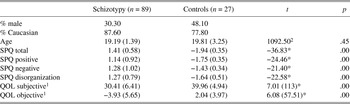
Demographic and clinical information for both the control and schizotypy groups is presented in Table 1. Groups were similar in terms of age, gender, and ethnicity. The schizotypy group showed significantly higher scores on all clinical variables and lower quality of life. Other than age (skew > 1.5), all variables were normally distributed unless otherwise noted, (all skew scores < 1.5). To correct for skew, age was analyzed using nonparametric statistics.
Means and standard deviations (M(SD)) for demographic and clinical variables for schizotypy and control groups

* p < .01.
1 n = 26 controls.
2 Mann Whitney U test.
SPQ = Schizotypal Personality Questionnaire; QOL = Lehman’s Brief Quality of Life Interview.
PERT Accuracy
First, males and females performed similarly on the PERT, (t(114) = .36, n.s.). Comparing the schizotypy and control groups, there was a significant main effect for emotion (F(2.93) = 74.73; p < .01). Bonferroni-corrected post hoc tests showed that happy was recognized most often (M = 95.60%; SD = 0.60%), followed by sad and neutral (M = 74.0%; SD = 1.80% and 63.69%; SD = 2.65%), and anger and fear were recognized least often (M = 59.05%; SD = 1.61% and 57.33%; SD = 1.67%). There was also a main effect for group (F(1) = 8.81; p < .01); the schizotypy group (M = 68.4% correct; SD = 0.11%) performed worse than the control group (M = 75.0% correct; SD = 0.19%). A significant interaction was also found (F(2.93) = 6.56; p <. 01). Post hoc analysis revealed that the control group was more accurate when identifying neutral faces than the schizotypy group t(114) = 4.15; p < .01. Mean accuracy scores for across different emotions are presented in Figure 1. Groups were not significantly different on any other emotion (all t’s < 0.93, n.s.).
Penn Emotion Recognition Test mean accuracy scores for the control and schizotypy groups.

Further post hoc analyses were conducted examining the high versus low intensity expressions. Groups were similar on the high intensity facial expressions (t(114) = .71, n.s.), however the control group (M = 69.68%) was more accurate than the schizotypy group (M = 65.03%) on the low intensity expressions at a trend toward significance (t(114) = 1.70; p < .10).
Post hoc tests were performed to examine the types of errors participants made. Because groups differed only when labeling neutral faces, we looked only within this category to examine errors. For this analysis we included only those participants who made errors labeling neutral faces (18 control, 81 schizotypy). We computed the percentage of total neutral errors mislabeled as each different emotion category (i.e., neutral as anger errors). Because these data were not normally distributed, we conducted nonparametric, Mann-Whitney tests to examine whether the schizotypy and control groups differed in the types of errors made. The schizotypy group labeled significantly more neutral faces as disgust (U = 512.50; p < .05). All other tests were nonsignificant.
PERT Reaction Time
Males and females were similar in terms of reaction times (t(114) = 0.86, n.s.). Comparing schizotypy and control groups, a main effect for emotion was again found (F(3.17) = 59.19; p < .01). Bonferroni-corrected post hoc analysis showed that happy faces had the quickest reaction times (M = 33078.32; SD = 10867.53), followed by sad and neutral faces which were not different from each other (M = 0480.00; SD = 17713.33 and M = 46755.23; SD = 21700.40). Fear was detected next quickest (M = 58494.68; SD = 28392.12), and angry faces showed the longest reaction times (M = 68401.12; SD = 28376.71). There was no difference in reaction times between groups (F(1) = 1.90, n.s.), and no interaction was found (F(3.17) = 0.24, n.s.).
PERT Valence Ratings
Males and females were similar in their ratings of the faces (t(114) = .31, n.s.). Comparing the schizotypy and control groups, there was a main effect for emotion (F(2.37) = 526.83; p < .01). Bonferroni corrected post hoc tests showed that happy faces were rated most positively (M = 2.53; SD = 0.97) followed by neutral faces (M = 5.52; SD = 0.52), then fear (M = 6.41; SD = 0.69) and anger (M = 6.98; SD = 0.73), sad faces were rated most negative (M = 7.16; SD = 0.68), but not significantly different from anger. There was no main effect for group (F(1) = 0.90, n.s.) and no interaction (F(2.37) = 1.61, n.s.).
The Relationship Between Schizotypy Symptoms and Emotion Recognition
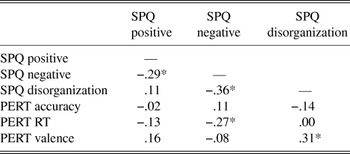
Spearman’s correlations between PERT accuracy, reaction time, valence ratings, and SPQ factors are presented in Table 2. Accuracy was not significantly correlated with any SPQ factor. Valence was significantly positively correlated with SPQ disorganization factor scores such that higher disorganization scores were associated with more negative ratings of faces (r = −0.31). Reaction time was significantly negatively correlated with SPQ negative factor scores in that SPQ negative factor scores were associated with quicker labeling of facial emotions (r = −0.27).
Spearman’s correlations between SPQ factors and PERT variables

* p < .01.
RT = reaction time; SPQ = Schizotypal Personality Questionnaire; PERT = Penn Emotion Recognition Test.
The Relationship between Emotion Recognition and Quality of Life
Spearman’s correlations between PERT variables and quality of life are presented in Table 3. Subjective quality of life was positively correlated with valence ratings of the faces; more negative ratings of faces were associated with lower quality of life ratings. Finally, as a last note, PERT accuracy, reaction times, and valence were not related, suggesting that associations between these variables would not account for the observed correlations. All other correlations were also nonsignificant.
Spearman’s correlations between PERT variables and quality of life

* p < .01.
RT = reaction time; QOL = Lehman’s Brief Quality of Life Interview; PERT = Penn Emotion Recognition Test.
DISCUSSION
As predicted, the current study revealed impaired facial emotion recognition abilities in individuals with schizotypy. While some previous studies on individuals with schizotypy have not found this, we believe our study addresses some critical limitations of prior research. We used a large schizotypy group with a broad range of symptomology, a more sensitive emotion recognition task including more culturally representative stimuli, and examined subjective ratings in addition to facial emotion identification accuracy scores. The present data offer some evidence that emotion recognition deficits may reflect an important vulnerability marker for schizophrenia-spectrum pathology. These deficits were present in the schizotypy group as a whole, and accuracy recognizing emotions was unrelated to any specific schizotypy trait. Deficits were not associated with particular schizotypy traits nor can they be attributed to the effects of severe mental illness such as medication or hospitalization.
Although much previous research has pointed to negative expressions as being the source of errors in schizophrenia patients (Bediou et al., Reference Bediou, Franck, Saoud, Baudouin, Tiberghien and Daléry2005; Dougherty et al., Reference Dougherty, Bartlett and Izard1974; Kohler et al., Reference Kohler, Turner, Bilker, Brensinger, Siegel and Kanes2003; Kucharska-Pietura et al., Reference Kucharska-Pietura, David, Masiak and Phillips2005; Leppänen et al., 2006; Muzekari & Bates, Reference Muzekari and Bates1977; Premkumar et al., Reference Premkumar, Cooke, Fannon, Peters, Michel and Aasen2008) and their relatives (Leppänen et al., Reference Leppänen, Niehaus, Koen, Du Toit, Schoeman and Emsley2008), our results suggest that it is only with the neutral expressions that schizotypy differ from controls. Overall performance was poorest with negative expressions in both groups, supporting prior evidence that labeling negative as opposed to positive emotions is a more difficult task (Johnston et al., Reference Johnston, Katsikitis and Carr2001). Our findings are, however, consistent with prior studies in individuals with schizophrenia that have shown patients have a tendency to label nonemotional faces as expressing an emotion, usually negative (Kohler et al., Reference Kohler, Turner, Bilker, Brensinger, Siegel and Kanes2003). This could be interpreted in multiple ways. First, Quirk and colleagues (Reference Quirk, Subramanian and Hoerger2007) has suggested that ambiguity brings out differences between individuals with schizotypy and normal participants. This is further supported in our findings of a trend for the schizotypy group to do worse on low intensity expressions than controls. Reading either a low intensity or neutral face could be considered a more ambiguous task than reading a pure facial expression of a basic emotion. Second, individuals with schizotypy may exhibit some type of cognitive or perceptual bias making them more likely to see emotion in a face even when it is not there. In support of this idea, fMRI studies of schizophrenia patients have shown different patterns of brain activation in response to facial emotion tasks (Fakra et al., Reference Fakra, Salgado-Pineda, Delaveau, Hariri and Blin2008; Phillips et al., Reference Phillips, Williams, Senior, Bullmore, Brammer and Andrew1999; Taylor, Liberzon, Decker, & Koeppe, Reference Taylor, Liberzon, Decker and Koeppe2002; Taylor, Phan, Britton, & Liberzon, Reference Taylor, Phan, Britton and Liberzon2005). Perceptual abnormalities may be present that alter individuals’ interpretations of faces (Gooding, Luh, & Tallent, Reference Gooding, Luh and Tallent2001; Gooding & Tallent, Reference Gooding and Tallent2002). In addition, social cognitive biases also alter how individuals interpret social information (Bentall et al., Reference Bentall, Corcoran, Howard, Blackwood and Kinderman2001; Penn et al., Reference Penn, Corrigan, Bentall, Racenstein and Newman1997; Pinkham et al., Reference Pinkham, Penn, Perkins and Lieberman2003), and may be important for understanding emotion recognition (Dougherty et al., Reference Dougherty, Bartlett and Izard1974; Smári, Stefánsson, & Thorgilsson, Reference Smári, Stefánsson and Thorgilsson1994; Tsoi et al., Reference Tsoi, Lee, Khokhar, Mir, Swalli and Gee2008). Although these factors have been researched in schizophrenia patients, they have yet to be demonstrated in individuals with schizotypy. In our study, the schizotypy group did not rate the neutral faces as being more or less negative than controls, nor did they take longer to decide which emotion was expressed. However, perceptual anomalies and biases may be present to different degrees in different subtypes (as suggested below), and do not necessarily alter processing speed in a systematic manner. If labeling a neutral face is thought of as a more ambiguous situation, this is where biases would operate. When patterns of neutral misattributions were examined, the schizotypy group tended to identify more neutral expressions as being disgusted than the control group. This suggests that a particular bias may be toward perceiving ambiguous or neutral faces as disgust. It is unclear why there would be a bias toward perceiving disgust rather than any other negative or threatening emotion, and this is something that should be investigated with further research.
The schizotypy and control groups did not differ in reaction times when identifying facial emotions, nor was reaction time associated with accuracy within the schizotypy group. This might suggest that individuals with schizotypy were not aware of their mistakes. An important goal for future research would be to examine the relationship between perceived performance and actual performance. However, considering the significant findings for reaction time in this study—their positive association with negative schizotypy symptoms, allows us to speculate about this issue at least within those individual exhibiting high negative symptoms. First, this relationship is surprising given the host of neurocognitive limitations present in these individuals (Diforio et al., Reference Diforio, Walker and Kestler2000; Kendler, Reference Kendler, Ochs, Gorman and Hewitt1991; Neumann & Walker, Reference Neumann and Walker2003). Our results suggest that individuals with high levels of negative symptoms, although they are not more or less accurate at identifying emotions, are more efficient. This is not to say they quickly arrive at the wrong answer; overall accuracy for the schizotypy group approached 70%. However, this might suggest that for some reason these individuals are not as invested in the task. Difficulty identifying emotions might be met by further effort and attention in those with low negative symptoms while not in those with high negative symptoms. This could possibly be because negative symptoms are associated with a schizoidal avoidance of social stimuli and interactions (Kwapil, Barrantes-Vidal, & Silva, Reference Kwapil, Barrantes-Vidal and Silvia2008).
While schizotypy as a group did not show a systematic valence rating bias, disorganization symptoms were related to subjective perception of emotional faces as being more negative. This is consistent with what has been observed more generally for patients with schizophrenia – that patients with disorganization tend to report seeing faces as being angry (Cohen, Nienow et al., Reference Cohen, Nienow, Dinzeo and Docherty2009). This raises two important issues for future research to consider. First, combining schizotypy into one group potentially obscures differences between those with different symptom presentations. Second, previous studies that have not examined the full range of schizotypy may produce results that apply to only a particular subtype and not to schizotypy as a whole. Given that disorganized schizotypy traits are often not assessed in schizotypy studies (e.g., those using the Chapman scales [Chapman, Chapman, Kwapil, Reference Chapman, Chapman and Kwapil1995)], it would be critical to use instruments that assess a full range of schizotypal traits.
One of the more general concerns of this study was whether or not facial emotion recognition ability was related to general quality of life. Our results suggest that while individuals with schizotypy may be less accurate at recognizing emotions, this is unrelated to quality of life. Rather, their subjective appraisals of the valence of emotional faces are related to self-reported quality of life. It is those individuals who see more negative faces that also say their quality of life is lower. Perceiving others’ emotions as negative could have an impact on social enjoyment, or believing that one’s life is not enjoyable (perhaps due to symptoms) may lead individuals to see the social world as more negative. Biased interpretation of emotional faces may be a factor that leads to social misunderstandings such as misinterpretation of others’ intentions, failure to comprehend social situations, and trouble learning how to react to and express emotions. It may also affect the development of social schema that accurately predict others’ behavior. This could offer explanations for why many individuals with schizotypy report less enjoyment in social situations (Horan, Brown, & Blanchard, Reference Horan, Brown and Blanchard2007) and may be less accurate in interpreting social cues (Kendler et al., Reference Kendler, Thacker and Walsh1996; Meehl, Reference Meehl1990).
This study has some limitations. First, participants in our sample were mostly Caucasian. Research in schizophrenia patients has shown that participants from other ethnic groups may not perform as well as Caucasians on measures of emotion perception (Habel et al., 2005). Although, at least in some studies, this may be due to the use of mostly Caucasian stimuli (Pinkham et al., Reference Pinkham, Sasson, Calkins, Richard, Hughett and Gur2008), examining emotion recognition across ethnic groups would be essential for future research.
Another important consideration not addressed in the current study is the effect of depression on facial affect recognition. There is research to suggest that individuals who are depressed are poor at recognizing facial expressions of emotion (Feinberg, Rifkin, Schaffer, & Walker, Reference Feinberg, Rifkin, Schaffer and Walker1986; Langenecker et al., Reference Langenecker, Bieliauskas, Rapport, Zubieta, Wilde and Berent2005). Given that depression is quite common in schizotypy (Gooding et al., Reference Gooding, Tallent and Matts2005; Lewandowski et al., Reference Lewandowski, Barrantes-Vidal, Nelson-Gray, Clancy, Kepley and Kwapil2006), examining the effects of and/or controlling for depressive symptomotology is an important avenue for future research in this area. As depression has been shown to be associated with errors on neutral and low intensity facial expressions (Csukly, Czobor, Szily, Takács, & Simon, Reference Csukly, Czobor, Szily, Takács and Simon2009), this is an especially salient limitation of the current study. Furthermore, depression (Angermeyer, Holzinger, Matschinger, & Stenger-Wenzke, Reference Angermeyer, Holzinger, Matschinger and Stenger-Wenzke2002; Goldney, Fisher, Wilson, & Cheok, Reference Goldney, Fisher, Wilson and Cheok2000; Pyne et al., Reference Pyne, Patterson, Kaplan, Gillin, Koch and Grant1997) and subclinical depressive symptoms (da Silva Lima, & de Almeida Fleck, Reference da Silva Lima and de Almeida Fleck2007; Goldney, Fisher, Dal Grande, & Taylor, Reference Goldney, Fisher, Dal Grande and Taylor2004) are related to quality of life. This is also important in individuals with schizophrenia (Huppert, Weiss, Lim Pratt, & Smith, Reference Huppert, Weiss, Lim, Pratt and Smith2001; Reine, Lançon, Tucci, Sapin, & Auquier, Reference Reine, Lançon, Tucci, Sapin and Auquier2003). Therefore, controlling for depressive symptoms may be important when considering quality of life as well.
While the PERT is an improvement over other existing facial emotional stimuli and shows promise as a more sensitive measure of emotion recognition, especially in individuals less impaired than patients with schizophrenia, it still does not approximate the manner in which facial expressions of emotion are experienced in daily life. Using dynamic rather than static emotional expressions may reveal further emotional processing abnormalities (Archer et al., Reference Archer, Hay and Young1994). Emotional expressions are also often accompanied by a variety of body movements and contextual cues which are used to interpret emotion. The use of stimuli that more closely resemble faces encountered outside of the laboratory would increase external validity of future studies.
In summary, our results support previous research suggesting that poor emotion recognition is associated with vulnerability to psychosis (Kee et al., Reference Kee, Horan, Mintz and Green2004; Williams et al., Reference Williams, Henry and Green2007) rather than a state-related effect of psychotic symptoms. Emotion recognition appears to be impaired in all individuals at risk for schizophrenia as it is unrelated to symptoms. However, it appears to operate by means of different processes in those with particular types of symptoms. This study suggests that these processes do affect functioning even in those individuals who are relatively unimpaired globally. Further research is needed to delineate the relationships between emotion recognition processes, symptoms, and social functioning.
ACKNOWLEDGMENTS
This project was funded by an internal university grant to the second author. The funding has no role in the design, implementation, analysis, interpretation, or writing of the manuscript.