INTRODUCTION
Patients in the final phase of life are often prone to polypharmacy (Nauck et al., Reference Nauck, Ostgathe and Klachik2004; Holmes et al., Reference Holmes, Haley and Alexander2006; Fede et al., Reference Fede, Miranda and Antonangelo2011). Medication overload increases the pharmacotherapeutic burden on the patient as well as the probability of adverse drug–drug interactions (Todd et al., Reference Todd, Nazar and Pearson2014). Many patients with a limited life expectancy use preventive medication and medication for comorbidities, chronic diseases, and symptom control (Holmes et al., Reference Holmes, Haley and Alexander2006; Bayliss et al., Reference Bayliss, Bronsert and Reifler2013; Tjia et al., Reference Tjia, Cutrona and Peterson2014; Nordennen et al., Reference Nordennen, Lavrijsen, van and Vissers2014). Various guidelines advise deprescribing medication in vulnerable patients to decrease the risk of inappropriate medication use and adverse events (Alldred, Reference Alldred2014). One recommendation is that patients who receive palliative care should have their medication reviewed in the context of their life-limiting disease with a focus on achievable therapeutic outcomes (Koh & Koo, Reference Koh and Koo2002; Maddison et al., Reference Maddison, Fisher and Johnston2011; Todd et al., Reference Todd, Nazar and Pearson2014).
Timely communication about their wishes and preferences helps patients in the end-of-life phase to receive pharmacological care that fits their personal goals (Nauck et al., Reference Nauck, Ostgathe and Klachik2004; Holmes et al., Reference Holmes, Haley and Alexander2006; Fede et al., Reference Fede, Miranda and Antonangelo2011; Bernacki & Block, Reference Bernacki and Block2014). However, physicians appear reluctant and uncomfortable about initiating end-of-life conversations. They fear stirring up patients' emotions and reducing hope. Generally, patients experience few barriers to discussing advance care planning and end-of-life preferences, but they expect physicians to start this conversation. Thus, while decision making about medication at the end of life can be complicated by pharmacological uncertainties, physicians' reluctance to broach relevant issues may prevent such conversations from occurring at all. This leaves the physicians to make decisions about pharmacological care without adequate information about patients' wishes.
Compared to what is known in geriatric medicine, little is known about the daily practice of medication management in palliative care (Reeve et al., Reference Reeve, Wiese and Hendrix2013a). Knowledge of the perspectives of patients receiving palliative care, their relatives, and healthcare professionals about managing end-of-life medication is essential for improving daily practice and developing tools that address the needs of all those involved. Our empirical study aims to gain insight into the perspectives of patients, close relatives, nurses, and physicians about managing medication for patients with a life expectancy of less than 3 months.
STUDY DESIGN
Our multicenter, qualitative, in-depth, multiperspective, interview study included patients with a life expectancy of less than 3 months and, for each patient, their most-involved close relative, a nurse, the medical specialist, and the general practitioner (Kendall et al., Reference Kendall, Murray and Carduff2009). Patients were interviewed before we interviewed the other involved parties. We employed purposive sampling to ensure diversity and saturation (Corbin & Strauss, Reference Corbin and Strauss1990). All interviews were audiotaped and transcribed verbatim.
Recruitment and Participant Selection
Potential participants were recruited from a university hospital, a general hospital, two hospices, and the offices of general practitioners (GPs). Treating physicians were asked to inform patients with a life expectancy of less than 3 months about the study and to ask permission for them to be contacted by one of the four interviewers (M.D., E.G., J.A., and B.H.). We interviewed the patient first, and after receiving his or her permission, we interviewed a close relative, a nurse, the medical specialist, and the GP. Before the patients gave their consent, we ensured they understood that they would be asked to name the informal and professional carers most involved in their care. All participants completed a short questionnaire about demographic data before starting the interview.
Interviews
We planned to interview patients at the location of their choice for no longer than an hour. When possible, we interviewed the patients alone to ensure that they felt free to voice their own views. The four interviewers included a GP, an internal medicine resident, an anesthesiology resident, and an anesthesiologist. The topic guide presented in Table 1 was utilized to examine the perspectives of participants on medication management in the final stage of life.
Topic guide

Analysis
We employed the constant comparative method, which is part of grounded theory, and ATLAS.ti software (v. 7.1; ATLAS.ti Scientific Software Development GmbH, Berlin) to analyze the transcripts. We began the data analysis after the initial interview to ensure a cyclical process of data collection and data analysis. We avoided using preset categories and explored the data as a whole (Corbin & Strauss, Reference Corbin and Strauss1990; Ritchie & Lewis, Reference Ritchie and Lewis2007). Each transcript was independently coded by two of the researchers: M.D. coded all the transcripts; E.G. and B.H. each coded half of the transcripts. The codes were descriptive at the level of participant statements. After the first five transcripts were analyzed, the three interviewers compared and discussed the codes until they reached agreement. Then the first draft of the codebook was drawn up. M.D., E.G., and B.H. coded all the transcripts and compared, discussed, and merged codes; they then added new codes as needed to the codebook after every fifth transcript. When no more new codes were identified, saturation was reached, and no further participants were recruited. M.D., E.G., and B.H. independently organized the codes. Provisional categories and themes were formulated and discussed with the peer group (E.L., W.D., A.H., L.Z., and R.P.) over several rounds until agreement was reached.
Definitions
Medication management: the broad range of professional activities and responsibilities within the qualified healthcare provider's scope of practice, aiming to ensure that patients understand their condition, level of risk, diagnostic results, and treatment goals, as well as comprehend the amount of control they personally exert over their condition and its outcomes, in order to use medication that is in line with their needs (Bluml, Reference Bluml2005).
Medication review: an assessment of the pharmacotherapy based on a structural and critical evaluation of the medical, pharmaceutical, and clinical information aimed to improve the quality, safety, and appropriate use of medicines (Blenkinsopp et al., Reference Blenkinsopp, Bond and Raynor2012).
Ethics Statement
The Radboud University Nijmegen Medical Centre Research Ethics Committee (no. NL44030.091.13) approved our study. The participating hospital and hospices (removed for review) also approved the research. All participants supplied written informed consent.
RESULTS
Characteristics
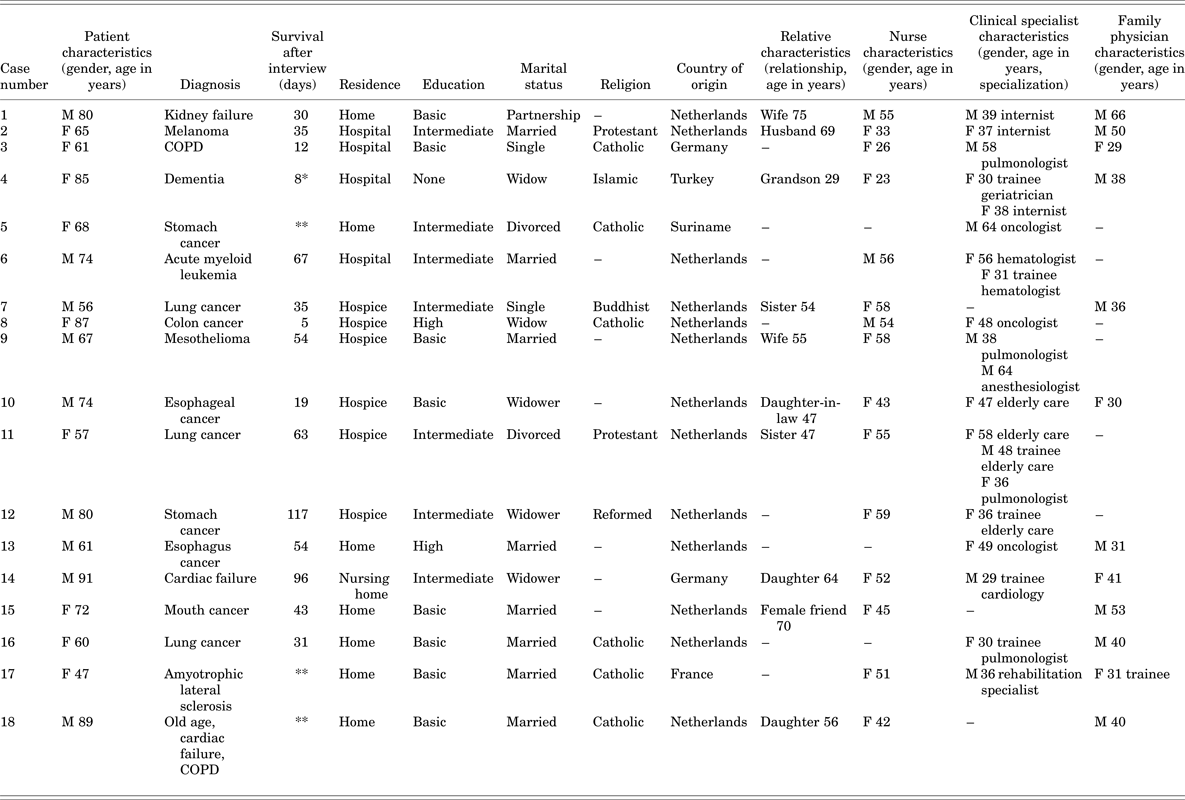
We selected 18 patients for interviews between October of 2013 and February of 2015. One patient could not be interviewed due to her condition. However, we included her case because it contributed to cultural diversity. We conducted 76 interviews with 17 patients, 12 relatives, 15 nurses, 20 medical specialists, and 12 GPs. Table 2 presents the relevant case characteristics. Not all of the eligible participants were interviewed, and six of the interviews with relatives did not take place. The reasons cited were as follows. Three patients considered it a burden for the relative, and so did the interviewer for a fourth relative. One patient had no relatives, and another's opinion was that her daughter had no say in medication management. No nurse was involved in three primary care cases. Two GPs and two specialists refused because of lack of time. There was no specialist in one case, and no GP was involved in another case.
Case characteristics

* Could not be interviewed.
** Survival longer than 6 months.
COPD = chronic obstructive pulmonary disease.
The 18 patients—9 men (aged 56–91 years) and 9 women (aged 47–87 years)—varied in terms of diagnosis, educational level, cultural background, and marital and occupational status. Some 8 patients lived at home, 1 in a nursing home, 6 in a hospice, and 3 in a hospital. According to the treating physicians, 11 patients participated in medication withdrawal conversations, while none of the patients were reported to be involved in the medication review process. Survival ranged from 5 to 117 days, and 3 patients were still alive after 6 months. The 12 relatives (aged 20–75 years) were spouses or close friends, and 8 were women. The 15 nurses (aged 23–59 years) included 3 men. We interviewed 20 specialists (aged 29–59 years), of whom 3 were trainees and 8 were men. Some 4 of the 12 interviewed GPs (aged 29–66 years) were women, and 1 was a trainee.
In 12 of the 18 cases, at least one of the involved physicians stated that there had been a conversation about medication use with the patient or a relative. Analysis of the interviews showed that no systematic tool was employed in any of these cases to evaluate or reduce inappropriate medication.
Perspectives about Medication Management
The participants described their perspectives on medication management in a multiplicity of very personal ways. Coding their statements resulted in 18 categories, from which 5 themes were identified: (1) priorities in end-of-life care; (2) appropriate medication use; (3) roles in decision making; (4) organization and communication; and (5) prerequisites (Table 3).
Themes, categories, and codes regarding perspectives on end-of-life medication management

Priorities in End-of-Life Care
The first theme includes four categories: (1) necessity of medication reviews; (2) quality of life, dying, and care; (3) symptom management; and (4) maintenance of hope. Our analysis showed that awareness of the importance of a medication review is not a matter of course. The interview itself was an incentive for several nurses and physicians to review the patient's medication. Quality of life, dying, and care were named as major matters in end-of-life care, and the efforts of medication reviews were not considered to contribute to this care. Further, when care strongly focused on symptom management in an approach of either a reactive or a proactive scenario, there was a tendency to add medications and pay little attention to reviewing medications. The importance of maintenance of hope was named as an argument to postpone conversations with patients and relatives about appropriate medication. Another argument was the possible demoralizing effect of medication withdrawal.
Appropriate Medication Use
The second theme includes three categories: (1) unnecessary medication; (2) deprescription barriers; and (3) appropriate medication management. Participants stated that patients should not use any unnecessary medications. They named a diversity of perspectives on medication use, such as: medication is a necessary evil; when starting a medication, a stop date should be considered; and medication should be reviewed systematically. They stated that palliative care checklists should include medication withdrawal options and that the indications for medication versus life expectancy should be regularly reconsidered. Cholesterol synthesis inhibitors, anticoagulants, and antidiabetics were considered as potentially inappropriate medications. They named nonmedical and alternative treatments as possibilities for reducing medication.
Physicians reported many deprescription barriers, including the risk of creating ethical dilemmas when starting the conversation, lack of time, burdens for patients, lack of guidelines, uncertainty about life expectancy, and the unknown consequences of withdrawing medications. They considered prescribing easier than deprescribing, and they were reticent about stopping a colleague's prescription. Furthermore, they pointed out that pharmacological knowledge and end-of-life conversation skills were lacking. Assuming that deprescription is the other physician's task and assuming that the patient prefers continuation both added to continuation. A focus (personal or professional, by culture or setting) on treatment continuation was an obstacle to deprescription considerations.
Appropriate medication management was mentioned in three forms. The first favors continuation until the patient asks for withdrawal, intake problems arise, or palliative sedation is begun. The second favors a multidisciplinary, proactive, recurrent, and structural approach that starts at a timely point along the palliative trajectory. It is patient-centered, and it is a part of an individual care plan aimed at preventing inappropriate medication use. The third form focuses primarily on tailor-made medication use that takes into account the patient's wishes regarding medication use, decision-making participation, perspectives on quality of life and dying, biography, and personality.
Roles in Decision Making
The third theme includes five categories: (1) the physician's domain; (2) the nurse as an intermediate; (3) the pharmacist as a supplier; (4) patient participation; and (5) relatives' advocacy. Participants unanimously reported that the ultimate responsibility for medication management as a whole is within the physician's domain. The nurse contributes to the process as an intermediary, and the pharmacist as a supplier of medication and knowledge. The perspectives regarding patient participation varied widely among professionals: from a matter of course to unnecessary or harmful for patients. Patients wanted to be involved but relied on the competence of their physician. Relatives themselves advocated for greater involvement, but professionals varied widely on the role they saw for relatives.
Organization and Communication
The fourth theme comprises three categories: (1) transparency of tasks and cooperation; (2) professional–patient and professional–relative relationships; and (3) end-of-life conversations. Participants were of the opinion that professionals should be transparent about how they cooperate or divide tasks. They should be clear about who is in charge and about transfers. There are different opinions about competencies, task interpretation, consultation preparedness, and working together. Participants saw professional–patient and professional–relative relationships as constituting an important aspect of medication management. Trust, continuity of care, communication and decision-making styles, competences, and the professional's personal perspectives are among the influencing elements. The third category refers to the opinion that, in order to talk to patients about appropriate medication, a patient should know that death is approaching, so that end-of-life conversations are crucial.
Prerequisites for Medication Review
The fifth theme covers three categories: (1) competence and attainability of professionals; (2) accessibility and quality of medical records; and (3) financial awareness. Our analyses brought to light that pharmacological and palliative care competence, medication review implementation, deprescription evidence, and the attainability of experts are seen as self-evident conditions for appropriate medication management during the final phase of life. In addition, the importance of optimal information and communications technology (ICT) facilities, along with actualized and accessible electronic medical records, were named as obviously necessary conditions. Furthermore, patients, relatives, and nurses pointed out that financial considerations are an important part of medication management. This applies to prescription and deprescription decisions on the individual patient level, in considering the patient's out-of-pocket costs, and regarding cost-awareness for the community. None of the physicians initiated the subject, and they were uncertain when asked about the place financial matters have in medication management.
DISCUSSION
To our knowledge, this is the first empirical study to have described the combined perspectives of patients, relatives, nurses, and physicians on medication management during the final phase of life in different settings. Five themes came to the fore: (1) priorities in end-of-life care; (2) appropriate medication use; (3) roles in decision making; (4) organization and communication; and (5) prerequisites. We discuss these themes here in the context of the relevant literature.
The Five Themes
First, our study confirms that there are many different perspectives about priorities in end-of-life care, appropriate medication, and desirability of conversations with patients about wishes and expectations regarding medication use and decision-making involvement. Thus, this study gives further empirical evidence supporting the conclusions of earlier systematic reviews, based on qualitative research, that medication management in daily practice is a complex interplay of many components. These components include beliefs, attitudes, knowledge, skills, behavior, work setting, health system, and cultural factors (Reeve et al., Reference Reeve, To and Hendrix2013b; Anderson et al., Reference Anderson, Stowasser and Freeman2014). We found many different perspectives on the priorities for end-of-life care that highlight the importance of patient–professional conversations and inter-professional conversations about prognostic information, decision-making preferences, fears and expectations, and wishes for family involvement. The emphasis on the need for these conversations underlines Bernacki and Block's (Reference Bernacki and Block2014) conclusions that understanding the patient's care goals in the context of a serious illness is an essential element of high-quality care. In line with Reeve et al. (Reference Reeve, Wiese and Hendrix2013a), we found that both personal and setting-related factors such as awareness, priorities, opinions about “good medication use” and withdrawal barriers influence the deprescription of possibly inappropriate medications.
Second, the common perspective that patients in the final phase of life should not use unnecessary medication is in line with other empirical studies and systematic reviews (Reeve et al., Reference Reeve, Wiese and Hendrix2013a; Reference Reeve, To and Hendrix2013b; Reference Reeve, Shakib and Hendrix2013c; Murray et al., Reference Murray, Boyd and Kendall2002; Sand et al., Reference Sand, Harris and Rosland2009; Todd et al., Reference Todd, Husband and Andrew2015). The professionals thought that conversations with patients about deprescribing medications could cause such ethical dilemmas as diminishing a patient's hope. This idea made the professionals hesitate to bring up the subject. Healthcare professionals consider maintaining hope to be essential. Their thoughts of what affects patient hope strongly influence their communication. However, the existing evidence does not support professionals' fear that such communication increases patient hopelessness. On the contrary, open and honest information allows patients and relatives to discuss wishes and make appropriate choices (Kylmä et al., Reference Kylmä, Duggleby and Cooper2009).
Third, our study elucidates the opinion that, in order to talk to a patient about appropriate medication, the patient should know that death is near. Thus, end-of-life conversations are necessary. However, we know from other research that physicians find it difficult to start conversations with patients about death and dying. While patients in general expect their physicians to initiate end-of-life conversations, physicians encounter barriers to broaching these issues, with the risk of making decisions that do not conform to patients' wishes (Hancock et al., Reference Hancock, Clayton and Parker2007; Bernacki & Block, Reference Bernacki and Block2014).
Fourth, we found remarkable agreement in participants' perspectives about the roles of professionals in medication management. Physicians are considered the main authority in medication use and decision making. There was also agreement about the importance of the nurse's role as an intermediary between patients or relatives and physicians. Pharmacists were seen merely as suppliers of knowledge and medication who have no say in clinical decision making or medication reviews. In the literature, evidence about pharmacists' involvement in managing palliative care medication is sparse. This contrasts remarkably with their role in the use of medication in geriatric medicine (Lee et al., Reference Lee, Slack and Martin2013).
The patients reported that they preferred to be involved in their medication use, but that they heavily relied on the competence of physicians. There were few signs of patients' need for autonomy or shared decision making in medication management. This agrees with the review by Bélanger et al. (Reference Bélanger, Rodríguez and Groleau2011), which reported that, while most interviewed patients wanted to participate to some extent in decisions about medication, achieving their preferred levels of involvement was not a matter of course. The relatives advocated for the patient and were more critical about physicians' authority and decision-making style (Witkamp et al., Reference Witkamp, van Zuylen and Borsboom2015). Physicians' perspectives about the desirability of patient and relative participation ranged from self-evident to unnecessary, to even harmful for patients. Our findings are in line with the absence of cross-functional interdisciplinary collaboration of nurses, pharmacists, specialists, and GPs, as well as the unknown interest of patients' preferences on medication use, as Turner et al. (Reference Turner, Edwards and Stanners2016) report.
In the fifth theme, financial awareness came forward. Patients, relatives, and nurses openly named this topic, while participating physicians appeared more reluctant to discuss the matter. This seems to be a consequence of the societal empowerment of citizens and patients with respect to price information, while physicians are rarely taught to consider the financial consequences of their decisions. They are more and more trained to discuss end-of-life topics and complex decision making; however, cost considerations are not yet topical in physicians' offices (Shah, Reference Shah2013).
STRENGTHS AND LIMITATIONS OF THE STUDY
One strength of our study is that we drew participants from three different Dutch settings to provide maximum variation of opinions and experiences. We used purposive sampling to maximize diversity in diagnosis as well as in the age, sex, and cultural background of patients. A limitation is that the results are not generalizable to countries where healthcare services are structured in a different way and where other cultural and professional end-of-life attitudes may exist. Recruitment by invitation may introduce participant bias toward motivated participants with an interest in medication management. However, this could also be an advantage, for it enables rich interviews, although it might be that less motivated participants have different perspectives, norms, and values. Three patients lived longer than expected; however, as all participants in these cases assumed a life expectancy of less than 3 months, this had no effect on the results.
CONCLUSIONS
Our study provides in-depth knowledge about the many different implicit and explicit thoughts, beliefs, and convictions of patients, relatives, and professionals, as well as information about the delicacy of dealing with the approaching death in relation to medication management. Good pharmacotherapeutic care must take into consideration the frailty, needs, wishes, and expectations of these patients. A guideline for providing such care is needed, one that favors a multidisciplinary and interdisciplinary approach that will encourage professionals to initiate timely conversations about the patient's wishes and expectations regarding end-of-life medication and decision-making participation. Such a guideline should support an interdisciplinary setting-transcendent approach to a strategy of medication management that reflects the patient's preferences and contributes to more appropriate medication use in palliative care. Moreover, we believe that palliative care and chronic disease guidelines should include information about awareness of proactively deprescribing medication and about structural, patient-centered medication reviews.
FUNDING SUPPORT
ZonMw funded the study under grant number 80-82100-98-210.