

Governments' inability to avoid fiscal interference in monetary management plays a key role in the literature dealing with the economic gap accumulated by Argentina in the second half of the twentieth century (Cortés Conde Reference Cortés Conde1989, Reference Cortés Conde2005; Della Paolera and Ortiz Reference Della Paolera and Ortíz1995; Della Paolera et al. Reference Della Paolera, Irigoin, Bózzoli, Paolera and Taylor2003b). Della Paolera and Taylor (Reference Della Paolera and Taylor2001) claim that Argentina fell behind due to its failure to hold a stable level of any nominal variable after World War II. This experience was in contrast to what had happened until then, when, although the financing of deficits had sometimes put macroeconomic stability under strain, the nominal anchor was not completely lost. The aim of this article is to provide a full picture of the influence that fiscal policy exerted on money and prices in the very long run. Our analysis covers the period from 1875, the first year for which GDP data are available, to 1990, just before the Convertibility Law of 1991. The latter, by pegging the peso to the dollar and imposing the full backing of the monetary base with international reserves, put an end to seigniorage.
When assessing the influence of fiscal policy on money and prices, a number of problems arise related to dynamics and to non-linearities (Catao and Terrones Reference Catão and Terrones2005). First, with respect to dynamics, it is important to consider the possibility of delayed effects of deficits on money creation. As Sargent and Wallace (Reference Sargent and Wallace1981) argue, inflation can initially be kept under control if the government issues debt to finance deficits. But, if deficits persist and a per capita real debt maximum is assumed, it is enough for the rate of return on debt to exceed the economy's growth rate for the budget constraint to eventually force the monetary authorities to print money. What matters is whether the inter-temporal budget constraint is met through seigniorage or not. To address this question, following King and Plosser (Reference King and Plosser1985), we test the hypothesis of fiscal dominance, that is, the existence of a causal link from deficits (contemporaneous or lagged) to money creation.
Second, even if a long-run dynamic relation between deficits and money is established, the link between deficit and inflation might remain hidden. This is because, as Sargent and Wallace (Reference Sargent and Wallace1981) point out, the influence of the deficit on inflation can be blurred by the effects of the expected rate of inflation on the demand for money. If a persistent monetary financing of deficits leads to a high and sustained inflation rate, this inflation, in turn, might reduce the public's willingness to hold domestic money in favor of other inflation hedges. In this case, deficits would affect inflation in a non-linear way, that is, deficits would not only affect inflation by raising the money supply, but also by simultaneously reducing the demand for this money. Given the spectacular flight from the Argentine domestic currency to dollars in the 1980s, the role of non-linearity is a possibility that cannot be ignored here. To address this question, following Catao and Terrones (Reference Catão and Terrones2005), we examine the link between fiscal policy and inflation after scaling the country's deficit by the country's money stock.
The results of our empirical exercise confirm the hypothesis of fiscal dominance for Argentina in the very long run. We start by applying a Vector Autoregressive (VAR) analysis to the relation between budget and money and find evidence of a long-run causal relation from the fiscal to the monetary variable in 1875–1990. However, a recursive analysis of causality shows that the intensity of this relation varied over time. More importantly, these variations fit in well with the chronology of episodes in which fiscal dominance could have prevailed, considering the constraints that the macroeconomic trilemma imposes on the domestic control of the money supply. Obstfeld and Taylor (Reference Obstfeld, Taylor, Bordo, Goldin and White1998, Reference Obstfeld, Taylor, Bordo, Taylor and Williamson2003) define the trilemma as the impossibility of simultaneously combining capital mobility, a fixed exchange rate and an activist monetary policy. One of these three objectives has to be sacrificed. We use the historical record to identify when the absence of a fixed exchange rate commitment and/or of capital mobility gave Argentina enough latitude to monetize deficits. We find that the chronology fits in well with our results.
As expected, causality from budget to money is highly significant in the early 1890s, after Argentina had repeatedly failed to maintain gold convertibility. Consistent with the plan of macroeconomic stability that followed the Baring crisis in 1890 and eventually allowed a sustained permanence of the country in the gold standard (1899–1913), the causal relationship registers an equally sustained loss of significance. With the outbreak of World War I and the suspension of gold convertibility, the link starts to recover significance, though the relation does not reach the levels of the early 1890s until after World War II. Our econometric analysis locates a structural break in 1941 – the year that Della Paolera and Taylor (Reference Della Paolera and Taylor2001) highlight as the end of a stable level of any nominal variable – after which the link from deficits to money substantially intensifies. Corresponding with periods of low financial integration, due to capital imperfection in the aftermath of World War II and capital controls from 1964 on, we find that seigniorage continues to rise in intensity between 1947 and 1977. The external capital liberalization of the latter year, together with the adoption of a crawling peg with decreasing pre-announced devaluations in January 1979, reduced Argentina's control of its domestic monetary variables. As a result, the causal intensity ceases to register gains in 1979–81. However, deficits do not disappear so the inter-temporal budget constraint led again to a reliance on seigniorage. This reliance is reflected in the sharp increase in causal intensity and fits in perfectly with the decision to float the currency in February 1981 – June 1982 and, from then on, to reintroduce capital controls.
To study the relation between deficit and inflation, we have applied the Autoregressive Distributed Lag (ARDL) approach and have not found any significant relationship when considering the first half of the twentieth century. But we do find a significant relationship if we extend the period, firstly to 1977 and, later, to 1990. Interestingly, we would not have uncovered any significant relationship from deficit to inflation for the whole period 1875–1990, had we not scaled the deficit variable by domestic money. This finding is fully consistent with the presence of a Laffer curve effect for Argentina in the late hyperinflationary 1980s, as Dornbusch (Reference Dornbusch1990) and Sargent (Reference Sargent1999) posit.
The article is structured as follows. Section I provides a historical narrative of fiscal and monetary regimes. Section II describes the theoretical framework, the econometric specifications, the data employed and the main results obtained in our analysis of long-run fiscal dominance. Section III empirically assesses the consequences of fiscal dominance on inflation. Section IV concludes.
I
In their detailed study of Argentina's search for monetary stability in 1880–1935, Della Paolera and Taylor (Reference Della Paolera and Taylor2001) use the macroeconomic trilemma framework to analyze the policy tensions generated by the inter-temporal budget constraint. As Obstfeld and Taylor (Reference Obstfeld, Taylor, Bordo, Goldin and White1998, Reference Obstfeld, Taylor, Bordo, Taylor and Williamson2003) put it, the trilemma refers to the impossibility of simultaneously combining a fixed exchange rate, capital mobility and an activist monetary policy. The reason is quite straightforward: when a country has credibly pegged its currency value to the currency of some reference country, any attempt to separate domestic from foreign interest rates is prevented by capital movements induced by the interest rate parity rule.Footnote 2 Therefore, with capital mobility, when a country pegs its exchange rate, the domestic money supply is endogenously determined, with little latitude for policymakers to implement a domestic monetary policy. Alternatively, if the priority is to use monetary policy for domestic goals, let us say, to finance public deficits, then the management of domestic money supply obliges them to give up fixed exchange rates and/or capital mobility. In this case, instead of an endogenously determined money supply, we would have a politicized money supply process.Footnote 3 The rest of this section summarizes how, according to the existing historical narratives, Argentina dealt with the policy trade-offs imposed by the trilemma in the long run (1874–1990). The final aim is to identify moments in which the absence of a fixed exchange rate commitment or of capital mobility gave Argentina enough latitude to finance deficits monetarily.
To work out a chronology of potential fiscal dominance episodes, we start from the well-accepted assumption that capital mobility prevailed in the world from 1870 to the 1929 crisis.Footnote 4 In this case, we can think of the trilemma as a tension between temptations to run an autonomous monetary policy and aspirations to keep a fixed exchange rate. General Mitre had declared the gold convertibility of the peso in 1867, thus fixing its rate against the other gold currencies and leaving very little room to run an independent monetary policy. This situation lasted until 1876, when demands for monetary financing of deficits led to the suspension of convertibility.Footnote 5 Convertibility was not restored until 1883, after several years of contractionary fiscal policy. But due to budgetary problems resulting from ambitious development plans, convertibility was suspended again in December 1885, and would not be restored until 1899.
To understand this 14-year delay, we need to refer to the Law of Guaranteed Banks (Ley de Bancos Garantidos). This law, passed in 1887 with the aim of easing the financing of deficits, authorized any bank with a minimum capital to issue paper notes on the condition that it used gold public bonds as a guarantee (Cortés Conde Reference Cortés Conde1989). For two years, banks had no problem borrowing from abroad the gold necessary to buy the new issues of public debt. As a result, the fiscal financing of deficits was accompanied by a gold-backed monetary expansion that maintained the peso exchange rate at a relatively stable level. However, in early 1889, when the London market showed the first symptoms of saturation with Argentine debt, all attempts to sustain the peso rate proved to be insufficient. The demand for gold from those who anticipated the necessity to return to money creation for the financing of deficits and, consequently, the impossibility of maintaining a fixed exchange rate, provoked a sharp depletion of the reserves of the National Bank (Banco Nacional, BN). Conversion was suspended in 1889 and it came as no surprise when Argentine policymakers, following the Baring crisis in 1890, declared themselves conscious that, to restore gold convertibility, no link between budget and money should be tolerated in the future.Footnote 6
The first step in this direction was the creation of a Currency Board (Caja de Conversión), which was granted the monopoly for issuing money. Initially, its role was limited to the redemption of paper currency, but once the peso exchange rate reached its legal gold par on the stock market, the Board was expected to start exchanging gold for paper. Meanwhile, consistent with the goal of installing a currency board system and the loss of monetary control that the board entailed, several fiscal measures were taken. The credit that the Treasury could get from the National Bank, transformed in 1892 into the Bank of the Argentine Nation (Banco de la Nación Argentina, BNA), was severely limited. More importantly, to step up fiscal revenues (which, until then, had come mainly from customs tariffs), a new tax on consumption was introduced.Footnote 7 The ensuing increase in revenues, compounded by a reduction in expenditures, shrunk the deficit, thus allowing the country to return to a gold standard in 1899.
This commitment to gold lasted until 1914. World War I caused problems for the Argentine economy, mainly due to a sharp fall in imports that, as already said, were the main source of public revenue. Moreover, war provoked a significant reduction in the level of Currency Board reserves, enough to bring about a severe monetary contraction and force the suspension of convertibility.Footnote 8 In fact, fears of further monetary contraction led the government to pass an emergency law allowing the BNA to rediscount commercial paper which, in turn, could be rediscounted at the Currency Board for cash. This measure meant that the bank could create a monetary base, breaking the rule that linked its variation exclusively to the flows of gold channelled through the Board. However, policymakers did not abandon the goal of resuming the gold standard and the BNA did not take advantage of the rediscounting possibilityFootnote 9 until much later, when the international crisis threatened to provoke a new gold drain. Thus, even if the peso remained unconvertible until 1927, variations in the monetary base were not divorced from the inflows of gold into the country.Footnote 10
The exogeneity of the monetary base fully re-emerged with the resumption of the gold standard between August 1927 and December 1929, until a fall in exports, together with a later drop in imports, led to a reduction in both public revenue and the level of reserves of the Currency Board. In response, the Board was closed to prevent an increased outflow of gold that would have meant a monetary contraction. This time, the abandonment of the standard would be forever. The steady drop in imports continued to enlarge the deficit and, in 1931, the Currency Board began to issue money backed by the BNA's rediscounted commercial paper and the government bonds.Footnote 11 Initially, these emissions were relatively small, as they continued to be when the creation of a central bank, the Central Bank of the Argentine Republic (Banco Central de la República Argentina, BCRA), in 1935 entailed the formal demise of the Board. Although rediscounting was initially meagre, some scholars have stressed that the genie of issuing free money was ‘yet again out of the bottle’ (Della Paolera and Taylor Reference Della Paolera and Taylor2001, p. 235). The consequences of it did not become clear until after World War II.
In the aftermath of the conflict, ‘imperfections’ in capital mobility prevented the trilemma from constraining monetary policies' autonomy.Footnote 12 Such ‘imperfections’ persisted until the early 1960s, thus allowing Argentina the degree of sovereignty necessary for monetizing deficits.Footnote 13 Peronism did not hesitate to take advantage of this situation. From 1946 to 1955, the government implemented a strategy of industrialization meant to achieve full employment, wage improvements and income redistribution. The public industrialization strategy markedly increased deficits, in the financing of which the BCRA, nationalized in 1946, played a key role (Rock Reference Rock1987; Gerchunoff Reference Gerchunoff, Di Tella and Dornbusch1989). Apart from financing the government's deficits, the bank directly financed public companies, for example, the Agricultural Institute for the Promotion of Exchange (Instituto Agrícola para la Promoción del Intercambio, IAPI). The IAPI, which was set up to guarantee minimum agrarian prices for farmers, was granted subsidies that were financed through rediscounts in the bank. The bank also rediscounted paper to finance the nationalization of public services (the national telephone company) and the official mortgage bank (Banco Hipotecario). Finally, the BCRA acted as a lender-of-last-resort, issuing public debt to offset the non-returned loans to the private financial system from the central bank.
Deficits continued to accumulate after Peron, despite the efforts to cut them. Among the reasons for this persistence, we can mention the failure to reduce the inefficiency of public enterprises. Moreover, the plans to open the economy to foreign investment as a way of fostering the domestic production of capital and intermediate goods resulted in growing interest payments for external debt. Meanwhile, the steps taken to ease international trade, beginning with Frondizi's Stabilization Plan of 1958, had a contractionary effect on customs revenues that could not be offset by the simultaneous rises in taxes on sales and profits. In sum, rising public spending along with decreasing public revenue, the latter accentuated by a rise in fiscal fraud, caused a chronic deficit.Footnote 14 According to the historical narrative (Díaz Alejandro Reference Díaz Alejandro1975; Cortés Conde Reference Cortés Conde2005), the BCRA, free from external constraints, continued to issue money to finance the deficit.
In practice, the trilemma did not re-emerge as a constraint on Argentina's monetary sovereignty until the recovery of world trade fostered international capital flows in the mid 1960s. Capital mobility, then, started to create frictions between the monetary financing of deficit and the Bretton Woods peso exchange rate commitment. This is proven by the fact that, to defend its peg against the US dollar, strict capital controls were introduced in 1964.Footnote 15 Strict controls remained in force until the mid 1970s and provided the room needed for the monetary financing of deficits with the return of Peronism to power. From 1973 to early 1976, increasing public employees' wages and transfers to inefficient state-owned companies meant sizeable additional expenditures (Di Tella Reference Di Tella, Tella and Dornbusch1989). Pressures to resort to monetary financing intensified when the government, as a reaction to the oil crisis, subsidized the exchange rate for imports. Losses resulting from the sale of foreign currency at prices lower than those paid to exporters were assumed by the Banco Central, which monetized them (Cortés Conde Reference Cortés Conde2005). By the end of the period, in March 1976, Argentina was on the verge of hyperinflation and the military government that succeeded the Peronists coped with the situation through the Stabilization Plan of Martínez de Hoz.Footnote 16
As a key element of the plan, capital mobility was fully restored, thus creating a new tension between the conflicting tasks of maintaining exchange rate stability and gearing monetary policy towards domestic objectives. At first, the program succeeded in lowering deficits and inflation and, in February 1979, to underpin this progress, the so-called tablita (little table) was introduced. The tablita worked as a crawling peg with pre-announced rates of devaluation.Footnote 17 Since the devaluation rates of the tablita were decreasing, it was necessary for the government to accept a progressive erosion of monetary sovereignty.Footnote 18 However, it did not take long for this constraint to clash with the other elements of the trilemma. To start with, the pre-fixed exchange rate of devaluation, in a context of financial liberalization, triggered a process of private external indebtedness, largely financed by borrowing abroad. The operation was profitable because the domestic rate of interest minus the devaluation pre-announced on the tablita was higher than the interest on foreign loans. Problems started when, in 1980, despite having lowered the annual rate of inflation below 100 percent, the overvaluation of the peso led financial markets to anticipate the necessity of devaluation. Private capital flows were reversed and, to defend the exchange rate, the central bank and public companies were forced to borrow massively from abroad. This effort to maintain the exchange rate lasted until February 1981, when the peso was sharply devalued. This was the end of the tablita's attempt to curb inflation by using the constraint that the trilemma, in a framework of capital mobility, imposes on monetary sovereignty.Footnote 19 From then until the Convertibility Plan of 1991, Argentina solved the trilemma policy trade-offs through monetary autonomy. Initially, from February 1981 to June 1982, this autonomy was preserved by freely floating the exchange rate. From 1982 on, monetary sovereignty was basically supported by the reintroduction of capital controls (Kiguel and Neumeyer Reference Kiguel and Neumeyer1995).
This change of scenario coincided with years of worsening deficits. In 1981–3, the deficit increased as a consequence of rising international interest rates and the Falklands War. Meanwhile, the central bank built up losses (the so-called quasi deficit) through three channels: by backing trade with exchange rate guarantee programs, by bailing out the financial system after the banking crisis of 1980–1 and by operating through the Monetary Regulation Account (Cuenta de Regulación Monetaria, CRM).Footnote 20 Moreover, in the early 1980s, deficits were exacerbated by the same inflation they were contributing to.
After decades of high chronic inflation, the real demand for Argentine money had been weakening in favor of interest-bearing assets and foreign notes. Historical narratives reveal a process of domestic demonetization and simultaneous currency substitution in the early 1980s, which fits in perfectly with the analytical framework proposed by Dornbusch and Simonsen (Reference Dornbusch and Simonsen1987) and Dornbusch (Reference Dornbusch1990) to explain extreme inflation in Latin America.Footnote 21 According to their model, the endogenous effect of inflation on deficits can be summarized as follows. Flight from domestic money reduces the base for the government's inflation tax and, consequently, the rate of inflation to finance a given fiscal imbalance increases (the Laffer curve effect). This increasing rate of inflation, in turn, due to lags in revenue collection, erodes the real value of taxation (the Olivera-Tanzi effect), leading to worsening deficits and encouraging new money creation. The vicious circle can only be broken through an enduring fiscal adjustment. However, as seen above, this was certainly not the case for Argentina in 1981–3, which helps to explain the inflation explosion of those years.Footnote 22
This vicious circle was still working when Alfonsín took power in January 1984. His first attempts to curb inflation by reducing deficit through cuts in civil servants' salaries and public investment did not work (Rock Reference Rock1987; Torre and de Riz Reference Torre, De Riz and Bethell1993). There was a steady worsening of inflation and several devaluations of the peso took place until June 1985. Then, following various months of inflation rates above 25 percent, the Austral Plan was approved. This plan included an increase in customs tariffs to cut the deficit, a freezing of wages and prices, a commitment by the BCRA not to issue money to finance the government and the launch of a new currency, the austral, which, once pegged to the dollar, entailed a large devaluation. In the short run, the plan brought home spectacular drops in deficit and inflation. But problems re-emerged when prices were liberalized in April 1986; then, anticipating the effects of its overvaluation, the fixed exchange rate was abandoned in favor of a crawling peg based on mini-devaluations.Footnote 23 By then, the budget had started to put pressure on money creation again. The fiscal adjustment had relied heavily on the strengthening of public revenues. The increase in public prices prior to the freeze, the rise in customs tariffs and the break in the erosion of real tax collection induced by the price freeze included in the plan had been the reasons for the spectacular drop in deficit mentioned above. However, since only one source of improvement, customs tariffs, was sustainable, the adjustment was made on a ‘transitory basis’.Footnote 24 Deficits did not disappear and, in the last quarter of 1986, their monetary financing was resumed.
The deficit continued deteriorating in 1987 and difficulties in finding external financing forced the BCRA to continue issuing money, despite its commitment not to do so, by granting direct rediscounts to public enterprises and public banks, as well as by placing Treasury paper denominated in dollars.Footnote 25 Flight from domestic currency regained importance and none of the following stabilization plans (the First Spring Plan, the February Plan, the Second Austral Plan and the Spring Plan in August 1988) could stem it. All were based on exchange rate devaluations and a freezing of wages and prices, but none of them included fundamental fiscal changes, so none eliminated the need to finance deficits through the issue of unwanted money. With each new price liberalization, exchange rate overvaluation re-emerged and the loss of competitiveness led to yet another devaluation prior to the approval of a further stabilization plan.
The inflation spiral accelerated in mid 1989, when a new stabilization plan, the first of a series that would focus more on fiscal adjustment and with little or no resort to wage-price freezes, was implemented. The Bunge and Born Plan (July 1989) fixed the exchange rate, previously devalued, and negotiated a three-month price freeze with the leading entrepreneurial organizations. Most importantly, it began a major fiscal adjustment through privatizations of the public sector. But again, the flight from domestic currency to the US dollar led to an inflation explosion at the end of the year.Footnote 26 The BONEX Plan (December 1989) was meant to address this situation. It included the floating of the currency and an important cut in liquidity by imposing the conversion of short-run deposits into long-run bonds (BONEX, 10-year External Bonds). The Plan also provided immediate fiscal relief thanks to debt rescheduling. These measures were complemented by the approval of a new stabilization plan in March 1990 aimed at deepening the fiscal adjustment (basically, cutting subsidies and public employment). But, even though the budget imbalances dropped in size, in practice, fiscal adjustments proved not enough to slow down inflation. As a response to this, the Convertibility Plan (March 1991) adopted full convertibility of the Argentine currency at a fixed exchange rate. In terms of the trilemma, the exchange rate commitment was quite reminiscent of the willingness that Argentina had shown a century before to sacrifice monetary sovereignty by creating the Conversion Office, in 1891, as a reaction to the Baring crisis.
To summarize, according to this historical narrative, Argentina accommodated fiscal dominance for most of the period under examination. It was only at the turn of the twentieth century and in the late 1970s that capital mobility and managed exchange rates guaranteed the exogeneity of the monetary base. During the rest of the century, Argentina solved the trilemma trade-offs through monetary sovereignty. The empirical analysis in the next sections investigates whether, by taking advantage of this sovereignty, deficits drive money creation in the long run and, therefore, influence the behavior of prices.
II
The concept of fiscal dominance, as the term itself suggests, refers to a scenario where monetary policy is driven by fiscal policy. According to King and Plosser (Reference King and Plosser1985), the potential influence of fiscal policy on monetary policy starts with the t single-period budget constraint:
 $$D_t - D_{t -1}=GNF_t+r_{t -1} D_{t -1} - T_t - Z_t \eqno\lsqb1\rsqb$$
where D t is the stock of public debt in year t; r is the nominal interest rate; GNF t, the non-financial public spending; T t the taxes collected in year t and Z t the funds transferred by the central bank to the Treasury, in other words, the seigniorage.
By dividing all the variables in [1] by the product of real income Y t and the price level P t, and solving forwardFootnote 27, we obtain:
 $$d_t+\sum\limits_{\,j=1}^\infty {\gamma _{tj} \,gnf_{t+j}=\sum\limits_{\,j=1}^\infty {\gamma _{tj} \lpar \tau _{t+j}+z_{t+j} \rpar } } \eqno\lsqb2\rsqb$$
where the lower-case letters indicate that the variables are divided by the nominal income and γtj denotes the product of j-periods ahead of one plus the real income growth divided by one plus the real interest rate. Equation [2] expresses the inter-temporal sustainability of budget constraint.
To introduce the role played by monetary policy in the budget constraint, King and Plosser (Reference King and Plosser1985) consider the t single-period behavior of the central bank:
 $$F_t - F_{t -1}=r_{t -1} F_{t -1}+\lpar MB_t - MB_{t -1} \rpar - Z_t \eqno\lsqb3\rsqb$$
where F t is the stock of assets held by the central bank in year t and MB is the monetary base. By transforming F t and Z t in the same way as those of the single-period budget constraint and substituting z in [2], the consolidated inter-temporal budget constraint is obtained:
 $$\lpar d_t - f_t \rpar +\sum\limits_{\,j=1}^\infty {\gamma _{tj}\, gnf_{t+j}=\sum\limits_{\,j=1}^\infty {\gamma _{tj} \lpar \tau _{t+j}+\displaystyle{{\Delta MB_{t+j} } \over {P_{t+j} Y_{t+j} }}\rpar } } \eqno\lsqb4\rsqb$$
where ∆MB t+j= MB t+j- MB t+j−1.
Given this constraint, fiscal policy is said to be dominant when the fiscal authorities autonomously fix the path of spending and taxation, leaving the monetary authorities to decide only about the rhythm of revenues from money creation required to satisfy this inter-temporal budget constraint. Thus, under a regime of fiscal dominance, the theoretical nexus is between deficits and the present value of revenue from seigniorage. In other words, fiscal dominance requires the existence of a dynamic causal link from deficits (contemporaneous or lagged) to money creation.
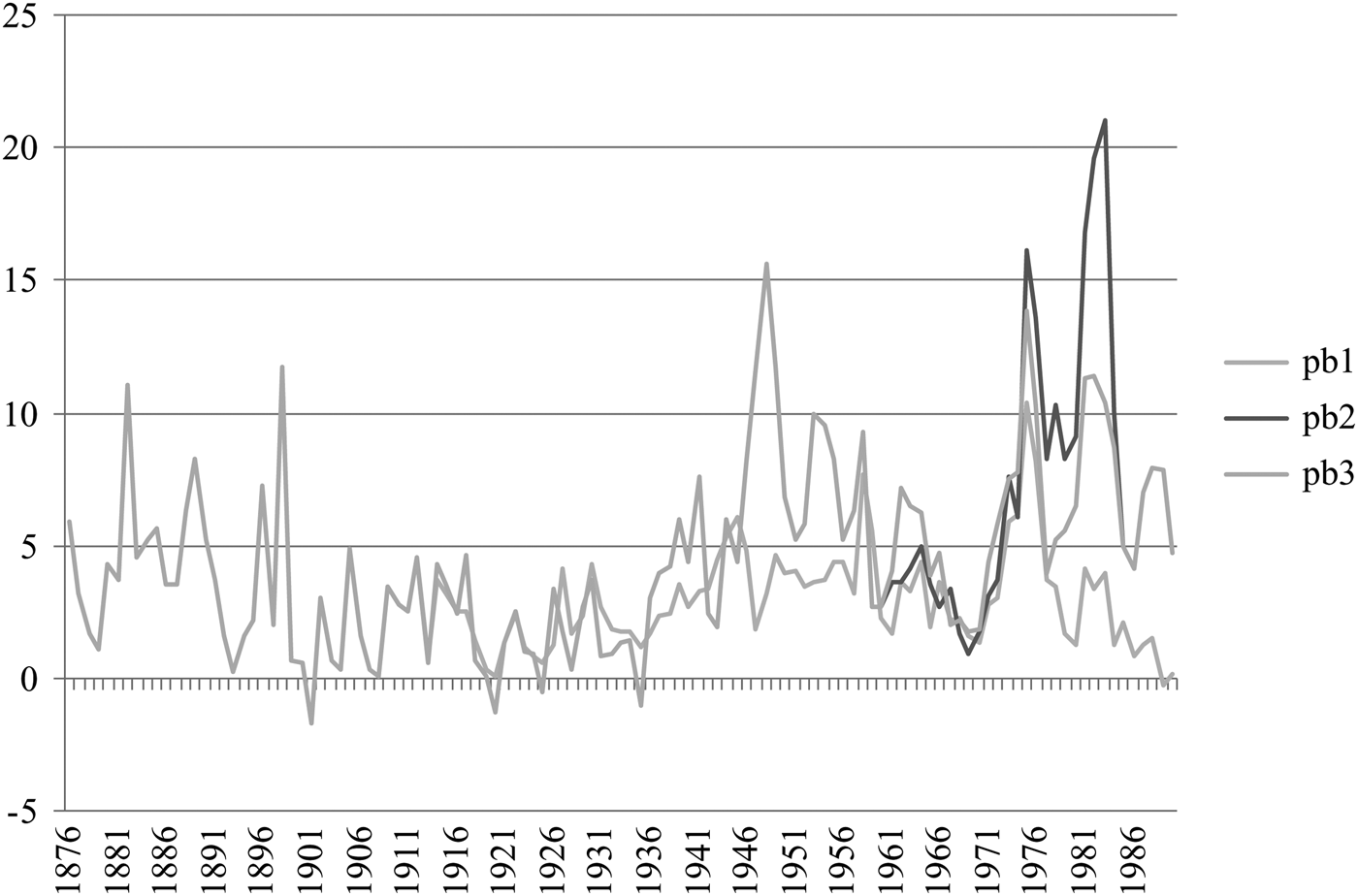
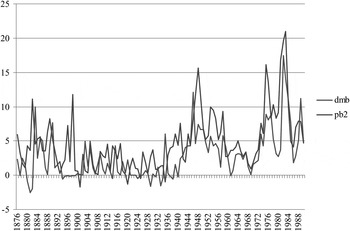
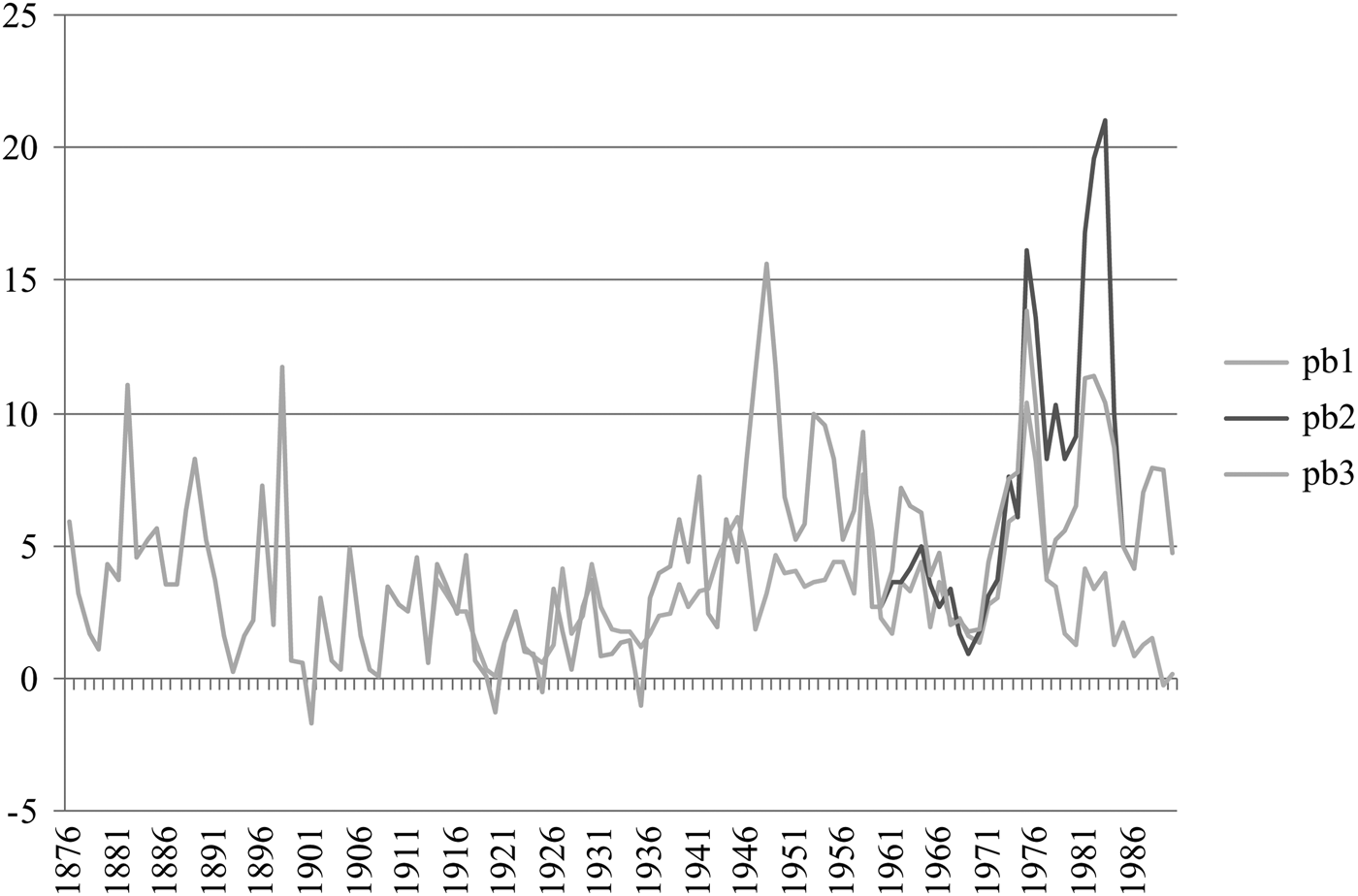
In Figure 1, we show the three available series of public budget, all related to nominal GDP (pb1, pb2 and pb3). The source for the first series, pb1, is Della Paolera et al. (Reference Della Paolera, Bózzoli, Taylor, Paolera and Taylor2003a). While this series spans the whole period 1875–1990, it has the disadvantage that it only considers the central government deficit, rather than the consolidated deficit. This is vital in the case of Argentina because provincial deficits, especially during the more recent years, have frequently caused serious problems at national level. For this reason, we built a second series, pb2, that links data for 1875–1912 from Della Paolera et al. (Reference Della Paolera, Bózzoli, Taylor, Paolera and Taylor2003a) with data for 1913–84 by Cavallo et al. (Reference Cavallo, Dómenech and Mundlak1986). The latter reports the consolidated deficit of Argentina's public sector, including provinces, municipalities and social security.Footnote 28 This source also provide a broad definition of fiscal deficit that includes expenditures and incomes resulting from the monetary operations of the Banco Central which were not recorded in the state's budget accounts. The financing of this deficit, known as quasi-fiscal, implies a direct effect on the monetary base, which justifies its consideration when testing the hypothesis of fiscal dominance (Cavallo and Peña Reference Cavallo and Peña1983). It is extremely important to take this into account, especially during the 1980s, when the quasi-fiscal deficit grew enormously.Footnote 29 For the years between 1985 and 1990, the pb2 series uses data provided by the Secretaría de Hacienda del Ministerio de Economía (2005) that, starting in 1960, are perfectly comparable in coverage to those of Cavallo et al. (Reference Cavallo, Dómenech and Mundlak1986). Finally, the third public budget series, pb3, results from combining pb2 from 1875 to 1960 with data provided by the Ministerio for the national administration, public enterprises, trust funds and other national and provincial public bodies from 1961 to 1990. For this latter period, the pb3 series does not include the non-financial public sector, so we consider it only as a control variable to confirm the robustness of the results obtained by using pb1 and, above all, pb2. Our analysis focuses on pb2, which is the series of public budget that appears in Figure 2 along with seigniorage, defined as the ratio between monetary base growth and the nominal GDP (dmb). The source for the monetary base series is Della Paolera et al. (Reference Della Paolera, Bózzoli, Taylor, Paolera and Taylor2003a) from 1875 to 1944 and the Central Bank of the Argentine Republic (online) from 1945 to 1990.
The evolution of non-consolidated and consolidated deficit (fiscal and quasi-fiscal) (%GDP)
Deficit and seigniorage (dmb)

We start by studying the order of integration of these series by applying a battery of unit root tests (the ADF tests of Dickey and Fuller (Reference Dickey and Fuller1981), the PP of Phillips-Perron (Reference Phillips and Perron1988) and the MZ-GLS of Perron and Ng (Reference Perron and NG1998) and Ng and Perron (Reference Ng and Perron2001)). As a complement, the KPSS test of stationarity of Kwiatkowski et al. (Reference Kwiatkowski, Phillips, Schmidt and Shin1992) is also applied. The results, shown in Table 1, confirm that the public budget and changes in the monetary base series, are I(0). Thus, having confirmed that both series are I(0), a stationary VAR (Vector Autoregressive Model) is used to study their relationship. In a general form, a p-order VAR can be expressed as:
 $$Y_t=\sum\limits_{i=1}^p {\gamma _i Y_{t - i}+\alpha D_t+\varepsilon _t }\eqno\lsqb 5\rsqb$$
Unit root and stationarity tests

Notes: Critical values for ADF and PP test in McKinnon (Reference Mckinnon1996). The number of lags of ADF and MZt-GLS have been selected in accordance with the MAIC method of Ng and Perron (Reference Ng and Perron2001). In the PP and KPSS test, quadratic spectral kernel has been used, choosing the bandwidth by Newey and West method (Reference Newey and West1994).
*Significant at the 5% level.
**Significant at the 1% level.
where Y t is a vector of k endogenous variables and D t may include the deterministic components, intercept, trend or dummy interventions. In our case, we have two variables (k = 2) and will use the following specification:
 $$Y_{1t}=\sum\limits_{i=1}^p {\gamma _i Y_{1t - i}+\sum\limits_{i=1}^p {\mu _i Y_{2t - i}^{}+\alpha D_t+\varepsilon _t } }\eqno\lsqb6\rsqb$$
 $$Y_{2t}=\sum\limits_{i=1}^p {\lambda _ {{}i} Y_{2t - i}+\sum\limits_{i=1}^p {\delta _i Y_{1t - i}^{}+\beta D_t+\xi _t } }\eqno\lsqb7\rsqb$$
We can test for causality between Y 1 and Y 2 in the sense of Granger (Reference Granger1969, Reference Granger1988) according to which Y 2 is not causing Y 1 if all lagged values of Y 2 are zero in [6], and Y 1 is not causing Y 2 if all its lagged values are zero in [7]. In practice, we test for the null of non-causality by applying a Likelihood Ratio test (LR), that is to say, by making μ i = 0∀ i in [6] and δ i = 0∀ i in [7]. Previously, we select the order of the VAR according to the SBIC and AIC criteria and check for autocorrelations, heteroskedasticity and normality in the residuals.
When testing for causality, as well as applying the LR causality test to the whole period, we carry out a recursive estimation. Figure 3 shows the evolution of this test and the normalized critical value at the 5 percent level of significance (3.84) is represented by the dashed line. According to this estimation, there is no effect from monetary base to public budget. Conversely, although with a different intensity depending on the public budget series, we find a long causal relationship running from this variable to monetary base. It is worth mentioning that, when considering pb2 (the series that best captures the size of budgetary imbalances), we find that the intensity of causality varies over time.Footnote 30 This leads us to consider the presence of structural breaks in the causal relationship between budget and monetary base.
Results of recursive causality test

To that end, we apply the methodology of Bai and Perron (BP) (Reference Bai and Perron1998, Reference Bai and Perron2003a, Reference Bai and Perronb) that, based on the principle of global minimizers of the sum of squared residuals, looks for multiple structural breaks, consistently determining the number of break points over all possible partitions as well as their location. They consider m breaks (m + 1 regimes) in a general model of the type:
 $$y_t=x^{\prime}_t \beta+z^{\prime}_t \delta _j+u_t \eqno\lsqb8\rsqb$$
where y t is the dependent variable; x t (px1) and z t (qx1) are vectors of independent variables of which the first is univariate and the other can change, β and δ j (j = 1, …, m + 1) are the corresponding vectors of coefficients and T i, …, T m are the break points treated endogenously in the model.Footnote 31
We have explored the existence of structural breaks in a pure changing model representing the causal relationship as in equation [6]. A maximum number of five breaks has been considered, which, in accordance with the sample size T = 125, means a trimming of ε = 0.10. The results, shown in Table 2, detect two breaks in 1889 and 1939 with the SBIC criterion and only one, in 1941, when using the sequential method recommended by Bai and Perron (Reference Bai and Perron2003b).
Multiple structural breaks in the causality relation between budget pb and changes in monetary base dmb (Bai-Perron methodology)

Notes: Changes in the partial structural model are tested selecting a trimming ɛ = 0.10 and a maximum number of 5 structural breaks. Serial correlation in the errors is not allowed. The consistent covariance matrix is constructed using the Andrews (Reference Andrews1991) method.
The previous econometric results are fully consistent with our fiscal dominance narrative. As highlighted in the previous section, following the Baring crisis in 1890, Argentina made a firm commitment to cutting deficits to stop their monetization. This allowed the country to return to the gold standard in 1899, a situation which lasted until 1913. The re-adoption of gold entailed the acceptance of fixed exchange rates for the peso plus full capital mobility and, consequently, the acceptance of an exogenously determined monetary base. Coherently with these efforts, the causal relationship between budget and money weakened sharply until 1899 and continued falling, although more slowly, until 1914. In that year, a severe monetary contraction provoked by the outbreak of World War I led Argentina to suspend convertibility and to authorize the Conversion Office to rediscount commercial paper. But, as we already said, the emissions by the Conversion Office were relatively under control until 1927 when, for just two years, until December 1929, gold convertibility was restored. The printing of money continued to be limited even after the creation of the BCRA in 1935 meant the demise of the Office. Thus, with the short parenthesis of 1927–9, the trilemma did not formally impose any monetary constraint on deficit financing from 1914 to 1935. Here again, the econometric findings fit in with the narrative, since the causal link from budget to money regained intensity.
However, for the causal relation to reach new heights, it is necessary to wait for the BCRA to become the main instrument in the Peron government's economic policy after World War II when, in a context of imperfect capital mobility, the trilemma continued to leave room for monetary policy to serve fiscal needs. We have seen that the analysis of structural breaks signals the 1940s as a turning point in the dynamics of the relationship between budget and monetary base. This change perfectly matches the intensification of causality from budget to monetary base in 1947 when considering the pb2 series, which includes the public losses directly assumed by the central bank. This continued until the mid 1970s, thus supporting the narrative that insisted on the failure of successive governments, including Peron's 1973–6 term of office, to reduce deficits. Deficits were financed through money printing, this possibility being feasible because of the strictness of capital controls introduced in 1964 to maintain the peso exchange rate. The scenario did not change until 1977 when, following the Stabilization Plan of Martínez de Hoz, capital outflows were liberalized. The introduction of the tablita in 1979, in a context of capital mobility, implied the acceptance of a progressive cutting of domestic control on money. This change of scenario is also captured by the econometric analysis, since the gains in causal intensity of previous years experienced a retreat in 1978–81.
But the tablita constraint only survived until February 1981, when the peso was sharply devalued. From then on, until the Convertibility Plan of 1991, Argentina recovered its monetary autonomy thanks to a floating regime and the reintroduction of capital controls. As proof that this sovereignty was used to finance deficits, the causal link from budget to money shot up in 1982, maintaining an upward trend until the end of the period under examination. Deficits had worsened in 1981–3 as a result of rising international interest rates, the expenses related to the Falklands War and the losses accumulated by the BCRA. Thus, the monetary financing of deficits fits in perfectly with the high values of the link in 1982–4, especially when focusing on the pb2 series, which includes the quasi-deficit. The narrative stresses how the fiscal correction introduced by the Austral Plan of 1985 was made on a transitory basis. The deficit soon began to recover and the BCRA, despite its commitment not to issue money to finance the government, started to do so again but this time indirectly through the granting of direct rediscounts to public enterprises and public banks, as well as by placing Treasury paper denominated in dollars. Nor did any of the multiple stabilization programs following the Austral Plan manage to eradicate the deficits whose monetary financing is reflected in the upward trend of the causal LR test in the second half of the 1980s.Footnote 32
III
Having empirically confirmed the fiscal dominance hypothesis in the long run, we now move on to test its influence on the evolution of prices. As we already emphasized, the levels of inflation before and after World War II differed widely. From 1875 to 1944, the annual inflation rate averaged 3 percent. From the mid 1940s to mid 1970s, prices showed a sustained rate of growth with an average inflation of around 30 percent. Inflation leapt in the mid 1970s, averaging almost 200 percent in the second half of the decade. The persistence of these high inflation levels laid the foundations for a process of reduction in the demand for domestic money that, according to Dornbusch and Simonsen (Reference Dornbusch and Simonsen1987) and Dornbusch (Reference Dornbusch1990), defined a non-linear relation between deficit and inflation for 1980s Argentina. Therefore, to reveal the real influence of deficit on inflation, we need to consider the interaction of the size of deficit with the responsiveness of money velocity to inflation, i.e. the more the money velocity increases as a response to inflation (the more the real demand for domestic money shrinks), the greater the inflationary impact of a given deficit. For this reason, we follow Catao and Terrones (Reference Catão and Terrones2005), who introduce non-linearity into the relationship between deficit and inflation.
Starting from a simple inter-temporal optimization model, they derive the following stationary equilibrium:
 $$\displaystyle{\pi \over {1+\pi }}=\displaystyle{{\,p\left[{g - \tau+b^{\,g} \lpar R - 1\rpar /R} \right]} \over M}\eqno\lsqb9\rsqb$$
where π denotes inflation, p price level, g real public spending and τ taxes; b g denotes the real value of the public debt stock, R real interest rate and M narrow money (effective plus demand deposits). Thus, equation [9] posits a long-run linear relationship between inflation and the proportion of deficit to narrow money. In other words, inflation is directly related to the ratio of deficit to GDP and inversely related to the ratio of narrow money to GDP, that is, the inflation tax base. As deficits (in the numerator) feed inflation and inflation reduces the real demand for money (in the denominator) the model allows for a non-linear impact of deficits on inflation.
In practice, allowing for generality and considering,  $ \pi \approx \displaystyle{\pi \over {1+\pi }}$, the authors propose the following functional form:
 $$\pi=\psi \displaystyle{{\lpar G - T\rpar } \over M}\eqno\lsqb10\rsqb$$
where (G−T) denotes nominal deficit and ψ the semi-elasticity to be estimated. We continue to work with the budget series pb2, which we scale by narrow money to obtain pb2-m. The source for narrow money is Della Paolera et al. (Reference Della Paolera, Bózzoli, Taylor, Paolera and Taylor2003a) for 1885–1944 and the BCRA (online) for 1945–90. The inflation source is Della Paolera et al. (Reference Della Paolera, Bózzoli, Taylor, Paolera and Taylor2003a). In this case, as shown in Table 1, one of the variables, inflation, is I(1). This is a different order of integration from pb2 and pb2-m, both I(0). For this reason, instead of the VAR methodology, which is only applicable to variables with the same integration order, we use, as Pesaran et al. (2001) suggest, the ARDL approach. This approach estimates the levels effects and short-run dynamics of a relation by OLS, obtaining the long-run coefficients no matter whether the regressors are I(0) or I(1). For example, in the case of an ARDL (1,1) model, the equation to estimate will be the following:
 $$\pi _t=\phi _1 \pi _{t -1}+\beta _0 pb_t+\beta _1 pb_{t -1}+\delta ^{\prime}w_t+u_t \eqno \lsqb11\rsqb$$
where pb can be either pb2 or pb2-m; the deterministic variable w it can include a constant and different dummies, and the long-run parameter to study would be 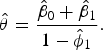 $\hat \theta = \displaystyle{{\hat \beta _0+\hat \beta _1 } \over {1 - \hat \phi _1 }}.$ To select the order of the ARDL model, the SBIC criterion is suggested.
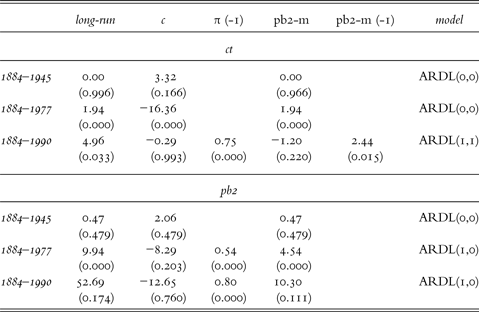
The results, in Table 3, show that there is no significant relationship between the deficit scaled by narrow money and inflation until 1945. But we do find a significant relationship when we extend the period until 1990. This leads us to conclude that the long-run influence of Argentine deficits on prices owes its significance to the post-World War II dynamics, which explains the similarity of our results to those of Catao and Terrones (Reference Catão and Terrones2005). When we examine the dynamics of the deficit scaled by narrow money and inflation in the period 1885–1990, we find an elasticity parameter of 4.96. This is very close to the parameter that they estimate for the sub-panel of high-inflationary countries (those in the upper quartile of the inflation distribution in a panel of 107 countries) in 1960–2001. For this group of high inflationary countries, which includes Argentina, Catao and Terrones (Reference Catão and Terrones2005) estimate an elasticity of 4.46 that, not surprisingly, falls to 0.40 when the hyperinflationary countries (Argentina, Bolivia, Brazil, Congo, Nicaragua and Peru) are excluded.
Long-run estimation of the relationship between inflation and public budget pb2 relativized by m1 and between inflation and public budget pb2 (ARDL approach by Pesaran and Shin Reference Pesaran, SHIN and Storm1999)
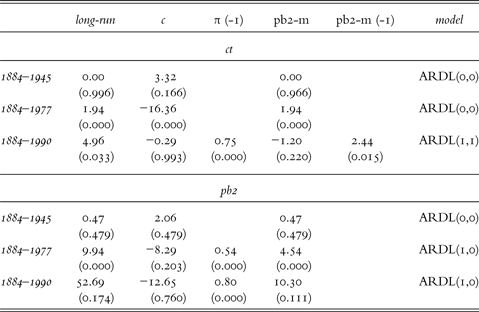
Notes: p-values in brackets. SBIC criterion selects the orders of the ARDL model.
Quite interestingly, had we not scaled the deficit by the stock of narrow money, thus introducing the magnifying effects of currency substitution into the picture, we would not have found, as shown in Table 3 for pb2, any significant link between fiscal problems and inflation. This finding, however, cannot be taken as evidence that currency substitution and not deficit lies at the root of high inflation. Deficits initially feed inflation, chronic inflation provokes currency substitution but, once currency substitution starts working, the drop in the demand for real money amplifies the inflation rate of a given deficit. The final result is the weakening of any linear relation between deficit and inflation, which, as Calvo and Vegh (Reference Calvo and Végh1992) warn, feeds ‘the perception that putting the fiscal house in order may, after all, not help in dealing with the inflation problem’ (Calvo and Vegh Reference Calvo and Végh1992, p. 8).
IV
This article deals with the role played by seigniorage in Argentina during the period 1875–1990, for most of which the authorities maintained control of domestic money and, consequently, there was enough latitude to finance the deficit monetarily. We find a dynamic relationship from deficits to monetary base when considering the whole period. Therefore, we can say that the hypothesis of fiscal dominance holds for Argentina in the long run.
The story is not that simple, however. In correspondence with the two exceptional episodes of formal renouncement to manage an activist monetary policy (gold standard and the tablita), we find that this causality weakens. We also observe a sharp difference in the intensity of causality before and after World War II. The causal intensity of the link between budget and money reaches unprecedented levels in the second half of the twentieth century.
This different pattern before and after World War II is equally clear in the case of inflation. We do not find any significant influence of deficits on prices until 1945. However, when we extend the period until 1990, a significant influence of deficits on prices is revealed. Consistent with the presence of currency substitution and a concomitant Laffer curve effect, this relation only emerges when the scaling of deficits by the domestic stock of money allows us to capture the simultaneous influence of inflation on the demand for domestic money in the 1980s. Argentines might not have seen many dollars before 1945, but in the fifty years after Peron asked the famous question ‘Did any of you ever see a dollar?' (¿Alguno de ustedes vió alguna vez un dólar?), the country's monetary history, as illustrated in our study, had been completely reversed.Footnote 33 The Convertibility Plan was meant to break this secular vicious circle. However, despite this and later attempts, the reluctance to hold Argentina's currency has survived.
Appendix 1
When testing for the hypothesis of fiscal dominance, we look for the existence of a significant causal relationship from public budget to the cash-flow measure of seigniorage (the growth rate of monetary base multiplied by the real monetary base). However, as highlighted in Honohan (Reference Honohan1996), the differences arising from using alternative measures of seigniorage can be large when empirical work is applied to transitional economies with highly variable rates of inflation. The figure below shows the results of recursively estimating the LR causality test for an alternative measure of seigniorage, the rate of inflation multiplied by the real monetary base or, in other words, the tax inflation. Comparing the figure below with Figure 3 in the text, we can see how the LR test for the inflation tax signals the same periods of losses and gains in causal intensity, thus supporting the results obtained for the cash-flow measure of seigniorage.