

Language translation of survey materials is often necessary in nation-wide surveys in order to collate a comprehensive set of data of the general population. While much effort is channelled into the planning of such large-scale studies to ensure that the procedure is scientifically sound and that the data collected is of high quality, many investigators often perceive translation as a mere technical step rather than central to the scientific process (Cortés et al., Reference Cortés, Gerena, Canino, Aguilar-Gaxiola, Febo, Magaña, Soto and Eisen2007). As such, translation procedures are often left to the very end. The importance of translation, however, is not to be underestimated. Poor quality translations can severely threaten the veracity of the data collected no matter how well thought out a study may be, as infelicities in translation may distort the original intent of the instrument, rendering biased comparison, possibly even in favour of one racial or ethnic group over another (Chang, Chau & Holroyd, Reference Chang, Chau and Holroyd1999).
A nation-wide survey initiative to establish the prevalence of mental disorders in Singapore and its associated factors, the Singapore Mental Health Survey (SMHS), necessitated the translation of several modules of the selected instrument, the World Health Organisation's (WHO) Composite International Diagnostic Interview (CIDI), a fully-structured clinical interview designed to be used by trained lay interviewers for the assessment of mental disorders according to the definitions and criteria of the ICD-10 and DSM-IV, into the Malay language, Bahasa Melayu, to reach the Malay-speaking population. Singapore is an island state which lies at the southern tip of the Peninsular Malaysia. The Malay population is the largest minority group in Singapore, constituting about 15 per cent of citizens in the country (Statistics Singapore, 2009) and many were descendants of the Malays in Malaysia who make up the majority of the population (15 million; Department of Statistics, Malaysia, 2010) and where Bahasa Melayu is the official language. While most individuals in Singapore are conversant in English, the percentage of individuals who are literate only in the Malay language is as high as 20 per cent of the Malay population (Statistics Singapore, 2000). It has been reported that individuals who are ‘Malay-speaking’ or express a preference towards speaking Malay, tend to be of lower socio-economic status and educational background (Aman, Reference Aman2008). As socioeconomic status has been regarded as a marker for various health outcomes including mental health (e.g., Adler et al., Reference Adler, Boyce, Chesney, Cohen, Folkman, Kahn and Syme1994; Hayward et al., Reference Hayward, Miles, Crimmins and Yang2000), prior efforts to identify the prevalence of mental disorders and assess the utilisation of mental health services that were conducted solely in English, have missed out a sizeable proportion of the population, whose mental health and need for treatment is conceivably even more urgent. Furthermore, while other studies have attempted to sample the non-English speaking population, there were no descriptions of any of the translation or adaptation procedures for the English language, US-developed instrument, thus questioning the validity of the data collected. Data on the non-English speaking population is thus needed and the translation of the well-established CIDI into Malay was considered to be a primary and integral component of the nation-wide survey.
The task of translating the CIDI into Bahasa Melayu for use in the Singapore population is a challenging one. Firstly, the CIDI is an instrument that focuses on symptoms to generate clinical diagnoses. However, it is known that different cultures particularly Western versus Asian cultures conceptualise and express certain psychological and emotional conditions differently (e.g., Bishop, Reference Bishop1998; Marsella, Reference Marsella, Marsella, DeVos and Hsu1985). One potential challenge thus lies in reconciling the Western terminologies for symptoms in an Asian, Singaporean context. Secondly, the English and Malay languages do not match up on a word-to-word level. The English language has a wide lexicon while the Malay language with its relatively smaller vocabulary stock, may not reflect key nuances in expressions adequately. Thirdly, as this translation initiative is a pioneer effort to produce such an instrument in the Malay Language, there is no resource currently available for use as a reference. An added complexity is that, certain English words may be a more casual form of everyday discourse than the Malay equivalent even among the ‘Malay-speaking population’ and there is a need to determine, in the translation process, the terms that would be best understood by the target population.
Due to these challenges, a rigorous translation procedure was adopted in order to produce a translated instrument that would enable comparability vis-à-vis the original instrument while allowing culturally and linguistically diverse populations to be evaluated fairly.
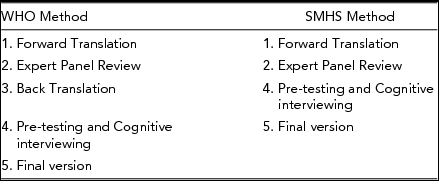
We adapted a procedure that was outlined by the WHO (2009). The central aim of the translation process was to achieve a Malay language version of the CIDI that is conceptually equivalent, as opposed to literally equivalent, to the original instrument. Conceptual equivalence refers to the absence of discrepancy in concepts or otherwise in meaning and content between the translated instrument and the original version, wherein the emphasis is on achieving equivalence at entire-item rather than at individual-word level (Canino & Bravo, Reference Canino and Bravo1994). Literal equivalence by contrast emphasises word-for-word translation (Sechrest, Fay & Zaidi, Reference Sechrest, Fay and Zaidi1972). Some researchers (Nida & Taber, Reference Nida and Taber1982) assert against such translations as the direct correspondence of word pairs often distorts the grammatical and stylistic patterns of the target language and hence misrepresents the message, making misinterpretations more likely, and comprehension unduly difficult. The translation procedure undertaken was aimed at achieving conceptual equivalence and entailed a four-stage process: 1) forward translation, the initial translation of the original English CIDI version 7 into Bahasa Melayu by professional translators, 2) an expert panel review, in which members who act as expert consultants in various fields pertinent to the study offer advice and possible solutions to address problems identified in the first draft of the translation, 3) pre-testing and cognitive interviewing to assess how well the questionnaire will be received by the lay members of the public, the target audience and 4) finally, the development of a final version. In this study, we omitted the back-translation process that was included in the WHO translation guidelines due to a number of problematic methodological issues with this step. Back translation refers to the validation process in which a translated text is translated back to the source language, without reference to the original source document with the objective of ensuring accurate translation (Van Widenfelt et al., Reference Van Widenfelt, Treffers, De Beurs, Siebelink and Koudijs2005). One major criticism is that the back-translation procedure promotes literal rather than conceptual equivalence (Rogler, Reference Rogler1999). In addition, more inaccuracies could be introduced by the back-translator (Ponce et al., Reference Ponce, Lavarreda, Yen, Brown, DiSogra and Satter2004). For example, if both the forward and backward translators share common misconceptions about a certain item, they could easily make the same mistake in translation and back-translation thus confounding the error. Alternatively, the forward translator may be excellent, but if the back-translator is poor, the end result may suggest erroneously that the translation is a poor one. Due to these potential problems, the back-translation step was omitted. Table 1 summarises the difference between the WHO method and the method adopted in the SMHS.
Comparison of the WHO and SMHS translation procedure

The objective of this article is to describe the process that was carried out as part of the SMHS to produce a version of the WHO CIDI in the Malay language that would perform in a comparable fashion to the original American English version 7.
Method
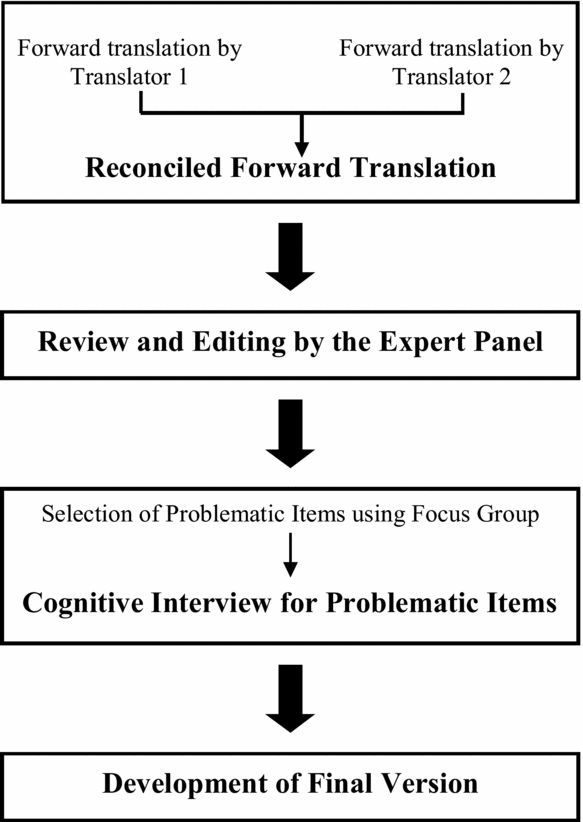
The translation procedure was a four-step process that was adapted from the WHO method: 1) forward translation, 2) expert panel review, 3) pre-testing and cognitive interviewing and 4) development of a final version. Figure 1 illustrates the procedures involved in the SMHS method in more detail.
SMHS translation procedure.

The first step was to attain a forward translation, that is, translation of the CIDI from American English into, Bahasa Melayu the target language. Two professional translators, who were native Malay speakers and were fluent in English, worked independently to produce two sets of forward translations of the CIDI. The translators were informed of the target audience and were instructed to aim at achieving the conceptual equivalence of a word or phrase, not a word-for-word translation, that is, not a literal translation. They should strive to be simple, clear and concise, using natural and acceptable language to reach the broadest audience and to avoid the use of jargons, colloquialisms, idioms or vernacular language. The two translators then compared their translated works to arrive at a composite version. The composite version could be achieved by the translators accepting the better of the two translations, combining components of their individual translations or putting together an entirely new translation. This approach was adopted to minimise the possibility of idiosyncrasies introduced by a single translator. All three versions; the two independent translations, as well as the composite version were documented.
In the second step of the translation process, a four-day expert panel meeting was convened with the goal of identifying and resolving inadequate expressions or concepts in the translation, to confirm if the language and level of diction is appropriate. The panel was made up of six members: one of the two professional translators, a survey translation expert, a subject matter expert, an expert in survey design, a lay member of the public, as well as the mediator who had received training in the CIDI by the developers. The member of the public was selected keeping in mind that he/she should represent the typical respondent. This member was in his 60s, a native-Malay speaker and expressed that he would have preferred to have completed the survey in Malay given his limited English and was therefore deemed a suitable representative. An independent review was first carried out by each panel member prior to the meeting. Issues were identified and suggestions to rectify those issues were submitted prior to the meeting. All issues were addressed during the meeting. Consensus was achieved when there was a clearly favoured option by the majority of the panel members. For many items however, the decision was not as straightforward. In such instances, issues that were raised by each expert were debated and possible resolutions were weighed on factors such as extent of accuracy, ease of comprehension and applicability to the population. Subject matter experts were careful to explicate the intent of the item to ensure that the goal of conceptual equivalence was maintained. Issues were resolved by critical evaluation of the considerations and recommendations by each expert in their respective fields. Where clear unanimous agreement could not be achieved, the mediator stepped in as an arbiter to adjudicate the best translation offered given the considerations.
The next step of the translation process was cognitive interviewing and pre-testing. A cognitive interview or cognitive testing is a qualitative procedure that allows for evaluation and further in-depth enhancement of the translation of the survey instrument (Levine, Fowler & Brown, Reference Levine, Fowler and Brown2005). This is achieved by assessing whether respondents are able to answer the questions, whether questions are consistently understood by respondents and whether respondents interpret questions in the way intended by the instrument's developers. The cognitive testing procedure involves asking individuals to explain their understanding of specific items and allows researchers to assess whether individuals understand the content and meaning of each question. Through cognitive interviews, items that were still (after expert panel review and editing) confusing, ambiguous, or difficult to understand can be identified and addressed. These are important functions that a traditional pre-test (i.e., administering items as intended with the actual sample) does not provide.
However, as the CIDI is a lengthy instrument comprising over 800 questions, a complete cognitive test for every item was not feasible, given the time and budget constraints. As such, discussions conducted in a focus group format with an average of eight Malay-speaking staff members who were not directly related to the SMHS and were naïve readers of the CIDI, were carried out to determine problematic items in the translation and to develop a standard protocol for this third stage of translation. The staff members were recruited to represent various age, gender and educational profiles of the target population. Every item in the CIDI that was to be used in the SMHS was reviewed. Staff members were informed that they had been called upon as consultants to help improve a questionnaire that was still in draft and were instructed to report any difficulty understanding the questions so as to minimise social desirability and to encourage reporting of problematic issues. Items that many staff reported difficulty understanding or needed much clarification were flagged for cognitive testing. Pre-testing was still carried out with the rest of the non-flagged items.
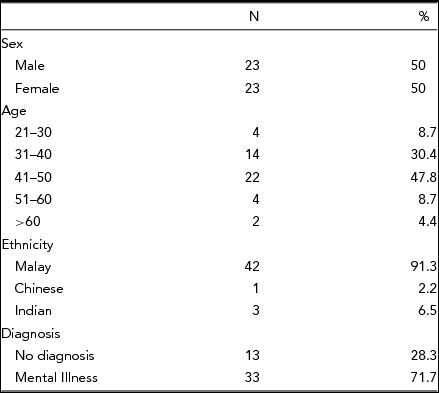
The actual cognitive interview cum pre-test was conducted with 13 Malay-speaking healthy individuals and 33 stable outpatients of the Institute of Mental Health (Singapore's only state mental institute and the country's main provider of mental health care). For the sake of parsimony, the term ‘cognitive interview’ will be used to refer to both the cognitive testing and pre-testing process. Ethics approval was obtained prior to the recruitment of participants who gave written informed consent. Respondents were compensated for their involvement in the procedure. Out-patients with known diagnoses were recruited to test out the diagnostic sections of the CIDI. Respondents (regardless of patient or non-patient status) were selected in quota fashion so as to attain an adequate socio-demographic (i.e., gender and age) representation of the target audience. Table 2 presents the demographic profile of participants recruited for cognitive interviews. Participants were instructed by trained interviewers using set protocols to first answer the questions asked and were then systematically probed on what they thought the question was asking, whether they could repeat the question back in their own words, and what came to mind when they heard a particular phrase or term. They were also asked how they decided on their response. Participants were also encouraged to report any word they did not understand and any word or expression that they found offensive or unacceptable. Also, when alternative words or expressions exist for one item or expression, participants were asked which word or expression conformed better to their usual language. The interviews were typically 90 minutes long, with each participant completing two to three CIDI modules or sections that were recorded on audiotapes and later transcribed.
Demographic profile of cognitive interview participants

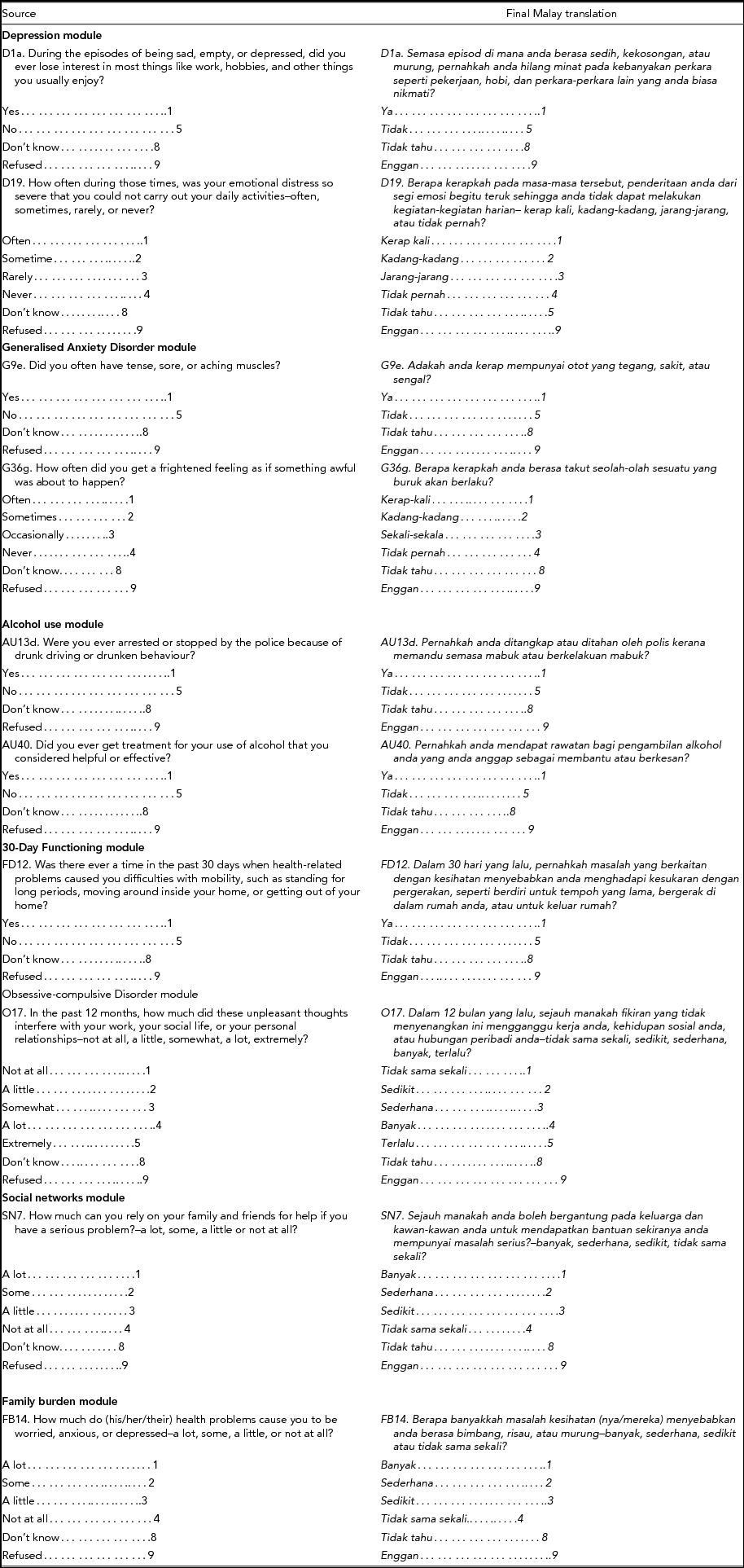
The final Malay language version of the CIDI was obtained by making amendments to specific items based on feedback and responses that were consistently reported by participants in the cognitive interviews. Often these changes were in the form of substitution of preferred alternative options or simpler words used by respondents in rephrasing that tended to be explained incorrectly by other respondents, or the inclusion of English terms that some respondents were more familiar with. A table presenting sample items from various modules of the CIDI and their corresponding finalised Bahasa Melayu translations are shown in the Appendix.
The complete CIDI instrument is freely accessible through the World Health Organisation website. (http://www.hcp.med.harvard.edu/wmhcidi/instruments_papi.php)
Pilot Data
A pilot was conducted from September to November 2009. The sample released for the pilot was part of the larger sample identified for the nation-wide survey. Out of the sample of 215 households released, 20 identified respondents opted to complete the study in Malay. The complete Malay version of the CIDI was tested on these 20 respondents.
Results
In this section, the translation problems and issues are discussed. Most of the issues were identified and resolved during the expert panel discussions and are detailed below. Several important amendments were made to the version that was produced after the expert panel discussion through cognitive interviewing and are presented in the second part of this section.
The translation problems that were documented in the expert panel meeting could be classified into four broad categories: 1) difficult words, 2) mistranslations, 3) ambiguous/non-specific expressions, and 4) grammatical errors. Cultural adaptation was also found to be necessary for some items during the expert panel and was also carried out.
Translation problems identified by the expert panel
Difficult words
Difficult words were those that were deemed too formal or pedantic and would be incompatible with the average literacy level of the target population. Such words are seldom used in every-day discourse and often have a simpler alternative. For example, the term ‘excited’, which was initially translated as teruja, was replaced with the more frequently used term ghairah. Occasionally, translators may feel driven to translate terms and expressions as far as possible, seeing it as part of their professional obligation, even if it is simpler to use the English term as it has become the local lingo. For instance, the translators translated the phrase ‘going on a date’ as pergi berpacaran. The term berpacaran however, is an Indonesian expression that is almost never used among the local Malays. The term ‘dating’ however is used even among the Malay-speaking population. The panel thus made the decision of preserving the English word. However, the reverse could occur in which a word borrowed from the English language would not be a good substitute as the term may have a different connotation from the intent of the question for this specific population. For instance, the English-adapted word imej was used in the translation for the phrase, ‘repeated unpleasant images’. However, imej is often reserved in the Malay language to refer to outward appearance rather than a mental picture. As such, this translation was deemed inappropriate and was substituted instead with a term which better reflects the concept of a mental picture, that is, gambaran.
Mistranslations
The second group of translation problems was mistranslations which could be further sub-classified as a) distortion, b) added meaning and c) too-close translation.
A mistranslation in which a distortion occurred is one in which there was a change in the lexical meaning of the original text thus tapping into something that differs from the original intent of the question. To illustrate, one of the questions to screen for Agoraphobia asked ‘Was there ever a time in your life when you had a strong fear of. . .being in crowds, going to public places, traveling alone or traveling away from home?’. The initial translation for ‘traveling’ was mengembara which refers to travels for the purpose of exploration rather than the type of travel intended in the question. Due to this distortion in meaning, the phrase ‘traveling alone’ was changed to berjalan-jalan seorang diri and ‘traveling away from home’ as meninggalkan rumah, as decided by the panel of experts to achieve a question that would be closer to the source.
Another type of mistranslation that was a common source of translation problem was adding an extra facet to the meaning of the question that was absent in the source. These additional dimensions included the infusion of a spiritual connotation and making assumptions regarding the valence or direction of magnitude of an otherwise neutral noun or adjective. For instance, in the phrase ‘a doctor said you were manic’, the clinical term ‘manic’ was translated as ibarat dirasuk which literally means ‘as though possessed. This translation added a spiritual angle to the word and hence deviates from the original phrasing. The panel also rejected the suggestion to use the English loan word manik as it would be confused with its alternate meaning, that is, ‘bead’. As the term ‘manic’ is used by doctors in Singapore, the final decision by the panel was to retain the English word in the question. Another type of mistranslation that occurred was when a neutral word was added a positive valence. For instance, the term ‘still water’ in the question, ‘Was there ever a time in your life when you had a strong fear of still water?’ was translated as air yang tenang which translates directly to ‘calm water’, thus adding a positive nuance. The panel's decision was to translate the phrase to air yang tidak mengalir or ‘water that is not flowing’ thus preserving the neutral stance of the question. Another example of a mistranslation that shows an erroneous assumption in direction of scale is in the translation of the statement, ‘you had a big change in dressing and grooming’. The term ‘big change’ was inaccurately assumed to be a reduction. The panel thus corrected the initial translation pengurangan yang besar to perubahan yang besar to capture the bidirectional possibility that was intended in the question.
The third type of mistranslation was ‘too-close translation’ or a translation that was literal and resulted in a language that was unnatural and awkward. An example of such a mistranslation is the use of the Malay term liar which means ‘undomesticated’ for the translation of ‘wild’ in the statement ‘You had an extreme change in dressing or grooming . . . like wearing wild make-up’, resulting in a strange-sounding question. The panel's decision was to correct this unsatisfactory translation with the expression, bersolek dengan berlebihan so that the language is natural and easily understood.
Ambiguous or non-specific translations
Another category of translation problems was translations that were ambiguous, unclear or non-specific, increasing the likelihood that they could be misinterpreted through an alternate meaning or otherwise resulting in a precision of the original version being obscured. For instance, the question ‘Have you ever had a period lasting several days or longer when most of the day you were very discouraged about how things were going on in your life’, ‘discouraged’ was translated as kecewa which is a non-specific, umbrella term for words that could not only mean discouraged but also sad and disappointed. The panel's decision was thus to use the idiom, patah-semangat which is a common expression in the Malay language to refer to discouragement. The term patah semangat literally means ‘broken spirit’. Another example is the sentence ‘waking up too early in the morning’ which was translated as bangun terlalu awal. This translation connotes a sense of voluntariness in action whereas the source language meant an involuntary rouse from sleep. The decision was thus to translate the term to the available alternative of terjaga terlalu awal which would better capture the meaning intended in the original version.
Grammatical errors
The last type of problem that was identified was grammatical error. These errors constituted violation of syntactical rules such as incorrect word order or the sequencing of incompatible words. For example, the question ‘How many visits did you make to the psychiatrist in the past 12 months?’ was translated as ‘Berapa banyakkah lawatan ke pakar psikiatri yang anda lakukan sepanjang 12 bulan yang lalu?’. While this question is nonetheless understandable, a better and more natural-sounding manner of asking this question would be, ‘Berapa kalikah anda melawat pakar psikiatri sepanjang 12 bulan yang lalu?’ A summary of translation problems we identified is presented in Table 3.
Summary of revisions made by the expert panel
Cultural adaptation
Cultural adaptation was also found to be necessary in the course of the expert panel discussions. Cultural adaptation refers to a shift in focus from simple, straightforward translation towards measuring a similar phenomenon in a different culture. It is essentially the production of an equivalent instrument adapted to another culture (Geisinger, Reference Geisinger1994). This was done because some of the behaviours described in the CIDI items that were deemed symptomatic of a particular disorder were in fact normative behaviour in the Malay-Muslim community and could possibly cause rates of that disorder to inflate for this population if not adjusted. For example, in the question ‘Did you ever have a time in your life when you carried out any other repetitive behaviours that you felt driven to do such as . . . praying over and over for forgiveness, or some other physical or mental act that you felt you had to do repeatedly?’, the phrase ‘praying over and over for forgiveness’ was translated as berdoa berkali-kali untuk mendapatkan kemaafan. However, in the Muslim religion which is practiced by 90 per cent of the Malay-speaking population, this type of prayer is often carried out repeatedly. Thus, the panel decided to substitute berdoa with another type of prayer bersembahyang to better capture an anomaly in behaviour. Another example of cultural adaptation was the addition of options to the question, ‘which of the following types of professionals did you ever see about problems with your emotions or nerves or your use of alcohol or drugs?’. As most of the Malay-speaking population are Muslims, the panel incorporated imam and ustaz to the list of religious and spiritual advisors as these professionals would be relevant to the Muslim religion.
Translation problems identified through cognitive testing
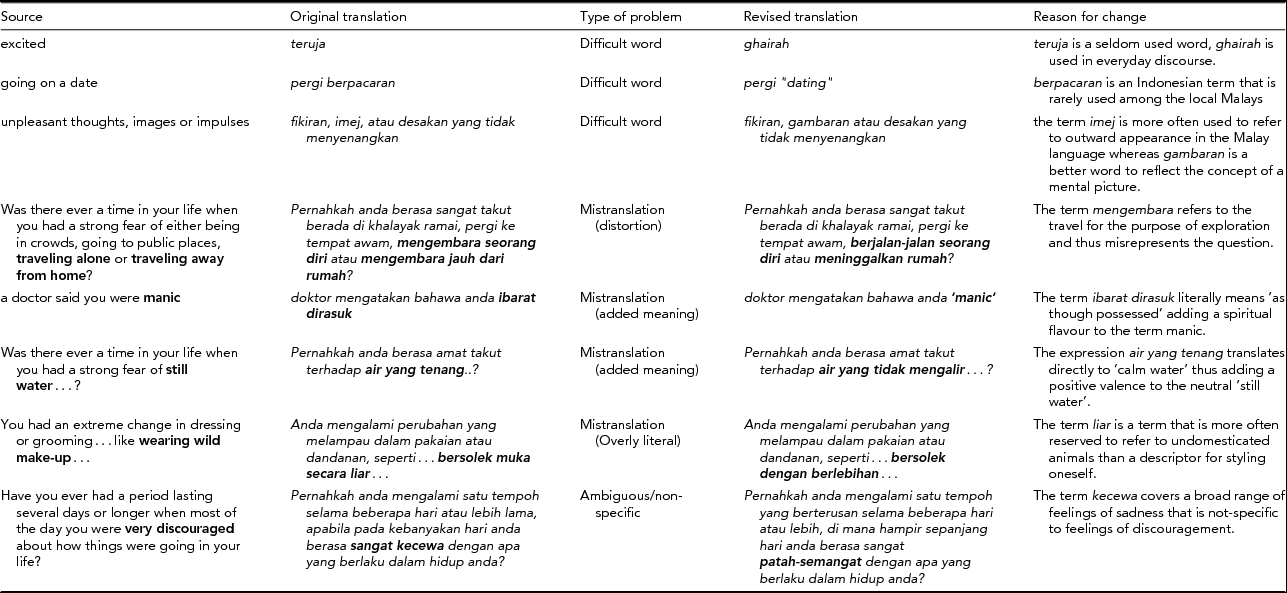
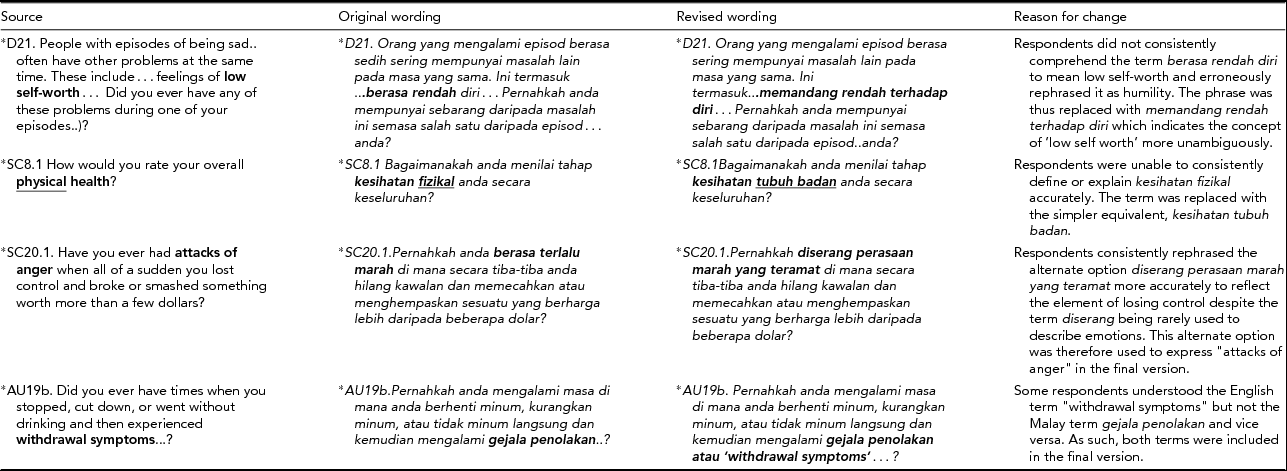
Cognitive testing showed that the majority of the items were adequately comprehended. However, there were some items that needed to be altered because responses and feedback on the cognitive interview revealed comprehension problems such as concepts or terms that were understood incorrectly or inconsistently by respondents. Table 4 presents some examples of the items that were revised following cognitive interviewing.
Sample of items revised following cognitive interviewing
Pilot data
Twenty respondents completed the Malay version of the CIDI. Of these, 13 were females (65%) and 7 were males (35%). The majority of them (70%) were older than 50 years and 13 of them (65%) had received up to primary school education. All the respondents completed all the modules of the Malay CIDI and did not report any specific problem with the wording or understanding of any question. The data were entered into the database using the Direct Data Entry (DDE) software. Results generated through the statistical analysis software (SAS) algorithm for generating the diagnoses according to the Diagnostic and Statistical Manual of Mental Disorders, 4th Edition (DSM-IV) showed that the Malay version of the CIDI performed comparably with the English and Mandarin versions of the instrument.
Discussion
The aim of the translation was to produce a Malay version of the CIDI that would perform in a comparable fashion to the original English version. A rigorous translation procedure that was based on the WHO translation guidelines was adopted. The translation procedure showed that translations are far from ready after the initial forward translations as various problems in translations were picked up in the expert panel meeting and the cognitive interview and pre-testing stage.
Difficult words were those that were not comprehended or not understood by a major segment of the population. Translators are often highly educated individuals and may be more pedantic in the way they speak and write. As dictionary-language is not the language of the general population, it was essential to deliver the same meaning intended with a simpler alternative word if available. However, the Malay language lexicon is not as extensive as that of English language and there was often no equivalent word. Another challenge faced was that the English and Malay language do not measure up on a word-to-word level and may not capture the nuances intended in the original item aptly. Several strategies were used to circumvent these two problems. The expert panel adopted the strategy of using several words to describe a concise word in the English language to capture the intent of the question as closely as possible. Other times, idioms were added. While it may seem logical to avoid idioms where possible, idioms are highly used words in everyday discourse and have been ingrained in the language. In conforming to conceptual equivalence, the panel agreed that this decision was most favourable. These strategies were also described by Weidmer, Brown and Garcia (Reference Weidmer, Brown and Garcia1999).
Mistranslations were another source of error that was commonly found in the translations. The mistranslations could be distortions, adding additional dimensions to words and over-literal translations. These translations point to the importance of having a content expert within the expert panel to elucidate the actual intent of the question and resolve these mistranslations. Errors such as these are difficult to resolve in translation efforts that solely involve iterations of forward and backward translations because both forward and backward translators may not be sensitive to the meaning of the questions and may come to a common erroneous understanding, resulting in a poor translation.
While the expert panel was useful in identifying problems in translation particularly those that were conceptual in nature, the cognitive interviews shed more light on adapting the language that was most appropriate for the general Malay-speaking population. The expert panel was represented mainly by highly-educated individuals and some of the words that were not appropriate to the population were overlooked. The cognitive interviews were useful in determining how appropriate the level of language was by delving into what respondents thought the questions were asking. They also played a role in determining the terms that were understood best where alternatives were available.
The final CIDI translation produced was suitable for the local Malay population as shown in the pilot study. While no specific analysis was carried out, no major problems were identified in the pilot. The frequency of missing data was also no higher than the original English version.
There were a number of limitations in the translation procedure. First, due to time and budget constraints, it was not feasible to conduct a cognitive assessment for each of the questions. Secondly, the cognitive interview protocol was based on the items that were found to be problematic by a selected sample of naïve readers and thus other questions that could have been improved were missed out. Also, only 46 cognitive interviews were conducted. A greater number of interviews would provide greater confidence over how the Malay version of the CIDI was performing. Nevertheless, the cognitive interviews were helpful in identifying suitable phrases for the target population. As Fowler (Reference Fowler1992) mentioned, even a few cognitive interviews are useful in improving the quality of a translation. Another limitation of this translation procedure was that only 13 modules of the CIDI were translated and then used as part of the nation-wide project. Again, time and budget limitations restricted the feasibility of translating the entire CIDI instrument. Nonetheless, this is the first major effort to translate the CIDI into the Malay language.
Conclusion
This translation project showed that translation, particularly of clinical instruments, is a challenging task due to language, cultural and a multitude of other interacting factors. One-way forward translations are no longer acceptable. Multi-staged translation involving the contributions of various experts in the field, content experts, language experts and experts in survey development as well as the lay population are vital in the production of a translation work if the validity of the data collected is to be retained.
Translation is increasingly a necessary step in nation-wide studies due to the diversity of the sample. Too often non-English speaking populations are excluded from rigorous clinical research because of the unavailability of reliable and valid instruments, thus limiting the generalisation of the findings. Further research on these populations is therefore essential.
At present, no translation model is available, indicating that there is a dearth of research in this area. The translation method used in this study was effective in identifying and resolving translation problems as well as tailoring the language of the instrument to best suit the Malay-speaking population in Singapore. Henceforth, we strongly advocate the translation procedure adopted in this translation effort to ensure inclusiveness in nation-wide studies as well as research involving non-English speaking populations.
Sample WHO CIDI items and corresponding finalised translation