In Canada, ~10% of hospitalized patients will develop a healthcare-associated infection (HAI),Reference Ducel, Fabry and Nicolle1 and multidrug-resistant (MDR) organisms cause an increasing proportion of infections, with increasing morbidity and mortality.2 Well-executed infection prevention and control (IPC) practices, such as hand hygiene, cleaning of surfaces, proper use of personal protective equipment (PPE), and isolation of patients with a transmissible infection, are some of the most cost-effective ways to stop transmission of MDR bacteria and prevent HAIs.Reference Maciosek, Coffield, Edwards, Flottemesch, Goodman and Solberg3
The importance of adhering to IPC guidelines is well recognized, yet adoption remains suboptimal among HCWs.4 Many expert committees and public health authorities noted the importance of developing a “safety culture” to enhance the adoption of IPC by HCWsThe term “safety culture” varies considerably in relation to healthcare, but this is a widely recognized definition:
The product of individual and group values, attitudes, competencies and patterns of behaviour that determine the commitment to, and the style and proficiency of, an organisation’s health and safety programmes.5
The objectives of this study were (1) to assess HCW perceptions of HAIs and risks of transmission; (2) to describe HCW perceptions and experiences of the successes and challenges in IPC; and (3) to identify solutions proposed by HCWs to increase the adoption of recommended IPC measures and to decrease HAIs transmission risk, based on their experience and practices.
Methods
Setting and design
In this qualitative study, we used an exploratory descriptive research design. Individual semistructured interviews with HCWs and observations were conducted from February to May 2018 in 2 large tertiary-care hospitals in Montreal (Québec, Canada). The first hospital was a 772-bed adult teaching hospital that opened in a new building in 2017, and the second hospital was a 450-bed freestanding children’s and maternity hospital renovated in 2016, with some patient care units remaining in the old building. Both hospitals were recently built and/or renovated to include only single-patient rooms. In each hospital, 4 inpatient units participated. These units were selected on the basis of their motivation and engagement in decreasing HAIs and developing an IPC culture (high vs low engagement), according to local investigators.
Recruitment
Healthcare worker recruitment was conducted in collaboration with local investigators. Potential participants were initially contacted by e-mail, and interested HCWs were contacted to schedule a first interview. Purposive sampling was used. Our aim was to recruit participants with different practices and opinions about IPC measures using the diversification criteria.Reference Quinn Patton6 In each participating hospital, we included HCWs with a range of characteristics such as profession (physicians, nurses, housekeeping, medical laboratory technologists, and respiratory therapists), number of years of practice (<5 years, 5–20 years, >20 years), and care unit.
Data collection
In-person individual interviews were scheduled according to participants’ availability and took place on site in a private room. The interview guide included questions on HCW perceptions and opinions regarding HAIs and IPC measures (ie, regarding suitability and usefulness); their experience in implementing (or not implementing) IPC guidelines in their work routine; and their successes and experience in preventing HAIs in their clinical settings. Interviews also explored HCW ideas and strategies regarding IPC measures and their need for tools and support to prevent HAIs in their care unit.Reference Halligan and Zecevic7 Our interview guide was informed by the appreciative inquiry (AI) model.Reference Reed8 The basic AI tenet is that an effective way to evaluate and develop organizations is to build on achievements rather than focus on problems.Reference Reed and Turner9 As a participatory approach, the AI model emphasizes the ideas, suggestions, and solutions that HCWs can offer based on their experiences.Reference Kavanagh, Stevens and Kennedy10 – Reference Yoon, Lowe, Budgell and Steele12
All interviews were conducted by a medical anthropologist (A.L.) and a master’s student (M.R.) trained in qualitative research, in collaboration with the lead researcher of the qualitative part of the project (E.D.) who is also a medical anthropologist. The interview guide was tailored to participants’ professions and adjusted throughout the data collection process as new themes emerged. Weekly discussions were held during data collection to develop more specific probes to be asked in subsequent interviews and to further refine the interpretation. All interviews were audio recorded and supplemented with field notes describing nonverbal responses, the context of the interview, and information given off record.
After a first round of interviews, site visits in patient care units of a subset of interviewed HCWs were conducted by A.L. and M.R. These care units were selected to ensure diversity in clinical settings (eg, long-term care or medical speciality) and patient population (eg, pediatric vs adult or medical vs surgical). Data were primarily collected by nonparticipant observations. Analyzing HCW workflow (ie, of nurses, IPC nurses, and patient attendants), especially with patients having a transmissible infection, and analyzing tools and strategies used to implement IPC guidelines, were included in the observations. Handwritten field notes were taken during observations and were then transcribed.
Data analysis
All transcribed interviews and field notes were read by A.L. and E.D. Data were aggregated and coded thematically by A.L. using NVivo 10 qualitative analysis software (QSR International, Burlington, MA). The data were coded using a constant-comparative and concept-development approach toward emerging themes. Reference Richards13 This approach allowed us to identify underlying patterns in the data and to generate hypotheses that were verified throughout the research process, in an approach inspired by grounded theory. Reference Strauss and Corbin14 To ensure consistency, after the first interviews, the coding scheme was discussed. Discrepancies were discussed, and the coding scheme was refined to facilitate the systematic coding of all data into appropriate content categories for analysis.
Ethics
This study was approved by each site’s research ethics board. Written informed consent was obtained from all study participants. This study was conducted on a voluntary basis. No incentives were given.
Results
Interviews lasted between 26 and 88 minutes and were conducted with mid-level managers (nurse managers and heads of department; n = 13); nurses (n = 4); physicians (n = 2); housekeepers (n = 3), and medical laboratory technologists (n = 2). Furthermore, 7 observations consisted in following IPC nurses (n = 3), nurses (n = 2), or patient attendants (n = 2) in their work routines. Observation visits lasted 2–6 hours.
Main challenges in IPC
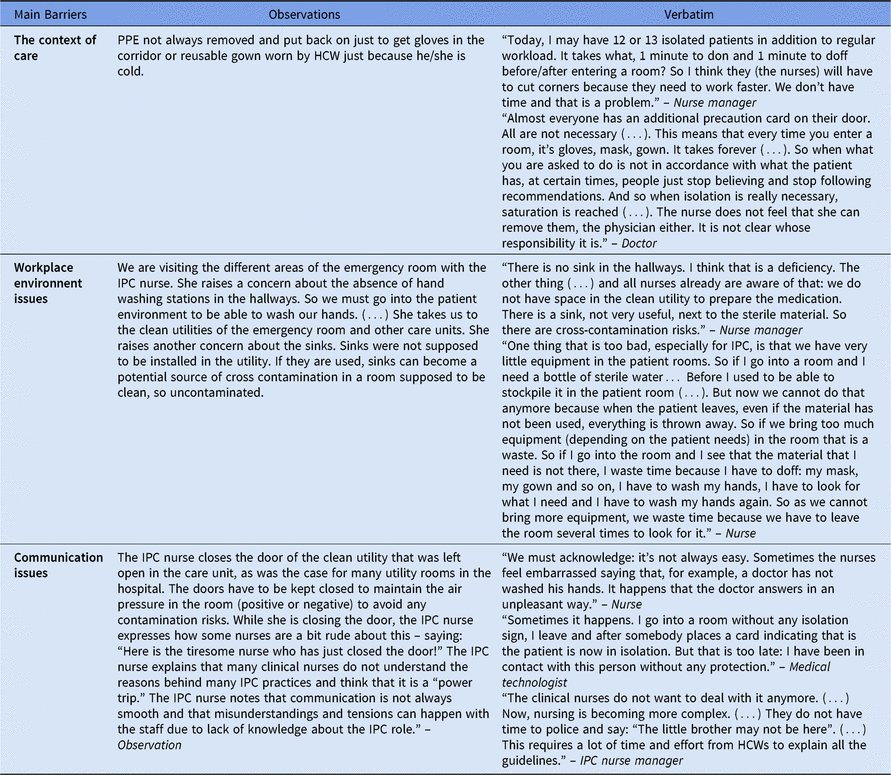
Generally, interviewed managers noted that most HCWs were knowledgeable about recommended IPC guidelines and measures. However, all participants mentioned that HCWs had not systematically adopted recommended IPC measures. Challenges mainly centered around the context of care, workplace environment issues, and communication issues (Table 1).
Main Challenges Met in Infection Prevention and Control (IPC) in Both Hospitals
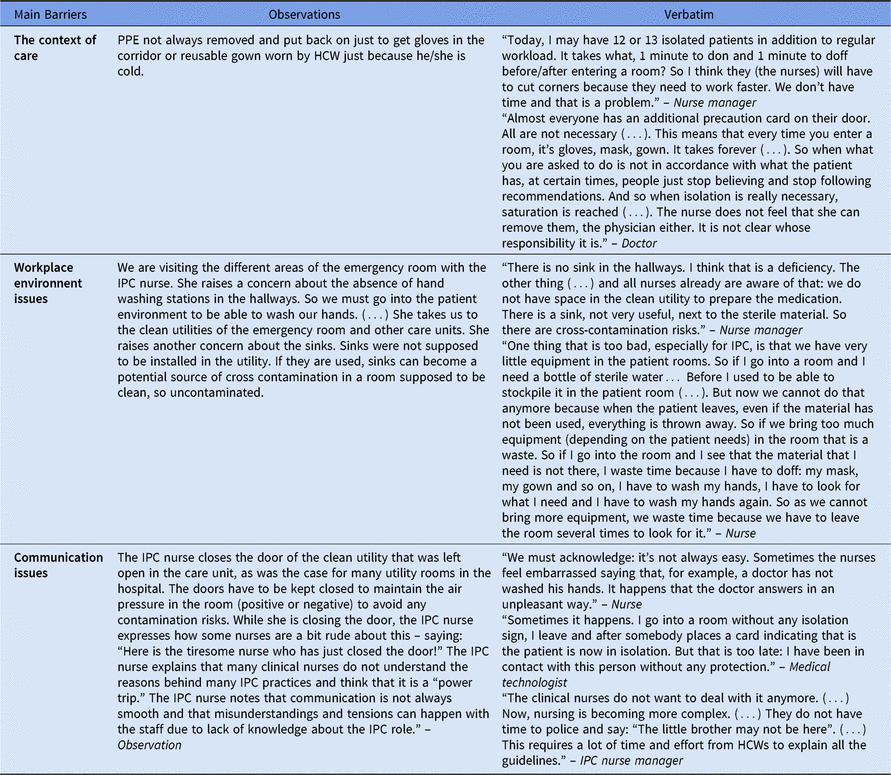
The context of care
First, both hospitals included in this study recently moved to new buildings and for one hospital, the move also merged staff from 3 sites. As mentioned in the interviews with managers, relocations of this magnitude have led to significant challenges for IPC, ranging from the need to adapt IPC guidelines and practices to new physical environments to the loss of local IPC committees.
Second, perceptions about the importance of applying recommended IPC measures varied according to the context of care and priorities: work overload, staff shortage, and management of very sick/critically ill patients. During interviews and observations, frontline HCWs noted that IPC recommendations were sometimes not applied when they judged that IPC measures were not necessary for the task to be performed (eg, they felt that wearing PPE was not necessary when only entering the room without contact with the patient), when they faced other competing priorities (eg, medical emergencies), and when they perceived the workload as excessive (eg, high patient turnover, period of staff shortage, high numbers of critically ill patients). During periods of work overload, some HCWs noted that additional precaution signage was not removed when no longer needed, so they just ignored it.
Equipment, material, and workplace environment issues
Several features of hospitals’ physical layout and structure were identified by HCWs as a barrier to adherence to IPC guidelines: lack of access to sinks or hand hygiene stations in hallways, absence of hooks on the walls outside isolation rooms, layout of clean/dirty utilities on care units, availability of handheld showers with the toilet (prohibited in IPC guidelines), and use of the same antechamber for 2 positive or negative pressure rooms instead of 1 per room. Some HCWs also noted a significant walking distance between patients and to utility rooms.
Some HCWs, managers, and the IPC teams noted issues with material supply (ie, gowns, gloves, and/or hand sanitizer) and a lack of access to medical equipment close to patient rooms on some units.
Communication issues
First, given the large number of HCWs and high staff turnover, as mentioned by managers in interviews, IPC teams were facing several challenges to ensure that all HCWs were informed and aware of IPC recommendations and that regular reminders about good practices were made.
Communication between services was also identified by IPC teams as problematic, even more so during a period of significant changes (eg, relocations of hospitals). Several “grey communication zones” (ie, misunderstandings, disagreements, or communication gaps) were identified in the interviews and observations. For example, medical laboratory technologists, in charge of sample procurement, were not always informed of a patient’s infectious status and could not apply appropriate additional precautions during sample procurement early after admission.
Communication with “outsiders,” such as visitors, consultants, and construction workers, was also problematic. The number of subcontractors and their lack of knowledge about the impact of their work on patient safety were considered a major challenge by IPC teams. For HCWs, lack of time and work overload were barriers to adequately inform and supervise visitors on IPC measures that should be adopted.
Successes in HAI prevention
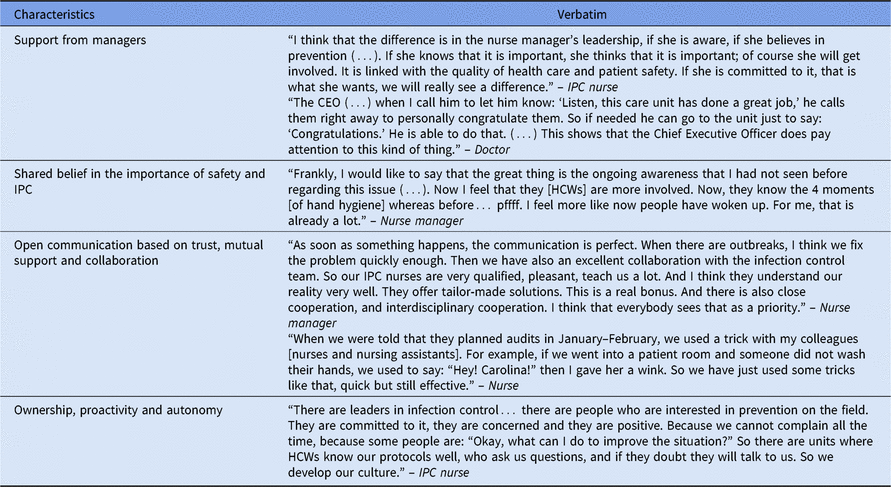
The most important strength noted by participants about HAI prevention was the “development of an IPC culture or safety culture” (Table 2). Different components of the safety culture were identified in the interviews and observations, but they were not equally present across all units. All 4 components of the safety culture were identified in 1 of the 8 participating units. In 3 other units, some components were absent or in the process of being implemented (eg, development communication tools and strategies).
Characteristics of the Infection Prevention and Control (IPC) Culture

Active and positive support from managers for safety (valuing IPC)
The support of the chief executive officer (CEO) and directors was highly valued by the IPC team as an indication of the hospital commitment to IPC. For example, in one hospital, the IPC team was involved in the relocation of the hospital from the initial planning stage to ensure that IPC issues were considered in the hospital layout. The IPC teams also noted the pivotal role of nurse managers as local leaders for IPC on their unit. This leadership was not perceived equally across all units, however. In 3 of 8 units, suboptimal support for safety from managers was observed and was associated with frequent changes in management, work overload, and/or lack of resources.
Shared belief in the importance of safety and IPC
HCW awareness and adoption of IPC recommendations were identified as an important strength in 2 units. According to IPC nurse managers, positive attitudes toward patient safety were often generalized among HCWs working on specific units. As mentioned above, nurse managers who had to deal with outbreaks in the past were more inclined to have positive attitudes toward IPC and to be engaged in developing “unit specific” IPC strategies.
Open communication funded on trust, mutual support, and collaboration
When omissions, errors or incidents occur, the safety culture is illustrated by the capacity to develop communication strategies to gain the trust and support of HCWs. Different communication strategies are tested and sometimes implemented to give feedback: widely disseminating audits results, providing positive feedback and valuing compliant HCWs, organizing short meetings at each work shift to remind HCWs of and discuss important IPC recommendations, and using interpersonal friendly reminders (eg, some nurses in a care unit winked to remind each other to wash their hands). These communication strategies were mainly observed in 4 of the 8 units included in this study.
Ownership of IPC measures, proactivity, and autonomy
The capacity to learn from past experiences and to develop locally relevant IPC strategies while taking into account IPC measures were perceived as a significant strength. This “IPC culture” was described as having more ownership of IPC guidelines, being proactive in finding local solutions, and being able to act to implement these solutions, and it was mainly observed in 4 of the 8 units. Many HCWs (including the housekeeping team) noted that “ownership of IPC measures” and “proactivity” were also due to the collaborative relationships and trust with IPC teams in working together toward common objectives.
Decreasing HAIs: What can be done?
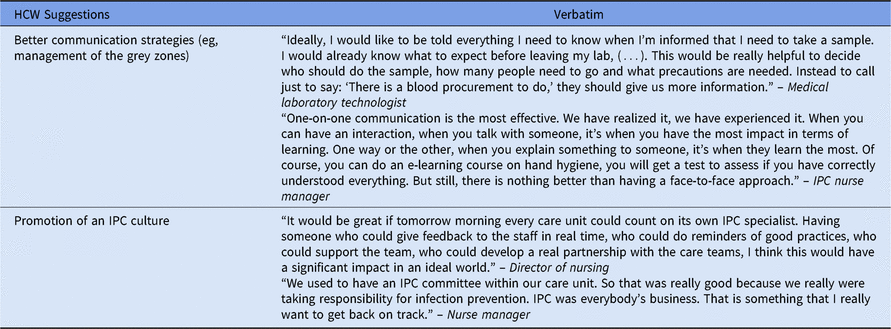
Many HCWs identified specific environmental changes that could be valuable in enhancing IPC, and these changes were related to the challenges identified (Table 3). For example, nurses noted that having specific kits with adequate materials for specific procedures (eg, respiratory or gastroenterology kits, etc), easily available at the bedside would be helpful in decreasing the need to leave the room to get the material, especially for isolated patients when PPE has to be worn.
Healthcare Worker (HCW) Suggestions to Decrease Hospital-Associated Infections (HAIs) Within Their Care Unit

The bulk of interventions suggested by HCWs were related to the promotion of a safety culture within their unit. Many HCWs suggested the implementation of a stable and more specialized IPC role within each care unit, supported by a small team, to manage the main IPC challenges and to ensure the development of a local safety culture. Some mentioned that this could be a specific role for someone on the unit to provide information, reminders, and updates to colleagues; to inform and screen visitors; and to facilitate communication. Another nurse manager suggested the implementation of an IPC committee, specific to the care unit, comprised of different local practitioners with an IPC nurse. Some managers mentioned that the IPC team should be better supported by their manager and the hospital’s direction.
Discussion
Although considerable work to provide clear policies and guidelines to reduce infection transmission in healthcare settings has been done, HCW practices do not always align with recommendations. One key issue, above and beyond IPC strategies, is the development of organizational strategies that “optimize health systems by using human factors engineering, improve and integrate information technology systems, and create and embrace a culture of safety.”Reference Buick, Joffe, Taylor and Conly15 The important role of HCW perceptions and institutional culture on adherence to IPC measures has been highlighted in several studies.Reference Bernard, Bernard, Biron and Lavoie-Tremblay16 – Reference Dixon-Woods, Leslie, Bion and Tarrant18 Staff perceptions of safety culture in their organization has also been associated with lower HAI rates in some studies.Reference Singer, Lin, Falwell, Gaba and Baker19 , Reference Blegen, Sehgal, Alldredge, Gearhart, Auerbach and Wachter20
In this qualitative study, we identified key determinants of the development of an “IPC culture” in care units: leadership support by managers committed to IPC, shared belief in the importance of IPC measures to limit HAIs, collaboration and good communication among staff, as well as proactivity and ownership of IPC measures (ie, development of local solutions to reduce HAIs, “working together” toward common goals). Our findings also demonstrate the importance of context in understanding the IPC culture. As also noted by Dixon-Woods,Reference Dixon-Woods, Leslie, Bion and Tarrant18 our study has highlighted that major changes, such as moving in a new work environment, competing priorities, clinical uncertainties, professional norms, resource inadequacies, organizational pressures and instability with high turnover of managers and staff, are key issues to consider when understanding determinants of HCW adherence to IPC measures. Often, noncompliance to IPC guidelines is not due to lack of knowledge, it is the result of institutional norms and culture. For example, our results demonstrate that the commitment to and endorsement of IPC practices by nurse managers has an impact on the adoption of IPC practice among staff in the unit. Also, having an IPC “champion” in a management position can help ensure that IPC issues are acknowledged and addressed by strategies tailored to the local context. In contrast, high workload and staff shortage were identified as major barriers to the adoption of IPC practices, even among HCWs that are perfectly aware of their importance. In this context, the layout of the physical environment is key to ensuring optimal adoption of IPC practices (eg, easily accessible hang hygiene stations and PPE, appropriate location of clean/dirty utilities to reduce walking distance, etc).
The IPC culture determinants we inductively identified from our qualitative research are similar to the findings of studies that assessed the characteristics of patient safety culture using standardized tools.Reference Bernard, Bernard, Biron and Lavoie-Tremblay16 , Reference Hessels, Genovese-Schek, Agarwal, Wurmser and Larson17 For example, Bernard et alReference Bernard, Bernard, Biron and Lavoie-Tremblay16 identified 3 different safety-culture perceptions in hospitals in Quebec and Belgium. In the “environmental/individual safety culture,” HCWs perceived patient safety from the perspective of IPC practices they could personally adopt to limit HAIs. In the “blaming safety culture,” HCWs perceived patient safety in terms of compliance to IPC guidelines. In the “collaborative safety culture,” HCWs perceived patient safety as the result of a team effort between patients, staff, stakeholders, and visitors on risk management. Their study showed that hand hygiene compliance rates were 35% in the hospital with an “environmental and individual safety culture” compared to 53% in the hospital with the “blaming safety culture” and 77% in the hospital with the “collaborative safety culture.”Reference Bernard, Biron and Lavigne21
These studies and our research emphasize the importance of promoting a culture that encourages HCW participation and involvement in decision making with regard to IPC. However, a key difference is that, in our study, these characteristics were not homogenous within each hospital. We have highlighted many differences in the IPC culture across units. As also emphasized by Halligan and ZecevicReference Halligan and Zecevic7, given these differences in safety cultures, it may be best to focus on the unit level rather than the entire organization, as is currently done in most studies. This is especially important because interventions to promote the adoption of IPC measures will only be effective if they are tailored to meet the needs of targeted groups they were designed for and if they are applicable in the context in which they will be implemented.22 Thus, efforts to improve safety need to be designed to account for the realities of practice, based on an understanding of the logics people are using to inform their practices.Reference Dixon-Woods, Leslie, Bion and Tarrant18
Our study had some limitations. We interviewed a limited number of HCWs. Participation was voluntary, and HCWs who were unavailable or declined to participate may have had characteristics and opinions that differed from those recruited. It is also possible that interviewed HCWs enhanced their responses to interview questions to provide socially desirable answers. We tried to control this by conducting observations and interviews with multiple participants from the same facility, which allowed us to observe HCW behavior and helped us identify any missing information from participant interviews. We reached data saturation for our main objective, to identify key barriers and enablers to adoption of IPC measures. In addition, we used different methodological techniques intended to enrich validity: purposeful sampling using diversification criteria, grounded theory, and double coding.Reference Malterud23 Another strength of our approach was the use of a participatory design, in which HCWs were partners in identifying problems and potential solutions to improve infection prevention in their clinical setting.
In conclusion, an in-depth understanding of the underlying determinants of adoption of IPC measures at the local level is key to design effective tailored interventions. The interdependence of individual factors, environmental constraints, and institutional climate must be considered. Global and local contexts matter. From the official IPC policies and procedures to the details of everyday work, adoption of IPC by HCWs is much more than a question of knowledge and awareness.
Acknowledgments
None.
Financial support
This study was funded by the Fonds de recherche du Québec – Nature et technologies, Fonds de recherche du Québec – Santé, Fonds de recherche du Québec – Société et culture (FRQ) through the Programme bilatéral de recherche collaborative Québec – Communauté française de Belgique. Caroline Quach is the lead investigator of the project.
Conflicts of interest
All authors report no conflicts of interest relevant to this article.