Introduction
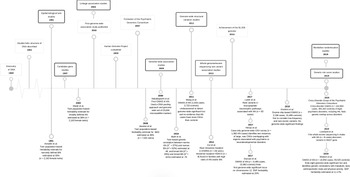
Cross-disciplinary efforts spanning the behavioral sciences, medicine, and genomics are furthering progress toward unlocking the biological basis of eating disorders. These efforts to develop insights into pathophysiology are intended to encompass major translational areas for the personalized care of patients, including screening, risk assessment, and treatment. Genes and the biological pathways underpinning eating disorders could provide novel targets for the development of safe, effective treatments and improve diagnostic nosology and classification of these disorders. This review provides an overview of genetic discoveries in eating disorders from human genomics research in the genome-wide era. Human genomics research in psychiatry has accelerated significantly in the past decade due to advances in high-throughput genomic sequencing and large-scale genomic data sharing and collaboration. A timeline of key achievements in the genetics of eating disorders is shown in Fig. 1. Table 1 overviews the topics covered in this paper and synthesizes the current state of knowledge.
Timeline of key advances in eating disorder genetics. Timeline outlining the history of our understanding of the genetics of eating disorders. Boxes with a heavy outline indicate the dates different types of studies were first undertaken within the eating disorders field. Boxes with a faded outline represent landmark achievements in genetics more broadly. The timeline is not drawn to scale and contains only a small portion of genetic studies in the field. References can be found in the online Supplementary material. AN, anorexia nervosa; BED, binge-eating disorder; BN, bulimia nervosa; CNV, copy-number variation; GWAS, genome-wide association study; h 2, narrow-sense heritability; NNAT, neuronatin (protein coding gene); SNP, single-nucleotide polymorphism.

Summary of the state of knowledge on the genetics of eating disorders

ADHD, attention-deficit/hyperactivity disorder; AN, anorexia nervosa; BED, binge-eating disorder; BMI, body mass index; BN, bulimia nervosa; CNV, copy-number variation; GRS, genetic risk score; GWAS, genome-wide association study; MDD, major depressive disorder; OCD, obsessive-compulsive disorder; SCZ, schizophrenia.
See the manuscript text for citations.
Eating disorders
Eating disorders are mental health conditions characterized by disordered eating behaviors and carry serious physical and mental health morbidity, and elevated mortality (Arcelus, Mitchell, Wales, & Nielsen, Reference Arcelus, Mitchell, Wales and Nielsen2011). The Diagnostic and Statistical Manual of Mental Disorders, fifth edition (DSM-5), defines the most widely recognized eating disorder, anorexia nervosa (AN), as maintenance of a significantly low body weight through restrictive eating behavior, acute fear of gaining weight, and body image disturbance (American Psychiatric Association, 2013). AN is subdivided into two subtypes: restrictive and binge-eating/purging. Binge eating is a key feature of two other DSM-5 defined eating disorders: bulimia nervosa (BN) and binge-eating disorder (BED) (American Psychiatric Association, 2013). BN is accompanied by recurrent compensatory behaviors such as self-induced vomiting (i.e. a purging behavior) and/or fasting (i.e. a non-purging behavior), whereas BED is defined by binge eating in the absence of such behaviors. Unlike with AN, there are no weight criteria for BN and BED. Persons with BN are typically of normal weight and overweight or obese for BED. Although AN and BN have been recognized in the DSM since 1980 (American Psychiatric Association, 1980), BED was only formally recognized as of the DSM-5 in 2013 (American Psychiatric Association, 2013). Lifetime prevalence estimates for AN, BN, and BED range from 0.9% to 1.4%, 0.5% to 1.5%, and 1.2% to 3.5% for females and 0% to 0.3%, 0.1% to 0.5%, and 0.3% to 2.0% in males, respectively (Hudson, Hiripi, Pope, & Kessler, Reference Hudson, Hiripi, Pope and Kessler2007; Preti et al., Reference Preti, Girolamo, Vilagut, Alonso, Graaf, Bruffaerts and Morosini2009; Udo & Grilo, Reference Udo and Grilo2018). The DSM-5 defines additional eating and feeding disorders; however, this review will focus on AN, BN, and BED, due to a current lack of genetic and epidemiological research on other eating disorders.
Genetic epidemiology
Twin studies were among the first lines of evidence to suggest a genetic component for eating disorders. They revealed substantial heritability (h 2twin), which ranges from 16% to 74% for AN (Klump, Miller, Keel, McGue, & Iacono, Reference Klump, Miller, Keel, McGue and Iacono2001; Kortegaard, Hoerder, Joergensen, Gillberg, & Kyvik, Reference Kortegaard, Hoerder, Joergensen, Gillberg and Kyvik2001; Wade, Bulik, Neale, & Kendler, Reference Wade, Bulik, Neale and Kendler2000; Walters & Kendler, Reference Walters and Kendler1995), 28% to 83% for BN (Bulik, Sullivan, & Kendler, Reference Bulik, Sullivan and Kendler1998; Bulik, Sullivan, Wade, & Kendler, Reference Bulik, Sullivan, Wade and Kendler2000; Kendler et al., Reference Kendler, Walters, Neale, Kessler, Heath and Eaves1995), and 39% to 45% for BED (Javaras et al., Reference Javaras, Laird, Reichborn-Kjennerud, Bulik, Pope and Hudson2008; Mitchell et al., Reference Mitchell, Neale, Bulik, Aggen, Kendler and Mazzeo2010). The estimates vary, partly, based on whether studies use threshold or relaxed DSM criteria. For example, the heritability of AN is higher when the definition of AN is broadened to include subsyndromal cases (Dellava, Thornton, Lichtenstein, Pedersen, & Bulik, Reference Dellava, Thornton, Lichtenstein, Pedersen and Bulik2011).
Twin and sibling studies are also a valuable tool to assess the genetic overlap between phenotypes, and have shown that roughly 60% of the genetic effects of AN and BN may be shared (Bulik et al., Reference Bulik, Thornton, Root, Pisetsky, Lichtenstein and Pedersen2010; Yao et al., Reference Yao, Larsson, Norring, Birgegard, Lichtenstein, D'Onofrio and Kuja-Halkola2021). Additionally, twin studies have suggested shared genetic risk between eating disorders and alcohol and substance use disorders (Baker, Mitchell, Neale, & Kendler, Reference Baker, Mitchell, Neale and Kendler2010; Munn-Chernoff & Baker, Reference Munn-Chernoff and Baker2016), obsessive-compulsive disorder (OCD) (Cederlof et al., Reference Cederlof, Thornton, Baker, Lichtenstein, Larsson, Ruck and Mataix-Cols2015), and major depressive disorder (MDD) (Wade et al., Reference Wade, Bulik, Neale and Kendler2000).
Molecular genetics
Twin studies do not illuminate the biological and molecular mechanisms involved in risk for which molecular genetics is instrumental. Genetics research in eating disorders has transitioned to the genome-wide era, furthermore, genome-wide association studies (GWAS) have become the dominant approach to identify genetic risk variants associated with complex traits and disorders. GWAS findings can facilitate gene and biological pathway discovery, polygenic risk prediction, and can illuminate causal risk factors and cross-disorder relationships. In this section, we focus predominantly on molecular genetic discoveries for AN, since such genetic studies of BN and BED are limited.
Genome-wide association studies
To date, there have been several eating disorder GWASs, all on AN (Boraska et al., Reference Boraska, Franklin, Floyd, Thornton, Huckins, Southam and Bulik2014; Duncan et al., Reference Duncan, Yilmaz, Gaspar, Walters, Goldstein, Anttila and Bulik2017; Nakabayashi et al., Reference Nakabayashi, Komaki, Tajima, Ando, Ishikawa, Nomoto and Shirasawa2009; Wang et al., Reference Wang, Zhang, Bloss, Duvvuri, Kaye, Schork and Hakonarson2011; Watson et al., Reference Watson, Yilmaz, Thornton, Hübel, Coleman, Gaspar and Bulik2019). Early GWAS for AN have been subject to important criticisms. With the benefit of hindsight, sample sizes have been too small and underpowered. The first GWAS (320 cases, 341 controls) identified 10 associated microsatellite markers, two of which remained associated in fine-mapping analysis (331 cases, 872 controls). However, the study used DNA pooling which is prone to errors, included only 23 000 markers, and did not safeguard against false positives from multiple testing or population stratification (Nakabayashi et al., Reference Nakabayashi, Komaki, Tajima, Ando, Ishikawa, Nomoto and Shirasawa2009). Neither Wang et al.'s (Reference Wang, Zhang, Bloss, Duvvuri, Kaye, Schork and Hakonarson2011) study among 1033 cases and 3733 controls or the Genetics Consortium of Anorexia Nervosa and Wellcome Trust Case Control Consortium 3 GWAS among 2907 cases and 14 860 controls (Boraska et al., Reference Boraska, Franklin, Floyd, Thornton, Huckins, Southam and Bulik2014) identified any single-nucleotide polymorphisms (SNPs) of genome-wide significance, but this is typical of small sample sizes.
The Psychiatric Genomics Consortium's (PGC) first GWAS for AN, amongst 3495 cases and 10 982 controls, identified one genome-wide significant locus on chromosome 12 (rs 4622308) that also tags genes implicated in type 1 diabetes and other autoimmune diseases (Duncan et al., Reference Duncan, Yilmaz, Gaspar, Walters, Goldstein, Anttila and Bulik2017). SNP-based heritability (h 2snp) was 20% (s.e. = 2%), indicating that common genetic variants accounted for a large proportion of the twin-based heritability of AN (i.e. at least 27%).
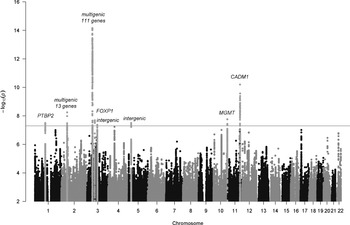
The second PGC GWAS with 16 992 AN cases and 55 525 controls identified eight genome-wide significant loci (Watson et al., Reference Watson, Yilmaz, Thornton, Hübel, Coleman, Gaspar and Bulik2019) (Fig. 2). The locus in the first PGC GWAS did not replicate in the second (p = 7.02 × 10⁻⁵). The risk effect was stronger in the first [i.e. C-allele: odds ratio (OR) 1.20, s.e. = 0.03 v. OR 1.06, s.e. = 0.01] and showed between-cohort heterogeneity in the second GWAS. Note, we expect that if the effect is in the more modest realm observed in the second GWAS, which is likely given it was initially large, or if the source of heterogeneity is accounted for, the locus will re-emerge in subsequent higher-powered data freezes. Gene-wise association tests, expression quantitative trait locus (eQTL) analyses, chromatin interaction analyses, and base pair coordinates implicated 133 genes. The h 2snp ranged from 11% to 17% (s.e. = 1%). The ORs of SNPs with the largest effects were in the same realm (OR ~ 1.08–1.17) as observed for psychiatric disorders with more advanced molecular genetic research (OR ~ 1.05–1.15), such as schizophrenia (Smoller, Reference Smoller2019). The results of these GWAS confirm that AN is highly polygenic and suggest that as sample sizes continue to grow, the field will discover more novel risk variants associated with eating disorders.
Genome-wide significant loci for AN. A Manhattan plot depicting eight genome-wide significant loci associated with AN in the second Psychiatric Genomics Consortium genome-wide association study of AN (Watson et al., Reference Watson, Yilmaz, Thornton, Hübel, Coleman, Gaspar and Bulik2019). In single-gene loci, the gene is annotated. The genome-wide significance threshold (p < 5 × 10⁻⁸) is represented by the horizontal line.

SNP-based genetic correlations
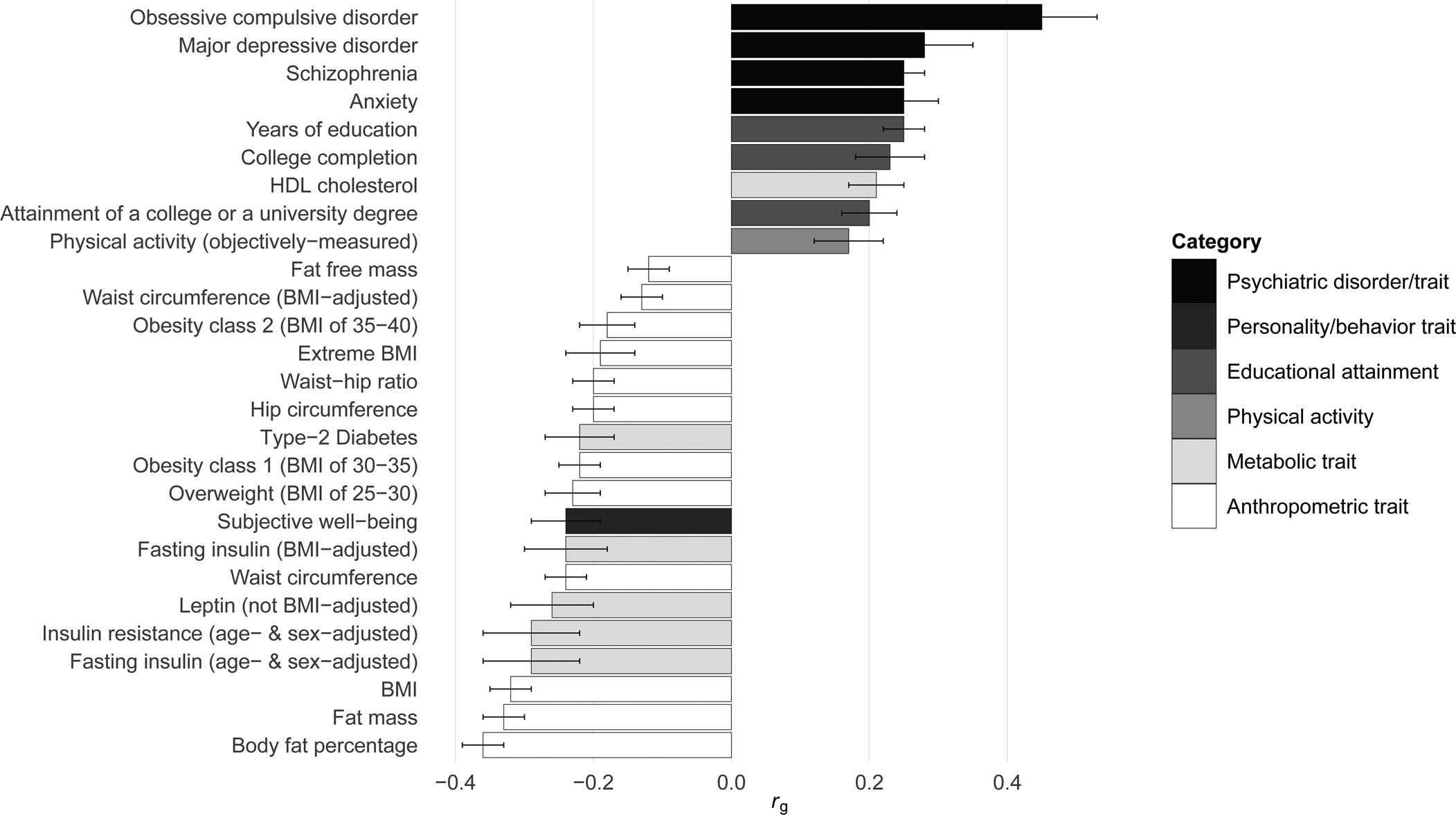
SNP-based genetic correlations (r g) provide insight into the overlapping genetics of traits and give further clues to their biological basis. The second PGC GWAS estimated SNP-r g of AN with 447 phenotypes. Statistically significant results fell into six categories: psychiatric, personality, educational attainment, physical activity, metabolic, and anthropometric (Fig. 3) (Watson et al., Reference Watson, Yilmaz, Thornton, Hübel, Coleman, Gaspar and Bulik2019). AN had significant positive SNP-r g with other psychiatric disorders, corresponding with many of the comorbidities observed in clinical and epidemiological studies (Hudson et al., Reference Hudson, Hiripi, Pope and Kessler2007), and with physical activity, which is compelling since compulsive exercise can be a clinical feature of AN. There were negative genetic correlations with anthropometric and metabolic traits, such as body mass index (BMI), leptin, and fasting insulin. The authors investigated whether the SNP-r g between AN and such traits was confounded by low body weight being a diagnostic criterion of AN, by exploring whether SNP-r gs remained significant after removing variance in AN genetic risk accounted for by BMI risk variants. There were modest and statistically non-significant SNP-r g attenuations with metabolic, glycemic, and anthropometric traits, suggesting that AN may be driven, at least in part, by metabolic mechanisms (Watson et al., Reference Watson, Yilmaz, Thornton, Hübel, Coleman, Gaspar and Bulik2019). This biological clue could explain why those with AN are able to sustain extremely low weights and long-term caloric restriction in the face of strong evolutionary and metabolic forces in the human population toward body fat retention. In a separate study examining the genetic architecture of substance-use-related traits with phenotype sample sizes ranging from 2400 to 537 000, a significant positive genetic correlation was found for AN with cannabis initiation (SNP-r g = 0.23) and alcohol use disorder (SNP-r g = 0.18), but the latter was no longer significant after co-varying for MDD loci (Munn-Chernoff et al., Reference Munn-Chernoff, Johnson, Chou, Coleman, Thornton, Walters and Agrawal2021). Additionally, although a positive genetic correlation was observed with cannabis initiation and AN with binge eating (SNP-r g = 0.27), significant negative genetic correlations emerged for smoking phenotypes and AN without binge eating (SNP-r g = −0.19 to −0.23), providing evidence for potential differences in the genetic architecture of AN subtypes (Munn-Chernoff et al., Reference Munn-Chernoff, Johnson, Chou, Coleman, Thornton, Walters and Agrawal2021).
Genetic correlations (r g) between AN and other phenotypes (Watson et al., Reference Watson, Yilmaz, Thornton, Hübel, Coleman, Gaspar and Bulik2019). Error bars show the standard error of the r g. Correlations with 447 phenotypes were tested. Only significant correlations surpassing a Bonferroni-corrected p value threshold (p < 1.11 × 10⁻⁴) are shown. Complete results are in online Supplementary Table 10 of Watson et al. (Reference Watson, Yilmaz, Thornton, Hübel, Coleman, Gaspar and Bulik2019).

Genetic risk scores
Similar to other psychiatric disorders, genetic risk score (GRS) analyses on GWAS results have suggested that thousands of genetic variants are associated with AN disease risk. GRS, also known as polygenic risk score, is the sum of risk alleles weighted by their effect sizes from GWAS (for a primer, see Wray et al., Reference Wray, Lin, Austin, McGrath, Hickie, Murray and Visscher2021). GRSs for eating disorders are in an early stage of use, given they rely on large, well-powered GWAS. In the second PGC GWAS of AN with 16 992 cases and 55 525 controls, individuals in the highest decile of AN GRS had more than four times the odds of lifetime AN than those in the lowest decile (Watson et al., Reference Watson, Yilmaz, Thornton, Hübel, Coleman, Gaspar and Bulik2019). GRS for psychiatric traits (such as OCD, schizophrenia, and bipolar disorder) and anthropometric traits have shown significant associations with eating disorder diagnosis and symptom phenotypes in population-based samples (Abdulkadir et al., Reference Abdulkadir, Herle, De Stavola, Hübel, Santos Ferreira, Loos and Micali2020; Nagata et al., Reference Nagata, Braudt, Domingue, Bibbins-Domingo, Garber, Griffiths and Murray2019; Solmi, Mascarell, Zammit, Kirkbride, & Lewis, Reference Solmi, Mascarell, Zammit, Kirkbride and Lewis2019). Many uses for GRS in eating disorder research are on the horizon. GRS can be used to investigate premorbid developmental trajectory, endophenotypes, and course of illness, such as disease severity, relapse, and treatment response. Other possible uses include shedding light on diagnostic nosology and classification, modeling gene–environment etiology, and evaluating whether GWAS findings generalize to multi-ethnic populations for which GWAS may not yet be available. Larger GWAS and more powerful GRS will improve prediction accuracy and advance scientific discovery.
Cross-disorder GWAS
Mental health conditions are highly comorbid with one another, and at times differentiation of a diagnosis based on symptoms may be complex, suggesting shared risk. Cross-disorder GWAS have begun to investigate common genetic pathways in etiology (Cross-Disorder Group of the Psychiatric Genomics Consortium, 2013; Cross-Disorder Phenotype Group of the Psychiatric GWAS Consortium et al., 2009). One such effort that included AN and seven other disorders [schizophrenia, bipolar disorder, MDD, attention-deficit/hyperactivity disorder (ADHD), autism spectrum disorder, OCD, and Tourette syndrome] in 232 964 cases and 494 162 controls identified 109 pleiotropic loci, with the 18q21.2 region showing pleiotropic association with all eight disorders (Cross-Disorder Group of the Psychiatric Genomics Consortium, 2019). AN, OCD, and – to a smaller extent – Tourette syndrome clustered together at a genetic level (Cross-Disorder Group of the Psychiatric Genomics Consortium, 2019). A cross-disorder GWAS of AN and OCD (combined sample of 3495 AN cases, 2688 OCD cases, and 18 013 controls) found that the SNP-r gs of the AN-OCD cross-disorder phenotype resembled the SNP-r g patterns of both disorders, but the GWAS did not detect any genome-wide significant variants (Yilmaz et al., Reference Yilmaz, Halvorsen, Bryois, Yu, Thornton, Zerwas and Crowley2020). When the unique contributions by AN and OCD were examined, the metabolic and anthropometric correlations observed were driven by AN and not OCD. A gene-set enrichment analysis using AN and OCD GWAS summary data (among 16 992 AN cases and 55 525 controls and 2688 OCD cases and 7037 controls) also revealed an overlap in many common features of brain regions and developmental stages for AN and OCD in mRNA expression profile, but not as much in DNA-level transcriptome-wide association studies (TWASs) (Cheng et al., Reference Cheng, Qi, Liang, Zhang, Ma, Li and Zhang2020), suggesting a role for future mRNA sequencing efforts alongside GWAS to better understand the biological nature of the shared risk between AN and OCD.
Mendelian randomization
Although follow-up analyses using GWAS data (such as genetic correlations and GRSs) have been instrumental in identifying risk factors associated with eating disorders, they do not provide evidence on causality. Mendelian randomization analysis uses linkage-disequilibrium independent genome-wide significant SNPs identified in GWAS as instrumental variables for a given exposure, and measures the degree to which the exposure is causally associated with the outcome (Davey Smith & Ebrahim, Reference Davey Smith and Ebrahim2003). Since genotypes are transmitted randomly from parents to offspring during meiosis, the genotype distribution should be unrelated to confounding factors that are often present in observational studies (Burgess et al., Reference Burgess, Davey Smith, Davies, Dudbridge, Gill, Glymour and Theodoratou2020; Teumer, Reference Teumer2018). For this reason, Mendelian randomization is often referred to as a natural randomized controlled trial. In the second PGC GWAS of AN, a Mendelian randomization analysis revealed a causal bi-directional relationship between AN and BMI, whereby genetic risk variants for AN led to lower BMI and genetic variants for lower BMI led to an increased risk of lifetime AN (Watson et al., Reference Watson, Yilmaz, Thornton, Hübel, Coleman, Gaspar and Bulik2019). This finding is complemented by, albeit limited, community-based findings that lower BMI predicts the onset of AN (Stice, Gau, Rohde, & Shaw, Reference Stice, Gau, Rohde and Shaw2017; Yilmaz et al., Reference Yilmaz, Schaumberg, Crowley, Breen, Bulik, Micali and Zerwas2019). In general population samples, Mendelian randomization results point to a positive causal association between higher BMI and eating disorder behaviors and symptoms (Reed, Micali, Bulik, Davey Smith, & Wade, Reference Reed, Micali, Bulik, Davey Smith and Wade2017). Similarly, epidemiological results link higher BMI to the onset of body dissatisfaction and disordered eating in the general population (Stice, Presnell, & Spangler, Reference Stice, Presnell and Spangler2002).
Adiponectin is a fat-derived hormone that plays a key role in energy homeostasis and appetite regulation (Coll, Farooqi, & O'Rahilly, Reference Coll, Farooqi and O'Rahilly2007; Steinberg & Kemp, Reference Steinberg and Kemp2007). Altered adiponectin levels have been observed in patients with AN and BN. Awofala, Ogundele, Adekoya, and Osundina (Reference Awofala, Ogundele, Adekoya and Osundina2019) performed a Mendelian randomization study using GWAS summary data for adiponectin (29 347 samples) and eating behavior disinhibition (898 samples) and found that higher blood adiponectin was causally associated with eating behavior disinhibition. These findings support previous studies which showed an association between effect allele carriers in the adiponectin gene and increased frequency of overeating, which may consequently lead to symptoms of eating disorders (Rohde et al., Reference Rohde, Keller, Horstmann, Liu, Eichelmann, Stumvoll and Böttcher2015). These studies point toward innate biological drivers that may lead toward symptoms of eating disorders.
Mendelian randomization for eating disorder research is in its infancy, since the strength of genetic instruments in Mendelian randomization is determined by well-powered GWAS (Zhu et al., Reference Zhu, Zheng, Zhang, Wu, Trzaskowski, Maier and Yang2018). Recent Mendelian randomization approaches allow for nonlinear-associations, which may significantly advance the application of Mendelian randomization in eating disorder research in the future, particularly with respect to anthropometric risk factors (Burgess, Davies, Thompson, & Consortium, Reference Burgess, Davies, Thompson and Consortium2014).
Rare and structural variants
Genetic studies have started to explore the role of rare and structural variants in eating disorders. Regarding studies of copy number variants (CNVs), Wang et al. (Reference Wang, Zhang, Bloss, Duvvuri, Kaye, Schork and Hakonarson2011) examined 2158 AN cases and 15 458 controls and found no evidence that cases had a significantly higher burden of CNVs. However, they identified a recurrent 13q12 deletion (1.5 Mb) in two cases, and CNVs disrupting the CNTN6/CNTN4 region in several cases. Similarly, in a sample of 1983 cases with AN, Yilmaz et al. (Reference Yilmaz, Szatkiewicz, Crowley, Ancalade, Brandys, van Elburg and Bulik2017) found another AN case with a deletion in the 13q12 region. The authors also observed two instances of CNVs with at least 50% reciprocal overlap with regions associated with psychiatric and neurodevelopmental disorders (Yilmaz et al., Reference Yilmaz, Szatkiewicz, Crowley, Ancalade, Brandys, van Elburg and Bulik2017). Alongside these well-established neuropsychiatric CNVs, instances of rare and large CNVs in AN cases were also observed (Yilmaz et al., Reference Yilmaz, Szatkiewicz, Crowley, Ancalade, Brandys, van Elburg and Bulik2017). In addition, mixed results have been found for microduplications at 15q11.2 (Chang et al., Reference Chang, Qu, Liu, Glessner, Hou, Wang and Hakonarson2019; Wang et al., Reference Wang, Zhang, Bloss, Duvvuri, Kaye, Schork and Hakonarson2011; Yilmaz et al., Reference Yilmaz, Szatkiewicz, Crowley, Ancalade, Brandys, van Elburg and Bulik2017).
Whole-exome and whole-genome analyses have also provided evidence for an enrichment of rare variants in AN (Bienvenu et al., Reference Bienvenu, Lebrun, Clarke, Duriez, Gorwood and Ramoz2019; Cui et al., Reference Cui, Moore, Ashimi, Mason, Drawbridge, Han and Lutter2013; Iacobellis & Barbaro, Reference Iacobellis and Barbaro2019; Lombardi et al., Reference Lombardi, Blanchet, Poirier, Lebrun, Ramoz, Rose Moro and Bienvenu2019; Lutter et al., Reference Lutter, Bahl, Hannah, Hofammann, Acevedo, Cui and Michaelson2017). A whole-exome analysis in two independent families with males with AN found variants in the neuronatin (NNAT) gene in both probands: one nonsense variant (p.Trp33*) and one rare variant in the 5′UTR (Lombardi et al., Reference Lombardi, Blanchet, Poirier, Lebrun, Ramoz, Rose Moro and Bienvenu2019). Eleven additional NNAT variants were found in a follow-up cohort of eight male and 144 females with AN. Another study combined exome sequencing, whole-genome sequencing, and linkage analysis to examine two families with recurrence of AN (Cui et al., Reference Cui, Moore, Ashimi, Mason, Drawbridge, Han and Lutter2013). In the first pedigree, they found a missense variant co-segregating with the affected family members in the ESRRA (estrogen-related receptor alpha), and a potentially damaging mutation in the HDAC4 (histone deacetylase 4) in the second pedigree (Cui et al., Reference Cui, Moore, Ashimi, Mason, Drawbridge, Han and Lutter2013). These genes are linked to the estrogen system.
Whole-genome sequencing analyses in eating disorders are less common. Bergen et al. (Reference Bergen, Shih, Zeeland, Carland, Bansal, Magistretti and Schork2019) performed a whole-genome sequencing analysis in six individuals – two maternally-linked cousins with severe AN and their parents – and found, of the approximately 5.3 million variants per individual analyzed, that 494 712 variants were shared identical-by-descent by the cousin pair based on maternally derived haplotypes (Bergen et al., Reference Bergen, Shih, Zeeland, Carland, Bansal, Magistretti and Schork2019). They identified novel variants in seven genes: TTC22, MRPS9, DNAJC30, HEPACAM2, USP20, ESF1, and CDK5RAP1. These findings suggest that there may be utility in whole-genome sequencing of families with affected individuals to detect rare variants that may influence eating disorders (Bergen et al., Reference Bergen, Shih, Zeeland, Carland, Bansal, Magistretti and Schork2019).
Despite strong evidence for the heritable polygenic risk of AN, rare variant contributions of large effect have not yet been identified. Early studies show promise and larger-scale studies with well-matched control groups and replication studies will be necessary for illuminating whether rare and structural variants contribute to eating disorders.
Gene expression
Gene expression offers insight into the genes and molecular mechanisms that influence phenotypes. Note that, whereas GWASs identify inherited genetic variants associated with disease risk and epigenetic studies investigate changes to the physical structure of DNA, gene expression studies measure messenger RNA expression levels in any given tissue, thus capturing the degree to which a gene is being expressed. Howard et al. (Reference Howard, Negraes, Voineskos, Kaplan, Muotri, Duvvuri and French2020) investigated brain regions enriched for gene expression to understand the molecular neuroanatomy of AN. The authors combined the gene lists from two common variant, a rare variant, and a stem-cell study (Duncan et al., Reference Duncan, Yilmaz, Gaspar, Walters, Goldstein, Anttila and Bulik2017; Lutter et al., Reference Lutter, Bahl, Hannah, Hofammann, Acevedo, Cui and Michaelson2017; Negraes et al., Reference Negraes, Cugola, Herai, Trujillo, Cristino, Chailangkarn and Duvvuri2017; Watson et al., Reference Watson, Yilmaz, Thornton, Hübel, Coleman, Gaspar and Bulik2019), and used genetic and transcriptomic resources spanning human fetal and adult and mouse gene expression data. Genes associated with AN resided in subcortical feeding and reward circuits; and furthermore, they implicated microglia genes and genes responding to fasting in mice hypothalami (i.e. RPS26 and DALRD3). Similarly, the PGCs recent GWAS of AN (Watson et al., Reference Watson, Yilmaz, Thornton, Hübel, Coleman, Gaspar and Bulik2019) found an enrichment of gene expression in CNS brain tissues and striatal and hippocampus neurons linked to feeding and reward.
Another set of studies applied transcriptome expression profiling to assess gene expression changes in six individuals with AN before and after inpatient weight restoration. Among the top 20 genes, was down-regulation of genes encoding for a cholesterol side-chain cleavage enzyme (CYPP450scc) and up-regulation of genes related to protein secretion, protein signaling, defense response to bacterial regulation, and olfactory receptor regulation (Kim et al., Reference Kim, Trace, Crowley, Brownley, Hamer, Pisetsky and Bulik2013). Of the top differentially expressed genes, CPA3 and GATA2 expression were positively associated with levels of leptin, a hormone linked to nutritional status and the immune response (Baker et al., Reference Baker, Kim, Crowley, Trace, Brownley, Pisetsky and Bulik2019). This aligns with studies suggesting a genetic overlap between AN, autoimmune disease, and metabolic function (Baker et al., Reference Baker, Kim, Crowley, Trace, Brownley, Pisetsky and Bulik2019).
In a study with seven females with AN and four healthy controls, Negraes et al. (Reference Negraes, Cugola, Herai, Trujillo, Cristino, Chailangkarn and Duvvuri2017) modeled AN using induced pluripotent stem cells, with their transcriptomic analyses revealing a novel gene, TACR1, that may contribute to AN pathophysiology. The TACR1 gene encodes the tachykinin (or neurokinin) 1 receptor which is involved in a range of biological processes, interacts with several neurotransmitters, and has previously been associated with anxiety disorders, bipolar disorder, and ADHD, suggesting a novel system that might contribute to AN symptoms (Schank, Reference Schank2014; Sharp et al., Reference Sharp, McQuillin, Marks, Hunt, Stanford, Lydall and Gurling2014). Although several studies on gene expression in eating disorders exist, there are not many and most have small samples, limiting the conclusions that can be drawn (Kim et al., Reference Kim, Trace, Crowley, Brownley, Hamer, Pisetsky and Bulik2013).
Epigenetic and gene–environment mechanisms
Epigenetics refers to chemical modifications to DNA and chromatin proteins that control gene expression but do not change the underlying base-pair sequence of the DNA (Ryan, Saffery, & Patton, Reference Ryan, Saffery and Patton2018). Epigenetic changes are typically measured via global methylation (amount of methylated cytosine compared to total cytosine) via a candidate gene approach, or more recently, via epigenome-wide association studies (EWAS), which have gained popularity and are carried out in a similar way to GWAS. Global methylation and candidate gene methylation study results in eating disorders, specifically AN, have been mixed, with largely inconsistent findings and opposite effects (Booij et al., Reference Booij, Casey, Antunes, Szyf, Joober, Israël and Steiger2015; Frieling et al., Reference Frieling, Gozner, Römer, Lenz, Bönsch, Wilhelm and Bleich2007; Hübel, Marzi, Breen, & Bulik, Reference Hübel, Marzi, Breen and Bulik2019; Saffrey, Novakovic, & Wade, Reference Saffrey, Novakovic and Wade2014; Tremolizzo et al., Reference Tremolizzo, Conti, Bomba, Uccellini, Rossi, Marfone and Nacinovich2014). EWAS using a hypothesis-free driven method have however identified multiple differentially methylated sites associated with AN (Booij et al., Reference Booij, Casey, Antunes, Szyf, Joober, Israël and Steiger2015; Kesselmeier et al., Reference Kesselmeier, Pütter, Volckmar, Baurecht, Grallert, Illig and Hinney2018; Ramoz, Guillaume, Courtet, & Gorwood, Reference Ramoz, Guillaume, Courtet and Gorwood2017). Samples in these studies have ranged from 29 to 47 AN cases and 15 to 147 controls. TNXB hypermethylation has been replicated, although the significance level was nominal and therefore a false-positive finding cannot be ruled out (Kesselmeier et al., Reference Kesselmeier, Pütter, Volckmar, Baurecht, Grallert, Illig and Hinney2018). TNXB plays a role in maintaining muscles, joints, organs, and skin and regulates the production of collagen. Future studies would need to replicate this finding using larger sample sizes, but these early findings could indicate epigenetic changes in people with eating disorders. Notably, future studies need to be well-designed in order to disentangle epigenetic differences in eating disorder patients by disorder type, tissue type, cell type, and take into account large numbers of environmental factors such as diet, binge eating and purging behaviors, and medication (Horvath & Raj, Reference Horvath and Raj2018; Kubota, Miyake, & Hirasawa, Reference Kubota, Miyake and Hirasawa2012; Moore, Le, & Fan, Reference Moore, Le and Fan2013).
Gene–environment interaction studies in eating disorders have predominantly focused on candidate genes relating to behavior, emotion, and the stress response, such as serotonin and glucocorticoid genes. However, candidate gene studies are subject to false-positive results. Another avenue to study gene–environment interaction is via the use of GRS to capture ‘G’. Recent studies have begun modeling GRS by environment interactions in various psychiatric disorders with some interesting findings (Mullins et al., Reference Mullins, Power, Fisher, Hanscombe, Euesden, Iniesta and Lewis2016). However, this methodology is in its infancy and has not yet been applied to eating disorders due to a lack of well-powered GWAS needed to calculate GRS. In the future, we are likely to see great advancements in this area of study.
Clinical implications
Integrating genomics into clinical practice
Translatability is a key goal for genomics research in eating disorders. Through continued research with larger sample sizes, the era in which personal genomic information – in combination with other known risk factors – occupies a potential role in forecasting eating disorder risk, outcome, and clinical decision-making will emerge. The most immediate benefit of current genomics research is an improved scientific understanding of the role genomics plays in eating disorder risk. For instance, genomics can be integrated into clinical settings in the context of psychoeducation. As part of standard care, health professionals give patients and families psychoeducation about eating disorders, which ought to include up-to-date information about heritability and genetic risk. Communicating information to patients and families is complex for it can arouse emotions such as guilt and fear (i.e. ‘passing on “bad” genes’) and unhelpful cognitions, such as reduced self-efficacy and fatalism, the belief that little can be done to reduce risk. There are few empirical studies on genetic counseling for eating disorders, or mental health in general, but some guidance is available in a synthesis (see Bulik, Blake, and Austin, Reference Bulik, Blake and Austin2019). When communicating with patients, it will be important for clinicians to recognize the possibility of such unhelpful cognitions and to explain to the patient that genetics is just one, non-deterministic piece of the puzzle, in the context of the totality of what is known about the risk for eating disorders. Evidence-based, user-friendly resources for clinicians, patients, and families, continually updated as genomics research evolves, will help patients benefit from cutting-edge research (Bulik et al., Reference Bulik, Blake and Austin2019). In the future when personalized genetic testing may become available, clinicians can collaborate with genetic counselors with expertise in communicating test results.
Bridging the therapeutic impasse
Genomic research progress is taking place contextually in a field with a long-standing clinical plateau in therapeutics, similar to other mental health disorders. The hope is that insights gained through genomics will break through the therapeutic impasse and speed up the search for novel, effective treatments.
Leading, empirically-supported treatments for eating disorders are a half-century old and their efficacy is limited. For example, cognitive-behavioral therapy, developed first for BN in the early 1980s (Fairburn, Reference Fairburn1981) was informed by depression theory and treatment pioneered in the 1960s (Beck, Reference Beck2019); interpersonal psychotherapy treatment was first applied to BN in clinical trials in the 1990s (Fairburn et al., Reference Fairburn, Jones, Peveler, Carr, Solomon, O'Connor and Hope1991); family-based treatment, also known as the Maudsley approach and the most recent addition to the therapeutic repertoire, was developed at the Maudsley Hospital in London in the 1970s (Lock & Le Grange, Reference Lock and Le Grange2013); and pharmacological agents to treat BN and BED, most notably selective serotonin reuptake inhibitors, were an extension of serendipitous discoveries related to depression from the 1950s (an exception is a recent treatment advance for BED in the form of stimulant, lisdexamfetamine; Hudson, McElroy, Ferreira-Cornwell, Radewonuk, and Gasior, Reference Hudson, McElroy, Ferreira-Cornwell, Radewonuk and Gasior2017). The long-term success rates of these treatments are around 25–65% (Agras, Reference Agras1997; Hilbert et al., Reference Hilbert, Bishop, Stein, Tanofsky-Kraff, Swenson, Welch and Wilfley2012; Lock & Le Grange, Reference Lock and Le Grange2019), with many individuals having chronic, partially recovered, or relapsing courses of illness, and no empirically-supported treatment has yet been established for AN in adults.
Understanding the biological pathways involved in eating disorders and the potential drug target genes may be fruitful for developing the next generation of interventions. Schizophrenia GWAS results, for example, are associated with antipsychotic drugs, which are already used in treatment, and also selective calcium channel blockers and antiepileptics, therapeutic classes that present repurposing opportunities (Gaspar & Breen, Reference Gaspar and Breen2017). Similarly, it is hoped that genomics findings will provide leads for novel eating disorder treatments. For example, pharmacological agents that address metabolic processes may represent pharmacotherapeutic targets for AN. Drug targets based on GWAS findings are more likely to be successful in phase II and III clinical trials and to make it to market (King, Davis, & Degner, Reference King, Davis and Degner2019; Nelson et al., Reference Nelson, Tipney, Painter, Shen, Nicoletti, Shen and Sanseau2015).
Future directions
GWAS
The immediate priority is to increase the statistical power of analyses by increasing sample sizes, a pursuit underway within the Eating Disorders Workgroup of the PGC for AN and other eating disorders. Twin and SNP-heritability estimates imply that with increased sample size it is only a matter of time before more risk loci are identified, for example, as has occurred for schizophrenia from 7 loci with ~18k cases (Schizophrenia Psychiatric Genome-Wide Association Study (GWAS) Consortium, 2011) to 108 loci with ~37k cases (Schizophrenia Working Group of the Psychiatric Genomics Consortium, 2014), and for MDD from 0 locus with ~9k cases (Ripke et al., Reference Ripke, Wray, Lewis, Hamilton, Weissman, Breen and Sullivan2013), 44 loci with ~135k cases (Wray et al., Reference Wray, Ripke, Mattheisen, Trzaskowski, Byrne, Abdellaoui and Sullivan2018), and 102 loci with ~246k cases (Howard et al., Reference Howard, Adams, Clarke, Hafferty, Gibson, Shirali and McIntosh2019). The genetic architecture of complex traits and diseases means that individual risk loci account for only a very small fraction of the heritability, but they may tag causal genes and cooperatively make contributions to disease pathways. Furthermore, statistical power will facilitate systems analyses that interpret the data in the context of how gene and biological pathways influence the phenotype, and other types of analyses discussed throughout this paper.
Expansion of eating disorder phenotypes
Similarly, expansion of eating disorder phenotypes to eating disorders beyond AN is needed. This includes gaining an understanding of how phenotype measurement – from gold standard (i.e. yielded through clinical interview) to other means (i.e. register diagnoses, electronic health record data, questionnaire-based algorithms, and self-report diagnosis history) – affects genomic findings. Interestingly, the MDD field found that similar GWAS-related results were yielded under detailed interviewer-based versus self-reported depression diagnosis and that continuous measures of non-pathological depressive symptoms yielded substantial genetic correlations with MDD (McIntosh, Sullivan, & Lewis, Reference McIntosh, Sullivan and Lewis2019). This tapped more samples globally for use and accelerated statistical power and discovery.
Functional genomics
As GWAS and rare and structural variant studies correlate genetic variants with eating disorder phenotypes, functional genomic analyses will be needed to convert these insights into an understanding of the underlying biological mechanisms. These analyses are important for identifying the causal variant tagged by the genome-wide significant SNP, the biological function of the causal variant, and the gene/s involved in its association. Many computational (i.e. statistical fine mapping, eQTL analysis, TWAS, and gene-set enrichment analysis) and molecular biology (i.e. RNA-seq datasets, ChIP-seq studies, Hi-C analysis, chromatin accessibility assays, and knock-out animal models) approaches are being used for functional follow-up. A challenge is that many significant SNP signals in mental health disorders, including AN, are falling in non-protein coding regions.
Conclusions
Genomics is a rapidly-evolving research area in eating disorders. Eating disorders aggregate in families, are moderately heritable, and (at least for AN so far) some of the risk is attributed to genetic variants commonly found in the population (Duncan et al., Reference Duncan, Yilmaz, Gaspar, Walters, Goldstein, Anttila and Bulik2017; Watson et al., Reference Watson, Yilmaz, Thornton, Hübel, Coleman, Gaspar and Bulik2019). Genome-wide era work is beginning to unravel the genetic architecture of AN. Several loci and over 130 genes have shown associations with AN, and genetic overlap between AN and psychiatric (especially OCD), personality and behavioral, physical activity, cognitive, metabolic, and anthropometric traits has been revealed. Now, efforts are needed to elaborate on the functional context of these genes. Genomic approaches such as Mendelian randomization are helping to identify causal risk factors and have so far highlighted the importance of metabolic traits such as BMI, and adiponectin, in AN. Further research is needed to disentangle metabolic genomic factors from low weight in AN. A peek over the horizon into clinical management suggests that patient screening, care, and outcomes may improve from advances in molecular genetics. Genomic discovery depends on very large sample sizes and large-scale collaborations. In the next few years, the Eating Disorders Working Group of the PGC and large-scale studies such as the Eating Disorders Genetics Initiative (EDGI) and Binge Eating Genetics INitiative (BEGIN) (Bulik et al., Reference Bulik, Butner, Tregarthen, Thornton, Flatt, Smith and Deboeck2020) will be important to watch for advances in progress.
Supplementary material
The supplementary material for this article can be found at https://doi.org/10.1017/S0033291720005474
Financial support
AH and AP are supported by the National Institute for Health Research (NIHR) Biomedical Research Centre at the South London and Maudsley National Health Service (NHS) Foundation Trust. HD is supported by an Economic and Social Research Council studentship. HW is supported by the National Institute of Mental Health (NIMH) (U01MH109528, R01MH120170, and R01MH120170). JB is supported by the NIMH (K01MH106675). ZY is supported by the NIMH (K01MH109782; R01MH105500; and R01MH120170) and a Brain and Behavior Research Foundation NARSAD Young Investigator Award (grant no. 28799). The content is solely the responsibility of the authors and does not necessarily represent the official views of the funding agencies.
Conflict of interest
All authors declare that they have no conflicts of interest.