

Introduction
“Every person in our society, regardless of age, is entitled to three things:
[to] live with dignity; to live with security; and to live as an autonomous human being” (Right Honourable Chief Justice of Canada Beverley McLachlin, 2007).
When Elder Abuse and Neglect in Canada was first published in 1991, the field was in a nascent stage, brimming with optimism about the growing awareness and initial research about this “new” form of violence against older adults. Equally of concern at that time was the huge demand for legal and social remedies – demands that outstripped the creation of cohesive policies to combat the problem, along with the research to inform these policies (McDonald, Hornick, Robertson, & Wallace, Reference McDonald, Hornick, Robertson and Wallace1991, p.1). In response, the 1990s introduced a new generation of studies in Canada which had the potential to guide practice, help formulate some policies, and, to a lesser extent, reform legislation (cf. Beaulieu, Reference Beaulieu1992, Reference Beaulieu1994; Beaulieu & Tremblay, Reference Beaulieu and Tremblay1995; Manitoba Seniors Directorate, 1993; McDonald et al., Reference McDonald, Hornick, Robertson and Wallace1991; Pittaway & Westhues, Reference Pittaway and Westhues1993; Poirier, Reference Poirier1992; Reis & Nahmiash, Reference Reis and Nahmiash1995; Stones & Pittman, Reference Stones and Pittman1995; Sweeney, Reference Sweeney1995). Beyond the 1990s, studies turned to institutions, albeit in a limited manner (Bigelow, Reference Bigelow2007; Ens, Reference Ens1999; Hirst, Reference Hirst2000, Reference Hirst2002; Kozak & Lukawiecki, Reference Kozak and Lukawiecki2001; McDonald et al., Reference McDonald, Beaulieu, Harbison, Hirst, Lowenstein and Podnieks2008). Studies focused on attempts to update estimates of prevalence (Pottie Bunge, Reference Pottie-Bunge, Pottie Bunge and Locke2000; Poole & Rietschlin, Reference Poole and Rietschlin2008), community development initiatives (Ontario Government, 2002; WHO, 2002), expanded abuse descriptions (Plamondon & Nahmiash, Reference Plamondon and Nahmiash2006), and legal issues (Canadian Centre for Elder Law, 2009; Watts & Sandhu, Reference Watts and Sandhu2006).Footnote 1 Probably the most important driving force behind these developments was the commitment of governments to increased funding for education and small-scale studies (from both psychosocial and legal perspectives) that were designed to help raise awareness among Canadians about abuse and neglect (PHAC, 2010).
The field of elder abuse and neglect has not, therefore, stood still in the past 20 years; indeed the field has been a hive of activity in its attempt to protect older adults from abuse and neglect. However, much of the work is recycling what is already known, and sometimes cycling uncorroborated information. More of the public, older adults, professionals, and policy makers are aware of abuse and neglect thanks to the New Horizons for Seniors funding initiative to create awareness of elder abuse across Canada (PHAC, 2010). Nevertheless, we still lack fundamental research that is necessary to equitably solve the problem. Research extinguishes urban myths about abused older adults (e.g., that they are all beaten, broken, frail, old women), and therefore by knowing the nature and extent of abuse and neglect we can determine who is counted as abused and who isn’t; who is at risk and who is not. Simply, the nature of the problem determines what the legislation covers and what it doesn’t cover and it determines who is eligible for service and who is not eligible for service (Biggs, Erens, Doyle, Hall, & Sanchez, Reference Biggs, Erens, Doyle, Hall and Sanchez2009). The nature of abuse will determine the type of treatment offered and, ultimately, the effectiveness of the treatment in halting the abuse and neglect. Thus, accurate data about abuse and neglect ensures accuracy in screening, classification, and appropriate treatment, if not prevention (McDonald, Collins, & Dergal, Reference McDonald, Collins, Dergal, Alaggia and Vine2006).
In recent history, a number of gerontologists did not consider abuse and neglect of older adults seriously because the numbers seemed too small to warrant attention. Although we still do not know the true extent of abuse in many jurisdictions like Canada, it has been shown in a nine-year, prospective cohort study in the United States that elder abuse has serious outcomes. Abuse was found to be associated with a more than threefold increased likelihood of mortality compared to those not abused (Lachs, Williams, O’Brien, Pillemer, & Charlson, Reference Lachs, Williams, O’Brien, Pillemer and Charlson1998).
The purpose of this article, then, is to review some of the developments that have occurred in the field of elder abuse and neglect since the publication of Elder Abuse and Neglect in Canada in 1991. In 1991, the monograph concluded that knowledge of elder mistreatment was “severely limited” in Canada and globally because of imprecise definitions of mistreatment, a paucity of incidence and prevalence studies, the lack of comprehensive theory and the need for many theories, the lack of due process safeguards in some of the Canadian legislation, and, in terms of intervention, few evidence-based services or programs. Here, we revisit the issues about the incidence and prevalence of abuse; the problems of definitions of elder abuse and neglect; the lack of progress on the theoretical front and the related problem of identifying risk factors for abuse and neglect. Changes in the adult protection legislation and related research are examined as are the state of interventions for mistreatment. The discussion concludes with a look at some ideas for future research.Footnote 2
The argument here is that the research in Canada, as situated within the context of international research, has not changed substantially in terms of outcomes despite the burgeoning number of “awareness-building” qualitative studies, the manuals, “tools”, websites, and protocols for assessment and intervention. The arguments are twofold: there is still little information about the prevalence and incidence of elder abuse and neglect in the community in Canada, the last dedicated study having been completed in 1989 (Podnieks, Pillemer, Nicholson, Shillington, & Frizzel, Reference Podnieks, Pillemer, Nicholson, Shillington and Frizzel1990). Unfortunately, there has never been a Canadian study of prevalence or incidence of elder abuse in institutions. Moreover, although there are hundreds of interventions available, few, if any, are based on evidence, and if evaluated rigorously, none have been shown to be particularly effective. As a result, there remains a poor understanding of the extent of the problem in Canada, with no substantial research on risk factors for abuse, no way to determine that the problem is better or worse, and no way to compare Canada to other nations to assess how Canada measures up internationally. Even though there are a number of qualitative studies of abuse, none has been devoted to theoretical advancements that might help explain abuse and neglect. Perhaps worse, nothing seems to put an end to the mistreatment. This is a story repeated in many areas of the world (Pillemer, Mueller-Johnson, Mock, Suitor, & Lachs, Reference Pillemer, Mueller-Johnson, Mock, Suitor, Lachs, Doll, Bonzo, Mercy and Sleet2006) although in some countries the research is better (e.g. Britain, Spain, Israel) than in others. That the cadre of elder abuse researchers is relatively small in Canada and worldwide simply exacerbates the problems with research. For these reasons, it is argued here that the glass is only half full when it comes to research on the abuse and neglect of older persons.
What We Actually Know about the Extent of Elder Abuse
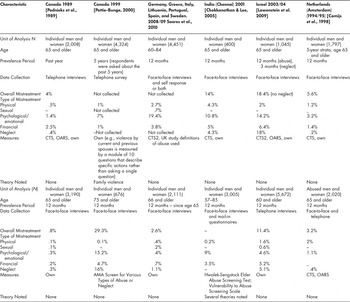
Without wading into the morass of definitional confusion, it is sufficient to note that most researchers would agree on three basic categories of elder abuse: (a) abuse of the older adult in the community; (b) institutional abuse; and (c) neglect. Most would also agree on the major types of abuse – physical, psychological, financial, and sexual abuse, but beyond this classification, there is little agreement, especially about neglect which can be intentional, non-intentional, and self-inflicted according to some (Bonnie & Wallace, Reference Bonnie and Wallace2003).Footnote 3 One of the more important developments since 1991 is the increase in prevalence studies worldwide. Tables 1 and 2 provide an overview of these studies drawn from an unpublished systematic review on the basis of an ongoing research project about definitions of mistreatment in Canada (McDonald et al., Reference McDonald, Beaulieu, Harbison, Hirst, Lowenstein and Podnieks2008). Out of hundreds of articles, the inclusion criteria were four: (a) the target population was defined by clear inclusion and exclusion factors (e.g., age); (b) probability sampling was utilized; (c) the data collection methods were standardized (closed-ended survey questions administered face-to-face, by telephone, paper and pencil); and (d) the abuse measures were standardized and valid (e.g., Conflict Tactics Scale).
Overall, 12 community prevalence studies in the research literature met the inclusion guidelines relevant to the research program. The community prevalence research included two studies from Canada (Podnieks, Reference Podnieks1993; Pottie Bunge, Reference Pottie-Bunge, Pottie Bunge and Locke2000); three from the United States (Acierno et al., Reference Acierno, Hernandez, Amstadter, Resnick, Steve and Muzzy2010; Laumann, Leitsch, & Waite, Reference Laumann, Leitsch and Waite2008; Pillemer & Finkelhor, Reference Pillemer and Finkelhor1988); one from India (Chokkanathan & Lee, Reference Chokkanathan and Lee2005); five from Europe (Comijs, Smit, Pot, Bouter, & Jonker, Reference Comijs, Smit, Pot, Bouter and Jonker1998; Executive Agency for Health and Consumers, 2010; Garre-Olmo et al., Reference Garre-Olmo, Planas-Pujol, Lopez-Pousa, Juvinya, Vila and Vilalta-Franch2009; Iborra, Reference Iborra2005; O’Keeffe et al., Reference O’Keeffe, Hills, Doyle, McCreadie, Scholes and Constantine2007); and one from Israel (Lowenstein, Eisikovits, Band-Winterstein, & Enosh, Reference Lowenstein, Eisikovits, Band-Winterstein and Enosh2009).
As Table 1 shows, the prevalence rates vary widely between countries (2.6% in the UK versus 29.3% in Spain) and within countries, as is the case for the United States and Spain. This comes as no surprise because the age for inclusion varies, as does the prevalence periods, the types of abuses addressed, the mechanisms for data collection, and the measures used. The most common factor among the studies was the absence of a theoretical model to guide the research except in one instance in which a family violence perspective was used (Pottie Bunge, Reference Pottie-Bunge, Pottie Bunge and Locke2000).
National Estimates of Prevalence of Mistreatment in the Community, Selected Countries

NOTE
An Irish community prevalence study was released in November 2010 by the national Centre for the Protection of Older People in Ireland, The random sample for this study consisted of 2,021 individual men and women, aged 65 and older who participated in face-to-face interviews. In the last 12 months the sample experienced 2.2% overall abuse, 1.3% financial abuse, 1.2% psychological abuse, .5 % physical abuse, .05 sexual abuse and .3% neglect. Retrieved June 2011, from http://www.ncpop.ie/index.php?uniqueID=1
ADLs: Activities of Daily Living
CTS: Conflict Tactics Scale
OARS: Older Americans Resources and Services Program .
Own: New measure developed by researcher
Since 1991, the most recent community-based study in Canada – the 1999 General Social Survey on Victimization – interviewed 4,324 randomly selected older adults over age 65, by telephone. Only one per cent of this population indicated physical or sexual abuse by a spouse, adult child, or caregiver in the five years prior to the survey (Pottie Bunge, Reference Pottie-Bunge, Pottie Bunge and Locke2000) while Podnieks et al. (Reference Podnieks, Pillemer, Nicholson, Shillington and Frizzel1990) found that 0.5 per cent of older persons living in private dwellings had experienced some form of physical violence. According to Pottie Bunge (Reference Pottie-Bunge, Pottie Bunge and Locke2000), seven per cent experienced psychological abuse compared to 1.4 per cent in the Podnieks et al., (Reference Podnieks, Pillemer, Nicholson, Shillington and Frizzel1990) study in 1989 and one per cent financial abuse, compared to two and a half per cent financial abuse in the Podnieks survey in 1989. Even though the two prevalence studies are often compared, this is misguided because the prevalence periods are different (i.e., five years versus one year), the abuse categories are different (i.e., sexual abuse was not measured in the Podnieks study) and different measures of financial abuse were used. As a result, little can be said about an increase, decrease, or constancy in abuse rates from 1989 to 1999 because of the differences between the studies.
Without doubt, some headway has been made given the increasing number of prevalence studies, although there are still problems. Most of the prevalence studies suffer from some type of limitation such as (a) inadequate sample size (e.g., Chokkanathan & Lee, Reference Chokkanathan and Lee2005), (b) limited descriptions of sample estimation procedures, (c) use of general surveys constructed for other reasons (e.g., Pottie Bunge, Reference Pottie-Bunge, Pottie Bunge and Locke2000), (d) inadequate information about response rates (e.g., Comijs et al., Reference Comijs, Smit, Pot, Bouter and Jonker1998), (e) the use of only retrospective studies with no etiology on the different types of abuse (e.g., Acierno et al., Reference Acierno, Hernandez, Amstadter, Resnick, Steve and Muzzy2010), and (f) little information on the psychometric properties of the measurements, especially when they were modified to suit the survey (e.g., Laumann et al., Reference Laumann, Leitsch and Waite2008).
It wasn’t until the early 1990s that the federal government, through the family violence initiative, highlighted the abuse and neglect of older adults in institutions by commissioning a literature review (Ens, Reference Ens1999), several discussion papers (Spencer, Reference Spencer1994; Spencer & Beaulieu, Reference Spencer and Beaulieu1994), and a three-part monograph on abuse and neglect in institutions (Kozak & Lukawiecki, Reference Kozak and Lukawiecki2001). The latter represented the views in publicly funded institutions of residents, staff, and family according to their perspectives of what constituted abuse and neglect, what should be done about it, and a description of what an abuse-free environment would be. In one of the first attempts to establish the prevalence of institutional abuse and neglect in Canada, a random telephone survey of 804 nurses and nurses’ aides in Ontario, 20 per cent reported witnessing abuse of patients in nursing homes, 31 per cent witnessed rough handling of patients, and 28 per cent witnessed yelling and swearing at patients (College of Nurses of Ontario, 1993). Where the abuse was witnessed, over what time frame, and to whom it was directed, was not explained. To date, there continues to be considerable interest in abuse and neglect in care facilities on the part of the public, the media, researchers, and educators, along with myriad organizations (McDonald et al., Reference McDonald, Beaulieu, Harbison, Hirst, Lowenstein and Podnieks2008), but the reality is that the prevalence and incidence of abuse and neglect in institutions in Canada remains unknown.Footnote 4
Table 2 provides an overview of the more robust studies done worldwide on institutional abuse. The institutional abuse studies include three from the United States (Griffore et al., Reference Griffore, Barboza, Mastin, Oehmke, Schiamberg and Post2009; Pillemer & Moore, Reference Pillemer and Moore1989; Ramsey-Klawsnik, Teaster, Mendiondo, Marcum, & Abner, Reference Ramsey-Klawsnik, Teaster, Mendiondo, Marcum and Abner2008); two from Germany (Göergen, Reference Göergen2001, Reference Göergen2004); one from Norway (Malmedal, Ingebrigtsen, & Saveman, Reference Malmedal, Ingebrigtsen and Saveman2009); one from Finland (Nurminen, Puustinen, Kukola, & Kivela, Reference Nurminen, Puustinen, Kukola and Kivela2009); one from Sweden (Saveman, Astrom, Bucht, & Norberg, Reference Saveman, Astrom, Bucht and Norberg1999); and one from Italy (Ogioni et al., Reference Ogioni, Liperoti, Landi, Soldato, Bernabei and Onder2007). There was one reliable pilot study of institutional abuse carried out in the United Kingdom by Purdon et al. (Reference Purdon, Speight, O’Keeffe, Biggs, Erens and Hills2007), not reported in Table 2 because it was a feasibility study of how to study abuse in an institution. As is evident in Table 2, the absence of a Canadian study is still the norm today.
National Estimates of Prevalence of Mistreatment in the Institution, Selected Countries

MDS-HC: Minimum Data Set for Home Care
The increasing research on institutional mistreatment is at least informative for any future study in Canada. The recent growth of institutional studies has demonstrated how methodological issues are amplified when the research focus moves from the community to the institution. The institutional studies indicate that staff members were more likely to be asked about abuse than the older adults themselves, and if staff were unavailable, families served as proxies. The methodological problems are similar to those found in community studies of prevalence; however, there is the added complication of whom to interview: the staff and what level of staff, or family members and which family members. One of the studies in Germany indicated that 37 per cent of staff providing hands-on care self-reported psychologically abusing an older adult, but the number differed in a repeat German study by the same author who reported 53.7 per cent of staff self-reported psychological abuse during hands-on care (Göergen, Reference Göergen2001, Reference Göergen2004). In the United States, a random sample study of nursing homes found 40 per cent of nurses, representing three levels of staff, self-reported psychological abuse (Pillemer & Moore, Reference Pillemer and Moore1989).
In contrast, 34.6 per cent of family members reported one to two incidents of psychological abuse of their relative in a nursing home (Griffore et al., Reference Griffore, Barboza, Mastin, Oehmke, Schiamberg and Post2009). In such instances, either the staff or the family member might be the abuser so an interview of the older adult, usually in person, is often preferable (Purdon et al., Reference Purdon, Speight, O’Keeffe, Biggs, Erens and Hills2007). Nevertheless, the problem is challenging to researchers especially in cases where older adults have cognitive impairments: in those situations, interviews with staff and families, and perusal of medical records, are the alternatives to interviews of the older adults. Notably, none of the prevalence studies included persons with cognitive impairments.
Marshal, Benton, and Brazier (Reference Marshall, Benton and Brazier2000) have argued that abuse is worse in the community than in institutions, but there are no grounds for this observation because the two cannot be compared on the basis of research design, especially since the respondents are different. What is significant about institutions in Canada in 2010 is twofold. First, the proportion of people aged 65 or older living in institutions has remained stable at seven per cent since 1981 (Ramage-Morin, Reference Ramage-Morin2005); however, the actual number living in health care institutions rose from 173,000 to more than 263,000 residents in 2005 (Ramage-Morin, Reference Ramage-Morin2005). As a result, even though the latest government policies support “aging-in-place” (Szikita Clark, Reference Szikita Clark2008), there will still be a substantial number of older adults who require institutional care (Kozak & Lukawiecki, Reference Kozak and Lukawiecki2001; Ramage-Morin, Reference Ramage-Morin2005). If the same level of institutionalization is maintained, it has been projected that over half a million (565,000) Canadians will require long-term care by 2031 (Trottier, Martel, & Houle, Reference Trottier, Martel and Houle2000), and the quality of care – including the prevention of abuse and neglect of residents – will become increasingly significant.
The second point to be made about institutionalization in Canada is that those 85 years and older constitute the largest age group in long-term care settings and are frailer, have more complex needs, and are more likely to have some degree of cognitive impairment, such as dementia, or physical disabilities compared to their community-residing counterparts (Spector, Fleishman, Pezzin, & Spillman, Reference Spector, Fleishman, Pezzin and Spillman2001). Only about 12–13 per cent of residents are married, and many others lack a close family member who lives within an hour of the facility (Hawes, Reference Hawes2002). Without an advocate, older adults in institutions are more dependent on others to provide care that heightens their vulnerability to abuse and neglect. Within this context, a study of institutional mistreatment in Canada would seem reasonable.
Definitional Disagreements
Today, as was the case in the 1990s, few researchers can discuss the abuse and neglect of older adults without first pausing to describe exactly what words will be used to explain the phenomenon. The discussion of definitions of elder mistreatment is both passionate and sometimes unpleasant: terms that are offensive to some are acceptable to others;Footnote 5 ethnic and marginalized groups reportedly have their own definitions which do not match the conventional definitions (Bent, Reference Bent2009; Moon, Reference Moon2000); researchers and practitioners rarely see eye-to-eye (Payne, Reference Payne2002); practitioners from different professions have difficulties communicating with each other, and older adults themselves are often ignored in the debate (Bennett, Reference Bennett1990; Bonnie & Wallace, Reference Bonnie and Wallace2003; Council of Europe, 1992; Decalmer & Glendenning, Reference Decalmer and Glendenning1993; Kozma & Stones, Reference Kozma, Stones and MacLean1995; Pillemer & Finkelhor, Reference Pillemer and Finkelhor1988; Sanchez, Reference Sanchez1996; Wallace, Reference Wallace1996). In support of the difference in perspectives, a Canadian study found that there was considerable difference between the public’s view of physical abuse and that of elder abuse professionals (Geobytes, O’Connor, & Mair, Reference Geobytes, O’Connor and Mair1992).
As would be anticipated, the definitions of mistreatment reflect the differences in purpose and agendas of the various stakeholders. There is no uniformity of the categories used by the experts, coupled with a lack of uniformity within the categories themselves. Some researchers, for example, include sexual abuse as a category while other researchers omit this category (Lowenstein et al., Reference Lowenstein, Eisikovits, Band-Winterstein and Enosh2009; O’Keeffe et al., Reference O’Keeffe, Hills, Doyle, McCreadie, Scholes and Constantine2007). The most common measurement used to evaluate physical and psychological abuse is the Conflict Tactic Scale (CTS), or its later version CTS2; however, in some studies the Conflict Tactics Scales is modified to suit each study (e.g., Lowenstein et al., Reference Lowenstein, Eisikovits, Band-Winterstein and Enosh2009; Podnieks et al., Reference Podnieks, Pillemer, Nicholson, Shillington and Frizzel1990). As well, the categories can contain such a wide range of abuses that they tend to become ineffectual in application because every act (e.g., spiritual abuse) in effect becomes abusive or neglectful (Spencer & Gutman, Reference Spencer and Gutman2008), which is unrealistic. In addition, some definitions focus on the outcome of abuse while others contain reference to the causal factors, the means, or the outcomes of abuse (Johnson, Reference Johnson1991; Stones, Reference Stones and MacLean1995).
The legal definitions of abuse and neglect are no less challenging. An unpublished work by the Canadian Centre for Elder Law (Canadian Centre for Elder Law, 2009) indicates that definitions of elder abuse and neglect in Canada have evolved differently than in other prevalence study jurisdictions. Because of Canada’s unique and forward definitions of breach of fiduciary duty, trust relationship breaches have their own more developed area of law, which is argued in addition to other “elder abuse” type torts. As such, definitions found in the common law in Canada are not limited to situations “in a relationship where there is an expectation of trust”. Rather, the scope of what is considered “elder abuse” in Canadian common law is significantly broader and can include systemic issues, stranger-targeted elder abuse, and directed exploitative marketing and “grooming” of an elder victim.
According to Watts and Sandhu (Reference Watts and Sandhu2006), within the criminal context, Canada has no specific “elder abuse” code provision, such as those found within some other prevalence study comparator jurisdictions such as the United States. Generally, elder abuse and neglect cases are woven into criminal code charges such as assault and aggravated assault, unlawfully causing bodily harm, murder/manslaughter, forcible confinement, criminal negligence, fraud, extortion, forgery, theft, theft by person holding a power of attorney, unlawful conversion, and sexual assault. However, there is also a growing body of criminal case law which has been using key sections of the criminal code to prosecute “elder abuse and neglect” cases. In particular, there has been a recent expansion of Canada’s Criminal Code, R.S., 1985, c. C-46, s. 215, on failure to provide the necessaries of life. Recent decisions of elder abuse and neglect have expanded understandings of failure to provide necessaries and have also broadly interpreted this section. In a recent case, financial abuse was formally connected with this section, paving the way for new elder abuse and neglect cases to more easily be located and prosecuted under this section. Again, the Canadian definition of elder abuse and neglect is different, in the legal context, and clearly does not require a “relationship where there is an expectation of trust” to exist.
Only one study has attempted to systematically analyze the variations in definitions and risk factors. In a secondary analysis of the data from the United Kingdom Study of Neglect and Abuse of Older People, researchers were able to expand the baseline definitions, the types of perpetrators, and reduced the number of times abuse or neglect occurred (Biggs et al., Reference Biggs, Erens, Doyle, Hall and Sanchez2009). As an example from this analysis, a widening of the definition of mistreatment to include single incidents of neglect and psychological abuse (rather than only counting cases including 10 or more events) increased the prevalence of neglect, as did expanding the definition to include neighbours and acquaintances as well as family, friends, and care workers as perpetrators. The one-year prevalence of mistreatment, based on a sample of 2,111 people aged 66 and older in the United Kingdom, was 2.6 per cent for the baseline definition. This increased to 5.3 per cent when only one incident of psychological abuse and neglect was counted, and to 8.6 per cent when mistreatment by neighbours and acquaintances was included. In essence, the prevalence of mistreatment increased from 1 in 40 to almost 1 in 10 when the definitions were changed. The unevenness of the definitions and their imprecise nature have contributed to the challenge of moving forward and investing in expensive prevalence and incidence studies that many Canadians may not agree with and never use. Also, Lachs (Reference Lachs2004), an American researcher, has argued that it might be easier to do nothing when there is no proof of abuse. Although it is now 20 years since this problem was identified in Canada, the Canadian government – through Human Resources and Skills Development Canada (HRSDC) – has recently tried to meet the challenge. HRSDC supports research to establish consistent definitions of elder abuse and neglect, theoretical development, and definitions of risk factors that most Canadians can agree on, with the aim that prevalence studies can be conducted in the community and institutions sometime in the future (PHAC, 2010).Footnote 6
Theoretically on Hold
It has been proposed in other contexts that establishing an explanation for abuse and neglect could be more important than determining prevalence, because explanations are integral to the development of preventative programs (Hawes, Reference Hawes2002). Unfortunately, there has been very little theorizing about abuse and neglect that occurs in the community or institutions (Ansello, Reference Ansello, Baumhover and Beal1996; Bonnie & Wallace, Reference Bonnie and Wallace2003; Harbison et al., Reference Harbison, Beaulieu, Coughlan, Karabanow, VanderPlaat and Wildeman2008; Phillips, Reference Phillips1983; Schiamberg & Gans, Reference Schiamberg and Gans1999; Wolf & Pillemer, Reference Wolf and Pillemer1989). Reasons for this are many (cf. Harbison et al., Reference Harbison, Beaulieu, Coughlan, Karabanow, VanderPlaat and Wildeman2008; McDonald, Reference McDonald and Birren2007, Reference McDonald2008). All of the theories in the field of elder abuse are well-known and have been critiqued extensively to the point that it is obvious that the theories are not especially useful (Harbison et al., Reference Harbison, Beaulieu, Coughlan, Karabanow, VanderPlaat and Wildeman2008; McDonald & Collins, Reference McDonald and Collins2000). In brief, much of the literature on elder abuse does not sufficiently distinguish between theoretical explanations and the individual factors related to mistreatment. In the elder abuse literature, particular factors, such as stress or dependency, are often treated as complete theoretical explanations although they are only factors and could be incorporated in any of the theories.
Many scholars have realized that there is a broad diversity in the manifestations of abuse and neglect and so have abandoned their search for a comprehensive, all-inclusive explanation of the phenomena. In the future, new theories of elder abuse may explain different dimensions of abuse and neglect but only a few have thus far been engaged in this undertaking (Shaw, Reference Shaw1998). Also, none of the more popular theories can link structural and individual factors for a more complete understanding of abuse; consequently, it comes as no surprise that there may be different theoretical frameworks required for institutional and domestic mistreatment.
Questioning approaches that consider only individual aspects of abuse as represented by the “biomedical model”, Bonnie and Wallace (Reference Bonnie and Wallace2003) developed a flexible model that encompasses social, psychological, and physiological factors within a social structural context. Their proposed model can be applied equally well to domestic abuse or institutional abuse. This framework is attractive because it covers the interactive nature of the abusive relationship, status inequality, and outcomes. In essence, the model is transactional, unfolding over time between the older adult and trusted others in the context of changing social, psychological, and physical circumstances of the parties involved and the aging of the older adult. The model is embedded in a sociocultural context that at least considers geographical locus, housing locus, and ethnicity (Bonnie & Wallace, Reference Bonnie and Wallace2003, p. 62). The authors argued that without some type of theoretical approach to data collection, facts about elder abuse and neglect in community or institutional settings will continue to be misleading and non-cumulative (p. 60).
Recently, McDonald (Reference McDonald2008) has argued that explanations of elder abuse in institutional settings is a case of the under-determination of theory and proposed that, to integrate findings, researchers could consider theory from the field of complex organizations. The under-determination of theory refers to a set of facts that can support any number of theories. The most reported factors from the research today have not changed much from 1991 and continue to emphasize staff training and resident aggression (Beaulieu & Tremblay, Reference Beaulieu and Tremblay1995; Braun, Suzuki, Cusick, & Howard-Carhart, Reference Braun, Suzuki, Cusick and Howard-Carhart1997; Brennan & Moos, Reference Brennan and Moos1990; Cassell, Reference Cassell1989; Chappell & Novack, Reference Chappell and Novack1992; Feldt & Ryden, Reference Feldt and Ryden1992; Gilleard, Reference Gilleard and Eastman1994; Göergen, Reference Göergen2001; Kingdom, Reference Kingdom1992; Meddaugh, Reference Meddaugh1993; Pillemer & Bachman-Prehn, Reference Pillemer and Bachman-Prehn1991; Spencer, Reference Spencer1994; Stilwell, Reference Stilwell1991; Whall, Gillis, Yankou, Booth, & Beel-Bates, Reference Whall, Gillis, Yankou, Booth and Beel-Bates1992). These factors, which have sometimes been referred to as the “blame and train” list, are ineffective as a list of problems because the roots of the problem are in the organization and its environment. Institutional organizational theory (DiMiaggio & Powell, Reference DiMiaggio and Powell1983; Greenwood, Oliver, Sahlin, & Suddaby, Reference Greenwood, Oliver, Sahlin, Suddaby, Greenwood, Oliver, Sahlin and Suddaby2008; Meyer & Rowan, Reference Meyer and Rowan1977; Selznick, Reference Selznick1949) that sees organizations as influenced by institutional logics of getting the job done and their institutional contexts (i.e., regulations, norms, organizational culture, and community environment) is proposed as a possible alternative (McDonald, Reference McDonald2008).
The Life Course Perspective as a Potential Starting Point
The complexity of elder abuse and neglect necessitates a longitudinal perspective that integrates the multiple levels that address individual characteristics – contextual factors like institutional or community contexts and structural indicators such as ageism in society (Marshall, Reference Marshall, Bengston, Gans, Putney and Silverstein2009).Footnote 7 A possibility from social gerontology theory would be the life course perspective that can be either incorporated into existing theories like the “situation model” or utilized as a shell-like framework of the life course that can host other theories and concepts about abuse and neglect at different levels of analysis (George, Reference George, Mortimer and Shanahan2003). The life course perspective has been used in a number of ways such as (a) the cohort approach which focuses on social change from generation to generation (Bengtson, Elder, & Putney, Reference Bengtson, Elder, Putney, Johnson, Bengtson, Coleman and Kirkwood2005), (b) constructionist approaches that consider individual action and social contexts as they interact over the life course (Cohler & Hostetler, Reference Cohler, Hostetler, Mortimer and Shanahan2003; Kelley-Moore, Reference Kelley-Moore, Dannefer and Phillipson2010), and (c) the structural approach that focuses on the interaction between policies and individuals that affects the sequencing and timing of life course transitions (Leisering, Reference Leisering, Mortimer and Shanahan2003; Leisering & Leibfried, Reference Leisering and Leibfried1999; Marshall, Reference Marshall, Bengston, Gans, Putney and Silverstein2009).
Most life course scholars focus on several of five paradigmatic principles that provide a concise, conceptual map of the life course: (a) development and aging as lifelong processes, (b) lives in historical time and place, (c) social timing, (d) linked lives, and (e) human agency (Elder & Pellerin, Reference Elder, Pellerin, Giele and Elder1998). If the principles of this framework are considered, abuse and neglect can be treated as a major turning point in a person’s life. The benefits of using this perspective include: the inclusion of systematic factors in abuse such as those found in institutions or the law; recognition that the abused older adult is embedded in relationships with others that incorporate professional, and informal caregivers; the inclusion of period and cohort effects to show how abuse and neglect may be influenced by the historical times and the cohort with whom the person has traveled through life, and most importantly, the appreciation that older adults are their own agents who are knowledgeable and capable of making their own decisions.
The life course perspective also opens the theoretical doors to make way for a number of current or new theories to be incorporated into its framework. For example, critical theory (Estes, Reference Estes, Minkler and Estes1999) which focuses on a critique of the existing social order and its treatment of the aged by exposing underlying assumptions such as ageism could serve as the bridge between the nature of the socioeconomic order (e.g., ageist policies) and the setting where the individual resides. The link between critical theory (macro level) and institutionalization theory (meso level) to explain the setting, ties socioeconomic factors to the institution, and the schemata of Bonnie and Wallace (Reference Bonnie and Wallace2003) links the setting to the individual to more comprehensively help explain abuse and neglect.
Conversely, if a researcher chooses a theory such as symbolic interaction that is already used to explain elder abuse, the theory could be considered over a life course. This type of analysis focuses on the different meanings that people attribute to violence and the consequences these meanings have in certain situations. Social learning, or modeling, is part of this perspective: the theory holds that abusers learn how to be violent from witnessing or suffering from violence, and the victims, in suffering abuse, learn to be more accepting of it. In short, this theory is already longitudinal, but little research has been collected to support the learning model over an older person’s life course.
Making Headway on Risks for Abuse and Neglect
It comes as no surprise that risk factors change as the definition changes. Bonnie and Wallace (Reference Bonnie and Wallace2003) noted that risk factors are defined as experiences, behaviors, aspects of lifestyle or environment, or personal characteristics that increase the chances that elder mistreatment will occur” (p. 89). The research in this area shows that some studies have focused on the older person’s characteristics, some have examined the caregiver’s characteristics, and others have assessed the living and social situation. More recently, researchers have emphasized that the duration of the caregiving situation and abuser-victim interactions and family history may also play a role in abuse and neglect if they are not risk factors themselves (Erlingsson, Carlson, & Saveman, Reference Erlingsson, Carlson and Saveman2003). Indeed, Erlingsson and colleagues (Reference Erlingsson, Carlson and Saveman2003), using an expert panel of 17 researchers, found 263 risk factors for abuse on their first round of a modified Delphi technique, thereby signifying the uncertainty in the field. Most recently, a qualitative investigation in New Zealand (Peri, Fanslow, Hand, & Parsons, Reference Peri, Fanslow, Hand and Parsons2008) added protective factors to the mistreatment equation, which includes personality factors, supportive families, and social connectedness (Brozowski & Hall, Reference Brozowski and Hall2003). These factors, however, which have been found to be related to the good health of all older adults in non-abusive situations are not likely to be useful in predicting abuse (McDonald, Reference McDonald, Tepperman and Curtis2009).
At least two frameworks have been offered for assessing risk factors. The earlier framework considered the victim and the perpetrator separately according to demographic, mental and physical health impairments, dependency, perpetrator and victim interactions, and length of care and family history (McDonald et al., Reference McDonald, Hornick, Robertson and Wallace1991). A more recent scheme by Bonnie and Wallace (Reference Bonnie and Wallace2003) refines this framework according to the supporting evidence for each risk factor. The researchers distinguished between risk factors that increase the probability that a problem will occur and protective factors that decrease the probability of occurrence. The way in which risk factors affect the likelihood of abuse is complex, and the impact of risk factors may be altered by the presence of other factors.
Following the National Research Council framework that is extensively used in the research on abuse (Biggs et al., Reference Biggs, Erens, Doyle, Hall and Sanchez2009), risk factors are divided into three categories. There are factors validated by substantial evidence for which there is unanimous or near unanimous support from a number of studies; there are possible risk factors for which the evidence is mixed or limited; and there are contested risk factors for which the potential for increased risk has been hypothesized but for which the evidence is lacking. Here we identify those factors that have been validated and those that have mixed evidence.
Seven factors clearly indicating risk include the following: (a) shared living situation (Lachs, Williams, O’Brien, Hurst, & Horwitz, Reference Lachs, Williams, O’Brien, Hurst and Horwitz1997; Paveza et al., Reference Paveza, Cohen, Eisorfer, Freels, Semla and Ashford1992; Pillemer & Finkelhor, Reference Pillemer and Finkelhor1988; Pillemer & Suitor, Reference Pillemer and Suitor1992); (b) social isolation and poor social networks (Compton, Flanagan, & Gregg, Reference Compton, Flanagan and Gregg1997; Grafstrom, Nordberg, & Winblad, Reference Grafstrom, Nordberg and Winblad1993; Lachs, Berkman, Fulmer, & Horwitz, Reference Lachs, Berkman, Fulmer and Horwitz1994; Phillips, Reference Phillips1983; Wolf & Pillemer, Reference Wolf and Pillemer1989); (c) the presence of dementia for physical abuse (Coyne, Reichman, & Berbig, Reference Coyne, Reichman and Berbig1993; Homer & Gilleard, Reference Homer and Gilleard1990; Paveza et al., Reference Paveza, Cohen, Eisorfer, Freels, Semla and Ashford1992; Pillemer & Suitor, Reference Pillemer and Suitor1992; Tatara & Thomas, Reference Tatara and Thomas1998); (d) mental illness of the perpetrator, mainly depression (Fulmer & Gurland, Reference Fulmer and Gurland1996; Homer & Gilleard, Reference Homer and Gilleard1990; Pillemer & Finkelhor, Reference Pillemer and Finkelhor1989; Reay & Browne, Reference Reay and Browne2001; Reis & Nahmiash, Reference Reis and Nahmiash1998; Williamson & Shaffer, Reference Williamson and Shaffer2001); (e) hostility of the perpetrator (Quayhagen et al., Reference Quayhagen, Quayhagen, Patterson, Irwin, Hauger and Grant1997); (f) alcohol abuse by the perpetrator (Anetzberger, Korbin, & Austin, Reference Anetzberger, Korbin and Austin1994; Bristowe & Collins, Reference Bristowe and Collins1989; Greenberg, McKibben, & Raymond, Reference Greenberg, McKibben and Raymond1990; Homer & Gilleard, Reference Homer and Gilleard1990; Reay & Browne, Reference Reay and Browne2001; Wolf & Pillemer, Reference Wolf and Pillemer1989); and, lastly, (g) perpetrator dependency on the abused older adult (Anetzberger, Reference Anetzberger1987; Dyer, Pavlik, Murphy, & Hyman, Reference Dyer, Pavlik, Murphy and Hyman2002; Greenberg et al., Reference Greenberg, McKibben and Raymond1990; Pillemer & Finkelhor, Reference Pillemer and Finkelhor1989; Wolf, Strugnell, & Godkin, Reference Wolf, Strugnell and Godkin1982). As can be seen by the citation dates, progress has been slow but there has been some research to further develop our understanding of these risk factors.
The “possible” factors are a little more recent indicating that the search for risk factors continues. These factors include gender (Tatara & Thomas, Reference Tatara and Thomas1998; Wolf, Reference Wolf1997; Wolf & Pillemer, Reference Wolf and Pillemer1989); personality of the victim (Comijs et al., Reference Comijs, Smit, Pot, Bouter and Jonker1998); and race (Lachs et al., Reference Lachs, Berkman, Fulmer and Horwitz1994, Reference Lachs, Williams, O’Brien, Hurst and Horwitz1997; Yan & Tang, Reference Yan and Tang2004). The relationship between victim and perpetrator appears to be one wherein the victims are more often abused by a spouse, rather than by a child or any other family member (Bristowe & Collins, Reference Bristowe and Collins1989; Pillemer & Finkelhor, Reference Pillemer and Finkelhor1988, Reference Pillemer and Finkelhor1989; Pillemer & Suitor, Reference Pillemer and Suitor1992).
No such helpful distinctions have been made for risk factors for abuse and neglect in an institution, possibly because the evidence is sparse. Several North American scholars have identified a number of factors, which they believe contribute to the abuse of older residents by staff in nursing homes. These include the following: (a) the lack of comprehensive and consistent policies with respect to the infirm elderly; (b) the fact that the long-term care system is characterized by built-in financial incentives that contribute to poor quality care; (c) the poor enforcement of nursing home standards; (d) the lack of highly qualified and well-trained staff; (e) the powerlessness and vulnerability of the elderly residents, especially those with some type of dementia or memory loss; and (f) the tendency of staff to avenge patient aggression (Beaulieu & Tremblay, Reference Beaulieu and Tremblay1995; Braun et al., Reference Braun, Suzuki, Cusick and Howard-Carhart1997; Brennan & Moos, Reference Brennan and Moos1990; Cassell, Reference Cassell1989; Chappell & Novack, Reference Chappell and Novack1992; Feldt & Ryden, Reference Feldt and Ryden1992; Gilleard, Reference Gilleard and Eastman1994; Kingdom, Reference Kingdom1992; McDonald et al., Reference McDonald, Beaulieu, Harbison, Hirst, Lowenstein and Podnieks2008; Meddaugh, Reference Meddaugh1993; Pillemer & Bachman-Prehn, Reference Pillemer and Bachman-Prehn1991; Spencer, Reference Spencer1994; Stilwell, Reference Stilwell1991; Whall et al., Reference Whall, Gillis, Yankou, Booth and Beel-Bates1992).
Allen, Kellett, and Gruman (Reference Allen, Kellett and Gruman2003) conducted a retrospective case record review of complaints registered with the Connecticut long-term care Ombudsman’s Office. They found that larger nursing homes were associated with higher rates of abuse complaints; facilities with unionized staff were more likely to have abuse and care complaints; and the semi-private room rate was positively associated with abuse complaints. Similarly, in his studies on employees in nursing homes in Germany, Göergen (Reference Göergen2001) found subtypes of elder abuse and neglect show differential correlation patterns with measures of work stress for nursing home staff. These stressors may be related to staff shortages or work overload and staffing patterns (Göergen, Reference Göergen2001, Reference Göergen2004).
Numerous studies worldwide have shown that residents diagnosed with dementia and/or deliriums were more likely to be restrained than patients with other diagnoses. This was found by Bredthauer, Becker, Eichner, Koczy, and Nikolaus (Reference Bredthauer, Becker, Eichner, Koczy and Nikolaus2005) in their study of patients in a psychogeriatric clinic in Germany; Saveman and colleagues (Reference Saveman, Astrom, Bucht and Norberg1999) in their cross-sectional survey of elder abuse in residential settings in two Swedish cities; Teaster and colleagues (Reference Teaster, Ramsey-Klawsnik, Mendiondo, Abner, Cecil and Tooms2007) and Teaster and Roberto (Reference Teaster and Roberto2003, Reference Teaster and Roberto2004) in their studies of sexual abuse; and Wang (Reference Wang2006) in a cross-sectional survey of randomly selected older adults in Taiwan. The highest incidence of restraints was found in elderly patients with severe cognitive impairments (diagnosis of dementia and/or delirium). Bredthauer and colleagues (Reference Bredthauer, Becker, Eichner, Koczy and Nikolaus2005) showed that, when adjusting for age and existing comorbidity, plus baseline functional abilities, a resident’s length of survival was not significantly affected by the regulatory status of an institution.
A number of problems accompany the definitions of risk factors. There is new evidence that changing definitions of abuse in multivariate analyses result in different risk factors (Biggs et al., Reference Biggs, Erens, Doyle, Hall and Sanchez2009). Marital status, depression, quality of life, and use of medication were found to be significant risk factors for abuse in the U.K. community prevalence study, regardless of the definition that researchers used. Increasing the scope of the abuse definition, however, appeared to reduce the overall number of risk factors. For example, sex was a risk factor in mistreatment by family perpetrators, but when neighbours and acquaintances were added to the definition, sex differences ceased to be significant.
Despite the fact that risk factors are subject to all the same problems as the definitions of abuse, risk factors at their most fundamental level could have causal influences, could represent the outcomes of abuse or neglect, or could simply co-vary with the abuse as a result of some common factor. At the same time, an important variable – unknown or unmeasured – might have been omitted from a study and finally, the multiple roles of risk factors has caused researchers considerable confusion where comparisons of studies are concerned.
Interventions: The Glass Could Be Empty
In 1986, Montgomery and Borgatta (Reference Montgomery and Borgatta1986) noted the difficulty in understanding “ the rapid emergence in the literature of recommendations for practice and policy” (p. 599). Wolf (Reference Wolf1997, p. 81) indicated that the elder abuse research was particularly lacking in “reliable data on the effectiveness of interventions”. Bonnie and Wallace (Reference Bonnie and Wallace2003) concluded in their chapter on evaluating interventions that “research on the effects of elder mistreatment interventions is urgently needed” (p. 119). In 2008, in a review of the many strategies for preventing, detecting and responding to abuse of older adults by Stolee and Hillier (Reference Stolee and Hillier2008) noted, “there is minimal research evidence to support their effectiveness” (p. iii). In a systematic review of the elder abuse research up to 2006, Erlingsson (Reference Erlingsson2007) found that, of the 398 citations, eight per cent were related to program development/evaluation and only 6.5 per cent examined detection, assessment, or interventions.
In 2009, Ploeg, Fear, Hutchison, MacMillan, and Bolan (Reference Ploeg, Fear, Hutchison, MacMillan and Bolan2009) conducted a rigorous systematic review of 1,253 interventions for elder abuse, and sifted their findings down to eight studies that met their criteria for inclusion (Brownell & Heiser, Reference Brownell and Heiser2006; Brownell & Wolden, Reference Brownell and Wolden2002; Davis & Medina-Ariza, Reference Davis and Medina-Ariza2001; Davis, Medina, & Avitabile, Reference Davis, Medina and Avitabile2001; Filinson, Reference Filinson1993; Jogerst & Ely, Reference Jogerst and Ely1997; Richardson, Kitchen, & Livingston, Reference Richardson, Kitchen and Livingston2002, Reference Richardson, Kitchen and Livingston2004; Scogin et al., Reference Scogin, Beall, Bynum, Stephens, Grote and Baumhover1989). They found that in the majority of studies, methodological flaws limited the validity of the results. Some of the limitations included (a) few random clinical trial designs; (b) failure to describe randomization procedures; (c) small sample sizes and missing sample size estimations and power analyses; (d) measures with little information about psychometric properties; and (e) biased outcome assessments (Ploeg et al., Reference Ploeg, Fear, Hutchison, MacMillan and Bolan2009, p. 191). They concluded that “there is currently insufficient evidence to support any particular intervention related to elder abuse targeting client, perpetrators, or health professionals” (p. 206).
Why these would be the findings is conjecture since there is limited research that has asked practitioners why practice research is slim (McDonald et al., Reference McDonald, Beaulieu, Harbison, Hirst, Lowenstein and Podnieks2008; Stolee & Hillier, Reference Stolee and Hillier2008). Some of the identified problems include (a) limited capacity for intervention research in the field of elder abuse, (b) limited targeted funding by governments to the research areas most in need of support like prevalence studies and random clinical trials, (c) limited access to what knowledge already exists, and (d) limited capability to professionally evaluate the quality of the knowledge. Anecdotally, it is evident that if tested knowledge was available – in an easily readable format like pocket tools, coupled with a formal venue for interdisciplinary knowledge exchange for both researchers and practitioners – the opportunity for knowledge exchange increases.Footnote 8 Whether knowledge transfer changes outcomes is anyone’s guess at this point in the brief history of knowledge transfer – which itself is a field with considerable hype and little evidence to its effectiveness (Graham et al., Reference Graham, Logan, Harrison, Straus, Tetroe and Caswell2006).
In 1991, we argued that the practitioner was in a rather thorny spot where he or she must solve a problem but where the definitions of abuse are unclear, where there are no reliable estimates of the people affected, where no one is sure about the cause or causes, and the intervention strategies remain unproven (McDonald et al., Reference McDonald, Hornick, Robertson and Wallace1991, p. 83). Twenty years later the situation appears unchanged.
Legal Interventions
Canada does not follow a comprehensive elder abuse statute approach as in the United States but pursues different aspects of elder abuse within separate legislative responses to domestic violence, to institutional abuse, and to adults who are incapable or otherwise unable to access assistance on their own. Besides the Criminal Code, the Canadian response to elder abuse continues to be a set of statutes that may apply to older adults but not always to the extent that the applicable legislation falls under domestic violence, adult protection, human rights, and institutional abuse legislation (Hall, Reference Hall2008). For example, in British Columbia, the older adult would receive some redress under the Adult Guardianship Act, Revised Statute of British Columbia (R.S.B.C.) 1996, c. 6, while both Nova Scotia and Prince Edward Island have specific adult protection laws. In Quebec, Article 48 of the Charte des droits et liberté de la personne a Revised Statute of Quebec (RSQ) c. C-12 and the provisions of New Brunswick’s Family Relations Act contain older adult specific provisions (Hall, Reference Hall2008).
The law, ultimately, often refers to adults of all ages, rather than specifically to older adults. This broader terminology may not be a problem if the goal is not to marginalize older adults. Moreover, elder abuse and neglect probably represent many problems that legislation could “mask” (Coughlan et al., Reference Coughlan, Downe-Wamboldt, Elgie, Harbison, Melanson and Morrow1995). More importantly, the law is frequently directed only to those cases where it is perceived that the older adult is in need of protection. From a research perspective, few attempts have investigated exactly what contribution legislative provisions for adult protection make to the resolution of abuse and neglect of older adults (Harbison et al., Reference Harbison, Beaulieu, Coughlan, Karabanow, VanderPlaat and Wildeman2008). In many instances, the legal enterprise continues to underscore that legislative solutions sometimes come dangerously close to undermining the rights and autonomy of older adults by providing more-intrusive solutions to problems that could have been handled by the health or social services systems (Harbison et al., Reference Harbison, Beaulieu, Coughlan, Karabanow, VanderPlaat and Wildeman2008, p. 29; Harbison, Coughlan, Karabanow, & VanderPlaat, Reference Harbison, Coughlan, Karabanow and VanderPlaat2005). A recent example is the Personal Information Protection and Electronic Documents Act (PIPEDA), implemented in phases over a three-year period that began on January 1, 2001.
PIPEDA is based on balancing an individual’s right to the privacy of personal information with the need of organizations to collect, use, or disclose personal information for legitimate business purposes (Office of the Privacy Commissioner of Canada, 2008). While the Act maintains that, generally, the individual has to give consent to the business to use personal information, usually at the time the information is collected, in certain sections this is not required, especially if for medical, legal, or security reasons or for the prevention of fraud or law enforcement where seeking consent “may defeat the purpose of collecting the information” (P.I.P.E.D.A, s. 1 c. 4.3). It is easy to see that this law has the potential to undermine the autonomy and independence of the older person as in the case of a police investigation of financial abuse involving a bank (Parliamentary Committee on Palliative and Compassionate Care, 2010).
Debate, which varies across Canada, also continues over mandatory reporting of abuse and neglect (e.g., mandatory reporting in Alberta, Manitoba, and Ontario of institutional abuse and, in the community, in Nova Scotia and Newfoundland). The question remains as to whether elder abuse laws appear to have had an impact on the detecting or reporting of abuse in Canada or the United States (Rodriguez, Wallace, Woolf, & Mangione, Reference Rodriguez, Wallace, Woolf and Mangione2006). No new evidence has yet emerged that mandatory reporting is effective in enhancing the treatment of elder abuse: previous research shows that reporting (voluntary or mandatory) is substantially less effective than public and professional education and awareness (Silva, Reference Silva1992), but this data needs to be updated and replicated.
Conclusions
The two arguments made here are that (a) we have no idea of the size and nature of the problem of elder abuse and neglect in the community or in institutions, and (b) we do not know what to do about these problems or their attendant corollaries. What we need to tackle in the future is therefore as obvious as it was 20 years ago. Our glass remains half full because we lack the type of investigations we most greatly need. We urgently require prevalence studies in the community and institutions based on sound definitions of the different types of abuse that are useful to Canadians and can be compared internationally. To achieve these goals, the definitions need to be Canadian-appropriate to meet regional needs (e.g., cultural diversity) and at the same time be expandable or collapsible at the operational level so comparisons can be made across jurisdictions. Too often the measures were adjusted to suit the study in question suggesting that it is time to develop new measures with strong psychometric properties.
It is clear that a Canadian prevalence study requires random stratified sampling of a sample of sufficient size, with a longitudinal component to monitor trends over time. While telephone interviews appear to be the norm in most large-scale studies in Canada, face-to-face interviews with older adults are the method of choice where possible, especially for those in institutions. Whenever feasible, the older person – even with some cognitive impairment – is the most reliable source of data. Although all prevalence studies have been retrospective to date, a prospective study of abuse would provide an etiology of the different types of mistreatment and their risk factors.
We desperately need innovative theory development to put an end to how Canada dissipates research resources on studies that are non-accumulative over time. Because the complexity of elder mistreatment spans the societal, contextual, and individual levels on the vertical axis, involves linked lives on the horizontal axis, and likely represents an accumulation of events over time, a life course perspective may offer a framework for theoretical advancement. In 1991 it was thought that many theories were required to explain abuse, but there was no apparent integrating framework as there is today. Moreover, the life course perspective would recognize the agency of the older person and lessen the tendency of many researchers and clinicians to infantilize older people. The theoretical research agenda could be furthered through qualitative methodologies to construct explanations of mistreatment.
Finally, it is time to use rigorous experimental designs to test our interventions both socially and legally, no matter how challenging. In particular, studies require (a) correct sample sizes; (b) appropriate random sampling and randomization techniques; (c) the use of measurement instruments with solid psychometric properties; and (d) appropriate adjustment for baseline differences between comparison groups. Some of the more pressing interventions would include education of older adults and their caregivers, training of staff in institutions, and crisis interventions that support older mistreated adults.
Clearly, the best of all circumstances would be to have more qualitative and more quantitative studies, but when the topic of elder abuse and neglect is not popular and the funds are severely constrained, priorities must be set if we are to move forward. A first priority would seem to be a prevalence study since everything else falls into place thereafter. Many of the theoretical wars that have been waged for a long time could genuinely be settled by rigorous research conducted with sensitivity and respect for older adults. This has been done in other countries, and it can be accomplished in Canada. Elder abuse and neglect literally increase the rate of mortality, a compelling statistic that should jolt the research community into action. As elegantly stated by the Chief Justice of Canada at the beginning of this article, no Canadian, older or younger, should have to endure the horror of abusive behavior.