Emotion regulation (ER) has been defined as the intrinsic and extrinsic processes through which individuals monitor, evaluate, and modulate their positive and negative emotions to achieve goals (Gross & Thompson, Reference Gross, Thompson and Gross2007; Thompson, Reference Thompson2011). Adolescence is a critical developmental period in the study of the ER, given the experience of new emotions and interpersonal situations that create a greater need to regulate emotions (Gilbert, Reference Gilbert2012). At this age, neurological and cognitive developments also contribute to improvements in ER skills (Steinberg, Reference Steinberg2005). Many current studies have evaluated the importance of ER skills in adolescent functioning using retrospective measures (e.g., Costa, Faria, & Takšić, Reference Costa, Faria and Takšić2016; Gullone & Taffe, Reference Gullone and Taffe2012; Teixeira, Silva, Tavares, & Freire, Reference Teixeira, Silva, Tavares and Freire2015) and conceptualizing ER as a trait (i.e., a relatively stable psychological characteristic across time and situations) evaluated from one single point. Although valuable, a full understanding of these processes requires the assessment of ER at the state level (i.e., assuming that their use changes across time and daily’ situations) in the immediacy of the various contexts that elicit the emotions (English, Lee, John, & Gross, Reference English, Lee, John and Gross2017).
To respond to and overcome these limitations, studies about the use and consequences of ER strategies in the context of daily life and with state-level methodologies have been increasingly viewed as an ecological approach to replicate findings obtained from trait-questionnaire research. In this sense, the present study aimed to evaluate the use of two emotion regulation strategies (cognitive reappraisal and expressive suppression) and their relationship with positive and negative affect, in the daily lives of adolescents.
Emotion regulation strategies
In the present study, we adopted the process model of ER (Gross, Reference Gross1998), one of the most frequently adopted theoretical framework to the study of ER in adult and adolescent samples. This model distinguishes between ER strategies based on where they have an impact in the emotion generative process: Antecedent-focused (i.e., adopted prior to the generation of an emotional response) and response-focused strategies (i.e., adopted after to the generation of an emotional response). The most studied strategies are the antecedent-focused strategy of cognitive reappraisal which consists of changing the way an individual thinks about a situation to alter its emotional impact and the response-focused strategy of expressive suppression, which involves reducing or inhibiting one’s external expressions of emotions from others.
In general, the use of cognitive reappraisal has been associated with better outcomes in the emotional domain than the use of expressive suppression. Research using the Emotion Regulation Questionnaire (Gross & John, Reference Gross and John2003), a trait measure, has revealed that the use of cognitive reappraisal was related to a greater experience of positive emotions and lowers the experience of negative emotions. In contrast, expressive suppression was related to a less positive emotional experience and a higher negative emotional experience (Gross, Reference Gross2002; John & Gross, Reference John and Gross2004).
Some researchers have started to evaluate whether the use of cognitive reappraisal is inherently adaptive and if the use of expressive suppression is inherently maladaptive. Regarding expressive suppression, one study with 101 college students after the September 11th terrorist attacks in New York City found that students who were able to flexibly enhance and suppress their expression of emotions in accordance with situational factors demonstrated better adjustment (Bonanno, Papa, Lalande, Westphal, & Coifman, Reference Bonanno, Papa, Lalande, Westphal and Coifman2004). A more recent study evaluated the contextual influences on the adaptive nature of cognitive reappraisal (Troy, Shallcross, & Mauss, Reference Troy, Shallcross and Mauss2013). In a sample of 170 participants, the authors found that the use of cognitive reappraisal was adaptive (i.e., associated with lower levels of depression) when individuals had little control over the stressors, but maladaptive (i.e., associated with greater levels of depression) when individuals could change the stressors.
In line with this evidence, Gross (Reference Gross2015) acknowledges the role of context in the use of ER strategies. Specifically, the author argues that “different regulation strategies have different consequences, but the outcome profile that is ‘best’ in a particular case will depend upon the details of the person, the situation, and the goals that person has in that situation” (p. 17). Taken together, both empirical (Bonanno et al., Reference Bonanno, Papa, Lalande, Westphal and Coifman2004; Troy et al., Reference Troy, Shallcross and Mauss2013) and theoretical (Gross) evidence support the contextual view of ER in which the adaptive nature of a given strategy depends on the context it is used in. This evidence claims the importance of studying ER in the context in which it is usually deployed, namely, in daily-life contexts.
Emotion regulation and affect in daily life
One of the main goals of ER processes is to modify emotional experiences (Gross, Reference Gross2002). The structure of emotional experience has been defined by between-individuals research, with two broad and independent factors representing positive and negative affect (Augustine & Larsen, Reference Augustine, Larsen, Mehl and Conner2012; Watson, Clark, & Tellegen, Reference Watson, Clark and Tellegen1988).
Some recent studies have started to evaluate the intraindividual relationship between the use of ER strategies and affect in daily life (Brans, Koval, Verduyn, Lim,& Kuppens, 2013; Brockman et al., Reference Brockman, Ciarrochi, Parker and Kashdan2016; Nezkel & Kuppens, Reference Nezlek and Kuppens2008). Nezkel and Kuppens, in a sample of 153 undergraduates who provided data at the end of each day for 3 weeks, found that daily expressive suppression was associated with higher negative affect and lower positive affect. The use of cognitive reappraisal was related to increases in positive affect but with no relationship to daily negative affect. College students regulated their emotions through cognitive reappraisal more than through expressive suppression.
Brockman et al. (Reference Brockman, Ciarrochi, Parker and Kashdan2016) conducted a study with college students who completed trait measures (e.g., emotion regulation strategies and affect) and a daily online survey concerning the use of ER strategies and experienced affect over a 21 day period. Individuals reported a more frequent use of daily expressive suppression than daily cognitive reappraisal. However, they reported a more frequent use of trait cognitive reappraisal than trait expressive suppression. A significant relationship between the use of the various ER strategies reported at the end of each day suggests that individuals use several strategies to deal with their emotions. The use of both strategies at the trait level was not associated, as has been consistently found in previous studies (John & Gross, Reference John and Gross2004; Teixeira et al., Reference Teixeira, Silva, Tavares and Freire2015). There was also no significant relationship between daily and trait measures for any strategy. The different methods used to evaluate daily (i.e., at the state level) and global/retrospective (i.e., at the trait level) uses of ER strategies has been advanced as the main justification for these results. Retrospective recall has been associated with cognitive and memory biases (Baxter & Hunton, Reference Baxter and Hunton2011; Maes et al., Reference Maes, Delespaul, Peters, White, van Horn, Schruers and Joore2015), and the relationships at the trait and state levels are often independent, representing different processes (Brockman et al., Reference Brockman, Ciarrochi, Parker and Kashdan2016; Nezlek & Kuppens, Reference Nezlek and Kuppens2008). The daily use of expressive suppression was associated with higher negative affect and lower positive affect. The use of cognitive reappraisal was associated with higher positive affect. Concerning negative affect, for some individuals, it was related with lower negative affect, and for others it was related with higher negative affect. Cognitive reappraisal predicted positive affect in the following day, but not negative affect, whereas the expressive suppression was not related to next-day affect.
In general, the results converge with those of Brans et al. (Reference Brans, Koval, Verduyn, Lim and Kuppens2013) who evaluated the use of six strategies (i.e., reflection, reappraisal, rumination, distraction, expressive suppression, and social sharing) and affect 10 times per day over 7 days, using the Experience Sampling Method (Csikszentmihalyi & Larson, Reference Csikszentmihalyi and Larson1987). According to the results, there was a positive within- and between-person relationship among all the strategies. Cognitive reappraisal was the least reported strategy in daily life. This strategy “may be less accessible for introspection than the other strategies and therefore, less likely to be self-reported” (Brans et al., p. 9). This study evaluated the lagged relationship (i.e., occurring over two consecutive beeps within the same day) between the ER strategies and affect, which revealed the degree to which change in affect from one sampling moment to the subsequent time was associated with the use of one ER strategy. In a similar way, the results of Brockman et al. (Reference Brockman, Ciarrochi, Parker and Kashdan2016) suggest that cognitive reappraisal was not related with changes in negative affect and was only marginally associated with higher positive affect. The use of expressive suppression was associated with lower positive affect and higher negative affect.
Taken together, these findings from daily studies, which evaluated the ER strategies and the affect that occurred either close to their use or at the end of each day, revealed some contrasting relationships with those obtained from trait measures of ER. Specifically, one of the main differences in the results concerns the relationship between the use of cognitive reappraisal and experienced affect. When evaluated in daily life, this strategy seems to be predictive of higher positive affect and, in the majority of studies, there is no relationship with the experienced negative affect. In addition, there were some contrasting findings about the most reported strategy used in daily life. When daily and trait measures of ER were evaluated together, the associations between them were non-existent (Brockman et al., Reference Brockman, Ciarrochi, Parker and Kashdan2016). However, all of these studies were conducted with college students, which provide no information whether or not the same pattern of relationships occurs with adolescents.
The current study
This study intends to innovate and to advance the current understanding, within the ER framework, of a specific period of development, adolescence, by evaluating ER strategies (cognitive reappraisal and expressive suppression) and affect (positive and negative) in daily life. Accordingly, we defined four goals with related hypotheses.
The first aim was to evaluate the use of cognitive reappraisal and expressive suppression in daily life, in terms of their average use and the relationship between these two strategies. Given the contrasting results in literature about the daily average use of both strategies, we therefore assert no specific hypothesis. Concerning the relationship between the use of cognitive reappraisal and expressive suppression, we hypothesized that both strategies would be correlated at the state level (H 1), whereas their use would be independent at the trait level (H 2).
The second aim was to evaluate, in an exploratory way, the concurrent relationship (at the same time interval or within beeps) between state ER strategies and state affect. The third aim was to evaluate whether ER strategies have a lasting effect on adolescents’ affect. In this sense, we evaluated the lagged relationship (occurring during two consecutive beeps) between state ER strategies and state affect. We hypothesized that state cognitive reappraisal would predict high positive affect and was not related with changes in negative affect at a subsequent sampling moment (H 3). We hypothesized that state expressive suppression would predict higher negative affect and lower positive affect at a subsequent sampling moment (H 4).
Finally, for a better understanding of within-person processes, we will follow the recommendation of Hoffman and Stawski (2009, p. 98) to evaluate the “additive and interactive influences of more stable individual differences”. In this sense, we also evaluated, in an exploratory way, the moderating role of trait ER strategies on the concurrent and lagged relationship between state ER strategies and affect.
Method
Participants
The participants included 33 adolescents (21 girls; 63.6%) aged between 12 and 18 years old (M = 14.48 years, SD = 1.58). Of the total sample, 97% were Portuguese and 3% were Brazilian. Most of the adolescents (n = 27; 81.8%) reported living with their parents and their siblings. Fathers’ ages ranged from 39 to 62 years (M = 47.44 years, SD = 5.37) and mothers’ ages ranged from 39 to 54 years (M= 45.03 years, SD = 4.48). Concerning parental education, approximately 52% of the parents held a college degree. Parents were primarily Portuguese (n = 63), two were Brazilian and one was Spanish. The adolescents were drawn from a larger project about adolescents and parents’ daily life.
Procedure
Participants were recruited from four public schools in northern Portugal after obtaining permission from the school staff. During classes and parent-teacher meetings, one researcher described the research project. Adolescents and parents received an informative flyer with the description of the study. The inclusion criteria for participating families were: Adolescents and both their parents living all together. All participants were informed about the research aims and the confidentiality and anonymity of their data, and they were told that participation was voluntary. Volunteers were later contacted to schedule the beginning of their participation. The study was conducted after the approval of the University Ethics Committee.
The data consisted of global self-report measures (e.g., trait ER strategies) and momentary assessments. Daily data were collected by means of the Experience Sampling Method, a method that provides data of an individual’s daily life through self-reports answered in real-time. Adolescents and their parents carried the electronic devices (Machado, Gomes, & Freire, Reference Machado, Gomes and Freire2009) and seven booklets (Experience Sampling Forms) for seven consecutive days. Participants received acoustic signals (beeps) from the electronic device programmed to randomly emit 8 beeps between 8:00 am and 10:00 pm each day. At each beep, the participants were instructed to complete the Experience Sampling Forms that included open-ended questions regarding their current situation (activities, locations, and who with) and Likert scales (1 not at all to 7 extremely) that evaluated momentary emotions and ER strategies.
A day before starting the study, the Experience Sampling Method procedures were explained to the participants. Informed consent was obtained from all adolescents and their parents, and the global self-report measures were administered. After the sampling week, the participants were debriefed, they completed a debriefing questionnaire about their week and received a certificate of participation.
Measures
Global self-report measures
Demographic Information. A brief questionnaire assessing four demographic characteristics (age, gender, nationality, and school year) was administered.
Debriefing Information. This was a brief questionnaire created to assess the participants’ perceptions about their sampling week. It comprises three items “It was an ordinary week”, “Participation in the study influenced my week” (reversed item) and, “I have answered the questionnaires accurately”. Items were answered on a 7-point Likert scale (1 - totally disagree to 7 - totally agree).
Trait emotion regulation strategies (ERQ-CA, Gullone & Taffe, Reference Gullone and Taffe2012; Portuguese version of Teixeira et al., Reference Teixeira, Silva, Tavares and Freire2015). The Emotion Regulation Questionnaire for Children and Adolescents is a 10-item measure that assesses the use of two ER strategies, namely cognitive reappraisal (6 items) and expressive suppression (4 items). The original response format was a 5-point Likert scale, however, a 7-point Likert scale (1 - totally disagree to 7 - totally agree) was adopted in this study to match the response format of Experience Sampling Method measures, as previously found in other studies (e.g., Bariola, Hughes, & Gullone, Reference Bariola, Hughes and Gullone2012). Scores were calculated based on the average of the items of cognitive reappraisal and expressive suppression, respectively. There are no reverse items. Higher scores mean greater use of the correspondent strategy. We found an alpha coefficient of .79 for cognitive reappraisal and .65 for expressive suppression, the same values found by the Portuguese version.
Experience sampling measures
State positive and negative affect. Positive and negative emotions at each beep were evaluated by assessing 14 emotions rated on 7-point Likert scales (1 - not at all to 7 - extremely). Factor analysis (principal components with varimax rotation) identified two factors that accounted for approximately 55% of the variance in participants’ emotions. Seven items (e.g., happy) loaded heavily on the first factor and composed the positive affect scale (α = .95). The seven items (e.g., sad) loading on the second factor composed the negative affect scale (α = .84).
State emotion regulation strategies. The participants reported their use of cognitive reappraisal and expressive suppression strategies to regulate their emotions at each beep. We chose two items for cognitive reappraisal strategy and two items for expressive suppression strategy from the trait measure also used in this study (ERQ-CA, Gullone & Taffe, Reference Gullone and Taffe2012; Portuguese version of Teixeira et al., Reference Teixeira, Silva, Tavares and Freire2015), which was based on factor loadings and appropriateness for administration in real time. We slightly reworded the items from the trait measure so they could be reported in specific daily moments. Cognitive reappraisal strategy was evaluated by the following items: “To feel happier about what was happening when the device beeped, I was trying to change the way I was thinking about it” and “To feel less bad (e.g., sad, angry, or worried) about what was happening at the beep, I was trying to change the way I was thinking about it”. Expressive suppression strategy was measured by the following items: “I was feeling happy at the beep, but I was careful not to show it” and “I was feeling bad (e.g., sad, angry, or worried) at the beep, but I was careful not to show it”. We adopted a 7-point Likert scale (1 totally disagree to 7 totally agree). For each beep, mean scores of cognitive reappraisal and expressive suppression scales were calculated (α = .89 for cognitive reappraisal and α = .69 for expressive suppression).
This process of creating the state level measures for ER, from the existing trait measures, has been increasingly used; on the other hand, cognitive reappraisal and expressive suppression have been the most commonly studied strategies in research about daily life (e.g., Brans et al., Reference Brans, Koval, Verduyn, Lim and Kuppens2013; Nezkel & Kuppens, Reference Nezlek and Kuppens2008).
Data Analyses
First, we calculated descriptive statistics for state variables of affect and ER strategies and trait ER strategies. Next, we performed correlation analyses. The within-person correlations that were obtained from multilevel analyses (see Brans et al.,2013) indicate the extent to which, on average, two variables co-occur during the same experience sampling moment (Goetz, Frenzel, Stoeger, & Hall, Reference Goetz, Frenzel, Stoeger and Hall2010). Between-person correlations (i.e., associations between variables across participants) were performed through Spearman’ correlation analysis. With the exception of the within-person correlations that were estimated with the statistical programming software R, all the analyses were performed using SPSS 22.0.
In the subsequent analyses, we used multilevel or hierarchical linear models (Raudenbush & Bryk, Reference Raudenbush and Bryk2002) to account for the hierarchical structure of the repeated measures collected for each participant. In our study, experience sampling reports were nested within days and within participants. We referred to these levels as beep level, day level and person level. We estimated our models using the package nlme (Pinheiro, Bates, DebRoy, Sarkar, & R Core Team, Reference Pinheiro, Bates, DebRoy and Sarkar2014) for the statistical programming software R. We used restricted maximum-likelihood estimation for all models. All predictors at the beep-level were group-mean centered (i.e., at the respective person’s own mean), and the person-level variables were grand-mean centered (i.e., at the sample’s overall mean). Each of the daily measures was analyzed with a null model to evaluate the variation in study’ variables at the three levels of analysis. State affect and ER strategies were analyzed with a null model, which enabled to calculate the intraclass correlation (ICC) representing the proportion of variance at the between person-level. The proportion of variance ranged from 0.44 (for negative affect) to 0.72 (for cognitive reappraisal) at the between person-level. Although we found considerable within-person variability, the highest proportion of variance was at the between person-level, which means that adolescents varied more from one another in affect and ER strategies than they varied from themselves over their daily life moments.
Next, we evaluated whether state ER strategies (cognitive reappraisal and expressive suppression) and state affect (positive and negative affects) were concurrently related, i.e., at the same time interval. We tested whether these associations were moderated by the trait ER strategies (trait cognitive reappraisal and trait expressive suppression) by cross-level interactions. Separate models were conducted for positive affect and negative affect.
Finally, we evaluated the lagged relationship (occurring during two consecutive beeps within the same day) between ER strategies and affect. Specifically, we predicted the positive affect and negative affect results at sampling moment t from the use of state cognitive reappraisal and state expressive suppression at t–1, controlling for affect at the moment t–1. We also tested whether these lagged relationships were moderated by the trait ER strategies by cross-level interactions. Separate models were conducted for positive and negative affects.
Results
Participants’ compliance with research procedures
All participants met the criteria for inclusion in the analyses, which was at least 15 experience sampling reports completed within 20 minutes after the beep (Csikszentmihalyi & Larson, Reference Csikszentmihalyi and Larson1987; Larson & Delespaul, Reference Larson, Delespaul and deVries1992). Participants completed 1,258 reports (68.07% of the maximum possible). From these reports, 12% were invalid (i.e., they were completed more than 20 minutes after the beep). The average number of completed reports per participant was 34 (range 24–48 responses).
Concerning the information from the debriefing questionnaire (using a 1 to 7 scale), the adolescents described that their sampling week was an ordinary week (M = 5.17, SD = 1.60); they perceived the study as not disruptive to their week (M = 4.87, SD = 1.74); and the adolescents also reported that they provided accurate answers (M = 5.70, SD = 1.34).
Descriptive statistics and correlation analyses
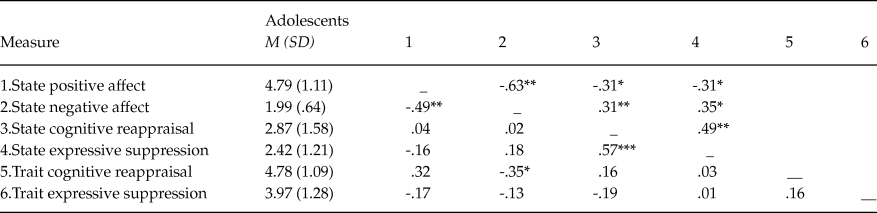
Table 1 shows the descriptive analyses for the study variables. Concerning state affect, participants reported higher average levels of positive affect in comparison to negative affect. We found higher average levels of cognitive reappraisal in comparison to expressive suppression both at the state and at trait levels.
Means, standard deviations and between- and within-person correlations between affect and ER strategies

Note: State affect and state ER strategies calculated at the aggregated person level. Correlations above the diagonal are within-person correlations. Correlations below the diagonal are between-person correlations calculated at the aggregated person level.
*p < .05; **p < .01; ***p < .001, two-tailed tests.
The results of estimated between-person and within-person correlation analyses are also displayed in Table 1. Concerning the within-person correlations, both state expressive suppression and state cognitive reappraisal were significantly negatively correlated with positive affect and significantly positively correlated with negative affect. The significant positive correlation between state cognitive reappraisal and state expressive suppression suggests that the use of these strategies tend to co-occur in daily situations (supporting H 1). In addition, we found a significant negative correlation between positive and negative affects.
Between-person correlations also found that positive and negative affect were significantly negatively correlated. In contrast with within-person correlations, state ER strategies were not significantly correlated with affect. The use of the two state ER strategies was significantly positively correlated, as found in the within-person analyses (supporting H 1). Concerning trait ER strategies, trait cognitive reappraisal was negatively correlated with negative affect. Adolescents who reported a more frequent use of cognitive reappraisal reported significantly less negative affect. However, trait cognitive reappraisal was not correlated with positive affect. Trait expressive suppression was not correlated with affect. Trait ER strategies were not correlated, as hypothesized (H 2). Finally, state ER strategies were not correlated with trait ER strategies.
Concurrent relationships between state ER strategies and affect
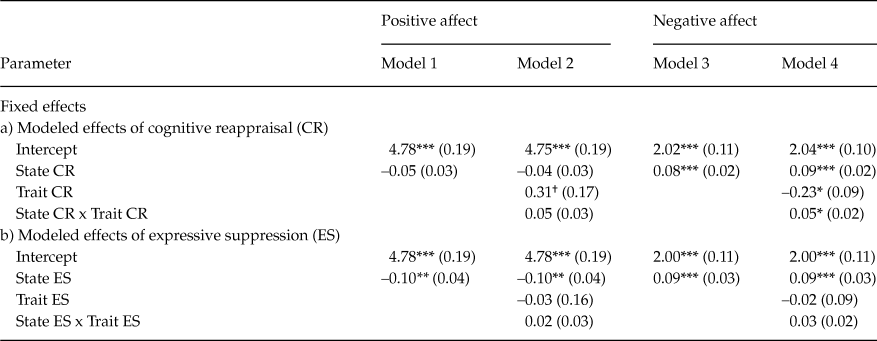
First, we evaluated the existence of a concurrent relationship (in the same time interval) between state ER strategies and affect (see Models 1 and 3). Table 2 shows the results. With the exception of the within-person relationship between cognitive reappraisal and positive affect, in every case there was a significant relationship between the use of ER strategies and experienced affect at the same moment. An unexpected finding was the within-person relationship between the use of cognitive reappraisal and negative affect, in which a greater use of this strategy was associated with higher levels of negative affect. We found that, expressive suppression was concurrently associated with high negative affect and low positive affect.
Moderation Analyses on Concurrent Relationships between Momentary ER Strategies and Affect

Note: Standard errors are in parentheses.
† p < .10. *p < .05. **p < .01. ***p < .001. Two-tailed tests.
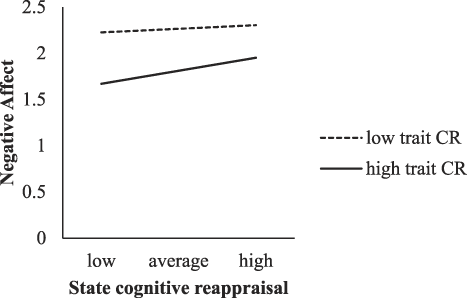
Second, we examined whether the trait ER strategies played a role in the within-person relationship between affect and state ER strategies at the same time interval (see Models 2 and 4). The within-person association between state cognitive reappraisal and negative affect was moderated by trait cognitive reappraisal (β = 0.05, p = .02) (see Table 2a). The moderator role of trait cognitive reappraisal is illustrated in Figure 1. The within-person relationship between state cognitive reappraisal and negative affect experienced at the same sampling moment is stronger for adolescents who revealed low use of this strategy than for those who revealed high use of trait cognitive reappraisal. Concerning the remaining cross-level interactions, we did not find significant results.
Cross-level interaction with trait cognitive reappraisal moderating the association between state cognitive reappraisal and the experienced negative affect. CR = cognitive reappraisal. Low state CR = 1 SD below the mean; High state CR = 1 SD above the mean; Low trait CR = 1 SD below the mean; High trait CR = 1 SD above the mean.

Lagged relationships between state ER strategies and affect
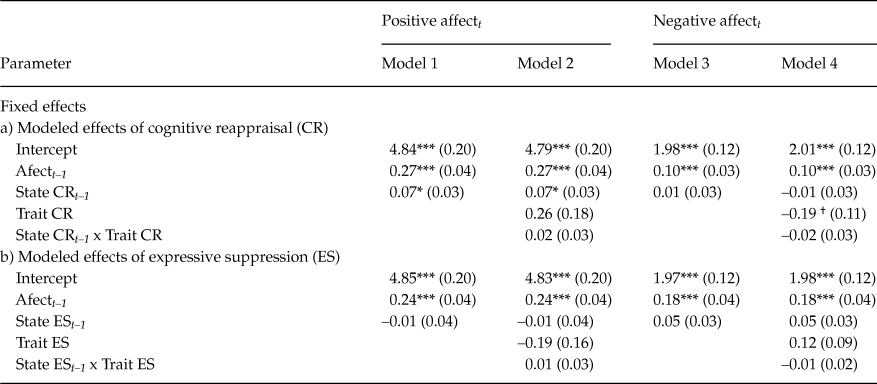
First, we evaluated whether, after controlling for positive affect (negative affect), state ER strategies at the sampling moment t–1 would predict positive affect (negative affect) at the subsequent sampling moment (displayed in Table 3). In all within-person models, affect at the previous sampling moment was a significant predictor of the subsequently experienced affect. However, in most of the models, the use of state ER strategies at the previous sampling moment was not a significant predictor of the subsequently experienced affect. The only significant within-person relationship was between state cognitive reappraisal at time t–1 and positive affect at time t (β = 0.07, p = .03), which supported our third Hypothesis (Table 3a). This result indicates that the use of state cognitive reappraisal predicted higher positive affect at subsequent sampling moments, even after controlling for previous levels of positive affect. The use of expressive suppression strategy had no effect on the subsequent experienced affect, not supporting our fourth Hypothesis (Table 3b).
Moderation analyses on lagged relationships between momentary ER strategies and affect

Note: Standard errors are in parentheses. t = current sampling moment; t–1 = previous sampling moment.
† p < .10. *p < .05. *** p < .001. Two-tailed tests.
Second, we evaluated whether trait ER strategies (person level predictors) would interact with state ER strategies (beep level predictors) to predict the experienced affect at the subsequent sampling moment, however we did not find significant results.
Discussion
Our study evaluated the average use of cognitive reappraisal and expressive suppression strategies in daily life. Cognitive reappraisal was used slightly more often than expressive suppression, at both state and trait levels. Previous research has been inconclusive concerning the most reported strategy in daily life, with some studies providing evidence for cognitive reappraisal (e.g., Nezlek & Kuppens, Reference Nezlek and Kuppens2008) and others for expressive suppression (e.g., Brockman et al., Reference Brockman, Ciarrochi, Parker and Kashdan2016). Existing studies with adolescents, using trait measures, found also evidence for a more frequent use of cognitive reappraisal than expressive suppression (Bariola et al., Reference Bariola, Hughes and Gullone2012; Teixeira et al., Reference Teixeira, Silva, Tavares and Freire2015). Nezlek and Kuppens justified this result by the different purposes associated to each one of the strategies. Cognitive reappraisal intends to increase positive affect and decrease negative affect, which tend to be perceived as immediate rewards to the individual, whereas expressive suppression involves the expression of emotions towards others and thus has a more interpersonal purpose.
The use of the two strategies was positively correlated at the state level (both within- and between-persons), as previously found with young adults (e.g., Brans et al., Reference Brans, Koval, Verduyn, Lim and Kuppens2013; Brockman et al., Reference Brockman, Ciarrochi, Parker and Kashdan2016). This result suggests that adolescents use both strategies simultaneously when they regulate their emotions. Individuals may use multiple strategies in order to ensure a greater success in the process of ER (Opitz, Cavanagh, & Urry, Reference Opitz, Cavanagh and Urry2015), even if those strategies are seemingly contradictory to their goals (Brockman et al., Reference Brockman, Ciarrochi, Parker and Kashdan2016). However, the same did not occur at the trait level, as was already found in previous studies with adolescents where results showed these strategies to be independent (Teixeira et al., Reference Teixeira, Silva, Tavares and Freire2015). Thus, these contrasting results may be explained by the different methods of data collection, i.e., real-time versus retrospective measures. Reporting experiences and reconstructing their meanings into global and retrospective measures involves complex processes that are inherently different from the processes used in real-time measures (Baxter & Hunton, Reference Baxter and Hunton2011; Brose, Voelkle, Lövdén, Lindenberger, & Schmiedek, Reference Brose, Voelkle, Lövdén, Lindenberger and Schmiedek2015). In addition, we did not find significant relationships between state and trait measures of ER strategies. This result was also found in another multimethod study (Brockman et al., Reference Brockman, Ciarrochi, Parker and Kashdan2016) and may suggests that the general use of emotion regulation strategies reported by adolescents before the sampling week was not related with their use over the next seven days of their daily life.
In general, the use of ER strategies appears to have both concurrent and lagged relationships with experienced affect in adolescents’ daily lives. Expressive suppression was associated with lower positive affect and higher negative affect in the same moment. This result corroborates the Gross (Reference Gross1998) process model of ER and studies on daily life with young adults (Brans et al., Reference Brans, Koval, Verduyn, Lim and Kuppens2013; Brockman et al., Reference Brockman, Ciarrochi, Parker and Kashdan2016; Nezkel & Kuppens, Reference Nezlek and Kuppens2008). State cognitive reappraisal was associated with higher levels of negative affect at the same sampling moment, which may suggest that re-interpreting an event may not have immediate effects on the reduction of negative affect. In support of this assumption, we found that the use of cognitive reappraisal measured as a trait was associated with low negative affect. Based on the Gross model, the use of ER strategies has momentary effects, and the chronic use of these strategies also has consequences that accumulate over time. Specifically, the frequent use of cognitive reappraisal is associated with less experience and expression of negative affect (John & Gross, Reference John and Gross2004). Concerning the moderator role of trait ER strategies on the within-person relationship between state ER strategies and affect, we only found the moderator role of cognitive reappraisal. Specifically, state cognitive reappraisal was associated with higher negative affect experienced at the same moment, and this relationship was stronger for adolescents who revealed a low use of trait cognitive reappraisal than for those who revealed high use of this strategy. This result may suggest a buffering effect of trait cognitive reappraisal, as the relationship between state cognitive reappraisal and concurrent negative affect is lessened by a higher trait use of this strategy.
State cognitive reappraisal was not concurrently related with positive affect. However, the results from the lagged relationships found that the use of state cognitive reappraisal predicted higher positive affect at subsequent sampling moments, even after controlling for previous levels of positive affect. This result is in accordance with the findings of Brans et al. (Reference Brans, Koval, Verduyn, Lim and Kuppens2013) who also evaluated the impact of ER strategies on affect in daily life. We concluded that the effect of cognitive reappraisal on positive affect was not immediately observed; it was instead delayed and only expressed in the next sampling moment. The efforts associated with this cognitive strategy (Dixon-Gordon, Aldao, & De Los Reyes, Reference Dixon-Gordon, Aldao and De Los Reyes2015), which consists of the re-interpretation of an event to alter its emotional impact, may justify this result. Another study in daily life also found that the use of cognitive reappraisal, assessed in the previous day, was a significant predictor of next day positive affect, but not negative affect (Brockman et al., Reference Brockman, Ciarrochi, Parker and Kashdan2016). This suggests that cognitive reappraisal has a long-term effect (not immediate) on positive affect, in terms of moment and day. Also, in accordance with the Brockman research, our lagged analyses revealed that expressive suppression was not related to next moment affect. These results seem to contribute to the emerging evidence that has found a different pattern of relationships between these two ER strategies and affect, relative to the relationships found with experimental or trait evaluations.
The remaining hypotheses regarding the lagged relationships were not supported. We believe these results could be explained by the lower number of reports involved, in comparison to the concurrent relationships, because it was necessary to have two consecutive beeps within each day of the sampling week to perform the analysis. As revealed by the results of a meta-analysis, lagged effects tend to be weaker than the corresponding concurrent effects, and their strength decreases as the interval between sampling moments increases (Hulin, Henry, & Noon, Reference Hulin, Henry and Noon1990).
This study has a reduced sample at the person level, as also found in previous experience sampling studies (e.g., Ilies & Judge, 2002; Juslin, Liljeström, Västfjäll, Barradas, & Silva, Reference Juslin, Liljeström, Västfjäll, Barradas and Silva2008). However, our analyses and the main results were focused on within-person relationships in which the number of moments was large and “thus the small number of participants does not impact the statistical validity of these results” (Ilies & Judge, p. 1135). Future studies should study ER strategies and affect in the daily life of a larger sample of adolescents to replicate our findings.
In addition, although the Experience Sampling Method has several evaluations across time, we cannot conclude causality between variables assessed at the same moment. Neither can we exclude the inverse relationship; i.e., the experience of certain emotions may facilitate or promote the use of specific strategies. As suggested by the broaden-and-build theory (Fredrickson, Reference Fredrickson2001), certain positive emotions (e.g., joy, interest, and contentment) may contribute to widening individuals’ habitual perspectives about situations, allowing them to have new and flexible thoughts and to consider more interpretations. Consequently, the experience of positive emotions may facilitate the use of cognitive reappraisal (Nezlek & Kuppens, Reference Nezlek and Kuppens2008). In this sense, future studies with adolescents should evaluate the possible bidirectional relationship between ER strategies and affect. For a more complete understanding of the daily emotion regulation processes, future studies should also include the assessment of other ER strategies within Gross’ process model of ER.
We believe, however, that this study contributes to a better understanding of emotion regulation in adolescence, for several reasons. First, we provide evidence about the complex within-person relationships between the use of cognitive reappraisal and expressive suppression strategies and affect, over time, in the daily life of adolescents. Second, the use of Experience Sampling Method for data collection provided evaluations of our variables in real-time, which minimized the biases of retrospective recall and increased the ecological validity. In addition, this method allowed us to evaluate the temporal relationships between ER strategies and experienced affect both concurrent and lagged, with the latter suggesting causal relationships. In general, we found that ER strategies were concurrently related to experienced affect with the exception of cognitive reappraisal, whose effects on positive affect are not immediately observed. Third, the adoption of a multimethod approach (real time data and retrospective data) provided the opportunity to evaluate the differential relationships between state and trait measures of ER and affect. We found daily affect was more closely related to momentary use of ER strategies than their trait use. However, the trait use of cognitive reappraisal played a role in the relationship between daily cognitive reappraisal and negative affect. Finally, we evaluated the relationship between ER strategies and affect in a sample of adolescents recruited from community settings, which may provide a normative reference of how these processes occurs in adolescents’ daily contexts.