1. Introduction
The closest prospect for the practical use of spherical tokamaks is associated with the realization of projects involving compact neutron sources (CNS) that are currently being developed (Peng et al.
Reference Peng2005; Voss et al.
Reference Voss, Davis, Dnestrovskij, Kirk, Knight, Loughlin, O’brien, Sychugov, Tabasso and Wilson2008; Kuteev et al.
Reference Kuteev, Goncharov, Sergeev and khripunov2010, Reference Kuteev2011). All of these projects assume implementation of neutral beam injection (NBI) into plasma with non-thermonuclear parameters. The main neutron rate will be due to the interaction of fast ions produced as a result of charge exchange of the beam atoms with thermal ions of the target plasma. The existence of fast particles with velocities exceeding the Alfvén speed
 $(V_{f}>V_{A})$
in the plasma will lead to excitation of Alfvén instabilities, which, in turn, can provoke additional fast particle radial transport and losses, decreasing the neutron rate. As shown in experiments on the tokamaks TFTR (Wong et al.
Reference Wong1991) and D-IIID (Heidbrink et al.
Reference Heidbrink, Strait, Doyle, Sager and Snider1991; Duong et al.
Reference Duong, Heidbrink, Strait, Petrie, Lee, Moyer and Watkins1993; Strait et al.
Reference Strait, Heidbrink, Turnbull, Chu and Duong1993; Strait, Heidbrink & Turnbull Reference Strait, Heidbrink and Turnbull1994), the toroidal Alfvén eigenmodes (TAE) are the most dangerous from the point of view of fast particle redistribution and losses. In the experiments listed above, it was impossible to separate the radial redistribution of the fast ions and their full losses. During the past decade, diagnostics have appeared that can provide direct measurements of expelled ions caused by TAE (Darrow et al.
Reference Darrow, Fredrickson, Gorelenkov, Roquemore and Shinohara2008; García-Munõz et al.
Reference García-munõz, Fahrbach, Günter, Igochine, Mantsinen, Maraschek, Martin, Piovesan, Sassenberg and Zohm2008).
In spherical tokamaks (as they operate at rather low toroidal fields), the fast ion velocity can be many times the Alfvén one, which is favoured for excitation of a wide band of instabilities. Experiments on the spherical tokamaks START (Gryaznevich & Sharapov Reference Gryaznevich and Sharapov2000), MAST (Gryaznevich & Sharapov Reference Gryaznevich and Sharapov2004) and NSTX (Fredrickson et al.
Reference Fredrickson, Cheng, Darrow, Fu, Gorelenkov, Kramer, Medley, Menard, Roquemore, Stutman and White2003) have indeed demonstrated excitation of different instabilities of the Alfvén frequency band, including TAE. The parameters of these tokamaks permitted the development of several modes simultaneously with different toroidal numbers. At high enough amplitudes, the modes started to interplay with each other, resulting in the formation of so-called Alfvén avalanches. As was shown in the experiments, they lead exactly to the largest fast particle redistribution and losses. So on NSTX, short TAE bursts of
 ${\sim}1~\text{ms}$
duration resulted in the drop of the neutron rate by 40 % associated with losses and redistribution of the fast particles (Fredrickson et al.
Reference Fredrickson2009; Podesta et al.
Reference Podesta2009). Thus, the modes of the Alfvén frequency band interact with magnetohydrodynamic (MHD) modes of lower frequency, such as fishbone and kink modes. As a result, it is very hard to understand what one mode or others contribute to the losses. On the spherical tokamak Globus-M, owing to the smaller dimensions compared to NSTX and MAST, a regime of TAE generation is realized with strongly developed single modes (Gusev et al.
Reference Gusev2011; Petrov et al.
Reference Petrov, Patrov, Gusev, Ivanov, Minaev, Sakharov, Tolstyakov and kurskiev2011). That allows us to separate the influence of single TAE on fast particle confinement. As, for a neutron source, the main parameter is neutron rate, so its change is essential for TAE development, which was the subject of our experiments. This paper concerns the results of experiments on Globus-M to study the effect of TAE on fast particle confinement.
2. Experimental set-up and main techniques
Globus-M represents a tokamak with small aspect ratio
 $R/a=1.5$
(major radius
 $R=36~\text{cm}$
, minor radius
 $r=24~\text{cm}$
), plasma current
 $I_{p}$
up to 250 kA and density
 $\langle n\rangle \leqslant 1\times 10^{20}~\text{m}^{-3}$
(Gusev et al.
Reference Gusev1999). The experiments to study the Alfvén mode were carried out at a toroidal magnetic field
 $B_{t}=0.4~\text{T}$
. Only weak non-regular instabilities in the Alfvén frequency range were observed at NBI on the current flat top. As was established in the first experiments (Gusev et al.
Reference Gusev2011; Petrov et al.
Reference Petrov, Patrov, Gusev, Ivanov, Minaev, Sakharov, Tolstyakov and kurskiev2011), the most intensive modes arise when the safety factor in the centre,
 $q(0)$
, exceeds unity. Such a regime is realized at the start of NBI during the stage of the rise in plasma current and density. Hydrogen and deuterium beams were injected (the NBI complex (Gusev et al.
Reference Gusev2007) was implemented on the tokamak). The NBI started 10–15 ms after the plasma current start-up and continued for 30–40 ms. The beam energy was
 $E=26{-}27~\text{keV}$
, and the power was
 $0.75$
MW for the deuterium beam and 0.85 MW for the hydrogen beam. At an energy of 26 keV, the velocity of the hydrogen and deuterium ions is
 $2.2\times 10^{6}$
and
 $1.6\times 10^{6}~\text{m}~\text{s}^{-1}$
, respectively, which exceed the Alfvén velocity, defined by the formula
 $$\begin{eqnarray}V_{A}=\frac{B}{\sqrt{{\it\mu}_{0}n_{i}m_{i}}},\end{eqnarray}$$
where
 ${\it\mu}_{0}$
is the permeability of free space,
 $B$
is the magnetic field, and
 $n_{i}$
and
 $m_{i}$
are the plasma density and mass, respectively. The injection was realized in the equatorial plane in co-current direction. The beam axis was tangential to the circle of radius
 $R=32~\text{cm}$
. Hydrogen and deuterium plasmas were used as a target.
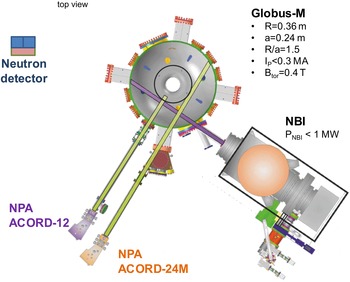
A microwave interferometer was used for plasma density monitoring, and the evolution of electron density and temperature profiles was recorded by means of Thomson scattering diagnostics by 10 spatial points during the whole discharge. The ion temperature was measured with a neutral particle analyser (NPA) ACORD-12 directed along the major radius, and the distribution function of fast ions was measured with the NPA ACORD-24M, which observed plasma with the same impact parameter as the NBI. The experimental set-up is shown in figure 1.
Experimental set-up.

In the recent experiments, the temporal resolution of the NPA ACORD-24M was improved from 1 to 0.1 ms, which allowed us to observe correlation between short TAE bursts and charge exchange (CX) atomic fluxes. Neutron fluxes arising due to D–D fusion reactions were measured with a neutron detector, which was represented by a He
 $^{3}$
-filled proportional neutron counter with a polyethylene moderator (Kornev et al.
Reference Kornev, Askinazi, Vildjunas, Zhubr, Krikunov, Lebedev, Razumenko, Rozhdestvensky and Tukachinsky2013).
The Alfvén mode identification was realized by means of four fast Mirnov probes (frequency band from 50 to 300 kHz) spread uniformly along the toroidal direction. Slow Mirnov probes (frequency band from 0 to 100 kHz) were used for observation of lower-frequency MHD instabilities.
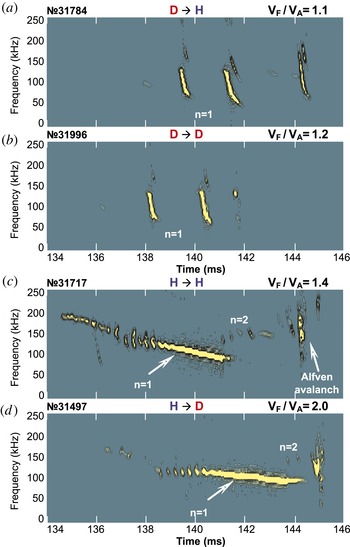
Spectrograms of the Mirnov signal with different beam–plasma isotopes D
 $\rightarrow$
H, D
 $\rightarrow$
D, H
 $\rightarrow$
H and H
 $\rightarrow$
D.

3. Results and discussion
The necessary condition for TAE excitation of the fundamental resonance is that the injected fast particle velocity should exceed the Alfvén velocity,
 $V_{F}\geqslant V_{A}$
. At NBI switching on during the plasma current start-up, the plasma density grows and the Alfvén velocity decreases in accordance with formula (2.1). One can anticipate that, at some density value (at a certain velocity and for a certain kind of injected particle), these velocities will become equal, and the TAE excitation will occur. Thus, the density at which the instability starts should be defined by the isotopic composition of the plasma and the injected beam (hydrogen/deuterium). However, as was shown in experiments, the TAE development was not always governed by this simple logic. The condition
 $V_{f}\geqslant V_{A}$
is a necessary but not sufficient one. The ratio
 $V_{F}/V_{A}$
at the moment of TAE excitation varied from 1.1 (for deuterium injection into the hydrogen plasma) to 2.2 (for hydrogen injection into the deuterium plasma). The TAE excitation always occurred in the same temporal interval in the discharge from 135 to 145 ms. Just at that period the favoured conditions exist for fast particle confinement: already high enough plasma current and, at the same time,
 $q(0)>1$
, which is supported by the absence of sawtooth oscillations. The mode frequency is defined by the formula (Cheng & Chance Reference Cheng and Chance1986)
 $$\begin{eqnarray}f_{\mathit{TAE}}=\frac{V_{A}}{4{\rm\pi}qR},\end{eqnarray}$$
and depends on the isotopic composition. The spectrograms of the Mirnov signal for different combinations of the injected beam and target plasmas are shown in figure 2. The ratio
 $V_{f}/V_{A}$
at the mode beginning is shown in the figure for all four cases. The spectrograms demonstrate the different character of mode behaviour for the different isotopes. At deuterium injection (figure 2
a,b), the mode develops in the form of short bursts of 0.5 ms duration with fast frequency drop during the burst, the so-called chirping modes. Such an evolution character is, obviously, described by the predator–prey model. The simple modes were observed on the tokamaks MAST (Gryaznevich & Sharapov Reference Gryaznevich and Sharapov2006) and NSTX (Fredrickson et al.
Reference Fredrickson2009; Podesta et al.
Reference Podesta2009). At hydrogen injection (figure 2
c,d), the mode starts from short bursts, and then, as a rule, transforms into a long-lasting mode with approximately constant amplitude, which is probably provided by the better confinement of protons as compared with deuterons (which will be discussed below). As is seen from figure 2, the TAE frequency in all four cases remains approximately in the same range
 ${\sim}100$
kHz, with the exception of the case of hydrogen injection into hydrogen plasma, when the first bursts of the mode appear at essentially higher frequency. However, the main intensive mode exists at the frequency
 ${\sim}100$
kHz as before. Correlation analysis of the signals of the four fast Mirnov probes spread in toroidal direction has shown that most of the modes are single modes with
 $n=1$
, which lays within the framework of the linear theory (Berk et al.
Reference Berk, Breizman and Ye1992; Cheng & Chance Reference Cheng and Chance1986), in accordance with which the maximum toroidal number of the TAE in a tokamak is defined as
 $$\begin{eqnarray}n_{max}=\frac{r{\it\omega}_{cf}}{q^{2}V_{A}},\end{eqnarray}$$
where
 ${\it\omega}_{cf}$
is the cyclotron frequency of fast particles. For the Globus-M conditions,
 $n_{max}$
is about 1–1.5. A weak
 $n=2$
mode, the character of which differs from the TAE behaviour, appears only sometimes. In figure 2(c,d), these modes are shown with a frequency that is growing in time, which are probably Alfvén cascades. In separate strong mode bursts, it was possible to identify number
 $m$
with a set of 26 poloidally spread probes. In all realizations, it turned out to be equal to 3. If we use the estimation formula for the mode frequency from (Cheng & Chance Reference Cheng and Chance1986), i.e.
 ${\it\omega}_{TAE}=V_{A}/2q(r)R$
, then substituting into this relation the values of frequency and density from the experiment, we obtain the safety factor
 $q(r)\sim 2.5$
. A formula from the same paper establishes the relation
 $q(r)=(m_{1}+m_{2})/2n$
, where
 $m_{1}$
and
 $m_{2}$
are the poloidal numbers of the combined mode. In accordance with this formula, the values
 $m_{1}=2$
,
 $m_{2}=3$
and
 $n=1$
correspond to
 $q(r)=2.5$
. We do observe
 $m=3$
and
 $n=1$
in experiments, but do not see
 $m=2$
. This may be explained by the lower sensitivity of the Mirnov probes to the more internal fluctuations. On the basis of this estimation, we can conclude that the TAE in our case exist in the region of
 $q(r)=2{-}3$
, which corresponds to medium radii of Globus-M.
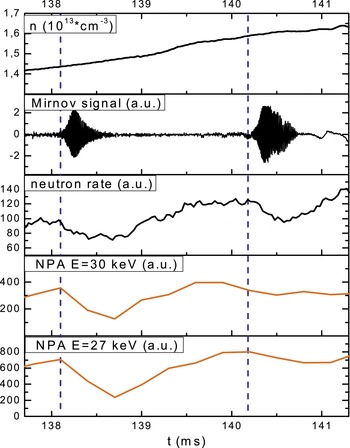
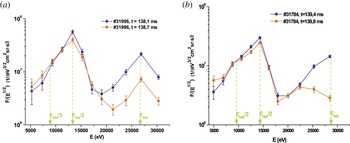
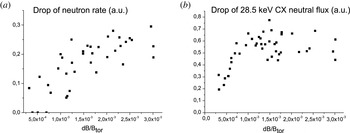
In the recent experimental series, correlation between TAE and fast particle confinement was established for the first time on Globus-M (Petrov Reference Petrov2014), owing to the improved diagnostic temporal resolution. The influence of the modes on the fast particle confinement was recorded by means of a tangentially directed NPA and neutron detector. The largest decreases in the neutron rate and NPA fluxes were recorded at deuterium injection. Waveforms of shot no. 31996 are shown in figure 3. It is seen that the TAE bursts (Mirnov signal) coincide in time with drops of the neutron rate and NPA fluxes with energy close to the injection energy, which was 27 keV. The NPA spectra at the moment before the mode burst (138.1 ms) and in the drop minimum (137.7 ms) are shown in figure 4(a). It is seen that the fluxes of the particles with injection energy undergo the largest decrease (75 %); the drop spreads down to an energy of 18 keV (corresponding to the Alfvén velocity for the current plasma parameters), decreasing in relative measure. A similar drop is seen in the neutron rate waveform. The dependences of neutron rate and CX fluxes of high energy on the relative TAE amplitude are shown in figure 5. Both dependences demonstrate a larger drop with mode intensity growth, with a tendency to saturate at high mode amplitudes. We assume that the neutron rate decreases by 25–30 %, which corresponds to real fast particle losses and decrease of the fast ion–main plasma interaction due to their radial redistribution at TAE development. Fast ions get a radial kick from the mode, which leads to their transfer into new orbits intersecting the wall or lying in regions with high neutral density. It is also possible for the particles to cross the trapped-passing boundary and to become lost on a large banana orbit. Transfer of the ion to a region with lower ion density decreases the fast ion–main plasma interaction and therefore the neutron yield. At the same time, the CX fluxes in the range of injection energy essentially decrease more strongly. Two possible explanations exist: either fast particles leave the central zone, or they change their pitch angle (turn in velocity space) in such a way that they miss the NPA.
Correlation of TAE with the neutron rate and NPA fluxes in shot no. 31996.

CX spectra at TAE burst measured before (blue) and just after (orange/brown) the mode burst. (a) Shot no. 31996, D injection into D plasma; (b) shot no. 31784, D injection into H plasma.

The portion of losses: (a) neutrons; (b) CX neutrals with energy of 28.5 keV versus relative TAE amplitude.

In all other cases, except for deuterium injection into deuterium plasma, neutron flux is absent, and therefore one can judge about particle redistribution and losses by the drops of the CX fluxes only. For deuterium injection into hydrogen plasma, the same strong modes were excited as for deuterium injection into deuterium plasma that led to yet a stronger drop in CX fluxes of high energies up to 80 % (see figure 4 b) due to the higher energy of the injected particles in this experiment (28.5 keV). A different picture is observed for hydrogen injection. First, the TAE intensity is lower on average than for deuterium injection. Secondly, fast particle redistribution and losses reflected in the drop of the CX fluxes in the range of injected energy are essentially lower. At the development of the long-lasting mode, one could observe only a smooth decrease of the fluxes by no more than 20 %. Even in the case of the most intensive mode flashes, the CX flux drop did not exceed 25 %. The lower losses of protons, compared to deuterons, are apparently associated with a smaller Larmor radius and an orbit width defined by the Larmor radius in a poloidal magnetic field. In Globus-M, these values for deuterons born at the plasma periphery are comparable with the minor radius of the tokamak.
It would be interesting to extrapolate the data obtained on Globus-M to the conditions that will exist in compact fusion neutron sources designed on the basis of a spherical tokamak (FNS-ST). For example, a project of CNS from Kuteev et al. (Reference Kuteev2011) has the following parameters:
 $R=50~\text{cm}$
,
 $a=30~\text{cm}$
,
 $B=1.5~\text{T}$
,
 $I_{p}=1.5~\text{MA}$
,
 $n_{e}=10^{20}~\text{m}^{-3}$
, and atomic deuterium beam energy
 $E_{b}=130~\text{keV}$
. The corresponding parameters for Globus-M are:
 $R=36~\text{cm}$
,
 $a=24~\text{cm}$
,
 $B=0.4~\text{T}$
,
 $I_{p}=0.2~\text{MA}$
,
 $n_{e}=3\times 10^{19}~\text{m}^{-3}$
, and
 $E_{b}=26~\text{keV}$
. One can see the quite close dimensions of the two tokamaks, but a very large gap in plasma current and toroidal field. So, for batter extrapolation, additional experiments are needed in conditions close to those of FNS-ST. Experiments on the upgraded tokamak Globus-M2 (Minaev et al.
Reference Minaev2014) (
 $B=1~\text{T}$
,
 $I_{p}=500~\text{kA}$
) may be considered as an intermediate step in this direction.
4. Summary and conclusion
Experiments on TAE excitation by means of NBI were carried out on the Globus-M spherical tokamak. All possible combinations of hydrogen and deuterium as the neutral beam and target plasma were tested. In all cases, mainly single-mode instabilities with toroidal number
 $n=1$
were observed, in accordance with the linear theory predictions for the Globus-M conditions. For deuterium injection, the mode developed in the form of short bursts of 0.5 ms duration with fast frequency drop during the burst, the so-called chirping modes. For hydrogen injection, the mode started from short bursts, and then, as a rule, transformed into a long-lasting mode of approximately constant amplitude. The difference in behaviour is apparently associated with the degree of influence of the excited mode on the exciting particle population, which is higher for deuterons due to their larger Larmor radius.
By means of a tangentially directed NPA and a neutron detector, the influence of the TAE on the decrease of neutron rate and NPA fluxes in the region of high energies was recorded. An essential drop of the neutron rate at the single-mode TAE development was recorded for the first time in experiments on Globus-M. Formerly, on spherical tokamaks, the drop in the neutron rate was observed only at Alfvén avalanches (Fredrickson et al. Reference Fredrickson2009; Podesta et al. Reference Podesta2009, Reference Podesta, Bell, Bortolon, Crocker, Darrow and Diallo2012; Fredrickson et al. Reference Fredrickson2013), the development condition of which is the simultaneous existence of several modes with different toroidal numbers. The experiments on Globus-M have shown that essential losses in the neutron rate (up to 25 %) associated with TAE are possible even in the absence of the Alfvén avalanches. The open question is the influence of TAE on fast particle losses in designed CNS. One cannot exclude an essential drop of the neutron rate at TAE development. Experiments on the upgraded tokamak Globus-M2 should provide additional data for extrapolation to CNS parameters.
Acknowledgements
This work has been carried out in the Joint Research Center ‘Materials Science and Characterization in Advanced Technology’ with financial support by the Ministry of Education and Science of the Russian Federation (agreement 14.621.21.0007, id RFMEFI62114X0007).