Russia, the largest and most significant country to emerge after the collapse of the Soviet Union, by 2015 had abandoned its two and a half decades-long transition to the Western model of capitalism and democracy. Its gradual slide towards authoritarianism was enabled by the curtailment and weakening of governance, private property, and the rule of law. Under the leadership of Vladimir Putin the agenda for building and strengthening governing institutions, which have long been argued to constitute the basis for national prosperity, has been abandoned, giving way to an increased domestic cronyism and belligerent foreign policy.
To explain this latest authoritarian turn and institutional deterioration in Russia most analysts focused on domestic issues: Russia’s super- and patronal presidentialism, partial reforms and resource curse, kleptocracy and corruption, historical legacies and political culture. Footnote 1 Methodological nationalism—the uncritical acceptance of the national scale as given—has been also predominant in the comparative study of governance and institutions. Footnote 2 Yet how warranted are such approaches in an era of globalization and “new interdependence,” when transnational interactions shape domestic institutions, Footnote 3 and when economic actors switch between distinct institutional environments to “exploit aspects of one to solve for a constraint in the other?” Footnote 4 Transnational influences did find their way into studies of democratization. Samuel Huntington first noted that late democratizers could rely on “snowballing” from earlier transformations. More recent studies of international diffusion of electoral revolutions underscored this idea as well. Footnote 5 The conventional wisdom on the origins of good governance and strong institutions however maintains a heavy “domestic origins” bias and, as many scholars agree, is still insufficient. Footnote 6
When the Soviet Union collapsed and the new post-Soviet states embarked on the path of market reforms, both Western policy advisors and Russia’s reformers hoped that reforms would be self-reinforcing. Footnote 7 The creation of private property itself was seen as an accomplishment sufficient for the reforms to stick because it was assumed that the new property owners would create a demand for good governance and secure property rights. Footnote 8 When it became clear that such demand would not emerge automatically, these expectations were modified (specifically in Russia) to highlight the role of “effective” owners, economic agents who had real control over property, like majority holders. Footnote 9 Sometimes even raiding conflicts were represented as property changing hands from “weak” to “more effective” owners. Footnote 10 But contrary to these expectations, the rise of real owners in the process of economic transition did not result in better institutions for protecting property rights.
Another conventional wisdom on institutional evolution was tested as Russia’s political regime turned more authoritarian and personalistic in the 2000s. This time it was Mancur Olson’s hypotheses on the positive effects of replacing “roving” with “stationary” bandits. Footnote 11 As Olson argued, stationary bandits have a stake in seeing their sovereign dominion grow and prosper and therefore they tax less, commit more credibly, and provide other public goods in order to stabilize their domain and provide for long-term maximization of profits. Vladimir Putin indeed sought to stabilize his rule, partially by allowing economic elites close to the Kremlin to enrich themselves. Despite the growth in the number of billionaires in Russia, however, institutional quality only worsened and the cronyism within the executive branch increased. Footnote 12 These developments took place even while the “demand for law” steadily grew as Russian businesses increased reliance on courts of arbitration and other legal means to resolve disputes. Footnote 13 Some scholars argued that the threat to property shifted from private-sector transgressions to sub rosa controls by Kremlin cronies, and even Putin himself, highlighting the worsening institutional environment in Russia. Footnote 14
In this study we counter the common national bend in the literature but bring attention to global institutional factors that condition domestic institutional evolution. More specifically, we explore the unintended consequences for “good governance” prospects in transition countries of institutional arbitrage opportunities available for big businesses relying on economic, financial, administrative, and legal institutions abroad. Escaping an imperfect institutional environment at home and taking advantage of various foreign institutions, business actors substitute and compensate for the weakness of home institutions. But what does this mean for the long-term prospects of institutional reforms at home? Who will work to change the domestic institutional status quo if the largest stakeholders—the big business owners—not only find transnational venues to protect their assets but might even see advantages in maintaining weak institutions at home?
Russia represents a paradigmatic case illustrating the dark side of globalization. It emerged as a new country after the fall of the Soviet Union and faced the challenges of economic reform, institution-building, and political transformation while simultaneously integrating into the global economy. Russia is thus a great laboratory for studying the complex inter-linkages between domestic politics, institution-building, and global forces and opportunities. Unlike its predecessor, post-Soviet Russia did not shun globalization. Over the last two and a half decades, propped up by its energy riches, it became an essential part of the global economy and global financial markets. Russian oligarchs built their financial and business empires mostly from natural resource extraction, and they have benefitted handsomely from entry into global markets. They have joined the global upper class, impacting property values and financial and political institutions not only in Moscow but also in London, New York, and Monaco. Footnote 15
Yet Russia’s democratic landscape—including its law-making and political party system, its judiciary and law enforcement, and civil society and the press—has been on a downward slope as Russia’s president has reached for “manual control,” shifting Russia’s political system strongly in the direction of personalism. Despite expectations to the contrary, the economic actors who benefitted most from Russia’s economic transformation and globalization have not lobbied openly for a rule-of-law state and, instead, they have preferred to collaborate with the increasingly kleptocratic regime to make money inside Russia that they can take abroad. Footnote 16
Russia is far from unique in this story. Weak institutions and non-accountable regimes appear to be a norm in many parts of the world. The significance of this problem—the role of global forces in shaping domestic institutions—reaches far beyond Russia and is pertinent to other countries with weak controls on the export of domestic capital. Ukraine, Kazakhstan, China, and Uzbekistan are just a few additional Eurasian examples; the entire universe of cases extends to Africa, Asia, and Latin America. An exploration of this puzzle—why a country’s economic elites might not over time press for institutions supporting property rights, political and civil freedoms, and the rule of law—brings scholarly and policy-communities’ attention to the forces that shape institution-building in the present-day global environment. Understanding the impact of globalization on contemporary efforts to build robust rule-of-law regimes will not only provide a better understanding of these processes but may also assist in the development of policy recommendations by those international institutions such as the World Bank or the IMF seeking to promote “good governance” and strong institutions.
Our structure here is as follows. In the next section we adopt political economist Albert Hirschman’s “exit, voice and loyalty” framework to explain one of the central dilemmas of institution-building in transition and developing countries and situate it in the existing literature on institutions and development. We lay out the concept of institutional arbitrage, importing insights from international economics and business management studies into political science. We then review the analysis of institutions in Russia-focused scholarship including the discussion of central expectations and realities of Russian transition. The subsequent section presents the empirical data on the primary institutional-exit strategies practiced by Russian capitalists. In the last section we discuss the central analytical and policy implications of our argument, including the role of the West both in enabling and in countering the negative effects of such global institutional interdependence. While no easy solutions are available to the problem we identify, learning the past lessons of institutional transformation in the context of globalization is paramount for developing the global economy and institutions that can underpin peace and stability worldwide.
Development, Institution-Building, and the Modern Dilemmas of Exit and Voice
The centrality of institutional quality for a country’s development and economic prosperity has emerged as a shared truth that has shaped not only theory but also the policymaking world. Footnote 17 The laws enacted and enforced by a country, and specifically those related to property rights and limited government, appear paramount in determining the economic growth potential of a country. Footnote 18 But where do good institutions come from?
Policymakers have learned that simply transplanting good institutions from one country to another rarely works. Footnote 19 Institutional change is a slow process shaped by previous institutions, economic conditions, and popular expectations. Most influential recent scholarship on this question has focused on the political foundations of “good” institutions. Whether in North and Weingast’s seminal analysis of the origins of credible commitment in seventeenth-century England or in more recent attempts to explain “why nations fail,” politics emerges as the central determinant of institutional quality. Footnote 20 More specifically, most accounts conclude that change only occurs through the domestic struggle of rival political elites—particularly economic elites—to challenge and limit sovereign authority by establishing the rule of law. Footnote 21
But the role of global institutions in shaping, and even undermining, transformation toward rule-of-law regimes domestically is not always considered. To be sure, some scholars have been cognizant of this transformational force highlighting, long ago, new political challenges wrought by the forces of financial internationalization and increased capital mobility. Bates and Lien first brought attention to the changing power dynamic between the capital owners and the state produced by capital mobility. Footnote 22 Carles Boix has also recently argued that the capital flight curbs redistributive pressures, forces governments to lower taxes, and reduces political conflict among capital holders and nonholders, thereby increasing the likelihood of democracy. Footnote 23 Opposing these optimistic arguments, Cai and Treisman raised concerns about their unrealistic assumptions. Footnote 24 We follow their lead and challenge these expectations about the effects of capital mobility on domestic institutions. Reality begs to differ. Unaccountable governments and weak institutions could be compatible with—and even in the interest of—highly mobile capital. Even further, capital mobility might be part and parcel of the broader political- economic arrangement whereby business elites take advantage of weak institutions at home to make profits, while using strong institutions abroad to safeguard them. Footnote 25 We call this phenomenon institutional arbitrage.
Institutional Arbitrage
Almost half a decade ago Albert Hirschman advanced his highly-acclaimed analytical framework for analyzing the behavior of firms’ employees and owners in the context of inadequate organizational performance. Hirschman found that some members might exercise the exit option by leaving the organization, while others would voice their concerns to the management. This simple framework also applies to the dilemmas of institution-building in the context of the highly-integrated global economy that nations face today. As domestic financial systems become increasingly integrated into global financial markets and institutions, economic actors face expanding opportunities to exit unfavorable domestic institutional constraints in favor of improved conditions abroad. A dense institutional infrastructure underpins the global economy and, more particularly, the global financial sector with international banks, offshore financial zones, and foreign legal institutions that are open for use by foreign clients. They all play a role in providing an exit strategy for businesses concerned with conditions at home.
Economic elites all over the world seek lower taxes and laxer regulations, but in predatory states they also seek to escape insecure property rights and unstable legal regimes. U.S. and other Western multinationals, for example, compensate for relatively high corporate taxes at home by moving their legal headquarters to lower-tax countries. In countries like Russia, where businesses have access to high short-term gains but are uncertain about both the security of their property rights and their long-term profits, they take advantage of global opportunities to secure their assets abroad.
Exit strategies represent a form of institutional “escape” and reflect the higher costs associated with the voice strategy. As Hirschman argued, “voice is political action par excellence.” Footnote 26 Resorting to voice signifies an attempt to change rather than to escape from an undesirable condition. Because it is more costly, its exercise is dependent on the availability of exit options. The voice option becomes preferred “whenever the exit option is unavailable.” Footnote 27 It stands to reason that when exit is available at a relatively low cost, actors will choose it over voice, and in so doing lessen their propensity to promote institutional reforms at home. Businesses can safeguard their interests abroad whether through diverting their assets into foreign banks and offshore companies or by using foreign laws and courts to resolve disputes with other economic actors. In these ways, their incentives to organize and engage in collective action to reform institutions at home could be expected to decline considerably.
Such considerations are especially important in countries where collective action is discouraged or even persecuted and the profit-making opportunities are conditional on deference to authority. The cost of voice in such countries—a defining characteristic of authoritarian regimes—far exceeds the cost of exit. This logic operates even more disturbingly in countries like Russia where selected big businesses closely connected to government officials can maximize short-term gains by limiting institutional protections for labor, property, and the environment. At the same time, they successfully expatriate their profits abroad through non-transparent channels to avoid future accountability.
The opportunity for firms to exploit the differences between institutional environments in different countries has been captured using the term institutional arbitrage. Footnote 28 Institutional arbitrage refers to strategies used by firms to locate all or part of their operations in the most favorable institutional environments. Such strategies have been explored empirically in economics and management studies, especially regarding firms expanding overseas, primarily to China. Unlike the case of outsourcing to China, however, mostly for the reasons of cheap labor and lax environmental regulation and while keeping corporate headquarters in the sending country, Russian entrepreneurs moved their corporate headquarters or major subsidiaries abroad, while maintaining their production facilities at home. Going against the conventional wisdom of treating firms’ internationalization as a strategic entry into foreign markets, the concept of institutional arbitrage sees these activities as a strategic exit from the domestic market to exploit better legal and financial institutions abroad. Footnote 29
Analysts who have explored corporate strategies for safeguarding economic assets from political extraction have found that a country’s institutional quality shapes firms’ decisions on the amount of liquid assets held. Economic actors in less secure and more politically-corrupt countries tend to channel their cash into assets that are harder for the state to capture. Footnote 30 Unsurprisingly, political instability is a key variable associated with capital flight and represents one of the indicators of the prevalence of institutional “exit” strategies employed by economic elites. Footnote 31
The linkage between financial flows and domestic institutions has also been made in a recent study that explored the impact of globalization on the domestic financial system. Noting that financial capital and foreign direct investments (FDI) tend to flow in opposite directions, economists Jiandong Ju and Shang-Jin Wei showed that developed countries with strong institutions import capital and export FDI primarily to developing countries. Footnote 32 They have concluded based on their analysis that developed countries benefit from globalization more than developing countries and suggested, along the lines we argue here, that, “financial globalization is a substitute for domestic financial reforms as capital can be put to the most efficient use even without domestic reforms.” Footnote 33
Given this growing research in the field of international economics, finance, and management studies, it is past time to import the key insights from this literature into political science and explore further the institutional implications of these internationalization strategies employed by businesses. Private actors, especially big businesses interested in institutional stability and profit maximization, are frequently considered the main stakeholders in promoting well-functioning market institutions, including those fundamental ones that guarantee property rights and the security of contracts. The institutional exit option exercised by these actors on a large scale might be at the bottom of the institutional “trap” that emerging countries like Russia find themselves in as their own business elites lose the incentive to fight for better domestic institutions. Footnote 34
Capitalism, Politics, and Institutions in Russia: Private Agency under Conditions of Limited Collective Action
It has never been easy to be a capitalist in new Russia. In the absence of effective market and state institutions capable of protecting private owners, private predation and violent entrepreneurship seized the day in the 1990s. Footnote 35 Later on, during the 2000s, private threats to businesses were replaced by predation originating from state officials. Footnote 36 With the political regime turning more authoritarian and personalistic, institutional quality only worsened, and the arbitrariness of the executive branch only increased. Footnote 37 These developments took place even while the “demand for law” steadily increased in Russia and business actors’ reliance on courts of arbitration and other legal means to resolve disputes grew. Footnote 38 Russia’s arbitration courts presented one of the very few cases of institutional improvement and growing transparency; yet even these developments were offset by the 2014 decision to abolish the Supreme Arbitration Court, putting its functions within the Supreme Court, a decision made without any significant public debate or input from Russia’s business community. Footnote 39
Russia’s nascent capitalists did engage in some collective action to promote and defend their interests. Business associations such as the Russian Union of Industrialists and Entrepreneurs (RUIE), the Chambers of Commerce and Industry (CCI), Delovaya Rossiya (a public organization for the non-extractive sector of the economy), Opora Rossii (an organization representing the interests of small and medium size enterprises), and Business Solidarity (an organization created to directly defend its members against illegal attacks) have been founded, among many others, at times in response to perceived corruption and hostile takeovers, or facilitated by government officials as sector-specific representation vehicles. Footnote 40 Membership in these organizations has been associated with a host of positive indicators for firms such as a greater capacity to lobby for specific laws and regulations at the federal and regional levels, a greater proclivity to appeal to courts and other government agencies in the event of predatory inspections, and even a higher propensity to invest. Footnote 41 Yet numerous cases of state-led violence against businesses, starting with the Yukos case in 2003, underscore the extreme weakness of business associations vis-à-vis the state. Footnote 42 A group of economists from Moscow’s Higher School of Economics concluded that “despite the importance of associations as fora for dialogue between the state and business, the associations did not acquire genuine levers of control over the enforcement of the reached agreements.” Footnote 43
As predatory actions by the state have increased, one would expect stakeholder alliances both with local communities in which companies or factories are located and with foreign companies that have invested in joint projects with Russian companies. Footnote 44 But as we argue in this study, “exit” to foreign institutions has prevailed against failing domestic institutions. Individuals’ private adaptation to conditions of implausible or ineffective collective action has clearly occurred.
It should not come as a surprise that the political significance of big businesses for institutional development should be expected to be greater than that of small or medium-size businesses. Footnote 45 Businesses differ in terms of the resources—whether economic, social, or political—that they can bring to the table, especially if it is a case of negotiating with the government or a single ruler. This is especially true in the Russian context of extreme economic concentration, where 35 percent of the country’s wealth is controlled by 100 or so oligarchs, while small- and medium-size businesses have struggled to survive, as reflected in their diminishing numbers. Footnote 46 The share of small and medium businesses in Russia’s GDP is estimated at 20–25 percent, lower than their normal share in both developed and developing countries. Footnote 47 One might expect in such conditions that the super-rich who control most of the resources would be crucial for institutional reforms; especially those that are designed to constrain the ruler’s arbitrary power. They have, supposedly, the most to lose from the institutional instability and unpredictability associated with the arbitrariness of personal power. Why then did the super-rich not push for better institutions and secure property rights in Russia?
The economist Konstantin Sonin has suggested that, if anything, the super-rich in Russia might have a particular disinterest in promoting strong institutions and property rights protection because they have the resources to invest in private protection; and equipped with those mechanisms, they are better positioned to take advantage of institutional unpredictability and the potential redistributive opportunities that might emerge. Footnote 48 Furthermore, high inequality might be inimical to high-quality institutions and secure property rights because the ruling elite in such contexts is able to appropriate a disproportionate share of the aggregate investment at the expense of the rest of the population since they control both market entry and any policy-making that would affect redistribution. Footnote 49 Qualitative empirical analysis of capitalist behavior in post-Soviet autocracies has revealed that prosperous businesses indeed see enormous advantages to the status quo that provides them with access to patronage, rents, and other opportunities to exploit the loopholes and market distortions. Footnote 50 The owners of big businesses are not likely to publicly challenge their rulers. Still, there are cases of “capitalist defection” and political acts challenging the regime and calling for institutional reforms, even in such closed, autocratic, and state-dominated countries as Uzbekistan 2and Turkmenistan. These incidents are rare and are unfailingly triggered by raiding conflicts and challenges to property rights as Barbara Junisbai argues. Footnote 51 Such exceptions, as when Mikhail Khodorkovsky, the owner of the Yukos oil company, challenged the system to improve its institutions, are noteworthy. They highlight that post-Soviet capitalists are not irrational in their preference for weak institutions. They can accept such institutions to the extent that they can exploit them while still safeguarding their assets. When their assets are under threat, they defect and attempt to mobilize opposition to change institutions. The fact that such defections are so rare reveals that business owners have found other mechanisms to protect their wealth. As we show next, they do that with the help of foreign institutions.
Protecting Wealth Abroad: Lessons from Russia
Although international capital movements are not a novel phenomenon, the foundations of the contemporary global financial system emerged in the 1970s after the removal of Bretton Woods capital controls between industrial countries. Capital liberalization between industrial and developing economies followed in the 1980s. Technological advancements in information and computer technologies further propelled financial globalization and integration, deepening global financial markets and, among other things, leading to the emergence of new international financial hubs, many of which also acted as tax havens or offshore financial centers. Footnote 52 These are jurisdictions with special legal regimes that not only enable capital holders to avoid taxes, but also in many cases allow the actual or “beneficial” owners to maintain secrecy and anonymity. Economic actors situated in various countries can easily create “shell” companies, trusts, and other corporate vehicles to move funds from one jurisdiction to another and “exploit aspects of one [institutional environment] to solve for a constraint in the other.” Footnote 53
By the time Russia set out on the path of integrating into the global economy in the early 1990s, the global financial institutional framework had already been established. Russia’s new capitalists made quick use of it. Stiglitz and Hoff reiterated the widely-held conclusion about the transition in Russia that “the transfer of state property to private hands was accompanied by the stripping of Russia’s assets.” Footnote 54 The first reaction of those elites who had access to the funds, logically, was to hide their involvement. Using foreign jurisdictions and new legal opportunities was at the core of the new Russian capitalists’ “securitization” strategy. Such reliance on foreign institutions continued and even intensified later, as asset-holders discovered that they could rely on foreign courts for dispute-resolution and, more generally, secure their future. In the remainder of this study, we discuss the main ways in which Russia’s capital-owners rely on foreign legal and financial infrastructures, as reflected in (1) capital flight and the use of foreign corporate structures, offshore financial centers, and real estate markets; (2) the round-tripping of foreign direct investment; and (3) reliance on foreign law in contract-writing and foreign courts in dispute-resolution.
Where Does Capital Fly To? Offshores and Real Estate Markets
After the Soviet collapse Russia became a country that funneled massive financial resources into the world economy. This flow was absorbed mostly by banks in the United States, Germany, the UK, and other countries, arguably fuelling economic growth and expansion of the financial services sector in the receiving states. Footnote 55 Capital started leaving Russia already during the late Soviet period. In 1990–1991, the Soviet security services organized a massive transfer of funds associated with the Communist Party of the Soviet Union to bank accounts established abroad. Footnote 56 This outflow intensified with the economic reforms of the early 1990s and has been an ongoing process ever since.
Estimates of the scale of capital flight vary depending on the methodology used to measure it. Figures for the first half of the 1990s, for example, vary considerably between $35–400 billion. Footnote 57 Even lacking the desired precision, the estimates are large enough to highlight the scale of the problem. Economists have argued that the size of the capital flight, combined with slow or negative domestic growth, indicates that the decision to take the money abroad was not a result of the desire for profit maximization or investment diversification. Rather, it was a response to economic and political instability, weak institutions, and ineffective regulation. Footnote 58
Even when the economic situation improved in the 2000s and capital started to return through “round-tripping” (as discussed in the next section), capital outflows still prevailed over inflows. In short, while business elites—both Russian and foreign—found Russia economically attractive in the short-term, they ended up taking more capital out of the country than they brought in. Analysts note, in addition, that outward FDI (OFDI) is statistically underestimated because investments are made with the intermediation of foreign business, i.e., a Russian company that invests abroad through or with the help of foreign firms. Footnote 59 These investments grew dramatically during the years prior to the 2008 global financial crisis, with Russia leading this expansion and responsible for around $42 billion in 2007 alone. Footnote 60 The underestimation also occurs due to unaccounted illicit financial flows. When illicit flows are taken into account, a recent study by economists from the International Monetary Fund and Global Financial Integrity finds that a total of licit and illicit outflows from Russia between 1994 and 2011 amounted to $782.5 billion (or about $43.5 billion annually, on average). Footnote 61 The same study estimates that the deliberate misinvoicing of trade produced $211.5 billion ($11.8 billion per annum) of illicit flows during the same period. Footnote 62
There are several main channels used to take capital out of the country. Under-invoicing of export earnings is a mechanism especially prevalent in the energy sector. Footnote 63 Much of Russia’s oil rents are utilized abroad. Overstatement of import payments and, related to that, use of fake advance import payments is another commonly employed tool. Capital is also taken abroad using capital account transactions involving the creation of fictitious firms through which funds are transferred to offshore companies. Footnote 64 A vast global financial industry aids these transactions. Most of the capital flowing out of Russia lands in offshore financial centers. Footnote 65 Business owners create limited liability, holding, and trading companies by contributing monetary funds or shares from a Russian company to these newly created structures, thereby placing assets under foreign ownership as well as corporate and tax laws. Whole sectors of the economy were gutted when Russian-owned but foreign-registered subsidiaries were set up to operate offshore while hollowed-out mother companies remained registered in Russia. Such offshore holding companies were used at the top of the ownership structure of all major Russian companies in the last two decades and reflected the major feature of the Russian process of transnationalization. It is estimated that between 70–90 percent of Russian companies formally belong to companies registered in offshore zones. Footnote 66 Most of Russian exports including the exports by state-controlled companies are channeled through offshore firms as well. Gazprom alone has more than one hundred wholly or majority–owned subsidiaries and affiliated companies registered in Russia as of 2014, and another hundred subsidiaries were registered abroad already by 2007, including five in the Virgin Islands, nine in Cyprus, seven in Switzerland, and two in the Cayman Islands. Footnote 67
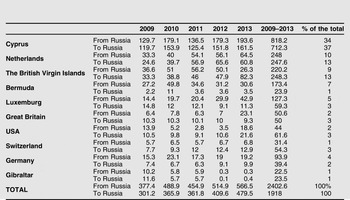
Establishing business in offshore centers has meant that companies can use preferential tax regimes and benefit from simplified registration, and, in many cases, anonymity. In the late 1990s Russians established 50,000–60,000 offshore companies; by the 2000s the number reached 100,000. Footnote 68 According to the Tax Justice Network, during the period 1990–2010, Russians have accumulated around $800,000 billion in offshore financial centers. Footnote 69 The geographical distribution of investments from Russia reveals the dominance of three specific offshore centers: Cyprus, the Netherlands, and the British Virgin Islands have been the predominant destination for Russian capital. Cyprus by itself has become a major landing place for capital from Russia and is home to approximately 14,400 Russian companies. Footnote 70 Table 1 shows that Cyprus alone accounts for around 35–40 percent of annual outward investments from Russia in the period from 2009 to 2013. Footnote 71
Top sources of foreign direct investment to and from Russia 2009–2013

Note: $bln.
Source: Central Bank of Russia, 2014. Available at www.cbr.ru.
Russia is not unique in these trends. Offshore centers are widely used by transnational corporations around the world. Footnote 72 Currently, approximately 30–50 percent of global FDI is accounted for by networks of offshore shell companies. Russia’s other neighbors such as Kazakhstan or Ukraine exhibit similar tendencies too. In the case of Ukraine under Yanukovych, for example, Cyprus accounted for a whopping 92 percent of total outward FDI in 2010. Footnote 73 However, while companies from the developed countries use offshore zones primarily for tax avoidance and regulatory flexibility, Russian and Ukrainian businesses pursue the goal of capital concealment and profit concentration, with tax evasion coming third in their list of preferences. Footnote 74
Real estate markets in Europe and other parts of the world have become another important channel for siphoning capital out of Russia. According to some estimates, in 2011 alone, $10 billion flowing out of Russia went into property in EU countries. Footnote 75 London, in particular, has experienced the inflow of “a gigantic geyser of foreign money” and has been transformed in the process. Footnote 76 Much of London’s high-end property market is dominated by Russians. Footnote 77 In 2006, for example, a fifth of all the prime real estate sold for above ₤8 million was bought by Russian buyers. That proportion was even higher for real estate priced above ₤12 million. The impact of Russian purchases on the real estate market in London goes beyond its contribution to property value inflation and the concomitant increase in wealth disparities in the city. Purchases of high-end properties are made by the ultra-rich who collect many such properties world-wide and are rarely in residence. Whole prestigious neighborhoods in London like Mayfair have been depopulated, as properties in the surrounding area are purchased often for their value as alternatives to more-strictly regulated bank accounts. While interest in a bank account holding ₤12 million would be taxed at the maximum rate in the UK, taxes on appreciation of properties are deferred. In addition, while cash cannot cross one border and be deposited in the bank of a second country without being registered and subject to regulations designed to deter money laundering, cash is still widely used to purchase high-end properties world-wide. And the beneficial owner’s identity can be masked quite legally by registering the property in the name of an anonymous LLC. Whole swaths of the most prestigious locations in cities from Miami to Monaco are owned by people whose identity is unknown. Footnote 78
Russia’s new role as a major capital provider in the world economy only reinforced the reality of Russia being a poor country. If the money made mostly on the sale of natural resources was reinvested domestically and circulated inside Russia, it would have, arguably, had a more positive impact on the general welfare of the Russian population. Footnote 79 The massive capital outflows that occurred beginning in the 1990s and early 2000s amounted to the financial “draining” of Russia’s economy, reducing capital stock available for domestic investment and bleeding the country’s effective tax base. Footnote 80 The Russian government is certainly aware of these consequences. In his December 2012 State of the Nation address President Putin advanced a new “deoffshorization” initiative proposing measures to bring businesses back to Russia. Concrete legal steps however have been taken only in late 2014, when Russia’s Tax Code was amended to include a new law designed to counter the use of tax havens to gain tax preferences. Footnote 81
The reaction of Russian businessmen has been lukewarm, at best. Although a few individuals, most notably Alisher Usmanov, have relocated some of their holdings back under the Russian jurisdiction, most asset-holders have taken a “wait and see” approach or have even tried to change their domicile status to escape the new tax rules. Footnote 82 Neither the capacity of Russia’s Investigative Committee, nor the low level of international cooperation under the current geopolitical circumstances is capable of ensuring the effective implementation of this “deoffshorization” law. Footnote 83 Additionally, some offshore financial centers have themselves engaged in activities to conform with the new Russian laws while continuing to provide safe haven for Russian assets. Footnote 84
Russia’s Round-trip Investors: When Does Capital Return?
The 7 percent average annual growth rate Russia experienced between 1999 and 2008 allowed for some degree of capital repatriation and re-investment. Economic analysts have captured these processes using the concept of “round-tripping,” which was sometimes deemed a distinctive feature of FDI in Russia, where there is “a very high correlation of inward and outward investment flows between the country and financial hubs such as Cyprus and the British Virgin Islands.” Footnote 85 For Russia, as table 1 demonstrates, the places capital is heading to have also become the major source countries for capital inflows back to Russia. In the words of a Moscow-based bank analyst, “most of Cyprus’ Russia-bound investments are nothing other than Russian oligarchs’ capital that was shipped overseas during the turbulent period of the ‘90s.” Footnote 86
“Round-tripping” capital, i.e., when funds are transferred abroad first and then brought back into the country as foreign investment, is an important example of institutional arbitrage. Such a strategy could be used to avoid taxes, hide illicit funds that are “illegally earned, transferred or utilized,” Footnote 87 or protect the funds from predatory state or private actors. In the case of China, where government policy encourages and privileges foreign investors over domestic investors, such strategies are likely to also be motivated by the financial incentives provided by the government. In the case of Russia such incentives are clearly absent. Most analysts, therefore, argue that “round-tripping” is caused by efforts to control institutional and political risk factors. Footnote 88 Russian businessmen tend to use foreign accounts not only to secure their legal assets but also to “launder” ill-gotten money and hide their identity from corrupt officials in Russia. Footnote 89
But why would these funds return back into an unsupportive institutional and unsafe political environment? The simple answer is that these “foreign investors”—being not foreign at all and, to the contrary, having local knowledge, experience and, frequently, insider access to specific economic opportunities—have comparative advantage vis-à-vis genuine foreign investors. A study of economic investment decisions made by “round-trippers” reveals that their decisions differ significantly from decisions made by genuine foreign investors. Footnote 90 Specifically, round-trip investors display a tendency to invest into regions with higher resource potential and greater corruption levels, while genuine foreign investors tend to prefer regions with lower corruption levels and higher educational potential. Footnote 91 It seems plausible to suggest that Russian round-trip investors are those private actors who are closely tied to government officials (whether regional or federal) and who, under their protection, take advantage of profit-making opportunities in Russia with the idea that with impunity they will be able to later stash their profits abroad.
Firms that have secured their assets in foreign institutions tend to return to their home countries only if they have preferential access to profit-making opportunities. Creating such access starts at the very top of the governmental pyramid. Consider the awarding of exclusive contracts to individuals associated with Putin’s inner circle for domestic projects from Olympics construction to food production and textbook publishing. Footnote 92 Such practices are so widely used at the regional and local levels that the proximity to regional governors and city mayors is considered one of the best determinants of firms’ success in Russia. Footnote 93 These business elites that take advantage of weak institutions at home for profit maximization rely on the best of both worlds—secure institutions in the West to protect profits over the long term and weak institutions in Russia to get super-profits in the short term. Weak domestic institutions serve the interests of those asset holders closest to the political authorities. The logic of development over time suggests that only those with access to “political cover” from the very top (the notorious Russian “roof”—krysha) will be left with property. And success is likely to increase among those who understand the unwritten rules of the game, not only including the need for protection but also the requirements to pay bribes and provide tribute and rent sharing.
Voting with Their Feet to Get Justice Abroad
The growing reliance of Russian businesses on foreign courts to settle their disputes is yet another case of institutional arbitrage. The London Court of International Arbitration (LCIA), the London Commercial Court (LCC, a division of the High Court) and the Arbitration Institute of the Stockholm Chamber of Commerce have become the most popular destinations used by businesses from Russia and the wider post-Soviet region for dispute resolution. Footnote 94 The International Court of Arbitration headquartered in Paris and arbitration courts in Geneva, New York, and other financial centers have also seen an increase in litigants from Russia although they are used less commonly. Footnote 95
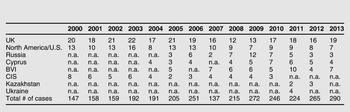
Comprehensive statistical data on these practices are not yet available. We gathered data from LCIA’s director general’s reports from 2000 to 2013 on the arbitration cases filed to the court over that period and the nationality of the claimants and respondents (refer to table 2). There is a clear growth in demand for international arbitration services provided by the LCIA as demonstrated by the near doubling of the number of cases submitted for arbitration in this court. Reports in the years up to 2005 did not mention Russia by name, using instead “CIS” to group together all the claimants from the post-Soviet region. Russian numbers start to be reported separately from 2005, with Kazakhstan and Ukraine replacing CIS in 2011. It is also not accidental that these reports add Cyprus and BVI into their accounting from 2004–2005. The cases associated with these offshore centers are in all likelihood linked to Russian or other CIS businesses; as discussed earlier, these islands represented the top destination for capital flowing out of Russia. The figures are self-explanatory. Starting in 2004–2005 businesses from Russia and other post-Soviet countries increasingly used the London Court of International Arbitration to resolve their disputes. So important have Russian clients become to LCIA that the court started in 2013 organizing “Russian Arbitration Day” in Moscow to discuss trends and developments in international commercial arbitration. Footnote 96
Annual arbitration cases filed at LCIA by selected countries of origin, percent

Source: LCIA Director General Reports (2000–2013); available at http://www.lcia.org/LCIA/reports.aspx.
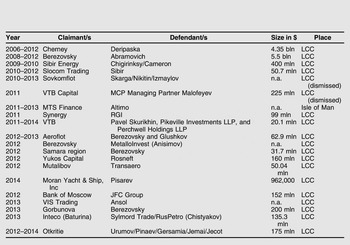
There are also studies done by international law firms—especially the key beneficiaries of these practices in London—that try to track information on the use of the LCIA and the LCC. Portland Legal Disputes, one such firm, analyzed High Court rulings between 2013–2014 and found that litigants from Russia were second only to those from the United States and were followed by claimants and defendants from Kazakhstan. Footnote 97 These disputes are frequently between Russian businesses and do not involve any foreign counterparts, although the Russian party almost always acts through their foreign registered affiliates. Footnote 98 In table 3 we present a list of the most notable litigation cases heard in London in the last ten years. They provide a glimpse, albeit selective in nature, into the actors and the stakes involved in these court battles.
Selected litigation cases involving Russian parties in the High Court of Justice (Commercial Division, LCC)

Most of the cases in the list are about the ownership of significant Russian domestic assets with no direct relationship to England. Conflicts between Russian and non-Russian companies within the Eurasian region are also often settled in the UK, where British courts admit to taking the cases because in their view, if they are not adjudicated in the UK, they would not be adjudicated anywhere. Footnote 99 Many Russian businesses agree in advance and in writing through the inclusion of a “governing law and jurisdiction” clause that in the event of a conflict, UK or other named Western courts would be used to settle the dispute, even though the businessmen are Russian and the business is operating in Russia. Footnote 100 Undoubtedly, they choose Western courts less out of absolute respect for law in general than out of the belief that their opponents’ opportunity to achieve a favorable ruling through force, bribery, or “telephone justice” will be limited outside Russia. Footnote 101
Besides dispute resolution in international courts, Russian businesses prefer placing most of their commercial transactions in contracts governed by English law. Since the 1990s, most of Russia’s oil and gas exports have been placed under foreign law governed contracts. Footnote 102 English law is also preferred in merger and acquisition transactions. Footnote 103 Part of the attraction of Cyprus to Russian businesses is that Cypriot corporate law was based on an earlier version of the English Companies Act, making it compatible with contemporary UK law. Conflicts between Russian companies registered in Cyprus therefore can easily be adjudicated in UK courts. Footnote 104 London is also important as a home to the London Stock Exchange, which Russian companies prefer over the New York Stock Exchange, with its stricter oversight by the U.S. government’s Securities and Exchange Commission. Footnote 105
These preferences reflect the widespread perceptions that Russian laws are not competitive enough and not sufficiently robust to adjudicate large business transactions. As argued by Delphine Nougayrède, a practicing lawyer with work experience in Russia, although Russian contract and corporate laws have evolved from the early 1990s, there are many concerns remaining with regard to lacunae in Russia’s contract laws, including (1) their inability to protect “an innocent contracting party in the event of contractual breach by the other party;” (2) the absence of product warranties that would allow a purchaser to claim for loss in the event of defects in the object (or a company) that has been acquired; and (3) the failure of the law to take into account the fact that completion of a transaction may be dependent on preceding conditions beyond their control. Footnote 106 The same challenges apply to Russian corporate law insofar as it fails to protect minority shareholders and, until 2009, failed to recognize and provide for shareholder agreements. Footnote 107
Nor do businessmen trust the Russian court system to be impartial. Nougayrède emphasizes the importance of a political risk factor—“the risk of discretionary deployment of the law by Russian state bodies as a weapon in pursuit of political or other extra-legal aims.” Footnote 108 Many other analysts confirm that throughout the 2000s the state has become even more discretionary and predatory in its relationship with businesses at all levels. This is not an outcome to be expected from Olson’s predictions about the increasing use of rule-of-law to minimize risk while still maintaining profits. Footnote 109
A caveat is warranted. The strategy of exiting Russia’s institutional environment in favor of more effective foreign institutions is not a replacement for domestic rule of law and not a foolproof solution to institutional problems. This “second-best” solution works most of the time, as long as businessmen do not go against the regime and stay out of politics. Proximity to the top echelons of power is still vital, but also risky. Particularly at times of economic difficulties, state predation can affect even those parties that have been otherwise collaborating with the regime. Footnote 110 Putin himself is said to have told the top oligarchs when reminding them that their wealthy lifestyle should not be confused with secure property rights: “A chicken can exercise ownership of eggs,” he said, “and it can get fed while it’s sitting on the egg. But it’s not really their egg.” Footnote 111 In such circumstances exit emerges as the only privately optimal and sustainable strategy—a strategy that ever consolidates as businessmen undergo through a selection mechanism which leaves afloat only those that rely on weak institutions and personal connections to make profits. These actors, of course, do not have any interest in changing how these institutions work. The second-best solution thus emerges as the most effective strategy to secure returns from the economic activity made possible by these institutions.
Global Capital and Domestic Institutions: Is There a Way Out?
Good institutions are imperative for long-term economic growth and national prosperity. Accountable governments and the rule of law are essential to democratic governance around the world. Scholars have largely converged on these basics. There is also a recognition that such treasured public goods are out of reach for many developing countries struggling with ineffective institutions and unaccountable governments. Institutional development appears to be a gradual process, immune to short-term policy interventions and tireless efforts by international organizations to improve them. There are important reasons for that. This study highlights the role of international structures—global financial and legal institutions—in shaping the incentives of economic actors around the world and limiting their proclivities towards political action aimed at restraining the government and constructing more effective institutions at home.
The global institutional environment offers an institutional escape mechanism for economic actors confronted with ineffective and unstable institutions and political risks at home. Foregoing costly and, at times, risky organization and collective bargaining economic actors have an opportunity of exiting the system and using institutions elsewhere. This study explored the case of Russia—a state geopolitically critical to the rest of the world—that stepped on the path of institutional transformation and integration into the global economy in the early 1990s. The process of transition in Russia resulted in the rise of new capital owners cleverly engaging in institutional arbitrage to make profits at home and use foreign institutions to protect their assets abroad, in more politically secure and institutionally-stable countries. Paradoxically, those who could commonly be expected to have the highest stakes in the development of functional rule-of-law institutions at home and the greatest capacity to lobby for their development have found a mechanism that allows them to resolve institutional problems without risky political action. In many cases these economic actors benefit from unpredictable institutional environment and have stakes in maintaining it in its present, highly suboptimal, state. Even when they are not directly benefitting from such environment and have an interest in changing it, the institutional effects of exit work “to atrophy the development of the art of voice.” Footnote 112
An important implication that emerges from this analysis is concerned with the questionable role of the West in this equation. After all, it is the most powerful western states (such as the United States and the European powers) that set the rules underpinning the global financial system and set the agenda for change. Why did the West assume the role of a safe haven for the Russian capital, frequently obtained through illegal means? Why did it allow for institutional arbitrage to continue in the face of such adverse implications for the country’s institutions? What steps could and should have been taken to break this pattern, if any? After all, these practices worked to intensify the kleptocratic and rent-seeking tendencies in Russia, with the growing number of actors acquiring the means of practicing them. Indeed, the global actors made these practices easy and accessible as the offshore centers and international financial institutions catered to Russian clients (and indeed to largely any asset holders). In an ironic twist, with institutional foundations corrupted, the Russian state has morphed into an aggressive revanchist power, becoming a problem for the system that helped to create it and raising challenging questions as to “what went wrong” and “who lost Russia” after all.
There are no simple answers and specific actors to blame. The global economy is underpinned by liberal principles of open access and separation of markets from politics: the model that privileges economic growth and efficiency and that has proven itself on economic growth indicators. The realization of institutional “traps” and perverse incentives has been slow to surface, which is not very surprising. The capital flowing out of one country and settling in another brings employment, prosperity and mega-profits to selected groups of professionals in investment banks, law firms, the real estate industry, and others. The loss of capital in Russia, Kazakhstan, Azerbaijan, China, and Nigeria means the capital gain in London, New York, and Zurich.
The western governments are realizing the detrimental effects of money laundering through western institutions and the global work on ensuring the integrity of the global financial industry has begun as selected governments, civil-society actors, and international financial organizations advanced a new policy agenda designed to counteract financial abuse and manipulation. The U.S., Swiss, and the UK governments have been at the forefront of these developments, promoting anti-money laundering rules and establishing new requirements for financial institutions and businessmen aimed at preventing tax evasion. International organizations such as the World Bank, the IMF, and the OECD have also prioritized the development of new rules to ensure the global financial system’s integrity.
But will these new policy developments help build stronger institutions in the developing countries? The marginal changes in the global structures are not likely to provide the magic bullet. The only hope of getting out of a structurally determined “exit trap” according to Hirschman, is activating the voice option. Footnote 113 Whether the voice will come from the people frustrated with corruption (as has happened in Ukraine, Georgia, and other countries) or disgruntled elites, the lessons learned from the last quarter-century of transition about the structural constraints on institution-building should not be lost. The spillover from institutional deterioration in such countries as Russia is potentially extremely dangerous and costly for the West. The current realities of global institutional interdependence place a burden of special responsibility on the actors that benefit the most and have the greatest influence in shaping the rules governing the current global system.