Introduction
Alzheimer's disease (AD) is the most widespread cause of dementia and affects at least 5% of individuals over 65 years of age (Jorm et al., Reference Jorm, Korten and Henderson1987). The National Institute of Neurological Communicative Disorders and Stroke/Alzheimer's Disease and Related Disorders Association (NINCDS/ADRDA) standard for the diagnosis of probable AD indicates that patients must demonstrate memory changes and alterations in at least one of the following cognitive functions: language, attention, memory, executive functions, visuospatial abilities and psychomotor abilities (McKhann et al., Reference McKhann, Drachman, Folstein, Katzman, Price and Stadlan1984). While other cognitive skills have been well documented in this population, language skills, at the level of discourse in particular, have been relatively sparsely researched to date. Most descriptions of the clinical and cognitive features of AD highlight deficits mainly in memory ability but also note the relative preservation of language skills until the very late stages of the disease (Forbes-McKay and Venneri, Reference Forbes-McKay and Venneri2005). Despite significant improvements in language assessment over the last two decades (Ortiz and Bertolucci, Reference Ortiz and Bertolucci2005) and the inclusion of some form of language gauge in several of the most commonly used neuropsychological methods of diagnosis, the characterization of language problems in people with dementia may still be unsatisfactory from a functional linguistic point of view (Keller and Rech, Reference Keller and Rech1998).
Investigations to date into language breakdown in AD have noted that as the disease progresses, any aspect of language can be affected (i.e. phonological, lexical, syntactic or discursive) (Groves-Wright et al., Reference Groves-Wright, Neils-Strunjas, Burnett and O'Neill2004). In the early stages, word-finding difficulties appear in spontaneous speech. This becomes more frequent in the middle stages, along with the appearance of paraphasias, and spontaneous speech is said to become more “fragmented” and sometimes incoherent. In the latter stages, speech becomes increasingly non-fluent, and all aspects of language are disturbed (Cardebat et al., Reference Cardebat, Demonet, Doyon, Brownell and Joanette1993).
While analysis of language skills such as naming of pictures and objects in isolation from everyday discourse provides information on lexical access under certain conditions, analysis of language in connected speech provides different information which is particularly relevant in dementia due to the broad cognitive nature of the disorder. To produce discourse, a speaker must integrate linguistic and non-linguistic skills. Such skills include selection, organization and planning and cognitive-linguistic abilities such as naming (Duong et al., Reference Duong, Giroux, Tardif and Ska2005). For this reason, discourse analysis is seen as a sensitive tool for detecting language impairment. Analysis of a person's discourse should thus be considered as a potential means of identifying linguistic disturbances in dementias, as well as in the follow-up of these patients to monitor changes occurring (Duong et al., Reference Duong, Giroux, Tardif and Ska2005).
Several studies have found that individuals with AD perform worse than normal controls on discourse production tasks. As examples of studies in English, Hier et al. (Reference Hier, Hagenlocker and Shindler1985) reported a reduction in lexical diversity, characterized by fewer words and less-relevant information. Nicholas et al. (Reference Nicholas, Obler, Albert and Helm-Estabrooks1985) found that AD produced fewer content elements but more semantic paraphasias, deictics, repetitions, indefinite terms, and empty phrases. Erlich et al. (Reference Erlich, Obler and Clark1997) verified that the amount of information pictorially represented in the picture narrative task significantly influenced the discursive performance of the AD subjects. Groves-Wright et al. (Reference Groves-Wright, Neils-Strunjas, Burnett and O'Neill2004) found that the discourse aspects are positively correlated with tests of lexical-semantic competence in the moderate stage of the disease, whereas in the early stage there is considerable heterogeneity in discourse ability. Forbes-McKay and Venneri (Reference Forbes-McKay and Venneri2005) found that a high proportion of AD subjects performed below the cut-off in a test of semantic-processing skills. Bschor et al. (Reference Bschor, Kuhl and Reischies2001) found that German AD patients performed worse than controls in picture description tasks but concluded that formal naming tests were more sensitive in showing language impairments. In addition, this group reported that in the most severe phases of AD, patients may not tolerate formal tests. In a French sample, Cardebat et al. (Reference Cardebat, Demonet, Doyon, Brownell and Joanette1993) verified that patients with AD are unaware of their narrative deficits. In another French sample, Croisile et al. (Reference Croisile1996) found that AD patients manifested a reduction in all word categories; although AD patients and controls produced an equivalent number of semantic errors, the AD patients had more word-finding difficulties. Hence, discourse tasks appear sensitive to the language deficits appearing in AD.
There are many types of discourse, including descriptive, narrative, procedural, persuasive, expository, and conversational. As narrative discourse plays a central role in almost every conversation, it is a well-accepted tool for obtaining samples of connected speech (Labov and Waletsky, Reference Labov, Walestzky, Paulston and Tucker2003). A narrative consists of a sequence of dependent events which contain at least one temporal juncture (Labov and Waletzky, Reference Labov, Walestzky, Paulston and Tucker2003). Narrative discourse can be elicited through open-ended questions or through picture-supported stimuli. This latter type provides at least three benefits: (1) it reduces the demand on memory because the stimulus remains with the subject at the time of evaluation; (2) it may facilitate linguistic analysis by describing the stimulus (Duong and Ska, Reference Duong and Ska2001); and (3) it does not suggest any linguistic clue that might disguise a malfunction (Marini et al., Reference Marini, Boewe, Caltagirone and Carlomagno2005).
There are two types of picture-supported stimuli: single picture and picture sequence (Duong and Ska, Reference Duong and Ska2001). Picture sequence encourages narration because it provides a temporal and logical sequence of events, whereas single picture generally prompts the subject to provide only a description, because narration requires that the information first be organized.
Producing narrative discourse can be considered to be a complex dynamic cognitive function, consisting of interactions at different levels of processing (Kintsch and van Dijk, Reference Kintsch and van Dijk1978; Marini et al., Reference Marini, Boewe, Caltagirone and Carlomagno2005). Three principal levels of processing can be separated: the microlinguistic (within-sentence) level, which is responsible for phonological, lexical and syntactic measures (intra-phrasal functions); the macrolinguistic (between-sentence) level, which is responsible for inter-phrasal functions (local cohesion and coherence); and a level of global-meaning processing (i.e. the generation of the mental model of a text) (Kintsch and van Dijk, Reference Kintsch and van Dijk1978; Glosser and Deser, Reference Glosser and Deser1990).
The consensus in the literature is that impairment of macrolinguistic skills exists in AD subjects; however, the literature is less clear cut with respect to the microlinguistic aspects. In order to gauge lexical skills in discourse, incidence of such phenomena as word-finding difficulties, production of indefinite terms, semantic and phonemic paraphasias, repetitions and oral revisions have been investigated (Croisile et al., Reference Croisile1996). Blanken et al. (Reference Blanken, Dittmann, Haas and Wallesch1987) found that word-finding ability is well preserved in AD patients. Glosser and Deser (Reference Glosser and Deser1990) and Croisile et al. (Reference Croisile1996) determined that normal performance is correlated with semantic paraphasias. On the other hand, various other studies revealed that lexical measures in tasks of connected speech were abnormal in patients with AD (Hier et al., Reference Hier, Hagenlocker and Shindler1985; Nicholas et al., Reference Nicholas, Obler, Albert and Helm-Estabrooks1985; Erlich et al., Reference Erlich, Obler and Clark1997; Kavé and Levy, Reference Kavé and Levy2003; Forbes-McKay and Venneri, Reference Forbes-McKay and Venneri2005).
In order to investigate syntactic skills in discourse, measures of grammatical errors and proportion of spoken complex sentences have been used. Through semi-structured interviews, Blanken et al. (Reference Blanken, Dittmann, Haas and Wallesch1987) compared the discourse of German AD patients with that of aphasic and healthy individuals, verifying that AD patients were able to produce complex, long sentence frames and concluding that there is no systematic disturbance of morphosyntactic operation in AD. Kempler et al. (Reference Kempler, Curtiss and Jackson1987) confirmed that not only are syntactical errors rare in the early to late stages of AD, but also the frequency with which different syntactic constructions are used is similar to that in both normal and demented individuals. Gloser and Deser (Reference Glosser and Deser1990) also failed to find a difference between the syntactic abilities of nine subjects with mild to moderate AD and those of healthy controls. Kaprinis and Stavrakaki (Reference Kaprinis and Stavrakaki2007) noticed the preservation of morphosyntactic abilities in 30 mild to moderate Greek AD patients, using semi-structured interviews. On the other hand, Hier et al. (Reference Hier, Hagenlocker and Shindler1985) found that AD patients in the early to late stages presented syntax that was more simplified than that of controls. Cardebat et al. (Reference Cardebat, Demonet, Doyon, Brownell and Joanette1993) confirmed that the discourse of 19 patients with moderate dementia was syntactically less complex than that of an older group. Croisile et al. (Reference Croisile1996) found that sentence complexity was simplified in 27 mild to moderate AD patients, based on a reduction in the use of subordinated clauses. Erlich et al. (Reference Erlich, Obler and Clark1997) also encountered a decrease in syntactic complexity in patients with mild to moderate AD and concluded that syntax may not be preserved in AD. Similarly, Kavé and Levy (Reference Kavé and Levy2003) found that Hebrew individuals with mild to moderate AD used complex sentences less frequently than did controls. Considering the results of these studies, there is no consensus regarding alterations in syntactic complexity in AD.
Previous published studies that investigated language skills in Brazilian Portuguese patients with AD did not attempt to study the microlinguistic aspects of discourse nor the macrolinguistic aspects of indexed publications. Hence, the objective of the current study was to identify possible alterations in the microlinguistic aspects of discourse in AD patients with respect to lexical errors and syntactic complexity. We hypothesized that AD subjects would exhibit alterations on both the lexical and syntactic microlinguistic levels.
Methods
A cross-sectional, observational study was carried out at the outpatient clinic of the Behavioral Neurology Division of São Paulo Federal University. The study was approved by the local Research Ethics Committee. After receiving full information about the study, written informed consent was obtained from all enrolled subjects.
Subjects
The sample consisted of the control (CG) and AD (ADG) groups. The general inclusion criteria were as follows: age ≥60 years; schooling ≥4 years; no history of alcoholism or drug use; no use of psychotropic medications, except for atypical neuroleptics; and the absence of visual or auditory impairments that might affect the outcome of the cognitive tests.
To evaluate general cognition and avoid the inclusion of patients with obvious dementia, the Mini-mental State Examination (MMSE) was used as a screening tool. We adopted a Portuguese-translated version, with cut-off scores adapted to the subjects’ educational levels (Brucki et al., Reference Brucki, Nitrini, Caramelli, Bertolucci and Okamoto2003): illiterate = 20; elementary (1 to 4 years of education) = 25; 5 to 8 years of education = 26.5; 9 to 11 years of education = 28; and high (more than 12 years) = 29.
Because the MMSE is merely a screening tool for dementia and has a ceiling effect, we also employed the cognitive subscale of the Alzheimer's Disease Assessment Scale (ADAS-Cog) for the selection of subjects in our sample. One standard deviation was added for the control group, and one standard deviation (DP) was subtracted for the AD group, based on the averages proposed by Schultz et al. (Reference Schultz, Siviero and Bertolucci2001). The scores were further stratified by educational level: CG –4 to 11 years of education, ≤10.5 or ≥12 years of education, ≤8.5; AD group –4 to 11 years of education, ≥17.5 or ≥12 years of education, ≥10.5.
The CG consisted of healthy elderly volunteers without neurological or psychiatric changes. The ADG consisted of AD patients who were diagnosed with probable AD based on the criteria of the NINCDS-ARDRA (McKhann et al., Reference McKhann, Drachman, Folstein, Katzman, Price and Stadlan1984). Only those individuals with an MMSE score greater than 12 and undergoing treatment for AD with a therapeutic dose of acetyl cholinesterase inhibitors (donepezil ≥5 mg, rivastigmine ≥9 mg or galantamine ≥8 mg) were selected.
A total of 157 individuals were screened in this study: 93 in the CG and 64 in the ADG. Thirty-two subjects were excluded from the control group because they had scores lower than those required by the screening tests (mean age 71.7 (SD = 5.6) years and mean schooling 4.9 (SD = 1.9) years). Four subjects were excluded from the AD group: two presented catastrophic reactions, and the other two had MMSE scores that exceeded the requirements of this study. Therefore, 60 patients with AD and 61 controls participated in the study.
Procedure
After the administration of MMSE and ADAS-Cog, the individuals were asked to relate a story based on a picture sequence that depicts “The Dog Story” (Le Boeuf, Reference Le Boeuf1976). This picture sequence consists of seven frames arranged on an A3 sheet of paper, 9.2 × 9.2 cm, in black and white. A summary of the story is as follows: a boy sees a dog in the street and decides to take him home; on arriving home, the boy asks the animal not to make any noise and hides him in the closet; when the boy's mother opens the closet and sees the dog, she demands an explanation; the boy then begs her to let him keep the dog, and she allows the animal to stay. In the end, the mother helps the boy build a little house for the dog. This story, used in the study by Cardebat et al. (Reference Cardebat, Demonet, Doyon, Brownell and Joanette1993), contains all of the elements of a narrative structure and is familiar enough to be part of the participant's family dynamics and daily life.
The individual was instructed as follows: “Do you see this picture? It consists of these seven frames (the evaluator points to the frames in sequence). I would like you to tell me the story described here. You may look as long as you think necessary before beginning.” The test began the moment the subject started to narrate the tale and terminated only when he/she indicated that there was nothing more to be said. Next, the evaluator asked the subject whether he/she had anything more to add. For those subjects who had difficulty beginning the narration, the evaluator encouraged them to converse without influencing the individual's oral narration.
The discourse was taped and later transcribed for analysis, taking into account the following aspects:
• Lexical errors (LE) (adapted from Croisile et al., Reference Croisile1996): these are divided into five subtypes:
(1) word-finding difficulties (WFD) – scores for this item were confirmed by both the transcript and tape of the subject's narrative;
(2) repetitions (R) – only immediate repetitions of isolated words were considered;
(3) revisions (Re);
(4) semantic substitutions (SS); and
(5) phonemic paraphasias (PP).
To analyze each of these variables, the total absolute number of lexical errors and the absolute number of their subtypes were counted. The general frequency of each subtype compared with the number of words emitted was also calculated.
• Syntactic Index (SI) (adapted from Duong et al., Reference Duong, Giroux, Tardif and Ska2005): this provides a measure of the syntactic complexity of discourse. The SI represents the ratio of the total number of complex sentences and their subtypes (subordinated [Su], coordinated syntactic [Co] and reduced [Rd]) to the total number of sentences spoken by the subject. Coordinated syntactic sentences are those united by a coordinating conjunction such as “and”. Subordinated sentences are those that are dependent or secondary to a principal sentence. Reduced sentences, which are quite similar to reduced relative sentences in English grammar, are spoken subordinated sentences that appear abbreviated, lack a conjunction and have nominal verb forms, either infinitive or gerund (André, Reference André and André1997). An example of a reduced sentence is “Here is the boy asking his mother to keep the dog . . .” (in the original Brazilian Portuguese, “Aqui é o garoto pedindo à sua mãe para ficar com o cachorro . . .”). Although they are called “reduced”, these sentences are considered sophisticated because they demand complex syntactic processing. Reduced sentences, like unreduced relative sentences, are a type of two connected clauses in which one occurs in the middle of another. Thus, the content of the main clause must be maintained in memory while the relative clause is being processed (Gibson, Reference Gibson1998).
The transcription of the discourse and the analysis of all the items mentioned were performed by the authors of this study. To prevent inaccurate transcription, at least two other independent persons were asked for verification.
A quantitative statistical method was used to assess the accuracy of our measurement techniques. The intraclass correlation coefficient (ICC) was calculated (Shrout and Fleiss, Reference Shrout and Fleiss1979) based on a random sample of 12 subjects (6 AD patients and 6 controls) assessed after a 6-month interval. When calculating the intra-rater, ICC (1.1) was 0.997 for the syntactic index and 0.963 for the lexical errors. When calculating the inter-rater, ICC (3.1) was 0.953 for the SI and 0.947 for the LE.
Statistical analysis
Differences in the means were tested by Student's t-test (t) followed by the Mann-Whitney test (U). When similar results were achieved with both tests, the parametric results were used; when there was a discrepancy, however, the non-parametric results were used.
Logistic regression analysis was performed to investigate the individual relationships between independent and dependent variables. The results of these analyses were calculated using the Wald test (Wald χ2), and the assumptions were verified. The results of the logistical regression are presented as Odds Ratio (OR). The results of the calculated ratios are presented as percentages.
A probability (p) of less than 0.05 was considered statistically significant, and all tests were two-tailed. Ninety-five percent of the confidence interval (CI) was calculated for the differences between the average and the OR. All of the calculations were performed using the statistical software SPSS (Statistical Package for the Social Sciences) 13.5.1 for Windows.
Results
General characteristics
No statistically significant difference was found between the ADG and CG with respect to years of schooling (6.8 (SD+3.7) versus 7.8 (SD+3.7) years; 95% CI = –0.2 to 2.3; t (119) = 1.5; p = 0.122) and gender (66.7% versus 75.4% for women; χ2 = 1.1; p = 0.280). The group of AD patients was significantly older than the controls (77.2 (SD = 6.4) years versus 69.7 (SD+ 6.5); 95% CI = –9.7 to –5.1; t (119) = –6.3; p < 0.001). The AD patients demonstrated significantly lower average scores on the MMSE than the controls (19.7 (SD + 3.40 versus 28.0 (SD = 1.4); 95% CI = 7.3 to 9.2; t(119) = 17.5; p < 0.001). On the other hand, the average scores on the ADAS-Cog test were significantly higher, indicating lower cognitive functioning in the ADG (28.8 (SD = 8.2) versus 6.6 (SD+ 2.0); 95% CI = –24.3 to –20.0; t(119) = –20.4; p < 0.001). These results show that the controls performed much better than the AD patients.
Evaluation of microlinguistic aspects
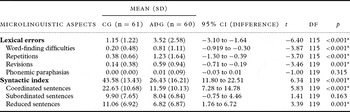
A comparison of the microlinguistic aspects between the CG and ADG was performed. The descriptive measurements and the results of the comparison between the averages of the controls and the AD group are presented in Table 1. The parametric test could be applied to all the sub-items, except the semantic substitutions measurement, which required the non-parametric test (U = 1617.00; p = 0.206).
Descriptive analysis results based on the mean measurements of microlinguistic aspects

SD = standard deviation; CI = confidence interval; DF = degrees of freedom; ADG = Alzheimer's disease group; CG = control group.
In general, the AD subjects displayed lower mean scores than the controls with respect to the syntactic index and lexical analysis. There was a statistically significant difference in all of the lexical error items, indicating a better performance by the controls in all items, except for paraphasias. In the syntactic index, the ADG showed less use of complex sentences, especially those with coordinated syntactic and reduced structures.
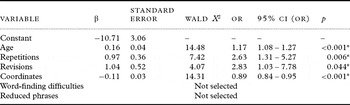
Multiple logistic regression analysis was used to identify the main microlinguistic aspects that differentiated the groups. The lexical errors and syntactic index subtypes that significantly distinguished between the two groups were inserted into the anterior analysis (word-finding difficulties, repetitions, revisions, and both coordinated syntactic and reduced sentences) as independent variables. Additionally, age was used as a confounding variable, as the AD patients were significantly older than the controls. The ADG or CG served as the dependent variable. For the final model, hierarchical forward-stepwise selection of the independent variables was performed based on the likelihood-ratio test (Table 2).
Results of the multiple logistic regression analysis (SFLR)
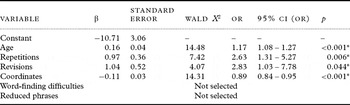
ADG, n = 60; CG, n = 61; OR = odds ratio. CI = confidence interval; ADG = Alzheimer's disease group; CG = control group.
The OR of the variables indicated the chance of having AD when the test scores were differentiated in a unit. Repetitions, revisions and coordinated syntactic sentences were selected as the variables for the model because they could differentiate AD patients from the controls independent of age. The higher the score for word repetitions and revisions, the greater the chance of the patient having AD (0.97 and 1.04, respectively), whereas the higher the coordinated syntactic sentences used, the less the chance (0.11) of the patient having AD. These findings were independent of each other and age.
Discussion
The main finding of our study is that AD patients exhibited more lexical errors in their discourse and a lower syntactic index compared with healthy, elderly subjects. This index represents the syntactic complexity, as evaluated by the mean number of complex sentences that have coordinated syntactic, subordinated and reduced sentences. In this study, the AD individuals spoke in reduced and coordinated sentences less frequently than the controls, and the latter sentence type more effectively distinguished between the two groups. No difference was observed between groups regarding the use of subordinated clauses. The low frequency of subordinated use by both groups can be explained by a tendency to produce simpler linguistic speech. Despite this finding, both the results related to the frequency of the other complex sentences (coordinated syntactic and reduced sentences) and the general measures of structural complexity (syntactic index) showed that patients with AD produced simpler syntactic utterances than did the controls. A narrative is defined as any sequence of clauses that contains at least one temporal juncture (Labov and Waletzky, Reference Labov, Walestzky, Paulston and Tucker2003). Therefore, coordinated syntactic and subordinated clauses are necessary when speaking. We consider subordinate sentences more complex than coordinated syntactic ones. In our study, coordinated syntactic clauses were used more often than subordinated ones, and thus, the narrative in both groups was based on a simpler syntactic structure. The speech of both groups was syntactically simple, but the speech of the AD group was noticeably simpler. Although the AD group did not differ from the healthy controls in their use of subordinated clauses, their narratives consisted of mainly coordinated syntactic sentences and fewer reduced sentences, demonstrating syntactic simplification.
The production of syntactically simpler utterances can be discussed within the model of speech production (Garrett, Reference Garrett and Bower1975; Levelt et al., Reference Levelt, Roelofs and Meyer1999), which includes three processing components. The first component represents the pre-verbal intention of the speaker to communicate (conceptual preparation). The second component, grammatical encoding, encompasses the selection of words with appropriate semantic meanings, through lemmas (functional processing) and the assignment of the lemmas to roles within a syntactic structure (positional processing). The third component, phonological encoding, is responsible for spelling out the sound forms of the words and the prosodic properties.
Thus, in grammatical encoding, sentences are constructed piecemeal from beginning to end, and the words tend to be placed early in the sentence with these initial placements constraining subsequent lexical and structural decisions (Garrett, Reference Garrett and Bower1975; Levelt et al., Reference Levelt, Roelofs and Meyer1999). For this process to occur synchronously, it requires lexicon demands and the capacity of working memory, both of which are impaired in AD (Caplan and Waters, Reference Caplan and Waters1995). According to Kolk (Reference Kolk1995), impairments result in a slow activation or a too-fast decay during grammatical encoding, causing reduced syntactic efficiency in the structure of the output. Kolk (Reference Kolk1995) also states that the sentence production system as a whole is adapted to its limited capacity and that syntactic simplification is a way for the patient to react to the newly acquired performance limitations via a “preventive adaptation”. Consequently, there is a tendency for simpler message level structures to be selected up to the point at which the system is no longer overloaded and relatively error-free utterances are produced.
According to Bates et al. (Reference Bates, Harris, Marchman, Wulfeck and Kritchevsky1995), patients with AD demonstrate syntactic preservation only for overlearned patterns and/or situations that strongly constrain the structures that ought to be used. It seems reasonable to assume that simple sentences are more frequent than most complex forms. According to Bates et al. (Reference Bates, Harris, Marchman, Wulfeck and Kritchevsky1995), the ability to produce simpler syntactic utterances is an automatic aspect of grammatical processing, and the construction of more complex utterances requires a suppression of this “automatization”. Thus, patients with AD present impairments if they are required to suppress highly accessible structures and/or generate and decide among a set of structural options to fit a novel situation.
Kavé and Levy (Reference Kavé and Levy2003) have analyzed discourse in Hebrew and found that the AD group used complex sentences less frequently than controls. The syntactic simplification was also a manifestation found in AD patients by Hier et al. (Reference Hier, Hagenlocker and Shindler1985), by Erlich et al. (Reference Erlich, Obler and Clark1997) with English-speaking individuals, and by Croisile et al. (Reference Croisile1996) and Cardebat et al. (2005) with French-speaking individuals. The reduction in complexity that was observed in the Portuguese used in this study has also occurred in several other languages. This observation suggests that a reduction in syntactic complexity in AD can occur in different linguistic codes, even though they have different grammatical structures.
On the other hand, there are several studies that did not find any difference in syntactic complexity (Blanken et al., Reference Blanken, Dittmann, Haas and Wallesch1987; Kempler et al., Reference Kempler, Curtiss and Jackson1987; Glosser and Deser, Reference Glosser and Deser1990; Kaprinis and Stavrakaki, Reference Kaprinis and Stavrakaki2007). One possible explanation is that the studies that did not find syntactic simplification were performed with open-ended stimuli. Bates et al. (Reference Bates, Harris, Marchman, Wulfeck and Kritchevsky1995) verify that utterances regardless of contextual information tend to be syntactically simpler in patients with AD. According to Fehringer and Fry (Reference Fehringer and Fry2007), this happens because in spontaneous conversation, there is a continuous activation of a number of elements that help the speaker maintain the topic while also monitoring his own production. Because discourse elicited by open-ended stimuli is a type of spontaneous conversation, the utterances of the individual improve in terms of syntax due to the demands of the interlocutor. Hence, picture-supported tasks are better suited to identify structural simplification.
This study was able to identify a syntactic alteration in the AD group because the syntactic index was a variable that differentiated the groups independent of age. We believe that considering the syntactic manifestations in AD as evidence of pathology is of fundamental importance in the evaluation and follow-up of these patients. Such linguistic changes may highlight the potential for other underlying pathological processes as well as functionally explain communication deterioration that may be occurring in coherence of the person's everyday discourse.
Hier et al. (Reference Hier, Hagenlocker and Shindler1985), Croisile et al. (Reference Croisile1996) and Kavé and Levy (Reference Kavé and Levy2003) all found a simplification in the sentence structure used in their studies, but none of these authors postulated that this simplification might be evidence of an alteration at the syntactic level. This oversight may have resulted from the absence of morphosyntactic errors made by the AD patients in their studies. Based upon the data presented here, however, syntactic simplification is an alteration that occurs in patients with AD due to limitations at different levels of the sentence production system, including grammatical encoding. Thus, we believe that syntactic simplification is a manifestation of AD that must be taken into account in any language-related diagnosis and should be included as part of a therapeutic follow-up examination of the patient because of its potential to compromise communication.
With respect to lexical errors, patients with AD presented more word-finding difficulties than did the controls, but this variable could not better differentiate the groups in the regression analysis. Because word-finding difficulties are one of the most common problems of oral speech in individuals with AD, this item was expected to better differentiate the groups. According to Blanken et al. (Reference Blanken, Dittmann, Haas and Wallesch1987), word-finding difficulties in dementia are more prominent in specific neuropsychological tests than in a speech situation. Another possible explanation for this finding can be related to the content of the frames in the tale of “The Dog Story” (Le Boeuf, Reference Le Boeuf1976). The majority of words used by the subjects in this sample were common to their vocabulary (e.g. “dog”, “boy”, “mother” and “house”), which could simplify the lexical complexity required by persons with AD to narrate these figures.
The AD individuals exhibited a greater number of immediate word repetitions, and this item was better at differentiating the groups. Forbes-McKay and Venneri (Reference Forbes-McKay and Venneri2005) also noted this aspect. According to them, the use of word repetitions in connected speech can also be considered as a word-finding difficulty equal to the use of indefinite terms. Nicholas et al. (Reference Nicholas, Obler, Albert and Helm-Estabrooks1985) and Croisile et al. (Reference Croisile1996) evaluated this detail both in healthy, elderly adults and in AD patients and found a significant use of repetitions in the latter group, whereas in the latter study, none of the 24 control individuals made repetitions.
Another detail that successfully differentiated between the groups was the subjects’ corrections of the words or ideas initiated by the proposed stimulus; the AD patients demonstrated more revisions compared with the controls. This finding differed from that in the study involving 22 AD patients and 24 healthy, elderly controls by Croisile et al. (Reference Croisile1996), who showed that both groups made a large number of revisions. An explanation for the differences between the two studies is that a picture sequence was employed in our study instead of a single picture and our study involved a larger number of patients and controls. We consider narrating a story based on a picture sequence to be more complex as it requires major preparation to connect the narrative. Thus, another explanation for the increased number of revisions is that a subject might not have conducted a global analysis of the content before initiating the story, necessitating corrections during the narrative.
Additionally, the AD patients exhibited more errors than the controls and required more revisions as a result. According to Vigliocco and Hartsuiker (Reference Vigliocco and Hartsuiker2002), if a mistake is made at a certain moment of linguistic production, a process of efficient speech is set in motion to correct it, producing an efficient emission of that thought. Based on that idea, making revisions during speech could be considered a positive aspect of communication. Despite having displayed errors in lexical access, patients with AD were probably correcting themselves quickly.
No differences were observed between the AD and control groups in our study with respect to the manifestation of semantic substitutions. This finding agreed with those of Blanken et al. (Reference Blanken, Dittmann, Haas and Wallesch1987), Glosser and Deser (Reference Glosser and Deser1990) and Croisile et al. (Reference Croisile1996). Nevertheless, the influence of AD on semantic substitution was apparent in other studies (Nicholas et al., Reference Nicholas, Obler, Albert and Helm-Estabrooks1985; Cardebat et al., Reference Cardebat, Demonet, Doyon, Brownell and Joanette1993; Forbes-McKay and Venneri, Reference Forbes-McKay and Venneri2005). In those studies, the controls were more successful in saying the target word and rarely used semantic substitutions. Examining the methodologies in the studies mentioned above, we noted that no differences were found in semantic substitutions when an open-ended discourse was stimulated but that there was no consensus when speech was initiated from pictures. For the purpose of this discussion, we believe that the pictures used need to be analyzed. In our study, we used a sequence of seven frames that composed “The Dog Story” (Le Boeuf, Reference Le Boeuf1976). Cardebat et al. (Reference Cardebat, Demonet, Doyon, Brownell and Joanette1993), who used the same sequence, observed differences between the groups of AD patients and control adults over 75 years of age. In our study, the age of the controls was significantly lower than that of the AD group, but even then, we failed to find differences in semantic substitutions. According to Hough (Reference Hough2007), however, the most frequently occurring error, even in healthy elderly individuals older than 60 years, was the production of words that were semantically related to the target. Furthermore, the sample analyzed in our study indicated semantic substitutions particularly when the individuals were incapable of perceiving a previously excluded person in the last picture of the tale. This type of error may have been due to the replacement of the boy's mother with a child, probably the boy's friend, or because the mother's figure was crouched down on her knees, possibly confusing the study subjects and resulting in a visual decoding flaw.
Likewise our study showed no difference between the groups in the occurrence of phonemic paraphasias; there is a consensus that alterations in phonological linguistic aspects are rarely found in the early to middle stages of AD (Croisile et al., 1993; Erlich et al., Reference Erlich, Obler and Clark1997; Groves-Wright et al., Reference Groves-Wright, Neils-Strunjas, Burnett and O'Neill2004).
This study has some limitations. Patients with AD were significantly older than the controls. The regression analysis, however, was performed such that the variables of discourse were studied independent of age. This age difference resulted from the difficulty of finding subjects over 80 years of age for the control group. In addition, many of the potential control individuals over 80 could not be included in this study because their education levels were less than the minimum requirements for this study.
The importance of this study is that it demonstrates that a sequence of picture-supported tasks is a tool that helps to analyze the microlinguistic aspects of discourse in AD patients. Furthermore, the use of stimuli that induce narrative discourse, such as the picture sequence composing “The Dog Story”, can be valuable in evaluating microlinguistic aspects in AD patients. Following Duong et al. (Reference Duong, Giroux, Tardif and Ska2005), we believe that discourse is a sophisticated tool for evaluating language in subjects with this disorder and that it can assist with the diagnosis of AD, monitor changes over time and explain communication breakdown in AD patients. This study demonstrated that a sequential picture-supported narrative task is sensitive to detecting changes in microlinguistic aspects of the discourse of AD patients.
Conflict of interest
None.
Description of authors' roles
Juliana Onofre de Lira collected, analyzed and interpreted the data, and drafted the paper. Karin Zazo Ortiz performed critical revision of the paper. Aline Carvalho Campanha collected the data and critically revised the paper. Paulo Henrique Ferreira Bertolucci critically revised the paper. Thaís Soares Cianciarullo Minett supervised the data collection and performed the analysis and interpretation of the data.