Introduction
Older age is associated with a number of brain changes, including decline in gray and white matter volume and decreased neuronal function, which are associated, in turn, with decline in certain cognitive abilities (Cabeza, Nyberg & Park, Reference Cabeza, Nyberg and Park2005). Although the decline is not uniform, with great inter-individual variability reported in the literature (e.g., Raz, Reference Raz2009), performance differences associated with aging have been reported for a range of neuropsychological tests in a number of cognitive domains, including attention and inhibition. For example, lower performance with age has been documented using tests that assess inhibition control, such as the Stroop Test (e.g., Van der Elst, Van Boxtel, Van Breukelen & Jolles, Reference Van der Elst, Van Boxtel, Van Breukelen and Jolles2006; West & Alain, Reference West and Alain2000) and the Simon task (Bialystok, Craik, Klein & Viswanathan, Reference Bialystok, Craik, Klein and Viswanathan2004; Van der Lubbe & Verleger, Reference Van der Lubbe and Verleger2002); tests that measure working memory spans (e.g., Park, Lautenschlager, Hedden, Davidson, Smith & Smith, Reference Park, Lautenschlager, Hedden, Davidson, Smith and Smith2002); and tests that assess ability to alternate attention, such as the Trail Making test (e.g., Salthouse & Fristoe, Reference Salthouse and Fristoe1995). Whereas some have argued that performance differences can be explained by age-related reductions in processing speed (Salthouse, Toth, Daniels, Parks, Pak, Wolbrette & Hocking, Reference Salthouse, Toth, Daniels, Parks, Pak, Wolbrette and Hocking2000), others maintain that lower performance on at least some of these tests is associated with age-related frontal system changes that have been hypothesized to account for decreased abilities collectively termed executive function (e.g., Verhaeghen & Cerella, Reference Verhaeghen and Cerella2002), and especially those associated with inhibition control (e.g., Raz, Reference Raz2009).
An intriguing finding reported recently suggests that certain older individuals do not show the typical age-related decline (Ghisletta, McArdle & Lindenberger, Reference Ghisletta, McArdle and Lindenberger2006; Kavé, Eyal, Shorek & Cohen-Mansfield, Reference Kavé, Eyal, Shorek and Cohen-Mansfield2008; Stern, Reference Stern2009). “Successful aging” may be associated with physical health (e.g., Albert, Spiro, Sayers, Cohen, Brady, Goral & Obler, Reference Albert, Spiro, Sayers, Cohen, Brady, Goral and Obler2009; Cahana-Amitay, Albert, Ojo, Sayers, Goral, Obler & Spiro, published online October 9, Reference Cahana-Amitay, Albert, Ojo, Sayers, Goral, Obler and Spiro2012; Spiro & Brady, Reference Spiro and Brady2011), intellectual and social health (e.g., Stern, Reference Stern2009), and intra-individual variability (Hultsch, MacDonald & Dixon, Reference Hultsch, MacDonald and Dixon2002). One sub-group of older adults who has been reported to show relatively well-preserved cognitive ability, at least for some cognitive skills, is bilingual individuals.
For example, Bialystok et al. (Reference Bialystok, Craik, Klein and Viswanathan2004) reported that older bilingual individuals experienced smaller interference effect on the Simon task than older monolingual individuals. The participants included in their study were younger (ages 30–58 years) and older (60–88 years) monolingual English speakers and bilingual English–Tamil and English–Chinese speakers. The task was the Simon task, in which a red or blue square appears on the right or the left of a computer screen and participants are asked to press the left shift key or the right shift key when they see a red or blue square, respectively. Half the trials are congruent, that is, the square is presented on the same side of the target response key, and half of the trials are incongruent, i.e., the square is presented on the opposite side of the response key. The authors found that the monolingual and bilingual participants who performed similarly on memory, intelligence, and vocabulary tests differed in their performance on the Simon task. Namely, the bilingual participants demonstrated a smaller Simon effect, that is, smaller response-time differences between congruent and incongruent conditions, than did the monolinguals. Moreover, there were greater age differences between the monolingual older and younger groups than between the two bilingual age groups.
These results have been replicated in Bialystok, Martin and Viswanathan (Reference Bialystok, Martin and Viswanathan2005) for bilinguals living in Hong Kong, India, and Canada, and, in part, in Salvatierra and Rosselli (Reference Salvatierra and Rosselli2011) with Spanish–English bilinguals living in the U.S. A cognitive advantage for young adult speakers of two or more languages has been reported in studies that used the Stroop Test, demonstrating a reduced interference effect in incongruent conditions for bilinguals as compared to monolingual peers (Hernández, Costa, Fuentes, Vivas & Sebastian-Gallés, Reference Hernández, Costa, Fuentes, Vivas and Sebatian-Gallés2010). Consistent results have also been reported in Soveri, Laine, Hämäläinen and Hugdahl (Reference Soveri, Laine, Hämäläinen and Hugdahl2011) for Finnish–Swedish bilinguals completing a forced-attention listening task. However, several recent investigations have failed to replicate the bilingual advantage (Colzato, Bajo, van den Wildenberg, Paolieri, Nieuwenhuis, La Heij & Hommel, Reference Colzato, Bajo, van den Wildenberg, Paolieri, Nieuwenhuis, La Heij and Hommel2008; Kousaie & Phillips, Reference Kousaie and Phillips2012) and the question whether older bilinguals specifically maintain superior inhibitory abilities is still under debate (Hilchey & Klein, Reference Hilchey and Klein2011).
What in the bilinguals’ experience might contribute to their better inhibitory abilities as compared to their monolingual peers? It has been hypothesized that bilinguals possess superior controlled inhibition, mental set shifting, and attention selection processes, due to their life-long experience managing two linguistic systems (Bialystok et al., Reference Bialystok, Craik, Klein and Viswanathan2004; Bialystok, Craik & Luk, Reference Bialystok, Craik and Luk2008; Macizo, Bajo & Martin, Reference Macizo, Bajo and Martín2010; Prior & MacWhinney, Reference Prior and MacWhinney2010). Specifically, bilinguals are hypothesized to continuously engage in the selection of the target language and the inhibition of the non-target, competing language (Green, Reference Green1998).
Support for the inhibitory account is found in neurolinguistic studies with bilinguals, demonstrating control network activation during language switching (e.g., Abutalebi & Green, Reference Abutalebi and Green2007; Green & Abutalebi, Reference Green and Abutalebi2008), and in psycholinguistic data demonstrating, for example, slower processing for trials following a switch between the two languages than for trials that do not follow a switch. Specifically, slower processing has been found for dominant bilinguals when they are required to switch back to their dominant language after producing words in their less-dominant language but not when switching back to their less-dominant language. This asymmetric switching cost has been interpreted as evidence for the active inhibition of the more proficient language of dominant bilinguals (e.g., Costa & Santesteban, Reference Costa and Santesteban2004; Kroll, Bobb & Wodniecka, Reference Kroll, Bobb and Wodniecka2006; Meuter & Allport, Reference Meuter and Allport1999). No such asymmetry is typically reported for highly proficient balanced bilinguals. Moreover, data from a recent comparison of dominant bilinguals and dominant bilinguals who have been working as professional interpreters have shown that the highly skilled interpreters – similar to balanced bilinguals – do not demonstrate the asymmetrical switching cost that was found for the non-translator dominant bilinguals (Ibáñez, Macizo & Bajo, Reference Ibáñez, Macizo and Bajo2010).
The inhibitory account and the findings above lead to the prediction that, within bilinguals, dominant bilinguals may possess superior inhibition skills as compared to balanced bilinguals and, similarly, that those individuals who use their two languages daily and regularly should have superior inhibitory and selection skills compared to individuals who are bilinguals but use mostly one of their languages. However, evidence on the relation between bilingual type (balanced vs. dominant) and enhanced cognitive abilities is unclear. For example, the participants in the Bialystok et al. (Reference Bialystok, Craik, Klein and Viswanathan2004, Reference Bialystok, Craik and Luk2008) studies comprised individuals who learned their second language early and later (before or after age 6), but all reported daily use of both languages. The participants in Salvatierra and Rosselli (Reference Salvatierra and Rosselli2011) comprised balanced and dominant bilinguals who reported using both languages daily. In their study, the authors found a bilingual advantage but not one specific to older bilinguals or to one bilingual type. Kousaie and Phillips (Reference Kousaie and Phillips2012), who did not report a bilingual advantage, tested participants who were highly proficient English–French bilinguals and who reported using both languages daily. The participants who showed smaller switching costs than monolinguals in Prior and MacWhinney (Reference Prior and MacWhinney2010) were non-balanced bilinguals, whereas those who showed cognitive advantages in Bialystok et al. (Reference Bialystok, Craik and Luk2008) were, presumably (not explicitly stated in the paper), balanced bilingual users. In a recent study, Prior and Gollan (Reference Prior and Gollan2011) reported a reduced switching cost among their English–Spanish bilinguals as compared to the English monolingual participants but not among their English–Mandarin bilinguals. The authors attributed the difference between the two bilingual groups to the difference in their reported frequency of switching between their respective two languages, hypothesizing that frequent code-switching between the two languages of bilinguals is directly related to advantages they might show on other switching tasks.
In most of the studies cited above, no direct comparisons between dominant and balanced bilinguals are reported. This is the approach taken in the present study, with the expectation that the examination of processes of inhibition within bilinguals will allow for the understanding of not only bilingual language processing (Grosjean, Reference Grosjean2008), but also of the potential source of the reported bilingual advantage (Rivera Mindt, Arentoft, Germano, D'Aquila, Scheiner, Pizzirusso, Sandoval & Gollan, Reference Rivera Mindt, Arentoft, Germano, D'Aquila, Scheiner, Pizzirusso, Sandoval and Gollan2008).
The present study was designed to examine whether bilingual type modulates the cognitive advantage among older bilingual adults. Data from a group of community-dwelling, Spanish–English bilingual adults between the ages of 50 years and 84 years were examined to answer the following questions:
-
(i) Do bilinguals experience age-related cognitive changes in inhibition, attention, and working memory abilities?
-
(ii) Does bilingual type, that is, being a balanced bilingual or dominant bilingual (in terms of language proficiency and in terms of language use), differentially affect age-related cognitive decline?
We selected three tests of executive function that have been shown to demonstrate age-related differences. Performance on these tests has been linked to three cognitive domains – working memory, inhibition control, and alternating attention.Footnote 1
Methods
Participants
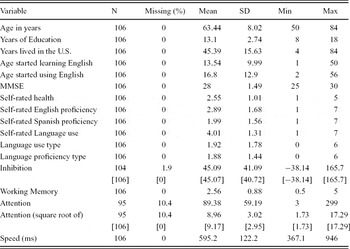
One hundred and twenty Spanish–English bilinguals were recruited from the community in the Bronx and the greater New York City area. Included were adults aged 50-years-old and older who reported using both Spanish and English. Exclusion criteria included history of neurologic disease, of language development impairment, of substance abuse, loss of consciousness greater than two hours, and general anesthesia within six months. As well, participants with a Mini-Mental Status Examination (MMSE, Folstein, Folstein & McHugh, Reference Folstein, Folstein and McHugh1975) score of less than 25 were not included in the analysis.Footnote 2 Following these criteria, we included in our analyses 106 eligible participants (72 females, 34 males) with a mean age of 63.4.Footnote 3 All participants had normal or corrected vision and hearing. The participants acquired Spanish early, at home, and varied in their age of learning and starting to use their English, in their proficiency in the two languages, and in their patterns of bilingual language use. Demographic information is presented in Table 1.
Descriptive statistics. Square brackets indicate statistics based on the imputed dataset.

Note: MMSE: Mini-Mental Status Examination; Self-rated health: 1 = Excellent, 5 = Poor; Self-rated English proficiency and Self-rated Spanish proficiency: 1 = Native-like knowledge, 7 = Very limited knowledge; Self-rated Language use: 1 = Spanish only, 4 = Equal, 7 = English only; Language use type and Language proficiency type: 0 = balanced, 6 = dominant (see text for description); Inhibition: response-time difference (in ms) between the congruent and incongruent conditions of the Simon task; Working Memory: span length; Attention: response-time difference (in ms) between conditions A and B of the Trail Making test.
Testing procedures and materials
Each participant was tested individually in one session. After obtaining written informed consent, participants were screened for hearing and vision acuity and for performance on the MMSE in English (Folstein et al., Reference Folstein, Folstein and McHugh1975). A battery of cognitive tests was then administered. In addition, each participant filled out a detailed language and background questionnaire. In the present paper, we include data from three neuropsychological tests administered in English, assessing three cognitive domains, namely, inhibition, alternating attention, and working memory.
The Simon task
In the Simon task (based on Simon & Wolf, Reference Simon and Wolf1963), participants are instructed to press the left shift key when they see one stimulus (e.g., a blue square) and the right shift key when they see another stimulus (e.g., a red square). In half of the trials, the stimulus is presented on the same side of the screen as the associated response key (congruent trials) and in half of the trials, the stimulus is presented on the opposite side (incongruent trials). The Simon effect, that is, the difference in response times between the congruent and incongruent trials, was measured. Following 20 practice items, there were 192 trials, half congruent and half incongruent. A speed choice reaction time measure was administered prior to the Simon task, for which we measured response time to press the correct button (right or left) as squares appeared on the left and right side of the screen.
Trail Making
In this test of alternating attention (Spreen & Strauss, Reference Spreen and Strauss1991), participants are instructed to connect numbers (A) and numbers and letters in an alternating manner (B). Errors made are brought to the attention of the participant for correction. The difference between the times it takes to complete parts A and B was measured.
Month Ordering Span
Month Ordering Span task is based on Kempler, Almor, Tyler, Andersen and MacDonald (Reference Kempler, Almor, Tyler, Andersen and MacDonald1998) (see also Goral, Clark-Cotton, Spiro, Obler, Verkuilen & Albert, Reference Goral, Clark-Cotton, Spiro, Obler, Verkuilen and Albert2011). In this task, participants are presented (auditorily) with increasing, random sequences of months and are asked to repeat each sequence in the order it occurs in the year. Working memory span, i.e., the longest sequence correctly produced in at least one of two trials, was measured.
Language proficiency and use
Participants filled a detailed questionnaire (see Appendix in Supplementary Materials accompanying the online version of this article, via http://journals.cambridge.org/BIL) developed to collect information about their self-rated language proficiency in both languages, in all language modalities (on a scale of 1–7, 1 = native-like knowledge, 7 = very limited knowledge), their history of language learning (e.g., age first started to learn English, age started to use English to communicate), and their past and current language use (on a scale of 1–7, 1 = Spanish only, 4 = equal Spanish and English, 7 = English only). Based on the self-rated language use and proficiency variables, two additional variables were derived: Language proficiency type was calculated as the absolute value of the difference between self-rated proficiency in English and in Spanish. The scores ranged from 0 to 6, with 0 representing balanced language proficiency (i.e., no difference between the self-rating in English and in Spanish) and 6 representing dominant proficiency in one of the two languages. Language use type was calculated by rescaling the self-rated language use scores in the following way: language use scores were first centered around 4, then the absolute values were rescaled on a 7 points scale ranging from 0 (balanced use) to 6 (dominant use of one of the two languages). The goal of the rescaling was to facilitate meaningful interpretation of the regression coefficients and to allow us to compare the effects of Language use type and Language proficiency type.
Analysis
All tests were scored for each individual. Two variables had a small proportion of missing values (see Table 1). Missing data were addressed by multiple imputation (Little & Rubin, Reference Little and Rubin2002), using the iterative Markov Chain Monte Carlo (MCMC) method implemented in the Stata function mi impute mvn (StataCorp, 2011). The missing data were assumed to be missing at random. Forty datasets were generated and the imputation was based on the variables used in the three regression analyses described below. Estimates from the imputed datasets were pooled using the functions mi estimate and mibeta in Stata (Harel, Reference Harel2009; Marchenko, Reference Marchenko2010; StataCorp, 2011).
Sequential regression analyses were then conducted to identify variables that predicted performance on each of the neuropsychological tests. Variables were entered in a theoretically constrained order. We first entered the two covariates to control for education and speed of processing, which were kept in the models regardless of their significance. Then, we entered age and tested main effects and interactions of self-rated Language use and self-rated Language proficiency, and Language use type and Language proficiency type. Curvilinear relationships among variables were also examined, along with the effects of MMSE and self-rated health. Age participants started to learn their second language (L2) and to communicate using that language were two additional variables that might have influenced the results; we initially included them in the regression models but neither emerged as a significant variable nor did they alter the results for the other predictors. For each analysis, variables that were not significant were removed from the respective regression analyses, and only final models are reported.
All predictors were treated as continuous variables to avoid problems introduced by dichotomization, such as loss of information, reduction in power, and uncertainty in defining cut-off points (Royston, Altman & Sauerbrei, Reference Royston, Altman and Sauerbrei2006). Therefore, to answer the research questions concerning bilingual type, participants were not classified as either balanced or dominant, but placed on a continuum from 0 (balanced) to 6 (dominant) as defined by the Language use type and Language proficiency type variables described above. Regression diagnostics, examined for each model, suggested that one participant was an outlier, based on their extreme Cook's distance and DFITS values. The participant was excluded from the regression analyses on the measures of inhibition (Simon task) and alternating attention (Trail Making test).Footnote 4 There were no other outliers.
Results
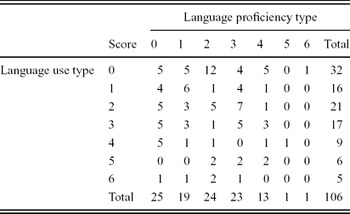
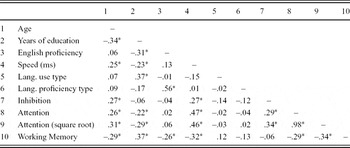
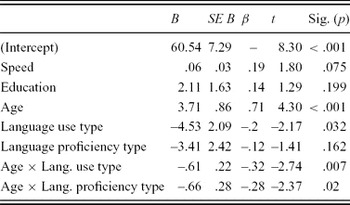
Table 2 shows the frequency distribution of the variables Language use type and Language proficiency type; Table 3 presents correlations among the cognitive measures and the covariates. Results for the three regression analyses, one for each of the three cognitive domains, are reported below and in Tables 4–6, respectively.
Number of participants by Language use type and Language proficiency type scores.

N = 106; Language use type and Language proficiency type: 0 = balanced, 6 = dominant
Pearson product–moment correlation of demographic and cognitive ability variables.

N = 106; * p < .05 (two-tailed)
Summary of multiple regression analysis predicting inhibition performance (Simon task).

N = 105; R2 = .24, F(7,95) = 5.03, p < .001
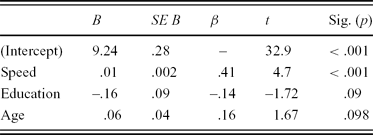
Summary of multiple regression analysis predicting alternating attention performance (Trail Making test).

Note: The dependent variable is the square root of reaction time.
N = 105; R2 = .29, F(3,95) = 11.38, p < .001
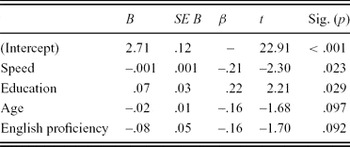
Summary of multiple regression analysis predicting working memory performance (Month Ordering).

N = 106; R2 = .23, F(4,99) = 7.69, p < .001
Inhibition
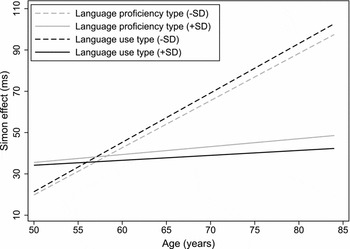
Accuracy was high overall (85%–100%) and the analysis focused on response-time difference between the congruent and incongruent conditions. Age was a significant predictor of performance on the Simon task, with older age associated with larger Simon effect. Language use type (balanced to dominant) significantly predicted performance, with balanced bilinguals showing larger values of the Simon effect. Whereas Language proficiency type (balanced to dominant) did not predict performance, the interactions between Age and Language proficiency type as well as between Age and Language use both emerged as significant. These interactions suggest that values indicating balanced proficiency and use in both languages were associated with an age-related greater Simon effect, whereas values associated with dominant language proficiency and use in one language were associated with smaller age-related change in the Simon effect (see Figure 1). Additionally, Speed appeared to predict performance (greater speed associated with smaller Simon effect) although the coefficient did not reach statistical significance (see Table 4). Language proficiency in each language was not a significant predictor nor did it interact with Age.
Effect of Age, Language use type, and Language proficiency type on Simon effect. Predicted values are shown for Mean plus/minus 1 SD. For Language use type: Mean – 1 SD = 0.14, Mean + 1 SD = 3.7. For Language proficiency type: Mean – 1 SD = 0.44, Mean + 1 SD = 3.32.

Alternating attention
Accuracy was high and response-time difference was the outcome measure used. Moreover, in this task, if a participant makes an error, the examiner points it out and the participant is required to correct it, which typically adds time to the total response time. In order to reduce the skewness of the reaction time data, a square root transformation was applied, which reduced the skewness from 1.16 to .27. The transformed variable was therefore selected as the dependent variable. Age was a marginally significant predictor of performance on the Trails outcome measure, with older age associated with slower times. Language proficiency type and Language use type (balanced to dominant) did not emerge as significant predictors nor was their interaction with Age significant. Speed was a significant variable (higher speed associated with shorter response times, see Table 5).
Working memory
Age was a marginally significant predictor for performance on the Month Ordering Span task (older age associated with lower span). Language proficiency type and Language use type did not predict performance nor interact with Age. For this more verbal task, Education predicted performance and English proficiency approached significance (see Table 6).
Discussion
In this paper we asked whether the type of bilingual experience affects age-related cognitive changes in inhibition, attention, and working memory. Overall, older bilingual adults performed less well than younger adults, as age negatively correlated with performance on the three cognitive domains measured here. However, the effect of age as a predictor of performance reached statistical significance only on the inhibition measure, the Simon task, possibly pointing to a weak effect of age on cognition in this participant group. Future studies comparing the magnitude of age-related cognitive changes among monolinguals and bilinguals are needed to further examine whether age is associated only weakly with performance among bilingual adults as compared to monolinguals. Such comparisons, however, should focus on comparing the relations between age and cognitive performance in the two populations, rather than on directly comparing performance of monolinguals and bilinguals on a given task (e.g., Grosjean, Reference Grosjean2008). We also note that our participants performed these tests in English, regardless of whether it was their dominant language or not, and this could have contributed to the pattern of results. However, we found that the participants’ English (or Spanish) proficiency did not predict performance, which is consistent with the fact that the cognitive tests administered were likely to rely less on verbal abilities. Indeed, the one test for which English proficiency approached significance was the verbal working memory test. Language proficiency would need to be further considered if performance of bilingual individuals is compared to that of monolinguals.
The weak effect of age could alternatively be associated with the relatively restricted age range included in the present study. Whereas we included an age span of over 30 years, we targeted middle-aged and older adults and did not include in our sample young adults. Greater age differences are typically reported when older adults are compared to younger adults (e.g., Margolin & Abrams, Reference Margolin and Abrams2009; Waters & Caplan, Reference Waters and Caplan2005; West & Alain, Reference West and Alain2000) than when only older adults are included in the sample (Connor, Spiro, Obler & Albert, Reference Connor, Spiro, Obler and Albert2004; Goral et al., Reference Goral, Clark-Cotton, Spiro, Obler, Verkuilen and Albert2011). Differences between very young and very old adults could result from age-related change as well as a number of additional variables, such as differences in experience and education across decades (Goral, Spiro, Albert, Obler & Connor, Reference Goral, Spiro, Albert, Obler and Connor2007; Hultsch et al., Reference Hultsch, MacDonald and Dixon2002).
Our second question focused on the modulating effect of bilingualism on age-related changes. Specifically, by adding the two variables of bilingual type and their interaction with age to the regression models, we examined whether being a balanced bilingual or dominant bilingual (in terms of differences in self-rated proficiency and self-reported use) differentially affected age-related cognitive differences. Here we found that bilingual type modulated the effect of age on performance, but only in one of the three domains we assessed, namely, inhibition control as assessed by the Simon task. That is, as can be seen in Figure 1, dominant proficiency and use was associated with constant performance across the ages, whereas balanced proficiency and use was associated with increased Simon effect with increasing age.
This differential effect for bilingual type is consistent with recent theories of bilingual cognitive control. Namely, if we assume that it is the life-long experience bilinguals have with inhibiting a non-target language that results in a cognitive advantage in this domain, we can further assume that those who are not balanced in their language proficiency require more effort in inhibiting the more proficient, regularly activated language. In contrast, those who have high proficiency in both languages may have achieved greater independence of the two linguistic systems and do not exercise the inhibition of one of their languages regularly. The difference between balanced and dominant bilinguals observed in the present finding is thus comparable to the selective switching cost and inhibition patterns found for dominant bilinguals in psycholinguistic studies (e.g., Costa & Santesteban, Reference Costa and Santesteban2004). We interpret our findings to suggest that dominant bilinguals – more so than balanced bilinguals – benefit from their continuous practice at inhibition. Nevertheless, because our sample comprised more balanced bilinguals than dominant bilinguals, this finding should be interpreted with caution.
It is of note that the dominant-balanced difference found here extends not only to language proficiency but also to language use. However, in contrast to the expectation that particularly those bilinguals who use both languages regularly – those who need to constantly switch between their languages and are likely highly adept at using both languages – would enjoy superior inhibition skills, our data demonstrate that the participants who use both languages equally often do not appear to enjoy the added benefit of the inhibition practice. It is likely then that the mental effort – rather than the frequency – associated with inhibiting the stronger language and the one used most often is the practice that affords bilinguals their cognitive advantage. In other words, it is specifically the need to inhibit the dominant, regularly used language among dominant bilinguals who typically rely on their dominant language that is critical to the superior inhibition abilities. We note that in our sample, most people use both languages regularly to some degree, given the bilingual community of Spanish–English bilinguals in the greater New York City area. Of interest, the bilingual group who showed a reduced switching cost in Prior and Gollan (Reference Prior and Gollan2011) had reported more frequent switching between their languages than the bilingual group who did not differ from the monolinguals. We note that those who showed the advantage in the Prior and Gollan study were also those with less balanced proficiency between their two languages, consistent with our results. Nevertheless, obtaining information on frequency of switching in addition to language use would be advisable.
The selective advantage of dominant bilinguals found here may help explain inconsistencies in previous findings. For example, the participants in several studies that found a bilingual advantage were dominant bilinguals (Prior & MacWhinney, Reference Prior and MacWhinney2010) whereas researchers who reported no bilingual advantage studied highly proficient, balanced bilinguals (Kousaie & Phillips, Reference Kousaie and Phillips2012). Nevertheless, proficiency and use patterns have not been reported consistently in previous studies of bilingual older adults. Moreover, there is no consensus about how to best define balanced vs. dominant bilingualism (e.g., Christoffels, De Groot & Kroll, Reference Christoffels, De Groot and Kroll2006; Flege, MacKay & Piske, Reference Flege, MacKay and Piske2002; Goral, Reference Goral and Faust2012; Wei & Moyer, Reference Wei and Moyer2008). The proficiency measure we used here was based on participants’ self-rated proficiency. Several studies have demonstrated that self-ratings are consistent with objective measures of proficiency (Marian, Blumenfeld & Kaushanskaya, Reference Marian, Blumenfeld and Kaushanskaya2007; Prior & Gollan, Reference Prior and Gollan2011). Moreover, in our own data, self-rated proficiency correlated significantly with a measure of picture naming (not reported in this paper). Finally, because we use the relative difference between a person's self-rated score in the two languages, we were able to avoid potentially skewed rating of individuals who are overly confident or overly timid about their own abilities. Self-rating is the also the most useful tool available to date to obtain information about language use.
Beyond age and bilingual type, additional variables included in the analysis did not predict performance. These include age of L2 learning and age of starting to use L2; years of education predicted performance only in the more verbal working memory task. In addition, the bilingual advantage did not extend to all cognitive domains. The present findings show a bilingual advantage in one domain, inhibition, as measured by the Simon task, as also reported by Bialystok and her colleagues (e.g., Bialystok et al., Reference Bialystok, Craik, Klein and Viswanathan2004). Prior and MacWhinney (Reference Prior and MacWhinney2010) found it – for young bilinguals – in a paradigm that required participants to switch between two tasks according to a cue. They interpreted their results as lending support for the hypothesis that bilingualism leads to enhanced inhibition abilities and, specifically, to superior control over proactive interference. Yet, inconsistent bilingual advantage has been reported for the Stroop Test, a task that also measures the inhibition of interference (Kousaie & Phillips, Reference Kousaie and Phillips2012).
The two other domains we examined, alternating attention and working memory, showed no evidence for a bilingual advantage among older adults in the current study, consistent with the comparable performance on working-memory tests found for monolinguals and bilinguals in Biaylsotk et al. (Reference Bialystok, Craik, Klein and Viswanathan2004) and in Prior and MacWhinney (Reference Prior and MacWhinney2010). Bilingual advantage on tests that measure attention skills might be expected on the basis of the hypothesis that bilinguals practice not only inhibition skills but also attention skills, as they are required to pay attention to the target language (Rivera Mindt et al., Reference Rivera Mindt, Arentoft, Germano, D'Aquila, Scheiner, Pizzirusso, Sandoval and Gollan2008). It is likely that good attention skills are also necessary for good performance on the incongruent conditions on the Simon task, and, similarly, good inhibition skills may be required for a better performance on the Trail Making test. Moreover, advantage in tasks such as the Simon task does not differentiate among control systems, such as conflict resolution versus response inhibition (e.g., Hilchey & Klein, Reference Hilchey and Klein2011). Indeed, previous investigators have recognized that higher cognitive skills, such as attention and inhibition control, are difficult to measure via existing neuropsychological tests and that dissociating the contribution of each skill to the completion of a complex test is extremely challenging (e.g., Ashendorf & McCaffrey, Reference Ashendorf and McCaffrey2008; Miyake, Friedman, Emerson, Witzki, Howerter & Wager, Reference Miyake, Friedman, Emerson, Witzki, Howerter and Wager2000). Whereas we find the dissociation between the results for the Simon tests and the other two test intriguing, we acknowledge that a more comprehensive assessment of the cognitive domains would involve multiple measures for each domain.
In conclusion, age-related decreased inhibition efficiency was evident in our sample for balanced bilinguals, whereas dominant bilinguals evidenced the bilingual advantage reported in previous studies. Our results suggest that in seeking an understanding of the cognitive advantages that bilingualism may offer in older age, it is critical to consider language-proficiency and language-use variables.