Introduction
Contemporary gerontological research shows two particularities: a predominant interest in the active and healthy third age, and a minimalisation, bordering on neglect, of the points of view of older adults with acquired impairments in later life. The conditions of the lives of these individuals meet some characteristics of the still-ambiguous concept of the fourth age (Gilleard and Higgs Reference Gilleard and Higgs2015; Grenier and Phillipson Reference Grenier, Phillipson, Baars, Dohmen, Grenier and Phillipson2014; Higgs and Gilleard Reference Higgs and Gilleard2016; Laslett Reference Laslett1991; Lloyd et al. Reference Lloyd, Calnan, Cameron, Seymour and Smith2014) and the concept of precarious old age that requires the recognition of shared vulnerability and responsibilities for care (Grenier, Lloyd and Phillipson Reference Grenier, Lloyd and Phillipson2017). On the one hand, we see a clear interest in third-age seniors, no doubt due to the large post-war generation entering retirement and enjoying their old age actively with greater health and financial security than any previous generation (Gilleard and Higgs Reference Gilleard and Higgs2014). On the other hand, our review of the literature related to older people living with acquired impairments shows that most findings rely on proxy accounts of the experiences of later age, usually provided by professional care-givers or care-giving family members (e.g. Stathi and Simey Reference Stathi and Simey2007). We would like to draw attention to the fact that only a small fraction of studies report research conducted with these people and not just about them. Some empirical works (e.g. Lloyd et al. Reference Lloyd, Calnan, Cameron, Seymour and Smith2014; Nicholson et al. Reference Nicholson, Meyer, Flatley, Holman and Lowton2012, Reference Nicholson, Meyer, Flatley and Holman2013) state that the lack of knowledge gained in interactions with these specific individuals originates in the limitations of the people (research participants) themselves. Evidently, some of these characteristics are considered barriers to research and consequently cause these forms of old age, which qualitatively differ from the third age, to be an under-researched phenomenon.
We decided to overcome these obstacles, to approach this research topic differently. We consider the difficulties of conducting research with older adults living with acquired impairments not to be the result of their health and social conditions but rather to be an outcome of what we call age asymmetries between researchers and research participants. A large body of literature discusses power imbalances in research practice caused by gender (e.g. Gill and Maclean Reference Gill and Maclean2002), ethnic (e.g. Hoong Sin Reference Hoong Sin2007) and socio-economic (e.g. Seidman Reference Seidman and Seidman2006) distinctions. However, the issue of age-based power imbalances in the research process is rather invisible in both qualitative and quantitative research. In this article, we argue that conducting intergenerational research requires detailed attention from both social gerontologists and scholars in the field of ageing studies.
The objective of this article is to deepen the understanding of age asymmetries in research practice and provide a new lens for future inquiries into old age lived in the conditions of acquired impairments. The article has two main aims. First, we hope to start a discussion about the existence of age asymmetries in social science research. Power imbalances are an inherent part of the research relationship and are aggravated by inequalities based on gender, ethnicity or socio-economic status. We propose expanding this list to include age asymmetries and stress that age asymmetries tend to come to the fore within the research interaction with those individuals with age-related and permanent impairments whose lives are qualitatively different from the lives of active and healthy third-agers. Secondly, we aim to show that age asymmetries, and the resulting challenges of the research process, are an important source of research data. We consider that addressing these age asymmetries in research relationships represents a way to deepen the understanding of the lives of these specific participants and to lend support to further research with vulnerable older people.
To fulfil these aims, the article is divided into four sections. The first discusses the theoretical background of age relations. In the second section, we introduce our conceptualisation of age asymmetries and distinguish their cognitive, physical and social dimensions. In the third, we outline our research project, which was conducted over the course of one year. Finally, reflecting upon our research experience, we describe the manifestations of age asymmetries within the research relationships and provide sample quotes from interviews and field notes. We present an approach to analysing how these asymmetries appeared in our research and emerged as challenges. Further, we propose viewing the asymmetries in terms of the roles of the researchers facing these challenges. We offer our results both as a contribution to the methodological discussion on age relations within the research relationship and as a testimony to the daily life of vulnerable older individuals with acquired impairments, who have so far received inadequate research attention.
Considering age relations in the research process
Long overlooked by scholars, age is, like gender, ethnicity and class, a source of possible power imbalance in research practice. Despite the apparent recognition that gender is multiply produced and intersected by other axes of difference, including age, feminist scholars have also largely overlooked the category of age and have rarely examined age relations critically. However, these scholars have theorised about the age relations that underlie the devaluation of old age in many spheres of life, including research practice. Many of them (e.g. Calasanti and Slevin Reference Calasanti and Slevin2006; King Reference King, Calasanti and Slevin2006; Krekula Reference Krekula2009) have called for the recognition of age as an organising principle of power and for further engagement with questions of methodology when working across age boundaries (e.g. Grenier Reference Grenier2007; Tarrant Reference Tarrant2014). In line with our assumptions, they argue that there is an extensive amount of care-work research, but that old age as a location of power has been largely ignored.
From the perspective of these scholars, age relations are systems of inequality based on age that privilege the not-old at the expense of the old and form the ways of sharing such resources as authority, wealth and esteem (Calasanti Reference Calasanti, Biggs, Lowenstein and Hendricks2003) – all distributed within social networks according to formal rules or ascribed status. These inequalities are further seen to be natural and thus beyond dispute. The reality that being old, in and of itself, is a position of low status is apparent, for example, in the flourishing anti-ageing industry. According to these scholars, age relations comprise three dimensions that together have consequences for life chances: (a) age serves a social organising principle, (b) different age groups gain identities and power in relation to one another, and (c) age relations intersect with other power relations. The second and third aspects of age relations speak more directly to issues of power and how and why such age-based organisation matters for life chances. Calasanti and Slevin (Reference Calasanti and Slevin2006) further argue that old age not only exacerbates other inequalities but also is a social location in its own right, conferring a loss of power for all those designated as ‘old’ regardless of their advantages in other hierarchies. In line with the perspective of feminist scholars, we would like to emphasise two important aspects of the power imbalances based on age: first, these power imbalances often deepen in such forms of old age that are qualitatively different from the third age and therefore even ‘less visible’ (Calasanti and Slevin Reference Calasanti and Slevin2006); and second, age relations differ to a certain amount from other power relations in that one's group membership shifts over time. As a result, one can experience both the advantages and disadvantages of age relations within a lifetime.
Although it remains little discussed, age relations also influence research practice and the relationship between researchers and researched (Tarrant Reference Tarrant2014). For example, Friedan (Reference Friedan1994), in The Fountain of Age, argues that most of the people who collect data from older people are almost always outsiders precisely because of their age differences. Grenier (Reference Grenier2007), in her exploration of intergenerational research encounters, contends that 20-something-year-old researchers, like herself, might be seen less as research professionals in the field and more as grandchildren. She further mentions that some participants might adopt family-like relationships and it might be harder to develop and explore certain topics (e.g. sexuality, mortality). Tarrant (Reference Tarrant2014) surmises that problems might arise when thoughts about age differences construe researchers as insiders or outsiders in the research process and risk reproducing these rigid binaries. It seems that working across age boundaries can be advantageous to younger researchers but also problematic; the negotiations of age relations within research practice certainly require more attention. In this article, we recognise that the knowledge in research practice is produced relationally in the complex negotiations of similarities and differences between researchers and research participants – including those based on age. Consequently, the research interview is a product of the research relationship itself (Fontana and Frey Reference Fontana, Frey, Denzin and Lincoln2000). Rather than reinforcing decisive lines between individuals and groups based on age, a relational and reflexive approach on age power imbalances within research relationships would acknowledge the potential for generating knowledge within the research relationship based on equality.
Though our theoretical argument refers to age relations, we are writing from the position of social gerontology researchers and take into consideration the consequences these power imbalances based on age have for individuals’ lived experience. Evidently, many older adults are stigmatised as sick and unattractive, receive little deference and are segregated from younger adults in some situations (King Reference King, Calasanti and Slevin2006). In the context of the Czech Republic, many of them – including some of our research participants – live in institutions such are nursing homes that are often located in the suburbs. Often, these individuals are served by young staff, which renders their age more relevant, and usually not in ways that privilege them. Consider, for example, the everyday situation of the bathing of frail clients in a nursing home. As shown in the analysis by Twigg (Reference Twigg2004), this ritual can reinforce the status of these people as bodies to be managed, and dirty ones at that. In many cases, people around them produce and reproduce the practices of inequality. Consequently, the residents may find that their age becomes even more salient than it would otherwise be and that they suffer for it (King Reference King, Calasanti and Slevin2006). We emphasise that these power inequalities are often more pronounced for those groups of older individuals who live in the conditions of age-related acquired impairments. These older people, who often do not maintain the activities popular among the middle-agers and third-agers often privileged with health, money and leisure time, are often considered to be ‘problematic’ older people (Calasanti and Slevin Reference Calasanti and Slevin2006; Holstein and Minkler Reference Holstein and Minkler2003; Katz Reference Katz2000).
We decided to resist the logic that distinguishes between ‘problematic’ and ‘unproblematic’ older adults (possible research participants) and emphasise that the challenges of conducting research with individuals who acquired impairments in their later years are mostly the consequences of the different possibilities for researchers and research participants. Through this approach, we aspire to shift attention from the perception of stable limitations of the research participants to the perception of emerging age asymmetries in the research relationship between researchers and research participants. In the following section, we present our conceptualisation of age asymmetries. As these asymmetries are understood as the result of relational research practice, we further call for a reflexive and transparent approach when these power imbalances based on age emerge.
Age asymmetries in the research process: opening the discussion
Age asymmetries exist in all research processes; however, only in some cases do they become more salient and necessary to address directly. We use the term age asymmetry to refer to the situated nature of the age positioning of individuals vis-à-vis each other and vis-à-vis the definitions, meanings, roles, norms and expectations associated with particular states within the lifecycle. In the research process, age asymmetries are not the outcome of the different chronological ages of researchers and research participants. Rather, they are the result of the interplay between the differences in the researcher's and research participant's ages, knowledge and personal experiences based on the dynamics of different socio-cultural and historical conditions, and health and social conditions. Age asymmetries are therefore constituted, negotiated and reproduced in and by the research practice. Experiencing these age asymmetries can lead to challenging research situations for both researchers and research participants that are at the same time an important source of data about the lives of those individuals with acquired impairments in later life.
Drawing on Atchley's (Reference Atchley, Morgan and Kunkel2001) distinction between psychological (cognitive), physical and social ageing, we distinguish three dimensions of age asymmetries in the research process: cognitive, physical and social. The cognitive dimension includes changes in cognitive functioning as research participants grow old. A wealth of research has investigated the possibilities for exploring the lives of people with dementia (e.g. Carmody, Traynor and Marchetti Reference Carmody, Traynor and Marchetti2015; Hubbard, Downs and Tester Reference Hubbard, Downs and Tester2003; Murphy et al. Reference Murphy, Jordan, Hunter, Cooney and Casey2015) and communication difficulties (e.g. Coons and Watson Reference Coons and Watson2013; Nind Reference Nind2008). Acknowledging the challenges of including people with dementia in research, several studies have developed techniques which can co-exist alongside interviews to get the researcher closer to the lived experiences of these people (Bartlett Reference Bartlett2012; Buse and Twigg Reference Buse and Twigg2014a, Reference Buse and Twigg2014b; Milligan, Bingley and Gatrell Reference Milligan, Bingley and Gatrell2005; Murphy et al. Reference Murphy, Jordan, Hunter, Cooney and Casey2015; Nygård Reference Nygård2006). According to Hubbard, Downs and Tester (Reference Hubbard, Downs and Tester2003), to conduct research with people with various cognitive impairments, researchers should be trained and skilled verbal and non-verbal communicators.
Some of these studies have addressed the power imbalance between researchers and participants with these types of impairments (e.g. Bartlett Reference Bartlett2012). However, the imbalances only partially overlap with the cognitive dimension of age asymmetries; disability asymmetries and age asymmetries should not be confused. Age asymmetries are not only disability asymmetries and disability asymmetries are not only about age. In addition, of course, not all older individuals have dementia. At the same time, however, older people experience slowed thinking and response to stimuli, sensory changes and short-term memory difficulties (Newman and Newman 2015). These cognitive changes are often the consequence of the involution process or other physical changes related to age. These conditions can sharply contrast with the researcher's use of (abstract) language, ability to quickly recall information from memory and structuring of the interaction, e.g. following the a priori defined structure of the interview and research plan. Awareness of these aspects of age asymmetries may lead the researcher to changes in language use, sound volume, rhythm, interview design, etc.
The physical dimension of age asymmetries entails the differences between researchers and research participants that result from physical changes related to advanced age or to acquired impairments that are permanent and irreversible (e.g. osteoporosis, arthritis). These changes in health conditions often cause restrictions in mobility, bring sudden surges of pain or tiredness and affect overall functioning (e.g. bathing and showering, dressing, personal hygiene, transferring, self-feeding, etc.). Such situations in the research relationship may make the research participant feel vulnerable and therefore require sensitive reflection on the part of the researcher. One definition of the fourth age derives from health conditions and focuses on frailty in later life and the boundary of old age as abject (Higgs and Gilleard Reference Higgs and Gilleard2016). For Grenier and Phillipson (Reference Grenier, Phillipson, Baars, Dohmen, Grenier and Phillipson2014), the fourth age captures the experience of older age combined with disability. These authors further understand the fourth age as a social position marked by declines that require the recognition of the shared vulnerability and responsibilities for care (Grenier, Lloyd and Phillipson Reference Grenier, Lloyd and Phillipson2017). Such a conceptualisation of the fourth age suggests that rather than classifying the stages of old age according to chronology (Baltes and Smith Reference Baltes and Smith2003; Laslett Reference Laslett1991), rather than a concept that focuses on proximity to death (Gerstorf, Ram, Lindenberger, and Smith Reference Gerstorf, Ram, Lindenberger and Smith2013) and rather than the concept of the fourth age understood as a ‘social imaginary’ (Higgs and Gilleard Reference Higgs and Gilleard2016), it is important to look at the distinction between able-bodiedness and infirmity or between the fit and the frail (Grenier Reference Grenier, Twigg and Martin2015; Nicholson et al. Reference Nicholson, Meyer, Flatley, Holman and Lowton2012, Reference Nicholson, Meyer, Flatley and Holman2013). Following this dichotomist view, the researcher – when being able-bodied and fit – creates a research relationship with an infirm subject whose life is significantly influenced by acquired and often permanent and irreversible impairments. These differences in health conditions can be anticipated but unknown factors, and a possible source of stress within the relationship.
Finally, the social dimension is an umbrella term for the imbalances in social role performance, and the mobilisation of agency in creating and reproducing social relations, networks and personal bonds. People with acquired impairments usually depend on varying levels of care from others. Often their network of care-givers becomes denser, while social contact with people other than care-givers may decline. This aspect of later life is more poignant when daily life is lived in institutions such as nursing homes (King Reference King, Calasanti and Slevin2006). According to the cultural gerontologist perspective of Gilleard and Higgs (Reference Gilleard and Higgs2015: 112), it is through care that the fourth age is most intimately connected to society. While the amount of agency in creating and reproducing social relations and ties may vary from senior to senior, we can conclude that older adults with acquired impairments are more vulnerable to such phenomena as social isolation and loneliness (Shankar et al. Reference Shankar, McMunn, Demakakos, Hamer and Steptoe2016; Smith Reference Smith2012). The lack of contact with people who are not care-givers or co-habitants of the institution may lead research participants to consider the researcher as a bridge with the outside world, or even as a friend. The social asymmetry caused by dissimilar access to social networks affects expectations about the role the researcher should play in participants' lives. From the participant's perspective, this may lead to unclear expectations and consequent feelings of dissatisfaction, disappointment and deepening isolation in cases where expectations springing from their definition of the research relationship are not met.
Different dimensions of age asymmetries appear in varied ways in each research relationship: sometimes the physical dimension becomes salient and the social dimension is less relevant, while in other cases it can be the other way around. Age asymmetries and their various dimensions are always a result of the life experiences of both the researcher and the participant. Both of them – when interacting, talking and sharing their views – have their own particular cognitive and physical health conditions and dispositions within the repertoire of social roles. Both of them bring their personal life experiences into the research relationship, but these experiences only become important in relation to those of the other person. These dimensions do not exist per se; rather, they are strengthened or weakened in the interaction during the research process.
Why should we address age asymmetries in research? From our experience, there are at least two reasons. First, reflecting on age asymmetries helps researchers to avoid othering research participants and prevents researchers from marginalising their life experiences. We aspire to show that the asymmetries are not in age itself, but in the interaction between researchers and participants during which age positioning is negotiated. We should not therefore ask just why it is difficult for us, as researchers, to approach these people, but at the same time also ask why it is difficult for them to participate in the research relationship and to speak with us. Secondly, we argue for recognising age distinctions in the research process as dynamic and for looking at how limitations as well as potentials on both sides are in play. Then the research process itself serves as a source of data about these older individuals with acquired impairments, as a collection of event-generating relationships and roles, expectations and norms which must be carefully analysed.
Outline of the research project: research participants and methods
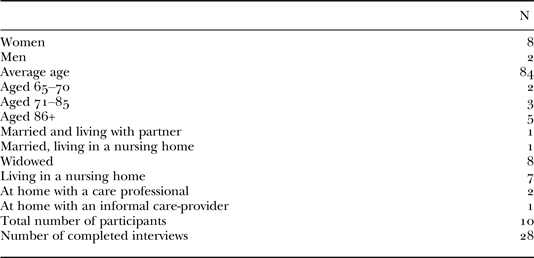
This article draws upon our qualitative research experiences during the research project ‘Fourth Age: The Identity of Disability During the Period of Active Ageing’ (GA15-03156S). In the qualitative part of this project, we conducted three repeated interviews with ten seniors, male and female, over the course of one year. All participants were from the Czech Republic and were over 65 years old (Table 1). Although we purposely did not assess the research participants with any tests or scales measuring cognitive impairment, frailty, or self-maintaining and instrumental activities of daily living, we can conclude that all of them suffered from acquired impairments that are permanent and irreversible, and significantly influence their daily living. In discussions with care professionals, the participants were identified as cognitively healthy people of advancing age who are – due to the changes in their health and age-related impairments – unable to carry out independent activities of daily living (e.g. bathing, showering, personal hygiene and management of medication). Most of our participants were immobile due to arthritis, osteoporosis, previous falls, fractures and overall weaknesses. These conditions were combined with other illness in some cases. In one case, the participant's poor health prevented us from carrying out or completing the third and final interview. One potential participant died before we could conduct the first interview, and one participant died during the project and we were therefore unable to complete the research with that participant. Participants had the capacity to consent to be interviewed throughout the study. All of the names and personal details have been changed in order to preserve participant anonymity.
Characteristics of participants

The first interview was narrative in nature. The subsequent two interviews had a semi-structured form and focused on daily activities; the help received during these activities and negotiating one's own involvement; the meanings of important material artefacts and assistive devices; the experiencing of one's body and health difficulties; past and current social relations, etc. The interviews were complemented by information provided in research diaries shared between researchers and participants, which the research participants kept between each interview with the help of their primary care-givers. The diary contained the yesterday interview used in the Berlin Ageing Study by Horgas, Wilms and Baltes (Reference Horgas, Wilms and Baltes1998) and a timeline technique which offered a graphical temporal structure against which participants could elicit and plot their recollections of everyday events and experiences during their old age (Adriansen Reference Adriansen2012; Guenette and Marshall Reference Guenette and Marshall2009; Sheridan, Chamberlain and Dupuis Reference Sheridan, Chamberlain and Dupuis2011). At the end of the series of three repeated interviews, we also conducted interviews with the primary care-givers of each participant, which served to complete the individual interviews with our participants. In this article, we do not focus on the materials written in the shared diaries of our research participants. We reflect only upon our experiences during the research interviews, working with the transcripts of the interviews with our participants and the field notes taken by the researchers immediately after each research interview. We use excerpts of the interview transcripts and field notes to illustrate the age asymmetries that emerged within the research relationship. Three researchers co-operated closely on the research project and the interviews.
Addressing age asymmetries in research interviews: the roles of the researcher
Reflecting upon age asymmetries is only the first step in the research process. This reflection should not reduce the representation of participant lives to mere vulnerabilities and limitations, but should rather be accompanied by some practical steps during the research process. We asked two questions:
1. How can we approach data collection and data analysis in such a way that will not produce and reproduce these asymmetries but rather will create and maintain a research relationship based on equality?
2. What is our role in the network of reflected age asymmetries?
We sought to answer these questions by reflecting on our personal research experience. Excerpts from the field notes and the narratives of our interviewees are presented in a fragmented way to demonstrate emerged asymmetries in our research relationship. We, as young, healthy and able-bodied researchers, encountered multiple identity positions that structured power relations between us and our research participants. In the following section, we demonstrate how we addressed these age-related asymmetries during our research experience and describe how we approached them in the research relationship through the roles which we played vis-à-vis the participants.
We decided to look at the challenges of conducting research with our participants by addressing our roles in the network of age asymmetries. Both asymmetries and the adopted roles of the researcher do not exist a priori but are (re)negotiated and performed during the research process. We locate our position in the relationship with our research participants at the crossroads of the following roles: (a) researcher as a message facilitator (cognitive asymmetries), (b) researcher as a supporter (physical asymmetries), and (c) researcher as a social world provider (social asymmetries). In our interactions with research participants, each of these roles were experienced differently, as in each case the salience of each role and the age asymmetries differed. What we present here is an overview of the asymmetries within the research relationships with all our participants. The overview of asymmetries should not lead to understanding them as an inherent part and stable limitation of a person; rather, the overview of these asymmetries and the adopted roles shows ways of being closer to specific older research participants with acquired impairments through an equal research relationship. We argue that the transparent reflection of these asymmetries may lend support to further research with vulnerable people, and thus provide important knowledge.
Cognitive asymmetries: researcher as a message facilitator
Although our participants were selected by professional care-givers as those older adults living with impairments who either had no cognitive impairment, or were mildly affected but were deemed able to consent and participate in research (see also Stocking et al. Reference Stocking, Hougham, Danner, Patterson, Whitehouse and Sachs2008), many of them experienced various sensory difficulties, slowed response to stimuli, short-term memory problems or a combination of these conditions. Take, for example, the case of Ms Tereza, an 82-year-old woman living in a nursing home, who is immobile due to multiple falls and fractures, and suffers from major hearing impairment.
Ms Tereza: Those ears are on batteries, you know. I've just got them from the nurse today.
Researcher (R): And you call them your ears?
Ms Tereza: Ears or headphones … Someone has one, someone, I … (silence) I have… (silence) My left ear hears better as they told me during the medical check-up. The right ear is worse. But they anyway gave me two so now I have two more ears.
During the interviews, her hearing aid kept falling out, disrupting the flow of conversation. Consequently, the hearing impairment became part of the interaction. In such situations, we decided to approach the theme of cognitive insufficiencies through talk about compensation devices, which are a part of her everyday life and body. Talking openly about the relationship to the hearing aid, we could show greater sensitivity in future situations when Ms Tereza's hearing impairment complicated the communication and brought new moments of misunderstanding.
Some of our participants were not able to recall the answer to specific questions and this might have caused them personal embarrassment. This was the case of the research relationship with Ms Sofie, a 70-year-old woman with limited mobility and severe joint pain.
R: So, you did not receive a full invalidity pension in those days.
Ms Sofie: No, I was not yet… (silence)
R: Hm, it was probably later…
Ms Sofie: (silence) Later I got, only later, it was, it was, in which year I got it? Well, eighty … four, nine, six or so, I … (silence) I do not know exactly.
R: It fits. You said you were born in 1945 and it fits. It's fine.
Ms Sofie: Forty, hm.
R: Yeah, it fits.
Ms Sofie: (silence) So I got it.
Today's interview brought about situations when Ms Sofie was unable to answer my questions in a manner that she probably expected of herself … I sensed that during these situations she did not feel at ease even when I showed her that everything was fine and we could continue. Ms Sofie stopped in her replies, moved frequently or retreated into herself, she seemed quieter overall. I became conscious of leaning towards her more frequently and putting my hand over hers to encourage her non-verbally that we can, despite missing facts, continue further. (Field notes, 22 October 2015)
During our meetings, actual anxiety in such situations was demonstrated via many verbal pauses, incomplete sentences, and changes in facial expressions and body postures. While factual accuracy was not as important for us as the meaning of lived experiences, Ms Sofie assumed that we primarily needed accurate facts. Even when we repeatedly reassured her, she continued to comply and adjust to these assumed requirements, deepening the existing cognitive asymmetries. Ms Sofie expected factual accuracy of herself and when she could not recall the facts, it led to frequent feelings of failure that impacted the research relationship.
Besides difficulty in recalling details, in some cases our participants gave only short answers to our questions, which made our communications ‘less effective’. On the basis of both our reflection and the interviews with care-givers, this situation in the research relationship, e.g. with Ms Jana, an 81-year-old woman with limited mobility of the lower limbs and weakening of the upper limbs after a series of fractures due to repeated falls in the household, was not caused by a lack of trust but rather was the result of her way of expressing herself in her current health conditions.
R: What do you enjoy the most in your everyday life?
Ms Jana: The memory training is good.
R: Could you tell me how you train memory?
Ms Jana: Well, some movies.
R: And what about the memory training? How is it for you?
Ms Jana: Hm.
R: What does it include? Is it counting?
Ms Jana: Also.
R: Is it led by someone who comes to the nursing home, or how does it work?
Ms Jana: We are always here in the club.
During the interviews, Ms Jana usually talked in shorter sentences, and the cognitive asymmetries were an apparent part of the research relationship that led, among other things, to ‘slower’ interviews often divided into shorter parts and to interview content that was interrupted or that repeated or diverged from the questions posed, thus creating a need to return multiple times to the same questions.
Taking into account the network of these cognitive asymmetries, we realised that while conducting the interviews, we frequently adopted the role of a message facilitator. The function of this role within the research relationship included creating and maintaining a calm and undisturbed environment, which supported the limited ability to recall from memory or the ability to concentrate. This was achieved by choosing a quiet room in the senior's household, by conducting shorter interviews, in the presence of the care-giver if necessary, and by watching for signs of cognitive tiredness and loss of attention. Further support for the memory recall process of our respondents was provided through stimuli and prompts that helped to organise their answers.
Physical asymmetries: researcher as a supporter
The research participants in our sample faced various types of physical vulnerabilities. Repeated hospitalisations of some of our interviewees lengthened the research process; in one case, poor health prevented us from carrying out or completing the research; one interviewee died before we conducted the first interview and another died before we could conduct the third interview. The physical conditions of our participants required careful reflection, and in many cases involved monitoring their feelings of fatigue, which might have resulted from their impairments and body weaknesses. This can be seen in the excerpt from the interview with 95-year-old Ms Hana, whose ability to move was limited mainly due to frequent falls and overall weakness.
R: So, you eat in the bed. Every time you eat they give you a kind of table over your bed.
Ms Hana: I would call it a board. They put it over my bed and myself and ask me to sit and eat. They serve me the meal and then I try to eat on my own. But I have to be careful not to flip over that board. You know, I could accidentally kick it and after that everything would be on the ground.
R: Sure.
Ms Hana: Well and now, my head…
R: Should I go now? Are you tired?
Ms Hana: I don't mind your presence, you can stay here, if you want.
Several times Ms Hana mentioned how sick she feels. It could be understood as a sign of resignation, but through all these references there was a considerable interest in the events all around her. In a certain phase of the interview, Ms Hana indicated that she was tired. I think it could have been 15–20 minutes after the beginning. However, she wanted to continue for another 30 minutes. She was further interested in the interview. Later, she suggested I should go. (Field notes, 26 May 2016)
As researchers, we were concerned about the everyday life of the seniors but we did not come to provide direct care for their needs. However, in some cases it was natural that during the interview we helped the bed-ridden research participants to sit up, as was frequently the case with Ms Jana and Ms Jaroslava, or to hand them objects that they needed during the visit, etc. Our role of supporter entered into the interview itself, most clearly in the case of Ms Sofie. The beginning of the third interview was marked by her hospitalisation, during which her legs became so weak she was hardly able to walk after returning from the hospital. This change was so key to her that it was practically impossible to speak of anything else. In the following excerpt, Ms Sofie expressed her sadness that the rehabilitation nurse did not arrive to take her out for a walk, and that she feared walking by herself.
R: Last time we met, you said that exercise makes you happy.
Ms Sofie: Well, maybe with the rehab, if she comes. Today, she was supposed to come but she did not come again. They probably had something important, they still have some seminars or workshops, so she does not have time for me. (silence) Lately, there was even a nurse, a student, she has just started to study and she promised me that she will come at eight and we will go for a walk together. But she did not come, either.
R: Hm. And you planned to go.
Ms Sofie: Yeah, with someone who could hold me when I faint. You know, my head is really spinning around, so I'm spinning too. I feel dizzy and fall backwards, I always fall backwards. I fall on my back and then that's bad.
The topic of immobility and desire to walk with accompaniment was so strongly articulated that the interview took place only after the researcher promised to take the research participant for a walk after the interview (see the interview excerpt, below). It was natural to take the woman out for a walk after we finished the interview, both for Ms Sofie, whose everyday life is characterised by relationships based on care and help, and for the researcher, as well, who was maintaining reciprocity in the research relationship. On the other hand, this decision raised a host of questions and potential dangers. Ms Sofie lives in an institution where relationships are formed according to certain rules, which should be respected. Given Ms Sofie's history of falling and the difficult physical and psychological consequences, the decision to help her with walking rehabilitation was risky. If she had fallen again and injured herself, not only would her health have worsened but the event would have put the researcher in the difficult position of having to justify the decision with the care personnel. Furthermore, the researcher would have to come to terms with the harm done to the interviewee during her research visit, the purpose of which was not rehabilitation.
R: You mentioned that when you had a broken arm the hygiene with the help of others was not pleasant for you.
Ms Sofie: Yes. And now it's almost the same situation. I do not know what I did with my feet, I do not know at all. I cannot even stand up… (silence)
R: Well, maybe you just did not use them during those weeks in the hospital.
Ms Sofie: Probably.
R: Now, they maybe need movement … Hm.
Ms Sofie: They all say that it will be better and I will start moving again. All the nurses tell me that.
R: And you believe in that. (silence)
Ms Sofie: I believe so. You know, yeah, I believe in it, I cannot believe, I must move. (silence)
R: (silence) When we finish with the interview, we can try to go for a walk if you want.
Ms Sofie: Okay.
R: And if we could not do it ourselves, I would call someone who could possibly help us so we would not fall.
Ms Sofie: Well, okay.
R: Let's try. All right. And now, I would like to ask more about relationships and some important people in your current life.
This excerpt illustrates the ways in which physical asymmetry between the researcher and research participant affects the interview process, and in fact the entire visit of the researcher with the participant. This is due not only to the fact that one is able-bodied while the other is infirm and often frail, but also because this state is mostly irreversible. One aspect of communication within many relationships is that one side complains about their state of health and expects reassurances from the other that ‘it will get better’, ‘you'll do better again’ or ‘you'll be all fit again’. Even though these words were mostly spoken rarely and rather ‘informally’ at the end of the research meetings (e.g. when leaving and saying goodbye, when a participant was visited by all the researchers), they were part of our research relationship and we reflected upon them. Such reassurance of possible improvement was a kind of imperative of the mutual contact, despite the fact that as researchers we lacked knowledge that would allow us to make such statements responsibly. We knew that the physical state of the respondents might not improve. However, as part of our role as supporter, which naturally fit into other care relationships already fulfilling this need, we were expected to give such assurances. We reflected regularly upon this aspect of our role during our research team meetings, which in this respect functioned as self-reflection of ethical issues and helped us to step back from this situation.
Social asymmetries: researcher as a social world provider
In our interviews, we asked about the ‘significant others’ in the current lives of our participants. We encountered stories about relationships with neighbours in the nursing homes, which were very often based on mutual help, and about relatives coming to visit the participants. Very often these stories revealed the quite weak social networks or limited repertoire of topics for discussion. Right after a few minutes of the first interview, Ms Sofie told us about how she and her neighbours in the house chatted mostly about diseases and new experiences from the doctor's visits. She said: ‘Yeah, yeah, we talk about that, about some illnesses, yeah, no one talks about anything but illnesses, for goodness sakes’. Her reflection of contact within the institution indicates a limited number of topics and opportunities for creating new social links. During her third interview, Ms Tereza replied in a similar spirit to our question about her current contact with people.
Ms Tereza: But can I tell you something? Just between the two of us.
R: Hm.
Ms Tereza: I like chatting with you, normal people, because with the people here, it's just not possible, really.
The testimonies of these participants demonstrate the character of their interpersonal relations and social networks. For most of the research participants, we were not ‘ordinary people’ but rather special visitors from the ‘outside’ world. This circumstance alone created asymmetries in our relationship, at least in three core conditions: ritualisation of the visit, confiding of secrets by the research participants, and gaining information about the social world and life through the researcher. We approached these situations by adopting the role of social world provider that included the role of welcomed visitors.
We were in the role of ‘welcomed visitors’ because our visits were very often marked by rituals, turning them into social events in the lives of the participants. They welcomed us into their households with joy and with considerable preparation. Mr Martin, a 67-year-old man whose disability incapacitated him from an independent life, invested energy into preparing his household for a ‘celebratory’ event on the day of the visit, as did many other participants. Activities that required the help of another, such as buying cookies and making tea, were delegated, prior to our visit, to his wife.
We sat first in the kitchen and then in the large and pleasant living room with a big table and prepared tea, coffee, cakes and plates. I felt like a welcome visitor. After the interview, I asked who had prepared it all. The wife of my participant disclosed the fact that her husband had been getting ready for the interview from early morning and had asked her to prepare a treat. In the morning, he tried to clean everything up. Later, he brought the plates to the table himself. (Field notes, 6 October 2015)
Ms Tereza approached our visits in a similar way to Mr Martin, making refreshments before each visit and insisting on sharing a cup of coffee with the researcher after the interview, which she prepared herself, while using a walker. These examples show how special the researchers’ visits were to our interviewees, and can be also interpreted as an indicator of the infrequency of social contact.
In some cases, the relationship with the researchers represented a special opportunity for our participants to share stories about an important experience or to unburden themselves of ‘secrets’. We were thus welcomed as the ‘confidants’ from the outside world who would listen to news as well as personal secrets that would remain safe. These secrets concerned, for example, ‘forbidden’ beer drinking, smoking, eating sweets and breaking dietary rules, as well as more serious issues regarding the participants’ health. One interviewee confided health problems to us that she had managed to keep from her family and care-giving personnel: ‘No, I didn't keep the pyorrhoea as a secret but I do keep both the back and the falls as secrets from the doctors, nurses and the family. I was hiding my back in front of my doctor. That's me. I'm a rascal’. She mentioned multiple falls that she did not disclose to anyone, so as to not cause them any worries. Such private revelations put us in an unusual position vis-à-vis the caring network, since the respondents had confided important and sensitive information.
The second interview with Ms Sofie began with an extensive description of a recent event, in which she was able to leave home after a long time and was able to see a spring meadow full of flowers, nature and strangers, an experience that was similar to her lifelong experiences from living in a secluded area near a village. Apparently, this participant had been waiting for somebody with whom she could share her experiences. For her, the research relationship represented primarily a way of having ‘normal human contact’. During our research, we noticed that in Ms Sofie's flat there was a list of various care duties with appropriate codes assigned. The codes, as we later learned, represented the amount of money charged for the care or duty performed. The duties included, to our surprise, conversation, billed by the minute. The need for natural and spontaneous contact outside the existing network of formal caring relationships was also sought in the interactions with the researcher.
Through the role of social world provider, the researcher was further expected to provide selected information of interest to research participants that they could not otherwise access to due to their age and age-related limitations. Such information included, for example, social and cultural topics, the state of nature in particular places and questions about the private lives of the researchers. We reflected upon these situations as a consequence of the role imbalance between the researcher and the participants. Many times, we were expected to talk about our private lives, e.g. holiday plans, experiences during the weekends or family plans. Our talking gave them, it appears, the vicarious experience of someone else's life, another world and another story. Ms Tereza, for instance, longed to know how particular mountains and cottages look now, as she knew she would never see them again. In another case, Ms Viktorie, an 82-year-old woman with limited mobility after surgery and paralysis of the lower limbs, showed determined interest in our family situation.
Ms Viktorie: And how do you telephone with your man when he lives abroad?
R: Hm, there's a program called Skype.
Ms Vikorie: Yeah, I heard something about it.
R: Well, Skype is part of my phone … And when I'm at home, I have a Wi-Fi connection. I think that Wi-Fi is also here in the nursing home, isn't it?
Ms Viktorie: I think there is Wi-Fi here. They were forcing me to learn how to use it (laughing). My daughter can control that machine. And my sister too and she makes me go up somewhere and get connected to it. She wants to teach me that (laughing).
We accepted the role of social world providers within our research relationships, as we deemed it important for our interviewees. Therefore, the visits to participants often took the form of a mutual exchange of information in some phases. For our participants, most of the ‘normal human contact’ was mediated through care-givers and visitors. As researchers, in some cases, we represented an opportunity to experience a special visit and an opportunity to relive or get to know something new under unusual social conditions. These social asymmetries framed our research interactions and shaped the content of the interviews.
According to our research experience, taking these cognitive, physical and social dimensions of age asymmetries into account was a necessary step when conducting research with people with acquired impairment in later life. These power imbalances based on age constituted age relations between researchers and research participants and, in their presence, we approached the research relationship through the roles played vis-à-vis the participants. However, research interactions are but one particular setting for emerging of these power imbalances based on age. Our analysis therefore invites the reader to reflect upon the emerging age asymmetries that might be enacted and produced through a variety of everyday life situations and other forms of interactions with older people with acquired impairment.
Discussion
In current social gerontological research, the majority of findings on older people living in conditions of acquired impairment rely on proxy accounts, usually provided by care-givers. Only a small fraction of studies reported research conducted with these individuals and not just about them. Based on the knowledge of age relations (Calasanti and Slevin Reference Calasanti and Slevin2006; King Reference King, Calasanti and Slevin2006; Krekula Reference Krekula2009) and drawing upon our own research experience, this article aimed to deepen the understanding of age relations in research practice. The article presents the conceptualisation of power asymmetries based on age that appear in the research relationship between young able-bodied researchers and research participants with acquired impairments in later life. Further, the article aimed to show that age asymmetries, and the resulting challenges within the research relationship, are an important source of data about vulnerable older individuals whose lives are qualitatively different from those of the third age and who have thus far received inadequate research attention.
Like many other researchers in the field (e.g. Grenier Reference Grenier2007; Lloyd et al. Reference Lloyd, Calnan, Cameron, Seymour and Smith2014; Nicholson et al. Reference Nicholson, Meyer, Flatley, Holman and Lowton2012, Reference Nicholson, Meyer, Flatley and Holman2013; Tarrant Reference Tarrant2014), we recognise that conducting research with this specific group of participants is beset by various challenges. Conducting research with individuals with acquired impairments in later life is demanding, even psychologically. Some interviews brought us face to face with ‘difficult’ topics such as chronic illness, loneliness, disability and even death, as well as fear and helplessness. In addition, the research presented logistical challenges, because as researchers we had to put forth large amounts of energy, time and creativity to adjust to unpredictable situations, with specific and rather unsatisfying results in particular situations (e.g. the transcription of short or incomplete answers from some interviewees). Finally, such research requires sometimes challenging negotiations of the age differences and the flexible management of roles. The reflection upon all these experiences led us to the decision to approach these research challenges differently and pay attention to age asymmetries within the research relationship.
We consider the difficulties of conducting research with older adults living with acquired impairments not to be the result of their health and social conditions but rather to be an outcome of what we call age asymmetries between researchers and research participants. We aspire to reverse this logic by showing that the asymmetry is not in the age itself, but in the interaction between researchers and participants during which age positioning is negotiated. From this point of view, we should not therefore ask just why it is difficult for us, as researchers, to approach these people, but at the same time also why it is difficult for them to participate in our research and to speak with us within the research relationship.
In this article, we argue for reflecting upon the net of age asymmetries during the process of data collection and data analysis, and see these asymmetries as co-existing with other forms of power imbalances between researchers and participants. We further stress that age asymmetries tend to come to the fore within the interactions (including research relationships) with those older individuals with age-related and permanent impairments. Here the asymmetries, negotiated and reproduced during the research process, do not lead to stereotyping older impaired people, but rather they invite younger, able-bodied researchers to seek opportunities to come closer to the participants’ lived reality. The researcher and the research participant enter the research process in two distinct phases of the lifecourse. Within such a relationship, there is an interplay between the differences in the researcher's and participant's ages, knowledge and personal experiences, health status and dispositions within their repertoire of social roles. Each of them has different life experiences as well as different physical, cognitive, and social abilities and limitations, all of which interact during the research process. The constellations of these asymmetries then enter the mutual research relationship and the related roles of the researcher and the participant.
Reflecting upon our own research experience, we assume that cognitive asymmetries may manifest in the researcher's role of a message facilitator who helps the participant to access, recall and articulate a certain type of knowledge or information. Physical asymmetries result in the creation of two roles: that of the supporter (the researcher) and the one who is being helped (the research participant), which is an example of the caring relationship that the fourth age intrinsically constitutes and forms (Gilleard and Higgs Reference Gilleard and Higgs2015: 112). Finally, social asymmetries crystallise at the moment when the researcher (a carrier of social capital and opportunities for social roles, social contact and participation in social networks) meets the research participant, whose options to mobilise social networks are limited and who is prone to experiencing solitude, loneliness or feelings of abandonment. In this case, the researcher becomes a social world provider.
Different dimensions of age asymmetries appear in varied ways in each research relationship: sometimes the physical dimension becomes salient and the social dimension is less relevant, while in other cases it can be the other way around. These dimensions do not exist per se; rather, they are strengthened or weakened during the research process. From our experience, there are at least two reasons to address age asymmetries: first, reflecting upon age asymmetries helps researchers to avoid othering older research participants and prevents us from marginalising their life experiences; and second, the negotiation of age distinctions in the research process is a dynamic process and we argue in favour of looking at how limitations as well as potentials on both sides are in play. Then the research process itself serves as a source of data about these older individuals with acquired impairments, as a collection of event-generating relationships and roles which must be carefully analysed.
In this article, we have sought to show that research with people with acquired impairments in their later years is possible and important, and results in valuable knowledge. We agree that it is an adventurous and sometimes challenging road. This road, however, leads to greater understanding of neglected and feared parts of the human experience. This article calls for transparent reflection and addressing possibly emerged age asymmetries within research relationships, which from our point of view represents a way to be closer to specific research participants in old age by maintaining an equal research relationship. We argue that this approach may support further research with vulnerable people in advanced age. Our hope is that this article will encourage and assist researchers to use qualitative research methods to explore the experiences of ageing individuals, particularly those in unique cognitive, physical and social conditions. Some of these ideas could also apply to older researchers working with children, or indeed any research that involves research across different ages.
Acknowledgements
This paper was created as a part of the research project ‘Fourth Age: The Identity of Disability During the Period of Active Ageing’ supported by the Czech Science Foundation (GA15-03156S). Financial sponsors played no role in the design, execution, analysis and interpretation of data. At the time of project realisation, Ethics Committee approval was not required. Both authors contributed to the preparation of the manuscript and approved the final version of the text; the first author contributed to the data collection and both authors contributed to the data analysis. The authors certify that there is no financial or other relationship that might be perceived as leading to a conflict of interest (i.e. affecting the authors’ objectivity).