

INTRODUCTION
Boardroom gender diversity is a contemporary ethical issue for companies as senior level diversity contributes significantly to embedding a strong ethical culture (Institute of Business Ethics, 2011; Carrasco, Francour, Labelle, Laffarga, & Ruiz-Barbadillo, Reference Carrasco, Francoeur, Labelle, Laffarga and Ruiz-Barbadillo2015). Women’s under-representation in positions of economic power encompasses issues around affirmative action (Bacchi, Reference Bacchi1996), corporate governance (Collier & Roberts, Reference Collier and Roberts2001; Arnold, Reference Arnold2012), and gender (Robin & Babin, Reference Robin and Babin1997; White, Reference White1992). Around the world, women face significant career progression barriers (Karam & Jamali, Reference Karam and Jamali2013), particularly to the highest echelon: corporate board directorships. In the US, sex segregation patterns in corporate boards are unlikely to change dramatically through organic processes (Kogut, Colomer, & Belinky, Reference Kogut, Colomer and Belinky2014). Many developed countries’ female board directorship shares have stagnated at or below 15% (Catalyst, 2015), reflecting strong homophily preferences in board appointments (Westphal & Milton, Reference Westphal and Milton2000) and the relatively few female corporate leaders as symbolic token gender representatives (Kanter, Reference Kanter1977). The persistent gender inequality in the upper echelons is surprising as women consistently outnumber men in degree programs, and achieve higher academic performance (OECD, 2015).
The ample supply of female talent implies a demand-led problem (Gabaldon et al., Reference Gabaldon, de Anca, Mateos de Cabo and Gimeno2015), suggesting ethics scholars examine power inequalities relative to qualifications. This approach inevitably leads to questions regarding the social equality of women and the role of business (Albrecht, Reference Albrecht2003) and organizations’ political and social mandates (Scherer, Palazzo, & Matten, Reference Scherer, Palazzo and Matten2009; Doh, Reference Doh2012). The growing evidence that gender-balanced boardrooms are better governed (Ferreira, Reference Ferreira2015) encourages business ethics scholars to investigate both the causes of and potential solutions to persistently low numbers of women directors.
There is a controversial solution that addresses the ethical issue of gender inequality in boards: a gender boardroom director quota (hereinafter quota). The first quota was announced in Norway in November 2002, and mandated at least 40% director representation from each gender. Subsequently, fourteen countries established quotas, and seventeen countries instituted voluntary codes for female representation on boards (Terjesen, Aguilera, & Lorenz, Reference Terjesen, Aguilera and Lorenz2015; see Appendix A). The Norwegian quota is described as a “snowball” (Machold et al., Reference Machold, Huse, Hansen and Brogi2013) gathering momentum that some feel as a “threatening avalanche . . . mobilizing ideological and political resistance” (Huse & Seierstad, Reference Huse and Seierstad2013: 38) and has led to a “fast changing” global landscape of quotas (Seierstad, Warner-Søderholm, Torchia, & Huse, Reference Seierstad, Warner-Søderholm, Torchia and Hues2015). Business ethics scholars can utilize a number of perspectives to question, support, and refute quotas such as examining whether quotas are undemocratic (Dubbink, Reference Dubbink2005) and discriminatory (Gopalan & Watson, Reference Gopalan and Watson2015). Quotas are described as a rational “last response” to an intractable problem (Fagan & González Menéndez, Reference Fagan and González Menéndez2012); however, as O’Connell, Stephens, Betz, Shepard, and Hendry (Reference O’Connell, Stephens, Betz, Shepard and Hendry2005: 94) explain, “to describe an organizational practice as rational, one must first ask for whom the practice is rational.”
Driven by ethical concerns and considerations, the goal of our paper is to review the extant literature, enlightening and advancing theoretical debates for or against quotas, and outline an agenda for the future. In so doing, we take stock of the recent burgeoning of academic literature which is mostly descriptive and sometimes offers conflicting evidence. From a business perspective, the quota is a radical change agenda which is often misconstrued and ill-informed, invoking emotional rather than rational responses. Taken together, there are many ethical issues surrounding quotas which deserve attention. We systematically collected, read, and analyzed all published and in-press articles about quotas. This process involved using search terms such as quota*, affirmative action, female director* on Business Source Premier, JSTOR, ProQuest, GoogleScholar, and other databases. These terms led us to a variety of journal and book publications in a diverse set of fields including ethics, law, management, psychology, and other areas. We also contacted 50 scholars who are interested in quotas and women on boards to obtain their forthcoming research. In total, we reviewed more than 120 articles, book chapters, working papers, white papers, and other publications.
We begin by describing how ethical concerns about quotas are best explored in relation to three considerations: motivations, legitimacy, and outcomes. We answer calls for more theoretical perspectives on women on boards (Terjesen, Sealy, & Singh, Reference Terjesen, Sealy and Singh2009) by analyzing these tensions through four different theoretical perspectives: institutional, stakeholder, social capital, and social identity. Institutional theory explores the relationships between organizations and their environments at industry and societal levels, examining how normative behavior patterns are maintained and sometimes change (North, Reference North1990; Scott, Reference Scott1995). Stakeholder theory is concerned with how stakeholders exert influence or are influenced by organizations’ activities (Donaldson & Preston, Reference Donaldson and Preston1995). Social identity theory considers intra- and inter-group relations and the dynamics of diversity in terms of social comparisons between “ingroups” and “outgroups” that order the social environment (Ashforth & Mael, Reference Ashforth and Mael1989; Kanter, Reference Kanter1977; Tajfel & Turner, Reference Tajfel, Turner, Austin and Worchel1979). It explains how the dominant group allows a few “other” individuals to be “cherry picked” and let through to the upper echelons (Haslam, Reference Haslam2004). Social capital theory explores how individuals access resources through their networks to others (Coleman, Reference Coleman1988). We then offer a future research agenda incorporating theory, anticipated ethical tensions, data, and methodology. Taken together, our research offers new theoretical insights into board gender quotas, implications for practice and policy, and a focus for future research.
HISTORICAL BACKGROUND
As context is critical (Johns, Reference Johns2006), we review the history of the first quota in Norway and the subsequent legislation around the world. Although academics generally agree that the status quo of gender inequality in the corporate upper echelon is unacceptable, there is considerable disagreement regarding whether quotas are the best approach (Choudhury, Reference Choudhury2015; Gopalan & Watson, Reference Gopalan and Watson2015; Holts & Kirsch, Reference Holst and Kirsch2015; Szydlo, Reference Szydlo2015; Engelstad & Teigen, 2002; Foust-Cummings, Reference Foust-Cummings and Machold2013). This historical overview illustrates ethical pressures and contradictions which we subsequently discuss in terms of tensions and theories.
In February 2002, the white conservative male Norwegian Minister of Trade and Industry [hereinafter Minister] Ansgar Gabrielsen called journalists to his home for a “surprise announcement.” Minister Gabrielsen shocked most of the country, including his cabinet colleagues, by declaring that Norway would introduce a 40% gender quota for boards of publicly traded firms and state-owned enterprises. The announcement was the first of its kind in the world—a government forcing businesses to ensure gender balance in boardrooms. Prior to the quota, Norway’s share of female directors languished at 10%, despite a myriad of government initiatives such as women’s networks, mentoring, training, databases, and law hearings (Huse, Reference Huse and Machold2013a; Strøm, Reference Strøm2015). Norwegian companies not in compliance faced dissolution and de-listing from the Oslo Stock Exchange. Despite initial and vehement opposition by many groups, all Norwegian listed companies achieved 40% female representation by mid-2008 (Bergstø, Reference Bergstø, Machold, Huse, Hansen and Brogi2013).
Minister Gabrielsen’s announcement also surprised the rest of the world. Although Scandinavian countries are renowned for egalitarian approaches, a quota for the business world was revolutionary. Five years later in 2007, Spain’s left-leaning government coalition announced a 40% quota by 2015 for publicly-traded firms with more than 250 employees, despite resistance from many organizations and individuals. The Spanish quota does not penalize non-compliance, instead offering incentives for state contracts for complying companies. The Spanish quota faced strong resistance, with less than half of targeted companies complying (Cabo, Terjesen, Gimeno, & Escot, Reference Cabo, Terjesen, Gimeno and Escot2015). Iceland’s devastating economic crisis in late 2008 was largely attributed to the actions of men running Iceland’s largest banks (Arnórsdóttir, Reference Arnórsdóttir2012; Arnardóttir & Sigurjonsson, Reference Arnardóttir and Sigurjonsson2014; Sigurjonsson, Arnardóttir, Vaiman, & Rikhardsson, Reference Sigurjonsson, Arnardóttir, Vaiman and Rikhardsson2015; Vaiman, Sigurjonsson, & Davidsson, Reference Vaiman, Sigurjonsson and Davidsson2011), and led to calls for more female representation on corporate boards. In March 2010, Iceland adopted a 40% quota for firms with more than 50 employees, and all firms complied by the September 2013 deadline. In early 2011, France legislated a quota of 20% by 2014 and 40% by 2018 including sanctions for non-compliance: no fees for individual corporate directors. France appears to be close to meeting the target. Malaysia, Italy, and Belgium followed suit in June 2011, by introducing 20%, 33%, and 33% quotas respectively. Italy’s quota requires 20% women by 2012 and threatens fines and directors losing offices (Brogi, Reference Brogi and Machold2013). Belgium’s sanctions are harsher, and include voiding the appointments of directors who do not conform to the board quota and suspending director benefits. India (2012) and the UAE (2013) set a quota for one woman on each board; however, there is little reporting or enforcement. The large and somewhat autonomous regions of Québec (Canada) and Greenland (Denmark) established 50% quotas in 2006 and 2013 respectively. In November 2014, German Chancellor Angela Merkel introduced a 30% quota for Germany’s largest public companies, with a sanction that the director seat must be left vacant.
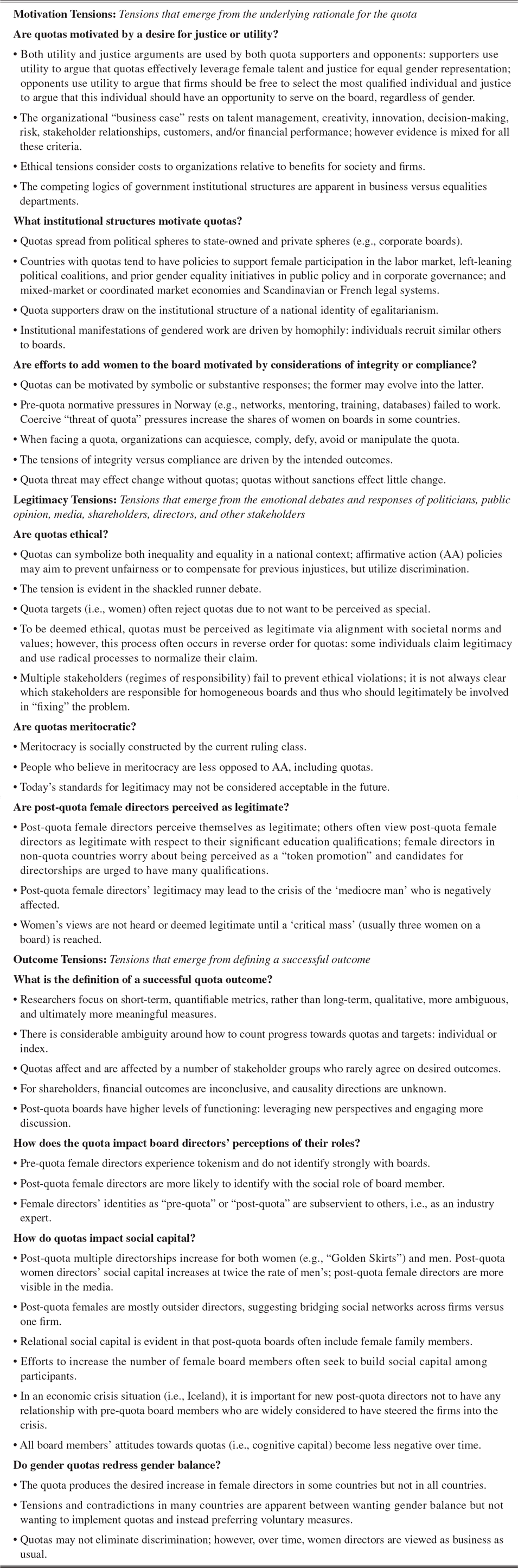
This historical overview illustrates that although countries have different board gender quota models, one unifying characteristic is the conflicting tensions that surface. Individuals, organizations, governments, and societies have differing, often juxtaposed, rationales and logics which subsequently create ethical tensions for organizations and their leaders. Although some scholars implicitly address how quotas create tensions (e.g., Machold et al., Reference Machold, Huse, Hansen and Brogi2013), there is no systematic attempt to describe and categorize these tensions. To review the literature on quotas, we follow Smith, Gonin, and Besharov (Reference Smith, Gonin and Besharov2013) in identifying three key tensions in how quotas are discussed and (re)presented: the motivations for quotas, including political ideologies; legitimacy in terms of meritocracy and ethics; and outcomes of implementing quotas for society, organizations, and individuals; and draw on four theoretical perspectives: institutional, stakeholder, social identity, and social capital. Table 1 depicts the framework.
Conflicting tensions concerning board quota quotas

CONFLICTING TENSIONS CONCERNING BOARD GENDER QUOTAS
Motivations for Adopting Board Gender Quotas: Ethical Tensions
Motivation tensions concern the underlying rationale for quotas, and stem from a range of strategic and emotive concerns. A review of the quota literature suggests three main questions arise around the motivations for quotas: desires for justice and utility, countries’ underlying institutional structures, and the pursuit of integrity or compliance.
Are quotas motivated by a desire for utility or justice? The two most frequently mentioned rationales for implementing quotas are utility and justice. The utility case seeks to achieve the most economically satisfying outcome, either for society or an organization (often referred to as “the business case”). The justice case argues for individual and social equality. These perspectives are anchored in contested political ideologies about capitalism and individualism versus state intervention and the role of business in society. Interestingly, utility and justice arguments are employed to argue both for and against quotas (Tienari, Holgersson, Merilainen, & Hook, Reference Tienari, Holgersson, Meriläinen and Höök2009). For example, utility perspectives emphasize capitalism and individualism in that firms should be free to select the most qualified individual to lead the firm. The utility lens is buoyed by findings that indicate that quotas help to effectively leverage female talent (Tatli, Vassilopoulou, & Özbilgin, Reference Tatli, Vassilopoulou and Özbilgin2013), and moreover that women directors bring fresh perspectives (Francoeur, Labelle, & Sinclair-Desgagné, Reference Francoeur, Labelle and Sinclair-Desgagné2008), greater attention to corporate governance (Adams & Ferreira, Reference Adams and Ferreira2009; Pathan & Faff, Reference Pathan and Faff2013), and active levels of participation (Virtanen, Reference Virtanen2012; Bilimoria & Wheeler, Reference Bilimoria and Wheeler2000; Ingley & Van der Walt, Reference Ingley and Van der Walt2003) and monitoring (Post & Byron, Reference Post and Byron2015) to their boards. Another illustration of the utility perspective is former EU Justice Commissioner Vivian Reding’s (Reference Reding2012, Reference Reding and Machold2013) contention that quotas will enhance Europe’s economic growth. Quota opponents use the justice rationale to argue that the most qualified individual should have an opportunity to be a board member. Quota proponents leverage justice to suggest that all demographic groups should be represented equally, e.g., women comprise half the population and therefore should hold half the power (Dahlerup, Reference Dahlerup, Griffin and Braidotti2002).
In Norway, one might assume that the quota was uncontested given the country’s long history of political quotas and other initiatives for women; however, the debate was extremely polarized between quota opponents (mostly industrialists) and supporters (mostly media and politicians) (Storvik & Teigen, Reference Storvik and Teigen2010; Teigen, Reference Teigen and Niskanen2011, 2012), with both sides using justice and utility arguments. The anti-quota industrialists emphasized the competitive landscape and the need for Norwegian businesses to choose their own leaders, and the belief that nothing hinders women’s careers (Meier, Reference Meier2013). Leaders at Norway’s confederation of business enterprises argued that the quota would reduce Norwegian firm competitiveness and performance (Hoel, Reference Hoel and Vinnicombe2008)—a rationale later used by Spanish and German business communities when quotas were suggested (González Menéndez & Martínez González, Reference González Menéndez, Martínez González and Fagan2012; Smith, Reference Smith2014).
At an organizational level, utility motivations rest on the “business case” for women on boards; however, there is conflict as to which “case” merits primary focus, and how the business case should be measured. Business case arguments revolve around talent management, creativity, innovation, decision-making, risk, stakeholder relationships, customers, and/or financial performance; however, for all criteria, there is mixed evidence regarding the impact of women directors (Terjesen et al., Reference Terjesen, Sealy and Singh2009). Neoliberal capitalists argue that market forces will ensure whether having more women directors is really beneficial to the business, and that quotas are inconsistent with Anglo-American market discourse (Tienari et al., Reference Tienari, Holgersson, Meriläinen and Höök2009). In the UK, quota supporters use the talent maximization argument to indicate that there is a market failure which justifies intervention (Mayhew, Reference Mayhew2013). A quota is more likely to be successful when it is supported by business and wider society, as is the case for utility-based rather than social or individual justice arguments (Seierstad et al., Reference Seierstad, Warner-Søderholm, Torchia and Hues2015). There are ethical tensions surrounding the cost/benefit analysis of the cost to organizations to implement a quota relative to the social benefit: an “ideological debate between social justice and the protection of ownership and its attached right to govern the disposition of assets unencumbered by political intervention” (Kogut et al., Reference Kogut, Colomer and Belinky2014: 891). When organizations are responsible for social change, there is an ethical need to scrutinize the outcomes and processes of their involvement (Banerjee, Reference Banerjee2010).
The logics of social justice and utility are each supported by distinct institutional structures. Distinct logics can cause tensions, but can also be advantageous as diverse perspectives give leaders greater latitude to develop creative solutions (Seo & Creed, Reference Seo and Creed2002). The competing motivation logics of justice versus equality are visible in Norway between Trade Minister Gabrielsen and Arni Hole (Director General, Ministry of Children, Equality and Social Inclusion) who both championed the quota. In the UK, to avoid a potential quota, the Business Innovation and Skills department and the Government Equalities Office initially worked together, despite competing motivations.
What institutional structures motivate quotas? A growing literature utilizing institutional theory offers insights into the tensions of motivations for quotas through the mechanisms of normative contagion and mimetic and coercive pressures. Institutional pressures operate across groups of organizations (e.g., firms listed on a particular stock exchange), sectors (e.g., from politics to business), and countries (e.g., across Europe and the global board quota debate). Interventions are far more common in public than in private spheres: nearly half the world’s countries have a quota in a political or state-owned sphere (Dahlerup & Freidenvall, Reference Dahlerup and Freidenvall2005; Dahlerup, Reference Dahlerup2013, Reference Dahlerup2015). Quotas spread from the political to the economic sphere in Norway (Teigen, Reference Teigen2012a), Latin America (Meier, Reference Meier2013), and elsewhere. Of the Belgian quota, Meier (Reference Meier2013: 463) explains: “Once a norm has been established with respect to gender equality, it is difficult to set a completely different one, even in another sector.” Historical institutional perspectives describe gradual and congruent interactions and trajectories (Mahoney & Thelen, Reference Mahoney and Thelen2010; Teigen, Reference Teigen2012a). Three country-level institutions precede quotas: “the female labor market and gendered welfare policies, left-leaning government coalitions, and a legacy of path dependent gender equality initiatives in public policy and corporate governance codes” (Terjesen et al., Reference Terjesen, Aguilera and Lorenz2015: 233). Countries with quotas have institutions aligned with mixed market economies (i.e., France, Italy, Spain) or coordinated market economies (i.e., Belgium, Finland, Norway), and legal systems of Scandinavian (i.e., Finland, Iceland, Norway) or French (i.e., Belgium, France, Italy, Spain) origin (Machold & Hansen, Reference Machold and Hansen2013).
Another institutional structure driving quotas are efforts to develop and maintain national identity which often draw on public opinion. Norway’s historical ideology of gender equality (Freidenvall, Dahlerup, & Skjeie, Reference Freidenvall, Dahlerup, Skjeie and Dahlerup2006) motivated quota debates (Sørensen, Reference Sørensen2013) as Minister Gabrielsen described the wasted money society spends on educating its daughters but then not allowing them to fulfill their potential. Another illustration of the powerful institution of national identity is Brazil’s longstanding multi-racial population who take great pride in the country’s “racial democracy” and the national discourse of “a multi-colored national race” rather than one race (Htun, Reference Htun2004: 61). Concerned with the grossly apparent inequalities when he came to power in 1995, then President Fernando Henrique Cardoso openly questioned the country’s self-identity and subsequently introduced quotas for blacks, women, and the disabled.
The institutional manifestations of gendered work, including the low representation of women’s talent in the upper echelons, can also be examined through Kanter’s (Reference Kanter1977) theory of homophily. Based on social identity theory, ingroup and outgroup dynamics explain how individuals feel more comfortable around, and are better able to understand and recognize similar others’ talents, competences, and potential (O’Reilly, Caldwell, & Barnett, Reference O’Reilly, Caldwell and Barnett1989). Homosocial reproduction processes suggest that leaders recruit individuals who are similar to themselves, and interventions are necessary to rectify the homophily-driven replication of the status quo.
Are efforts to add women to the board motivated by considerations of integrity or compliance? A controversial new regulation such as the quota can raise concerns about whether the goal is integrity in the sense of meeting the spirit of the new law or considerations of compliance, responding more to the letter of the law. Institutional theory offers insights into why this question is important given the ways in which organizations respond to institutional pressures—at times emphasizing symbolic responsiveness (i.e., the notion of decoupling highlighted by theorists going back to DiMaggio and Powell, Reference DiMaggio and Powell1991) and at times more substantive responsiveness (see Selznick, Reference Selznick1994). Agency and interests are central to institutional processes (DiMaggio, Reference DiMaggio and Zucker1988) which are subject to individuals’ self-interest, and bounded by norms of fairness and reciprocity (Bosse & Phillips, Reference Bosse and Phillips2015). In Norway, extensive normative pressures such as mentoring, training, databases, and law hearings did not substantially improve shares of women on boards (Huse, Reference Huse and Machold2013a). However in France, the largest CAC40 firms implemented the greatest post-quota improvements (Singh, Point, & Moulin, Reference Singh, Point and Moulin2015). The coercive pressure of the “threat of quota” increased shares of women on boards in the UK and Australia (Klettner, Clarke, & Boersma, Reference Klettner, Clarke and Boersma2014; Sheridan, Ross-Smith, & Lord, Reference Sheridan, Ross-Smith and Lord2014; Vinnicombe, Doldor, Sealy, Pryce, & Turner, Reference Vinnicombe, Doldor, Sealy, Pryce and Turner2015).
Organizations utilize five different strategies to address competing institutional demands: acquiesce, comply, defy, avoid, and manipulate (Pache & Santos, Reference Pache and Santos2010). Approximately half of the Spanish companies defy the law by simply ignoring it. In Norway and Iceland, most firms acquiesce and comply; a handful of Norwegian firms avoided the law by changing their listed status (Ahern & Dittmar, Reference Ahern and Dittmar2012; Bøhren & Staubo, Reference Bøhren and Staubo2014). The UK government strategy avoids the threat of an EU law by addressing the issue pre-law at a national level. Some French companies manipulate the law by placing celebrity female directors (Branson, D., Reference Branson2012).
Tensions of integrity versus compliance are driven by intentions of action. Norwegian proponents justify the quota in terms of utility of female talent, with the hope of improving female participation rates across the entire workforce. Subsequent EU countries’ (e.g., Italy) quotas are often ascribed to mimetic compliance pressures to gain legitimacy. At an organizational level, some British firms provide board diversity statements of intent to avoid negative media attention as such attention is a mechanism for social change (Vasi & King, Reference Vasi and King2012). However, “even ceremonial adoption can unintentionally trigger a chain of reactions that have real organizational effects” (Bromley & Powell, Reference Bromley and Powell2012). UK FTSE Chairs report initially agreeing to increase female board representation to meet normative expectations, and soon realize the real changes and benefits of female directors (Vinnicombe et al., Reference Vinnicombe, Doldor, Sealy, Pryce and Turner2015).
Another tension concerns whether regulations on counting and reporting the numbers of women lead to substantive or only symbolic change. Governance regulation on reporting can help to achieve stakeholder accountability (Hess, Reference Hess2007), as demonstrated in Australia and the UK’s new gender-metric reporting regulations at board, senior management, and firm-wide levels. Voluntary reporting on detailed actions taken towards succession planning and increasing the number of women at all levels reveals differences between compliant platitudes and true commitment of resources towards the goal. The voluntary shift from symbolic to substantive response allows real change to occur and embed, rather than remain at a superficial level (Sealy, Turner, Pryce, & Vinnicombe, Reference Sealy, Turner, Pryce and Vinnicombe2015). Self-regulation can be largely symbolic in order to dispel criticism (Arya & Salk, Reference Arya and Salk2006); however, voluntary or mandated policies that do not include sanctions are less likely to work (Gray, Reference Gray2015). The threat of quotas can motivate voluntary actions: in the UK, thirty-four senior stakeholders express the need for continued external pressures on organizations to proactively increase female leadership (Vinnicombe et al., Reference Vinnicombe, Doldor, Sealy, Pryce and Turner2015). Since Kanter’s seminal work on tokens, liberal feminist researchers and demographers focus on improving numbers in order to change gendered cultures (Ely, Reference Ely1994, Reference Ely1995). Based on homophily and social identity theory, a “critical mass” of at least 33% of each gender shifts group dynamics, preventing mere compliance and ensuring substantive rather than symbolic change (Joecks, Pull, & Vetter, 2015; Kanter, Reference Kanter1977; Konrad, Kramer, & Erkut, Reference Konrad, Kramer and Erkut2008). Gender is now widely accepted as socially constructed, suggesting that countries adopt quotas either “as a response to changing attitudes about women,” or in the hopes of doing so (Pande & Ford, Reference Pande and Ford2012: 3).
A final, related debate concerns whether quotas for outsider (i.e., external, non-executive) or supervisory directorships are more symbolic than substantive. Context is key, as many European countries have a two-tier board system such that board quotas only affect outside directors. The UK and Australia’s unitary board systems’ new women directors are primarily outsiders (Davies, 2015). It is unclear whether new female supervisory directors can substantively impact their organizations’ cultures for all women employees. Initial progress from voluntary measures in Australia stalled and the Norwegian quota was not followed by an increase in female executives. The UK witnessed a small rise in female insider directorships, and a wave of publicly declared gender targets for top executives in large corporations and law firms. As leadership is created by and creates images (Fisher & Fowler, Reference Fisher and Fowler1995), the targets put women in these roles, leading society to deem the social identity of an all-male board as increasingly unacceptable and re-imaged.
Legitimacy and the Adoption of Board Gender Quotas: Ethical Tensions
Tensions concerning legitimacy arise in the emotional debates and responses of politicians, public opinion, media, shareholders, directors, and other stakeholders. From the literature, we identify three main concerns around the ethical and meritocratic nature of quotas, and the perception of individuals who are affected by quotas.
Are quotas ethical? There are tensions among various ideological and ethical arguments for and against implementing quotas. Gender quotas symbolize equality, signify justice, reflect the value of equal representations of both sexes, and “stand for the current under-representation of women and over-representation of men that is no longer considered normal” (Meier, Reference Meier2013: 462). Discrimination is a “pervasive and insidious phenomenon” (Oswick & Noon, Reference Oswick and Noon2014: 35) which organizations and countries have addressed for decades through laws, policies, and approaches for equal opportunities, diversity, and, more recently, inclusion. Despite popular rhetoric, the world is not meritocratic and systemic biases prevent equality of opportunity. Governments have considered various affirmative action (AA) policies since the 1960s, and aim to correct imbalances “by adjusting the positive weighting of the majority group membership that is ingrained in the system” (Clayton & Tangri, Reference Clayton, Tangri, Blanchard and Crosby1989: 181). However, it is unclear as to whether AA actions are aimed at preventing unfairness or at compensating for previous injustices (Reskin, Reference Reskin1998). This tension is eloquently described in the case of the shackled runner (Noon, Reference Noon2010): If after the race has started you realize that one runner is in shackles, do you stop the race and simply remove the shackles and tell the runners to continue, or do you bring the previously shackled runner up to the same level as the unshackled runner before continuing the race?
AA is paradoxical (Fullinwider, Reference Fullinwider1980) as it aims to prevent discrimination by utilizing discrimination. Women who are AA targets often reject the method of reducing inequality, not wanting to be identified as “special” or treated differently (Heilman, McCullough, & Gilbert, Reference Heilman, McCullough and Gilbert1996). However, women’s initial scepticism disappears once they observe that more competent women are offered board appointments and post-quota female directors perceive the quota as “an imperfect strategy in an imperfect world,” but the right thing for Norway (Seierstad, Reference Seierstad2015: 18).
To be perceived as legitimate, an organization’s actions need to be seen as “desirable or appropriate” (Santana, Reference Santana2012: 257), in the interests of a broad group of stakeholders (Freeman, Harrison, & Wicks, Reference Freeman, Harrison and Wicks2007), and consistent with societal values (Pfeffer & Salancik, Reference Pfeffer and Salancik1978; Ruef & Scott, Reference Ruef and Scott1998). Institutional theory explains how actors seek legitimacy to survive (Suchman, Reference Suchman1995), and thus offers insights into how a previously considered illegitimate concept emerges, survives, and comes to be perceived as a legitimate institutional process (Smith et al., Reference Smith, Gonin and Besharov2013). The quota process generally proceeds with a few key individuals claiming legitimacy for a radical process and using institutional pressures to normalize their claim. For example, Australian and British institutional authorities changed national governance codes—a significant step towards measurement and targets (Klettner et al., Reference Klettner, Clarke and Boersma2014; Sealy et al., Reference Sealy, Turner, Pryce and Vinnicombe2015).
Stakeholder theory investigates respective stakeholder groups’ legitimacy of claims, power, and urgency (Mitchell, Agle, & Wood, Reference Mitchell, Agle and Wood1997; Jensen, Reference Jensen2002; Vasi & King, Reference Vasi and King2012), keeping in mind that social legitimacy is important for the institution of business (Wood, Reference Wood1991). When considering major corporate scandals of the past two decades (e.g., Enron, Arthur Anderson), there are “regimes of responsibility”—multiple stakeholders who failed to prevent these ethical violations (Goodstein & Wicks, Reference Goodstein and Wicks2007). Board homogeneity is also a systemic failure on the part of multiple stakeholders. For example, search firms collude in anti-diversity practices with Chairs by using ambiguous and subjective assessments such as “intrinsics” and “fit” rather than objective measures (Doldor, Sealy, & Vinnicombe, forthcoming). As Goodstein and Wicks (Reference Goodstein and Wicks2007: 380) note about regimes of responsibility: “What is striking is that they got away with it for so long.” Certainly this is evident in the decades of low representation of women on boards in many countries. Failures can be solved by cooperation across stakeholders who generate novel, mutually beneficial solutions (Goodstein & Wicks, Reference Goodstein and Wicks2007), without resorting to legislation. Scholars such as Perrault (Reference Perrault2015: 1) suggest the importance of efforts to “decry the lack of legitimacy of homogenous (all-male) boards.” However, as Goodpaster (Reference Goodpaster2010: 741) states, “the pursuit of stakeholder satisfaction is not immune to moral critique” and different stakeholder groups are likely to have different voices on the legitimacy of such an intervention.
Are quotas meritocratic? Whilst the ideology of meritocracy in careers and organizations is central to Western society (Son Hing, Bobocel, & Zanna, Reference Son Hing, Bobocel and Zanna2002), most director appointments are not purely talent-based (Sealy, Reference Sealy2010). A meritocratic class—often white, middle-class, middle-aged, educated men—perpetuate their privilege and power by defining merit (McNamee & Miller, Reference McNamee and Miller2004). True merit is only possible in a society with no biases (Son Hing et al., Reference Son Hing, Bobocel and Zanna2002).
Women’s strong convictions for meritocracy shape their sense-making about careers (Sealy, Reference Sealy2010; Simpson, Ross-Smith, & Lewis, Reference Simpson, Ross-Smith and Lewis2010; Seierstad, Reference Seierstad2015). When workplace discrimination is obvious, people who strongly believe in meritocracy are less opposed to AA (Son Hing et al., Reference Son Hing, Bobocel and Zanna2002). Sealy’s (Reference Sealy2010) study confirms these findings, with women reducing their opposition to quotas over time. Initial adherence to meritocracy is a gender-neutral principle; however, female directors use merit to support radical strategies and to justify women’s presence on post-quota boards (Seierstad, Reference Seierstad2015). Companies that appear legitimate and meritocratic in the eyes of their stakeholders will gain acceptance and resources (O’Connell et al., Reference O’Connell, Stephens, Betz, Shepard and Hendry2005; Meyer & Rowan, Reference Meyer, Rowan, Powell and DiMaggio1991). As both meritocracy and legitimacy are socially constructed (Ely, Reference Ely1995; Harvey & Schaefer, Reference Harvey and Schafer2001), some stakeholders’ claims were previously considered legitimate, but are not today (Santana, Reference Santana2012). That is, all-male boards were previously deemed normal and therefore natural; however, this gender imbalance is increasingly unacceptable in many countries.
Deliberative democracy suggests that a process can only be legitimate if it is preceded by authentic involvement of decision-makers who have equal say (Scherer & Palazzo, Reference Scherer and Palazzo2007). Each country’s pre-quota process is characterized by different decision makers’ involvement. In some cases, such as Spain, it is not clear that the pre-quota process sufficiently involves all decision-makers. British and Slovenian pre-quota negotiation processes involve many stakeholders.
Are post-quota female directors perceived as legitimate? A third legitimacy tension concerns the perceptions of new female post-quota leaders by the women themselves and by other members of society. In terms of self-perception, post-quota female directors in Norway report feeling “legitimate,” possessing significant influence, sharing considerable information, and engaging in low levels of self-censorship (Elstad & Ladegård, Reference Elstad and Ladegård2010). Considering the discourse on board quotas in Swedish and Finnish media, Tienari et al. (Reference Tienari, Holgersson, Meriläinen and Höök2009: 513) quote post-quota female directors: “It doesn’t bother me one bit if they call me a quota woman”; another states “I agree . . . owners only want people they consider competent on their board.” Post-quota female directors report that they still have to prove themselves, but the calibre of the new women far exceeds the “mediocre men” they replace (Seierstad, Reference Seierstad2015). In Sweden the post-gender political quota increase in female candidates’ competence, relative to male candidates is coined the “crisis of the mediocre man” (Besley, Folke, Persson, & Rickne, Reference Besley, Folke, Persson and Rickne2013).
Others perceive the post-quota female directors as possessing high levels of education but less work experience. For example, evidence from Spain and Norway indicates that post-quota female directors are, compared to their pre-quota counterparts, considerably younger (Ahern & Dittmar, Reference Ahern and Dittmar2012; Gonzalez Menéndez & Martinez González, Reference González Menéndez, Martínez González and Fagan2012), have less CEO experience (Ahern & Dittmar, Reference Ahern and Dittmar2012), and less likely to be owners/partners or self-employed (Heidenreich, Reference Heidenreich and Machold2013). Post-quota female directors are more likely to have backgrounds in finance and economics (Gonzalez Menéndez & Martinez González, Reference González Menéndez, Martínez González and Fagan2012) and higher levels of education, especially in law (Heidenreich, Reference Heidenreich and Machold2013) or general Masters qualifications (Gonzalez Menéndez & Martinez González, Reference González Menéndez, Martínez González and Fagan2012). In France, pre-quota women directors establish their legitimacy through family ownership, elite educations, strong State ties, and top corporate careers (Singh, Point, Moulin, & Davila, Reference Singh, Point, Moulin and Davila2015). There is also evidence of French “figurehead” or celebrity directors such as a former tennis professional, former first lady Bernadette Chirac, and wives of major shareholders (Branson, D., Reference Branson2012). In terms of ethical considerations, Doh (Reference Doh2012) suggests that actions are legitimate as long as no one is made worse off; hence, the “mediocre man” is one group of stakeholders with grounds to question the legitimacy of quotas.
Related research assesses non-quota countries’ female directors’ feelings around legitimacy. In the UK, new female directors report worrying about being “a token promotion” for their sex rather than for their ability, struggle with what they want to believe versus what they experience, and subsequently have lower perceptions of the legitimacy of the processes and their organizations (Sealy, Reference Sealy2010). Consistent with the findings reported above, UK female directors appear to require more qualifications in order to be perceived as legitimate: compared to their male peers, female directors are more likely to hold MBA degrees, and have substantially more multiple sector and international experience (Singh, Terjesen, & Vinnicombe, Reference Singh, Terjesen and Vinnicombe2008). Search firms report that women director candidates are a “harder sell” to the Chairs and that to be deemed legitimate, women directors need to have as many qualifications as possible, especially finance skills (Sealy & Doherty, Reference Sealy and Doherty2012).
Perceptions of female directors’ legitimacy undoubtedly shifts once women comprise a critical mass [usually operationalized as three women directors on a board] (Konrad et al., Reference Konrad, Kramer and Erkut2008; Torchia, Calabro, & Huse, Reference Torchia, Calabrò and Huse2011)] versus numbering as tokens (i.e., less than 15 percent; Kanter, Reference Kanter1977). Once there is a more balanced board with a critical mass of women, women’s views are perceived as more legitimate, and a woman’s voice becomes that of just another individual, rather than a representative of an entire demographic group (Kanter, Reference Kanter1977).
Outcomes and the Adoption of Board Gender Quotas: Ethical Tensions
Based on our review of over 25 papers examining outcomes, it is apparent that there is no consistent definition of quota success. We highlight debates around the definition of success, directors’ perceptions of their roles and identities, social capital, and gender balance.
What is the definition of a successful quota outcome? One critical challenge involves measuring and defining success in academic research. Managers are typically evaluated based on their ability to maximize their firms’ long-term value (Jensen, Reference Jensen2002); however, academic research focuses more on short-term, quantifiable metrics than on longer-term, qualitative, and sometimes more ambiguous measures (Levinthal & March, Reference Levinthal and March1993).
A second challenge is the great ambiguity, across countries, about how to count progress towards quotas and targets. In Norway, the quota is clear: each company must meet the 40% target. In the UK, the 25% target for FTSE 100 companies is interpreted as an aggregate percentage across the largest 100 firms, consistent with historical FTSE reporting. The outcome is that whilst FTSE 100 female director representation increased from 12.5% to 26.1% from 2011-2015, some firms have 50% female directors, and others reluctantly place a single woman on the board—10% (BoardEx, 2015; Vinnicombe et al., Reference Vinnicombe, Doldor, Sealy, Pryce and Turner2015).
Board gender quota outcomes affect and are effected by a number of stakeholder groups including shareholders, current (pre-quota) and future (post-quota) directors, women in society, general public, local, national, and international politicians, search firms, industry associations, and the firms themselves. Stakeholders rarely agree on all issues and vary in power (Freeman, Reference Freeman1984) and desired outcomes—thus creating conflicting demands and outcome tensions.
Shareholders are often the most powerful set of stakeholders (Freeman, 1994). A growing literature examines the impact of quotas on financial and accounting performance, with mixed results. Panel analysis of 166 Norwegian public firms from 2001-2008 reveals a negative relationship between the post-quota appointment of female directors and firm value: a 10% increase in women directors is associated with a 12.4% decline in Tobin’s Q (Ahern & Dittmar, Reference Ahern and Dittmar2012). Immediately following the Norwegian quota announcement, stock prices drop, especially for firms with no female director (Ahern & Dittmar, Reference Ahern and Dittmar2012). For a short period after the Norwegian quota, only some Norwegian firms enjoy positive stock returns (Nygaard, Reference Nygaard2011), revealing “the opinion of a portion of the market regarding the predicted effect of the measures announced” (Goplan & Watson, Reference Gopalan and Watson2015: 11). Post-quota Norwegian firms’ comparatively lower short-term profits may be due to high labor costs and employment levels and fewer workplace reductions (Matsa & Miller, Reference Matsa and Miller2013). Other research finds no effects of post-quota female representation on return on assets or operating revenues and costs in Norway (Dale-Olsen, Schøne, & Verner, Reference Dale-Olsen, Schøne and Verner2013). A recent meta-analysis of mostly pre-quota studies shows correlational evidence between increased board gender diversity and improved board performance (Post & Byron, Reference Post and Byron2015). However, few studies provide the direction of the correlations: more women directors may lead to some measure of better performance, or leaders of better performing companies favor board diversity (Adams, de Haan, Terjesen, & van Ees, Reference Adams, de Haan, Terjesen and van Ees2015).
Shareholders and board members are also interested in post-quota board functioning, of which a growing number of studies generally report favorable responses. Following initial resistance to quotas, “boards just get on with business like before” (Teigen, Reference Teigen2010). Interviews with board members, board chairs, and election committee members indicate that post-quota boards are more professional and make better quality decisions (Bolsø, Bjørkhaug, & Sørensen, Reference Bolsø, Bjørkhaug, Sørensen and Machold2013). Post-quota female directors’ contributions vary based on board tasks (Huse, Nielsen, & Hagen, Reference Huse, Nielsen and Hagen2009). Post-quota boards with more women consider new perspectives and engage in more discussions (Heidenreich, Reference Heidenreich and Machold2013). These findings are generally consistent with growing evidence on the process-related benefits of board gender diversity (McKinsey, 2008; Post & Byron, Reference Post and Byron2015; Terjesen et al., Reference Terjesen, Sealy and Singh2009) and women’s active roles enhancing human resource development, role models, and participative decision-making (McKinsey, 2008; Teigen, Reference Teigen and Fagan2012b).
How does the quota impact board directors’ perceptions of their roles? An individual may feel attached to multiple groups, with varying strengths of identification. Board directors identify with multiple roles and social groups (Hillman, Nicholson, & Shropshire, Reference Hillman, Nicholson and Shropshire2008; Withers, Corley, & Hillman, Reference Withers, Corley and Hillman2012). Female board members who do not comprise a “critical mass” do not identify strongly with the board (Jonsdottir et al., Reference Jonsdottir, Singh, Terjesen and Vinnicombe2015). Taken together, social identity and tokenism theories explain why, in a pre-quota context, moving from zero women to one woman makes no difference to other women in the organization or to the overall culture. Once an intervention such as the quota begins to have an impact, the “dominant” group’s influence wains and tokenism’s effects dissipate. The intended beneficiaries often object to AA or quotas (Kakabadse et al., Reference Kakabadse, Figueroa, Nicolopoulou, Hong Yang, Kakabadse and Ozbilgin2015)—a great irony as one of the most common emotive arguments by women against quotas is “I don’t want to be a token woman,” and yet, by definition, tokenism does not occur when a quota is imposed because the gender split becomes more balanced and women cease to be seen as “other.” After the Icelandic quota, when women constitute at least 40% of a board, female directors are more likely to identify with the social role of board member (Jonsdottir, Reference Jonsdottir2010).
Once a quota is introduced, a woman may identify or be identified with a particular role based on when she joined the board, i.e., as a pre-quota director or a post-quota director. These identities can be subservient to others, e.g., as an expert in a particular industry. Comparing the social identity of pre- and post-crisis directors in Iceland, women added to mature, previously male-dominated boards are perceived to be “directors on approval” (Jonsdottir et al., Reference Jonsdottir, Singh, Terjesen and Vinnicombe2015). On newly-formed post-crisis gender balanced boards in Iceland, there is “a cohort effect” with increased group cohesion and fewer gender differences in directors’ identification with their roles (Jonsdottir et al., Reference Jonsdottir, Singh, Terjesen and Vinnicombe2015: 1). Negative responses to new directors in Norway are not gendered; all new directors need to “earn” their roles (Dhir, Reference Dhir2015)—suggesting that social identity can help explain outcomes when women join previously all-male boards.
How do quotas impact social capital? Social capital theory describes the structural, relational, and cognitive capital that individuals obtain through networks and relationships which are closely tied with a firm’s organization, development, and strategy (Nahapiet & Ghoshal, Reference Nahapiet and Ghoshal1998). From a structural perspective on individuals’ number and nature of relationships, post-quota female directors’ social capital increases almost twice as much as men’s—indicating that female directors serve as knowledge brokers across firms (Seierstad & Opsahl, Reference Seierstad and Opsahl2011). This finding may be due to the fact that, for a short period immediately following the quota in Norway and Spain, several female directors held multiple directorships and thus were structurally embedded in multiple firms. In Norway, these women are known as “Golden Skirts” (Huse, Reference Huse and Machold2013b, c). Post-quota, the number of male directors with multiple directorships also increases for a short period (Løyning, Reference Løyning2011; Seierstad & Opsahl, Reference Seierstad and Opsahl2011; Heidenreich, Reference Heidenreich and Machold2013; Huse, Reference Huse, Gröschl and Takagi2012), a trend driven by the initially perceived limited pool of female candidates (Teigen, Reference Teigen2012a). Post-quota boards retain the most powerful male directors with multiple directorships, while less experienced men are replaced by women directors (Teigen, Reference Teigen and Teigen2015a). These findings suggest that post-quota female and male directors may be “busier” as they sit on multiple boards.
Female directors’ extensive social capital may enable them subsequently to serve on many corporate boards in their career. By contrast, less powerful, pre-quota male directors may face less demand for their services as independent director appointments on quota-affected firms, and instead pursue careers as directors on unaffected entities such as private firms, non-profits, and universities, thus developing bridging capital across disparate networks. Structurally, in Norway and Spain, post-quota female directors tend to occupy outsider directorships (Gonzalez Menéndez & Martinez González, Reference González Menéndez, Martínez González and Fagan2012; Staubo, Reference Staubo2010; Bøhren & Staubo, Reference Bøhren and Staubo2015; Huse, Reference Huse and Machold2013a), suggesting that women’s social networks are more likely to bridge across firms than to embed in one firm. Pre-quota efforts to increase women’s representation on boards were dominated by a number of failed structural capital initiatives (e.g., mentoring networks) (Huse, Reference Huse and Machold2013a). Post-quota female outsider directors in Spain are more visible in the media than their male counterparts (de Anca & Gabaldon, Reference de Anca and Gabaldon2014).
The relational component of social capital concerns trust, norms, and expected obligations shared in relationships. Pre-quota board females are often embedded in family relationships, e.g., as the wife, sister, daughter, or other relative of the founder and/or owner. Spanish and French family-owned firms promote a higher share of female family members to their boards (Fagan & González Menéndez, Reference González Menéndez, Martínez González and Fagan2012). Programs designed to help women land directorships such as Norway’s Female Future (NHO, 2013) organize training and events to increase participants’ relational capital (Håpsnes & Buvik, Reference Håpsnes and Buvik2013). Icelandic evidence indicates that post-quota directors do not have relationships with directors before they join boards (Arnardóttir & Sigurjonsson, Reference Arnardóttir and Sigurjónsson2015), and this lack of taint by association is considered imperative post-crisis (Jonsdottir, Reference Jonsdottir2010).
The third social capital component, cognitive, concerns how individuals or groups develop shared meaning and understanding, and is often only possible once structural mechanisms are embedded. In this regard, board members’ attitudes towards the quota become less negative over time (Arnardóttir & Sigurjónsson, Reference Arnardóttir and Sigurjónsson2015).
Do gender quotas redress gender balance? In Norway, the quota produced the desired increase in female directors (6% in 2002; 12% in 2005; 18% in 2006; 36% in 2008; 40% in 2009; Storvik & Teigen, Reference Storvik and Teigen2010), and was accompanied by increases in female political leadership (Meier, Reference Meier2013) but not improvements to the female positions at lower levels in corporations or the gender pay gap (Bertrand, Black, Jensen, & Lleras-Muney, Reference Bertrand, Black, Jensen and Lleras-Muney2014). Norway and Iceland are the only two countries to achieve the quota target [both 40%]; France’s CAC40 (33.2%), Spain’s IBEX 35 (19.1%), and Germany’s DAX (21.2%) are behind (BoardEx, 2015).
Some countries’ (e.g., Sweden, Finland, UK) voluntary systems (i.e., comply or explain legislation) led to increases in women on boards. Cultural change is often assumed to be more likely through “voluntary” measures rather than compulsion through law; however, there is no supporting evidence in the literature. Compared to quotas, voluntary measures make smaller and slower differences (Armstrong & Walby, Reference Armstrong and Walby2012; Labelle, Francoeur, & Lakhal, Reference Labelle, Francoeur and Lakhal2015).
DIRECTIONS FOR FUTURE RESEARCH
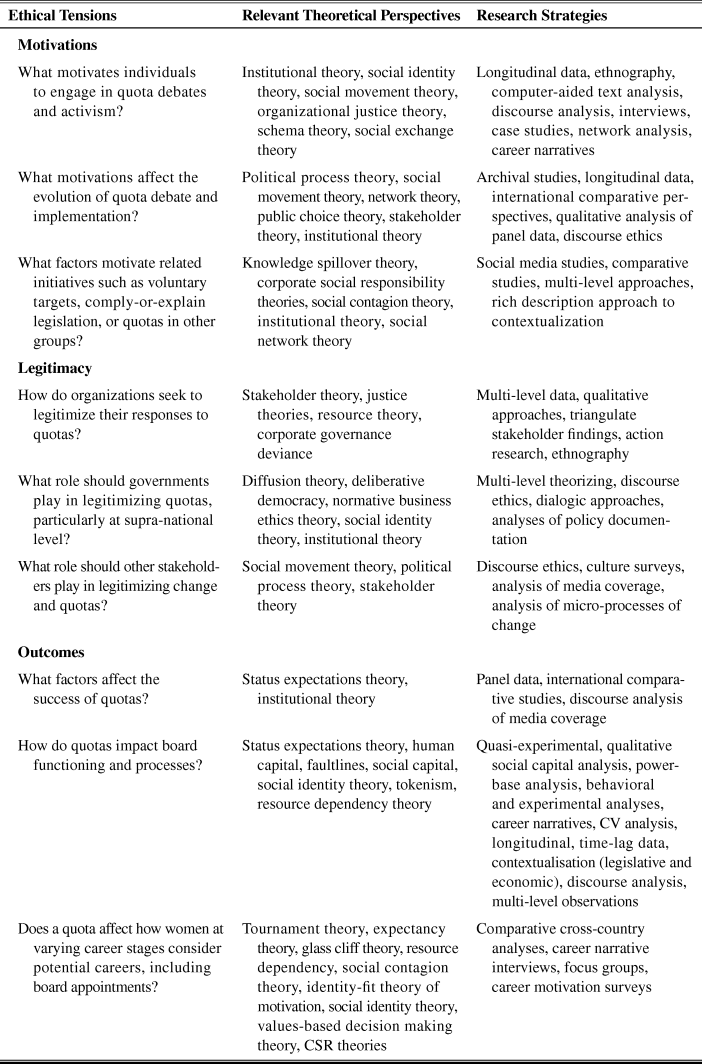
Our review allows us to offer a comprehensive set of suggestions for future research which we organize in terms of ethical tensions, theoretical perspectives, and research strategies (Table 2.)
Future research directions
Ethical Tensions
Motivations. We suggest researchers consider three perspectives around individuals’ motivations for quotas, implementation, and motivations for related initiatives such as voluntary targets.
What motivates individuals to engage in quota debates and activism? We urge researchers to examine individual-level motivations to engage in quota debate and activism, leveraging multi-level lenses from stakeholder, institutional entrepreneur, schema, and social movement theories.
One unexplored component of stakeholder and institutional theory concerns the role of institutional entrepreneurs—individual agents who create, initiate, or disrupt institutions (Lawrence, Suddaby, & Leca, Reference Lawrence, Suddaby and Leca2011; Pacheco, York, Dean, & Sarasvathy, Reference Pacheco, York, Dean and Sarasvathy2010; Wilmott, 2010). Prominent institutional entrepreneurs leverage resources to “break with the rules and practices associated with the dominant institutional logics and practices” (Battilana, Reference Battilana2006: 657), and can manage conflicting institutional logics to change the status quo (Smith, Besharov, Wessels, & Chertok, Reference Smith, Besharov, Wessels and Chertok2012). There are many institutional entrepreneurs who championed the Norwegian quota including Trade Minister Gabrielsen and Gender Minister Valgerd Svarstad Haugland (Machold, Reference Machold and Machold2013; Terjesen et al., Reference Terjesen, Aguilera and Lorenz2015). In the UK, former minister Lord Davies personally cajoles individual CEOs and Chairs to balance their boards, and entrepreneurs such as Virgin founder Richard Branson now offer support for quotas (Branson, R., Reference Branson2012; Velkova, Reference Velkova2015). Furthermore, less obvious actors are involved in the change process and have varying motivations (Seierstad, Reference Seierstad2015; Doldor et al., forthcoming). This raises a question regarding whether it is important what motivates the individual to change, as long as they make change happen? Who should the constellation of actors in quotas include and how do they emerge? Recent research on activists indicates that these groups act differently (Eesley & Lenox, Reference Eesley and Lenox2006), for example relying on tactics such as dragging firms “through the mud” in the media or utilizing lawsuits or proxy votes (Eesley, DeCelles, & Lenox, Reference Eesley, DeCelles and Lenox2015). Certain institutional investors advocate strongly for certain personal interests; some shareholder activists pursue board gender diversity (Perrault, Reference Perrault2015). For example, Robert McCord of proxy advisory Glass Lewis votes against any firm that does not have an initiative to increase the women’s representation on the board, and the California State Teachers’ Retirement System (CalSTRS) expresses dissatisfaction on social media if a company has an all-male board (Branson, Reference Branson2012a). Activists tend to target large, visible consumer-oriented firms (King, Reference King2008; King & Lenox, Reference King and Lenox2000).
Individual-level research could examine individuals’ perspectives about justice, utility, and other philosophical views. With growing numbers of women in managerial positions, women’s social identity as potential leaders may grow stronger, raising the possibility that corresponding moral convictions may lead women to believe that they should hold more positions of power. Should we, therefore, expect more collective action on this issue, particularly in non-quota countries? Researchers may find schema theory—the organization of individuals’ patterns and thoughts (Piaget, Reference Piaget1926) to be useful in understanding what individual life experiences have activated certain worldviews.
Individual-level motivations could be investigated using a broad range of data and methodologies such as ethnographies and computer-aided text analysis. For example, key individual and organizational actors’ editorial comments about the quota could be analysed to better understand the arguments. For example, entrepreneur Richard Branson (Reference Branson2012b: 1) argues, “By today’s standards, we would find it unsettling if a jury were comprised of 12 middle-aged white men. So why have so many business leaders been slow to take notice when women are absent from the boards of their companies?” Another potential strand of research could use social network approaches to examine how individual actors (nodes) have relationships (ties) with others (see Scott, Reference Scott2012) and build these over time, within and across firms and stakeholders.
Social movement research utilizes a range of methodologies including in-depth interviews, archival studies, participant observation, single-case studies, comparative designs, life-history interviews, discourse analysis, simulations, network analysis, and studies of narratives (Klandermans & Staggenborg, Reference Klandermans and Staggenborg2002), all of which may be promising when examining both individual and group perspectives on involvement in the debate and activism of quotas. New developments in computer-aided text analysis (Pollach, Reference Pollach2012) can analyze texts. Theory and methodology choices ultimately rest with the selection of the specific research question.
Taken together, we urge quota scholars to identify and utilize new sources of data that move beyond the current focus on secondary data (generally counts of directors), or a small set of interviews or surveys from one time period. Although scholars struggle to access elites (Feldman, Bell, & Berger, Reference Feldman, Bell and Berger2004), in-depth, qualitative studies offers tremendous insights into board processes. Researchers should seek out interesting groups such as the elite, member-only, and somewhat secretive Belizean Grove and Today’s Already Rising Achievers (TARA) whose members are very influential in corporate and diplomatic sectors. Other data sources include parliamentary debates, press articles, and publications in influential social media such as blogs.
What motivations affect the evolution of quota debate and implementation? Future research could examine what organizational motives shape the actual debate and implementation of quotas. For example, the ongoing EU debate about a potential quota across 28 member states evolved from initial discussions for a mandate for all publicly-traded firms and a 40% quota for both inside and outside directors to a more “watered down” code.
Political process theories consider “political opportunities”—that is, the complex environments in movements such as the quota as well as the role of “mobilizing structures” (established networks and organizations that help groups to mobilize) and “cultural framing” to understand social movements (McAdam, McCarthy, & Zald, Reference McAdam, McCarthy and Zald1996). This line of research could benefit from public choice theories which consider the aggregate of many private decision makers (Buchanan & Tullock, Reference Buchanan and Tullock1962). Researchers might also consider emerging perspectives in stakeholder theory which focus on “total value” evaluations (Harrison & Wicks, Reference Harrison and Wicks2013) thus shifting the conversation “away from performance outcome and back to variables that go into creating competitive advantage itself” (Husted & Allen, 2001: 5). This emerging theory suggests that social welfare is multi-dimensional and thus to create a good society, companies should have multiple objectives (Mitchell, Weaver, Agle, Bailey, & Carlson, Reference Mitchell, Weaver, Agle, Bailey and Carlson2015).
This line of research could take a comparative perspective, and examine how institutions in certain countries have shaped the dialogue. For example, with respect to the potential EU quotas, nineteen EU countries’ evidence gathering session at a European Commission (2012) meeting reveals the significant variety of institutional contexts in terms of women’s representation in the workforce, education levels, maternity rights, childcare provision, and cultural familial norms. Given that countries have differing institutional structures which affect gender roles, should the EU seek a potential “one-size-fits-all” gender quota legislative framework? Sweden, Finland, Germany, and the UK initially opposed an EU quota, despite significantly different representations of women on boards (Sweden: 28%, Finland: 26%, Germany and UK: 10-15%). Future research could examine the evolution of multi-country negotiations and the roles of national institutions and leaders in the process.
From a methodological standpoint, longitudinal research could track the evolution of the quota debates in parliaments and media outlets using qualitative analyses of panel data. Future research might compare the development of the quota argument with earlier feminist initiates, such as suffrage or equal pay. Scholars could use discourse ethics (Gilbert & Rasche, Reference Gilbert and Rasche2007; Stansbury, Reference Stansbury2009) to examine how various parties’ presuppositions are used to seek to establish normative or ethical truths.
What factors motivate related initiatives such as voluntary targets, comply-or-explain legislation, or quotas for other groups? Future research could examine the motivations behind non-quota legislation, such as firms’ voluntary targets. The term “targets” is increasingly perceived as acceptable and even desirable; firms proudly announce targets as a mark of social responsibility. For example, UK Lloyds Banking Group has a 40% female target for the top 5,000 global senior managers by 2020. A related phenomenon are countries’ “comply or explain” policies which can often be found alongside a threat of legal sanctions or quotas (either from within the nation or supra-nationally) if these “voluntary” measures do not achieve required targets. For example, the UK’s Davies Report (Reference Davies2011: 2) clearly states that the “Government must reserve the right to introduce more prescriptive alternatives if the recommended business-led approach does not achieve significant change” [i.e., quotas if FTSE 100 companies do not meet the 25% target]. The tension around the term “voluntary measures” is apparent when the threat is perceived as real. The UK’s Secretary of State for Business recently described the quota as “a nuclear deterrent” and expressed hope that companies would “own this issue rather than have it imposed on them” (Roberts, Reference Roberts2014: 1). There is also the potential for board gender quotas to spillover to other minority groups (e.g., ethnic directors) and other arenas (e.g., private sector firms, universities). As another example, the UK’s Business Secretary now focuses on the proportions of minority ethnic directors. In other arenas, the UK’s proposed Athena Swan program will require universities to increase the number of women in leadership positions or face sanctions such as rejecting institutions’ applications for funding. Given that we know very little about the conditions under which increasing diversity, at various organizational levels, “works” (Guillaume, Dawson, Woods, Sacramento, & West, Reference Guillaume, Dawson, Woods, Sacramento and West2013) or the mechanisms by which individual, work, or organizational outcomes are affected, should future research explore how quotas are diffused into other spheres of influence and other minority groups?
This line of research could leverage a variety of theoretical perspectives. First, contagion theories, e.g. knowledge spillover, may explain how certain ideas of equality diffused across sectors (McFarland & Ployhart, Reference McFarland and Ployhart2015). Institutional theory and social network theory are also relevant. Lessons could be learned from corporate social responsibility theories. Scholars could use comparative studies, social media studies, multi-level approaches, and rich description approach to contextualization (Rousseau & Fried, Reference Rousseau and Fried2001).
Legitimacy. Our review suggests three promising directions around legitimacy concerning how organizations legitimize their responses to quotas, and the roles of government and other stakeholders in legitimizing quotas.
How do organizations seek to legitimize their responses to quotas? Organizations initiate varied responses to quotas, but a common denominator is that they seek to legitimize their responses. Although stakeholder theory is sometimes criticized for focusing too much on shareholders and short-term impacts (Parmar, Freeman, Harrison, Wicks, Purnell, & De Colle, Reference Parmar, Freeman, Harrison, Wicks, Purnell and De Colle2010), and is a work in progress (Agle, Donaldson, Freeman, Jensen, Mitchell, & Wood, Reference Agle, Donaldson, Freeman, Jensen, Mitchell and Wood2008), we believe that this theory can help us understand longer term perspectives on how organizational responses to quotas seek to legitimize claims with various stakeholders. Given that firms that manage stakeholders, based on distributional, procedural, and interactional justice are more likely to acquire information and resources that can then satisfy these stakeholders (Harrison, Bosse, & Phillips, Reference Harrison, Bosse and Phillips2010), we might expect that firm responses consider the potential legitimacy. This “managing for stakeholders” perspective should explore stakeholder management behaviors around quotas and how organizations seek to establish legitimacy among certain stakeholder groups and could involve action research or ethnographic approaches.
Once stakeholders accept that the status quo regarding the under-utilization of female talent is sub-optimal, they face the question: Is an “evolutionary strategy” (i.e., voluntary measure) or “a single overarching vehicle” (i.e., quota) the best way forward for change (Dawkins, Reference Dawkins2015: 21)? The recent focus on women on boards highlights asymmetries of power (Dawkins, Reference Dawkins2015) and masculine hegemony (Lewis & Simpson, Reference Lewis and Simpson2012) which lead to stakeholder exit (of women) who see no possible means of redress against what is perceived to be the natural order. If organizations do not want quotas, then they have a moral obligation to find alternative means by which to radically alter the status quo and allow more women, as stakeholders, to remain engaged. Building on Dawkins’ recent contributions to agonistic pluralism (2015: 21), stakeholders could ask: “What types of institutional changes are required, and what characterizes a new or ideal hegemony?”
What role should government play in legitimizing quotas, particularly at a supra-national level? Given current research that shows that gender quotas are neither a necessary nor a sufficient condition to achive a high number of women on boards, research could examine the role of government. Most social movements are characterized by organizations lobbying governments for change; however, in all fifteen quota countries, governments lobbied for change—formally, with hard laws and, informally, with soft laws. Considering that complex, multi-level problems are more quickly solved through top-down than bottom-up approaches (Kozlowski & Klein, Reference Kozlowski, Klein, Klein and Kozlowski2000) and the breadth of political actors (Scherer & Palazzo, Reference Scherer and Palazzo2007), it is possible that governments legitimately promote institutional/regulatory change to ensure marginalised voices are heard in corporate decision making in the future. Activists who attempt “action level” change with a number of women’s initiatives may fall into the “normativistic fallacy of ignoring the existing practical constraints imposed by the rules of the game” (Goodman & Arenas, Reference Goodman and Arenas2015: 172). If it becomes apparent that “action level” only leads to incremental rather than transformative change, should governments then take a “constitutional level” approach (Schreck, van Aaken, & Donaldson, Reference Schreck, van Aaken and Donaldson2013)?
Taking a discourse ethics approach, future research might consider the European Commission’s attempt to legislate an EU-wide quota. Quotas are usually seen as a coercive instrument (“strategic action,” where influence is about coercion and power) and yet the normative process of the EU quota pursues a “communicative action” approach “establishing moral norms by rational argumentation” (Goodman & Arenas, Reference Goodman and Arenas2015: 169), taking into account multiple viewpoints of varying countries, to arrive at a norm acceptable to all. Analyzing the text of policy meetings, parliamentary debates and the consultation with social partners, research could explain: How do negotiations evolve within a country and/or across countries? How can the emerging theory of “corporate governance deviance” (Aguilera, Judge, & Terjesen, Reference Aguilera, Judge and Terjesen2015) be examined in a quota construct?
Given recent findings that Norway’s gender quota did little to improve the share of women in non-board top management roles and calls for future intervention (Teigen, Reference Teigen2015b), future research could examine: Do board quotas then legitimize further intervention at top management levels? To avoid quotas in the UK, governments set successful voluntary board diversity targets. Senior level diversity targets are now considered legitimate across most of the largest banks and professional service firms. Diffusion theory could investigate how the boundaries of what is legitimate have shifted substantially in a short time frame.
Research might also consider: How do non-quota country governments legitimize their non-intervention positions, particularly in the presence of other policies or statements that extol the virtues of diversity? Once the status quo is recognized as a sub-optimal market failure, intervention is considered a rational response (Mayhew, Reference Mayhew2013). Acceptance of and action on voluntary targets is likely to be based on strength of argumentation rather than incentives or the threat of punitive sanction (Goodman & Arenas, Reference Goodman and Arenas2015). Such argumentation needs to educate, or else bounded ethicality (e.g., in the form of unconscious bias, or in-group favoritism, explained by social identity theory) will prevent any progress. Researchers may argue about whether there is value in setting targets or legislating soft quotas that they believe will not be implemented but Kim, Monge, and Strudler (Reference Kim, Monge and Strudler2015: 341) argue that “normative theorizing should continue to set high ethical standards.”
What role should other stakeholders play in legitimizing change and quotas? Social shareholder engagement (SSE) brings marginalized voices to corporate decision making. Shareholders make multiple demands on public firms (Scherer & Palazzo, Reference Scherer and Palazzo2007), such as environmental, social, and governance (ESG) responsibility; gender diversity is often included as a social concern. Non-financial ESG engagement has grown substantially with the discussion shifting from whether ESG investments make sense to how to achieve them (Eurosif, 2014).
Media coverage of women director issues increased in the UK’s mainstream and business press (Davies, 2015), although the Davies report suggests that institutional investors—one of the stakeholder groups targeted by the original report—have not been sufficiently active in the change process. Does this shift in media reporting reflect or affect public perception of women on boards? Research in media coverage within or between multiple countries sheds some light on the change process. For example, Swedish media has increased its support for quotas. Future research could examine: Does the pace of change influence the media’s impatience for more progress and calls for quotas? Do institutional investors “have a moral obligation to work towards the empowerment and participation of all affected stakeholders” (Goodman & Arenas, Reference Goodman and Arenas2015: 177) if stakeholders believe that business exists to serve society rather than just for financially driven shareholders (Vinnicombe et al., Reference Vinnicombe, Doldor, Sealy, Pryce and Turner2015)?
Social movement theories (Morris, Reference Morris1992) examining justification and outcomes for social, cultural, and political realms could consider the collective bargaining, relative sense of deprivation, and inequality highlighted by the media, political opportunity, and framing of the discussion. This repertoire of theories involves resource mobilization theories investigating why individuals protest when they do, and political process theories exploring how political arenas influence social movement trajectories (Klandermans & Staggenborg, Reference Klandermans and Staggenborg2002). Taken together, which main actors should push these changes—individuals, organizations, government, or society? What are the micro-processes that define their change agency? As noted above, bounded ethicality is a problem for many actors. However, what could we learn in studying those who manage to break through bounded ethicality and do the “right thing” (Kim et al., Reference Kim, Monge and Strudler2015)?
Are more stakeholders involved in the change process in voluntary approaches rather than quota-led change? The success of the UK’s approach is often attributed to multiple stakeholders tasked by the 2011 Davies report (Vinnicombe et al., Reference Vinnicombe, Doldor, Sealy, Pryce and Turner2015)—that is, Chairs, CEOs, headhunters, regulatory bodies, and institutional investors. Australia’s Securities Exchange regulatory body was one of the first to introduce diversity reporting in 2010. Does having more stakeholders involved lead to more embedded cultural change? This could be monitored by measuring proportions of women at all organizational levels, culture surveys and qualitative data.
Finally, various stakeholders engaged in this issue should reflect upon what their ultimate goals are and what sort of business/society is envisioned, e.g. 50/50 gender split? Fair representation of all identified minority groups? Stakeholders likely have differing views concerning which goals are legitimate goals and potential changes. For example, the UK’s 2011 Davies report set a “stretch target” of 25% by 2015, and, having achieved this, extended the target to 33% by 2020. Headhunters and institutional investors suggest that targets should extend to Executive Committee levels (Davies, 2015).
Outcomes. We also highlight three key questions around factors that affect quota success, quota impact on board functioning and processes, and career preferences.
What factors affect the success of quotas? There is very little understanding of what factors affect the success of quotas. Relevant theoretical perspectives include institutional and status expectations theories.
From an institutional theory perspective, despite the rich comparative corporate governance literature on institutional perspectives (e.g., Aguilera & Cuervo-Cazurra, Reference Aguilera and Cuervo-Cazurra2004; Aguilera & Jackson, Reference Aguilera and Jackson2003), only a handful of comparative studies of quotas explore national environment antecedents to the quota (Terjesen et al., Reference Terjesen, Aguilera and Lorenz2015), female directors’ perceptions and experiences of Norway’s hard law and New Zealand’s soft law (Casey, Skibnes, & Pringle, Reference Casey, Skibnes and Pringle2011), differences in media coverage of quotas in Sweden and Finland (Tienari et al., Reference Tienari, Holgersson, Meriläinen and Höök2009), and elites’ perceptions of gender equality in Norway and Sweden (Teigen & Wängnerud, Reference Teigen and Wängnerud2009). This research could be meaningfully extended by examining the extent to which distinct national institutional structures (i.e., gender equality, maternity leave, family policy) and the severity of sanctions (i.e., no director fees, de-listing) impact quota success across countries. Research efforts in countries with strong religious institutions such as Islam should consider the institution of religion jointly with culture and business (Syed & Van Buren, Reference Syed and Van Buren2014). We caution that all comparative cross-country studies should be theoretically motivated in the choice of countries and strive to incorporate sample selection and data collection equivalence into research designs. Given the global nature of quotas, we urge scholars to pursue multi-country studies in collaboration with colleagues on the ground in these countries, e.g., How is the Norwegian quota discussed in other countries’ media, government, and society?
Ethnographies involve field-based, multi-factorial, long-term observations which could yield new conclusions about quotas. We encourage researchers to look for opportunities such as observing how executive search firms conduct post-quota director searches or how boards debate issues in post-quota environments.
Although sometimes criticized for generalizability, a fast-growing stream of research utilizes experiments to examine how individuals of a particular gender benefit from favoritism and contribute to public goods (Mollerstrom, Reference Mollerstrom2015). Experiments could help us to better understand public reactions to quota announcements and post-quota environments including unintended consequences and implicit biases. As mixed method approaches provide critical insights (Shah & Corley, Reference Shah and Corley2006), quota researchers could combine social network analyses of board members with interviews, or ethnographies of board meetings together with firm performance data. These questions could be addressed using a range of data such as panel data.
How do quotas impact board functioning and processes? We have very limited understanding of the effect of quotas on board functioning and processes. Key theoretical perspectives here include status expectations theory, human capital, fautlines, and social capital.
Status expectations theory suggests that others infer expectations about an individual based on his/her diffuse status characteristics, e.g., gender, ethnicity, and education (Berger, Cohen, & Zeldich, Reference Berger, Cohen and Zeldich1972; Berger, Fisek, & Norman, Reference Berger, Fisek and Norman1977). Gender is particularly important as cultures routinely attach more respect and honor to men than to women (Berger et al., Reference Berger, Fisek and Norman1977). Indeed, Schein’s (Reference Schein1975, Reference Schein2007) “think manager, think male” describes how leadership behaviors are strongly believed to reflect male traits; furthermore women are frequently assessed as having lower potential and less favorable evaluations of their performance compared to men (Eagly & Karau, Reference Eagly and Karau2002; Lyness & Heilman, Reference Lyness and Heilman2006). This line of research could examine how expectations of post-quota board members are based on gender and other characteristics.
While there is an abundance of social capital research, there is limited examination of inequality, particularly vertical structuring (Kwon & Adler, Reference Kwon and Adler2014). Social capital research on quotas tends to focus on structural aspects, as historically, potential candidates needed to be “known” by the board of directors. The “old boy’s network” was the de facto system. Structural work could be advanced by considering how social capital is activated, for example around the strength, reciprocity, and density of ties (e.g., Granovetter, Reference Granovetter1973). Furthermore, the tensions around the motivations for quotas force closer consideration of social capital’s relational and cognitive elements, as simply increasing network (structural capital) does not necessarily lead to greater opportunity; subtle processes are at play (Sealy & Doherty, Reference Sealy and Doherty2012). Concerning social capital’s cognitive dimension (Nahapiet & Ghoshal, Reference Nahapiet and Ghoshal1998) of shared narratives, languages, and codes, there is evidence that multinational corporations, even those headquartered in non-Anglo American countries, increasingly use English in boardrooms and therefore directors who are less comfortable in English (i.e., often older males) exit the boards (Piekkari, Oxelheim, & Randøy, Reference Piekkari, Oxelheim and Randøy2015). Researchers could explore: How does the quota affect directors’ social networks and the language(s) spoken by the board?
Social capital theory offers insights into how post-quota directors develop social networks before and after their appointments. Research could leverage Bourdieu’s (Reference Bourdieu1993) notion of capital in the context of the social struggle to appropriate capital. Directors operate within a field (i.e., board, firm, industry, and business environment) and power relationships control flows of cultural, symbolic, and physical capital within and across fields. A potential research question is: How do stakeholders develop and utilize power and legitimacy over time?
Recent behavioral and experimental analyses of social capital (e.g., Andorfer & Liebe, Reference Andorfer and Liebe2013) can be extended to board research to examine how post-quota board directors develop social capital. Furthermore, recent commentary on the downsides of social capital (Portes, Reference Portes2014) could be considered to explore the potential negative implications.
Theories of human capital (Becker, Reference Becker1975) suggest that education, training, and other investments can lead to positive career outcomes. Existing work analyzes post-quota directors’ human capital profiles but could go further to examine: How does human capital facilitate the development of social capital in post-quota environments? As boardroom heterogeneity enhances thought and perspectives, future research could examine: Are post-quota women sufficiently different from their male colleagues to contribute cognitive diversity?
Different types of faultlines (separation-, disparity-, variety-based) lead to different types of sub-groups (identity-, resource-, knowledge-based) that lead to different types of inter-subgroup processes (threat of identities, fragmentation, asymmetric perception of fairness, and centralization of power) (Lau & Murnighan, Reference Lau and Murnighan1998). Post-quota boards’ faultlines around gender, age, experience, and other pertinent characteristics merit research on: How do faultlines shape identities and impact board functioning?
Resource dependency theory suggests that boards nominate directors whose competencies fill firm needs (Hillman, Cannella, & Paetzold, Reference Hillman, Cannella and Paetzold2000). Quotas inevitably lead firms to shed some male directors—unless appointing a large number of new females to the existing board is an option— and thus merit investigations such as: How do quota-affected firms manage resources in this changing board context?
The quota is “an effort to achieve and maintain [gender] balance” (Rosenblum, Reference Rosenblum2009: 85) that sometimes results in situations where men become tokens. For example, in 2009 in Iceland, the post-crisis, pre-quota bank boards reinstated by the government were 60, 80, and 100% female (Jonsdottir et al., Reference Jonsdottir, Singh, Terjesen and Vinnicombe2015). The new Icelandic quota then limited each gender to 60%; boards with 80% and 100% women had to replace some females with males or add new male directors. As men have less negative experiences as tokens (Chatman & O’Reilly, Reference Chatman and O’Reilly2004), future research could examine how post-quota men experience tokenism.
Despite early counts of women’s presence on board committees (Bilimoria & Piderit, Reference Bilimoria and Piderit1994; Kesner, Reference Kesner1988), there is no examination of post-quota women’s presence on important committees such as nomination and remuneration. This line of research would extend the pre-quota research on women directors’ strategic contributions to boards (Nielsen & Huse, Reference Nielsen and Huse2010).
Other unaddressed phenomena include the worldwide debate surrounding potential director tenure limits and the maximum number of board positions a person may hold at any one time. Tenure may compromise the outsider directors’ independence; multiple directors may comprise quality to their organizations. Several Western economies’ corporate governance guidance rules incorporate limits on director tenure or other directorships. For example, stakeholder activists in the UK and Australia are pushing for director tenure caps of 9-12 years; and in the UK less than 2% of FTSE 100 directors sit on more than two FTSE boards (Vinnicombe et al., Reference Vinnicombe, Doldor, Sealy, Pryce and Turner2015). There is, however, little agreement across countries as to a “best” recommendation. Further legislation would “churn” the demand of directorships, creating opportunities to increase the pool of directors. Future research could examine: How do voluntary or mandatory tenure requirements affect the profiles of post-quota directors’ selection on boards and their subsequent careers within and across boards? Does the debate on director tenure draw on arguments for gender quotas? How might limits on board directorships affect quota implementation?
The mature stream of research tracking the number of female directors incorporates historical developments and statements from leading advocates on all sides of the debate (e.g., Bourez’s Reference Bourez2005 census of female directors across Europe and Catalyst reports); however, there are few multi-year studies of quotas. Longitudinal investigations are possible, particularly given quotas’ multi-year [3-5 year] time horizon from initiation to implementation and the availability of panel data through BoardEx and other sources. Time lags offer potentially more robust tests of causality from pre- to post-quota, controlling for other factors. Furthermore, longitudinal data can consider contextual issues such as changes in corporate governance legislation or economic crises. Future researchers should include the multiple dates of debates, milestones, and actions to capture changing discourse and progress.We echo calls for more integrative theory and evidence concerning how greater diversity at multiple levels impacts organizational outcomes (e.g., Guillaume et al., Reference Guillaume, Dawson, Woods, Sacramento and West2013) in the quota context. Existing quota research often identifies the importance of context at multiple levels, but does not incorporate multi-level observations or theorizing. Future research could examine, in tandem, individual experiences, board processes, firm strategies, industry environments, and country-level corporate governance bundles.
Does a quota affect how women at varying stages consider potential careers, including board appointments? Key theoretical perspectives here include tournament theory, expectancy theory, glass cliff theory, resource dependency.
Quotas drive demand for top level talent which may influence women’s perceptions of career outcomes, meriting joint consideration of expectancy and tournament theories. Vroom’s (Reference Vroom1964) expectancy theory describes how an individual will undertake activities that he/she perceives will result in positive outcomes. An individual’s sense of “fit” to an organization is also important: women and men who perceive lower fit are less likely to identify with the organization and have ambitions for their careers in the organization, and are more likely to psychologically exit (Peters & Ryan, Reference Peters and Ryan2010; Peters, Ryan, & Haslam, Reference Peters, Ryan and Haslam2014). Tournament models suggest that expected payoffs increase players’ willingness to continue to participate in multiple “tournaments” in one’s career and move up the hierarchy, and largely neglect gender (Connelly, Tihanyi, Crook, & Gangloff, Reference Connelly, Tihanyi, Crook and Gangloff2014). Board gender quotas suggest larger potential career success payouts for females in managerial careers, and may motivate women to continue to move up the pipeline. Future research could investigate: Does a quota fundamentally change how women at varying career stages consider potential careers, including board appointments? What ethical dilemmas do women experience while pursuing the tournament to the top of firms?
Early research in the professional services industry indicates that women’s gender identity is affected by the numbers of women in senior positions within their organization (Ely, Reference Ely1994; Reference Ely1995). This work could be extended to consider: Does the number of female directors influence women’s gender identities? As most quotas affect only supervisory/outsider directors with limited day-to-day contact with employees, would increasing the number of female inside directors have a greater impact? Recent work describes how moral convictions that are embedded in a relevant social identity predict collective action to achieve social change (van Zomeren, Postmes, & Spears, Reference van Zomeren, Postmes and Spears2012). However, most countries’ quota efforts were not driven by collective action. Will the growing numbers of women in the workforce, including at managerial levels, increase women’s social identities as managers and moral convictions that women should hold more positions of power? If so, can we expect more collective action on this issue, including in non-quota countries? In arguing for agonistic pluralism in stakeholder relations, Dawkins (2015: 9) proposes collective action as a mechanism to allow stakeholders to protect their interests, “consistent with human dignity and procedural and distributive justice.” In some Western economies, a dominant culture of individualism constrains the acceptability of collective action.
Theorizing on identity and business ethics within organizations is being extended by new work showing that individuals’ moral identification with organizations affects employee attraction, motivation, and retention (May, Chang, & Shao, Reference May, Chang and Shao2015). These important new findings on values-based decision-making could address the idea that women who do not morally identify with these roles will not put themselves forward for the most senior roles. Another recent study finds that individuals are more attracted to organizations based on beliefs about the moral and ethical behavior of teams and organizations than perceptions of competence (Van Prooijen & Ellemers, Reference van Prooijen and Ellemers2015). Employees’ moral identification might be driven by their perceptions of the organization’s moral development. Previous decades of scholarship on corporate social responsibility reporting can inform diversity reporting. Governance reporting “allows corporations to effectively escape stricter regulation” (Hess, Reference Hess2008: 448) which may drive quicker behavioral changes—the ultimate goal. Moral development is possible when organizations report data externally, and use the data internally to challenge assumptions and embed real actions with respect to operations and strategy. If the reporting is only a response to external pressure or a publicity exercise, this decoupling will be apparent to the organization’s internal members, and moral identification will not occur. Research can combine governance reporting and social identity to investigate: How does an organization’s public stance on boardroom gender diversity affect employees’ social identity? Does detailed diversity reporting enhance female employees’ moral identification? This line of thinking could consider individuals’ bounded self-interest (Bosse & Phillips, Reference Bosse and Phillips2015).
Women on boards research rarely addresses issues of intersectionality. Researchers must acknowledge that the women in this discussion come primarily from privileged white, middle-class, and educated backgrounds (Atewologun & Sealy, Reference Atewologun and Sealy2014). How do women (and men) of color fit into this discussion? What are the most salient aspects of individuals’ “privileged” identities (seniority, gender, ethnicity) that help or hinder their paths to the boardroom?
The “glass cliff” theory (Ryan & Haslam, Reference Ryan and Haslam2007) suggests that women are often appointed to precarious leadership positions. Board service is less attractive due to longer hours, higher reputational risk, and greater liability concerns (Barnard, Reference Barnard2006). Critical research questions include: Do women face a rank injustice in being intentionally or inadvertently placed in post-quota “glass cliff” positions? The organizational “fall guy” problem has already been dealt with in organizational ethics program guidelines that state that the person must be an executive, and can be leveraged for quota research. We encourage future researchers to investigate multiple theories in parallel to identify the most useful lens—a technique known as theory pruning (Leavitt, Mitchell, & Peterson, Reference Leavitt, Mitchell and Peterson2010).
CONCLUSION
Corporate board gender quotas raise ethical concerns that are both driven by and affect multiple sets of actors, organizations, and governments. Quota research has reached a state of maturity such that it is possible to describe the tensions and ethical dilemmas in terms of motivations, legitimacy, and outcomes, highlighting the frequency and variability of these dilemmas and then offer insights from current theoretical perspectives. We have attempted to rationalize the often emotive discussions on corporate board quotas by questioning and reconceptualizing everyday constructs such as meritocracy and legitimacy, and reconsidering the definition of “successful” outcomes of quotas and other affirmative action measures. Extant studies attempt to explain quotas through a particular theoretical framework which we view as incomplete. We offer a deeper understanding through overlapping four different perspectives. As quotas are a multi-level phenomenon, we strongly advise future researchers to take a more integrative approach—for example, combining multiple theories and data. Our hope is that this review consolidates existing knowledge for scholars, policymakers, and practitioners, and inspires future research.
ACKNOWLEDGEMENTS
We thank Associate Editor Jerry Goodstein and the three anonymous reviewers for their developmental feedback throughout the review process. We are grateful for comments on earlier drafts from Denis Arnold, Brad Agle, Doug Bosse, Aleksandra Gregorič, Morten Huse, Amalia Miller, Val Singh, and Jason Stansbury.
APPENDIX A: Countries with Board Gender Quotas