Introduction
Rapidly growing evidence indicates that individuals with schizophrenia show disturbances in the domain of social cognition (Green et al. Reference Green, Olivier, Crawley, Penn and Silverstein2005; Penn et al. Reference Penn, Addington, Pinkham, Lieberman, Stroup and Perkins2006). One aspect of social cognition that has received a great deal of research and theoretical attention is mentalizing or ‘Theory of Mind’ (ToM). Mentalizing is a multifaceted construct that typically refers to the capacity to ascribe distinct mental states to oneself and others, and to make correct inferences about the content of those mental states (Premack & Woodruff, Reference Premack and Woodruff1978; Frith & Frith, Reference Frith and Frith2003; Leslie et al. Reference Leslie, Friedman and German2004). Mentalizing involves processes at a number of levels, from relatively automatic perceptual processes, such as biological motion perception, to higher-level conceptual processes, such as understanding others' intentions and emotions (Leslie, Reference Leslie, Hirschfeld and Gelman1994; Blakemore & Decety, Reference Blakemore and Decety2001). It is theorized to reflect an evolved psychological capacity that facilitates effective social communication and interpersonal functioning (Brothers, Reference Brothers1990; Dunbar, Reference Dunbar1998; Brune & Brune-Cohrs, Reference Brune and Brune-Cohrs2006; Burns, Reference Burns2006).
Recent reviews document performance deficits in schizophrenia patients on a diverse range of tasks (Brune, Reference Brune2005; Harrington et al. Reference Harrington, Siegert and McClure2005). Some studies indicate that patients perform poorly on the classic false-belief tests (e.g. Wimmer & Perner, Reference Wimmer and Perner1983) that use short stories with or without accompanying props to assess understanding of basic first-order beliefs (i.e. that someone can hold a false belief about a state of the world) or more complex second-order beliefs (i.e. that someone can have a false belief about the belief of another person). Patients also show deficits on tasks that involve arranging cartoon panels into coherent stories based on the characters' mental states, and on tasks that use written vignettes to assess detection of deception, hints or sarcasm (see Brune, Reference Brune2005; Harrington et al. Reference Harrington, Siegert and McClure2005). These impairments appear to have functional and clinical relevance, as they show significant associations with patients' actual community functioning (Couture et al. Reference Couture, Penn and Roberts2006). In addition, mentalizing disturbances have been proposed to underlie particular symptoms (Frith, Reference Frith1992, Reference Frith2004; Corcoran et al. Reference Castelli, Frith, Happe and Frith1995). In his influential theory, Frith proposed that patients with negative symptoms may never have developed an adequate ability to mentalize, those with thought disorder and certain positive symptoms possess a mentalizing capacity but use it in a faulty manner (e.g. hyper-mentalizing associated with paranoid delusions), and those with passivity experiences (e.g. delusions of control) or in remission may have spared ToM. Although some studies support these hypothesized associations, the results have been inconsistent (see Brune, Reference Brune2005; Harrington et al. Reference Harrington, Siegert and McClure2005).
Although schizophrenia patients show disturbances across a range of mentalizing tasks, several methodological features of commonly used paradigms may limit their ability to validly assess this broad construct. First, many of these tasks were designed for use in studies of normal or abnormal (particularly in the context of autism) child development, using stimuli that are developmentally inappropriate for adults with schizophrenia. A related concern is that these brief tasks often use categorical ‘all-or-none’ scoring formats that limit their ability to detect more fine-grained quantitative individual differences (Klin, Reference Klin2000). Second, tasks that use written social vignettes make considerable demands on cognitive processes such as verbal ability and memory, which are known to be disrupted in schizophrenia (Nuechterlein et al. Reference Nuechterlein, Barch, Gold, Goldberg, Green and Heaton2004). The use of explicit verbal stimuli might serve to artificially enhance mentalizing task performance by facilitating language-based strategies for generating solutions to problems concerning others' mental states (Klin, Reference Klin2000).
Third, standard ToM tasks do not capture spontaneous mentalizing as it typically occurs in the course of daily life (Frith, Reference Frith2004). The ToM tasks described above require subjects to make reflective, logical inferences about others' mental states in clearly defined social problem-solving situations, which has been described as explicit mentalizing (Frith, Reference Frith2004). However, social interactions are typically ambiguous and dynamic, and successfully navigating them relies on an ability to rapidly apprehend others' fluctuating intentions and emotions from contextual cues (Klin, Reference Klin2000). Much of this ongoing processing appears to occur in a largely automatic, non-reflective manner that is not captured by explicit mentalizing tasks (Frith & Frith, Reference Frith and Frith2003; German et al. Reference German, Niehaus, Roarty, Giesbrecht and Miller2004; Spiers & Maguire, Reference Spiers and Maguire2006; Lieberman, Reference Lieberman2007). This process has been described as implicit mentalizing (Frith, Reference Frith2004) and assessed using a variety of behavioral, physiological and neuroimaging paradigms that expose subjects to socially relevant cues (Puce & Perrett, Reference Puce, Perrett, Cacioppo and Gary2005; Frith & Frith, Reference Frith and Frith2006). The perceptual cues that spontaneously trigger attributions of agency and associated patterns of neural activation can be quite impoverished, including simple motion patterns displayed by non-human figures (Heider & Simmel, Reference Heider and Simmel1944; Heberlein & Adolphs, Reference Heberlein and Adolphs2004). In a recent elaboration of his theory, Frith (Reference Frith2004) speculated that although schizophrenia patients show explicit mentalizing impairments, their use of implicit mentalizing is probably intact.
The current study sought to address these methodological issues by examining the performance of schizophrenia patients on an Animations Task designed to assess implicit aspects of mentalizing across diverse age groups (Abell et al. Reference Abell, Happe and Frith2000; Castelli et al. Reference Castelli, Happe, Frith and Frith2000, Reference Castelli, Frith, Happe and Frith2002). In this paradigm, subjects watch a series of videos depicting geometric figures that move about in Random, Goal-Directed (GD), or Theory of Mind (ToM) movement conditions and provide open-ended descriptions after each video. This paradigm was inspired by Heider & Simmel's (Reference Heider and Simmel1944) classic studies of social attribution in healthy adults, in which a silent video that depicted geometric shapes moving in a contingent fashion almost invariably elicited anthropomorphic descriptions, such as intentions, personality traits, and emotions. The validity of this and similar paradigms is supported by studies indicating that: (1) these socially impoverished stimuli trigger automatic attributions of agency and mentalizing in healthy adults and children across different cultures (Hashimoto, Reference Hashimoto1966; Marek, Reference Marek1966; Berry et al. Reference Berry, Misovich, Kean and Baron1992; Berry & Springer, Reference Berry and Springer1993; Abell et al. Reference Abell, Happe and Frith2000; Castelli et al. Reference Castelli, Happe, Frith and Frith2000), (2) the task activates a putative mentalizing neural network in healthy subjects (Blakemore & Decety, Reference Blakemore and Decety2001; Frith & Frith, Reference Frith and Frith2003), and (3) the social interpretation of the stimuli, and corresponding brain activity, is substantially reduced in children and adults with autism or Asperger's syndrome (Abell et al. Reference Abell, Happe and Frith2000; Bowler & Thommen, Reference Bowler and Thommen2000; Castelli et al. Reference Castelli, Happe, Frith and Frith2000; Klin, Reference Klin2000; Klin & Jones, Reference Klin and Jones2006).
The animations used in the current study have been used in one prior study of schizophrenia. Russell et al. (Reference Russell, Reynaud, Herba, Morris and Corcoran2006) administered the task to a sample of predominantly in-patients with clinical diagnoses of schizophrenia using the original task administration and scoring procedures (Abell et al. Reference Abell, Happe and Frith2000). At the beginning of the task, subjects were instructed that they were going to see animations showing ‘an interaction with feelings and thoughts’, ‘a simple interaction’ or a ‘random movement’. A title was provided for each upcoming scene that provided a cue about the intended content (e.g. ToM animations were given human titles such as ‘a grandmother and grandson’ and the GD animations were given animal titles). Mentalizing was scored using a categorical approach, with each response categorized as using action, interaction, or mental state attribution terms. Compared to healthy controls, patients were less likely to use mentalizing terms to describe ToM scenes and generally showed lower levels of accuracy. Symptom-based subgroup analyses indicated that disturbances were most apparent in patients with negative symptoms, thought disorder and paranoia, as compared to those with passivity symptoms (e.g. delusions of control) or in remission.
The current study evaluated whether well-characterized schizophrenia out-patients demonstrate spontaneous mentalizing impairments using modified Animations Task administration and scoring procedures (Castelli et al. Reference Castelli, Happe, Frith and Frith2000, Reference Corcoran, Mercer and Frith2002). The modified administration procedure did not provide explicit cues about the nature of the task or scene contents. In addition, Intentionality ratings are based on a continuous scale that may more sensitively capture individual differences.
The primary prediction was that patients would demonstrate less intentionality and accuracy than controls in their descriptions for the ToM animations but not for the Random animations. We did not have strong predications about group differences for the less complex GD condition. However, some studies suggest that patients with particular symptoms, such as paranoid or disorganized symptoms, show impaired visual perception of causality or contingent movement (e.g. Blakemore et al. Reference Blakemore, Sarfati, Bazin and Decety2003; Tschacher & Kupper, Reference Tschacher and Kupper2006).
Method
Participants
Participants included 55 schizophrenia out-patients and 44 non-patient controls. Patients met criteria for schizophrenia based on the Structured Clinical Interview for DSM-IV (SCID; First et al. Reference First, Gibbon, Spitzer and Williams1996). Diagnostic interviewers were trained to a minimum κ of 0.75 for rating psychotic and mood symptoms by the Treatment Unit of the Department of Veterans Affairs VISN 22 Mental Illness Research Education and Clinical Center (MIRECC). All patients were receiving antipsychotic medications at clinically determined dosages (n=47 for atypical only; n=3 for typical only; n=4 for both). Non-patient controls were recruited through newspaper advertisements and flyers posted in the local community. Controls were screened with the SCID and SCID-II (First et al. Reference First, Spitzer, Gibbon, Williams and Benjamin1994) and were excluded if they met criteria for any psychotic disorder, bipolar mood disorder, recurrent depression, substance dependence, or paranoid, schizotypal, schizoid, avoidant or borderline personality disorder. Controls were also excluded if there was any evidence (according to participant report) of a history of psychotic disorder among their first-degree relatives. Additional exclusion criteria for all subjects included age <8 or >55 years, active substance use disorder in the past 6 months, identifiable neurological disorder, mental retardation, or seizure disorder.
Clinical ratings
Brief Psychiatric Rating Scale (BPRS)
For all patients, psychiatric symptoms during the previous month were rated using the expanded 24-item UCLA version of the BPRS (Overall & Gorham, Reference Overall and Gorham1962; Lukoff et al. Reference Lukoff, Nuechterlein and Ventura1986) by a trained rater. BPRS raters achieved a median intra-class correlation coefficient (ICC) of 0.80 or higher across all items compared with the criterion ratings (Ventura et al. Reference Ventura, Green, Shaner and Liberman1993). From this version of the BPRS, five empirically derived subscales scores [based on the mean of items comprising the scale (possible range 1–7); Guy, Reference Guy1976] and a 24-item total score were derived.
Scale for the Assessment of Negative Symptoms (SANS)
Negative symptoms during the preceding month were evaluated using the SANS (Andreasen, Reference Andreasen1984). Four SANS global scales were used in the current study: Affective flattening, Alogia, Anhedonia-Asociality, and Avolition-Apathy. The Attention scale was not included, given findings suggesting that it is not conceptually related to the negative symptom construct (Blanchard & Cohen, Reference Blanchard and Cohen2006).
Measures
Wechsler Test of Adult Reading (WTAR; Wechsler, Reference Wechsler2001)
The WTAR is a task of general word knowledge that is frequently used as an estimate of pre-morbid verbal ability. Participants are handed a written list of 50 words and are asked to read aloud all of the words to the best of their ability. A total score is calculated from the number of correctly pronounced words.
Animations task
Materials
Twelve silent animations, lasting 34–45 s each, were presented on a computer screen using Quicktime software. All featured a big red triangle and a small blue triangle, moving about on a white background (see details in Castelli et al. Reference Castelli, Happe, Frith and Frith2000). The stimulus parameters of movement change were equated across conditions.
Procedure
Administration procedures followed those described by Castelli et al. (Reference Castelli, Frith, Happe and Frith2002). Subjects were told that the task was designed to learn about how people perceive movement. They were informed that they would be shown a series of animations and that they would be asked to provide a description of how they perceived or interpreted the movements after each animation. Two practice animations were administered to familiarize subjects with the task and to ensure that they comprehended the instructions.
A total of 12 animations were shown: four animations for each of the three different conditions. The stimuli were presented in an intermixed, random order. The scripts (i.e. type of interaction intended by the developers of the task) underlying the ToM interactions involved one agent coaxing, seducing, mocking or surprising another. The GD and Random conditions serve as control conditions that also involve triangles moving in a self-propelled manner, but do not depict interactions that involve complex mental states. The scripts underlying the four GD interactions involved one agent chasing, fighting, dancing or leading another. In the Random animations the triangles moved in a non-interactive, non-contingent manner. After each scene, the experimenter always asked the same neutral question: ‘What was happening in this animation?’ On no occasion was feedback given, but subjects were generally praised for their descriptions. All responses were digitally recorded and transcribed for scoring.
Scoring
Full scoring details and examples of responses are provided in Castelli et al. (Reference Castelli, Happe, Frith and Frith2000). In brief, the verbal descriptions given after each animation were coded along two different dimensions: (1) ‘Appropriateness’: how accurately the descriptions capture the events depicted in the animations, as intended by the underlying scripts; and (2) ‘Intentionality’: the degree to which purposeful movements and mental states are described. In addition, the Length of each narrative was calculated using a word count. The Appropriateness score is based on the following 0–3 scale: 0=‘don't know’ responses; 1=focuses solely on a minor aspect of the animation; 2=partial description; 3=fully correct description.
The Intentionality score reflects the degree to which the subject describes complex, intentional mental states. This rating is made based on the selection of verbs in the narratives (i.e. verbs that conveyed internal mental states were scored higher). It was rated independently of whether the verb correctly matched the underlying script. Thus, a particular description can be rated high on Intentionality but relatively low on Appropriateness. The degree of Intentionality is rated on a 0–5 scale: 0=non-purposeful action (e.g. ‘they are just bouncing around’); 1=purposeful action without another (e.g. ‘they are swimming in circles’); 2=purposeful action with another (e.g. ‘the blue one is copying the red one’); 3=goal-directed intention (e.g. ‘the blue one is trying to get away from the red one’); 4=attribution of mental states during reciprocal interaction (e.g. ‘the red one is feeling upset by what the other one did’); 5=one agent intentionally affecting or manipulating the mental state of another agent (e.g. ‘the red triangle is tricking the blue triangle to embarrass it’).
Prior to scoring the transcripts, three raters were trained by one of us (F.C.), who developed the scoring system and co-rated a set of practice transcripts with the raters. Each transcript was independently rated by all three raters, who were blind to group membership. ICCs were excellent for ratings of Appropriateness (ToM=0.97, GD=0.93, Random=0.98) and Intentionality (ToM=0.96, GD=0.97, Random=0.94). Consensus ratings for each item were used in the data analyses.
Data analysis
Group differences in participant characteristics were evaluated with paired t tests for continuous variables and χ2 tests for categorical variables. For the primary analyses, group differences on the Animations Task were evaluated using 2 (group)×3 (condition: ToM, GD, Random) repeated-measures ANOVAs for three dependent measures: Intentionality, Appropriateness, and number of words. Associations between task performance and clinical symptoms were evaluated with Pearson correlation coefficients. All statistical tests are two-tailed, using a significance level of p<0.05.
Results
Preliminary analyses
Preliminary analyses evaluated correlations between Appropriateness and Intentionality ratings. The strength and direction of the correlations differed substantially across the Random (patients=−0.85, controls=−0.90), GD (patients=0.31, controls=0.20), and ToM (patients=0.85, controls=0.69) conditions. In the Random condition, relatively high Intentionality ratings indicate a tendency to hyper-mentalize (under-mentalizing is not possible) and are strongly linked to describing the intended meaning of the scenes inappropriately. By contrast, relatively low Intentionality ratings in the ToM condition indicate under-mentalizing (hyper-mentalizing is not possible) and are strongly linked to describing the intended meaning of the scenes inappropriately. Thus, the pattern of relationships across conditions is expected.
Participant characteristics
As shown in Table 1, the groups did not significantly differ on age, sex, ethnicity, marital status, education, or parental education. WTAR scores were significantly lower in patients than controls [t(97)=2.59, p<0.01], indicating lower estimated verbal abilities in the patient group. Consequently, the primary analyses were conducted both without and with WTAR scores included as a covariate.
Participant characteristics for schizophrenia (n=55) and control (n=44) groups

s.d., Standard deviation.
* p<0.01.
This out-patient schizophrenia sample had generally mild levels of symptoms. Mean ratings on the BPRS subscales were: 1.7 (s.d.=0.6) for Anergia, 2.4 (s.d.=0.8) for Anxiety/Depression, 2.5 (s.d.=1.2) for Thought Disturbance, 1.2 (s.d.=0.3) for Activation and 2.0 (s.d.=0.8) for Hostile Suspiciousness. The mean BPRS Total score (based on the sum of the 24 BPRS items) was 44.0 (s.d.=9.7). Mean scores on the SANS were: 1.8 (s.d.=1.3) for Affective flattening, 0.8 (s.d.=1.0) for Alogia, 2.9 (s.d.=1.2) for Apathy/Avolition and 2.5 (s.d.=1.2) for Anhedonia/Asociality. Patients had a mean age of onset of 22.1 years (s.d.=6.2) and a mean duration of illness of 17.4 years (s.d.=9.3).
Performance on the Animations Task
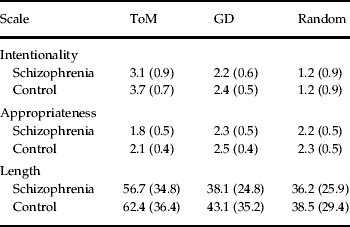
Descriptive statistics for the Animations Task are presented in Table 2. For Intentionality ratings, there were significant effects for condition [F(2, 97)=325.25, p<0.001] and group [F(2, 97)=5.87, p<0.05] as well as for the condition×group interaction [F(2, 97)=5.98, p<0.005]. These effects remained significant when WTAR scores were included as a covariate. Within the control group, Intentionality ratings were higher for ToM scenes than for GD scenes [t(43)=13.11, p<0.001], which were in turn higher than Random scenes [t(43)=10.59, p<0.001], supporting the validity of this paradigm. Similarly, within the patient group, Intentionality ratings were higher for ToM scenes than for GD scenes [t(45)=10.47, p<0.001, which were in turn higher than Random scenes [t(45)=9.66, p<0.001].
Ratings of participants' descriptions on the Animations Task

ToM, Theory of Mind; GD, Goal-Directed.
Values given as mean (standard deviation).
As predicted, the groups did not differ significantly on Intentionality ratings for the Random condition [t(97)=0.02, p>0.05] and patients had lower Intentionality ratings than controls for ToM animations [t(97)=3.75, p<0.001]. Patients also had lower ratings than controls for GD animations [t(97)=2.23, p<0.05]. To determine whether the group difference on the ToM condition was significantly larger than that on the GD condition, a follow-up 2 (group)×2 (condition: GD v. ToM) ANOVA was conducted. This analysis revealed a significant interaction [F(1, 97)=5.63, p<0.05], indicating that the between-group difference for ToM animations (d=0.76) was significantly larger than for GD animations (d=0.48).
For Appropriateness ratings, there were significant effects for condition [F(2, 97)=21.84, p<0.001] and group [F(2, 97)=8.45, p<0.005] but not for the condition×group interaction [F(2, 97)=0.18, p>0.05]. The condition and group effects remained significant when WTAR scores were included as a covariate. Patients had generally lower Appropriateness ratings than controls across conditions. Irrespective of group, Appropriateness ratings were significantly lower for the ToM condition compared to the GD (t=7.19, p<0.001) and Random conditions (t=5.00, p<0.001), which did not differ significantly from each other (t=0.84, p>0.05), (all df=97).
For the Length of the narratives, there was a significant condition effect [F(2, 97)=62.98, p<0.001]. Importantly, the groups did not differ significantly on Length [F(2, 97)=0.63, p>0.05] and the condition×group interaction [F(2, 97)=0.54, p>0.05] was also non-significant. This pattern was not altered by including WTAR scores as a covariate. Across the groups, descriptions for ToM scenes were longer than the GD scenes [t(97)=10.77, p<0.001], which were in turn longer than the Random scenes [t(97)=2.10,p<0.05].
Associations with clinical symptoms within the patient group
For clinical symptoms rated on the BPRS, there were no significant correlations or notable trends between the five subscales or total scores on the one hand, and Intentionality or Appropriateness scores on the other (all r's <0.20). To further evaluate associations between the Animations Task and symptoms, we computed indices from the BPRS items that correspond to the major symptom domains described by Liddle (Reference Liddle and Tamminga1999) : Psychomotor Poverty, Conceptual Disorganization, and Reality Distortion. We also evaluated associations with the individual BPRS Paranoia item. None of these correlations were significant (all r's <0.20).
Looking at negative symptoms as rated by the SANS, most of the correlations with performance were non-significant, but a few reached significance for the Random scenes. Higher Apathy/Amotivation correlated with higher Intentionality (r=0.35, p<0.05) and lower Appropriateness (r=−0.32, p<0.05) ratings. Similarly, higher Anhedonia/Asociality correlated with higher Intentionality (r=0.39, p<0.01) and lower Appropriateness (r=−0.30, p<0.05) ratings. Associations with these negative symptoms all remained significant when WTAR scores were entered into partial correlations (all p's <0.05). No correlations were significant for ToM or GD scenes or for Affective Flattening and Alogia (all r's <0.20). Performance on the Animations Task also showed no significant associations with age of onset or duration of illness (r's <0.20).
Discussion
Most prior studies of mentalizing in schizophrenia used verbal vignettes or social cartoon stimuli to assess whether patients can make rational inferences about the mental states of others in explicitly defined social situations. The current study focused on a different component of mentalizing, namely the capacity to spontaneously attribute social meaning to ambiguous visual stimuli. Although Frith (Reference Frith2004) speculated that the mentalizing impairments of schizophrenia patients are limited to explicit tasks, the current findings suggest that their impairments extend to implicit aspects of mentalizing as well.
As predicted, schizophrenia patients had lower Intentionality ratings than controls for ToM animations, but did not differ significantly for the Random control condition. The patients also had lower Intentionality ratings than controls for GD animations, although the magnitude of this difference was significantly smaller than for the ToM animations. These findings indicate that patients were less likely to attribute social meaning to animations depicting complex interactions at a mental state level, as well as less complex interactions depicting contingent, purposeful movement. Patients also received generally lower Appropriateness ratings than controls across conditions, indicating that their narratives less accurately described the underlying scripts of the Animations. The group differences were not simply attributable to overall amount of verbal output or level of verbal ability, as the lengths of the narratives did not differ significantly between groups and the differences persisted when estimated verbal ability was accounted for in the analyses.
The current results are largely consistent with those of the recent study by Russell et al. (Reference Russell, Reynaud, Herba, Morris and Corcoran2006). Following different administration and scoring procedures, Russell and colleagues also found that schizophrenia patients less frequently used mental state attribution terms for ToM scenes and were generally less accurate in describing the underlying scripts of the animations than controls. The current study replicated these findings using alternative administration and scoring procedures in which explicit task instructions and explicit cues for each scene were not provided. The consistency of findings suggests that the impairment shown by schizophrenia patients is observable when subjects are provided with cues about context (as in Russell et al. Reference Russell, Reynaud, Herba, Morris and Corcoran2006) and also when they are not cued and responses are spontaneous (as in the current study).
A difference between our results and those of Russell et al. (Reference Russell, Reynaud, Herba, Morris and Corcoran2006) concerns the general lack of associations between clinical symptoms and mentalizing in the current study. The few medium correlations that were found between higher negative symptoms and higher Intentionality ratings in the Random condition are inconsistent with findings by Russell et al. (Reference Russell, Reynaud, Herba, Morris and Corcoran2006) and run counter to Frith's theoretical model (Reference Frith1992, Reference Frith2004). Frith linked this type of hyper-mentalizing (i.e. attributing higher levels of Intentionality than are contextually appropriate) to symptoms such as paranoia and disorganization. Discrepancies across studies could partly reflect the fact that Russell et al. evaluated a predominantly in-patient sample that probably displayed a greater range of symptoms than our stabilized out-patient sample. Another difference is that we used a dimensional approach to evaluate symptoms whereas Russell et al. categorized patients into subgroups. These discrepancies fit with the larger literature on mentalizing in schizophrenia, in which theoretically predicted relationships to particular symptoms have been reported about as frequently as not (Harrington et al. Reference Harrington, Siegert and McClure2005).
It is noteworthy that the schizophrenia patients' overall pattern of performance is somewhat distinctive compared to individuals with autism spectrum disorders. Using the same version of the Animations Task, Castelli et al. (Reference Castelli, Frith, Happe and Frith2002) found that adults with high-functioning autism or Asperger's disorder demonstrated lower Intentionality and Appropriateness ratings than controls only during the ToM scenes. Intact perception of GD motion in adults and children with autism was also found in a subsequent study that used a novel paradigm to directly assess this arguably ‘lower’ level of mentalizing (Castelli, Reference Castelli2005). By contrast, we found Intentionality differences between patients and controls that were large in the ToM condition and medium in the GD condition, as well as generally lower Appropriateness. The group difference in the GD condition is consistent with a few other studies showing relatively low-level agency detection abnormalities in schizophrenia patients using paradigms that involve perceiving contingent movement or biological motion from simple abstract figures (Blakemore et al. Reference Blakemore, Sarfati, Bazin and Decety2003; Kim et al. Reference Kim, Doop, Blake and Park2005). Thus, schizophrenia appears to be characterized by a more pervasive pattern of mentalizing disturbances than autism spectrum disorders.
Although the Animations Task has some advantages over other commonly used mentalizing paradigms, this study has some limitations. First, although the stimulus materials in this task are non-verbal and relatively brief, the response format makes non-trivial verbal and cognitive demands that could adversely impact the schizophrenia patients' performance. Second, although the results were not strongly associated with quantity of verbal output or the lower general verbal abilities in this schizophrenia group, the study did not include a broad neurocognitive battery to assess relationships with other processes. Third, the cross-sectional design does not permit an assessment of whether the current findings reflect trait- or state-related phenomena, although the lack of significant associations with symptoms in this community-dwelling out-patient sample suggests that the findings were not strongly impacted by acute clinical symptoms (see also Herold et al. Reference Herold, Tenyi, Lenard and Trixler2002). Fourth, patients were chronically ill and medicated. Although performance was not significantly related to age of onset or duration of illness, studies of samples that are early in the course of illness, unmedicated, or randomly assigned to receive different types of antipsychotic medications will be required to directly address chronicity and medication effects.
Although implicit social cognitive processes are widely believed to play a key role in adaptive functioning (Bargh & Williams, Reference Bargh and Williams2006; Lieberman, Reference Lieberman2007), implicit aspects of social cognition have received limited attention in studies of functional outcome in schizophrenia. It will be useful in future research to determine whether implicit social cognitive processes explain the large portion of variance in the social functioning of individuals with schizophrenia that is not explained by explicit social and non-social cognitive tasks (Green et al. Reference Green, Kern, Braff and Mintz2000; Couture et al. Reference Couture, Penn and Roberts2006). In addition, social cognitive neuroscientists have developed a variety of neuroimaging paradigms to assess implicit aspects of mentalizing and other social cognitive processes (e.g. Frith & Frith, Reference Frith and Frith2006; Lieberman, Reference Lieberman2007), which provides a rich foundation for translational research into the neural correlates of schizophrenia patients' disturbances in these areas.
Acknowledgments
This research was supported by a NARSAD Young Investigator Award (W. P. Horan), by research grants MH43292 and MH65707 (PI: M. F. Green) and Institutional NRSA MH14584 (PI: K. H. Nuechterlein) from the National Institute of Mental Health, and by the Department of Veterans Affairs VISN 22 MIRECC. We thank Tamara A. Russell for helpful consultation during the planning of this study, and Shelly M. Crosby, Kelly Tillery, Karina Shokat-Fadai, Joseph Ventura, and Sarah Wilson for their contributions to this project.
Declaration of Interest
None.