INTRODUCTION
Birds, mammals and reptiles are host to the same groups of intracellular parasites (i.e. plasmodiids, haemogregarines). However, in spite that the diversity of reptilian haemoparasites is greater than that of mammals and birds in terms of the overall number of genera and species, the amount of studies of blood parasites of reptiles is comparatively small (Telford, Reference Telford2009).
Haemoparasitic apicomplexan are a group of blood-borne intracellular sporozoans that include, among others, the genera Hepatozoon, Plasmodium and Haemoproteus (Jacobson, Reference Jacobson2007). With more than 300 described species, Hepatozoon parasites are the most widely distributed blood parasites of reptiles world wide (Telford, Reference Telford2009). Although the negative effects of Hepatozoon infection are well known in mammals (Baneth et al. Reference Baneth, Mathew, Shkap, Macintire, Barta and Ewing2003; Marchetti et al. Reference Marchetti, Lubas, Baneth, Modenato and Mancianti2009), the effects and prevalence of such haemogregarine infections in reptiles are inconclusive, showing either severe effects (Amo et al. Reference Amo, López and Martín2004; Ujvari and Madsen, Reference Ujvari and Madsen2006) or little or no pathogenic effect (Wozniak et al. Reference Wozniak, Kazacos, Telford and Mclaughlin1996; Caudell et al. Reference Caudell, Whitter and Conover2002; Amo et al. Reference Amo, Fargallo, Martínez-Padilla, Millán, López and Martín2005).
Vertebrate hosts of blood parasites often harbour two or more species of parasites, or multiple genetically distinct clones of a single parasite. These blood parasites mixed infections have been reported in birds and mammals (Karbowiak et al. Reference Karbowiak, Rychlik, Nowakowski and Wita2005; Valkiūnas et al. Reference Valkiūnas, Zickus, Shapoval and Lezhova2006; Marzal et al. Reference Marzal, Asghar, Rodríguez, Reviriego, Hermosell, Balbontín, Garcia-Longoria, De Lope and Bensch2013), and also in reptiles (Schall, Reference Schall1990; Telford, Reference Telford1988, Reference Telford2009; Vardo-Zalic and Schall, Reference Vardo-Zalik and Schall2007). However, the effects of such co-infections of blood parasites are largely unknown. Although antagonistic effects between parasites have been described in some studies (Fenwick, Reference Fenwick1980; Juhl and Permin, Reference Juhl and Permin2002), other studies have found synergetic effects between two blood parasites infecting simultaneously (Taylor et al. Reference Taylor, Mackinnon and Read1998; Zehtindjiev et al. Reference Zehtindjiev, Ilieva, Westerdahl, Hanssonb, Valkiuñas and Bensch2008). In reptiles, most of studies showing mixed infections of blood parasites are merely descriptive (see Telford, Reference Telford2009 for detailed review), whereas studies analysing the effects of mixed infections are very scarce and inconclusive (Schall, Reference Schall1990; Vardo-Zalik and Schall, Reference Vardo-Zalik and Schall2008).
Some groups of reptiles such as turtles have received comparatively less attention in the study of blood parasites than lizards or snakes. In particular, although freshwater turtles are frequently parasitized by intraerythrocytic blood parasites (Davis and Sterrett, Reference Davis and Sterrett2011), there is very limited information on the prevalence and genetic diversity of blood parasites of terrapins (Dvořáková et al. Reference Dvořáková, Kvičerová, Papoušek, Javanbakht, Tiar, Kami and Široký2014, Reference Dvořáková, Kvičerová, Hostovský and Široký2015).
The Spanish terrapin (Mauremys leprosa) is a thermophile medium size semi-aquatic turtle, which is found in southwestern Europe and northwestern Africa (Da Silva, Reference Da Silva, Pleguezuelos, Márquez and Lizana2002). It preferably inhabits ponds and streams with riparian vegetation, and it is nowadays ranked as a vulnerable species in Spain (van Dijk et al. Reference van Dijk, Mateo Miras, Cheylan, Joger, Sá-Sousa and Pérez-Mellado2004). Although there are several historical reports of haemogregarine infections in M. leprosa (Billet, Reference Billet1904; Ducloux, Reference Ducloux1904; Laveran and Pettit, Reference Laveran and Pettit1909), very little is known about biodiversity of blood parasites and their effects on this host. So far only a single study has recently employed molecular methods to analyse haemogregarine infections in M. leprosa (Dvořáková et al. Reference Dvořáková, Kvičerová, Papoušek, Javanbakht, Tiar, Kami and Široký2014). Here, we examine for the first time the prevalence and genetic diversity of blood parasites from one genus of haemoparasitic apicomplexan (Hepatozoon) in two populations of Spanish terrapins. We also investigate whether there is any association between blood parasite infection status and the body condition, haematocrit values and the phytohaemagglutinin (PHA)-induced immune response of individuals.
MATERIALS AND METHODS
Study site
The study was conducted in two different populations of freshwater turtles located in dehesa-oak woodlands close to ‘Olivenza’ (population 1, coordinates: 38°39′16″N, 7°13′14″W) and ‘Alconchel’ (population 2, coordinates: 38°27′35″N, 07°04′55″W) (Badajoz province, southwestern Spain) in spring of 2011 and 2012. We captured a total of 140 adult turtles (93 males and 47 females) in several ponds, small streams and tributaries of the Guadiana River in both sites. We captured turtles during April coinciding with the start of the reproductive season of this species (Arnold and Ovenden, Reference Arnold and Ovenden2002). We used a modified version of the traditional underwater funnel traps, which include a mesh chimney that reaches from the body of the trap to the surface allowing the turtles to come to the surface to breath (Kuchling, Reference Kuchling2003; T & L Netmaking, Mooroolbark, Victoria, Australia). We baited traps with sardines and protected them from terrestrial predators by waiting in the proximity. We revised the traps every hour to collect turtles. All collected turtles were alive.
Turtles were held in captivity in a country house building close to the capture sites while we took morphological and physiological measurements (see below) and to be used in other experiments. Turtles were housed in individual outdoor plastic aquaria (60 × 40 × 30 cm3) containing water and rocks that allowed turtles to bask out of water. Turtles were fed on minced meat, earthworms and a commercial compound of fish ‘pellets’ three times a week. Photoperiod and temperature were the same as those of the surrounding area. All turtles were permanently marked by performing small sawing notches in the scutes of the carapace following an individualized code (Cagle Reference Cagle1939). This method allowed us to identify recaptured individuals. Once all measurements were collected, turtles were returned to the exact locations of capture in good health.
Size, body condition haematocrit and immune response
Turtles’ carapace length and body mass were measured immediately after capture with a metal ruler and a Pesola spring balance, respectively. To obtain an index of the relative amount of fat stored and hence an estimation of physical condition or nutritional state (Bonnet and Naulleau, Reference Bonnet and Naulleau1994; Green, Reference Green2001), we calculated body condition of individuals as the residuals of the regression between log-weight and log-body length (Polo-Cavia et al. Reference Polo-Cavia, Engstrom, López and Martín2010).
Blood samples were collected from the caudal sinus at the base of the tail by using a 1 mL syringe, with a 27 G, 1/2, 0·4 × 13 mm2 heparinized needle for each turtle (Polo-Cavia et al. Reference Polo-Cavia, Engstrom, López and Martín2010). Blood was placed in a heparinized capillary tube and centrifuged during 10 min at 10 000 rpm. The haematocrit (i.e. the volume percentage of red blood cells in blood) was measured in each capillary tube as the ratio between the length of the capillary tube occupied by packed red blood cells and the total length of the capillary tube occupied by the blood sample. Additionally, a few drops of blood were stored in 500 µL SET buffer (0·015 m NaCl, 0·05 m Tris, 0·001 m EDTA, pH 8·0) at room temperature for molecular analyses.
We measured the immune response of 76 turtles (35 females and 41 males) by means of the PHA test (Smits et al. Reference Smits, Bortolotti and Tella1999; Tella et al. Reference Tella, Scheuerleim and Ricklefs2002). This is a test ‘in vivo’ that estimates the delayed hypersensitivity immune response mediated by T lymphocytes, but that may also involve components of the innate and adaptive immune system (Martin et al. Reference Martin, Han, Lewittes, Kuhlman, Klasing and Wikelski2006). However, we used this index because it is a standard measure of immunocompetence and health state, regardless of the type of cells involved in it (Polo-Cavia et al. Reference Polo-Cavia, Engstrom, López and Martín2010). To avoid any effect of the PHA injection on haematocrit values, we performed this test some days after taking blood samples. We used a spessimeter (accuracy of 0·01 mm; Digimatic indicator ID-C Mitutoyo Absolute cod. 547–301, Japan) to measure the thickness at the same marked point of the left hind paw of turtles before and 24 h after injection of 0·04 mg of PHA dissolved in 0·02 mL of phosphate buffered saline. The general health of turtles was not affected by this test. The only noticeable effect of the injection of PHA was a slight swelling of the skin that disappeared after 48 h. We calculated the immune response as the difference between the thickness of the leg at the injection site before and after antigen injection (Smits et al. Reference Smits, Bortolotti and Tella1999; Polo-Cavia et al. Reference Polo-Cavia, Engstrom, López and Martín2010).
Molecular detection of blood parasite infections
Haemoparasite prevalence in turtles was assessed using molecular techniques. To confirm the genus and to identify the species of haemoparasites, genomic DNA was extracted from blood samples in the laboratory using standard chloroform/isoamylalcohol method (Sambrook et al. Reference Sambrook, Fritch and Maniatis2002). To detect the presence of haemoparasites of the Hepatozoon spp., a polymerase chain reaction (PCR) was used to amplify the 18S RNA gene of Hepatozoon spp. as described previously (Harris et al. Reference Harris, Maia and Perera2011). Briefly, a nested PCR reaction with primers HEMO1 and HEMO2 (Perkins and Keller, Reference Perkins and Keller2001), and then primers HEPF300 and HEPR900 (Ujvari et al. Reference Ujvari, Madsen and Olsson2004), were used for Hepatozoon species confirmation and identification. All PCR experiments contained one negative control for every eight samples. In the very few cases of negative controls showing signs of amplification (never more than faint bands in agarose gels), the whole PCR batch was run again to make sure that all positives were true. Parasites detected by a positive amplification were sequenced using the procedures described by Bensch et al. (Reference Bensch, Stjerman, Hasselquist, Östman, Hansson, Westerdhal and Torres-Pinheiro2000). Amplified fragments were sequenced from 5'end with HepF300 (Hepatozoon spp.). The obtained sequences of 600 bp were edited, aligned and compared in a sequence identity matrix using the program BioEdit (Hall, Reference Hall1999). A BLAST search was performed to match the product sequence to that of a known haemoparasite species. Parasites with sequences differing by one nucleotide substitution were considered to represent evolutionary independent lineages (Bensch et al. Reference Bensch, Pérez-Tris, Waldenstrom and Hellgreen2004; Ricklefs et al. Reference Ricklefs, Swanson, Fallon, Martinez, Scheuerlein, Gray and Latta2005). Mixed infections of different lineages of the same parasite genus were identified as ‘double base calling’ in the electropherogram.
Statistical procedures
The probability of being infected was modelled by using a logistic regression analysis. Year of sampling, population, sex, body condition, haematocrit and immune response were included as predictors in the logistic regression in order to understand which factors were influencing the probability that a turtle was infected. We used general linear mixed models (GLMMs) followed by the Tukey's post hoc tests with body condition, haematocrit or the immune response as dependent variables. In these models, sex, site of sampling, year (i.e. environmental variation) and infection status (uninfected, single infected and mixed infected) were included as independent variables in each case. As some turtles were recaptured in the second year of the study (n = 20), we controlled for repeated measurements of some individuals by including individual ID as random effect in the models. There was missing information for some individuals, which resulted in slightly varying sample sizes in the different analyses. For each study area, we applied the multiple-kind lottery model to evaluate whether the prevalence of mixed infection deviates from an independent random distribution pattern (null hypothesis) (Janovy et al. Reference Janovy, Clopton, Clopton, Snyder, Efting and Krebs1995; Mehlotra et al. Reference Mehlotra, Lorry, Kastens, Miller, Alpers, Bockarie, Kazura and Zimmerman2000). This model assumes that acquisition of infection is an independent event. Infection is designated as p1. Extending this to the two Hepatozoon lineages, p1 and p2 would represent infection by the individual lineages MALEPRO 2 and MALEPRO 3, respectively. The expected frequency of infection by two parasite lineages is the product p1p2. The χ 2 values were calculated using heterogeneity tests to compare observed with expected values.
The genetic relationships between parasites found in the present study and other haemogregarines infecting Iberian reptiles, and terrapins and turtles, was investigated by analysing the 18S rDNA sequence divergence using a neighbour-joining method with a Kimura-2 parameter distance matrix in the program Geneious, version 10.1 (Kearse et al. Reference Kearse, Moir, Wilson, Stones-Havas, Cheung, Sturrock, Buxton, Cooper, Markowitz, Duran, Thierer, Ashton, Mentjies and Drummond2012). The phylogenetic tree was rooted with a sequence from Cryptosporidium serpentis (GeneBank #AF093499). Estimates of evolutionary divergences were calculated using MEGA7: Molecular Evolutionary Genetics Analysis version 7.0 for bigger datasets (Kumar et al. Reference Kumar, Stecher and Tamura2016).
All analyses were performed using STATISTICA 8.0 software.
RESULTS
Prevalence and genetic diversity of blood parasites
We found two different blood parasites lineages of the genus Hepatozoon. We compared our sequences with those in GenBank and discovered that the two lineages were not previously found in other studies (Hepatozoon: MALEPRO 2 and MALEPRO 3). The sequences of these two lineages are very similar (three base pair of difference between them) (see Supplementary Table S1). The phylogenetic analyses revealed the affiliation of MALEPRO 2 and MALEPRO 3 together with other haemogregarines found in other terrapins and turtles as Emys orbicularis, Mauremys caspica, Mauremys rivulata, M. leprosa and Platysternon megacephalum (see Supplementary Fig. S1). New sequences were deposited in GenBank under the accession numbers KJ740753 and KJ740754, respectively.
Of 140 turtles screened from two populations, parasite infection was detected in 46·4%. Of the 65 turtles positive for infection, 98·46% (n = 61) were infected with MALEPRO 2 and 16·92% (n = 11) were infected with MALEPRO 3. In addition, 12·30% (n = 8) of infected individuals harboured mixed infection by the two lineages.
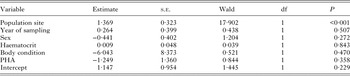
Only population significantly explained variation in blood parasite infection (Table 1). The overall prevalence of Hepatozoon infection was significantly higher in Alconchel population (infected/examined: 57/81; prevalence: 70·37%) than in Olivenza (8/59; 13·55%) (Pearson's χ 2 = 24·07; df = 1; P < 0·001). As an overall, mixed infections were observed 3·6 times more often than expected in terrapins. More specifically, the proportion of Hepatozoon mixed infections in terrapins was significantly higher than expected by chance in Olivenza (χ 2 = 43·703; P < 0·001) and Alconchel (χ 2 = 19·200; P < 0·001).
Results of a logistic regression analysis of factors determining blood parasite infection by Hepatozoon spp. of Spanish terrapins

Population site, year of sampling, sex, body condition index, haematocrit and PHA-induced immune response were included as predictor variables. Sample size was 76 individuals.
Body condition, haematocrit and blood parasite mixed infection
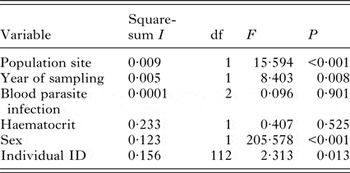
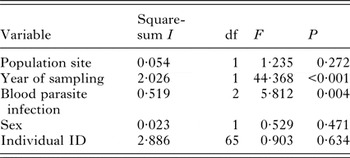
There was no significant difference in body condition index among uninfected (mean ± s.e. = 0·005 ± 0·005), single-infected (−0·007 ± 0·006) and mixed-infected turtles (0·001 ± 0·018) (Table 2). However, the estimate of body condition varied significantly with sex, with males being in lower condition (mean ± s.e. = −0·022 ± 0·003) than females (0·043 ± 0·045) (Table 2). The body condition index was significantly higher in individuals from Alconchel population (mean ± s.e. = 0·010 ± 0·005) than in Olivenza (−0·007 ± 0·005) (Table 2).
Factors explaining variation in body condition in Spanish terrapins
A GLMM was used with population site, year of sampling, blood parasite infection (uninfected, single infected and mixed infected), haematocrit and sex as fixed factors, and individual ID as random factor. Sample size was 140 individuals.
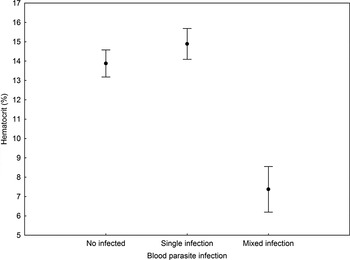
Year of sampling and blood parasite infection explained variation in haematocrit (Table 3). Specifically, we found that the value of haematocrit was significantly higher in 2011 (mean ± s.e. = 15·151 ± 0·611%) than in 2012 (11·804 ± 0·865%). We also found that mixed infected individuals had the lowest value of haematocrit (Fig. 1). Tukey's post hoc tests at α = 0·05 between the three infection status resulted in significant differences in haematocrit between single-infected and mixed-infected individuals (P = 0·004) as well as between non-infected and mixed-infected individuals (P = 0·010), but there was no significant differences in haematocrit between uninfected and single-infected terrapins (P = 0·550).
Haematocrit values (mean ± s.e.; %) for uninfected (N = 74), single-infected (N = 55) and mixed-infected Spanish terrapins (N = 8).

Factors explaining variation in haematocrit in Spanish terrapins

A GLMM was used with population site, year of sampling, blood parasite infection (uninfected, single infected and mixed infected) and sex as fixed factors, and individual ID as random factor. Sample size was 140 individuals.
PHA-induced immune response and blood parasite mixed infection
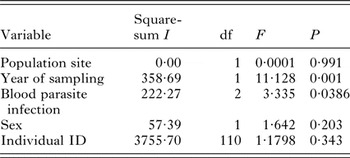
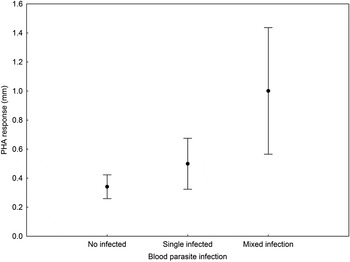
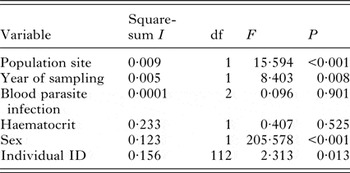
Infection status (uninfected, single infected vs mixed infected) and year significantly explained variation in the immune response of the turtles, while sex, body condition, haematocrit and population had no effect (Table 4). Specifically, the values of immune response were significantly higher in 2012 (mean ± s.e. = 0·60 ± 0·01 mm) than in 2011 (0·24 ± 0·01 mm). Mixed-infected individuals had significantly higher immune response than uninfected or single-infected individuals (Fig. 2). Tukey's post hoc tests at α = 0·05 among the three infection status showed significant differences in PHA-induced immune response between uninfected and mixed-infected individuals (P = 0·012) and between single-infected and mixed-infected individuals (P = 0·020), but there was no significant difference in immune response between uninfected and single-infected individuals (P = 0·813).
PHA-induced immune response (means ± s.e.; PHA response in mm) for uninfected (N = 40), single-infected (N = 28) and mixed-infected Spanish terrapins (N = 8). PHA, phytohaemagglutinin.

Factors explaining variation in PHA-induced immune response in Spanish terrapins

A GLMM was used with population site, year of sampling, blood parasite infection (uninfected, single infected and mixed infected) and sex as fixed factors, and individual ID as random factor. Sample size was 76 individuals.
DISCUSSION
The use of molecular methods is straightforward to detect parasites. Despite this fact, the effects that parasites may have on host physiological state remains poorly studied. In our study, we describe the prevalence and genetic diversity of blood parasites in the Spanish terrapin. Furthermore, we also discuss the relation of parasitic infection on turtle physiological state.
Prevalence and genetic diversity of blood parasites
Almost half of the analysed terrapins were infected with haemoparasites, which was within the range reported for other species of freshwater turtles. For example, previous studies on several species of turtles showed a prevalence over 50% for haemogregarine infection (Davis and Sterrett, Reference Davis and Sterrett2011; Dvořáková et al. Reference Dvořáková, Kvičerová, Papoušek, Javanbakht, Tiar, Kami and Široký2014; Javanbakht and Sharifi, Reference Javanbakht and Sharifi2014). Our results are in accordance with previous studies, because members of Hepatozoon are the most common and widely distributed intracellular protozoans of reptiles (see review in Telford, Reference Telford2009).
The application of molecular data in the study and diagnosis of blood parasite infection is now widely employed in many host–parasite systems, including reptiles (Perkins and Keller, Reference Perkins and Keller2001; Hellgren et al. Reference Hellgren, Waldenström and Bensch2004; Ujvari et al. Reference Ujvari, Madsen and Olsson2004). However, the use of molecular techniques in the haemoparasites of chelonians is more recent (Pineda-Catalan et al. Reference Pineda-Catalan, Perkins, Pierce, Engstrand, Garcia-Davila, Pinedo-Vasquez and Aguirre2013; Dvořáková et al. Reference Dvořáková, Kvičerová, Papoušek, Javanbakht, Tiar, Kami and Široký2014, Reference Dvořáková, Kvičerová, Papoušek, Javanbakht, Tiar, Kami and Široký2015). For example, although nowadays the number of available sequences of chelonian haemosporidians in public databases is increasing (see Maia et al. Reference Maia, Harris and Carranza2016 for an updated phylogeny of Haemosporida), the availability of genetic data from chelonian haemosporidian parasites is very recent (Orkun and Güven, Reference Orkun and Güven2013; Pineda-Catalan et al. Reference Pineda-Catalan, Perkins, Pierce, Engstrand, Garcia-Davila, Pinedo-Vasquez and Aguirre2013; Javanbakht et al. Reference Javanbakht, Kvičerová, Dvořáková, Mikulíček, Sharifi, Kautman, Maršíková and Široký2015). Here, we found that the two parasite lineages discovered had not been described in any previous study, and hence they were considered as new parasite lineages. This result points out that the discovery and identification of reptile parasite species is urgent, especially in wild threatened species of reptiles that received low attention (Davis et al. Reference Davis, Benz, Ruyle, Kistler, Shock and Yabsley2013).
We found that the overall prevalence of blood parasites varied between populations. Intraspecific variations in prevalence of blood parasite infection have been historically attributed to differences in environmental factors, such as climate and topography, affecting parasite-specific vector abundance (Merilä et al. Reference Merilä, Björklund and Bennett1995; Sol et al. Reference Sol, Jovani and Torres2000; Sehgal et al. Reference Sehgal, Buermann, Harrigan, Bonneaud, Loiseau, Chasar, Sepil, Valkiūunas, Iezhova, Saatchi and Smith2011). However, our two study sites are very close to each other (~20 km) and share the same climate. On the other hand, Placobdella leeches are the invertebrate hosts and vectors for Hepatozoon in many turtles (Paperna, Reference Paperna1989; Siddall and Desser, Reference Siddall and Desser1992; Romero et al. Reference Romero, Duarte, Narváez-Ledesma, Farfán and Real2014). It has been proposed that an increase in livestock density and the use of ponds as drinking trough for domestic animals may contribute to the expansion of leech populations (Álvarez, Reference Álvarez2010; Soler et al. Reference Soler, Cortelezzi, Berkunsky, Kacoliris and Gullo2014). In the sampling site of Alconchel, the livestock density was four times higher than in Olivenza (personal observation), which may explain why terrapins from Alconchel had the highest Hepatozoon prevalence.
A total of eight individual Spanish terrapins presented double infections with parasites belonging to two lineages of the genus Hepatozoon (MALEPRO 2-MALEPRO 3). Six out of these eight mixed infections were in terrapins from Alconchel population. The interpopulational differences in the composition of these mixed infections could be interpreted as a consequence of the variation in prevalence of each parasite lineage in the two populations of Spanish terrapins. The differences could also be due to divergences between the sites of sampling in the abundance of vectors that may affect the parasite transmission (Merino et al. Reference Merino, Moreno, Vásquez, Martínez, Sánchez-Monsálvez, Estades, Ippi, Sabat, Rozzi and Mcgehee2008). Future studies analysing the diversity and abundance of vector fauna of these parasites are desirable to understand the composition of mixed infections in this host–parasite system.
The proportion of Hepatozoon mixed infections in terrapins was significantly higher than expected by chance in both populations. Besides a PCR bias towards one of the parasites could not be ruled out, these outcomes suggest a facilitation process between these co-infecting lineages. Following this idea, recent studies have shown that the infection with one parasite increased the host susceptibility to another pathogen (Pollit et al. Reference Pollitt, Bram, Blanford, Jones and Read2015; Ramiro et al. Reference Ramiro, Pollitt, Mideo and Reece2016).
Physiological state and blood parasite mixed infection
The body condition index has been widely employed in many ecological studies as a determinant of the health and fitness of an individual (Green, Reference Green2001). For example, Garrido and Pérez-Mellado (Reference Garrido and Pérez-Mellado2013) found a higher prevalence and parasite load of haemogregarines in Podarcis lilfordi lizards with lower body condition. The infection with multiple parasite species could be especially harmful due to the consumption of host resources by the parasites (Lagrue et al. Reference Lagrue, McEwan, Poulin and Keeney2007; Choisy and de Roode, Reference Choisy and Roode2010), as it has been shown in birds (Marzal et al. Reference Marzal, Bensch, Reviriego, Balbontin and De Lope2008) and other reptiles (Schall, Reference Schall1990; Dunlap and Mathies, Reference Dunlap and Mathies1993). According to all these findings, we might expect that co-infected turtles would have the lowest values for body condition. Surprisingly, we did not find any difference in body condition among individuals with different infection status. We propose several non-mutually exclusive hypotheses to explain this observation. Firstly, differences in the capture probability of infected and uninfected individuals in the wild might bias estimates of population prevalence and lead to underestimate the real effects of the parasite infection (Hook and Regal, Reference Hook and Regal1995; Lachish et al. Reference Lachish, Gopalaswamy, Knowles and Sheldon2012). Infected individuals with higher parasite loads might have reduced mobility or might not survive in the wild and, therefore, not be captured in our traps.
Alternatively, our measure of body condition might not reflect the health of the turtles with accuracy. In this sense, it has been shown that dry shell mass may represent ~35% of the total body mass in turtles (Marvin and Lutterschmidt, Reference Marvin and Lutterschmidt1997) suggesting that a considerable variation in overall weight might be due to shell weight that does not represent fat stores. Therefore, body condition per se could not be a good indicator of physiological health status in turtles, as it has been previously reported in pond turtles Emys marmorata (Polo-Cavia et al. Reference Polo-Cavia, Engstrom, López and Martín2010). In addition, the use of body condition as a proxy of fat stores could be misleading due to the effect of individual reproductive state. For instance, gravid females could increase their relative weight to those non-gravid due to the weight of the eggs. A combination of several condition measurements would be more informative (Waye and Mason, Reference Waye and Mason2008; Peig and Green, Reference Peig and Green2010).
Finally, it could be that the negative effects of mixed infection could be rather patent in other estimates of individual health. The haematocrit is considered to be among the most reproducible and reliable indicator of health status in reptiles (Mader, Reference Mader2006). According to this, we showed that mixed-infected terrapins had the lowest values of haematocrit, which may show more accurately the pathogenic effects of blood parasite double infections.
The immune response of turtles also changed with infection status, with mixed-infected individuals having higher PHA-induced immune response than uninfected or single-infected individuals. Infections of hosts by multiple parasites occur in many host–parasite systems (Read and Taylor, Reference Read and Taylor2001), which may induce higher virulence in these infections (Mosquera and Adler, Reference Mosquera and Adler1998; Taylor et al. Reference Taylor, Mackinnon and Read1998). Moreover, it is known that double infections with parasites could be especially harmful to their hosts, leading to the host death in many cases (Schall, Reference Schall, Lewis, Cambell and Sukhdeo2002; Marzal et al. Reference Marzal, Bensch, Reviriego, Balbontin and De Lope2008). Because cell-mediated immunity is the principal defence mechanisms against intracellular parasites among jawed vertebrates (Abbas et al. Reference Abbas, Lichtman and Pillai2010; Schmid-Hempel, Reference Schmid-Hempel2011), individuals that could face mixed-infections and survive might be those with a strong immune system that allow them to control the infection.
In conclusion, our study reveals the prevalence and genetic diversity of new blood parasites infecting M. leprosa, highlighting the importance of haemoparasites studies on reptiles. The prevalence of Hepatozoon varied between populations, suggesting an interaction between livestock density and the abundance of parasite vectors. Our outcomes also indicate the negative effects of blood parasite mixed infections on the haematocrit of terrapins, in spite of their high body condition indices, thus emphasizing the importance of using several physiological methods in assessing the health status of turtles. Further studies exploring the interactions between stocking density and abundance of reptile haemoparasites and their vectors would be desirable to design agri-environmental management policies in order to assess the conservation of wildlife populations.
SUPPLEMENTARY MATERIAL
The supplementary material for this article can be found at https://doi.org/10.1017/S0031182017000889.
ACKNOWLEDGEMENTS
We thank A. Marzal and D. Martín for allowing us to work in their dehesa states (‘La Asesera’ and ‘Cabeza Rubia’). We also thank three anonymous referees for their constructive suggestions that helped to improve our study. Captures and experiments complied with all current laws of Spain and the Environmental Agency (‘Consejería de Industria, Energía y Medio Ambiente’) of the ‘Junta de Extremadura’ Local Government (permit number: CN0008/11/ACA). Procedures conformed to recommended guidelines for use of live reptiles in laboratory research (ASIH 2004).
FINANCIAL SUPPORT
This work was supported by a MEC-FPI grant (reference: BES-2009-025228) to A.I. and by the projects MICIIN-CGL2011-24150/BOS, MICIIN-CGL2012-36665/BOS and MICIIN-CGL-64650P. Technical and human support was provided by Facility of Bioscience Applied Techniques of SAIUEx (financed by UEX, Junta de Extremadura, MICINN, FEDER and FSE).