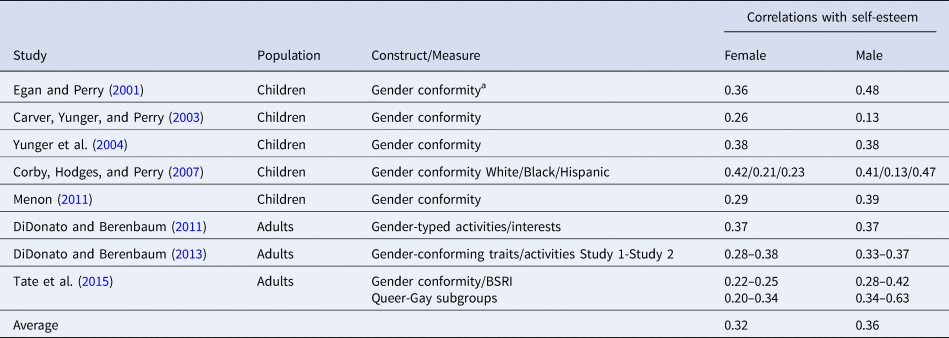
The view of gender as a fluid and flexible experience and expression that may vary across time, place, and relationships has been gaining increasing acceptance in recent years (Hyde, Bigler, Joel, Tate, & van Anders, Reference Hyde, Bigler, Joel, Tate and van Anders2019). In theory, this increased acceptance should benefit individuals whose physical appearance or behaviors do not align with societal expectations of their gender (also referred to as gender nonconforming or gender atypical), making them feel more at ease, experience less psychological distress, and enjoy a better self-image. Findings, however, tell a different story. Not only does gender nonconformity undermine self-esteem (e.g. DiDonato & Berenbaum, Reference DiDonato and Berenbaum2013; Egan & Perry, Reference Egan and Perry2001; Tate, Bettergarcia, & Brent, Reference Tate, Bettergarcia and Brent2015; see Table 1), but it is also linked to a high prevalence of depressive symptoms and suicide attempts (e.g. Lowry et al., Reference Lowry, Johns, Gordon, Austin, Robin and Kann2018; Roberts, Rosario, Slopen, Calzo, & Austin, Reference Roberts, Rosario, Slopen, Calzo and Austin2013).
Overview of effect sizes for associations between gender conformity and self-esteem
BSRI, Bem Sex Role Inventory.
a For the sake of consistency, we use the term ‘gender conformity’ throughout, although in some of the listed studies, ‘gender typicality’ was used.
Although the term gender nonconformity is frequently associated with sexual minorities, such as transgendered and non-binary persons, in the present work we use the term to denote a continuum that ranges from a gender nonconforming to a gender conforming extreme in the wider population. Apart from the difficulty of obtaining large cross-national samples of transgendered or non-binary individuals, several studies have shown that the minority stress experienced by LGBT persons is more about adverse experiences associated with gender-nonconforming behavior than about sexual orientation or gender identity per se (e.g. Jacobson, Cohen, & Diamond, Reference Jacobson, Cohen and Diamond2016; Martin-Storey, Reference Martin-Storey2016; Rieger & Savin-Williams, Reference Rieger and Savin-Williams2012). For example, the more transgender people are seen as gender nonconforming by others, the higher their likelihood of experiencing major discrimination and attempting suicide (Miller & Grollman, Reference Miller and Grollman2015). Furthermore, cisgender heterosexuals who display gender nonconforming traits are as vulnerable to the negative psychological repercussions of gender nonconformity as are those who identify as LGBT (Tate et al., Reference Tate, Bettergarcia and Brent2015). By focusing on gender nonconformity as a dimension, rather than on categories of individuals with sexual minority status, results may have a wider range of application.
Of the psychological impairments associated with gender nonconformity, self-esteem is of particular significance. First, gender nonconformity is associated with low self-esteem beginning in childhood, whereas links to other psychological impairments are less clear (e.g. Yunger, Carver, & Perry, Reference Yunger, Carver and Perry2004). Second, distress across multiple domains, including ill health, underperformance at work, relationship dissatisfaction, and mental illness, has been shown to be predicted by both low self-esteem (e.g. Donnellan, Trzesniewski, Robins, Moffitt, & Caspi, Reference Donnellan, Trzesniewski, Robins, Moffitt and Caspi2005; Reinherz et al., Reference Reinherz, Giaconia, Pakiz, Silverman, Frost and Lefkowitz1993; Sowislo & Orth, Reference Sowislo and Orth2013) and gender nonconforming behavior (Bennett, Borczon, & Lewis, Reference Bennett, Borczon and Lewis2019). Thus, a fuller understanding of the mechanisms underlying this association should be an integral part of efforts to ensure that children can develop into happy adults. More broadly, understanding the link between low self-esteem and gender nonconformity has the potential to inform current debates as to which ought to be a target for intervention: gender nonconforming individuals who are experiencing low self-esteem and other forms of psychological distress, or society's intolerance for gender nonconformity (Vasey & Bartlett, Reference Vasey and Bartlett2007).
Most explanations for the link between gender conformity and self-esteem derive from one form of social role theory or another. Common to these views is the notion that women and men are socialized in ways that will encourage them to internalize gender roles and acquire the skills and behaviors necessary to fulfill their respective roles. The reason this occurs is that gender role conformity is rewarding: It validates shared beliefs about men and women, thereby facilitating social interaction and promoting a sense of group belongingness (DiDonato & Berenbaum, Reference DiDonato and Berenbaum2013; Meyer, Reference Meyer2003). Even in the absence of others, internalized gender roles act as standards against which individuals continuously monitor and evaluate their own behavior. In turn, gender non-conformity triggers negative social reactions from an early age, including parental discomfort (Spivey, Huebner, & Diamond, Reference Spivey, Huebner and Diamond2018), peer rejection and victimization (Martin-Storey, Reference Martin-Storey2016; Roberts et al., Reference Roberts, Rosario, Slopen, Calzo and Austin2013), and negative self-evaluations when individuals fall short of their own standards for gender conformity (Wood & Eagly, Reference Wood, Eagly, Zanna and Olson2012; see also Tobin et al., Reference Tobin, Menon, Menon, Spatta, Hodges and Perry2010).
Although it is plausible that the association between gender nonconformity and low self-esteem comes about through gender role socialization, most evidence in its support has so far come from US studies of children and adolescents, and some of the evidence is inconsistent. For example, the association between gender conformity and self-esteem was found to be exceptionally weak in a sample of Black preadolescent girls and boys (rs = 0.21 and 0.13, respectively; see Table 1). This is all the more surprising because Black children reported more pressure to conform to gender roles than White children did, for whom the correlation of self-esteem to gender conformity exceeded 0.40. Conflicting findings on the relationship between self-esteem and gender conformity have also been described in other studies (e.g. Good and Sanchez, Reference Good and Sanchez2010), raising questions about its pervasiveness.
To know whether associations between self-esteem and gender conformity are consistently linked to gender role expectations as enacted by the macrosocial context, it is indispensable to examine this relationship across several countries that vary in their gender role culture. If the fulfillment of societal expectations related to gender conformity affects self-esteem, as predicted by social role theory, individuals' self-esteem should be more strongly related to their gender nonconformity if they live in societies characterized by a traditional as opposed to a progressive gender role division. Conversely, if self-esteem turns out to be equally related to gender conformity across societies, regardless of the societies' prevailing gender role norms, this would pose a challenge for social role explanations of the psychological implications of gender non-conformity, warranting a search for alternative etiologies, such as the possibility of a common neurogenetic disposition underlying both gender nonconformity and psychiatric disorders (e.g. Shumer, Roberts, Reisner, Lyall, & Austin, Reference Shumer, Roberts, Reisner, Lyall and Austin2015; Yildirim, Perdahli Fis, Yazkan Akgul, & Ayaz, Reference Yildirim, Perdahli Fis, Yazkan Akgul and Ayaz2017). Because the DSM-5 defines mental disorders as dysfunctions in the individual and does not regard conflicts between the individual and society as mental disorders (American Psychiatric Association, 2013, p. 20), evaluating evidence related to these alternative positions is not only of scientific interest, but may also have a bearing on clinical considerations and practices.
The current research
The central question to be examined in this study is whether associations between gender nonconformity and self-esteem vary across societal contexts that differ in their gender role norms. To this end, we conducted two cross-national studies. In Study 1, participants from nine nations that systematically differ in their gender role culture responded to an online survey that included a self-esteem scale and a gender conformity measure that asks respondents to self-categorize their gender conformity from a comparison with peers. We assessed national gender roles and norms through two national gender equality indicators that not only reflect actual gender discrimination and gender role divisions in different areas of life, but that have also been shown to be sizably correlated with citizens' gender attitudes. Thus, individuals in high gender equality countries tend to be more open in their gender role attitudes compared with those in lower gender equality countries (e.g. Sani & Quaranta, Reference Sani and Quaranta2017; Shu, Barnett, & Faris, Reference Shu, Barnett and Faris2020). Study 2 expanded the number of countries and types of gender conformity measures to evaluate the generalizability of the findings and address questions left unresolved by Study 1. Specifically, we examined whether findings obtained in Study 1 could be reproduced using a different gender conformity measure that defines gender identity in terms of personality attributes. We also assessed individuals' gender ideology to examine the extent to which nations' structural gender equality is reflected in gender attitudes among its citizens and to explore whether individual gender biases play a similar moderating role as that of societal gender biases. Because of the similarity in methods and measures between the two studies, results are presented for both studies combined following the Method section of Study 2.
Study 1
Method
Sample
A total of 2075 individuals (1201 females, 874 males, mean age 27.14 years, s.d. 8.49) provided complete data in response to an online survey concerning gender-related behaviors. As part of the survey, participants provided information about age, gender, nationality, sexual orientation, and educational and relationship status. Online Supplementary Table S1 provides demographic details for the nine individual nations – Austria, Germany, Greece, Italy, Hungary, Romania, Poland, Spain, and Sweden. Participants had lived more than 90% of their lifetime in their native country.
Measures
Gender Equality
Because no perfect index of gender equality exists, this study uses two of the most comprehensive national gender equality indices to date, the Gender Inequality Index (GII) and the Global Gender Gap Index (GGI). The GII is a composite measure of gender inequality developed by the United Nations (United Nations Development Programme, 2018). It captures inequality between women and men on three dimensions: (1) reproductive health, (2) empowerment, and (3) labor force participation. It ranges from a score of 0 (women and men fare equally) to a score of 1 (women or men fare poorly compared with the other in all dimensions). The second measure is the GGI, published by the World Economic Forum (Zahidi, Geiger, & Crotti, Reference Zahidi, Geiger and Crotti2018). The GGI is a composite measure that includes 14 single indicators grouped in four dimensions: economic (e.g. labor force participation, wage equality), political (e.g. women in parliament, heads of state), educational attainment (e.g. literacy ratio, higher education enrolment), and health (e.g. life expectancy ratio, sex ratio at birth). The highest possible score is 1 (parity) and the lowest possible score is 0 (imparity).
The GII scale was inversed to match the direction of the GGI scores, so that higher values indicate higher gender equality regardless of the index. Because index values of single years can deviate markedly from a nation's characteristic standing on gender equality, the index scores were averaged across the 5 years leading up to the time of data collection (2013–2017). To capture gender equality as comprehensively as possible, we averaged across the values of the GII and GGI, obtaining an aggregate index termed gender equality in all subsequent analyses (see online Supplementary Table S2 for details).
Gender conformity
The extent of self-perceived gender conformity was assessed with the Adult Gender Typicality scale (AGT; Tate et al., Reference Tate, Bettergarcia and Brent2015), which is an adaptation from Egan and Perry's (Reference Egan and Perry2001) measure of gender typicality for children and adolescents. Participants were presented with six statements that reflected the typicality of their stated gender membership. For women, sample items of the AGT were, ‘I feel I fit in with other women’ or ‘I feel that my personality is similar to most women's personalities’. For men, the parallel items were, ‘I feel I fit in with other men’ and ‘I feel that my personality is similar to most men's personalities’. Participants had to rate their agreement with each statement on a Likert scale from 1 (totally disagree) to 7 (totally agree). For women, Cronbach's α ranged from 0.82 (Spain) to 0.88 (Germany); for men, it ranged from 0.78 (Romania) to 0.89 (Poland).
Global self-esteem
Self-esteem was measured with the Rosenberg Self-Esteem Scale (RSES; Rosenberg, Reference Rosenberg1965). It contains 10 items, five of them negatively keyed. Respondents answered on a five-point Likert scale from 1 (strongly disagree) to 5 (strongly agree). Higher scores denote higher levels of global self-esteem. Cronbach's α ranged from 0.86 (Spain) to 0.92 (Sweden).
Unless adaptations were already available, all questionnaires were translated into the language of each of the included countries. For each language, one bilingual native speaker translated the questionnaire into the target language, and another provided the back-translation into English. A third bilingual speaker resolved any discrepancies between the original version and the back-translation.
Procedure
An online version of these measures was created with LimeSurvey software. To help raise awareness of the survey in as wide a population as possible, we placed targeted email announcements and postings across a variety of social media in the target countries. The conditions for participation stated that prospective participants be nationals and have spent a minimum of 50% of their lifetime in their respective home countries. In an informed consent clause, participants were informed about the nature of the study and assured of the study's anonymity and confidentiality and their right to withdraw from the study at any point.
Study 2
Method
Sample
A total of 2411 individuals (1382 females, 1029 males) from a second batch of nine nations that varied slightly more widely in the range of gender equality completed the online survey: Austria, Brazil, Czech Republic, Finland, Germany, Guatemala, Norway, Sweden, and the USA. Participants' mean age was 29.63 years (s.d. 10.87) and they had lived more than 90% of their lifetime in their native country. Additional demographic information can be found in online Supplementary Table S3.Footnote 1
Measures and procedure
These were the same as in Study 1, with two additions:
1. The Bem Sex Role Inventory (BSRI; Bem, Reference Bem1974) was included as a measure of the endorsement of personality traits that have traditionally been associated with masculinity and femininity. In the present study, we used the short version developed by Fernández and Coelleo (Reference Fernández and Coelleo2010; see also Ahmed, Vafaei, Auais, Guralnik, & Zunzunegui, Reference Ahmed, Vafaei, Auais, Guralnik and Zunzunegui2016). Participants were asked to rate the extent to which each of the six masculine (agentic) and feminine (communal) items describes them on a Likert scale from 1 (never or almost never true) to 7 (always or almost always true). For men, BSRI gender-conforming traits were scores on the masculinity subscale; for women, gender-conforming traits were scores on the femininity subscale. Thus, men with higher scores saw themselves as possessing more traditionally masculine traits, and women with higher scores saw themselves as possessing more traditionally feminine traits. Cronbach's α ranged from 0.73 (Czech Republic) to 0.89 (USA).
2. The Ambivalent Sexism Inventory (ASI; Glick & Fiske, Reference Glick and Fiske1996) was included as a measure of sexist attitudes toward women. In the present study, we used the 12-item short form by Rollero, Glick, and Tartaglia (Reference Rollero, Glick and Tartaglia2014). Participants rated their agreement to six statements that represented hostile sexism and six statements that represented benevolent sexism on a Likert scale from 1 (disagree strongly) to 6 (agree strongly). Cronbach's α ranged from 0.78 (Guatemala) to 0.88 (Sweden).
As in Study 1, questionnaires were translated into the language of each of the included countries by using the back-translation method unless adaptations already existed. Eighty-eight participants did not complete the Ambivalent Sexism Inventory; thus, analyses involving sexism were confined to 96.4% of the sample.
Data analysis
Moderation analyses using ordinary least squares regression
To test the hypothesis that the association between gender conformity and self-esteem increases as gender equality decreases in Studies 1 and 2, we first ran a multivariate regression by using PROCESS Model 1 (Hayes, Reference Hayes2018), which estimates the effect of gender conformity on self-esteem at different levels of the moderator. Predictor and outcome variables were standardized in Studies 1 and 2 to have a mean of 0 and a standard deviation of 1 in order to allow for effect size interpretations and to ensure commensurateness across the studies. Analyses were conducted by using module processr in the R software environment (version 3.6.1.). We controlled for age, sex, and educational background due to these variables' relevance to self-esteem.
Moderation analyses using multilevel modeling
To account for the nested structure of the data, we used multilevel modeling techniques (using R package lme4, version 3.6.1). Level 1 represented variation among individuals within nations and Level 2 represented variation between nations. Because estimates for cross-level interactions are of uncertain accuracy when the number of Level 2 clusters is small, particularly below 10 (e.g. McNeish & Stapleton, Reference McNeish and Stapleton2016; Stegmueller, Reference Stegmueller2013), and given the similarity in the methods and measures of Studies 1 and 2, we combined the samples of both studies into one single sample with a total of 4486 participants nested within 15 countries. (Although each study involved nine countries, the combined sample consisted of 15 countries because of the presence of Austria, Germany, and Sweden in both studies.)
In a first step, we ran a fully unconditional model (Model 1), which partitions the total variance in the outcome measure into within-country and between-country components, yielding a measure of the importance of the grouping effect via the intraclass coefficient (see online Supplementary Table S4, Equation 1). In a second step, we ran a multilevel analysis with a random intercept model (Model 2) to examine whether gender equality, individuals' gender conformity, and the gender equality × gender conformity interaction were related to self-esteem (see online Supplementary Table S4, Equation 2). Finally, we extended this model so as to include the additional Level 1 independent variables (Model 3) age, sex, and educational background as control variables. In all three models, we used maximum likelihood estimators (see online Supplementary Table S4, Equation 3).
Meta-analysis and meta-regression
To analyze country-level effects, we used meta-analytic statistics, which allow for an assessment of heterogeneity in country-level effect sizes and its moderation (e.g. Hedges & Olkin, Reference Hedges and Olkin2014). We used a mixed-effects model, that is, a random-effects model followed by meta-regression with mixed effects. R package lme4 and metaphor under R version 3.6.1 were used to perform these analyses (Viechtbauer, Reference Viechtbauer2010).
Variable-aggregation
We conducted all analyses using the AGT (Studies 1 and 2), and the BSRI (Study 2). We also created a composite gender conformity variable by aggregating across the AGT and BSRI, which were significantly correlated in Study 2 (r = 0.28, p < 0.001). Since the results replicated regardless of which of the three measures was used, we report the results for the composite variable (termed gender conformity) in the main text where not otherwise specified. This choice was made for the economy of presentation and because assessments of constructs based on multiple relevant indicators tend to be more reliable and content-valid. For analyses conducted on the combined samples of Study 1 and Study 2, the composite variable consists of standardized AGT values for participants of Study 1, and the averaged standardized values of the AGT and the BSRI for participants in Study 2. Results obtained with the component measures (AGT or BSRI) are available in online Supplementary Tables.
Statistical power considerations
Statistical power to detect cross-level interactions in multilevel models is determined by a variety of factors, including the magnitude of the cross-level interaction, the standard deviation of lower level slopes, the lower and upper level sample sizes, and the intraclass coefficient. Since some of these quantities were unknowable, an optimal sample size could not be calculated from an a priori power analysis and we followed general recommendations instead (e.g. McNeish & Stapleton, Reference McNeish and Stapleton2016; Stegmueller, Reference Stegmueller2013). For the meta-analysis, we relied on the correlational point of stability concept, according to which correlations around r ≈ 0.3 stabilize at sample sizes between N = 200 and N = 250 (Schönbrodt & Perugini, Reference Schönbrodt and Perugini2013).
Results
Descriptive associations
Computed across all nations, the associations between self-esteem and gender conformity were in the order of magnitude reported in previous studies (see Table 1), regardless of which gender conformity measure was used, the AGT (Study 1, r = 0.282; Study 2, r = 0.332, ps < 0.001), or the BSRI (Study 2, r = 0.266, p < 0.001). When controlling for sex, age, and educational background, the partial correlations remained in the same order of magnitude for both measures: AGT (Study 1, r = 0.284; Study 2, r = 0.311, ps < 0.001) and BSRI (Study 2, r = 0.275, p < 0.001).
Ordinary least squares regression
In both studies, the association between gender conformity and self-esteem became increasingly stronger as gender equality decreased, as indicated by an interaction between gender conformity and gender parity in Study 1, b = −0.04, t(2071) = −1.73, p = 0.07, and in Study 2, b = −0.08, t(2407) = −4.22, p < 0.001. Study 2 also provided evidence for a significant association between national levels of gender equality and individuals' ambivalent sexism scores, on both the country level, r (7) = 0.69, p < 0.05, and on the individual level, r (2321) = 0.25, p < 0.001. This result is consistent with previous reports on correlations between citizens' gender attitudes and national gender equality levels.
We explored the possibility that individual-level sexism might moderate the association between self-esteem and gender conformity, just as this association is moderated by societal gender inequality, but found no evidence in its support. Specifically, regressing self-esteem on ambivalent sexism scores and the AGT, we obtained a main effect for gender conformity, b = 0.33, t(2319) = 16.28, p < 0.001; no main effect for personal gender ideology, b = 0.01, t(2319) < 1, ns; and no interaction between gender conformity and sexism, b = 0.03, t(2319) = 1.43, p = 0.15. Conversely, the moderating effect of national gender equality on the association between gender conformity and self-esteem remained significant after sexism was controlled for, b = −0.07, t(2317) = 3.52, p < 0.001, indicating that individual gender attitudes were overpowered by societal gender equality.
Multilevel analyses
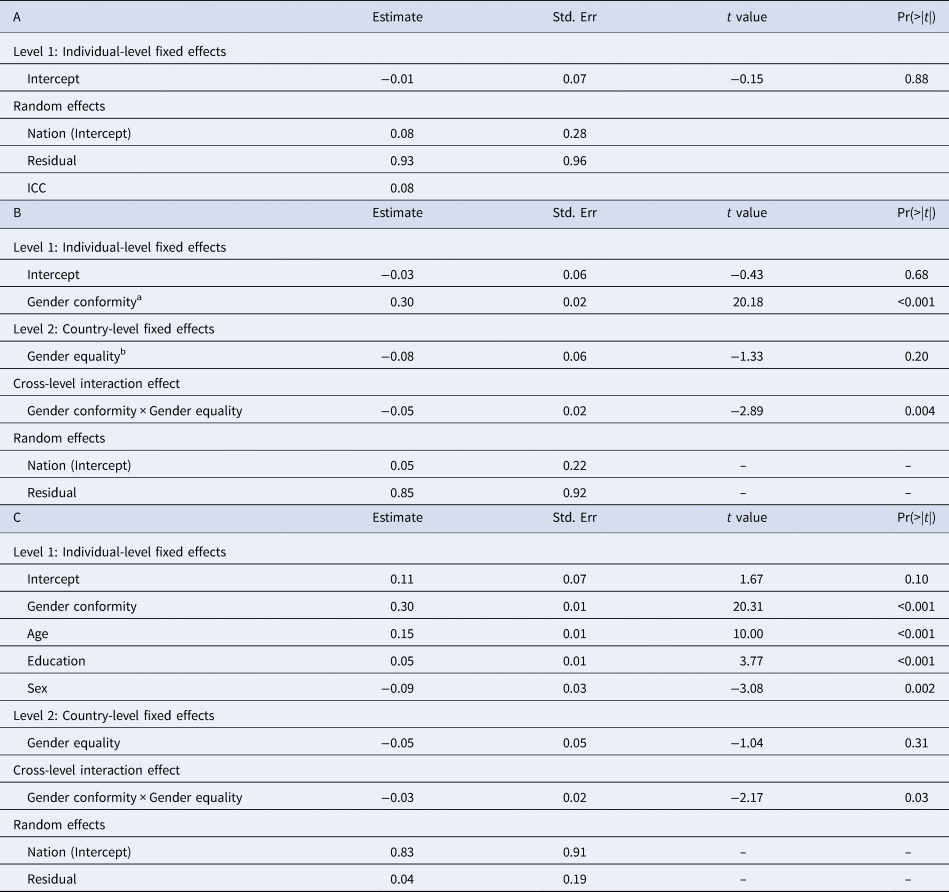
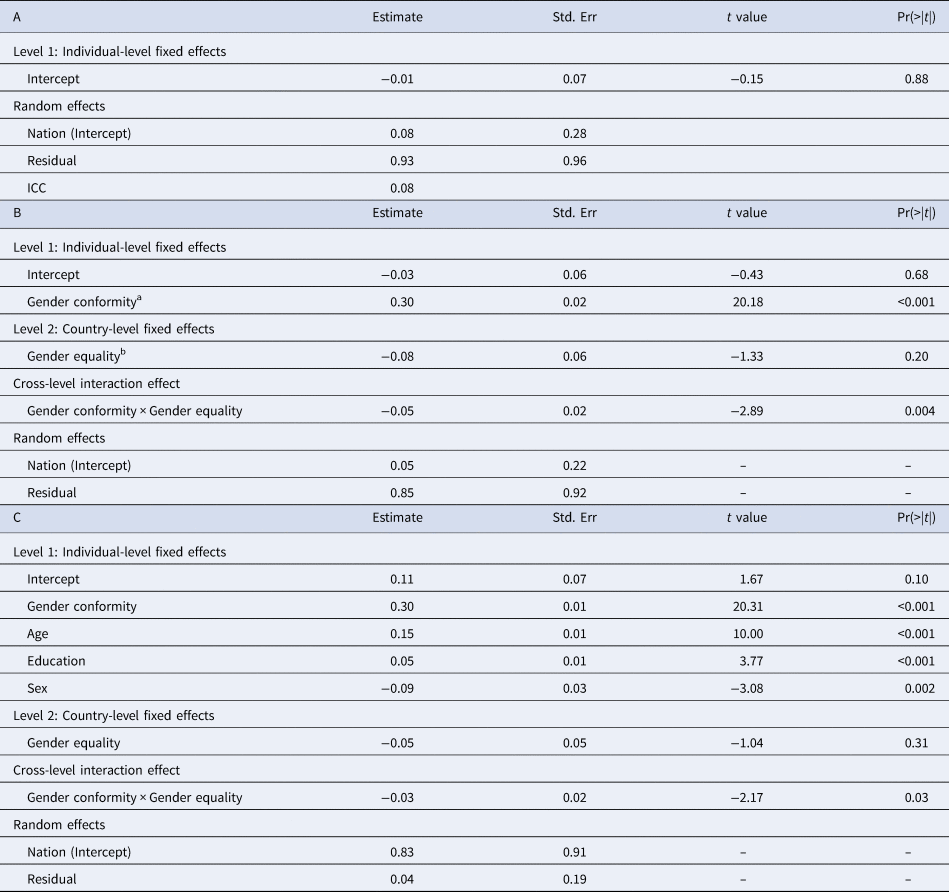
The multilevel analysis yielded a significant main effect of gender conformity, b = 0.30, t(4479) = 20.18, p < 0.01; no main effect of gender equality; and, crucially, a significant cross-level interaction between gender conformity and gender equality, b = −0.05, t(4481) = −2.89, p = 0.004. The cross-level interaction remained significant when we controlled for participants' age, sex, and educational background, b = −0.03, t(4473) = −2.17, p = 0.03. Table 2 provides the complete parameter estimates in accordance with the procedures described in the Data analysis section (see online Supplementary Table S4 for the relevant equations). Results obtained by using AGT and BSRI separately were similar and are reported in online Supplementary Tables S5 and S6.
Parameter estimates of multilevel model: (A) two-level unconditional model, (B) two-level random intercept model for effects of individual-level gender conformity and country-level gender equality on self-esteem, (C) is same as B with control variables included
ICC, Intraclass Correlation Coefficient.
a see ‘Variable-aggregation' section for details.
b see ‘Measures' section for details.
Meta-analysis and meta-regression
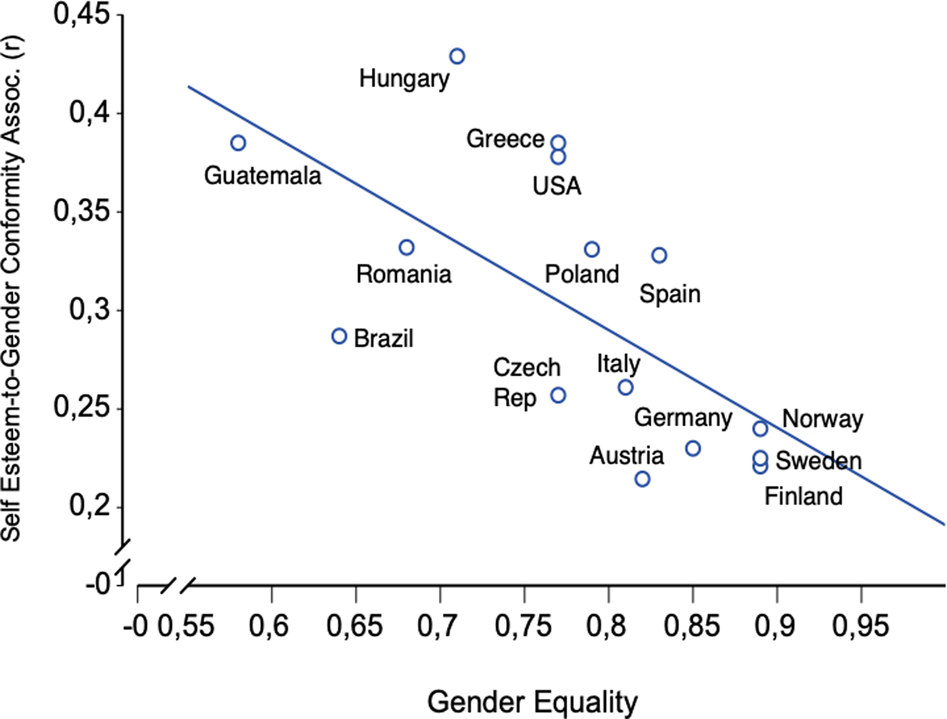
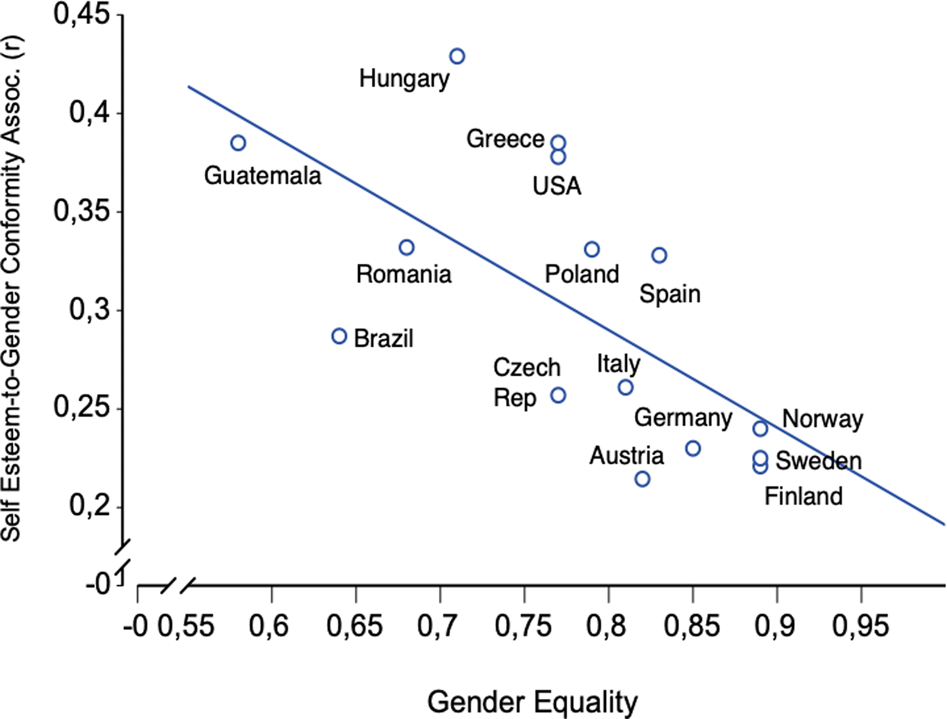
Using the random-effects model, we found significant cross-national heterogeneity in self-esteem-to-gender conformity effect sizes, Q(14) = 33.33, p = 0.01, I 2 = 58%. To examine whether country-level gender equality significantly moderated the association between gender conformity and self-esteem, we ran a mixed-effects meta-regression (method of moments model; see Borenstein, Hedges, Higgins, & Rothstein, Reference Borenstein, Hedges, Higgins and Rothstein2010). Gender equality significantly accounted for the dispersion of self-esteem-to-gender conformity effects across countries, b = −0.78, Z = 4.21, p < 0.001. Because nations' gender equality was positively related to nations' GDP per capita (r = 0.78), to countries' main religion (r = 0.63; coded 1 = Catholic/Orthodox; 2 = Protestant), and to the national average of our participants' educational background (r = 0.21), we controlled for these variables and found that the moderation by gender equality remained significant (b = −0.84, Z = 2.39, p = 0.02).Footnote 2 The relationship between gender equality and the self-esteem-to-gender conformity association across countries is illustrated in Fig. 1.
Strength of relationship (Pearson r) between gender conformity and self-esteem (Y-axis) as a function of nations’ gender equality (X-axis). The scores on the Y-axis are self-esteem correlations with the AGT, which was used in both studies.
Discussion
The current research shows that gender nonconformity is linked to low self-esteem across countries, highlighting the wide-ranging nature of the problem. At the same time, the cross-national nature of the study allowed us to identify societal gender inequality as an influential factor in the association between gender non-conformity and self-esteem. The association was weakest in countries with the highest level of gender equality, being indeed smaller than the associations previously reported in US studies (see Table 1) and strongest in countries with the lowest gender equality, exceeding the associations previously reported in US studies. The results held up when potential confounds such as age, sex, education, countries' GDP per capita, and religion were held constant, and they reproduced across two types of gender conformity measures and different data-analytic approaches (ordinary least squares regression, multilevel analysis, and meta-analysis). Taken together, these results suggest that proximal gender role effects on the relationship between self-esteem and gender nonconformity identified in previous research, such as gender contentedness or felt gender conformity pressure (e.g. Tobin et al., Reference Tobin, Menon, Menon, Spatta, Hodges and Perry2010), need to be considered within a broader macrosocial context that constrains people's freedom to move against gender role norms to a greater or lesser degree.
Conceptual and clinical implications
The findings have both theoretical and practical implications. Prior to this study, empirical support for explanations of the psychological difficulties associated with gender nonconformity derived from social-role theory centered on proximal gender role effects as identified in US studies. Having shown that associations between gender nonconformity and self-esteem vary across countries that differ in their gender role culture broadens the support for social role-based explanations of the distress associated with gender nonconformity.
In addition to contributing to an understanding of the psychological implications of gender nonconformity, the current findings also have clinical implications. Low self-esteem is a sensitive predictor of various psychological disorders, notably depression (e.g. Sowislo & Orth, Reference Sowislo and Orth2013). Hence, even relatively minor shifts in self-esteem can have a significant impact on the risk for depression. For instance, individuals who developed major depressive disorder and those who did not were found to score approximately 2 points apart on the RSES at the premorbid stage, which corresponds to an effect size difference of d = 0.38 (Ormel, Oldehinkel, & Vollebergh, Reference Ormel, Oldehinkel and Vollebergh2004). Differences in self-esteem related to national gender equality levels were of a similar order of magnitude for individuals with marked gender nonconformity (those falling in the top quintile of the distribution).Footnote 3 In other words, and all other things being equal, prevailing gender role norms could be the factor that tips the balance toward mental health or illness for individuals with marked gender nonconformity.
A second clinical implication of our findings relates to the conceptualization of mental disorders of the DSM-5, noted in the introduction, as dysfunctions within the individual rather than as outcomes arising from a conflict between the individual and society. The interdependence of self-esteem, gender-related behaviors, and societal contexts highlighted by the current findings implies that rather than being inherently noxious, gender non-conformity becomes detrimental to self-esteem when it clashes with restrictive gender role norms that are enacted by the macrosocial context. Such clashes are particularly likely to occur when individuals exhibit the more extreme forms of gender non-conformity distress, such as gender dysphoria. An interesting question for future research to explore is whether gender-dysphoric individuals living in societies with rigid gender role norms might have a higher incidence of co-morbid conditions, and possibly even a greater desire to transition to the opposite sex, because the more prescriptive a culture's binary gender roles are, the more challenging it may become to live outside these roles.
Unexpected findings
Although most country-level effects fell in line with predictions, there were some exceptions to the general trend illustrated in Fig. 1 that can help shed light on how and when gender equality may affect outcomes linked to gender nonconformity. In Hungary, for instance, the association between gender conformity and self-esteem was stronger and in Brazil it was weaker than would have been expected from the countries' respective standing on gender equality. One possible explanation is that the congruence between structural gender equality and citizens' attitudes toward gender equality varies from country to country. Where the two diverge substantially, the nexus between self-esteem and gender conformity may be less clearly aligned with national gender equality. Thus, although Brazil ranks comparatively low on structural gender equality, a recent survey on global attitudes toward gender equality revealed that 48% of Brazilian women said that there were more advantages of being a man, whereas 76% of Hungarian women did so. Similarly, 39% of Brazilian men defined themselves as ‘feminist’, whereas only 17% Hungarian men did, reflecting some of the highest and lowest proportions of self-defined feminist men worldwide (Beaver, Kaur-Ballagan, & Hall, Reference Beaver, Kaur-Ballagan and Hall2019).
Limitations
The current study should be seen as a first step toward a cross-culturally informed understanding of the psychological implications of gender nonconformity. It leaves several open questions for future studies to address and has a number of limitations. First, the concept of gender equality is unquestionably complex, involving a confluence of demographic, economic, and religious factors. Although the effect of gender equality held up when these potentially confounding factors were controlled for, we cannot rule out the possibility that some other relevant factor might have escaped our attention. Second, although our studies included a relatively broad assortment of countries with reasonably large sample sizes, future research should seek to expand the range of nations and populations. On one hand, our samples cannot be viewed as representative of the populations in each country, and on the other, the countries did not capture the full spectrum of gender equality levels. Thus, none of our countries fell into the bottom tertile of the worldwide gender equality distribution. Even a mild range restriction, such as when the bottom 20% of a distribution is truncated, can markedly decrease statistical power and bias the observed effect sizes downward (e.g. Aguinis & Stone-Romero, Reference Aguinis and Stone-Romero1997). In light of this, it is perhaps all the more notable that moderation effects could be detected. A final limitation of the present research concerns the size of some of the effects. Although we were impressed that the results emerged across studies and types of gender conformity measures, the moderating effect of gender equality on the self-esteem-to-gender nonconformity association was quite small, especially if individual-level rather than country-level analyses are used as the source of evidence.
Conclusions and outlook
These limitations notwithstanding, our findings offer the first large-scale evidence suggesting that the probability with which departures from gender conformity result in low self-esteem and possibly in other mental health conditions is related to societies' gender role culture. The power of societal factors highlighted herein gives rise to two types of outlooks for the future of gender-related expressions. In the longer term, the outlook should improve because of the dynamic nature of gender attitudes within societies (Eagly, Nater, Miller, Kaufmann, & Sczesny, Reference Eagly, Nater, Miller, Kaufmann and Sczesny2020) and a gradual shift toward more gender-equal attitudes and policies in many parts of the world (Zahidi et al., Reference Zahidi, Geiger and Crotti2018). Consider the Scandinavian countries, where the nexus between gender non-conformity and self-esteem is crumbling already. Only a generation ago, these countries used to have gender parity levels typical of today's Western European countries. The latter, in turn, had levels of gender equity typical in today's Southern Europe a generation earlier (Zahidi et al., Reference Zahidi, Geiger and Crotti2018). If this macrosocial movement toward more gender-equal norms is maintained, headwinds against crossing gender role boundaries can be expected to lessen over the long term.
In the short and midterm, crossing gender role boundaries is likely to remain difficult to sustain to any significant degree, when at the same time systemic factors impart a sense of inferiority to gender nonconforming individuals. The mixed findings of isolated efforts at changing individual gender attitudes seem consistent with this view (see Levy et al., Reference Levy, Darmstadt, Ashby, Quandt, Halsey, Nagar and Greene2020, for a review), as well as with our own findings suggesting that personal gender attitudes are less influential than the broader gender role culture in moderating the associations between gender nonconformity and self-esteem. These results serve as a reminder that effective coping with distress arising from gender nonconformity should be judged or addressed not only on a personal level, but also on a societal level. Actions at the societal level may include policies supporting early intervention programs designed to foster positive attitudes toward gender nonconforming boys and girls (Kwan et al., Reference Kwan, Shi, Nabbijohn, MacMullin, VanderLaan and Wong2020), or raising awareness for gender-atypical professions that reward rather than sanction gender nonconformity.Footnote 4
Supplementary material
The supplementary material for this article can be found at https://doi.org/10.1017/S0033291720003645.
Acknowledgements
We are grateful to Pia Gmyrek and Laura Odenwald for their help during the initial phase of the project, to Hannah Strauß for assistance with data collection, and to Dr Alexander Korte for comments on the manuscript.